青春残酷物語 / Cruel Story of Youth (Nagisa Oshima, 1960)

Released in 1960, Nagisa Oshima’s cutting critique of Japanese outsider youth culture was an unexpected success upon its original release, amid controversy and criticism over its content. Viewed now in its glorious 4K scan restoration by Shochiku, it is an enjoyable, if flawed, experience.

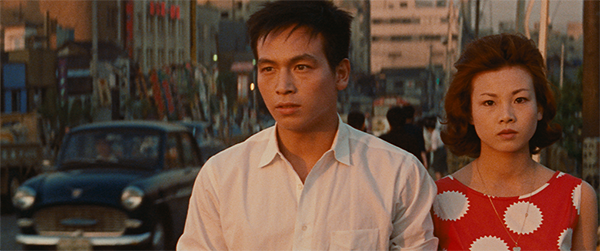
It is the story of high-school girl Makoto (Miyuki Kuwano), who we first see being advanced on by a sleazy middle-aged man. She is saved from being sexually assaulted by Kiyoshi (Yusuke Kawazu), a university student. As their unconventional romance blossoms, so too does their alienation from the society around them, running a corrupt business that involves using Makoto to lead men on, only for Kiyoshi to appear and demand payment to keep them from going to the police.

An unusually morose ending to the film.

An unusually morose ending to the film.

Clearly this isn’t an ideal way to build a relationship and it is by no means a traditional love story. It does make for an interesting dynamic for our two leads. At least, it would do but for an underwhelming performance by Kawano. Whilst Kawazu perfectly plays the disillusioned and rebellious student on the cusp of either prison, gang warfare or death, his female counterpart struggles with the dynamics that the role demands.

In a memorable early scene, soon after Kiyoshi saves Makoto, he takes her to the local docklands, forces himself on her, then threatens to drown her. It’s an uncomfortable scene to watch due to the nature of the content, but her efforts to make it look like she’s struggling to swim let the scene down. It’s also not very convincing that she is either desperate to avoid his advances, nor is the contrast to her giving in particularly stark.

This is all filmed in a brilliantly bold colour wash by Ôshima, which creates an unusual but impressive contrast to the wholly depressing content of the film. The negativity contained in the social commentary surrounding outsider youths became a staple of Ôshima’s later films. Whilst it isn’t a masterpiece, it is not without merit.

The package offered by Eureka and Masters of Cinema makes this release another great value for money Blu-ray. The transfer is top class and the booklet and extensive discussion with scholar Tony Rayns give a massive insight into the film. It’s rather like a short film study course on the film. If you can find an equivalent for around £10 then you’re doing well.

青春残酷物語 / Cruel Story of Youth is available on Blu-ray now.

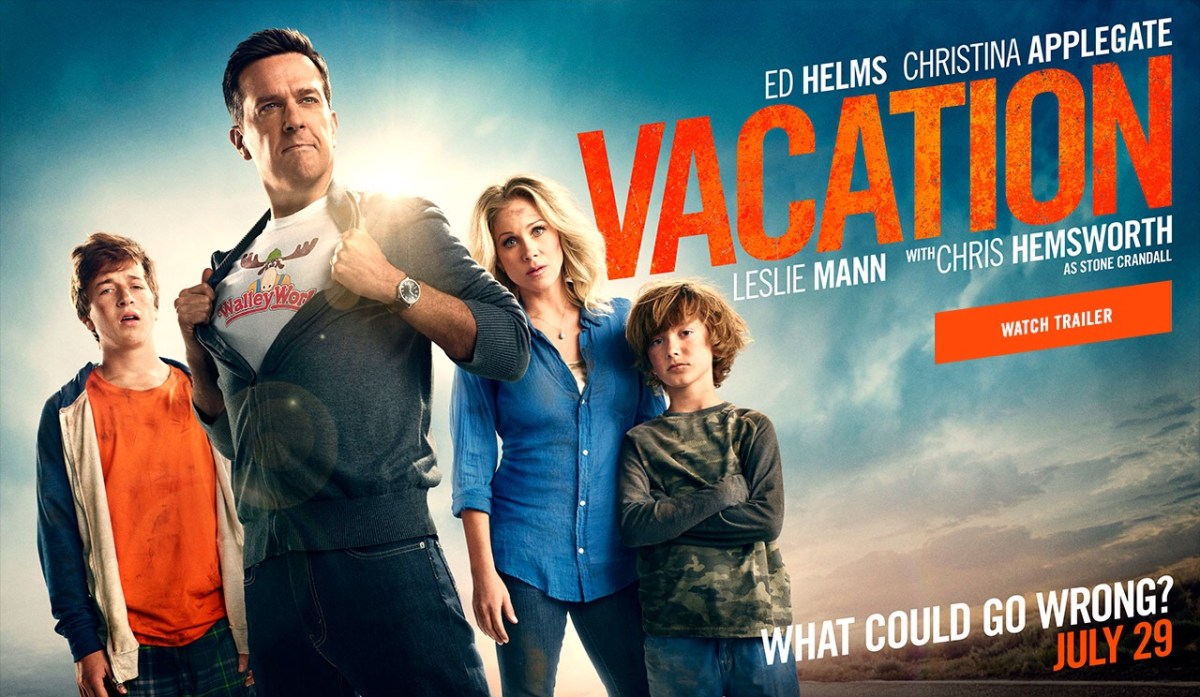
Vacation (Jonathan Goldstein and John Francis Daley, 2015)

The newest addition to the Vacation legacy is an attempt to reboot the previously successful franchise and bring the story to a whole new audience. It’s a shame then that it fails to do either and also tarnishes the memory of the originals in the process.

It stars Ed Helms as the now grown up Rusty, who we know as the son of the old Griswold family. He now has a family of his own to look after. Following in his father’s footsteps, he decides to reboot their family bonds by taking his wife Debbie (Christina Applegate) and two sons Kevin (Steve Stebbins) and James (Skyler Gisondo) to Walley World. Hilarity ensues.

The opening twenty minutes or so as they set up the characters is delivered in a very tedious manner and doesn’t really achieve the desired results of showing a truly dysfunctional family. There are some cheap gags as the four family members conform to some stereotypical character traits before the real action gets going and some fun starts, but to have such a slow start to a big summer comedy is a risky move that contributes to the film’s downfall.


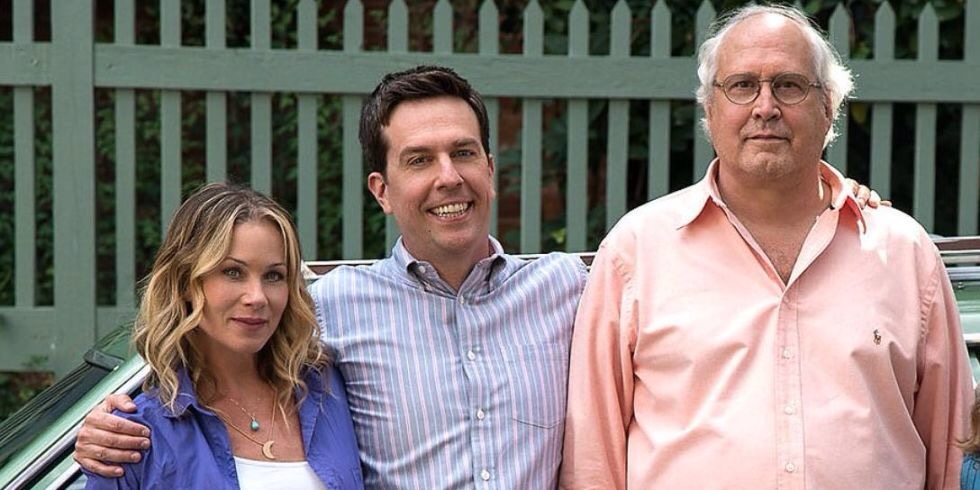
The best moments come when the Griswolds interact with other characters appearing in cameo roles. Most notable are Chris Hemsworth as Stone, the well-endowed brother-in-law, and Charlie Day as Chad, a depressive river rafting guide. Both spawn some great moments that are let down by the punctuating gags between about rim jobs and swimming in poo.

The lowest point is when Chevy Chase appears in a wholly unfunny late scene. Watching him attempt to make the removal of a medium sized guitar from a large cabinet look awkward and clumsy for over ten seconds is simply excruciating.

It’s a valiant attempt to bring the kind of humour that made the originals so successful to a new audience but it actually tarnishes the originals as I’m now questioning whether they were all of this quality. Avoid this film unless your main priorities are familiarity with a rehashed storyline and a lack of anything remotely thought-provoking.

Fear The Walking Dead – Series 1, Episode 1 (Scott Dow, 2015)

It’s an interesting prospect, this new series. The Walking Dead itself wasn’t spectacularly popular on its original debut run, though thankfully AMC stuck with it and had faith in the comic to the point where it was given a lot of breathing space and has become one of the biggest sleeper success stories on TV this decade. Plenty of people who would never watch a zombie film have tried out an episode and found it to be much more than a gore-fest, with characters afforded the time to develop without the two-hour constraint a movie imposes on them.

When this series was announced many months ago, it seemed like an odd choice. Everyone was happy to follow Rick Grimes and his band of merry survivors as they loosely followed a path set out by the comics. This would be a new series, following a completely different set of survivors in a completely different area of the same country. Why should we care about them? Doesn’t Rick eventually jus any other group anyway, so the fate of anyone we see is ultimately sealed anyway? As the plot and approach were slowly revealed, mega-fans were somewhat appeased and given hope that the new series would actually be able to survive on its own two feet.In this first feature length episode, we are introduced to a highly dysfunctional family living on the wrong side of Los Angeles. School councillor Madison Clark (Kim Dickens) lives with her two children: over-archiving Alicia (Alycia Debnam Carey) and drug-addict Nick (Frank Dillane). Also living with them is Madison’s boyfriend Travis Manawa (Cliff Curtis), a teacher at her school. The episode opens with Nick waking from a drug comedown and seeing what we know is an early sign of the oncoming zombie apocalypse. Running outside, he is panicked and quickly finds himself run over and ends up in hospital. However, given his frame of mind, nobody believes him, least of all his family, who all think he is going insane.

One of the big promises made by the series creators in the early days of the promotional material was that it would provide a cause of the zombie apocalypse. That is hinted at in the first episode and will no doubt be looked at further in the future.

Did it live up to the hype? Honesty, it’s too hard to say at this point. They’ve laid the groundwork for what could be an excellent series, or it could be seen as a slow start to a series that won’t speed up too much as it needs to stretch out the five weeks between the start of the apocalypse and where the main Walking Dead series started in earnest. The dynamics between the four main characters were on show already and it has to grow quickly to retain the attention of the many millions of viewers that have already tuned in.

AMC’s Fear The Walking Dead will continue next week at 9pm.

The Walking Dead: Weird and Wonderful Merchandise

As with any hugely popular TV series, there’s always a big attempt to get its fans to part with their hard earned money by any means necessary. The Walking Dead is no exception. Check out these weird and wonderful items that could be yours if you have more money than sense.

Bland Officially Licensed Socks

Why wouldn’t you want to put some cool images from The Walking Dead on your feet? Imagine the heads of zombies exploding as a bullet impacted on their undead skulls. What about the mixture of fear and anger Michonne has when seeking revenge on The Governor? Or, maybe you’d prefer a picture of Andrew Lincoln portraying Rick Grimes pensively looking out into the distance whilst crouching in the middle of nowhere? No? Oh… Pick them up here.
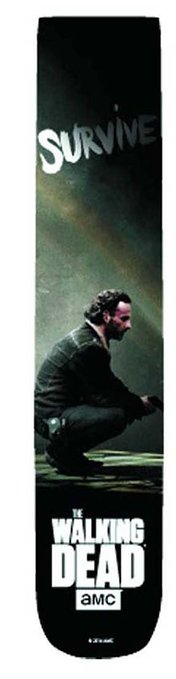
Shit socks? Yes please.

Shit socks? Yes please.

The Walking Dead Comic-Con Exclusive Zombie Burst Guitar

Yours for just £329 plus shipping, this guitar will make you the envy of all your friends who will sit back and think “I wish I was so rich that I could blow so much money on a terrible-looking guitar and think it was a good idea.”

“This would look great alongside my CSI: Miami saxophone”

Michonne Sword Letter Opener

If you’re asking yourself “Why?”, I say to you “Why not?”. Then I laugh and say “No seriously, why?”

Available for just $89.99.
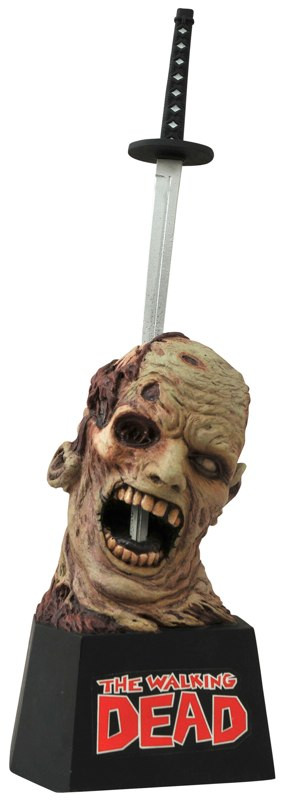
His success had gone to his head.

His success had gone to his head.

Rick Grimes Resin Deluxe Boxed Statue

Clearly the $350 asking price on the official website didn’t put many people off. It has to be said, this looks spectacular. It’s a lot of money to spend on something like this, but of all of the comic book range of toys and collectibles, this is up there with the best.

A collectible as bad-ass as the man it portrays.

A collectible as bad-ass as the man it portrays.

The Walking Dead Plain Logo T-Shirt

Another stylish piece of merchandise is this, a nice, plain and simple logo t-shirt that really works in the charcoal grey colour. There are plenty of other options with catchphrases and other gimmicks, but if you want something more subtle then this is what you need. It will set you back $19.99.
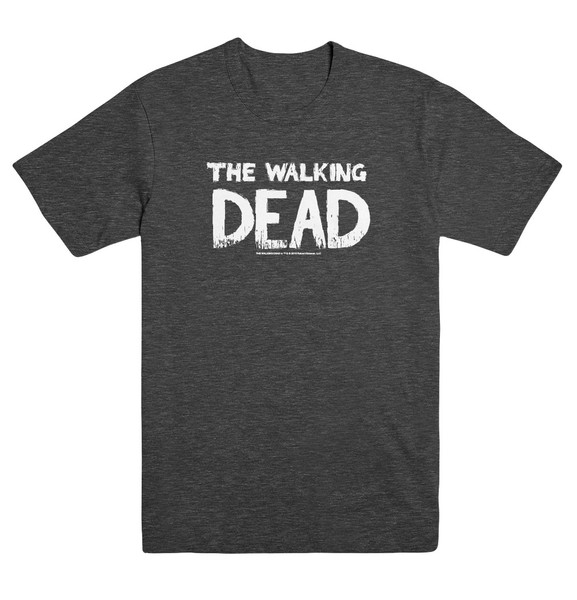
Simple and stylish clothing for fans of the comic.

Simple and stylish clothing for fans of the comic.

Stern Pinball Machine

Not much to say here, but if you’re sitting in the middle of a Venn Diagram that consists of the categories “Loves The Walking Dead”, “Loves Pinball”, “Has too much money” and “Had no sense” then this is the product for you.

Yours for just $7495. I would if I could.

SUCH A SUPPLE WRIIIIIST!

SUCH A SUPPLE WRIIIIIST!

The Walking Dead Battle Scene Wallet

This may be more within your price range. A mere $20 will get you this stylish wallet inspired by the All Out War story arc of the comic book series. It will be cool to get hold of it now and then when the story kicks in early next year in the television show you can say “It was much better in the comics” as you whip out your cool wallet and pay for a mug of smug.
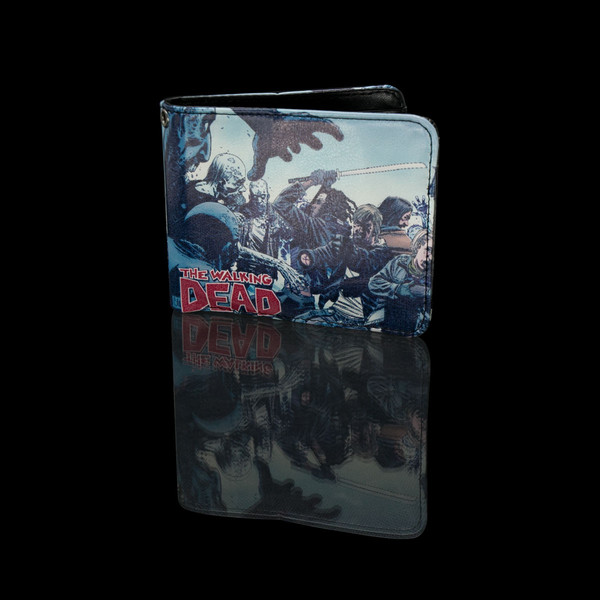
Both cool and practical.

Both cool and practical.

Check back tomorrow for a review of the first episode of Fear The Walking Dead, the new series that premieres on the BT-exclusive AMC channel.

The Walking Dead: Road To Survival (Scopely, 2015)

Robert Kirkman has just taken to the official The Walking Dead Twitter account to reveal a new free-to-play game available from the Apple Store and Google Play Store. Titled Road To Survival, it is a global strategy game that focuses on The Governor period of the story timeline. The visuals are a sort of full-colour beefed-up interpretation of the comic book, but looks of the same universe.

Hear Robert Kirkman talking about it here.

Have you played it yet? Is it any good?

The Walking Dead: The Game – Season One (Telltale Games, 2012)

One way to further your total immersion into the Walking Dead universe is to take on the emotionally-tiring episodic video game series from Telltale Games. Be warned: do not attempt if you have a history of heart conditions.

Whilst most modern games push for bigger and better graphics, more epic explosions, larger guns and loud noises, this take on the interactive adventure genre instead induces panic by forcing the player to make incredibly tough decisions in a snapshot of time without much prior warning.

The action takes place in the events immediately after the outbreak of the apocalypse in the same Atlanta locations as the early parts of the comic and TV series. You take control of convicted murderer Lee Everett, a character we are yet to meet in any other canonical Walking Dead media, as he comes to terms with the loss of his family, whilst trying to keep himself and young girl Clementine alive.

The character Clementine is the masterstroke of the game, giving it an emotional edge seldom seen in video games. The decisions made aren’t on the level of which zombie to kill first to keep us alive, but rather how can Lee earn the trust of Clementine to make sure she sides with him and can be kept safe. In this way, whilst there are always choices to be made, there is a tendency to take the moral high-ground and sensible options to ensure the right impression is made at all times.

Decision, decisions.

Decision, decisions.

This is easier said than done. Often the prompt to make a decision flashes on the screen and a button input must be made immediately. There may be four options displayed but there is always the fifth option available too: doing nothing at all often leads to the worst outcome. Mild panic ensues each time the decision prompt appears – a great way to keep players on edge.

There are some nice touches, with several familiar characters appearing to help Lee and Clementine on their early missions. Hershel, his son Shawn and Glenn appear, though these are the only ones seen in the first game.

The game was released as an episodic series in 2012 in five parts, with the 400 Days DLC released soon after. As a result, each episode is left on a slight cliffhanger, a nice touch that makes it necessary to go back for the next part (much like the comic and television series).

Stylistically, it stands on its own away from the designs of the comics and the TV series. Yet, somehow it inhabits both worlds. This is testament to both the design team and the guidance offered by the fully realised world of the source material.

As an immersive experience, The Walking Dead: The Game – Season One is one of the most accomplished video games this genre has ever seen. If you’ve completed it, you can always check out Season Two and the upcoming Michonne DLC, due in December.

The Walking Dead: The Game – Season One is available to purchase as a Game of the Year Edition, featuring all episodes and DLC, now.

Film review – Fed Up (Stephanie Soechtig, 2014)

A lazy and by-the-numbers approach to modern-day documentary making threatened to undermine the message of Fed Up, though the overall result is somewhat satisfying. 

It tells the story of the food industry of North America, focusing on the diets many believe are good for them and the root-causes of the misinformation they base their knowledge on. Several teenagers are used as central figures in the obesity epidemic to add a personal touch to what would otherwise be a rather statistical-based story.

The obesity problems weigh heavy on the scales of America.

As cross-examinations of entire industries go, there have been worse. However, it lays its message down early on and doesn’t really allow any competing points-of-view to be treated with any credibility. The result is that for the undescerning viewer their opinion may be altered quite quickly, though anyone used to this technique (Michael Moore does it very well) it immediately makes anything offered a potential falsety. That’s a shame because the message is one of the most important facing the developed world today.

A missed opportunity.

Fed Up can be watched on Netflix in the UK now.

Video game review – Yoostar 2: In The Movies (Namco Bandai, 2011)

The premise of this game is fantastic. Making use of the Kinect camera controller for the Xbox 360, the disc contains 80 movie scenes from famous films (and Cheech and Chong’s Up In Smoke) for the player to act out, placing their performances over those of the original actor or actress. Sound fun? Well, yes. Kind of.

The thought of acting out scenes from films may appeal to some, but for many even considering standing in front of a room full of people and attempting to deliver an accent-perfect Derek Zoolander just isn’t a good way to spend an evening. It fills them with dread.

Another crowd-pleasing Ben Stiller film scene. Great for crowds of Ben Stiller fans.

For those willing to get involved, enthusiasm doesn’t reward much. The technology causes many issues by just being generally poor: images are low resolution, the background of the playing environment occasionally make their way into the finished scene, the sound is hard to hear when acting and the cue points are really hard to predict.

Both the film choice and the scene selection leaves a lot to be desired. It may be fine if you really like Ben Stiller. Too often there are scenes where your character is looking sideways on. This only works if you know the film off-by-heart or you happen to have a series of strategically-placed mirrors allowing you to read the script as you look away from the screen.

When it goes right it has the ability to cause hilarity. The Terminator is one of the better scenes as Arnie remains relatively still and doesn’t say much. The Casablanca clip works well too, being that it doesn’t require perfect comic timing.

It has the makings of a fantastic party game but unfortunately the flaws mean it never really hits the required heights. Still, it kept my party entertained for about an hour and at the price I paid (£1.33) that is excellent value for money.

Yoostar 2 is available now. Pay no more than £3 for it.

Network (Sidney Lumet, 1976)

“Get up out of your chairs, open the window, stick your head out, and yell, and say it: “I’M AS MAD AS HELL, AND I’M NOT GOING TO TAKE THIS ANYMORE!””

When Sidney Lumet’s scathing attack on the televisual media hit the big screen in 1976, this was one of many quotes from lead character Howard Beale (Peter Finch) that resonated with the public psyche. It was a huge critical success and would eventually prove to be Lumet’s defining moment as a director.

“I’M AS MAD AS HELL, AND I’M NOT GOING TO TAKE THIS ANYMORE!”

The film opens spectacularly. We’re introduced to television news presenter Beale and the news that he has been sacked from his role at UBS due to his declining ratings. He has been given two weeks’ notice by his long-time friend Max Schumacher (William Holden in fine form) but his reaction is to go onto his next live broadcast and announce “I’m going to blow my brains out right on this program a week from today. So tune in next Tuesday.” This causes mixed reactions amongst those at the studio. The conservative Frank Brackett (Robert Duvall) leads a campaign to get rid of him immediately, whilst Diana Christensen (Faye Dunaway) sees it as a potential ratings spinner, eventually facilitating him receiving his own evening slot in which he rants about the media, advertising, indoctrination and the state of American society. It proves an instant hit and the internal politics of the situation spiral.

The entire cast are on fine form, not just those in lead roles. One stunning sequence involves Beatrice Straight’s Louise Schumacher, wife of Holden’s Max, occupies the screen for only five minutes and two seconds but this was long enough for her to win the Academy Award for best actress. It is far shorter than any other performance that has ever won an Academy Award. It’s hard to say in isolation whether it is wholly deserving of such accolades, though it is possible that the Academy couldn’t bring themselves to award the prize to Jodie Foster, the then 13-year-old who was nominated for her controversial role as Iris “Easy” Steensma in Taxi Driver. You can watch the clip in a sub-standard quality below, if that’s your thing.

The topics covered in Network resonate louder today than they ever have. The anger felt by Beale at the state of the network he works for isn’t necessarily centred around the network itself but rather the people who consume it without question. Ironically, the people who begin to love his show begin to accept it and consume it, thus keeping them watching the television rather than switching it off altogether and avoid potential further indoctrination. We now live in a society four decades later where the way information is fed to consumers is controlled more tightly than imagined in Network, be it on television, in newspapers or online. The latter of these is crucial – one of the biggest opportunities civilisation has had to take over the way information is consumed and what that information is has been hijacked by corporations and advertising. That Lumet so closely predicted this future makes this essential but somewhat eerie viewing.

Network is available on Arrow Video Blu-ray now.

Family Plot (Alfred Hitchcock, 1976)

Family Plot is the final film directed by Alfred Hitchcock, released four years before his death. Based on the book The Rainbird Pattern by Victor Canning, it is a shadow of his most celebrated works owing to a slow pace and a lack of chemistry between the lead characters.

The story concerns two couples. Fake psychic medium Blanche (Barbara Harris) and taxi-driver George (Bruce Dern) are petty criminals who find an opportunity to locate the son of an heiress called Edward Shoebridge and collect a £10,000 reward. In searching for this heir their lives become unexpectedly intertwined with professional criminals Fran (Karen Black) and jeweler Arthur (William Devane), who kidnap famous millionaires and return them in exchange for jewel-based ransoms.

Dern, Dern, Deeeeeeeern!

Dern, Dern, Deeeeeeeern!

Bruce Dern wasn’t the first choice for the lead role. Hitchcock’s preferred actor was Al Pacino, but his price was too high. Hitchcock went with Dern following his experience with him in Marnie and also in Alfred Hitchcock Presents episodes Night Caller and Lonely Place. Of the four central characters, he is perhaps the most entertaining to watch. It’s a highly believable turn as a man controlled by his girlfriend and partner in crime and his comic abilities are put to great use. It’s hard to see Pacino improving on this, as talented as he is.

Roy Thinnes was originally cast as the Arthur / Edward character and five days of shooting were completed before the first choice William Devane became available and Thinnes was dismissed. Devane’s turn is one that doesn’t really deliver. The character calls for malice and terror, which never really comes to fruition; this in turn makes Black’s performance as his partner fall short as the coldness she tries hard to rescue never really comes to the forefront of their scenes.

Barbara Harris was in the middle of a career purple patch when this was released. Family Plot came sandwiched between two other career successes: Nashville and Freaky Friday. All three earned her Golden Globe nominations, though it is hard to see why her turn as Blanche was so celebrated at the time. True, there are moments of real hilarity in there, and she is clearly having fun with Dern with the relentless innuendos Hitchcock has littered throughout the script, but often she comes across as irritating and it feels like she is over-cooking her lines. The low point in the film is a scene where the pair lose control of the car they are travelling in when the brakes are cut. It goes on far too long and her reaction to the situation is at odds with her portrayal in the rest of the film. It came as no surprise to find out that Hitchcock was unable to be involved with these scenes due to his deteriorating health and this and other such scenes were filmed by a second unit headed up by Wayne A. Farlow and Howard G. Kazanjian. They do, unfortunately, lack the usual Hitchcock touch.

Many of Hitchcock’s films feel like they inhabit the same universe, but the same can’t be said of this film. It is a genuine disappointment. Coupled with a lazy transfer by Universal – one of the worst I’ve ever seen on the Blu-Ray format – this is overall a real disappointment. Steer clear unless you’re really desperate.

Family Plot is available as part of the Alfred Hitchcock: The Masterpiece Collection Blu-Ray boxset, or as an individual release.