Stalag 17 (Billy Wilder, 1953)

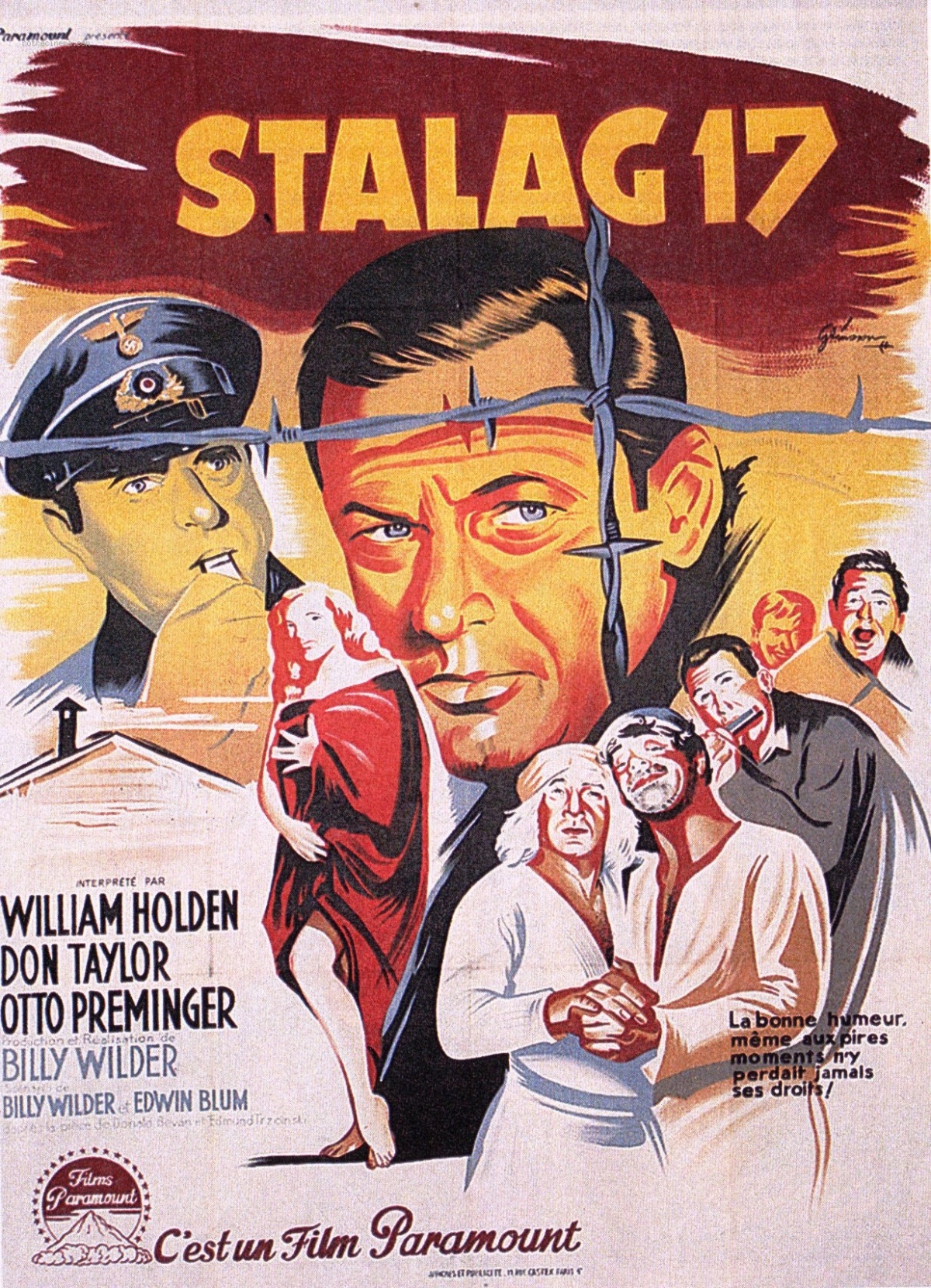
Billy Wilder made a habit of directing films that are arguably the quintessential examples of their genre. In 1944’s Double Indemnity he defined the film noir genre. Then in 1950 Sunset Boulevard hit the big screen, perhaps the best film to ever tackle Hollywood itself. With Stalag 17, a film released in 1953, he directed what many people consider to be the greatest Prisoner of War (POW) film ever released. Of course, fans of The Bridge on the River Kwai and The Great Escape may argue the toss, but Stalag 17 is up there with the best of them.

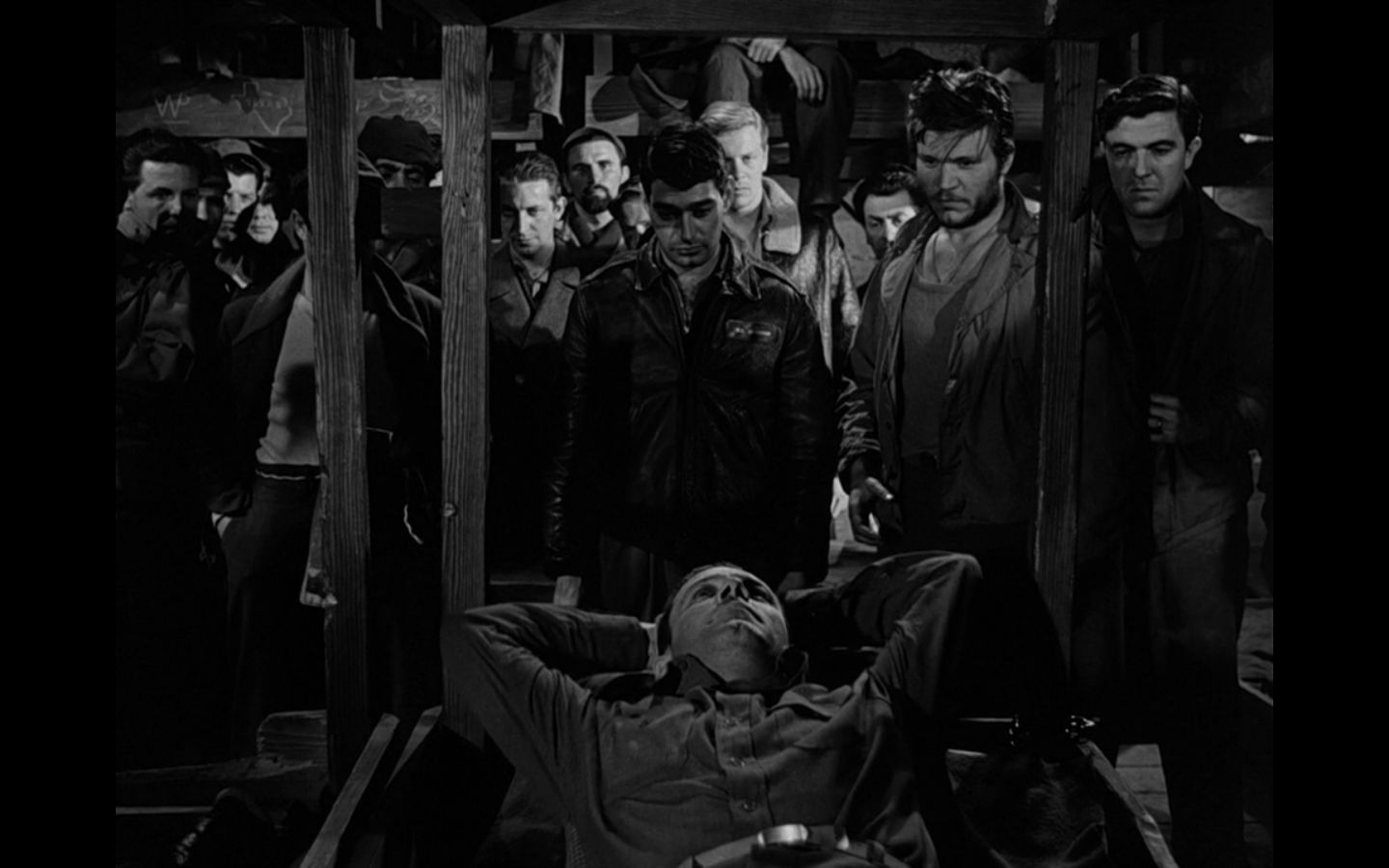
One of the most memorable scenes of the film, expertly framed.

One of the most memorable scenes of the film, expertly framed.

Set in 1944, the film focuses on the titular Luftwaffe POW camp where 640 American captured sergeants reside alongside Polish, Czech and Russian captives. It is narrated by Clarence “Cookie” Cook (Gil Stratton), reminiscing on his time in the camp. The opening sequence shows two men trying to escape from the camp, whilst the remaining men in their block argue with Sefton (William Holden) about their potential success at escaping as he takes their bets. As the only person sure of their failure, Sefton wins a large supply of cigarettes from his comrades. As the men come around to the thought that their failure may have been caused by a tip off to one of the Nazi officers, suspicion falls on the ever-cynical Sefton, who appears to be profiting nicely from various trades and deals far more than anyone else held captive. Unwilling to protest his innocence, Sefton resolves to find the real informer and expose him before another there are any more casualties.

What strikes most prominently about this film is its inclination towards comedy. It is certainly rooted in the seriousness of being held as a POW in Nazi Germany, but the comradeship and light-heartedness with which the Americans deal with their situation sets it apart from other films in this genre. It doesn’t just stop at the relationship between those of the same nationality. Indeed, it takes on quite a comical depiction of the relationship between the guards and the captives, illustrating a softer side to the Nazi officers that is seldom depicted elsewhere.

As the film progresses, however, the comical aspects fade somewhat to allow the seriousness of the situation to take centre stage. This contrast is less harsh than, say, Life is Beautiful (Roberto Benigni, 1997), but it works perfectly. The light-heartedness encourages the viewer to warm to all the characters quicker than would have otherwise been possible and by the time the final act plays out the tension is at its peak.

William Holden rightly won an Oscar for his performance as Sefton, spoiling the party that year for the likes of Marlon Brando (Julius Caeser) and Richard Burton (The Robe). The popularity of the film can be put down to two factors at the time. Firstly, the film was withheld from release until 1953 because Paramount Pictures didn’t believe anyone would be interested in a POW film; only when the release of prisoners following the end of the Korean War did it have a widespread political context (both the US release and the end of the Korean War occurred in July 1953). Secondly, the backdrop of the film industry itself was focused on the Hollywood Blacklist, a list of those industry professionals considered to be supportive of communism. This was at its height in 1953, but no studios would dare release a film to directly tackle these issues. The storyline of a lone man being singled-out by his peers based on false circumstantial evidence will no doubt have gained extra resonance against this ongoing issue.

Stalag 17 deserves to be seen, for its excellent performances, magnificent direction and historical relevance. With it being a Masters of Cinema release, there has never been a better time to check it out.

Stalag 17 is available to purchase now from Masters of Cinema on Blu-Ray.

スーパーマリオブラザーズ 2 / Super Mario Bros.: The Lost Levels (Nintendo, 1986)

Following the success of Super Mario Bros. on the Family Computer in Japan in 1985, Nintendo decided to capitalise and release a sequel using the same game design and graphics. This one, titled Super Mario Bros. 2, didn’t initially see the light of day in Europe or USA, owing to the fact that it was deemed too difficult for gamers outside of the Asian market.

Instead, the Western markets got their own separate game, which might have had the same name but was actually a sprite update of Japanese game Yume Kōjō: Doki Doki Panic. In 1986, nobody in the West cared because hardly anyone knew what had happened. We got a fantastic game in which you could choose to play as Mario, Luigi, Toad or Princess Toadstool. It introduced many gameplay elements and character traits that stuck with series forever more, as well as a host of enemies. It was simply the next in the series and a welcome one at that.

It wasn’t until the the Japanese game was released as part of Super Mario All-Stars on the Super Nintendo in 1993 that the wider Western public became aware of it. What they found when they began to play it was a game full of pitfalls and frustrating game design with the sole purpose of over-challenging anyone who dared continue to see if it got any easier.

The version most readily available nowadays – and the version play-tested here – is available on both the Wii and Wii U virtual consoles. It doesn’t cost the world (500 points) so may well tempt those unaware of its background.

Playing the game now it’s clear why it wasn’t unleashed on the Western gamers of 1986. It may well have killed the franchise. The difficulty picks up at around the same difficulty or World 7 or 8 of the predecessor, meaning that by World 3 the whole game is entirely infuriating.

All the things that might have helped you in the first in the series are either toned down or flipped to trick you. In addition to the 1-UP and power-up mushrooms, there are now poison mushroom that cause you damage. In addition to the Warp Pipes that you’d expect to help you every time, there are additional pipes that take you backwards to earlier worlds, meaning that unless you do your research (remember how difficult that would have been in 1986?) you could end up going backwards. The number of coins available is greatly reduced as well.

The fun-dampening doesn’t end there. Many of the jumps are near-impossible leaps of faith that often don’t leave much confidence prior to trying them out. Doing so is a trial and error situation that can quickly cause you to game over. Trying to speed through a level? Good luck – the game designers have placed a smattering of hidden mystery boxes that usually cause instant death by knocking you off balance. The platform lengths are unforgiving too, meaning both run ups and landing spaces require pin-point precision or else Mario will fall into another pit.

There are also several levels that require a particular pathway to reach the end goal; running from left to right will just cause an infinite loop and the final goal will never be reached. The only solution is to either hope you get it right by chance or give in and search for a solution on YouTube (always a disappointment).

This is the first Mario game to introduce the concept of hidden worlds post-completion. If you manage to complete the game without using a Warp Pipe then you’ll be rewarded with World 9, which is a fantasy world that utilises a psychadelic colour scheme and some bizarre game mechanics. It’s entirely straightforward and requires no concentration whatsoever despite the fact they remove all your hard-earned lives before the start. In additional to World 9 are Worlds A-D, which were also available to anyone willing to persevere. However, anyone that wishes to see how they play (apparently they’re even trickier than the main game) will need to complete the game eight times in the same save file.

Are you FUCKING kidding me!?

Are you FUCKING kidding me!?

The one saving grace is that on the Virtual Console versions there is the opportunity to save at any point throughout the game. This will no doubt be implemented by most quite a lot towards the end of the game, as an absolute necessity. When tackling a single jump takes ten or more attempts, the thought of trying to do this without a save option will fill anyone with dread.


This is what many hours of misery will reward you with

 
This game will suit die-hard fans and people with sadistic tendencies. It is a form of self-punishment and is seldom enjoyable. Completing the game won’t fill you with joy, but it might give you more confidence to tackle the hardest levels on Mario Maker when it arrives later this year.

Super Mario Bros.: The Lost Levels is available now on the Wii U virtual console.

Shohei Imamura Masterpiece Collection – Preview

This week Masters of Cinema announced the release of a new boxset titled Shohei Imamura Masterpiece Collection. So what does it contain and is it worth a purchase?

The box contains eight films, all of which have already been released before. The contents are as follows:

盗まれた欲情 / Stolen Desire (1958)
西銀座駅前 / Nishi Ginza Station (1958)
豚と軍艦 / Pigs and Battleships (1961)
にっぽん昆虫記 / The Insect Woman (1963)
人間蒸発 / A Man Vanishes (1967) – DVD only
神々の深き欲望 / Profound Desires of the Gods (1968)
復讐するは我にあり / Vengeance is Mine (1979)
楢山節考 / The Ballad of Narayama (1983)

In the Blu-ray era of Masters of Cinema, only three other boxsets have been released. The first was the three-film Martin Scorsese Presents World Cinema Foundation Volume One boxset, the second was the excellent Late Mizoguchi boxset and the final was the Shoah five-film boxset. All are worthwhile boxes to buy full of new films that hadn’t seen the light of day prior to their release (apart from the Mizoguchi release, which only had four  newly-transferred-to-HD films out of eight).

For those with any or all of the contents of this newly announced box, it no doubt represent a disappointing announcement. I was aware there was a gap in the numbering of the Masters of Cinema Blu-Ray releases, between 120 Medium cool and 129 Dragon Inn, so I was hoping that an eight-film director-centric boxset would be announced. Having just got back into Imamura I was underwhelmed when I realised the boxset would contain eight films, seven of which I already own on Blu-Ray.

That said, the films include one Palme d’Or winner, two Blue Ribbon Best Film winners, Imamura’s debut film and some excellent insights into the career of a film director considered to be one of the greatest ever to come out of Japan. Not every film is amongst his best – notably Nishi Ginza Station is fairly poor – but if you have a copy of both The Eel and Black Rain (not Masters of Cinema) then you’ll have pretty much all of his most important works. It spans his entire career and represents the only way in the UK to get any of his films on Blu-Ray.

Importantly, it is rumoured that this will be the last chance to buy these films as part of the Masters of Cinema releases as they have let the rights lapse on them. If this is true, and you don’t have these films yet, then this is a must-buy.

The Shohei Imamura Masterpiece Collection boxset is available for pre-order now.

Masters of Cinema Cast – Episode 42: The Lost Weekend (Billy Wilder, 1945)

I had the pleasure this week of recording an episode of the hugely popular and entertaining podcast Masters of Cinema Cast with Joakim Thiesen. We talked at great length about the 1945 Billy Wilder film The Lost Weekend.

Here’s the link.

Give it a listen! Hope you enjoy it!

Film review – The Interview (Seth Rogen and Evan Goldberg, 2014)

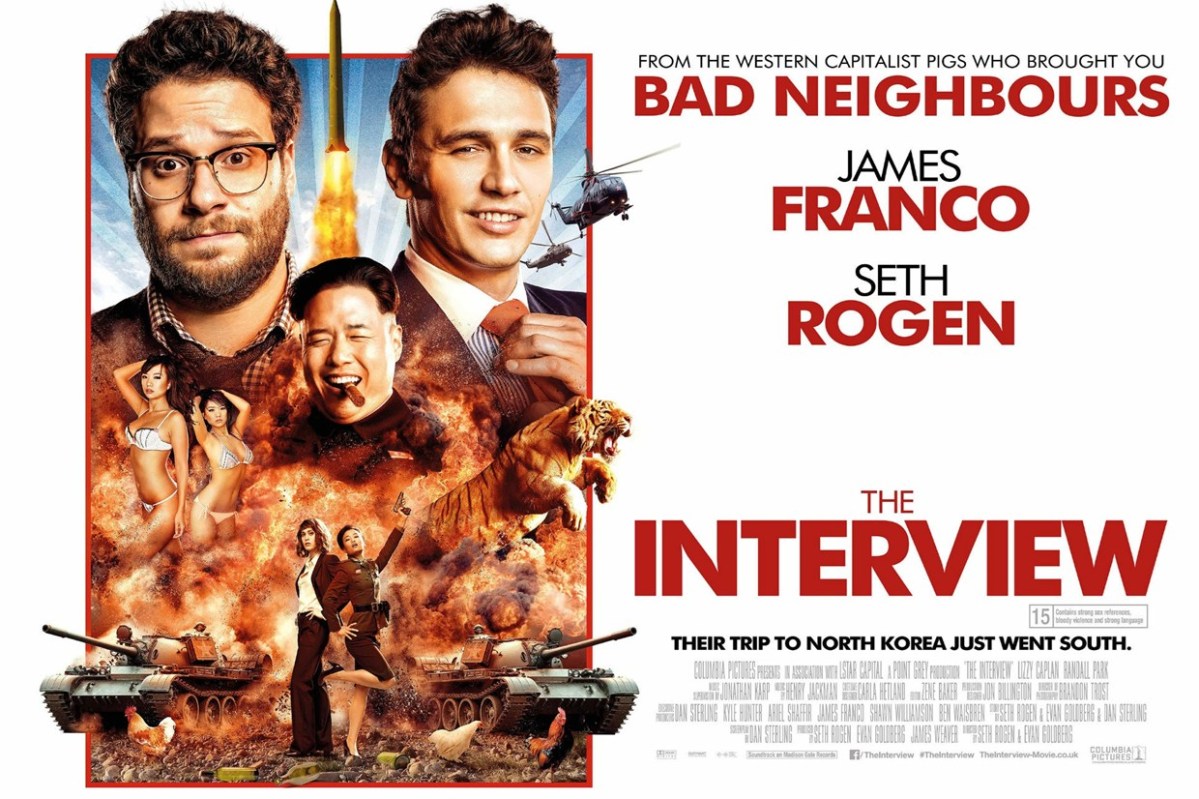
So, here we have it. The film that almost started World War III. The film that Sony were so adamant it was going to release they refused to listen to threats from North Korea, even ignoring the fact that they were being infiltrated by “The Guardians of Peace”, a hacking group from North Korea.

It’s a shame it’s such a terrible film.

Another failed attempt at the "water sprinkler" dance move.

Another failed attempt at the “water sprinkler” dance move.

The premise of the film is thus. Dave Skylark (James Franco) is a popular trash entertainment TV presenter in USA and has his own show called Skylark Tonight. However, as they reach their 1000th show his producer Aaron Rapaport (Seth Rogen) longs to produce something with a bit more depth. When an unlikely interview with North Korean leader Kim Jon-Un (Randall Park) becomes a reality, their breakthrough into high-brow entertainment is quickly turned into an undercover CIA mission to assassinate the leader. Hilarity ensues.

The humour in the film is generally derived from one of two sources: poking fun at the North Koreans or crude toilet humour gags. At one point a botched administering of ricin leaves the two stranded in North Korea without the ability to complete the mission. The CIA, in a continuity-challenging move, send over two additional ricin doses in a small rocket. Rogen, by this point facing imminent death due to a stray tiger (what?) and a group of about 15 guards closing in on him decides the only way to save the day is the insert the entire capsule into his anus.

Elsewhere we discover that Kim Jong-Un is a huge fan of cocktails and Katy Perry. He has emotional issues due to disconnection and lack of approval from his father. He regularly spends time with prostitutes. Despite their differences to the Western world, North Korea is a proud nation with a lack of understanding of the ways of the west. On this level it is understandable why this film would cause them a serious issue.

It’s a shame that this film has no sense of intelligent writing that has been on display in the creative outputs of both of its lead characters. Of all the films to fall flat with, it’s most unfortunate that it happened with a film that had the eyes of the world focused on it.

The Interview is out now on Blu-Ray and DVD.

Film review – Ant-Man (Peyton Reed, 2015)

The problem that many British viewers of this film will have when viewing this film is a pining for what could have been. Edgar Wright and Joe Cornish had for a long time both been attached to the film, the former as director and both as co-writers. Both are extremely well-known amongst the geeks of Britain and the fact they were teaming up was an absolute dream. Edgar Wright proved what he could do when given the freedom of the source material when he directed the excellent Scott Pilgrim vs The World in 2010. Whilst the Ant-Man series wasn’t as well known as the likes of X-Men and Spiderman, in the right hands it had the potential to be a great film.

Phenomenal powers, itty bitty living space.

Phenomenal powers, itty bitty living space.

However, it slowly became apparent that Marvel had a different idea of the direction it should take. In an interview with Mike Ryan of the Huffington Post, Edgar Wright said “It is pretty standalone in the way we’re linking it to the others. I like to make it standalone because I think the premise of it needs time. I want to put the crazy premise of it into a real world, which is why I think Iron Man really works because it’s a relatively simple universe; it’s relatable.” Clearly Marvel wanted the film to be set in the Marvel Cinematic Universe and the compromises required to slot it in with Thor, Iron Man and the clan didn’t sit well with Wright and Cornish. With not long to go before release date – 420 days to be precise – the pair (along with director of photography Bill Pope) co-announced with Marvel Studios that they were leaving the project, citing “differences in their vision of the film”.

So what are we left with? Well, Peyton Reed has come on board as emergency director. His previous work has been pretty much exclusively romantic comedies (Down With Love, The Break-Up) and the impression is that he was brought in to do what the studio needed rather than drive his own vision of the narrative. Ironically that makes him a kind of yes man. [1]

What’s really frustrating is that the script has some very Wright/Cornish-esque humour in there. One of the large scale fights near the climax of the film happens around a Thomas the Tank Engine toy train track. Anyone familiar with Joe Cornish’s route to fame in the 90s will see the likelihood that this was one from him. Or maybe Peyton Reed is a big fan of Series 2, Episode 18 of the original Thomas the Tank Engine series “Thomas Comes To Breakfast”, which first aired in the UK in October 1986.

The one saving grace of the film is Paul Rudd doing and excellent job as Scott Lang, the thief-turned-hero who wants to make up for lost time with his daughter. His humour and sharp wit make the journey through the film entirely pleasurable. He is a great comedic actor and the film has benefited from his presence on the rewriting team.

However, for all the good that is done by some great work in the cast (Michael Peña is hilarious throughout), we keep getting reminders that this is two films woven into one. The worst moment of the film comes when there’s an oblique reference to The Avengers, which sticks out like a sore thumb. Just as we are forgetting about it, Falcon arrives on the scene. Yes that’s right, Anthony Mackie has his very own cameo role in everyone’s eleventh-favourite Avenger (12th if you include Ant-Man, 13th if you include Nick Fury… who knows where by the time Civil War is released). It’s so pointless and so clearly an afterthought that it not only doesn’t help fit it in with the Marvel Cinematic Universe but rather actually just causes a detrimental effect on the absorbing world that was almost being created in this film.

It’s a shame that we will never see that Wright/Cornish film that never was. It must be said that it was unlikely to ever see the light of day without some serious compromises, but as two huge fans of Marvel comic books that was never going to happen. Instead we’re left with a reasonable film with some rewarding moments, which never really gets going because it is so disjointed.

Ant-Man is out at cinemas globally now.

[1] Yes I went there.

Hot Rod (Akiva Schaffer, 2007)

The tagline on the poster of a film says a lot about it. When it announces to the world that it’s going to “Smack Destiny in the Face”, it probably isn’t going to take itself too seriously.

Hot Rod is the story of Rod Kimble, an aspiring stuntman trying to step into the great shoes left behind by his father, a man Rod believes to be one of the greatest stuntmen of all time. One of his greatest goals in life is to earn the respect of his step-father Frank (Ian McShane), which apparently will be achieved by “beating the crap out of him”. This goal is a long way from being realised and time is running out as Frank’s health is deteriorating. To save his life, Rod decides to pull off a series of publicised stunts to earn money for his operation, whilst fighting for the affections of his love interest Denise (Isla Fisher) with her boyfriend Jonathan (Will Arnett), with the ultimate aim of getting Frank back to full health so he can have a fair fight with him.

“Who wants to see me do a big-ass stunt?”

Admittedly, the premise is somewhat flimsy when written out like that, but it’s a film that defies expectations. It tempts you to set the bar low, aims low, but yet somehow works. Many critics hate films that ask the viewer to accept what they’re seeing at face value. Indeed, it is usually a recipe for disaster (see Freddy Got Fingered, a film I consider to be one of the worst ever made). On the rare occasion that a studio gets it right, the results can be hilarious.

It was written initially by Pam Brady (South Park, Team America) for Will Ferrell. After a period of production hell, it was released by Paramount for use by The Lonely Island, who at the time were rapidly gaining popularity through their work on Saturday Night Live. It’s hard to see Will Ferrell in Samberg’s lead role, likely because Samberg has evidently evolved the character way beyond the original concept.

Hot Rod was a commercial failure at the time of release, exactly eight years ago today. The critics weren’t too kind either. It has since taken on something of a cult following. If you’ve ever heard someone say “cool beans”, “Hi I’m Rod and I like to party”, “Hwhiskey”, “I’m too legit to quit” or “ultimate punch”, then it’s quite possible you’ve let a cult quote slip right over your head. Throughout the film there are highly memorable scenes, not least the many failed stunts Rod attempts and the Footloose parody. At times it’s as quotable as Anchorman, perhaps the epitome of modern cult comedies.

When films like this misfire, studios can end up with a total embarrassment on their hands. When they get it spot on, as they have here, it can be pure comedy gold. As with most cult comedies it won’t be for everyone, but it would be criminal not to try it. It’s legit.

赤線地帯 / Akasen Chitai (Kenji Mizoguchi, 1956)

One of the highlights of the Late Mizoguchi boxset, and indeed Mizoguchi’s entire career, is the film Akasen Chitai. Literally translated as “red-line district”, the film concentrates on the legal brothels of post-war Tokyo. Two months after its release a groundbreaking law was passed in Japan that made prostitution illegal in Japan, putting an end to the “red-line” and “blue-line” zones that had operated up to that point. Mizoguchi would die in August of the same year whilst developing his next film “An Osaka Story” (later directed by Kōzaburō Yoshimura). This Akasen Chitai would prove to be his final film.

The five stars of a five-star film.

The five stars of a five-star film.

The film follows the fortunes of five prostitutes working in Dreamland, a legal brothel, contemplating their future should the Diet pass a law to make their profession illegal. The five lead characters – Yasumi (Akayo Wakao), Hanae (Michiyo Kogure), Yumeko (Aiko Mimasu), Yorie (Hiroko Machida) and Mickey (Machiko Kyô) – all form a central part of the plot in different portions of the film.

Hanae has arguably the most heart-breaking story. Trying to make ends meet to support a young child, her husband suffers from depression and suicidal tendencies as his inferiority engulfs his being. She is not a natural in her profession as her colleagues and if often criticised for her “scruffy” appearance. The only thing she fears more than her job is the possibility that she will lose her job in the near future. It is a complex and depressing sub-plot that

Conversely, the glamorous Yasumi is a compulsive liar who is playing on the emotions of her most devoted client to get him to buy her presents and give her monetary hand outs. It takes a skilled director to convince the audience to find sympathy for such a character, but that he does.

It is Mickey that eventually becomes the focal point of the plot. She arrives as a young and confident new employee at Dreamland and immediately proves popular amongst the clientele. Whilst her colleagues are all working out of desperation and a hope for a better life, it later transpires that Mickey has runaway from the home of her successful business-owning father. The scene in which he arrives to take Mickey home and avoid a family scandal is perhaps the film’s most powerful and memorable, full of elements of the mise en scène Mizoguchi was so famous for.

Whilst the overarching message is that of depression and desolation, the the film is effective because the characters are believable. There are also elements of humour littered throughout. For example, when the aging Yorie discovers one of her frequent clients with the younger Mickey. An argument ensues and the client calls her a whore, to which her response is “If I’m a whore then what does that make you?”, setting up the perfect response: “I’m the client!”

It may not have been his planned swansong, but Akasen Chitai is an excellent way to bookend the career of a masterful director.

Akasen Chitai is available as part of the late Mizoguchi boxset, though you may find the price of the DVD a little more palatable.

豚と軍艦 / Pigs & Battleships (Shohei Imamura, 1961)

Partly as story about criminal gangs, partly a love story and partly social commentary, Pigs and Battleships succeeds in many ways. Perhaps its biggest success is being a vehicle for Imamura to stick two fingers up at the Nikkatsu Corporation, who had forced him to product uncharacteristically light fare (such as Nishi-Ginza Station), returning to the electric edginess hinted at in his debut picture Stolen Desire (also featured here).

This tone would be the cornerstone of a rich career in the film industry and Pigs & Battleships was the first time the world saw what Imamura was capable of. The unexpected controversy coupled with a spiraling budget led to Imamura being banned from directing by Nikkatsu for two years.

The plot of the film revolves around the frictional relationship between Kinta (Hiroyuki Nagato) and Haruko (Jitsuko Yoshimura). Kinta is a member of the local yakuza gang who are hatching a plan to farm and sell pork to the occupying US Naval Forces. Haruko is desperate for them both to move away from the tricky environment they both live in; she is two-months pregnant and still being sold by her mother for dates with US sailors. Kinta, though, is his own man and wants to make a name for himself and thus avoid becoming a slave to the wage.

A wonderful new put-down enters our lives.

A wonderful new put-down enters our lives.

Sinsaku Himeda’s cinematography contributes to a beautiful-looking picture and, coupled with some wonderfully-realised characterisation by Imamura, the film is extremely accessible and enjoyable even for those without an affinity for Japanese political films over half a century old. As the film progresses, the focus shifts from Kinta to Haruko, with the storyline almost outgrowing the former’s immature and selfish outlook to focus on Haruko’s determination to find a better life. This is the overarching statement achieved in the film, with Imamura drawing on his own experiences as a black-marketeer with American soldiers to clearly point out to any viewers willing to look under the cracking façade that the post-war occupation of Japan by the US Forces with creating a disjointed and self-destructive society in which nobody could hope to build a future for themselves.

The Masters of Cinema dual-format Blu-Ray and DVD of Pigs and Battleships + Stolen Desire is available to purchase now.

西銀座駅前 / Nishi-Ginza Station (Shohei Imamura, 1958)

Hidden away on the Masters of Cinema Blu-Ray release of The Insect Woman is the second feature film directed by Shohei Imamura, Nishi-Ginza Station. It isn’t as fondly remembered as the main feature and for good reason, featuring almost none of the hallmarks of a director who would later come to be regarded as one of the greatest in Japanese film history.

The story plays second fiddle to the music, the recurring titular song as sung by Japanese crooner Frank Nagai. You’ll be forgiven for thinking you’re about to watch one of the worst musicals of all time after the first five minutes, though thankfully the support cast only get that one chance to derail both the song and the feature. What isn’t overly evident is that it is for all intents and purposes an extended music video for Nagai’s follow-up to his previous hit “Let’s Meet in Yarakucho”, a result of Imamura’s refusal to give the song a full playthrough at any point of the film.

One of Imamura's finest hours in film... can be found elsewhere on the same disc.

One of Imamura’s finest hours in film… can be found elsewhere on the same disc.

The supporting story relates in no way to the words of the song, indeed contradicting it in many ways. It tells the story of a man name Oyama (Yanagisawa Shin’ichi), whose suppression at the hands of his wife Riko (Yamaoka Hisano) leads him to bouts of daydreams of his former days in the Japanese army, particularly a dream where he is trapped on an island with a beautiful girl named Sally (Hori Kyoko). When his wife and two children take a short break, he is encouraged by his friend Dr Asada (Nishimura Ko) to go out on the town and have a one night stand whilst he has the chance, under the pretense that he will clear his head, stop daydreaming and concentrate on his life as a family man.

It has its charms at times, but the rushed pace means it is littered with unexpected jumps that are at odds with the subtly developing romance between Oyama and love interest Igarashi Yuri (also played by Hori Kyoko). Imamura’s original screenplay was probably haphazardly chopped to get the running time down. Regardless, his third film of 1958 – Endless Desire – was on the horizon and there wasn’t time to make the film work.

Nishi-Ginza Station is certainly not amongst Imamura’s finest work, but will find a place in the interests of fans of his famed later works.

The Masters of Cinema dual-format release of The Insect Woman and Nishi-Ginza Station is available to purchase now.