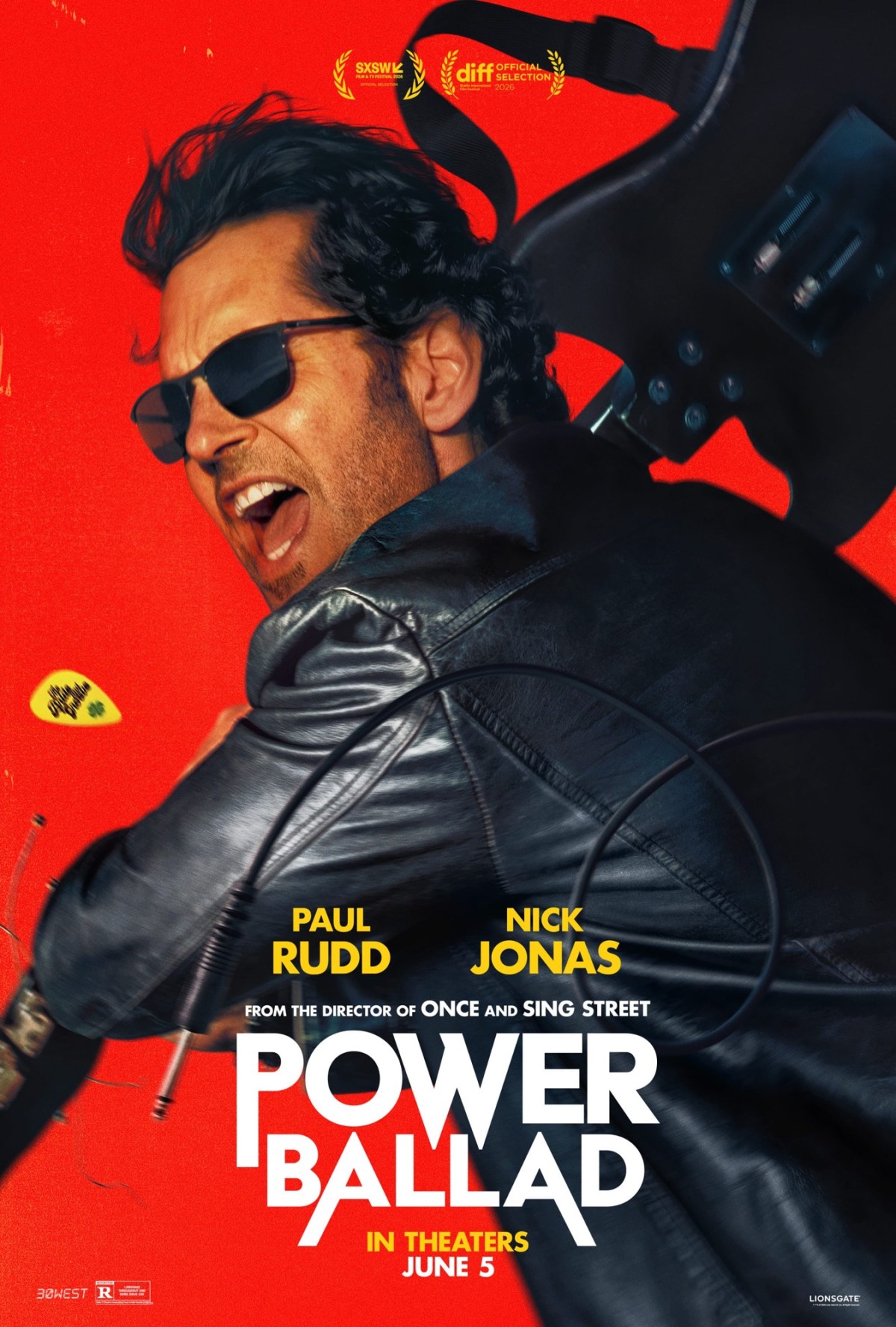
Film Review – Power Ballad (John Carney, 2026)

Irish filmmaker John Carney shot to prominence in 2007, when his romantic musical drama ‘Once’ became an unexpected hit. What had started as a little film that cost just $150,000 to make ended up grossing over $23m at the global box office, won an Academy Award for Best Original song, and was later remade into a stage musical. The warmth shone through the end product to make a connection with the audiences beyond anything that Carney could have ever dreamed of.

Since then, he has focused a lot of his directorial output on the musical genre. These have been fairly consistent in their quality despite varying box office returns. First there was 2013’s Begin Again, a saccharine effort starring Keira Knightley and Mark Ruffalo. Then in 2016 he helmed Sing Street, an Irish-set bittersweet musical that again outperformed expectations. Finally, Flora and Son, a Gary Clark collaboration, performed poorly with a limited release in 2023 before moderate success when it arrived on Apple TV+.

And so we come to Power Ballad, his latest musical comedy. This time, Paul Rudd takes centre stage as Rick Power, the front man of a jobbing wedding band called The Bride and Groove. We are introduced to the band in the middle of a very successful performance at a wedding party, which goes awry when Rick decides to use his formerly successful rock band’s biggest hit as the encore. Inevitably the audience doesn’t dig the sound and the show falls flat. This is a great springboard for his story – he has made a compromise on his personal success by fully committing to family life with his wife and daughter, but is still writing songs with no platform to showcase them.

We are then introduced to Danny Wilson, played by Nick Jonas. He is a struggling former boyband member that is looking to write a hit comeback single. When a chance meeting between him and Rick leads to them jamming out a few song ideas, Nick takes one of Rick’s songs and uses it as the lead single on his new album. The catch? Rick didn’t give him permission and he isn’t credited on the song.

As a member of a very unserious dad rock band who had flashes of musical success in my youth, a lot of the film resonated hard with me. John Carney is a talented songwriter himself, and he is uniquely adept at showing the songwriting process in a realistic manner. I really enjoyed Paul Rudd’s performance in the lead role, which is both lightly humorous and soaked with emotional baggage too.

As a piece of cinema, I have only one small gripe with Power Ballad. The whole film hinges on the magic of one single song as it becomes the most popular piece of music in the entire world. Unfortunately, the song itself is not quite of that quality. It’s not a bad song by any means, but it does have an unlikely callback to another recent musical comedy: K-Pop Demon Hunters. When you watch that film and the same snowballing success happens with ‘Golden’, it’s believable because that song is pop perfection. ‘How To Write A Song (Without You)’ isn’t really hitting that level, and it undermines the entire plot.

Frustratingly, the song that does hit that mark from a previous John Carney film is ‘Falling Slowly’. We do briefly see a busker belting it out in central Dublin, giving us a glimpse of what could have been if that song had been used in this film.

Overall, despite a few limitations, this is a very good film. If you want a bit of uplifting musical comedy in your life, then this is the film for you.

Power Ballad Official Trailer

Film review – Ant-Man (Peyton Reed, 2015)

The problem that many British viewers of this film will have when viewing this film is a pining for what could have been. Edgar Wright and Joe Cornish had for a long time both been attached to the film, the former as director and both as co-writers. Both are extremely well-known amongst the geeks of Britain and the fact they were teaming up was an absolute dream. Edgar Wright proved what he could do when given the freedom of the source material when he directed the excellent Scott Pilgrim vs The World in 2010. Whilst the Ant-Man series wasn’t as well known as the likes of X-Men and Spiderman, in the right hands it had the potential to be a great film.

Phenomenal powers, itty bitty living space.

Phenomenal powers, itty bitty living space.

However, it slowly became apparent that Marvel had a different idea of the direction it should take. In an interview with Mike Ryan of the Huffington Post, Edgar Wright said “It is pretty standalone in the way we’re linking it to the others. I like to make it standalone because I think the premise of it needs time. I want to put the crazy premise of it into a real world, which is why I think Iron Man really works because it’s a relatively simple universe; it’s relatable.” Clearly Marvel wanted the film to be set in the Marvel Cinematic Universe and the compromises required to slot it in with Thor, Iron Man and the clan didn’t sit well with Wright and Cornish. With not long to go before release date – 420 days to be precise – the pair (along with director of photography Bill Pope) co-announced with Marvel Studios that they were leaving the project, citing “differences in their vision of the film”.

So what are we left with? Well, Peyton Reed has come on board as emergency director. His previous work has been pretty much exclusively romantic comedies (Down With Love, The Break-Up) and the impression is that he was brought in to do what the studio needed rather than drive his own vision of the narrative. Ironically that makes him a kind of yes man. [1]

What’s really frustrating is that the script has some very Wright/Cornish-esque humour in there. One of the large scale fights near the climax of the film happens around a Thomas the Tank Engine toy train track. Anyone familiar with Joe Cornish’s route to fame in the 90s will see the likelihood that this was one from him. Or maybe Peyton Reed is a big fan of Series 2, Episode 18 of the original Thomas the Tank Engine series “Thomas Comes To Breakfast”, which first aired in the UK in October 1986.

The one saving grace of the film is Paul Rudd doing and excellent job as Scott Lang, the thief-turned-hero who wants to make up for lost time with his daughter. His humour and sharp wit make the journey through the film entirely pleasurable. He is a great comedic actor and the film has benefited from his presence on the rewriting team.

However, for all the good that is done by some great work in the cast (Michael Peña is hilarious throughout), we keep getting reminders that this is two films woven into one. The worst moment of the film comes when there’s an oblique reference to The Avengers, which sticks out like a sore thumb. Just as we are forgetting about it, Falcon arrives on the scene. Yes that’s right, Anthony Mackie has his very own cameo role in everyone’s eleventh-favourite Avenger (12th if you include Ant-Man, 13th if you include Nick Fury… who knows where by the time Civil War is released). It’s so pointless and so clearly an afterthought that it not only doesn’t help fit it in with the Marvel Cinematic Universe but rather actually just causes a detrimental effect on the absorbing world that was almost being created in this film.

It’s a shame that we will never see that Wright/Cornish film that never was. It must be said that it was unlikely to ever see the light of day without some serious compromises, but as two huge fans of Marvel comic books that was never going to happen. Instead we’re left with a reasonable film with some rewarding moments, which never really gets going because it is so disjointed.

Ant-Man is out at cinemas globally now.

[1] Yes I went there.