The writer behind Saturday Night Fever was pretty insincere and shallow.
He was called Barry Glib.
The writer behind Saturday Night Fever was pretty insincere and shallow.
He was called Barry Glib.
This film is surely,
Of all the Pixar Cars films,
One of the top three.

Arrow’s release of Yasuharu Hasebe’s 1968 yakuza film ‘Retaliation’ is well with picking up alongside another release from the same director, ‘Massacre Gun‘ (which I have previously written about). I will admit that these are films in a genre for which my interest far outweighs my actual experience in, but as usual the Arrow discs serve not only as an excellent way to view the films but also to immerse yourself in the history of the company and background to the films themselves. But more on that later.
The film is a tale of gang warfare. Jiro Sagae (Akira Kobayashi) returns to the streets after eight years in prison to find that much of his former life has moved on – his gang is all but completely disbanded and the city he knows and loves is now in the midst of a land dispute over farmland, with two gangs using heavy-handed methods to acquire land off farmers to sell on at a profit to a company that wants to build a new factory there. Jiro approaches the leader of the Hasama family to offer his assistance in settling the dispute and is given two promises: he can complete the task his own way and he will get control over the area once the task is complete. Jo Shishido also stars as Hino, a former gang rival waiting to kill Jiro after his escape from prison, and there is an early performance by Meiko Kaji (as Masako Ota) as the love interest of Jiro, years before her starring roles in Lady Snowblood and the Stray Cat Rock series.
The plot does, at times, feel overly complex. This is perhaps due to the need to introduce characters of interest in each of the gangs, plus a lead character, plus a backstory between two of the Nikkatsu Diamond leading men and a love interest. There’s also an unexpected homosexuality twist near the end, which was undoubtedly controversial at the time. At its heart, however, is a simple turf war story that is the bread and butter of any mafia or yakuza film.
Nikkatsu may have later become known for their sexploitation films, with Yasuharu Hasebe even turning his hand to several “pink” films, but at the time they specialised in yakuza action films. Hasebe’s directorial technique is quite distinctive. The content is, invariably extremely violent (for the time, at least). He was a specialist in violence, and threw in elements of S&M briefly and a sexual assault that should have warned Nikkatsu of what to expect when they eventually gave him complete freedom to direct a number of sexploitation films in the late 1970s.
Another technique is to use foreground blocking to affect the composition of the shots. This is particularly used in fight scenes and in quiet meetings between gang members to give a sense of the action being the kind of thing you usually find behind closed doors, almost as if the cameraman has hidden away and is filming the characters, but if they realised then he’d be in danger. It’s a clever way to raise the intensity of the film.
As previously touched on, there are some essential bonus features on both this disc and that of ‘Massacre Gun’ that are well worth discovering. The half-hour interviews with film historian Tony Rayns are fantastic insights into the company and serve as a video essay to establish the background to the company at the time the films were released and also a means to discover more about the director Hasebe and one of the stars Jo Shishido. Additionally, Jo Shishido is also interviewed on each disc, providing an unfiltered take on the filmmaking process and his memories and experiences about the studio. In the booklets, Japanese film expert Jasper Sharp provides a long essay on the film and the studio that is also well worth reading.
As someone who has never had any kind of film or media training and with no formal qualifications behind me, items like these serve time and time again as very effective mini film study courses. I’m able to watch a film in its best possible picture and sound quality, learn more about it from experts, immerse myself into the history of the company behind it and then check out more films from the era if I wish to. It’s easy to take this kind of situation for granted, but 20 years ago it simply wasn’t possible without finding a rare VHS copy and doing significant research at libraries or enrolling on a course. Indeed, I would probably never have even heard of the film let alone giving it a chance by watching it.
A must have for budding Japanese film fans and one that you need to act fast on since only 3000 copies were released.
What do Klingons use to protect their hands from dirt and oil?
Worf-ega
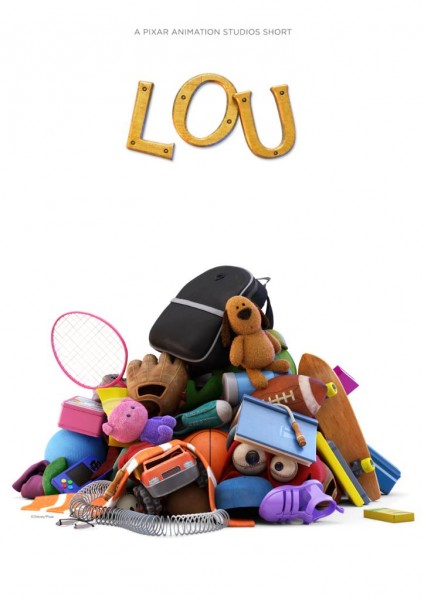
A sweet short film about a bully’s relationship with a lost and found box in a playground might just make your ticket to Cars 3 worth the entry fee.
Dave Mullins is a first time director but has been working with Disney since 1995 and Pixar since 2000, working in the animation department for the likes of Up, Monsters Inc., Ratatouille and Inside Out. It is clear that his attention to detail and love of a great story is at the heart of this film, which is brought to life wonderfully in a story that lasts only a few minutes.
The film opens with the lost and found box attracting the attention of the children in the playground of a school boy, encouraging them to play with the contents. However, the school bully J.J. begins teasing his class mates by taking away their toys and teasing them in the process. However, when the contents of the lost and found box come to life and start to turn the tables on him, he quickly learns a fast lesson in being nice to his peers, awakening memories he’s hidden inside himself that may be the real problem behind his poor behaviour.
It’s incredibly difficult to create something with such a large story and get the whole point across in a strictly limited timeframe, but Mullins and his team completely manage it. The short is, essentially, a silent film, but it has no difficulty in delivering a succinct but strong message.
The audience, which were mainly children, were completely captivated and gave a spontaneous round of applause at the end of the screening.
You can watch the opening 40 seconds below.
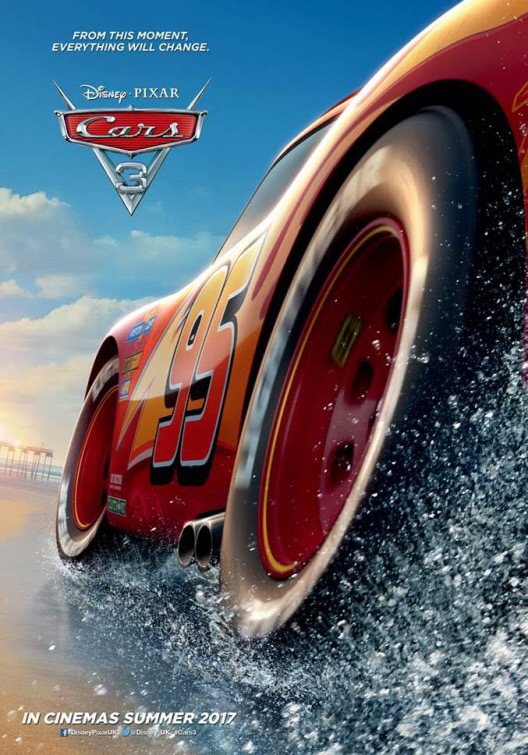
I always try to stay positive about a film I’ve seen. With that in mind, I can happily announce that Cars 3 is one of the top three films in the series.
The wayward plot that feels deeply familiar on many levels. It’s Rocky III on wheels, with the care and attention of The Karate Kid III. This does little to rescue a franchise that looked in danger of sinking since the poorly-regarded Cars 2.
Put simply, Cars 3 is defined by lacklustre character designs and a thinly veiled attempt to use a film as a means to sell merchandise and toys.
This time around, Lightning McQueen (the returning Owen Wilson) is struggling as an ageing racing car. An arrogant young car named Jackson Storm (Armie Hammer) has shown up and is utilising modern technology to achieve better performance from his specs, forcing cars based on the older technology into retirement. McQueen refuses to retire and pushes his car too much in the final race of the season, leading to a horrific crash that takes him months to recover from. Determined not to retire, McQueen takes on additional training at a new facility sponsored by Sterling (Nathan Fillion), though he seems to want McQueen to retire and turn him into a brand rather than let him keep racing. Regardless of this, he’s given a personal trainer called Cruz Ramirez (Cristela Alonzo) who he quickly strikes up a love-hate relationship with.
One of the tough sells for the film outside of North America is that McQueen is essentially a stock car racer. NASCAR is the second most popular sport on American televisions, but is largely unpopular in Europe and the UK. Indeed, the sport is ridiculed by many who see it as vastly inferior and less exciting than the likes of Formula One and MotoGP. Perhaps as a British film fan I am spoiled when I see stock car racing – maybe the subtleties of the skill involved are lost on me. But converting that into an exhilarating plot point in a film is an unenviable task and something I don’t think is achieved in Cars 3.

For all the disappointment associated with the story, the visuals are nothing short of stunning. There have been huge advancements in animation in the eleven years since the original’s release. The benefits are felt with the backdrops, which feel somehow much more life-like than it’s predecessors. Even the character design, which is hampered by the restrictive nature of bringing cars to life, feels more advanced; a clear sign they’ve learned from two predecessors.
At its heart, this film eventually ends up being a buddy movie. Whilst it takes a while to get there, it’s an important move to bring the film closer to the original movie. I didn’t like either of the first two instalments, but Cars 3 stands alongside the original as being more in line with the Pixar ethos. It is, as the investors would say, “on brand”. So, whilst the first-time director Brian Fee has taken no risks here and the outcome is something that probably won’t overly please anyone, but nor will it offend anyone.
A safe bet that will maintain the franchise and opens the door for further sequels. Bland, forgettable, but pleasant enough to keep its target audience happy.
Though I do think Cars 2 is a better film.
I had a great hypothesis about a Paul Newman and Robert Redford film that challenged the very basic concepts of physics.
I called it Sting Theory.

I am battered, exhausted, grotty, but yet still absolutely on top of the world that I was lucky enough to be at Glastonbury Festival 2017.
For anyone attending in their 30s, especially those in a stable relationship, there comes a time when going to these festivals with your friends becomes an increasingly reflective time. Specifically, there is an impending thought that this could well have been my last attendance for a while. The festival won’t be held next year, whilst there is a rumour circulating that the subsequent one will be held away from the site. That takes us to 2020 before the next one. Who knows where I will be by then, and who knows where my friends will be too.

As a result, I was determined to make the most out of it and pack as much in as possible whilst not destroying my body.
I wrote about each of the days in posts at the end of each day, which can be found below:
Day One – Arrival, Pitching, Fireworks Sleeping
Day Two – Prince Achmed, Quiz, Napalm Death, Everything Everything
Day Three – The Pretenders, Glass Animals, Elbow, Radiohead
Day Four – Thundercat, Jeremy Corbyn, Foo Fighters, The National
Day Five – Ed Sheeran, Goldfrapp, Barry Gibb, Chic
I also posted short reviews of three acts I enjoyed that coincided with a bit of time to make notes:
First Aid Kit
Radiohead
Laura Marling
Goldfrapp
Other highlights included a trip around the circus and theatre field (who knew man could juggle five ping pong balls without using hands or feet?), a Pilton Palais for some cinematic refuge, some fantastic food, the world’s smallest nightclub and endless other bizarre surprises I saw whilst walking around.
The most important thing is to make sure you spend it with close friend and family. I had a great bunch with me this year and managed to meet up with some friends I’d lost touch with over the years. The magic of Glastonbury never ceases to amaze me.

Setlist:
Soothing
Wild Fire
The Valley
Nothing, Not Nearly
Don’t Pass Me By
Sophia
Once
Salinas
Daisy
How Can I
I Speak Because I Can
Rambling Man
On a hazy afternoon at the Pyramid Stage, just before Barry Gibb kickstarted a night of partying for a crowd ready to go out in a blaze of glory, Laura Marling was providing a set equivalent of the quiet before the storm. It was a beautiful and understated performance that showed her abilities both as a songwriter and as a performer, with a subtle backing band providing a platform to allow her songs to soar.
The first and only time I had seen her previously was at the Hop Farm Festival in Kent in July 2008. Back then she’d just released her debut album ‘I Speak Because I Can‘, which was making waves at the time, and she wowed an audience who were there primarily there to watch Neil Young, Supergrass and My Morning Jacket. Not bad for an 18 year old.
Fast forward to 2017 and you can see a massive development in her as an artist. Her latest album, ‘Semper Femina‘, is a collection of songs exploring what it is to be a female. For me, music has to come from a position of passion and commitment to what is being said. For that very reason, Laura Marling absolutely one of the most authentic artists out there and the album rates in the top releases so far this year.
The new songs featured heavily in the setlist, making up five of the twelve tracks, including ‘Nothing, Not Nearly’ and set opener ‘Soothing’. But it was ‘Rambling Man’ from her debut album that stuck with me the most, with most of the crowd joining in for the famous refrain.
To those unaware of her work, she could be mistaken for being overly indebted to Joni Mitchell. This is wholly untrue and inaccurate. Marling is an artist in her own right and has been prolific and consistently excellent for a decade now.
Long may it continue.
[Note] When Marling introduced Daisy, she mentioned a friend of hers called Daisy May-Hudson who last year directed a film called ‘Halfway’, a film about homeless housing struggles. I had never heard of it but I’ve located a trailer for it online here and if I can locate it online I’ll make sure I watch it

Setlist:
Anymore
Train
Slide In
Everything Is Never Enough
Become the One
Systemagic
Number 1
Ride a White Horse
Ooh La La
Strict Machine
They may have had some technical difficulties that delayed the start of their set, but once they finally arrived Goldfrapp absolutely blew away the John Peel Tent at Glastonbury Festival on Sunday afternoon.
Alison Goldfrapp may well be one of the most engrossing female performers in the industry. Her striking black costume, sumptuous vocals and commanding stage presence are a powerful concoction.
They led the set off with latest single ‘Anymore‘, taken from recent album ‘Silver Eye‘. It’s a dance floor filler and highly indicative of the first half of the album. As two dancers strutted across the stage, jolting sharply, it was clear this was going to be as much performance art as it was a live gig. [1]
Favourites ‘Train’ and ‘Slide In’ followed, continuing the dance vibe that the crowd were clearly enjoying.
A trio of songs from ‘Silver Eye’ followed, with the highlight being ‘Systemagic‘, which happens to be the next single taken from the album. It’s another powerful track with a mixture of heavy bass and industrial drums. Alison was in fine form, enjoying giving some new material a new audience.
As Alison said “You know this one I think…” before the electronic pounding of the intro to ‘Number 1’, she kicked off a familiar conclusion to the set. The final tracks rounded off the set nicely, with all four amongst the most popular (or perhaps most mainstream) of their material: ‘Number 1’, ‘Ride a White Horse’, ‘Ooh La La’ and ‘Strict Machine’. This is a sensible choice at a festival, even if the more dedicated fans would have loved to hear a song or two from ‘Seventh Tree‘ or ‘Felt Mountain‘.
I’ve seen Goldfrapp on many occasions and they seem to get better and better. Predictably, the crowd went wild for them, setting sail into the warm Glastonbury air for the final night of the festival having seen one the best sets of the weekend.
[1] Catch their latest music videos below. Systemagic gives a great idea of what their stage dancers look like.
 Cinema, etc.