Wakolda (Lucia Puenzo, 2014)

Lucia Puenzo’s controversial new film is a thriller of sorts that really failed to thrill me in any way. Based partly on fact, it centres around a family living in Patagonia in the 1960s who are unexpectedly befriended by a German doctor. This doctor, it turns out, is actually Nazi war criminal Josef Mengele in hiding. He takes an unhealthy interest in their daughter Lilith and in the father’s hobby of making steampunk dolls with creepy beating hearts.

I’m not up on my post-second-world-war Nazi manhunt history, so I can’t comment on the factual accuracy of it all, but what I can say is that the finer details seemed a little far-fetched. The fact he was in Latin America in this period has been proved in many historical documents. However, I can’t relate in any way to a family that would allow their youngest daughter to be experimented on by a complete stranger who is quite obviously in hiding, especially when that man is German and it is known that Nazi war criminals are in hiding in South America. And you’re in South America. And he’s a creep that wants to experiment with drugs on your daughter.

IMG_9097.JPG
The acting also left a lot to be desired. The normally animated Brendemuhl (Mengele) pitches his character as too wooden and fails to elicit the correct level of hatred that is required. Indeed, for large periods of the film it feels like we are being encouraged to feel empathy for him, which in my eyes is quite divisive. Perhaps the director should be praised for being brave and allowing the actor to portray him as something other than a cinema-standard psychopath. For me, the result is just a little bit directionless.

Wakolda has won awards at festivals all around the world and perhaps the global appeal is down to the fact it is a story that involves the history of so many people’s countries. On the pure level of looking at it as a convincing and effective story in its own right, I think it falls short. It certainly wasn’t a roller-coaster ride and I didn’t really feel much for the characters, so when the story reached its climax I just didn’t feel overly engaged.

Wakolda is out now in selected cinemas across the UK.
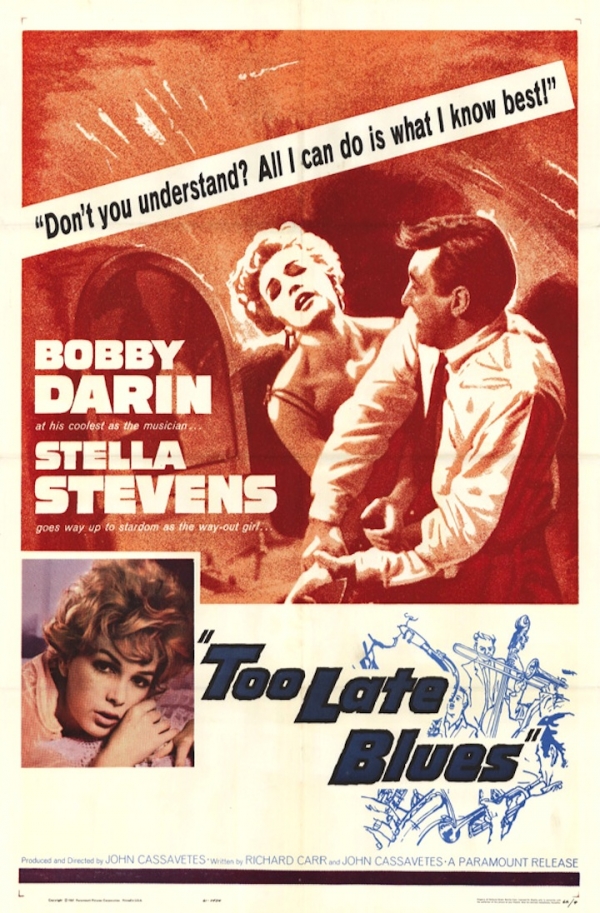
Too Late Blues (John Cassavetes, 1961)

I’m growing tired of the Masters of Cinema releases. Time after time they release excellent transfers of classic forgotten cinema, more often than not films I’ve never heard of before, put a lovely package together and release it for about the same price as going to the cinema. It’s sickening. Unfair almost.

Elaborating on my first point – my wife and wallet are growing sick of the Masters of Cinema releases. I personally can’t get enough of them.

Too Late Blues has largely been considered a failure, not least by director John Cassavetes. His major studio debut, released following the hugely successful Shadows in 1959, the film is infamous for its compromises, which cover everything from the music to the script and even the main cast. Watching it now it is hard to see what the controversy is about.

I was particularly taken aback by Bobby Darin’s performance. I’m of a generation that knows him almost exclusively for his huge signature tune “Beyond The Sea”, and less so for “Splish Splash”, which is now unfortunately associated with the “falling in the garden pool” segments on You’ve Been Framed.

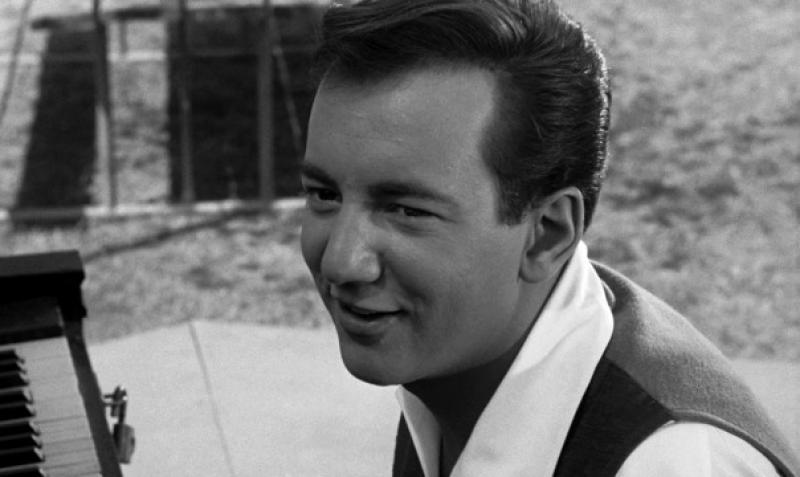
Bobby Darin finally takes time to play his piano between baths

Bobby Darin as Ghost in Too Late Blues

Playing Ghost, the leader of a struggling jazz band, Darin toys with the frailty of a damaged ego whilst putting on a front for his love interest and fellow aspiring musician Jess (played by Stella Stevens). He plays it with charm and integrity and it’s a fantastic performance in one of his early film roles.

Cassavetes ensures his stamp is made on the film by carefully throwing in one-liners that subtly defend his fear he’d be viewed as selling out by fans of his debut. At one point, a line is delivered that points to the “mixin’ up of the races” as one of the sins of jazz musicians. The fact this is delivered by an idiotic ruffian is a clear indicator that Cassavetes did not agree with the statement and was using the line as a critique of the copious Hollywood films about the thriving mixture of inspirations and culture that was the 1950s jazz scene, but which all centred on exclusively white musicians (Young Man With A Horn and Pete Kelly’s Blues are good examples of this). Indeed, the very subject matter of Too Late Blues is a man struggling with artistic integrity and what he sees as selling out. It’s an intelligent compromise and the fact it made it past the studios sort of proves his point.

Stealing the show above everyone else though is Everett Chambers, who plays the artists’ agent Benny Flowers. Reminiscent of Joe Pesci at his most evil, he perfectly plays a man riddled with jealousy. His efforts to sabotage his acts’ careers in order to keep them in his control are trumped only by the efforts he puts into ensure Ghost and Jess never become a couple, so desperate he is to end up with the girl himself. This reaches breaking point in a highly memorable bar-room brawl, which he orchestrates to perfection whilst seemingly never getting involved. It is a shame that this would prove to be one of the few roles that Chambers completed before transferring to a very successful career in television production, as he shows every pointer of being an excellent actor.

The promise shown in the opening act of the film are never really delivered on, and this is probably because of pressures from the studio upon seeing the progress as it was made. That said. it is a worthy addition to the continually excellent Masters of Cinema collection and well worth the monetary and emotional investment.

Too Late Blues is out now in the UK on Blu-ray and DVD dual format release, courtesy of the Masters of Cinema collection.

Lilting (Hong Khaou, 2014)

Hong Khaou’s Lilting is a film of understated power. Watching it is a deeply moving experience.

The plot deals with the unexpected death of a young man played by Kai, and the toll this takes on his lover Richard (played by Ben Whishaw) and his mother Junn (played by Cheng Pep-pei). The snag in the situation is that the mother is unaware that her son is homosexual, and the situation is made more complex by the fact that Richard intends to respect his lover’s wish to keep this secret whilst at the same time ensuring Junn is looked after, which raises issues that are extenuated by the fact they have no common language. Or rather, they don’t until Ben hires a translator, though this gives rise to as many issues as it resolves.

This is a complicated storyline to see through and could easily fall flat with poor performances. Junn is brilliantly stubborn and cold, though we can see a heartbroken woman underneath the façade. Whishaw’s turn is an absolute revelation and every quirk adds to the belief that he is completely ripped apart by the situation.

A large amount of praise also needs to be heaped on the unwillingness to shy away from the fact we are seeing a homosexual relationship. So many times in films we see same-sex relationships implied but rarely do we see the playful intimacies and passion of such a relationship. This isn’t to say that there are any gratuitous sex-scenes, but the story called for the young men to be very much in love and the closeness is not shirked. Hopefully this is something we will see more of in the future.

Lilting is one of the best films I’ve seen this year. It’s a stunning study of the emotions people go through when someone they are close to dies with a secret, and the difficult resolutions they find to deal with the loss. If you get a chance to see it, then grasp it with both hands.

Lilting is out now in selected cinemas across the UK, and will be released in the USA on 26th September 2014.

Deux Jours, Une Nuit (Jean-Pierre Dardenne and Luc Dardenne, 2014)

The latest film from the Dardenne brothers, Two Days, One Night, stars Marion Cotillard in what on the face of it seems quite an unlikely situation: a woman is voted out of her job by her colleagues as a result of a vote between her colleagues who choose between keeping her in employment or receiving their annual bonus. Whilst it felt far-fetched when I read the synopsis, the way it is delivered makes it not just believable but heart-breaking.

Whilst the whole story centres around Sandra’s struggles as she reacts to the news of the decision, we are treated to an expert display of serial short story writing. Sandra (Cotillard) has from 5pm on Friday night until 9am on Monday morning to visit, in person, each of her 16 work colleagues and convince them to vote in her favour when the ballot is repeated on Monday morning. Given the minimal screen time they have to offer their reasoning (the whole film is just 95 minutes in length) each character is wonderfully deep. This ensures that this one-woman tour-de-force doesn’t begin and end with the main star.

The shooting technique adds to the realism. Most scenes are completed in a single shot, which gives the effect of feeling like you’re a bystander allowed to eavesdrop on the most personal and revealing of conversations. We see extreme stubbornness, tears of guilt and logical reasoning as each character paints the picture of how they came to their decision and – more importantly – whether or not they will change it.

It is a film that sets itself up to spark debate amongst the viewer. It’s certainly not a crowd-pleaser. It is too heavily laden with working-class socio-realism for that. But does it achieve what it sets out to do? Probably, yes.

Two Days, One Night is out now at selected cinemas.

Ruggles of Red Gap (Leo McCarey, 1935)

Having recently watched McCarey’s excellent Make Way For Tomorrow, I thought I’d dig below the surface and watch some of his other films. I came into Ruggles of Red Gap knowing nothing about Charles Laughton and the other members of the cast, and very little about McCarey. I have to say that on first impression, I am very disappointed.

Laughton portrays Ruggles, an English valet who is working in Paris but is transferred to America to work for a brash American (confusingly portrayed by Charlie Ruggles). Once in Washington, our valet develops as a character and grows in confidence, going from obedient servant to full independence, eventually deciding to open his own Anglo-American restaurant.

Laughton biographer Simon Callow, in a key bonus feature on the UK Masters of Cinema release, discusses in great detail his opinion on the performance and his disappointment having watched it. In context, he was comparing him to his great performances as the Hunchback of Notre Damme and as Henry VIII, to name a couple. I have not seen these, but I wholeheartedly agree with everything he says. I’d go further – as an Englishman, the whole thing is utterly insulting.

The Ruggles that is portrayed is a bumbling Brit that would leave any aristocratic servant-employer worried for their own safety. Indeed, I’d probably ask for a different waiter if I was served by Ruggles in a restaurant. The portrayal leaves the viewer with an air of discomfort. There’s something going on between his flickering eyes and his awkward body language that made me want to look away. In hindsight, I think it was Laughton’s attempt at comedy. Perhaps it was “of the time”, but it really hasn’t aged well.

That he can’t find any route out of servitude until he goes to America, which is patriotically portrayed here – unashamedly – as the land of the free, is undermining of Britain. With very little knowledge of Laughton as a person, I’m willing to guess that he must have been very anti-British to accept such a role.

The film was hugely popular amongst American viewers and very much not popular in Britain, and for the reasons just mentioned I can understand why. Having listened to Callow speak so fondly of Laughton and McCarey, I’m really keen to seek out something that justifies their enduring popularity. I’ll gladly welcome any suggestions!

Ruggles of Red Cap is available now in the UK on Blu-ray and DVD.

Ilo Ilo / 爸妈不在家 (Anthony Chen, 2014)

Back in October 2013, I saw the first ten minutes or so of Ilo Ilo in the most unfortunate of circumstances. Managing to get down to the London Film Festival (LFF) for a couple of days, I had to carefully select my programme of films based on stuff I really was desperate to see and then fill it with pictures I found interesting that I knew little about. This film was the latter, but my viewing pleasure was doomed from the start.

In a packed auditorium in Leicester Square, director Anthony Chen looked in in horror as his debut feature – on its UK premiere and being screened in competition – began playing with a terrible synchronisation problem that left the sound about two seconds ahead of the action. In the first instance I was disgruntled, having wasted an opportunity to so many other delightful films on offer by picking one that failed to even get started. Over the next few days, though, I began to be more frustrated by the fact I wasn’t going to get to see the rest of the film for an unspecified period of time.

Indeed, I did get to see the film last Tuesday, a whole nine months since my first attempt. As the feature started the familiar sound of Jiale feigning injury brought back memories of the LFF, and the dread overtook me that maybe I wouldn’t get past the first ten minutes again. At last, though, success. Everything was as it should be. Was it worth the wait? In every way.

The story focuses on a young boy called Jiale, who is causing issues at home and at school that are too much of a burden for heavily pregnant mother Hwee Leng and struggling father Teck. To ease the strain, they employ a housemaid Teresa (or Terry), a Filipina in search of better job opportunities. We join them on a journey as the family learns to adapt to the extra presence in the house and Terry becomes part of the family.

If you’re even considering seeing a Singaporean independent film at the cinema, then I’m going to assume it’s your kind of thing. I chose to see Ilo Ilo over the likes of Maleficent, Transformers: Age of Extinction and other summer blockbusters. I did this not to be purposefully obtuse and avoid populist opinion, but because I enjoy the wide variety of storytelling methods that I find when watching films from other cultures and continents. In fact, I don’t think I’ve ever seen a Singaporean film before. Every director is influenced by his surroundings and experiences, and this is inferred in the way they tell their stories.

The film has no car chases, no romantic sub-plots, no heated affairs. It avoids a clichéd happy ending, even when there was an opportunity to play out a really obvious conclusion. To do so would have betrayed the previous 70 minutes of subtle and realistic character development. The point of the story isn’t to resolve everyone’s financial and emotional issues, but rather to show the massive effect the housemaid Terry has on Jiale’s life, as we join him on a journey from being a misbehaving child to something a little easier for his parents to cope with through the bond he forms with Terry.

Ilo Ilo. Not a film for every cinema goer, but if you’ve come as far as searching out this blog to look for an opinion on it then I have an inkling that it’s something you’ll enjoy. I’m sure you won’t be disappointed.

Ilo Ilo is showing at selected independent cinemas in the UK now.

Film review – Star Wars Episodes I-III (George Lucas, 1999-2005)

I have a special guest reviewer for the Star Wars prequels, which were released to much fanfare and equal amounts of dismay from 1999 onwards. It’s my fabulous wife, a week after our wedding day!

I say review. It’s more of a quote. Here goes…

“The prequels are to Star Wars what Crocs are to shoes. An abomination.”

If you wish to remind yourselves of said abominations, they are available as a complete box set with butchered versions of the original trilogy now from here.

20140613-214607-78367299.jpg

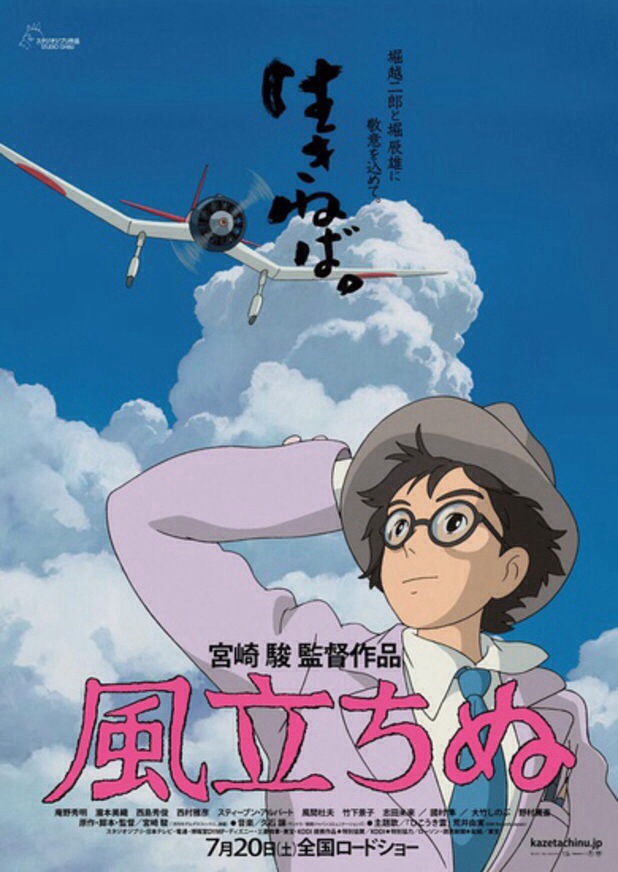
The Wind Rises / 風立ちぬ (Hayao Miyazaki, 2013)

“I am talking about doing something with animation that can’t be done with manga magazines, children’s literature, or even live-action films.”

It’s that last line that really bothers me. That was Hayao Miyazaki talking, in 1978, about what animation means to him. It wasn’t a hard quote to locate. I only started reading his autobiography (of sorts), Starting Point, five minutes ago. It was right there in the third paragraph of the first page.

I don’t think there’s any denying that, when looking back at the career of one of the greatest and most imaginative directors of all time (and I’m not limiting that to animation either), he has created a body of work that surpassed that which would have been capable in any other medium. If you look at Nausicaä, Princess Mononoke, even his work on Sherlock Hound The Detective, it’s difficult to see how any other medium mentioned above could have portrayed his story any better than in 2D animation.

So when I was sat there at the cinema watching The Wind Rises, even before I read that opening quote, I couldn’t help but wish for the magic to ooze back into play. I was with a fellow anime fan and another friend who was unaware of any of his output, and we all agreed that the film could have been better served as a live-action film. There wasn’t really any call for the animation. Yes, it looked visually stunning as usual, but it didn’t add anything to the story.

It’s sad that Miyazaki has chosen to finish his body of work with this film. Don’t get me wrong, it is definitely not a terrible film and it won’t tarnish his reputation. The story is solid, the characters well-realised, the backdrops deep in detail. It’s just a bit of an anticlimax after a series of such amazing films.

One for the completists and die-hard fans, but if you’re new to Miyazaki, you’d be better to start with Howl’s Moving Castle or Spirited Away.

The Wind Rises is out in cinemas in the UK now. Reviewed was the Japanese version with English subtitles.

Godzilla (Ishirō Honda 本多 猪四郎,1954)

Spectacular special effects, a metaphor for nuclear weapons, the start of a still-popular franchise. There are many things that have been repeatedly said about the 1954 original of the Godzilla story by Ishirō Honda. But how does it stand up to viewing sixty years down the line?

I imagine a lot of people will seek the film out ahead of the release of the Gareth Edwards modernisation next month, a task made all-the-more easier by the fact it is out of copyright and there are plenty of copies available for free around the net.

For those not used to watching foreign or classic cinema, it might come as a shock. There are a few things you need to buy into if you’re going to enjoy it.

The use of miniatures at the time probably took most cinema-goer’s breath away, but nowadays you can spot them a mile away. What we are seeing looks very little like the complete destruction of Tokyo, but more like the complete destruction of a very little Tokyo. They’ve not even got the speed of the slowed-down film correct.

It’s also difficult to watch the film without seeing Godzilla as a man in a rubber suit. Haruo Nakajima is clearly putting a lot of effort into his portrayal but it’s hardly convincing by today’s standards. Remember, this is over two decades after King Kong had terrorised the big screen and there must have been some advances in technology in the intervening years.

I have seen this film before, probably around seven years ago. The flimsy conclusion to the film really had slipped my mind. Having annihilated several towns and cities in his reign of terror, we are quickly asked to buy into the concept that putting Dr. Serizawa’s Oxygen Destroyer under water will do the trick. Wait… Hasn’t he spent most of the film breathing fire on people above water? I know he’s sleeping underwater, so I guess he’s amphibious? We already know he can survive for hours above water so why does he die immediately? And why are there no dead floating fish at the surface? If the oxygen has been completely removed then why do the humans live on? I know, I know… He’s a giant fire-breathing dinosaur… Everything else is water under the bridge.

Overall I see this film as entertaining but flawed, historically significant but unbelievable. I enjoyed my time watching it, but I wouldn’t recommend it to someone looking to get into classic Japanese cinema.

And at least it wasn’t directed by Roland Emmerich.

Oscars 2014 – What missed out

20140302-181314.jpg

With the Oscars taking place later tonight, I look at the films that have been overlooked by the Academy.

Monsters University
20140302-181458.jpg
Okay, it wasn’t the best picture Pixar has come up with over the years. It wasn’t even the best Monsters film they’ve produced. That said, they did find space for The Croods in the nomination pool, which was fine but could you really say it was better than MU? If Pixar had released The Croods, there would have been mass derision. Miyazaki’s The Wind Rises is a hot tip to take the prize this year, but I can’t comment until it gets a UK release.

Rush
20140302-181717.jpg
I feel like this film has suffered because it wasn’t released in the typical awards season. It didn’t play by the book. It came out back in September 2013 and performed well at the box office without an Academy recommendation. Bruhl and Hemsley were both outstanding, not just as eerily accurate take-offs but as flawless acting performances in their own right. The recreation of the classic races was spot on from Howard and the story was as exhilarating as the action. In my eyes, it could have easily come in as the 10th film on the best film list. To not even get an appreciative nod for best makeup (Bruhl’s scarring was critical and spot on) or visual effects (though admittedly this was a strong category this year) is surprising.

Inside Llewyn Davis
It’s the Coen brothers latest release and they usually get nominated, right? Not this year. Whilst it’s a strong year for nominations in the Best Picture category, it should have received a nod for best song. In fact, whole soundtrack could have been considered. It received one for best sound mixing, which is a bit of a throwaway category overall. At least it was appreciated on some level.

The Hunger Games: Catching Fire
20140302-181550.jpg
Okay, I don’t agree that this film should have been nominated for best film or best acting or anything else. However, the song “Atlas” by Coldplay is easily one of the best original songs in what was admittedly a poor year for soundtracks. It’s a shame they had a song on the list that was later disqualified, especially one as awful as “Alone, Yet Not Alone” by Bruce Broughton and Dennis Spiegel. There was also space for the bland “Ordinary Love” by U2. Neither of these should have made it and they would have made room for “Atlas” and, well, anything from Inside Llewyn Davis or Her.

Saving Mr Banks
20140302-181628.jpg
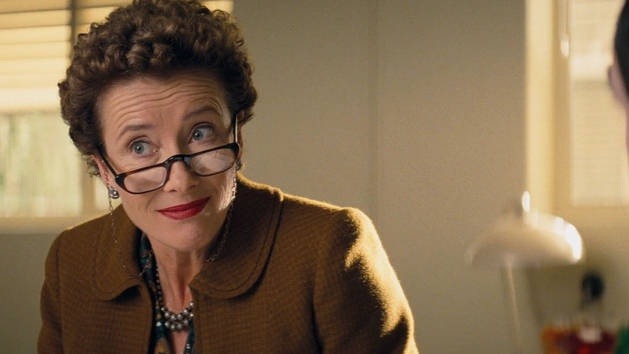
One of the biggest and most talked about shocks was the lack of a nomination for Emma Thompson in Saving Mr Banks. It’s frustrating to see Meryl Streep nominated for the 18th time for a role that she will never win the top prize for when Thompson could have been a front runner for.

Nymph()maniac
20140302-181509.jpg
I would have loved it if the Academy could have found it in themselves to nominate Uma Thurman’s fantastic supporting performance in Lars Von Trier’s latest film. It blew me away and really stood out in what was otherwise a pretty bland film. That said, it may not have qualified this year so we may have to wait another year before we see if this – and indeed Christian Slater’s excellent performance – was overlooked.

Elsewhere
Tom Hanks missed out twice for Saving Mr Banks and Captain Phillips, the latter being the biggest shock as it is probably his best performance for over a decade. Whoever thought the cinematography in 12 Years A Slave wasn’t worth noting must have been on drugs. Nothing for Robert Redford’s performance in All Is Lost was also a big surprise, though I’m not convinced Redford lost any sleep over it. The Butler was a massive omission but maybe a little too much like a typical Oscar nominee.