Sean Connery is one of the most renowned British actors of all time. He has starred in so many well regarded and successful films, including The Hunt For Red October, The Untouchables and Indiana Jones and the Last Crusade. He is, of course, remembered most fondly for his performance as the quintessential James Bond, starting with Dr No in 1962 and finishing with Diamonds Are Forever in 1971. He also reprised Bond in 1983 with Never Say Never Again.
His prominent films remain prominent and he will be remembered for these great successes. That said, unless you go out of your way to seek his wider body of work, it’s quite difficult to build up a fuller idea of his talents.
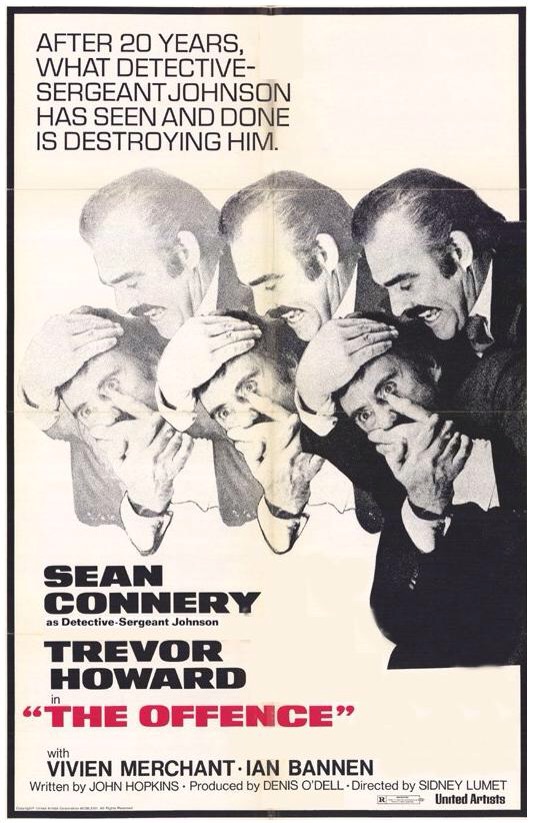
Fortunately, Masters of Cinema are on hand to help us out a little, pointing us in the direction of The Offence, Sidney Lumet’s cross-section of Detective-Sergeant Johnson (Connery) and his struggle to cope with the inner demons he has as a result of the constant horrors he sees in his line of work. Released in 1972, it was one of the earliest post-Bond films he released so was one of his first chances to show the world his full gamut of talents.
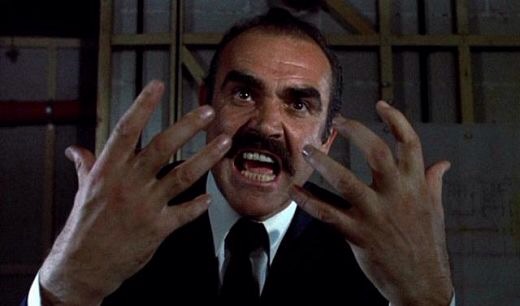
The film opens with a bold slow-motion shot of policemen rushing into an interrogation room, where we find Johnson fighting off his colleagues, with the dead beaten body of Kenneth Baxter (Ian Bannen) lying on the floor. Evidently Johnson has killed Baxter and through a series of flashbacks we discover the chain of events that lead to this happening.
This is an excellent performance from Connery, adding weight to a character that has been carefully constructed by screenwriter John Hopkins. The story is told in a non-linear way, which is cleverly executed to ensure the reveals happen at regular intervals. Bannen’s performance kept me second-guessing throughout and ensured it wasn’t just a one-man-show. It’s a stylish and grim view of Britain in the 1970s and it hits home further by being so realistic, which I credit to director Sidney Lumet and his work with cinematographer Gerry Fisher.
It’s a film that warrants a first and indeed second viewing. The latter will undoubtedly come before long. I’ll be devouring the bountiful array of extras first.
The Offence is available on Master of Cinema dual-format Blu-ray and DVD now.
At first, The Trip seems like a terrible proposition. It can be summed up as follows: Steve Coogan and Rob Brydon, playing exaggerated versions of themselves, visit six Michelin-starred restaurants in Northern England to review them for an Observer article, spending most of their time together bickering over who can do better impressions of a number of famous people. Well, about seven famous people.
Somehow, over the course of six episodes in the first series, they make it a success so consistently I was left wondering how such a simple idea could fail to work when the two central characters have so much chemistry together. The whole thing is clearly full of improvisations and no matter how many times we hear Michael Caine, Hugh Grant and Ronnie Corbett, they never fail to disappoint.
Yet at the heart of the show we find that it isn’t just a whimsical improvised comedy that borders on self-indulgence, but rather a dissection of one man’s inner struggle to come to terms with the level and manner of his past successes. Coogan’s desire is to alter his legacy and change the public perception of him as a character comedian to something of more substance by taking on more serious roles. He doesn’t see himself as a comedian but as a character actor. His biggest frustrations come from interchanges with Brydon who discusses their similarities, which is hard to receive from a man who Coogan sees as simply an impressionist.
In many ways, parallels can be drawn with Michael Keaton’s recent performance in Birdman, a role that won Keaton an Oscar. In that film, Keaton pushes himself to the cusp of a breakdown as he ploughs all his remaining money and efforts into a theatrical production that he thinks will completely overhaul the public perception of him. It was ironic that Keaton, in this film, established himself as an actor of serious depth in a role that exaggerated the public’s perception of his own life. Similarly here, Coogan manages to come out of the series with a huge level of credibility for his portrayal of a man striving for more, finishing the six-part series almost completely emotionally broken. It is an excellent performance from Coogan and one I’m sure he’d rather be remembered for than Pauline Calf and Alan Partridge.
On the back of this, Coogan went on to star in the Oscar-nominated Philomena, and duly received critical acclaim for another role of real substance. Perhaps The Trip was the stepping stone onto this, but the fact a follow-up was commissioned in 2014 suggests both Brydon and Coogan know that they hit on something special in the first series.
The Trip is available to watch on Netflix UK and can be purchased on Blu-ray or DVD.
[Note] I can only apologise to the creator of the lovely alternative poster at the top of the page. I can’t give credit as the website from which it was sourced (movieweb) has lost the page. It is lovely though.
I’ve just watched the infamous Robert Downey Jr. interview walkout. I recommend you watch it too, especially if you’re a fan of the Marvel Cinematic Universe. If you read the articles without watching the video, then you’re playing into the hands of the kind of journalism RDJ was walking out of.
The way Guru-Murthy conducts himself in the interview is very much the same as he did in the Quentin Tarantino interview a couple of years ago. He sets his stalls out to deliberately antagonise the star in an attempt to become the focus of the interview and further his credibility. It’s completely disrespectful and I truly hope it backfires.
In an eight-minute interview for a blockbuster superhero movie, it’s too much to try to get under the skin in a way that doesn’t seem superficial. I can totally understand RDJ’s reaction and I hope it doesn’t damage the credibility he has been restoring for the last fifteen years, following his release from prison on drug charges. I just don’t get why you’d do this to such a likeable guy.
The latest film in the Marvel Cinematic Universe (MCU) sees the ever-growing cast of superheroes pitted against Ultron, the villainous result of an experiment in peacekeeping by Tony Stark and Bruce Banner that goes catastrophically wrong. Bringing back almost all the huge stars from the previous films (Gwyneth Paltrow and Natalie Portman were the only notable omissions), we see a number of dynamic storylines interwoven intelligently with some hugely impressive action sequences and set pieces delivering an answer to the age old question “What does a $250m film-making budget buy you these days?”. Quite a lot actually.
The opening sequence, set in the frosty hills of Sokovia, a fictional Eastern-European country, was one of the best opening action sequences I’ve ever seen, slowly re-introducing our familiar heroes one at a time whilst setting up the plot for the rest of the film, along with two of the main enemies they would encounter: Pietro and Wanda Maximoff (Quicksilver and Scarlett Witch respectively). It had enough elements to feel like we hadn’t seen it before and had an over-arching purpose so the spectacle didn’t feel gratuitous.
There has been a concerted effort this time to give more depth to the main characters that are yet to have their own standalone films. Clint Barton / Hawkeye (Jeremy Renner) is arguably the central character this time around. He is portrayed as the emotional glue that holds the rest of the team together and he finally gets the opportunity to prove how integral he is. It’s a nice touch as he is perhaps the least super of our superheroes, though I must say the manner in which they introduce a backstory for him is a little clumsy. There’s probably not enough depth to the character to warrant a stand-alone film so this is a great substitute.
Elsewhere Bruce Banner / Hulk (Mark Ruffalo) and Natasha Romanoff / Black Widow (Scarlet Johansson) have a blossoming romance, and we get to see a softer side to both characters that hadn’t been shown before. The intimacy reminded me a little of the now-much-underrated Peter Jackson version of King Kong, with Naomi Watts’s Ann Darrow playing off against Andy Serkis’s ape to a never-before-seen level of motion and facial expression capturing. It made me really keen to see a standalone film exploring their relationship more, though how that would fit into the grander scheme of planned films I’m not sure.
It was nice that Andy Serkis got a cameo appearance as Ulysses Klaw, along with many other recognisable stars (I’d put Samuel L. Jackson, Paul Bettany, Don Cheadle and Anthony Mackie in this category due to their limited screen time). His accent fell somewhere between East London, Eastern European and the required South African, though he’ll get chance to further develop that in Black Panther in 2018 [1].
Johannesburg is just one of many recognisable cities from around the globe that shows up in Avengers: Age of Ultron. Another such city is Seoul in South Korea. Interestingly, the Korean government reportedly paid Marvel Studios £2.4m for Seoul to be portrayed in a positive light for tourism purposes. I don’t think this is a problem really. It was just nice that London didn’t get blown up. Again.
I’ve seen a lot of huge blockbuster films fall flat in recent years. Any of the Transformers sequels, The Dark Knight Rises, Pacific Rim, Real Steel. More often than not, they just aren’t amazing films. Marvel, however, get it right time and time again. With a wave of films being announced to take us up to the end of the decade, the test will come not in successfully releasing a film like Avengers: Age of Ultron, a film destined for success. Rather, the true test will come with a film like Ant Man, due for release later this year. It’s a film everyone thinks will be a huge flop. If they can pull that one off and make it successful, then they truly do have the Midas touch.
Avengers: Age of Ultron is in UK cinemas now and globally over the next month. [2] [3]
[1] Ulysses Klaw is the main enemy of Black Panther, for which there is a MCU film set for release in 2018. Chadwick Boseman is set to star in the lead role.
[2] There is only one post-credit sequence this time around, which appears about halfway through. There is nothing at the end after the credits so you don’t need to wait. Howard the Duck does not appear.
[3] I went to see this film with fellow WordPress blogger Jordana Makin, who has a blog titled “Ahoy Small Fry“. Check it out, it’s pretty cool.
While We’re Young is the latest film from Noah Baumbach, following the recent critical successes of 2010’s Greenberg and 2012’s Frances Ha. The film stars Ben Stiller as established documentary filmmaker Josh, now struggling to find the inspiration and money to finish his current project, and Adam Driver as young aspiring documentary filmmaker Darby, who seemingly hits on endless streams of ideas without much effort. Naomi Watts and Amanda Seyfried also star as Josh’s wife Cornelia and Darby’s wife Jamie, respectively, though the men take centre-stage as the focal point of the slow-reveal story.
This is an excellent film with an intelligent theme. As is often the case with films about filmmaking, the central characters are extremely rich in backstory and well-realised. Ben Stiller himself is an actor, director, producer and writer (his last feature as director being 2013’s admirable The Secret Life of Walter Mitty) and I’m sure he drew on his experiences to add depth to his character. He brilliantly paints the frustrated picture of a man desperate to stay true to the values of filmmaking whilst at the same time reacting in disbelief that nobody else wants to follow that same journey with him. It’s yet another example of Stiller at the top of his game and it’s a shame that the box office receipts for his more serious roles are inevitably dwarfed by those of, for example, the Night at the Museum franchise.
Naomi Watts and Ben Stiller co-star in While We’re Young.
Both couples give the impression of aspiring to live out of their own time and the emotional plot devices are driven by the fact that the elder couple is far less comfortable trying to fit in with the younger generations than vice-versa. For Darby and Jamie, attempting to remember a morsel of information they’d forgotten is the source of great fun; they are determined to avoid becoming reliant on modern technology when it is to the detriment of thought-provoking discussion. Conversely, Josh and Cornelia are much quicker to jump onto their tablet device to find their answers as they would rather find the solution as quickly as possible. This was initially a clever role-reversal to aide character development, though it becomes a key part of the plot further down the line (and one which I won’t go into here).
One of my favourite aspects of the film is the excellent soundtrack. James Murphy (of LCD Soundsystem fame) provides the original score and has compiled a playlist of original songs, including Paul McCartney and Wings, David Bowie and Haim. The song choices mix the old and new in a way that underlines how little the musical landscape has changed, but it also serves to reflect the dovetailed lives of our four main characters. The songs sit side-by-side with one-another and the particular choices are all artists that would be deemed fashionable by the Topshop generation, either in a serious or ironic way.
It is a critical time in Adam Driver’s career. Regardless of whether the upcoming Star Wars films are successes or flops, it is inevitable that the careers of the main stars will be defined for the foreseeable future by such a massive franchise. Both Driver and his co-star Oscar Isaac have been rapidly adding to a varied list of assured performances in the last year or two, though less has been happening with John Boyega and Daisy Ridley, who are being touted as the main stars. This could potentially be seen as a risky strategy. Driver can be happy that he can add this excellent performance alongside his roles in Lincoln and Inside Llewyn Davis as prime examples of his acting ability. Oscar Isaac is already well-established with plenty of huge roles under his belt. Time will probably prove that this was a wise move for their post-Star Wars careers.
This film is highly recommended and should be sought out if you get the chance. You simply can’t argue with such an intelligent script, especially when it’s delivered in a package like this.
While We’re Young is on general release at cinemas in the UK now.
I’ve just got home from Nottingham after visiting Rough Trade for Record Store Day. It has become somewhat of a pilgrimage for my wife and I who do this every year and we always have a great day out with today being no exception. I have to say that Rough Trade has been the best experience I’ve ever had at a Record Store Day event, and the fun is still going on as I type. Get down there quick!
Supergrass – Sofa (of my Lethargy)
As I mentioned in my preview, top of the bill was a 7″ vinyl pressing of Supergrass track “Sofa (of my Lethargy)”. It was fantastic to hear that this was finally being released. A promotional CD had been sent around to radios ahead of the Mercury Music Prize on 12th September 1995, which was a couple of months after “Alright” (and “Time”, technically) had infested the charts and infected the subconscious of an entire nation. Previously the only way to hear the radio edit was to get hold of that promo CD or a copy of the Ten Albums of the Year promotional CD issued as a tie-in with the Mercury Music Prize that year. Finally, however, this release has seen the light of day and allows “Sofa…” to sit pretty with the rest of my Supergrass 7″ vinyl singles, in all its luscious green glory.
However, for the die-hard Supergrass fans out there, there is also a much more interesting track on the b-side. Titled “I Believe In Love”, it is an out-take from the “I Should Coco” sessions from 1995 and represents the first new Supergrass material to be released since the “Rebel In You” b-side “Car Crash” in 2008 (also a vinyl-exclusive). It’s a nice catchy summer tune with a memorable “Ba ba ba ba ba ba ba ba” chorus. It sits somewhere between early Supergrass and stuff most of the band had been producing as part of The Jennifers, though it doesn’t give any of the album tracks a run for their money. A nice track to hear and I’m sure it will see the light of day on a CD re-issue sooner or later.
Matt Berry / Mark Morriss – This Is The Lie (and That’s the Truth) / October Sun
I’m a huge fan of Mark Morriss, who has been working hard since the break up in 2011 of The Bluetones. One of his projects is playing rhythm guitar in Matt Berry and The Maypoles. Another is as a solo artist in his own right, most recently releasing the excellent 2013 album A Flash of Darkness. Combining these two elements, this Acid Jazz Records release (the home of both Mark and Matt) sees Mark cover Matt track “October Sun” as the AA-side, whilst the A-side is a version of “This Is The Lie (And That’s the Truth)” by Matt Berry. Both tracks are excellent and this item is a must have for fans of either, especially given that the songs contained aren’t available anywhere else. Keep an ear out for the new psychedelic ending to the A-side, which takes the song in a whole new direction.
Syd Barrett / R.E.M. – Dark Globe / Dark Globe
One of many Side-by-Side releases this Record Store Day, this item sees the song “Dark Globe” performed by its original writer and performer Syd Barrett and what many consider the definitive version as performed by R.E.M. The latter originally included it as the b-side to “Orange Crush”, though it later reappeared on the b-side to one of their biggest hits “Everybody Hurts” after successfully being included as a regular on their touring setlist. I have to say, R.E.M. take the bare-bones of a song and turn it into something haunting, revealing layers that aren’t even evident in the original version. This is a nice artifact for fans of Pink Floyd and R.E.M. (of which there are many), but it’s also a really effective way to compare the two versions. It may seem a little more back-to-back than side-to-side, but somehow it works.
Graham Miller and Steve Shill – The Moomins Theme
A bit of an oddball release this one, but not so if you’re aware of the Finders Keepers record label. Whilst the label website provides a comprehensive overview of what they do there, it is essentially a label lovingly overseen by Andy Votel and Doug Shipton who dedicate a disproportionate amount of their time to seeking out obscure, rare and forgotten music from around the globe, with a heavy emphasis on soundtracks of (usually) unknown films. The results are more often than not astounding and I’ve never been disappointed with a release.
The item we get this Record Store Day is a debut release for The Moomins Theme as created by Graeme Miller and Steve Shill. It was a UK-specific release as they were hired to re-soundtrack the show ahead of it being brought to UK television screens in 1983. The contents of the vinyl are quirky but worth the attention that has already been afforded by those behind the release. The packaging alone is worth your money – a hand-stitched fuzzy felt sleeve in one of two designs (approximately 450 each). Snap it up before it disappears for another 32 years!
Other Items
One of my favourite items from Record Store 2015
I was able to pick up three (THREE!) David Bowie releases, the nicest of which is probably the “Changes” picture disc. There was also a lovely Foo Fighters 10″ vinyl titled “Songs From The Laundry Room”, which features demos of two tracks from their debut eponymous release, plus a cover of Kim Wilde’s “Kids In America” and a new track “Empty Handed”. The White Stripes released “Get Behind Me Satan” on vinyl for the first time, which I was lucky enough to locate. Finally, I was extremely pleased to find the Silva Screens Records release of the Psycho orchestral themes, which is a beautiful piece for cinephiles like myself.
I missed out on Paul McCartney’s “The Family Way OST”, though I’m hoping to pick it up at a later date. One missed item from such a long list isn’t bad, even though I did have to set my alarm to 2am to guarantee my luck.
Holy motors! I just watched a live-action Street Fighter movie, and it wasn’t bad. In fact, I’d go as far as saying it was… great. Let’s go back in time to justify my surprise.
The year is 1992. I’m seven years old. I’m in possession of a Commodore Amiga and a copy of Street Fighter II: The World Warrior. My brother, channelling every ounce of his O.C.D. nature, has annoyingly mastered the character of Ryu, who everyone knows is the coolest character on the game. This was no mean feat, especially on a Powerplay Cruiser. When I say “mastered”, he was actually untouchable on it. Occasionally the computer A.I. would get into hadouken competitions with him, but couldn’t keep up. He was, at this moment, the coolest kid at school, a height he wouldn’t achieve again until he accidentally set off an alarm and the police showed up at school. As we all know, cheaters never prosper. [1] [2]
This was 1992 though, and any child wasn’t worth his weight in Nerdz if they didn’t have a copy of Street Fighter II: The World Warrior. Or, later, Street Fighter II: Champion Edition. Then Super Street Fighter II. And don’t forget Super Street Fighter II Turbo, if you could convince your parents that the additional £60 spend was worth it for the “thrill” of playing as DeeJay. [3]
Sit down DeeJay. Sit down.
Unfortunately, whilst the games came thick and fast, seemingly adding lots to the gameplay and making sure the improvements were worth the extra investment, the associated media interpretations were mixed to say the least. There were some good things out there. I remember being a huge fan of the comic book, which itself was an adaptation of Street Fighter II: The Animated Movie, a decent-quality anime version of the game.
Unfortunately, all interpretations of the Street Fighter characters’ back stories were immensely overshadowed by the big-budget, star-studded and hugely hyped film titled Street Fighter: The Movie. After I got over the initial dismay at the idiotic titling of the film, it truly started to sink in – this was possibly the worst film I’d ever seen. [4]
Street Fighter: The Movie starred Jean Claude Van Damme as Guile, Kylie Minogue as Cammy, Raul Julia as M Bison in his final cinematic role and a young Ming-Na Wen as Chun Li, almost 20 years before she’d reappear on our screens as Melinda May in Marvel: Agents of Shield. This hotch-potch of acting talent was gelled together by a flimsy plot and some terrible dialogue and it destroyed in an entire generation any interest in the Street Fighter franchise outside of simply playing the games.
By 2009, studios felt safe enough to release a Chun-Li origin story starring Kristen Kreuk, but this went down almost as poorly as the 1994 movie. In fact, arguably worse. It really wasn’t worth the time and effort, but fortunately not many people put either into it.
So it’s with great trepidation with which ardent fans approach this latest offering, Street FIghter: Assassin’s Fist. It is essentially the origin story of Ryu and Ken, the main characters of the original Street Fighter game and firm favourites in the Street Fighter II series. I’m happy to say that I wasn’t disappointed at all. I was actually rather impressed.
The story takes place in a secluded area of Japan in 1989 as Ryu and Ken learn the traditional ancient fighter technique of 暗殺拳 / Ansatsuken (Assassin’s Fist) from their 先生 / Sensei (master) 剛拳 / Gouken. Ryu appears to be achieving more than the hot-headed Ken, who is becoming increasingly frustrated by the slow pacing of the training. Through a series of flashbacks we learn the true past of Gouken and his relationship to his younger brother 豪鬼 / Akuma as they both trained in Ansatsuken.
Stylistically they get everything right, both in terms of making a good film and also in terms of being respectful to the original source material. There’s very little in terms of deviation from the back-stories generally considered to be canon, and the only extra embellishments comes in the form of explaining answers to previously unanswered questions, for example how Ken ended up in Japan in the first place.
Stylistically they get everything right.
It seems like such an obvious formula: pick out the key characters that people who played the game found interesting, focus on their back story and pick out the meatiest parts, get the story right and tell it in an interesting way. It’s a far better idea than trying to somehow piece together the fabricated back-stories of sixteen unrelated characters for the completion’s sake. This way we are able to see some good acting breathe life into the characters for the first time. It’s not Oscar-winning acting, but it is as good as anything I’ve seen in a video-game-to-film release.
The original release was actually in the form of thirteen webisodes released via Machinima, which was later edited into a full film. Such was the popularity of this, there is a planned sequel that will focus on the シャドル / Shadaloo organisation, which is headed up by M. Bison and also includes the original remaining three final boss characters of Balrog, Vega and Sagat, and the characters in the original game series that had joined the fighting tournament to bring down the organisation (Guile, Chun Li, Cammy and T. Hawk). This has a lot of potential and could be as successful as long as they give the characters as much space to breathe as in this release. Clearly having eight stories to tell is more difficult than four, and the tone of the film would be a huge departure from Assassin’s Fist should this be the route down which they choose to go.
The entire film can be watched here below, though it is also available in HD on Netflix and is available on Blu-ray.
[1] The “cheaters never prosper” line was something the Amiga version threw at you if you keyed in a cheat for invincibility. You could sail through the game but when it got to the post-game conclusion story screens, you instead were treated to a screen reading “Congratulations, but as we all know, cheaters never prosper.” It was harsh but in a way taught us all a life lesson.
[2] Another thing that spoiled my enjoyment of the Amiga version of the Street Fighter II game was that when you loaded up either Ken or Chun Li, the top halves of their bodies were a scrambled mess of pixels. I never knew why this was the case.
[3] Super Street Fighter II: The New Challengers / スーパーストリートファイターⅡ -The New Challengers was released in 1994 and featured hugely enhanced graphics and four new characters: Cammy, T. Hawk, Deejay and Fei Long. Whilst it was a neat effect to bring in four new characters to milk the popularity of the existing franchise, anyone who regularly picked any of these four characters was generally treated with dismay in my group of friends. It’s a bit like saying your favourite Beatles album is “Band on the Run”.
[4] Bored of the relentless tweaking involved with each iteration of essentially the same game, we eventually tracked down a copy of the original Street Fighter on the Amiga. It featured Ryu, Ken and Sagat – all familiar – but also characters like Birdie, Adon and Gen. Inevitably none of these featured in the film. Obviously the feature film should have been called Street Fighter II: The Movie, or something similar.
Frank tells the story of Frank Sidebottom, the comedic persona of Chris Sievey who performed as a musician and entertainer for over 25 years from 1984 to Sievey’s death in 2010. At least, I thought that’s what it was going to be, mainly because I didn’t read the synopsis. I was quite confused when one of the main characters started Tweeting.
It turns out that it’s a story only partly inspired by the Frank Sidebottom story, but any fans of the infamous persona will be sadly disappointed. It is based on the memoirs of Jon Robson (author of The Psychopath Test), covering his time in the Oh Blimey Big Band with Sidebottom. Frank in this film is a distant relative of the real Frank, and the action is set firmly in modern Ireland and USA rather than 1980s Greater Manchester.
Frankly a disappointment
It is a big-name cast for what is essentially quite a small story. Michael Fassbender plays the unstable titular role; Domhnall Gleeson plays the ambitious musician Jon (the equivalent of Jon Ronson); and Maggie Gyllenhall plays Clara, a pivotal band member. There are two Academy Award nominees there and the film at times risks feeling a little like it had been over-cast.
I didn’t really enjoy much of it, if I’m being brutally honest. The music around which the story is built seemed a little contrived. I get that they had to replace the original Frank Sidebottom songs for the modern settings, which have ended up occupying a similar plane without using the songs in any way, and I suppose there isn’t a place for “I’m In Love With The Girl On A Certain Manchester Megastore Checkout Desk” in a film like this. Yet it begs the question: was it relevant to feature the likeness of Frank Sidebottom when the final result has nothing to do with the character? I find it unfair that Chris Sievey worked his whole life to create a celebrated persona, only for the world view of it to be irreparably altered by a film release that essentially has nothing to do with the subject.
Thankfully, a truer reflection of the man inside the mask will be available when Steve Sullivan’s crowd-funded film Being Frank: The Chris Sievey Story is released later this year. Inevitably it won’t be as popular – it won’t have Michael Fassbender to help sell it – but at least a truer reflection of the story will be told.
Frank is available on Blu-ray and DVD now, as well as on Netflix.
This is a truly historic film artefact, badly damaged though it is: the very earliest footage of Manchester United, shot months after they changed their name from Newton Heath. The frenetic action shows United (in dark tops) apparently on the back foot against near-neighbours Burnley, although the home team ultimately lost 2-0. The result helps explain why the film was never advertised in Burnley. [1]
This is really interesting for me. I have been a Manchester United fan for as long as I remember, though I grew up in neighbouring Burnley where this film was recorded. I class Burnley as my second team, which generally means I want them to win in all but two weekends of the season.
The ground still stands in the same spot to this day at Turf Moor on Harry Potts Way, though it has obviously undergone a lot of developments. In this video you can see the single-tiered Brunshaw Road end (now the Bob Lord stand), to which a second tier was added a few years later. The ground looks fairly sparse, and a bit of research reveals that the attendance that day was around 4000.
There’s clearly a huge difference between the way the game is played today and how it was 113 years ago. Immediately the attire is completely different, with most wearing their shorts way higher up than their bellies. The pace of the game is much slower, probably due to the thicker clothing, longer grass, heavier ball and general lack of fitness of the players (note Bulldog cigarettes advertised above one of the stands). On the plus side, there are no free-kicks given for soft fouls, no diving, nobody shouting at the referees and no shirt advertising.
So what does it show? Is the game better or worse today? Well, it is certainly different. This is a fantastic early artefact of the game. There is earlier footage available – the earliest of which is thought to be Blackburn Rovers v West Bromwich Albion from 1898. It’s also only 1 minute and 35 seconds long, so you might as well watch it.
The Tale of Princess Kaguya is a faithful interpretation of the classic Japanese fable The Tale of the Bamboo Cutter, one of the oldest folklore tales in the history of the country. It is also Isao Takahata’s fifth film as director for Studio Ghibli, following the dark Grave of the Fireflies, the fun ecological adventure Pom Poko, the episodic comic strip interpretation My Neighbours the Yamadas and romantic drama Only Yesterday.
It tells the story of Princess Kaguya, a tiny girl found inside a stalk of bamboo by an aging bamboo cutter and his wife. She rapidly grows in size into a beautiful young lady, though she hides a secret for which she must, eventually, face the consequences.
The first thing that hits you when watching this film is the breathtaking quality of the animation techniques. Putting aside the great storyline, the film is worth watching just for the fact it is so beautiful to view. It really serves to remind us how effective 2D animation can be and we’re lucky that Studio Ghibli is yet to embrace 3D animation in the same way as Disney has, all but throwing away their heritage (though nontheless still churning out mostly excellent films).
My favourite scene involved the princess running away from her adopted home in panic and fear. At this point the art style subtly changed and became more expressive and less controlled, with darker greats and blacks filling the screen, and it was an intelligent way to channel her emotions into the visuals.
There is an immediacy of beauty in the animation style.
The film arrives in North America and Europe with a lot of endorsements, not least the nomination at this year’s Adademy Awards in the category of Best Animated Feature (it lost out to Big Hero 6). I usually prefer the Japanese voice-overs with subtitles and was lucky to find a screening with this option, but the English-language cast is nothing if not star-studded (including Chloë Grace Moretz, James Caan, Lucy Liu, Mary Steenburgen and Beau Bridges). I look forward to being able to hear this version once it reaches home media later this year.
At 137 minutes it might be too long for most children but if youre looking for an intelligent way to entertain your family this weekend I heartily recommend this film.
The Tale of Princess Kaguya is out now at selected cinemas across the UK.