Orphaned child Harry
Gets headhunted by Hogwarts
Starts wizard training
Category / Cinema
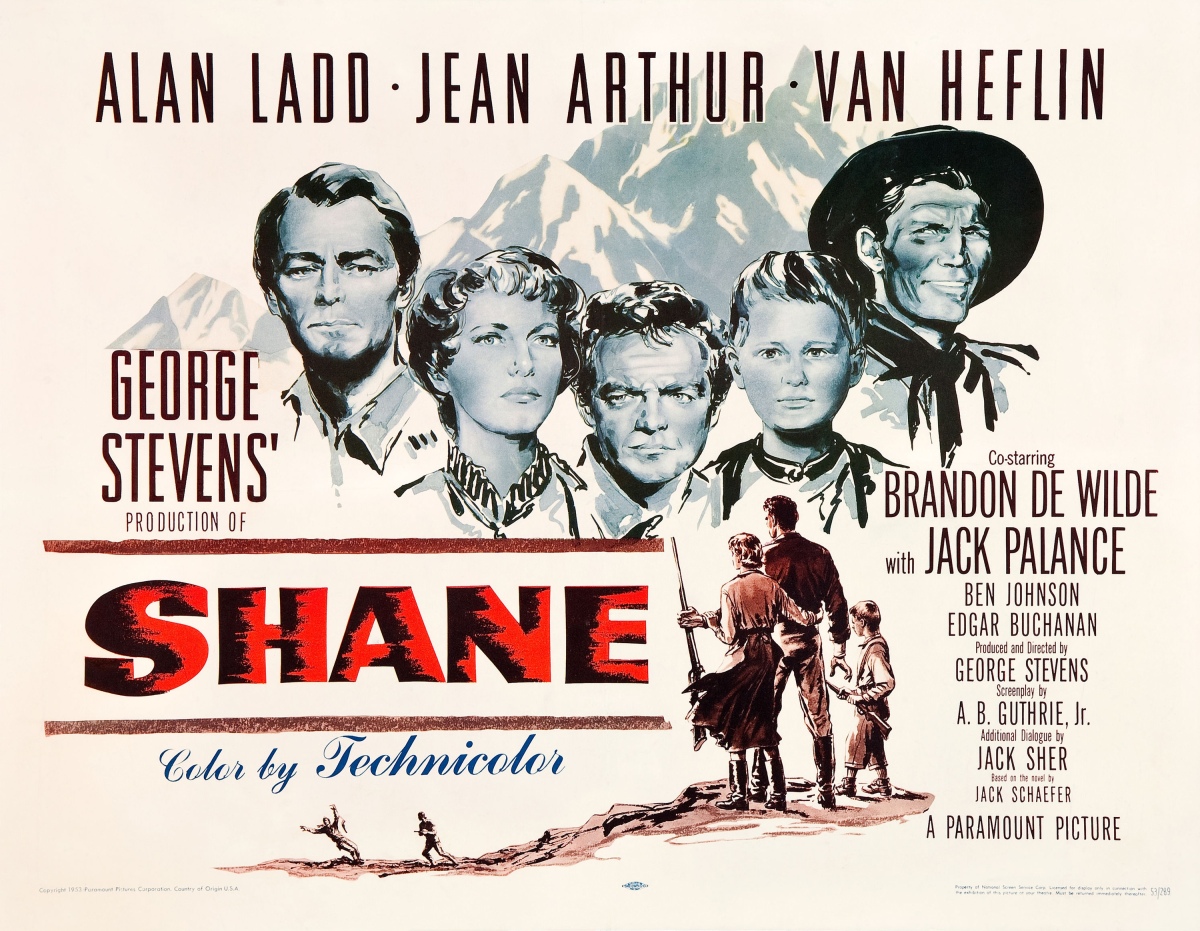
Film review – Shane (George Stevens, 1953)
I’ve never been a huge fan of Westerns. It’s a slight bugbear of mine and I hate to be so sweepingly dismissive of an entire genre, but until recently they’ve always seemed so formulaic and lacking in unique characters.
That’s not to say I don’t have many fond memories of Westerns. My grandfather was a huge fan of any films with cowboys in. Growing up, I lived away from most of my family and so getting to my grandparents’ house was a long journey that would usually have us arriving in the early afternoon, by which point my grandfather would often be settling in to watch a good Western. At the time, the subtleties of the character development or the most intense of standoffs was undoubtedly lost on my pre-teen self.
With the trusted Master of Cinema label now lovingly releasing a select few Western films (with the typical smorgasbord of bonus material to help put the films into context), I’m giving the genre a second chance, if nothing else to prove my smarmy little 10-year-old self that he was wrong all along.
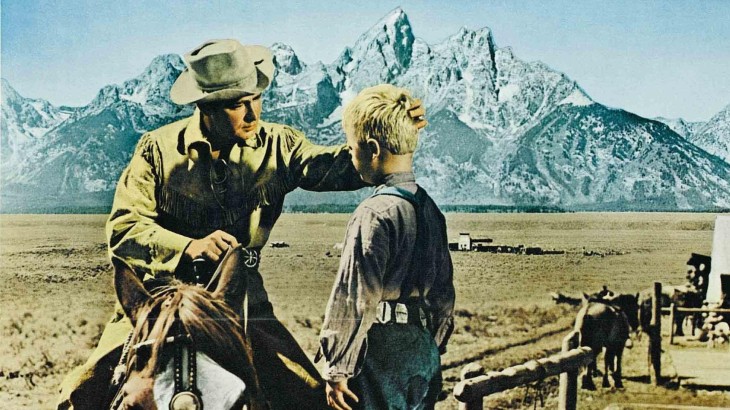
Shane tells the story of the titular hero, played by Alan Ladd. As the opening credits play out, he rides into a small isolated town in Wyoming to meet the Starrett family. He has a mysterious past but quickly wins their favour before the father Joe (Van Heflin) invites him to stay on their property to help out on the ranch.
Over dinner, he learns that the entire town is being terrorised by Rufus Ryker (Emile Meyer) and his gang, who are driving out families one-by-one to gain total control over the land in the area in order to better herd their cattle.
Thus, the story plays out with Shane and Joe forming a stern partnership to rally against the gang and save the town for those families already settled. As the conflict escalates, Shane emerges as the classic lone gunman hero in which the whole town’s hopes lie.
Whilst the story itself is quite familiar, befitting of any good cowboy or samurai film, director George Stevens gets away with the over-idolisation of Shane as the all-American hero by the inclusion of the young Joey Starrett (Brandon deWilde). It is through his eyes that we see everything happen. This has one of two effects. Firstly, it allows Shane to be as formulaic as he needs to be by virtue of the fact that the story can be considered as a retelling of the tale through Joey’s memory of the fact. If that doesn’t sit well as an interpretation, then at the very least the saintly actions of Shane can be seen as a means to leave a positive impression on the child – which he certainly does.
He is clearly a man wrestling with the wrongs of his past, and spends most of the film trying to hide this from the Starrett family. When he finally reveals his gunslinging credentials in front of the Joey, he decides it’s time to move on, presumably to the next place he stumbles upon that needs rescuing.
Whether he makes it to that next town is open to interpretation. Indeed, in the final shootout, he does take what looks like a fairly serious wound to the torso. He plays this down for his final leaving speech for Joey, but as he rides off I couldn’t help but wonder whether he was going to survive. After all, he’s spent the best part of two hours putting a brave face on for every other aspect of his life – he certainly wouldn’t let on to Joey that he was about to die.
The romantic subplot between Shane and Joe’s wife Marian (Jean Arthur) adds an interesting subtext to the situation. Clearly she is pining for him, and her interest is underlined in every scene they share. It feels a little shallow, and does nothing for Marian as a character as she follows every stereotype in cinematic history. Alas, it was typical of the time and her only purpose is to add some sex appeal to Alan Ladd’s handsome hero.
Shane may be a typical Western, but it is a fine and pure example of the genre that is rightly being held up as one of the best of its kind.
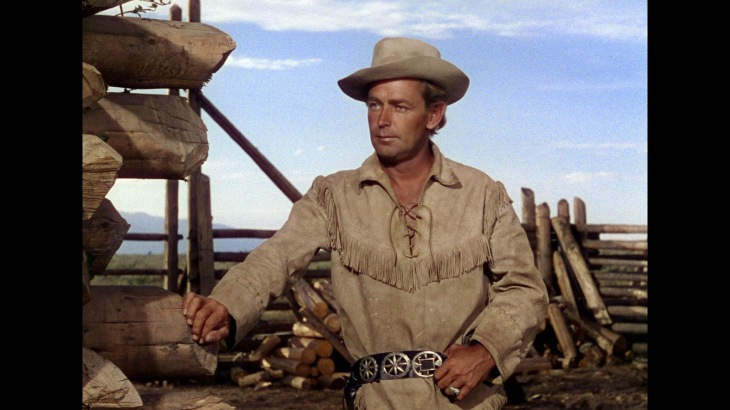
[Note 1] The second screenshot in this review is how the film should look on your widescreen television, with black bars down the left and right sides of the picture. This is due to the aspect ratio used (1.37:1). There is a second aspect ratio available on the disc, though as Adam Naymar explains in the booklet note “Don’t Fence Me In” this is a controversial version of the film. I’ll let you read it for yourselves should you make the purchase.
[Note 2] Below is the theatrical trailer for Shane. It is proof that cinema goers in 1953 cared not for spoilers, as the critical climax of the final scene of the film is included. Quite why this was done is a mystery to me as it completely ruins the entire film, but since the film is now 63 years old I don’t feel it is fair to be angry towards me for including it in this article. After all, I’ve given you fair warning…

Film review – The Program (Stephen Frears, 2015)
In the midst of the Lance Armstrong doping scandal, Sunday Times journalist David Walsh published his book Seven Deadly Sins. The sole purpose of the book was to blow the cover on Lance Armstrong and reveal the truth about the complex doping program he was involved with during his supremacy in cycling, specifically the Tour de France. Whilst Armstrong was banned for life from cycling in October 2012, two months prior to the release of the book, vindicating David Walsh and the contents of his book.
The Program re-tells this story, with Chris O’Dowd as David Walsh and Ben Foster as Lance Armstrong.
There are narrow margins in its portrayal of Armstrong. Frears gives a fair portrayal of the man, allowing room within the character to justify his actions. It doesn’t shy away from the fact he spearheaded this complex program of systematic doping, on a level so widespread that USADA (U.S. Anti-doping Agency) referred to it as “the most sophisticated, professionalized and successful doping program that sport has ever seen“. However, to fully represent him, it must also be shown that he used a significant amount of his own time alongside the money earned to aide cancer research. The Program just about lands perfectly in the middle without feeling like it is sitting on the fence, only tipping into an out-and-out negative portrayal when he loses sight of his goal to beat cancer and instead gets addicted to winning at all costs.
When a massive scandal such as this is at the forefront of the public eye, it is easy to forget how successful and inspiring Lance Armstong was for both cyclists and cancer sufferers. It must be remembered that Lance Armstrong started doping, like most cyclists, because he couldn’t win a race without it. In this version of events, he was driven by the fact that doping was already widespread in the sport when he first considered it. It doesn’t strike me that Spears was condoning his actions; he wasn’t the first, nor was he the last. He was simply the most successful.

In hindsight, it was a win-win-win situation for everyone involved. Lance Armstrong won medals and tournaments every season, cancer research programs gained a lot of money and the profile of the sport was raised due to the success story playing out in the public’s eye. The only real losers were the honest cyclists who were unable to compete on the same level.
In time, this film won’t prove to be the definitive biopic on this subject, but with the media pursuit of truth as the approach it offers a unique angle on the situation. One wonders whether its success wasn’t hindered somewhat by the similarly-themed Spotlight, which was busy on the festival circuit at the same time as this. Spotlight may have not been everyone’s favoured choice for the Best Picture Academy Award in January, but it was certainly a more powerful film than The Program.
Cannes Film Festival 2016 – Winners in Full
Ken Loach has become the eigth filmmaker in history to win the Palme d’Or on more than one occasion, for his film ‘I, Daniel Blake’.
Here’s a list of winners in full.
Palme d’Or
Ken Loach’s ‘I, Daniel Blake’
Grand Prix
Xavier Dolan’s ‘It’s Only the End of the World’
Jury Prize
Andrea Arnold’s ‘American Honey’
Camera d’Or
Houda Benyamina’s ‘Divines’
Best director (tied)
Olivier Assayas for ‘Personal Shopper’
Cristian Mungiu for ‘Graduation’
Best screenplay
Asghar Farhadi for ‘The Salesman’
Best actress
Jaclyn Jose for ‘Ma ‘Rosa’
Best actor
Shahab Hosseini for ‘The Salesman’
Short film
‘Timecode’, Juanjo Jimenez
Honorary Palme d’Or
Jean-Pierre Léaud
Haiku film review #021 – Inside Out
Riley’s emotions
And imaginary friend
Made you cry a bit.

Why AMC allowing mobile phone usage is short-sighted
The news of the AMC chain of multiplex cinemas in USA announcing plans to allow cinema-goers to text during films is probably the worst film-related news I’ve heard in a long time. AMC chief executive Adam Aron has shown himself to be completely out-of-touch with the paying cinema-goers to a level that is beyond my comprehension.
There are still many great reasons to go to the cinema. Watching the latest films on the best available format is an experience that continues to be unrivalled in the home cinema market. No matter how much you spend on your setup at home, you can’t replicate sitting down and watching at a huge 4K huge screening with Dolby surround sound in a perfectly dark cinema. Being transported into a different world with no distractions for a couple of hours is the whole point of going to the cinema.
Whilst it is an almost perfect experience for me, there are a number of things that have crept in in recent times that have marred my experience as a cinema-goer. The primary things I get infuriated about going to the cinema are as follows:
· People talking
· People eating overly-pungent or crunchy food
· People using their mobile phones
· The cinema management and employees doing nothing to prevent any of the above
I think most or all of the above issues are annoyances shared with all other cinephiles around the world. They are also wholly avoidable by having strict policies at the cinema.
The generalisation from Aron that he wants to allow texting to encourage millennials is a short-sighted statement that indicates he hasn’t actually been to the cinema recently. A 50-year-old man who has just left his office is just as likely to text as a 16-year-old out with their friends.
One generalisation I will make is that the kinds of people who text during films are the kinds of people who will also be happy to talk through films. Neither group really care about the film they’re supposed to be watching, they’re just going through the motions. Let’s face it, if you’re on your phone, you aren’t watching a film.
If Aron is happy to drive away a large amount of AMC’s market share with this tactic then that’s fine, as long as other cinemas don’t follow suit. Unfortunately, for cinema purists seeing this kind of attitude just encourages us to stay away.
The only solution is to have a blanket ban on texting and phone use during films. If anyone uses their phone, they should be ejected with no second chances. Doing this and guaranteeing the purity of a trip to the cinema will protect the current revenue in cinemas. If tickets are being charged at £8 or more for a standard ticket then a trip to the cinema is a luxury night out and this should be reflected on the experience.
Guaranteeing a good and hassle free experience will encourage the current customers to go back again after the slow decline due to this very issue.
Allowing mobile phone usage will just be another nail in the coffin for cinemas.
Visit to Fruit Candy Café in Akihabara, Tokyo
When people visit Japan, it is often the case that they do so to find “the real Japan”. This is a great phrase that means something different to everyone who visits. For some this means going to as many Buddhist shrines and temples as possible (regardless of their religious persuasions), for others it means eating only Japanese food and only with chopsticks. For a select few, the weird and wonderful side of Japan is the place to be. You know – the places where you’ll be able to start your anecdotes with the words “You’ll never guess what they have in Japan…”.
This is how we found ourselves in the Akihabara district of Tokyo. Akihabara is the perfect location if you’re partial to manga, anime, maid cafés, robots and the like. A typical otaku hangout.
Fruit Candy Café is an igaru café in Akihabara. Igaru cafés are places you go to and pay to enjoy your drinks with the added novelty of being able to play with extremely well-groomed and adorable rabbits as you do so.
It costs 1300¥ per person for thirty minutes of all-you-can-drink coffee and tea and as much play as you can manage with the huge selection of rabbits available to choose from. A set of rules is provided that includes no shoes in the café, no photos of the staff and no cuddling the rabbits (a weird one but really it just meant no aggressive man-handling of the rabbits). We managed to spend time with four different rabbits of different breeds, some more friendly than others, but all extremely cute.

One tip: if you are going to go, make sure you spend 200¥ more to get the rabbit feed. Some of our rabbits weren’t interested until we could offer them some nibbles.
Another tip: it’s actually really difficult to find. Luckily a wonderful guide has been provided here. It was actually a lifesaver for us as we had been wandering around for about 30 minutes before jumping on the local wi-fi and stumbling across that website. We couldn’t have done it without you!
It was a bizarre experience, but that’s what you expect when you come to this part of Tokyo. A unique, bizarre, very Japanese experience.
Theatre Review – ‘Hikosan Gongen Chikai No Sukedachi’ at the Kabukiza Theatre in Tokyo,02/04/2016
The Kabukiza Theatre in Tokyo is the primary theatre in Tokyo to watch traditional kabuki theatre. The theatre is stunning both inside and out, designed in a traditional manner despite the many reconstructions over the years. Seeing a show there is a must for anyone visiting Tokyo wanting to see traditional Japanese theatre done properly.
What is kabuki theatre?
Kabuki is a traditional form of Japanese entertainment. The name literally means sing-dance-skill. It was allegedly first performed in the 17th century and has continued to be popular throughout the intervening period.
Theatrical productions in the kabuki style tend to be in five acts. They are typified by stark make-up and fanciful costumes, with performers striking “mie” (kabuki-style picturesque poses) as they deliver their lines. Audience members will shout out the actors’ Yagō (house name) to show their appreciation.
The stage consists of a typical framed stage as you’d expect in any Western-style play. Uniquely, however, kabuki theatre stages have a hanamichi – a walkway protruding out of the stage on which performers make dramatic entrances and exits from the stage.
How do I get tickets?
Each month a new programme of single act shows is performed, making up approximately four hours of performances in the afternoon and four hours of performances in the evening. Multi-act tickets for either the afternoon or evening performances can be bought in advance either at the box office or online, though those only wanting to see a single act can turn up at pre-determined time slots to buy cheap single-act tickets from the box office. This is the option we chose.
A word of warning on this – they operate a queuing system and only 150 tickets are available for each act, with only the first 90 getting seats. The remaining 60 stand behind the seats. It is also almost impossible to get tickets in this way for consecutive acts as the timeslot for the next set of tickets usually lands in the middle of the prior performance. Basically, if you want to see the whole show you need to buy in advance, though for newcomers one act is usually enough.
For 1000 JPY you can also rent an English subtitle box. This is essential for your enjoyment of the show and can’t be recommended enough.
Where is it?
The Kabukiza Theatre is located in the Ginza area of Tokyo. The best subway stop to reach it is at Higashi-Ginza station on the Toei Asakusa Line. The main box-office is located in the subway station along with a small market and several coffee shops and restaurants. Single-act tickets must be purchased upstairs at the dedicated box office outside the theatre.
Review – ‘Hikosan Gongen Chikai No Sukedachi’
‘Hikosan Gongen Chikai No Sukedachi’ is a single-act play that is showing at the Kabukiza Theatre throughout April. It makes up half of the evening performance, with a second unrelated story following.
The storyline centres around Keyamura Rokusuke (Kataoka Nizaemon), a farmer and master swordsman living at the base of Mt. Hiko, who we are introduced to shortly after the death of his mother. A proclamation has been made that any man who can defeat Rokusuke in a sword fight will be put into immediate employment by the ruler of Kokura. One night, when Rokusuke is praying for his mother, Mijin Danjo (Nakamura Karoku) a masterless samurai passes by with his old mother. Danjo asks Rokusuke to let him win the sword match under the premise that it will show him to be a good son to his mother, who is close to death. Rokusuke is touched by this suggestion and immediately promises to throw the fight. However, once the fight is thrown, Rokusuke discovers that Danjo isn’t as trustworthy and honorable as he first thought.
At one hour and thirty-five minutes, the play was a perfect length for someone new to kabuki theatre. As an English speaker who couldn’t really pick up most of what was being said in Japanese, the subtitles worked perfectly well.
It is a uniquely Japanese experience that doesn’t, in truth, compare to anything I’ve seen anywhere else. However, that doesn’t mean it’s difficult to access and within a few minutes I was completely engrossed in what was going on on stage.
Kataoka Nizaemon XV is a popular kabuki actor and his nuances were well received by the audience. He was recently awarded with the title of National Living Treasure in Japan. This is really a one-man-show and he carries it perfectly, utilising moments of real sorrow for a man missing his mother and juxtoposing them with tremendous comedy as he deals with the various women residing at his home as well as an adopted son.
If you enjoy surprises it is advised that you don’t read the synopsis before you go in as it very much reveals everything you will see performed, including the conclusion of the final act. Indeed, this is a play that ends on a cliffhanger without playing out the story to a defined conclusion, leaving the audience to take the story on in their own heads to wonder and assume what happens to the featured characters further down the line. This may come as a surprise to those expecting a satisfyingly concise ending, but this is a performance that sticks to the original script rather than tinkering to please modern audiences.
As an art form, kabuki is more accessible than most would expect and the opportunity to see it in Japan should be seized, especially with great seats available at such reasonable prices. It’s something I hope to enjoy again in the future and hope you do too.
Haiku film review #019 – Godzilla
So I’ve just got back from an amazing trip to Japan. We were lucky enough to be there during cherry blossom season. So, on a slightly overcast afternoon at Ueno Park in Tokyo I enjoyed the festivities and spent some time under the sakura writing haiku poems about Japanese films.
The first one was about Godzilla:
This giant monster
Is a thinly-veiled reference
To nuclear bombs
Haiku film review #017 – Star Wars: Return of the Jedi
A trilogy ends.
It’s the last good Star Wars film
For thirty-three years.

