TV review – Teenage Mutant Ninja Turtles – Season One (Vincent Davis, 1987)

The year was 1989. Turtle Power had taken over the planet and, more importantly, my school. The turtles were everywhere. Everyone had to have a favourite of the four hero turtles (I’m from the UK so our heroes were called “Heroes” not “Ninjas”). It was not optional. Mine was always Raphael, though I had to occasionally be Michaelangelo despite not really being a party dude. Probably because I was five years old.

The appeal of the Turtles was far and wide. Initially it was just the action figures. Then it was colouring books, cereal and lunch boxes. Then it was colour-changing t-shirts, sticker books, video games and pizzas. Underpinning the whole mess of parent bankruptcy was the television show.

Cowabungaaaaahhhh!

If you were a British child at the time, you were probably introduced to the Turtles by Andi Peters from the inside of a broom cupboard. It’s more normal than it sounds. Whilst the cartoons were generally of a very high standard for the height of their popularity, often riffing in unexpected ways on old horror films, nothing ever quite touched the first season – a five-episode masterpiece that functioned as well as an episodic release as it does in hindsight as a one-off special.

The story itself is reasonably close in plot to the original Eastman-Laird comics on which it is based, only slightly softer in tone. The Turtles are chanced upon by news reporter April O’Neill, who the four heroes save from a gang attack. They take her back to their sewer-based hideout to recover and upon her waking they tell her their backstory along with that of their ninja master Splinter.

From their we follow them as they defend New York City from the evil Shredder, acting at the behest of the literal brains of the operation Krang, along with their two bumbling goons Bebop and Rocksteady and a clan of Footsoldiers and Mousers.

The standard of animation was perhaps so good it was unsustainable for a weekly animation. The show was essentially a means to peddle the merchandise and action figures, so the quicker they churned episodes out the more outfits we could see the Turtles in and the more friends and foes they could encounter. Each ended up with their own action figure – never more apparent than the Ace Duck TV hero who literally appeared on screen for less than ten seconds but was exceptionally popular as a toy.

The first season was also much darker in tone than the future seasons, at least until the popularity was faltering and they tried to take it in a new direction. Writer David Wise always preferred this earlier darker tone but the lighter and more comedic direction played into the hands of the popularity of the show. After all, the parents were the ones buying the toys.

This van runs on Turtle Power yey! Oh no wait it runs on petrol.

This five-episode story arc remained untouchable for my younger self, desperate but unable to see the sort of serious animation coming out of Japan at the time. It was an interest sparked by my brother’s subscription to Manga Mania, though we didn’t get to enjoy the Akira feature film until it aired on BBC Two on 8th January 1994.

I can’t recommend this original series enough. Almost three decades later the story and animation hold up and it brings back a heap of memories of a misspent childhood. Seek it out.

Star Wars: Shattered Empire (Marvel Comics, 2015)

There have been quite a number of Star Wars comics released by Marvel over the last few months, all in the run up to the release of The Force Awakens. First came the Jason Aaron and John Cassaday Star Wars series, which focuses on the original series heroes in events after A New Hope. Then there was the Darth Vader series from Kieron Gillan and Adi Granov, following a similar time period. There was also the five part Princess Leia series from Mark Waid and Terry Dodson, which is a neat addition to the story.

The one I picked up first was the Shattered Empire series, written by Greg Rucka and pencilled by Marco Checchetto. It covers the time immediately after Return of the Jedi and follows the main characters of the original Star Wars trilogy as they attempt to rid the galaxy of the last remnants of the Empire.

Single page from Shattered Empire


The biggest appeal for this is that it begins to bridge the gap between the last film and the one we’re so excited about seeing next week. Indeed, as the panels above show us, it is actually a backstory of sorts for Poe Dameron, the fighter pilot portrayed by Oscar Isaac in The Force Awakens. What we learn here is that his parents were part of the Rebellion with Han, Luke, Chewbacca and Leia. It’s perhaps not a revelation but it paints a broader picture of the situation he’s in and the relationship he might have with Han and Chewbacca when they interact.

The story is neat and the artwork is high quality, with plenty of detail afforded. Exactly what you’d expect from a Marvel comic these days.

The trade paperback also comes with the first issue of the Leia comic at the back, providing a flavour of what to expect from that series. Overall well worth a purchase.

Noel Gallagher live at BBC Radio Theatre, 07/12/2015

Setlist
1. It’s Good To Be Free
2. Talk Tonight
3. The Death Of You And Me
4. If I Had A Gun
5. Do You Wanna Be A Spaceman
6. Listen Up
7. Sad Song
8. The Importance of Being Idle
9. Cast No Shadow
10. Half The World Away
11. Slide Away
12. Wonderwall
13. AKA… What A Life
14. Don’t Look Back In Anger

Review
It’s not common to see an artist of Noel Gallagher’s stature in such a small venue. He may be seen at times to be divisive and opinionated, but whether you like him as a person or not, it’s hard to argue against his contribution to the music industry over the last two decades. His successes were never more apparent than tonight’s career-spanning setlist featuring new stripped-down twists on many familiar songs.

In terms of importance, doing a gig like this for BBC Radio 2 is about as big as it gets for most artists. Today Noel has performed a sound check during the Ken Bruce show in the morning (actually just a performance) and was then interviewee during the Simon Mayo drive-time show. The main event was an hour-long performance for Jo Whiley at 8pm, delivered in the intimate 400-capacity BBC Radio Theatre venue but beamed to millions around the world. So that’s three shows with very different demographics, plus the additional buzz for the last week or so on every show on the most popular radio station in Britain, plus coverage on the Red Button on any BBC TV channel.

Whilst Noel Gallagher doesn’t really need to do this now – he’s popular enough that his name will sell enough albums and tickets to turn a profit for everything he does – it’s impeccable timing with all those husbands’ and dads’ stockings to fill and a tour with a smattering of tickets left. It’s never a bad thing to remind everyone how good your tunes are. And that is exactly what he does.

The audience would have been forgiven for expecting stripped down versions of songs from his latest record. His second album Chasing Yesterday, released earlier this year, silenced anyone who was suggesting his debut was only good because he’s been saving songs from Oasis albums throughout their career. It was arguably better than that excellent debut album. However, Chasing Yesterday was conspicuous by its complete absence from the set tonight.

Indeed, prior to the gig my brother and I had joked about what songs he was going to play. Whatever we said, we didn’t honestly think we’d get six Oasis b-sides, two Oasis album tracks, three huge Oasis singles and just three High Flying Birds tracks (all from the first album). By the time Sad Song was being played, we genuinely wondered whether the suggestion that he’d play Little James as the encore seemed a little less unlikely.

With each track completely stripped down to suit the setting and played by a tightly rehearsed band, the songs have rarely sounded this good. This time 10000+ fans weren’t going to be singing every line back to him and with it being transmitted around the globe, precision was key.

So if the goal wasn’t to promote the new album but rather remind the world exactly just how good his back catalogue was, then this was the perfect night for Noel. Topped off with some great banter with the audience (Stoke and John Lewis were on the receiving end of some sharp quips) and a well-behaved crowd (sadly a rarity for Oasis-related gigs), it couldn’t have gone better. The audience left in disbelief that they’d seen so many songs they never thought they’d see live, all the more special when seen in such an intimate setting.

An excellent performance. Well done sir.

Star Wars Articles

If you’re in need of even more of a Star Wars fix this week, you could check out some of these past articles here on Cinema, Etc., all related to Star Wars in some way.

Film Reviews
THX 1138 (George Lucas, 1971)
The Star Wars Holiday Special (Steve Binder, 1978)
Secret Cinema Presents: The Empire Strikes Back (Irvin Kirschner, 1980)
Caravan of Courage: An Ewok Adventure (John Korty, 1984)
Star Wars: Episodes I-III (George Lucas, 1999-2005) – Guest reviewer!
Elstree 1976 (Jon Spira, 2015)
Star Wars Episode VII: The Force Awakens

Video Games
Star Wars (Lucasarts, 1991)

The Force Awakens
The Force Awakens – Do Your Homework
The Force Awakens – It’s Going to be Good, Right?

Film review – Grave of the Fireflies / 火垂るの墓 (Isao Takahata, 1988)

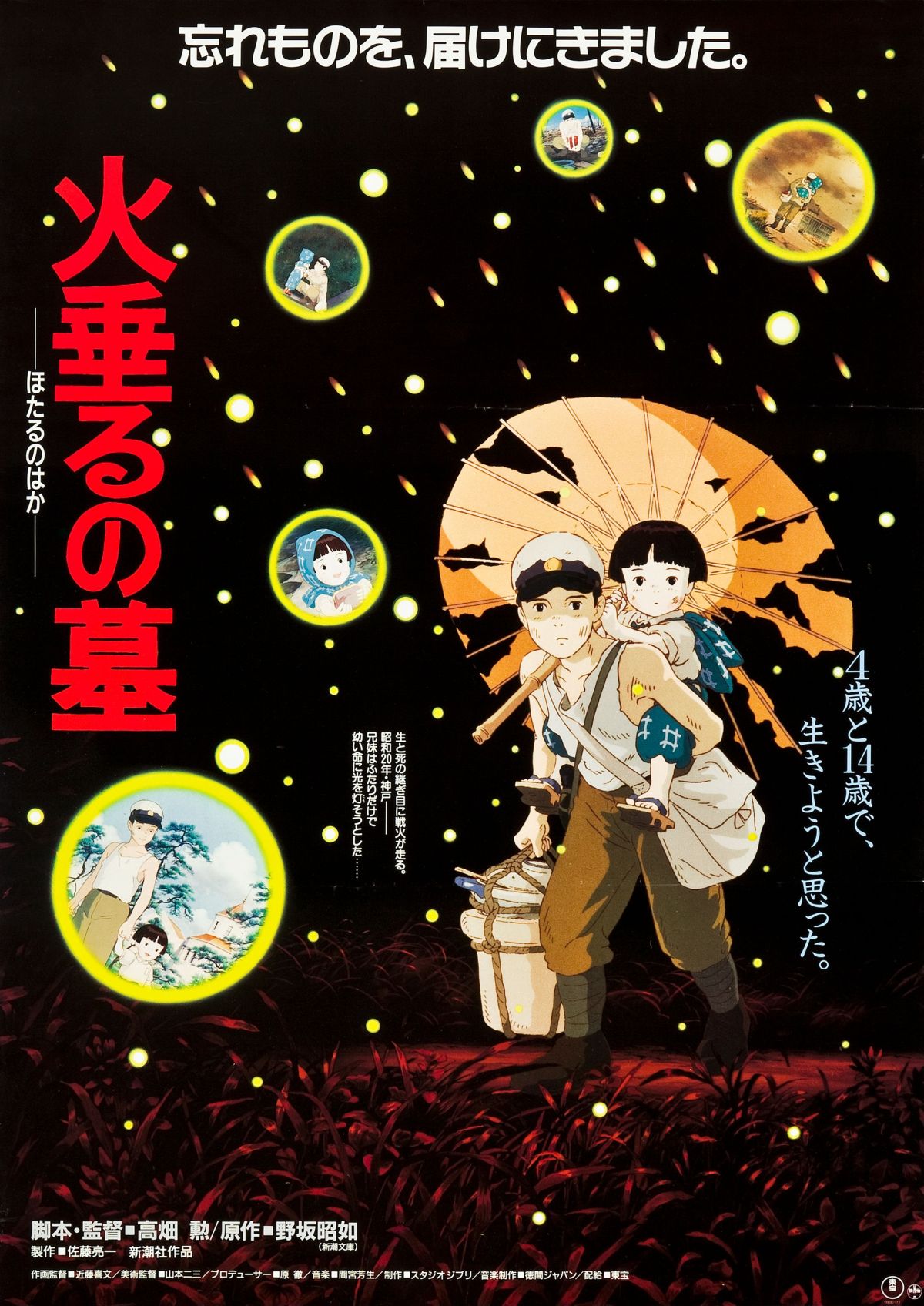
To be fair to Isao Takahata, writer and director of Grave of the Fireflies, he doesn’t pretend he’ll be delivering a happy-go-lucky lighthearted anime to the audience. The title hardly screams cute, the poster smacks of grimness. Then there’s the opening scene, in which the voiceover declares that he dies.

The film tells the story of two children – Seita (Tsutomo Tatsumi) and Setsuko (Ayano Shiraisha) – who are struggling to stay alive in the final few months of World War II. Their mother has died in an American air raid and their father is a captain in the Imperial Japanese Navy, meaning they have to stay with their unsympathetic aunt. However, with the continued threat of airstrikes and a growing unease with their situation, the pair decide to fend for themselves.

When discussing this film with anyone who has been lucky enough to see it, you will invariably get the same response. “Grave of the Fireflies?” Then comes the deep intake of breath. Then comes the deeper exhaled sigh. “Grim. Great film, but really depressing.”

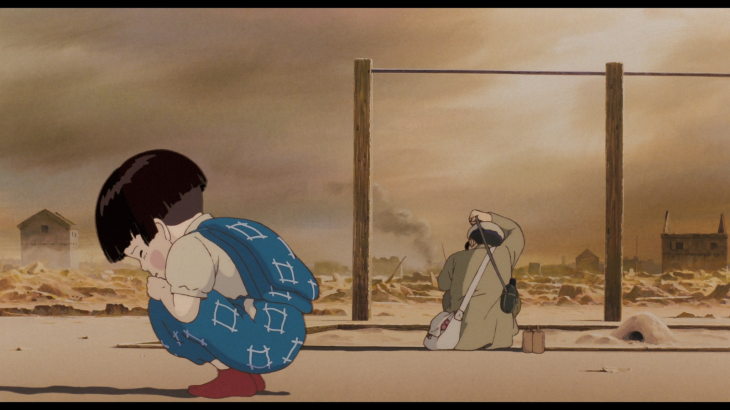
graveofthefirefliesscreenshot.png

The film does not glamorise war in any way. It spends the entire running time delving into the relationship between the two siblings, the bond the war is creating and their resilience despite the tragedy surrounding them. The film gives an overwhelming sense of the individual impact of the war on the innocent people it affects. It doesn’t explicitly give a negative anti-war message, and it doesn’t attempt to portray the enemy (in this case the American Air Force) in a bad light. All these things are simply deduced by the fact that Setsuko and Seita’s story is so unbelievably sad.

The animation is absolutely stunning. It’s almost three decades since its release and its hard to think of a more realistic portrayal of Japan in animation. As the screenshot above shows, it is all greys and browns, though in this case Setsuko sits in the foreground in a blue ball attempting to protect herself of the reality of her mother’s fate. As Seita deals with it in his own way in the background, the effect is one of the most powerful images in the film. What else would two children do when their whole lives are turned upside down in such a catastrophic manner?

Since the release of this excellent film, Takahata has directed just four  more animated feature films, all of which were released with Studio Ghibli: Only Yesterday, Pom Poko, My Neighbours The Yamadas and The Tale of Princess Kaguya. Whilst all of these are excellent films, none quite have the same impact as Grave of the Fireflies, a film that has stuck with me since the first time I saw it over a decade ago.

Film review – The Good Dinosaur (Peter Sohn, 2015)

Pixar’s latest effort The Good Dinosaur is a by-the-numbers buddy comedy set in an alternative history where the asteroid that would have wiped them out has missed Earth completely, meaning dinosaurs and Neanderthal humans live side-by-side. It concerns a timid dinosaur called Arlo (Raymond Ochoa) who is split up from his family has to befriend a dog-like human called Spot to survive and return home.

The Good Dinosaur was destined for problems before it was released. Originally scheduled for a Christmas 2013 release, it has been put back several times, each time causing confusion and issues for the other Disney films on track for their respective releases. According to Denise Ream, one of the film’s producers, the primary reason for the rescheduling was “the story was not working, period, full stop, it just was not where it needed to be.” The director Bob Peterson, who previously found success with Up, was removed and replaced with Peter Sohn, allegedly because he was too involved with the film.

The upshot of it all is that it has found itself living in the shadow of the excellent Inside Out, which has barely left the cinemas, and is competing for shelf space in the various toy stores across the land with Star Wars: The Force Awakens, which is set for release less than a month after The Good Dinosaur. It was also released in the middle of a school term, drastically reducing the opportunity to go and see it for anyone with children in school. So does that make the target audience parents who aren’t working and have children old enough to go to the cinema but under the age of 4? I guess so… [1]

The film itself feels like an unfinished product. It is the first time I’ve watched a Pixar film and genuinely felt like they’d given up on it. It feels like a last-gasp chance to recoup on a project that will, at best, break even.

The character design is uninspired. None of the dinosaurs offer any of the individuality or appeal audiences have come to expect from a Pixar or Disney film. The beautiful environment goes some way to make up for this, but only Spot himself felt like a fully realised character.

If the reports are to be believed, then the problems with the film lied in the final third. This is, then, presumably where the cavalry came in to take over and save the day. Sadly for Peterson, this is exactly where the film picked up a bit and paid off on some of its promise.

Two scenes stuck out as being particular highlights. The first was a beautiful montage scene where Arlo and Spot ran through an open plane full of birds was vintage Pixar. The second was an emotional scene in which Spot is effectively adopted by another Neanderthal family at the encouragement of Arlo.

Perhaps both of these were Peterson’s work. Will we ever know?

As a 31-year-old man, I know I’m not the target audience for this film. I do have an appreciation for all good animation though and this falls a long way short. The best critics are the children. Four days after its release, the cinema was about 10% full. The children present seemed restless and disinterested. A few parties left. Maybe they went home to watch something more enjoyable. Or, you know, fun.

The Good Dinosaur is currently on release at UK cinemas.

[1] In my local cinemas only one screening was achievable for workers and people at school, which was a 6:30 screening at a Cineworld. I don’t know how many people were at earlier screenings.

Sanjay’s Super Team (Sanjay Patel, 2015)

If you were keen enough to get to the cinema early enough before The Good Dinosaur, one of the worst Pixar feature films thus far, you’ll have been treated to Sanjay’s Super Team, one of the worst Pixar short films thus far.

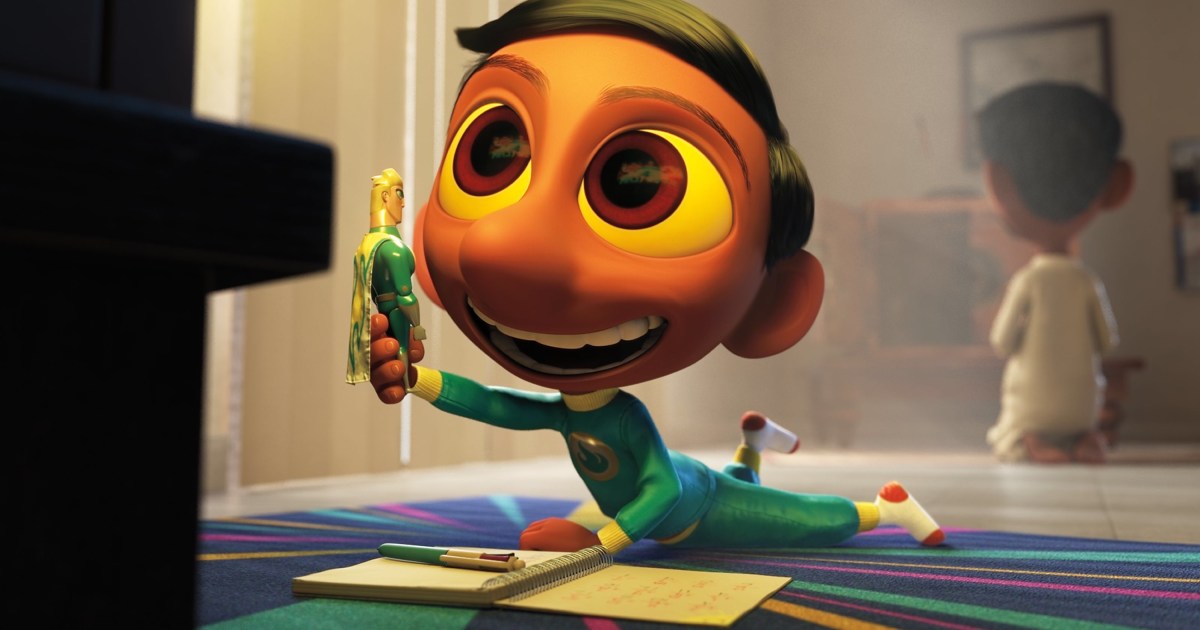
Sanjay realises just how bad The Good Dinosaur is.

The story, based on the true memories of director Sanjay Patel, revolves around him as a young child and the conflict between him wanting to enjoy a superhero TV show and his father wanting him to join him in prayer. Frustrated when his father turns the TV off and forces him to pray, Sanjay uses his time of reflection to daydream into a strange world where his Hindu gods are more like superheroes.

The cel-shading technique used in the daydream sequences is a bit of a let down and feels like a quick solution, despite the best efforts to make it look as colourful as possible. I couldn’t help but imagine how good it would have looked with more attention to detail.

This is a film about a child having doubts over his beliefs and a clash of cultures. Whilst many won’t understand the precise religious and cultural aspects at play, most will appreciate the story from the position of a child not wishing to have to follow in the footsteps of the parents. In principal I don’t agree with using religion as a basis of children’s entertainment, but it works well in this case to create a story for the older audience members.

Unfortunately, the overall result is a bit bland. There was no dialogue, the brilliantly coloured dream sequence lacked any real wow factors and it didn’t move fast enough to make use of the lengthy running time for a short film. The children in the audience voted with their restlessness and disinterest. 

In this sense, it was the perfect warm up for the main feature.