Film review – Jackie (Pablo Larraín, 2016)

One of the most shocking moments of the 20th Century was the assassination of U.S. President John F. Kennedy on 22nd November 1963. Driving along Dealy Plaza in the early afternoon, two shots were fired by a single assassin. The enduring image is that of his wife, First Lady Jackie Kennedy, as she scrambles to protect her husband, head in lap, striving to comprehend what had just happened to her. It was a tragedy.

Portman delivers a stunning performance


Central to Pablo Larraín’s biopic of Jackie Kennedy is a stunningly affecting performance from Natalie Portman. She’s capable of being both isolating and isolated within moments, in one of the most complex performances you could ever wish to take on as an actor. Portman doesn’t need to remind us of her capabilities, which we’ve known about since her debut as a 13-year-old in Luc Besson’s Léon: The Professional. 

The film is delivered in the form of Jackie Kennedy in an open interview to a nameless Time Magazine reporter (Billy Crudup). She reminisces about her television programme “Inside the White House with Mrs John F. Kennedy”, in which she effused about her collection of presidential memorabilia (as well as her abilities as an interior designer) though the story predominantly focuses on the fateful day in Dallas and the immediate aftermath as she reinvents herself as the director of her husband’s funeral, an event she hopes will rival – or at least evoke the memory of – Abraham Lincoln.

There are some solid supporting roles from the likes of Richard E. Grant, Peter Sarsgaard and the late John Hurt. Greta Gerwig also appears, though I can’t say she is in the same category.

One jarring aspect of the film is the unusual score, provided by the usually brilliant Mica Levi. It’s surprisingly sinister and usually doesn’t match the onscreen visuals, tonally or stylistically. This isn’t Levi’s fault. She’s just doing what she does best (see Under the Skin for her best scoring work). It’s jarring and made me long for something a little more conforming. I’m amazed that it has been nominated for an Academy Award for Best Score.

Portman, though, is very much deserving of her nomination. It’s a strong year of competition, but she has every chance of taking home her second statue at the 89th Academy Awards.

A must see.

Short film review – The Ugly Duckling (Jack Cutting and Clyde Geronimo, 1939)

This Walt Disney Productions short animation fell under the Silly Symphony banner when it was released in 1939. It went on to win the Academy Award for Best Animated Short, the eighth in a run of eight Walt Disney films to do so.

It’s a fine little episode that tells the tale of a swanling that somehow ends up in a nest of ducklings, and is immediately shunned and ridiculed for being different to his surrogate brothers and sisters. 

A duck? Nah you must be quackers.

It curtails the original Hans Christian Andersen story by removing the whole extended pain of being without a family for around a year, skipping straight to the point where he is found by a swan family, presumably his own. In doing so, they miss out the point where he turns into an adult swan and the ducks are in awe of his beauty.
In its short sub-nine minute running time, it manages to fit in a surprising amount of substance. This is, for the whole part, a tale about an orphan who is unwanted by his new family. This would surely resonate with anyone in any element of this situation, and there is no holding back when the mother and father have a full-blown argument in front of the innocent swanling. Indeed, there’s a suggestion from the drake that since he looks nothing like the swan then perhaps his duck wife has been sleeping around. Or perhaps I’m reading too much into it.

The animation is, inevitably, a thing of beauty. Two of Disney’s Nine Old Men were on animation duty (Milt Kahl and Eric Larson) and it certainly has the feel of one of their classic films (it was released between Snow White and the Seven Dwarves and Pinocchio). There’s a certain amount of warmth you find in these old animations that has never been replicated.

It’s probably not the best short releases around this time from Walt Disney Studios, but it is deserving of all the praise it has received over the years. Why not revisit it? You’re only 78 years late to the party!

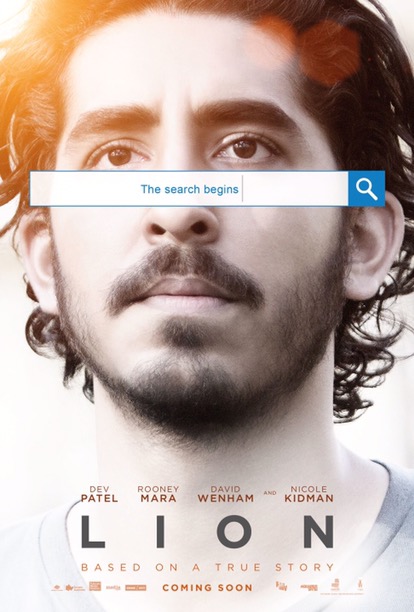
Film review – Lion (Garth Davis, 2017)

Garth Davis’s debut feature, Lion, tells the true story of Saroo Brierley (Sunny Pawar), a boy who is separated from his brother at a train station in central India at the age of five. Boarding a train he believes his brother is aboard, Saroo falls asleep and the train sets off. He travels for two days across unfamiliar territory, eventually arriving in Kolkata on the far Eastern side of India, 1600km from his home. Unable to read or write, and with everyone speaking the unfamiliar Bengali language, he finds it impossible to reconnect with his home and is sent to an orphanage. He is eventually adopted by an Australian couple (David Wenham and Nicole Kidman). Twenty years later, a grown-up Saroo (Dev Patel) starts a relationship with Lucy (Rooney Mara), before a chance encounter reignites his interest in his origins and he starts to try to reconnect with his real family.

Sunny Pawar is phenomenal as the young Saroo

Dev Patel is as brilliant as ever in the lead role as a grown-up Saroo, building on his celebrated performances in Slumdog Millionaire and The Best Exotic Marigold Hotel (and its sequel). It’s a role that needs to provide a reflection of the innocent and likeable younger Saroo we have watched for the first half of the film, whilst also covering the emotional turmoil of a man who has lost his past and lived a completely different life due to a small but very significant fork in his road.

But it is Sunny Pawar as the young Saroo that steals the show. He has a charisma that shines through even when he’s completely still, effortlessly shifting from anger to sadness to fear and to contemplation as the plot develops. Without this young star, the film may have fallen flat. [1]

There is a clear distinction between the feel of the film between India and Australia. The filmmakers achieved this difference by having an almost entirely different production team for the two countries, with natives of each being involved with every aspect of the process. It’s well worth staying around to see the end credits so you can witness the difference – they run the two side by side, giving each equal billing.

This is one of the most heart-warming stories of the year, if not the decade. It may be a bit of a predictable ending (suspend your inquisitive mind and stop yourself from contemplating whether or not the story would even be a story if it had an unhappy ending), but the beauty is in the performances and the characters’ journeys – be they figurative or literal. Do yourself a favour and make sure you catch this one.

[1] There’s a fantastic article on the casting process of Sunny Pawar on Vulture.com. Check it out here: http://www.vulture.com/2016/12/sunny-pawar-lion-casting.html


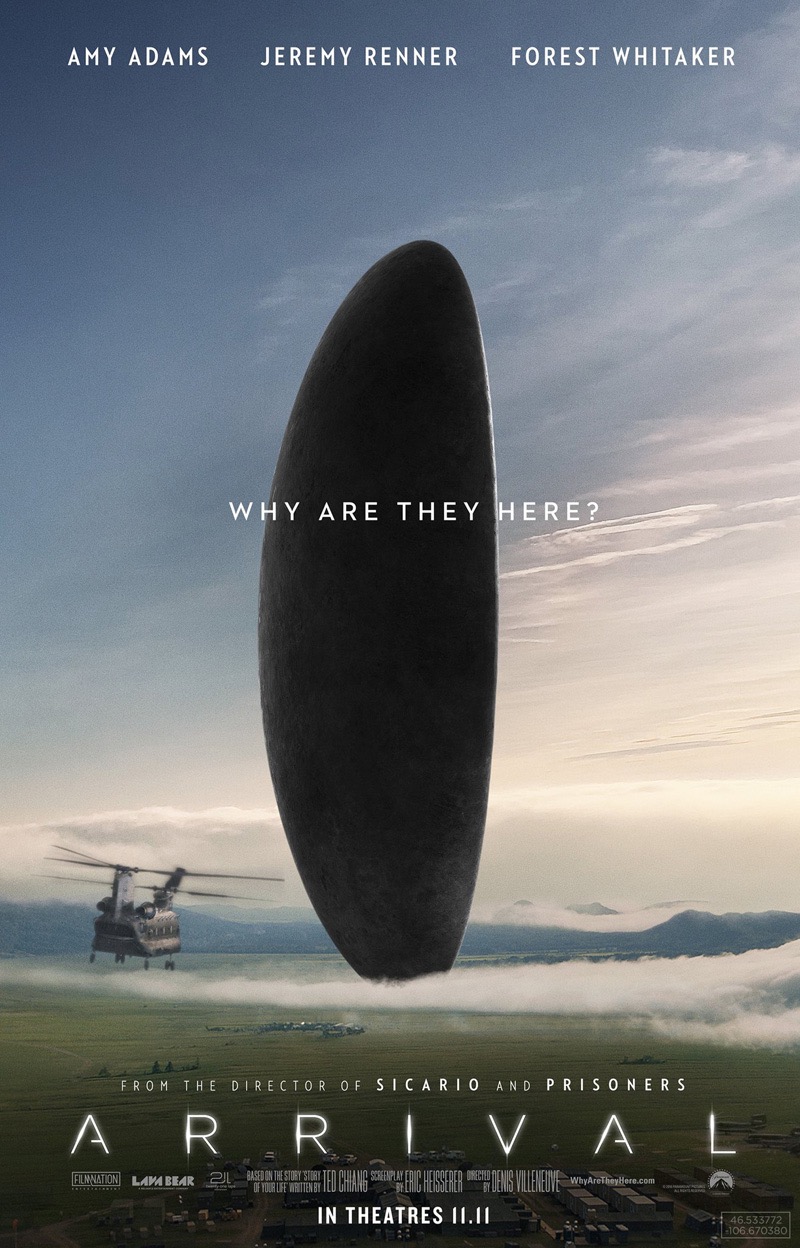
Film review – Arrival (Denis Villeneuve, 2016)

For many cinema-goers, Arrival may have been one of the worst films of the year. For all its big-budget sci-fi overtones and its positioning alongside other space-based 2016 blockbusters such as Independence Day: Resurgence, Passengers and Rogue One, if you sought out Arrival expecting more of the same you may have been disappointed. Indeed, you will have been tricked into that much-elusive cinematic experience: thinking.

Set in modern-day USA, it stars Amy Adams as renowned linguist Louise Banks, brought in by the government to help humanity communicate with extra-terrestrial life forms that have mysteriously landed throughout Earth. She teams up with physicist Ian Donnelly (Jeremy Renner) to begin to decipher their language and understand why they have chosen now to begin communication.

Amy Adams as linguist Louise

It is anything but a full-blown rollercoaster of action, instead concentrating its efforts on an elegant storyline with some seriously unsubtle political messaging. Or should that be serious and unsubtle?

What screenwriter Eric Heisserer has set out to do – and succeeded – is position the viewers in the shoes of alien lifeforms understanding Earth for the first time. In that sense, we are asked to consider the absurdity of the fact that so many countries have ongoing conflicts, unable to get along with one-another.

It may be set in the USA but you would be mistaken in thinking this was a lazy choice in making the Americans the saviours. The decision was more likely financial. Sure, the hero could have been from Pakistan or Chile, but this would have seriously hindered sales in the USA and all other countries where English is either a first or second language.

Amy Adams, as always, puts in a brilliant turn as the determined linguist Louise. She’s a likeable and versatile actress, perhaps at the top of her game right now, and it is a crime that not one of her five Academy Award nominations has thus far earned her a win. Perhaps this year, with a potential double-nomination for this and Nocturnal Animals, we’ll see her rightly rewarded.

Arrival is one of the best films of the year. Gripping, intelligent, thought-provoking and stylish. A must see.

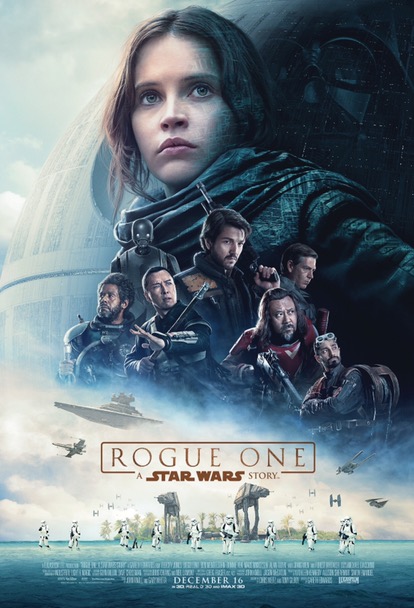
First reaction – Rogue One: A Star Wars Story (Gareth Edwards, 2016)

I’ve just exited the cinema following a midnight screening of Rogue One: A Star Wars Story. I don’t want to give too much away because I’m sure most people will want to discover how good it is for themselves. 

I will say this though: it’s very good, but not brilliant. There are some great moments but these are undercut by a handful of letdowns.

Full review to follow.

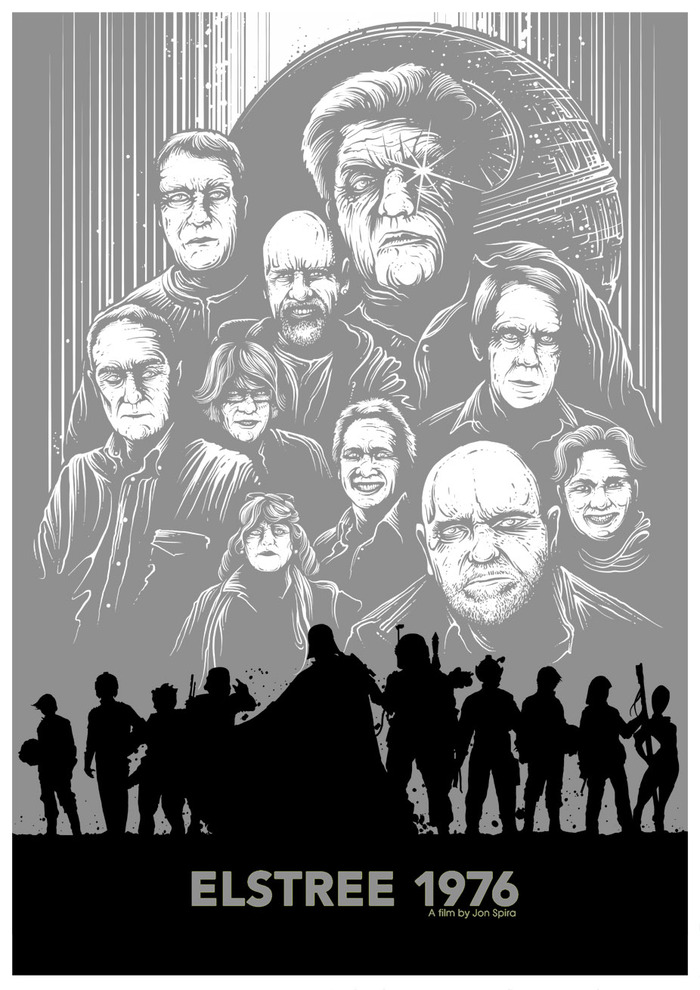
Film review – Elstree 1976 (Jon Spira, 2015)

Elstree 1976, the latest documentary from Jon Spira, explores the lives of ten people who were involved in the original Star Wars films as extras, supporting characters or inside costumes and thus were unseen. Catching up with them 38 years later, the film gives an insight into their respective positions in the wider Star Wars fandom universe, their take on one of the most bizarrely dedicated communities and their memories of their time on set.

The featured cast includes a mixture of actors and actresses who range from household names to people only die-hard fans will know. The ten are as follows:

Paul Blake (Greedo)
Jeremy Bulloch (Boba Fett)
Garrick Hagon (Biggs Darklighter)
Anthony Forrest
David Prowse (Darth Vader)
Angus MacInnes (Gold Leader Rebel Pilot)
Pam Rose (Leesub Sirln)
Derek Lyons (Massassi Temple Guard)
Laurie Goode (the Stormtrooper who banged his head)
John Chapman (Red 12 Drifter Rebel Pilot)

For a film where it seems there is a huge difference in the interest in each of the stars, the narrative benefits by giving equal billing to each of them. But then that is the point of the film – it shows the human side of everyone involved and cross-examines the fact that the only reason they are anything more than actors is that they have been part of a great film and the fans have an unfaltering level of affection for everyone involved.

Justice for Greedo

They didn’t realise at the time but their involvement with the film would come to define their lives. It’s something that they have forever been associated with and can’t get away from, whether they like it or not.

The film opens with a humorous montage of each of their action figures, as they talk about how they feel about how they turned out (or didn’t!). There’s also a little controversy with what different interviewees believe is the right level of relevance to permit them to attend the conventions and be classed as an actor in Star Wars.

There are some moments of real emotion, just as there are moments of hilarity. Of course, they offer their own perspective on the film and provide some morsels of tales about the production, but Spira has instead made the decision to give the stories of their subsequent lives the space to breathe. This film gives them the chance to prove that they aren’t just the Stormtrooper who hit his head or the guy whose voice wasn’t quite right for Darth Vader. What makes this film work isn’t the immense details of how the most famous of sci-fi films was made. Instead it concentrates on the human side of each of the ten people we learn about.

It has been a long road to get here for the Kickstarter backers – almost two years in fact – and Jon Spira has been absolutely transparent in what must have lost him many nights of sleep through stress (the whole distribution farce is well documented on the Kickstarter campaign page). For everyone who is now able to watch it, it was well worth the wait.

Elstree 1976 is available now on Blu-ray and DVD, as well as on streaming services.

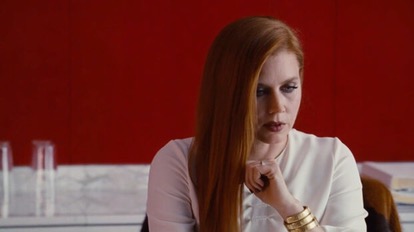
Film review – Nocturnal Animals (Tom Ford, 2016)

Whilst Nocturnal Animals may be one of the most stylish and effecting pieces of cinematic art released in 2016, it may also suffer from being the second biggest Amy Adams film released in the month of November (Arrival is set to hit cinemas later this month). The films are targeted at a completely different audience, and if you’re interested in seeing Tom Ford’s latest then you need to know what you’re getting yourself in for. It’s a veritable misery-fest. And it’s absolutely breathtaking.

The film stars Adams as Susan Morrow, a hugely successful art gallery curator married to a handsome but unrelatable husband (Armie Hammer). Feeling like her life is unfulfilled, she unexpectedly receives a manuscript for a novel through the post from her ex-husband Eddie Sheffield (Jake Gyllenhaal). The book, titled ‘Nocturnal Animals’, is dedicated to her. As she delves deeper into the grippingly horrific story – which plays out for the viewers with fabulous turns from Gyllenhaal, Aaron Taylor-Johnson and Michael Shannon – we come to discover the history between Susan and Eddie and the inspiration for the story.

There were long periods of the film where I was so absolutely gripped by the fictional tale Gyllenhaal’s character was spinning – the film within a film – that I almost dated to forget that we were reading it with Adams’s Susan as she struggles with her insomnia. The meta-tale is brutally horrific, with the male central character experiencing the some of the worst experiences imaginable in life. It takes until quite near the end of the film to realise why he has written this story, and at this point we also remember the times Susan has thrown the book down in disgust. It’s easy enough to play out a story and leave a reveal until the very end. It’s quite something else to leave the audience so gripped in the journey.

Tom Ford executes every moment of the film with an unrivalled stylishness that was evident in his debut feature ‘A Single Man’. It is in the L.A. art scene that we see the characters inhabit the sort of regal living spaces most people can only dream of, despite their thin veneers here only acting as a cover for a desperately hollow existence.

The resoundingly successful final scene is an absolutely devestating act by Eddie. Susan is left emotionally drained following the reading of the manuscript that finally reveals his potential as a brilliant writer. It is also laced with accusations at Susan. She is left with no resolution. This is a clearly a reflection of how he felt after their relationship originally broke down. The answer is never clearly spelled out, with the audience left as smartly frustrated as Susan. This is a really intelligent move that epitomises the ability of Ford to sit the viewers firmly in the position of the people on the screen and ask themselves how they really feel.

It is a wonderful piece of cinema that I’ll be recommending to anyone who will listen.

Film review – Absolute Beginners (Julien Temple, 1986)

Panned on its original release and a complete commercial failure [1], Julian Temple’s musical Absolute Beginners is a film that is often cited as the cause of a partial collapse of the British film industry. Looking at it with fresh eyes, the criticisms are undoubtedly harsh, but the film still has too many flaws to warrant anything more than cult status.

The musical charts the on-off romantic relationship between aspiring model Crepe Suzette (Patsy Kensit) and unestablished photographer Colin (Eddie O’Connell) as they try to make their way in 1950s London. Weaving elements of gang warfare, race riots and youth culture in a way that is almost brilliant, but largely incoherent.

It wuzza strange casting choice

The film starts with the familiar sound of David Bowie’s title track, which was a global hit at the time and proved to be one of his most enduring songs. If, like me, you were made aware of it solely because David Bowie has a named role in the film, then prepare to feel shortchanged. Bowie stars as Vendice Partners, a sales and marketing man who first appears about halfway through the film. By all accounts, his prominence in the film was more a marketing choice than an artistic choice, but his scenes breathe life into a stagnant portion of the film as it threatens to grind to a halt.

Temple was famed for his music videos and by the time this film was released he’d been responsible for some of the most celebrated music videos of the 1980s, including efforts for the likes of The Beat, Culture Club, The Sex Pistols, Depeche Mode, The Kinks and Sade. Some of the best moments in Absolute Beginners are the standalone tracks that could be lifted straight out of the film and placed on MTV. The two best examples are Ray Davies’s ‘Quiet Life’ and David Bowie’s ‘That’s Motivation’, the latter of which has Bowie tap dancing around a giant typewriter.

The film’s lack of focus is its downfall. When Colin gets caught up in the Notting Hill race riots in the final third of the film, he takes a wrong turn to avoid danger and ends up in a neo-Nazi war rally. This is a scene that creates some really powerful imagery but the themes had been underplayed in the build up, making its inclusion neither relevant nor integral to the plot. Indeed, the threat of violence is imminent all around the city without ever feeling anything more than a light touch suggestion. Yes, it’s a musical, but I can’t help think that if they’d just cut a couple of needless scenes earlier in the film there could have been a better balance struck between the romantic side and the social commentary. It is hard to believe that the die-hard fans of the book don’t feel the same way.

It was a troubled film to develop and the brilliant 53-minute documentary now included in the Blu-ray release is enough justification to pick up a copy. It’s also a curiosity for fans of any of the stars in this bizarrely-assembled cast. It is, however, not a good piece of cinema.

[1] Absolute Beginners took £1.8m at the box office in the UK and $930k in the USA against a budget of £8.4m.

Game review – Hotdog Hurdles (Tom Santoro, 2016)

I’ve just lost another hour of my life. This is becoming a huge problem. I lost two last night as well. I can’t help myself. Just. One. More. Go.

Addiction is a very serious thing, but it’s something that Hotdog Hurdles, the debut game by self-professed nerd Tom Santoro, is happy to embrace and encourage . As with many mobile apps, the beauty of the game is in its simplicity.

Initially, you play as a simply-drawn hotdog called Frank. The aim of the game is to not die as you jump over hurdles at a surprisingly well-attended athletics tournament. Every time you land a jump, you run faster and faster. You will fail, no question. It is a game of delaying the inevitable.

There is a strange hierarchy involved in the status of the fast food you can run as. Starting as Frank, you progress to Pops the Popcorn, Soda the Soft Drink, Angus the Hamburger and finally, the king of all fast foods, Don the Donut. A typical meal out then. These are earned by cashing in money earned on runs or through logging in on consecutive days.

Donuts are surprisingly good runners

Everyone watching on is a human, presumably salivating at the tasty food on offer whilst hoping that each item doesn’t burn too much fat through exercise (think about that for a few minutes…).

It is an infinite runner and some people won’t like that, but as they go this is potentially one of the best on the market. All you have to do is beat your own high score (mine stands at a terrible 21, the world record is 34) or the score of your friends through the Apple Game Centre (it is currently an Apple-exclusive).

You get nothing for your efforts, not even a thank you. You just get more failure. But yet you click the play button.

In a world where there’s quite a lot to think about and get sad or angry about, something like Hotdog Hurdles is just what we need.

Hotdog Hurdles is available to download now from the App Store.

Bowie Berlin Tours

I recently enjoyed a brief holiday in the capital of Germany, Berlin. The city is rich with modern history and everywhere you look there’s a potential point of interest. I can honestly say it was one of the most educational and enriching holidays I’ve ever been on.

No discussion of the political landscape of Berlin over the last 100 years would be complete without mention of the music scene that grew organically within the city from the late 1970s onwards that produced some of the greatest works of the era, inspired by the unique make-up of a city split in two and equally inspiring those living there. It is a music scene that also arguably helped to bring down the wall (or factually if you are the German Foreign Office).

Spearheading the scene was David Bowie, who in 1976 was out of money and keen to break away from the LA drug scene that had facilitated his addiction to cocaine. It was there that he famously completed his ‘Berlin Trilogy’: Low, “Heroes” and Lodger [1], which kickstarted his career and helped him on his road to recovery.

If you’re in Berlin and have an interest in David Bowie the you’ll definitely want to make sure you sign up to the Berlin Bowie Walk, operated by the Berlin Music Tours company. For a relatively small fee you will be guided around the famous city for around three hours, taking in the outside of the famous Hansa Studios (where he recorded throughout his time there); Potsdamer Platz (you can now get the train there!); the Brandenburg Gate; the Reichstag, which was the site of his famous 1987 performance; and his flat in Schöneberg.

If you’re feeling especially adventurous, you can return on a second day and visit the inside of Hansa Studio, standing in the Hall by the Wall and looking out from the former control studio through the window from the same spot Bowie where famously wrote the lyrics to “Heroes” – the precise details of which were debated by the many Bowie übergeeks during my tour.

I’ve been purposefully scant on the details of the tour because I don’t want to ruin your enjoyment, but both sessions were truly special experiences and brought me closer to one of my favourite artists.

The studio tour was actually Depeche Mode focused, but that wasn’t a huge problem. In fact, it was great to be able to learn a lot about a band that are surprisingly famous outside the UK. They recorded most of their most successful music at Hansa and this was clearly a pilgramage for many of those on the tour. They run several tours that are focused on different artists, including U2 and David Bowie. Sadly as yet Lou Bega hasn’t been given a tour yet [2].

If I have one recommendation it’s that both tours overran on their expected finish time. This meant we got great value for money each day but if you have something else booked in (for example a visit to the Reichstag) then you should leave at least two hours at the end of the tour to do your next activity. On the walking tour you end up at Café Neues Ufer, which was a former favourite spot of Bowie and Iggy Pop to drink in – we ended up spending over two hours in there and didn’t want to leave!

These tours are excellent value for money and packed full of anecdotes from people who are passionate about their subject. When that subject is David Bowie, it’s a no-brainer!

[1] The trilogy is often referred to as such despite Low being written prior to Bowie’s arrival in Berlin and Lodger actually being recorded in Switzerland.

[2] Lou Bega recorded his infamous ‘Mambo No. 5’ track in the late 1990s with some of the producers who now work at Hansa, a fact recognised by the double-platinum proudly on display in the lobby area of the studio.