Live music review – Goldfrapp, Glastonbury Festival, 25th June 2017

Setlist:
Anymore
Train
Slide In
Everything Is Never Enough
Become the One
Systemagic
Number 1
Ride a White Horse
Ooh La La
Strict Machine

They may have had some technical difficulties that delayed the start of their set, but once they finally arrived Goldfrapp absolutely blew away the John Peel Tent at Glastonbury Festival on Sunday afternoon.

Alison Goldfrapp may well be one of the most engrossing female performers in the industry. Her striking black costume, sumptuous vocals and commanding stage presence are a powerful concoction.

They led the set off with latest single ‘Anymore‘, taken from recent album ‘Silver Eye‘. It’s a dance floor filler and highly indicative of the first half of the album. As two dancers strutted across the stage, jolting sharply, it was clear this was going to be as much performance art as it was a live gig. [1]

Favourites ‘Train’ and ‘Slide In’ followed, continuing the dance vibe that the crowd were clearly enjoying.

A trio of songs from ‘Silver Eye’ followed, with the highlight being ‘Systemagic‘, which happens to be the next single taken from the album. It’s another powerful track with a mixture of heavy bass and industrial drums. Alison was in fine form, enjoying giving some new material a new audience.

As Alison said “You know this one I think…” before the electronic pounding of the intro to ‘Number 1’, she kicked off a familiar conclusion to the set. The final tracks rounded off the set nicely, with all four amongst the most popular (or perhaps most mainstream) of their material: ‘Number 1’, ‘Ride a White Horse’, ‘Ooh La La’ and ‘Strict Machine’. This is a sensible choice at a festival, even if the more dedicated fans would have loved to hear a song or two from ‘Seventh Tree‘ or ‘Felt Mountain‘.

I’ve seen Goldfrapp on many occasions and they seem to get better and better. Predictably, the crowd went wild for them, setting sail into the warm Glastonbury air for the final night of the festival having seen one the best sets of the weekend.

[1] Catch their latest music videos below. Systemagic gives a great idea of what their stage dancers look like.

Glastonbury 2017 Day Five: Ed Sheeran, Goldfrapp, Barry Gibb, Chic

The fifth and final day at the festival had been and gone. I am a beaten man, but it was worth it.

My first port of call for music for the day was to catch Jamie Cullum on the Pyramid Stage as he did the lunchtime slot. Nobody can deny he gives all his energy into his performances, and he has plenty of it. He’s an extremely talented man, and performed a mixture of covers and originals with his tightly-rehearsed group. Amongst the covers was a jazzed-up Ed Sheeran number.

I moved in close to the front the see Laura Marling, who captivated the audience with her unique country-folk hybrid styles. It’s hard to deny being reminded of Joni Mitchell as she pairs a voice that borders on yodelling with the most intricate of guitar work. Her final song ‘Rambling Man’ was simply beautiful.

Barry Gibb was next on the main stage, with the traditional Sunday afternoon legends slot. I definitely “got into” the set, and there is plenty of evidence of me singing along on the live broadcast. Fair play to him for donning the golf jacket for the end of the set.

The disco bar was raised another level when Chic took to the stage. From a hit-packed set my absolute highlight was ‘Let’s Dance’, which blew my mind. Singing that at full volume with 100,000 other fans is a truly special moment.

I had to swim against the tide to get to Goldfrapp at the John Peel Stage. Clearly some bad planning going on as the Chic-then-Goldfrapp option was appealing to many and at the same time Killers-then-Biffy was equally appealing. Cue pandemonium on the walkway between the two. Goldfrapp’ set was slightly delayed but once they kicked off they were as glorious as I expected them to be. Singer Alison Goldfrapp commands the stage like no other and there wasn’t a still waist in the tent. Their new album ‘Silver Eye’ had a good run out, with ‘Systematic’ being my particular favourite.

I caught the end of the Biffy Clyro set, with Matt Carole cover ‘When We Collide’ going down a treat [1].

The main headliner, Ed Sheeran, was an act I wasn’t particularly fussed about seeing when the day started. In lieu of there being no other appealing headliners we stuck with him and I can heartily say it was the biggest positive surprise of the weekend. This is a 26-year-old man and he has gone out on the main stage and powered through a set full of hits to an eager crowd. ‘Castle on the Hill’, ‘A Team’, ‘Shape of You’ and ‘Thinking Out Loud’ are undoubtedly songs of the highest quality and nobody can deny he has an extremely powerful voice. A talented man, full of confidence and charisma. Absolute quality.

A quick look around Cineramageddon as the 1970 Mick Jagger film Performance began to play and we saw a close to our festival. I can safely say that nobody had the exact experience I had – everyone’s pathway through the biggest party in the world is completely unique and wonderful. It’s exhausting, it’s exhilarating and it’s something I never want to end.

Thank you Michael and Emily. Until next time.

[1] I’M TROLLING YOU DON’T WORRY!

Live music review – First Aid Kit, Glastonbury Festival, 23rd June 2017

Setlist:

Wolf
Master Pretender
Waitress Song
The Lion’s Roar
You Are the Problem Here
Ghost Town
King of the World
It’s a Shame
The Gambler
Stay Gold
Emmylou
My Silver Lining

Sandwiched between Northern indie rockers Blossoms and country legend Kris Kristofferson and with a rain cloud threatening above them, First Aid Kit managed to bridge the tonal gap whilst standing out as a powerful group well at home at a festival they were appearing at for the third time.

Kicking off with 2012 single ‘Wolf’, it was hard not to feel mesmerised by the band, fronted by sisters Klara Söderberg and Johanna Söderberg. These are not just great singers and musicians, but great performers too, exhibiting passion and anger at times to provide an edge to what many try to pigeonhole as either folk or country music. Or both.

Recent single ‘You Are The Problem Here‘ was a case in point, with Klara’s refrain “I hope you fucking suffer” causing plenty of mid-afternoon picnic blanket revellers to stand up and take up notice.

With songs like ‘Stay Gold’ and ‘My Silver Lining’, it’s truly difficult not to fall in love with them and their songs. They’re simply beautiful, heartfelt and honest pieces of music. It’s hard to think that anyone who was really paying attention wasn’t a fan by the end of their set.

A triumph.

Film review – Die Abenteuer des Prinzen Achmed / The Adventures of Prince Achmed (Lotte Reiniger, 1926)

The uniquely-animated ‘Die Abenteuer des Prinzen Achmed’, Lotte Reiniger’s 1926 film, is a hugely important film. Work started on it in 1923, and it is the earliest-surviving animated feature film – it clocks in at 65 minutes.

The animation technique used involved cutting out cardboard silhouettes of the characters and manipulating them frame by frame. Some 93,000 frames were created for the film.

Reiniger’s attention to detail was matched by that of the restoration team at the Deutsches Filmmuseum, who in 1999 returned it to its former glory and allowed new generations to enjoy it.

Today’s screening, which was at the Tilda Swindon-curated Pilton Palais at Glastonbury Festival, was accompanied by a unique re-score by the Guildhall Electronic Music Studio.

It’s easy to create a modern score for a classic piece that simply doesn’t fit – Air’s ‘The Journey to the Moon’ is certainly guilty of that – but the mix of classical piano and basic sound effects works perfectly. Mike Oliver oversaw the project and acted as a mentor to those involved. The piano accompaniment from Barbara De Biasi is reminiscent of the Joe Hisaishi scores for Ghibli Studio. As a fan of Hisaishi’s work this was very much welcome. This was augmented by Eric Fabrizi with paper-based sound effects and live narration from Mike Oliver and his daughter Molly.

It all came together wonderfully and felt respectful of the original work whilst breathing a new life into it for a new, younger audience.

It was well attended by an early-afternoon festival crowd. Anyone appearing early for the Frozen sing-a-long would have been entirely confused. For everyone else, the film was a triumph. Congratulations to all involved.

Film review – My Life as a Courgette (Claude Barras, 2017)

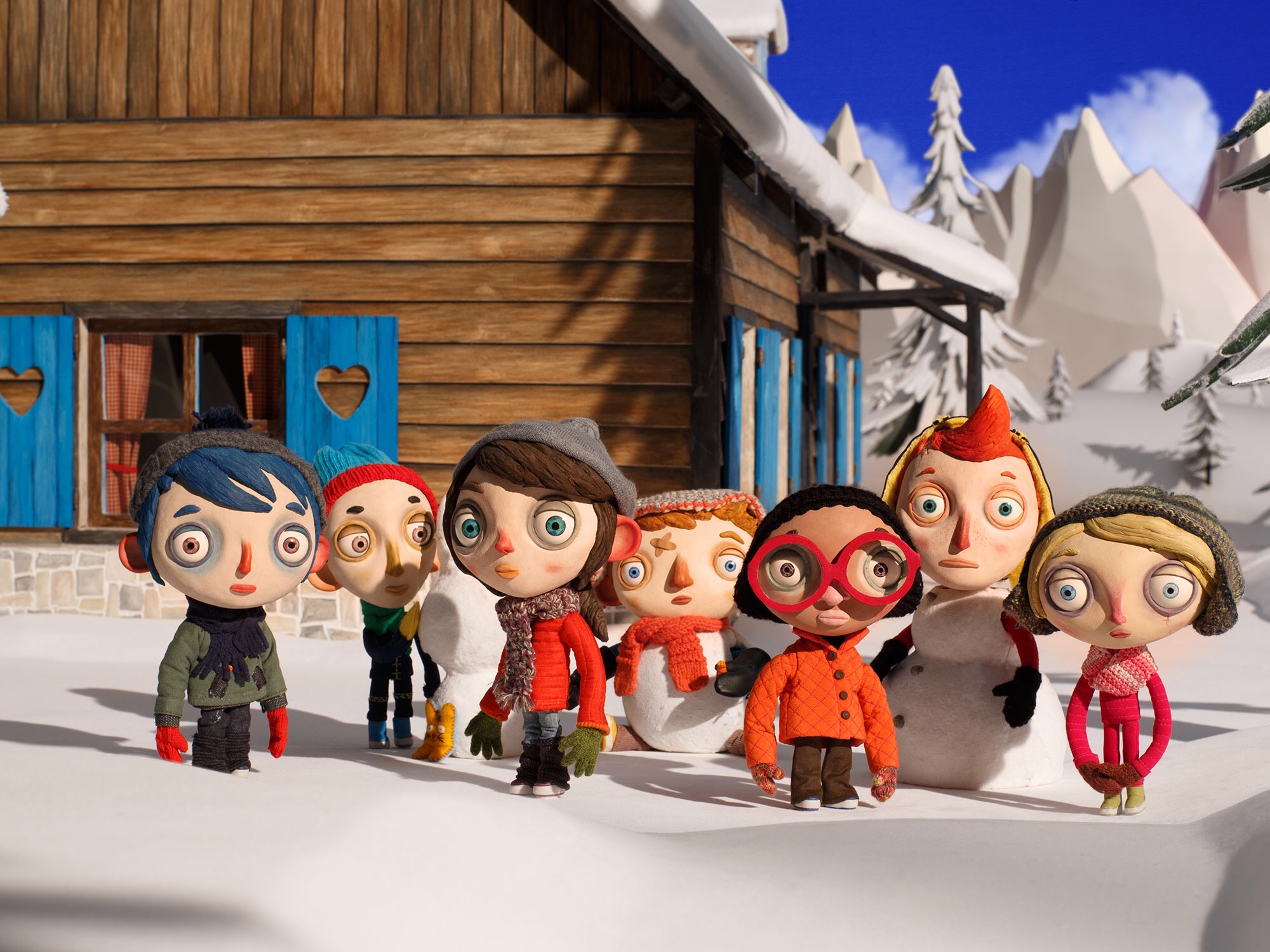
My Life as a Courgette is a stop-motion animated film directed by first-time feature director Claude Barras. Short in length but big in heart, it has a way of drawing the viewer in and delivering a weighty emotional drama, despite its saccharine veneer.

It tells the story of the titular Courgette, a boy who is forced into an orphanage at the age of nine. He has come from a lonely and unhappy background but quickly learns to adapt and find his path with the six other children he lives with, notably the over-confident Simon and new girl Camille, whom he takes an immediate liking to.

This shot is one of the most memorable lingering shots of the film

The narrative is carried out from the perspective of the children, which gives rise to some elements of humour whilst giving the situation a melancholic edge. These are children all going through the same issue, as one child puts it they’ve “ran out of people to love them”.

The animation is truly beautiful and endearing, with a unique character design coupled with an a seamless stop-motion animation style. It is simply a joy to watch.

You’ll be hard-pressed to find a more emotionally-involving story in cinemas right now. This is one that needs to be seen.

My Life as a Courgette is out in cinemas now. You can watch a free ten minute preview below.

Film review – Mindhorn (Sean Foley, 2017)

Julian Barrett and Simon Farnaby have come together to create a brilliantly British comedy in Mindhorn, with the pair co-writing and co-starring in a story about a washed up actor who can’t let go of his former glories.

Barrett takes the role of Richard Thorncroft, who is better known as the titular TV detective Mindhorn. Twenty-five years after his show was axed, disgraced Thorncroft is desperately in need of a fresh angle to kick start his career. The love of his life and former co-star Patricia Deville (Essie Davis) has now married Clive Parnevik (Farnaby), who was previously a stunt double for Mindhorn. When a police investigation into a probable murderer called Paul Melly (Russell Tovey) takes a bizarre turn, Thorncroft is brought on board to help talk to the man and discover the real truth.

The jokes come thick and fast, though many could be easily missed for those not tuned into this style of comedy. Plenty of the beats come from Alan Partridge and it does feel like a variation on the script for Alpha Papa. This isn’t a bad thing at all. Incidentally, Steve Coogan appears as a rival and former co-Star of Thorncroft named Pete Eastman.

The story is quirky, but comedies live and die on the amount of laughs they deliver. In this sense, Mindhorn soars. From the nuanced references to 1980s British television, to cringeworthy moments largely shared between Barrett and Farnaby, it is hilarious from start to finish.

Foreign markets are yet to experience the brilliance of the film. If I’m honest, I’m not sure how it will land. The humour is distinctly British, whatever that means. Mind you, it’s more accessible than the likes of Monty Python and The Mighty Boosh, which all enjoyed global audiences, so hopefully I am wrong on that front.

This isn’t the kind of film that rises to the top of the charts on its first week of release. Instead, I’m predicting it will follow the path of Anchorman and Hot Rod to become a comedy sleeper hit that people will talk about in a few years’ time.

Do yourself a favour and get in on the act now. You can’t handcuff the wind.

Film review – Alien: Covenant (Ridley Scott, 2017)

I have to lay out some home truths before we start. After five years, it appears the dust has settled and most of us have decided Prometheus was a pile of rubbish.

The Alien prequel was a return to the helm for Ridley Scott after a 33-year hiatus. Despite the anticipation, the disappointment amongst the hard-core fans stemmed from some convenient plot points that seemed to allow progression of the story despite not really making sense (“Why did she run in a straight line?”, “Why did the navigator guy get lost?”, “She’s just had a caesarean… how is she running?”).

I saw the film as a midnight screening and I remember coming out of the cinema buzzing with excitement. The film was, in my opinion, a return to form for the franchise after the overwhelmingly disappointing Alien v Predator films (which worked better as a toy line than as a film). It wasn’t a patch on the first two – Alien and its sequel Aliens – but probably stood alongside or better than any of the other instalments.

Yes, that’s right. I am a fan of Prometheus.

I went into an early screening of Covenant with the same kind of excitement and anticipation as I had five years ago. The advertising campaign has been nothing if not relentless, so finally getting to see the film on the big screen felt as much a trip to the cinema as it was a way to quench my carefully manipulated thirst for a next instalment.

The film is set in 2104, ten years after the main events of Prometheus and around twenty years before the events of Alien. The opening sequence, which features a reprisal cameo from Guy Pearce as Peter Weyland, explores the themes of humanity’s desire to meet its creator. It could easily have been a part of the first instalment, but bridges the gap and reminds viewers of the unhinged nature of David, one of two robots played by Michael Fassbender.

The main body of the film focuses on a colonisation mission from Earth to to a remote planet Origae-6, aboard the titular spaceship Covenant. The main crew includes Captain Branson (James Franco) and third in command Daniels (Katherine Waterston), a terraforming expert and wife to Branson. Christopher Oram (Billy Crudup) is a man of faith who is unexpectedly promoted to captain shortly into the mission. Michael Fassbender’s second character in the film is a synthetic android named Walter, a more advanced version of David. The crew also includes Chief Pilot Tennessee (Danny McBride), Sergeant Lope (Demián Bichir) and Karine Oram (Carmen Ejogo). Aboard their ship is around 2,000 human embryos, with the purpose of populating their destination planet upon arrival.

After a neutrino shockwave hits the ship, the main crew are woken up to deal with the repairs on the ship. They are seven years away from their destination planet but a matter of weeks away from an alternative planet that appears to offer the same prospects as Origae-6. New captain Oram makes the decision to land on the newly-found planet, which turns out to be the one Dr Elizabeth Shaw (Noomi Rapace) and David set sail for at the end of Prometheus. Needless to say, the story goes downhill from here for our crew, with disastrous consequences.

Given the popular misgivings about Prometheus, I couldn’t help but pick fault with a couple of major issues with the decision making of the crew of the Covenant. Most glaringly, none of them seem keen to wear masks when they leave the spaceship, even though there’s no obvious investigations into how viable to atmosphere is to breathe. It just seemed odd that they were so confident only minutes after being so worried. Surely that’s rule number one for space travel?

All the people on the ship have a partner on there, meaning everyone is at risk of losing a loved one at every turn. This falls down, however, when you throw a couple of red coats onto the first expedition. Where were the devastated husbands and wives grieving their loved ones? Do they not get to show emotion because their rank is too low? I’m looking at Ledward here. Surely he has a wife or girlfriend on board?

Aside from picking nits, the film is genuinely a great effort, probably a lot better than Prometheus. There are a number of great nods to previous films – the face-hugger makes its comeback – and it feels like Scott has set out to make a crowdpleaser. That’s definitely not a bad thing.

The partner element is an intelligent way to add depth to all of the characters. Shortly into the main plot, James Franco’s Captain Branson dies, immediately answering the question of why he wasn’t featured more prominently in the advertising campaign (a missed trick in my opinion). This plunges Katherine Waterston’s Daniels into immediate emotional turmoil, though she quickly rises out of it and continues with her mission objectives.

Waterston has some big Sigourney Weaver sized shoes to fill in terms of taking the female lead role. I’m sure she has felt the pressures of her predecessor, though it doesn’t show on screen. She does a fantastic job and at times carries the film, acting as the sensible decision maker, the natural leader and the only one with the will to fight back when everything goes pear shaped. Sure, the strong and intelligent female protagonist is becoming a bit of a broken record in modern cinema, but it shouldn’t be forgotten that Signourney Weaver in Alien is probably the best early example of it being done so well, certainly in terms of Blockbuster films in genres usually associated with male audiences.

The final act is wholly worth of the Alien canon, rescuing a film that at times had threatened to go off the rails. It’s here that Scott ramps up the tension and action, paying off the setup over the previous 90-ish minutes.

If the final 30 minutes is great, then the final ten seconds is utter genius.

If you have any misgivings about the Alien franchise, Covenant is the film that will bring you back on track.

Video game review – Yooka-Yaylee (Playtonic Games, 2017)

Version reviewed: Xbox One

Yooka-Laylee has finally arrived on Xbox One and PlayStation 4, bringing to an end one of the most successful video game crowd-sourced campaigns of all time. Launched on Kickstarter on 1st May 2015, it reached its initial target of £175,000 within 38 minutes and its stretchiest of stretch goals (£1,000,000) in 21 hours. Clearly this indicated a thirst from the fans of the studio, Playtonic Games, which had behind it four of the key players from Rare’s heyday in the mid 1990s:  Chris Sutherland, Steve Mayles, Steven Hurst, and Grant Kirkhope. 

If you’re unsure, Rare was the video gaming powerhouse that came to prominence in the 1990s with games such as Goldeneye 007, Banjo-Kazooie, Perfect Dark and Donkey Kong Country. Both Banjo-Kazooie and its sequel Banjo-Tooie were laced with a charm and humour typical of Britain, with sign-posted gags coupled with animation that stood out at the time as exemplary. The games were also a lot of fun to play through, with the right amount of collecting and story development to keep even the most easily distracted 10-year-old interested. 

So it’s understandable that the gaming community was so enthusiastic about getting a spiritual sequel to Banjo-Kazooie.

When I started up Yooka-Laylee, the memories of Banjo-Kazooie came flooding back. As these memories engulfed my mind I couldn’t help but wonder whether time hadn’t been quite as kind to the original games as my romanticised view of them. 

The opening sequence is extremely pedestrian, with the criminal mastermind called General B. at his headquarters called Hivory Towers. There is no big wow factor, just a bit of a conversation that introduces the characters. He has created an evil device that has stolen a magical book from our heroes. This book has golden pages and within a short while we are told we must retrieve all of the pages (named “pagies”) to restore balance in the universe. Or something like that. It’s a McGuffin typical of 1990s platformers – go to several worlds and collect everything to complete the game. 

The look and feel of the game is brilliantly nostalgic for an era that doesn’t often get treated as being retro, although sadly it definitely is now. It harkens back to the Nintendo 64 era, so it’s 3D but not as beautifully rendered as more recent titles.

This is both a good and bad thing.

I don’t know whether it was intentional, but the camera issues that blighted video games for years has come back to bite us again. It’s highly frustrating and was the cause of several issues in the opening world when all I was doing was simply jumping between platforms. It’s poor design that this can cause failure and unfortunately my patience isn’t quite the same as two decades ago – I genuinely don’t have hours and hours to sink into video games per week so wasting 30 minutes jumping up some platforms just isn’t something I enjoy.

The soundtrack, however, is on the positive side of nostalgia and one that brilliantly fits with the retro design of the game. David Wise, Grant Kirkhope and Steve Burke are behind it, and these were frequently involved with Rare’s most famous soundtracks. I’m annoyed I didn’t opt for the soundtrack option when I originally backed it, but I’m sure there will be a way to rectify this soon! 

Rextro can go swivel


As the game progresses, so does the difficulty. This generally means that the collectibles aren’t sat in such obvious positions on the level, hidden in holes and requiring more skill to unlock. By the final world, the frustration at poor controls and cameras comes back and you’re left wishing you’d never started the mini-golf challenge in the first place.

A key part of the game is the Rextro Arcade challenges, which take 8-bit-inspired gaming and set mini challenges to beat the game and then the high score. These largely provide a lot of fun to proceedings until the bugs take over and you’re left short of a high score through no fault of your own.

The end result on initial play through is one that almost hits the spot but makes me wish they’d had a longer player testing period. This often gets pushed back if programming overruns, and there will doubtless been a lot of back and forth between the coding and testing departments. I just wonder whether everyone’s view became muddied before the final release of the game.

Film review – Alien (Director’s Cut) (Ridley Scott, 1979)

I’m not sure exactly when I first saw Alien. I’m sure I was far too young. I know this because I remember I was really sad I couldn’t see Alien 3 at the cinema. I’ve calculated that I was eight years old at the time. Why was I gutted? Because I’d already seen the first two films and didn’t want to wait.

Yes, that’s right. Somehow either my mum was supremely lenient or we pulled a fast one on her and managed to get a VHS copy of both films.

Looking back on the 1979 debut, it’s easy to see what the appeal was for a eight-year-old. Sure, the heart of the film lies in a character-driven plot and it’s powered by Scott’s unwavering ability to build suspense. At the time I wasn’t sat there thinking “Well, Parker and Brett have an agenda now because of this pay dispute, so this is going to get really interesting.” No. I was looking at the alien, the guns, the space travel and the explosions.

All of these things are, unquestionably, of great appeal to a child. Or, at least, they were to this child.


It was great, then, to finally see this masterpiece of cinema on the big screen as part of Alien Day. As an adult. And, completing the circle, with my mum as well. 

It’s a film that deserves to be seen on the big sceeen, away from disturbances that home viewing might detract from the experience. 

The film was originally released in 1979, in the midst of the wave of hysteria for space-based films created by Star Wars. However, it is very much the antethesis of the 1977 space opera. The distant past setting is replaced with a not-too-distant future. The bright and open planets are replaced with a singular, isolated spaceship. The droids played for light relief are dropped in favour of a malfunctioning synthetic human with a hidden agenda.

Indeed, whilst the film may have seemed like a lucrative prospect for 20th Century Fox after Star Wars, Alien owes a lot more to films like Jaws or Forbidden Planet in both tone and pacing.

It is a film about isolation, playing on the claustrophobia of being trapped in the middle of nowhere and allowing your survival instincts to take over. 


Jerry Goldsmith’s score, conducted by Lionel Newman and performed by the London Philharmonic Orchestra, may be one of the most perfectly-suited film scores ever crafted. It starts off exactly where the audience do at the beginning of the film – somewhere between romanticism and intrigue. As the horror unfolds, the score increases in intensity and loses any sweetness it ever had, heightening every moment we see on screen.

The set design and the Alien itself was famously designed by surrealist artist H. R. Giger. It’s as iconic as the film itself, critical to the story and heightening the horror when we eventually see the creature fully formed in the final act of the film.

It was a hard act to follow and they’ve spent 38 years trying to reach the heights of the original film. James Cameron’s sequel may be preferred by some, but for me you simply can’t compare that to the original. They are in the same universe but are completely different genres, one wrapped in suspense and the other all-out action.

Theatre Review – Hello, Dolly! (Jerry Zaks, Sam S. Shubert Theater, 17th March 2017)

Note: This is a review of a preview of Hello, Dolly! Out of respect for the performance I only published it after the opening night. 

The first time I saw Hello, Dolly! was when I was 27 and preparing for an amateur production of the great musical in England. I had been cast in the role of Cornelius Hackl, the employee of Horace Vandergelder who has just been promoted from impertinent fool to chief clerk. Popping out of the store room box in the opening scene is exciting for all Cornelius-portrayers the world over – for two reasons. Firstly, you get to deliver your hotly-anticipated opening line in the show and finally get a glimpse of the audience. Secondly, it means you can breathe properly for the first time since lights down – you’ve been trapped with your assistant Barnaby in a tiny box for the last 15 minutes as the rest of the characters are introduced to the audience at a seemingly excruciatingly slow pace.

I was relaying this information to the perfectly lovely gentleman who was stood next to me at Broadway’s Shubert Theatre on Friday night when I asked him “So are you involved in this production at all?”. “Why yes,” he responded, “I’m the director.”

That would be four-time Tony Award-winning director Jerry Zaks. [1]

Outside the theatre

His production of Hello, Dolly!, set to run at the Sam S. Shubert Theater from 20th April, is exactly what you would hope to see from a Broadway version of a musical that has been around for the last 50 years. It simply oozes quality and class.

The opening number “Call On Dolly” is full of bright and wonderful costumes with perfectly-precise movement from the ensemble. Warren Carlyle’s choreography at this point is nothing too complicated, but there’s a certain beauty in its simplicity – a matter counterbalanced with “The Waiters’ Gallop” in the second half.

The real star of the show, inevitably, is Bette Midler. As the titular character she is able to sweep from playful to heartbroken in the space of a song. Done correctly, it is a surprisingly nuanced character. She is larger than life when she’s entertaining guests, putting on a show for the cast and the audience in equal measures. However, when she is alone she reveals what drives her throughout the story – her lost love and former husband Ephram Levi. Midler may have the audience in stitches when she’s slowly eating a delicious chicken dinner, but they’re eating the palm of her hand when she’s speaking from her heart.

David Hyde Pierce is a great counterpoint for Midler as the angry shop owner and “half-millionaire” Horace Vandergelder. He is a seasoned Broadway star, winning a Tony Award in 2008 for his role in Curtains. It was great to finally see “Penny in my Pocket” restored and performed in front of the curtain at the start of the second act. It’s a song that’s great for someone like Pierce – full of characterisation and expression. It was cut from previous Broadway runs to shorten the second half.

Gavin Creel (Cornelius Hackl), Kate Baldwin (Irene Molloy), Taylor Trensch (Barnaby Tucker) and Beanie Feldstein (Minnie Fay) are all brilliant in their Horace-avoiding storyline, with “Elegance” a particular highlight in the second half. Creel’s rendition of “It Only Takes A Moment” with Baldwin was simply beautiful; a clear sign that musical director Andy Einhorn can get the best out of his performers.

The tickets for this production may well sell because Bette Midler is such a huge star and is massively popular on Broadway, with David Hyde Pierce also offering added interest. However, what audiences will find is a musical that is excellent across the board, from the back row of the ensemble to the lead star, with not a thread on a costume out of place.

To think that what I saw was supposed to be a preview, I only wish I could see it when it hits the full run.

It will be a smash.

[1] It was to my shame that I didn’t recognise Jerry Zaks. He was the perfect gentleman. By the time we had started chatting he had already noticed that we hadn’t got a Playbill and found an usher to retrieve a couple for us. What kind of director does that?! He seemed genuinely interested in whether we were enjoying the show, seeking us out at the end to garner our opinion before signing our programme. Great job sir and thank you for finding the time to talk to us.