LOLA is a beautifully constructed science fiction tale that is as innovative as it is chilling.
Directed by Andrew Legge in his directorial debut, it tells the story of sisters Thomasina (Emma Appleton) and Martha (Stefanie Martini), who together invent a machine that transmits television broadcasts from the future. Initially using it to discover cultural touchpoints 30 years ahead of time, they then switch it to the war effort. After they use it to help prevent a German attack on British soldiers, they are enlisted by the Allied Forces and begin coordinating defence strategies with Lieutenant Sebastien Holloway (Rory Fleck-Byrne).
In LOLA, Legge has created a deeply rich alternative world that plays out with a good pace to great effect. The storytelling technique utilised is innovative and delivered with great aplomb by the two leads, each bringing humour and realism to their respective roles. Neither steals the show, instead complimenting each other with natural comradery.
With a 79-minute running time, there isn’t scope to slow down and the length and pace feels perfect. It’s an exciting debut and one that rightly has those that discover it wondering what Legge will come up with next.
Thomas Hardiman’s stylishly gritty debut finds a new setting for a well-worn path. The story unfolds around a murder that takes place during a hairdressing competition, meshing together neatly with some strong performances from the entire cast, creating a powerful piece of cinema.
Murder mysteries have come back into fashion in recent times. Two ensemble blockbuster franchises have helped bring this wave of popularity to people’s attention – Rian Johnson’s Knives Out and Kenneth Branagh’s Poirot – but the genre doesn’t need a host of A-listers to succeed.
In a way Medusa Deluxe operates in exactly the same way. It is an ensemble piece, with none of the all-British cast standing out as significantly more established than the next, although a few are certainly recognisable. Their interactions and interplay are the real star.
It’s impossible to watch the film without the awareness that this is a one-shot labour if love. Admittedly, there are a few points where there is an obvious cut in the action, but even in the handful of long shots this represents a mammoth undertaking that almost gives Boiling Point a run for its money.
There is a verve to the performances that really disconcerted me as a viewer. Clare Perkins starts the film overflowing with anger as hardened hairdresser Cleve, and only ramps up further as her colleagues and models shrink with nervousness. Harriet Webb brings an element of sympathy to her prickly take on Kendra, which is an important part of the story.
Despite a few moments of heavy-handedness, the really shocking moments of Medusa Deluxe will stick with you for a while after watching. The one-shot approach is an interesting element that brings urgency but the real draw here is an intriguing story and some top-drawer performances from a strong cast.
It has been twenty-three years since we first saw the original Chicken Run on the big screen. A lot has happened since then. Upon its release in Britain, Tony Blair was the Prime Minister, the country was congratulating itself on avoiding the millennium bug, but we were still wondering what to do with the big dome we’d built in London. The biggest film at the box office was Gladiator, Kylie Minogue hadn’t made her golden-hot panted comeback yet and we were hotly awaiting the release of PlayStation 2. Oh, and Erling Haaland was about to be born.
Basically, it was a while ago.
So how does bringing back such an old film feel, after all this time? Honestly… like a huge big warm hug.
This is not a departure in style. Indeed, it picks up right where we left the clucky gang of misfits – on the idyllic island they’d found at the end of the first film. The opening act is something of a scene setter, introducing us to the new lead character in the film. Molly, played by Bella Ramsey, longs for everything her mum and dad ran away from in the first film. From her island, the outside world is full of wonder, delight and mystery. Frustrated by a feeling of suffocation, she escapes the island and looks for a new adventure with the first chicken she finds, a zesty Liverpudlian called Frizzle (played playfully by Josie Sedgwick-Davies).
Much speculation has been made about the refreshed voice acting cast. Only a few of the original cast have maintained their spots in the cast, with high profile names such as Phil Daniels, Timothy Spall and Julia Sawalha being recast. In their case, it was a simple move to ensure the voices sounded as youthful as the characters they were playing. It’s a distraction when the voice doesn’t match what you’re seeing, and you only need to see the first 20 minutes of Indiana Jones and the Dial of Destiny to know how skin-crawlingly dreadful it is for your brain to have to work overtime to live with it. There may be more reasons at play for some of the cast, but there’s a whole additional essay that could be written about that…
I loved the film, and the small screening I was lucky enough to attend with all agreed. The audience was a mix of older fans revisiting a childhood memory, and younger people who were being introduced to the chickens for the first time. My four-year-old daughter, well-versed in Aardman, had a fantastic time and was annoyed she couldn’t watch it again any time soon. She was restless during the first 10 minutes but a swift bribe with a Curly-Wurly and she was golden. My only concern is how many sheltered children will be asking questions about their chicken nuggets next time they eat them.
This isn’t groundbreaking material, but nor does it need to be. As the film plays out, it does feel familiar. There’s an evil plot, the protagonists need to club together to stop them. But that’s children’s animation. It’s a formula that might feel tired to some, but sometimes what you need is exactly this. A big huge warm hug. And when hugs are this good, I don’t think you need much more.
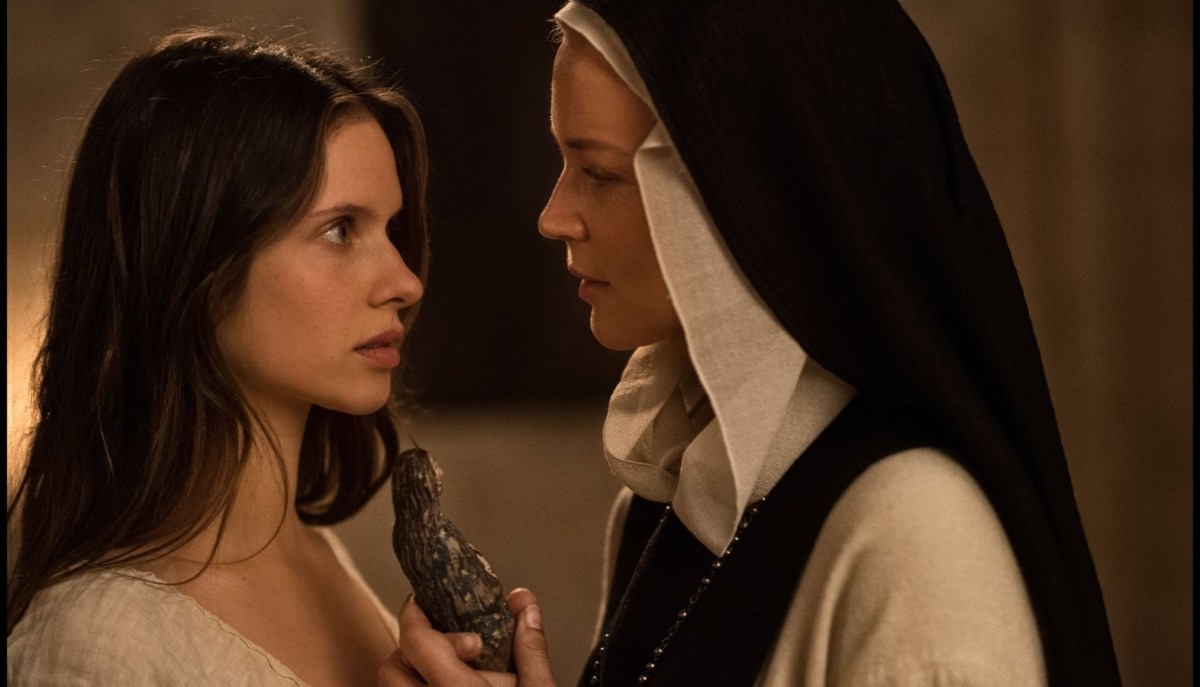
Paul Verhoeven’s retelling of the story of Benedetta Carlini may surprise fans of his most mainstream English-language work (for example, Robocop, Total Recall and Starship Troopers), but it is deftly executed and performed to perfection by a strong cast, all of whom raise the bar of a smartly-written tale.
The film is set in 17th century Italy, where the titular Benedetta is taken to Pescia to become a nun. After a humorous but important opening scene of Benedetta as a child, we are transported to her in adulthood, as she begins to have visions of Jesus that raise her standing amongst her fellow sisters in the convent, belying her secret desires to start a lesbian relationship with a younger nun, the illiterate Bartolomea.
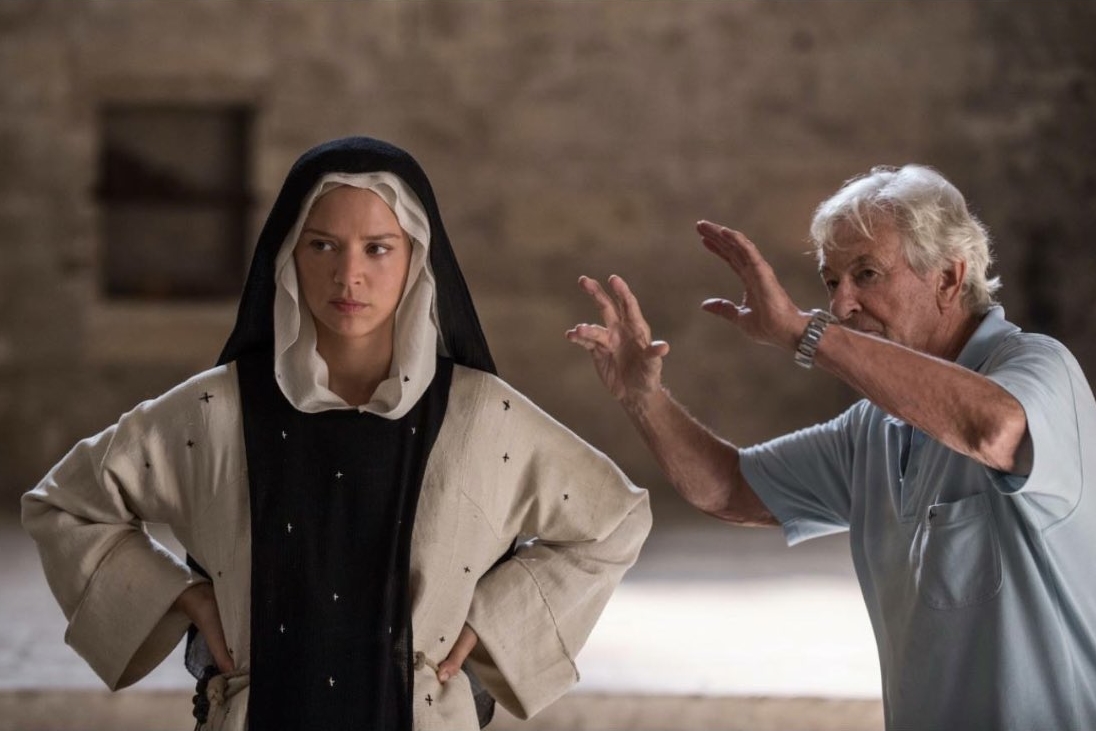
Virginie Efra on the set of Benedetta with Paul Verhoeven
Virginie Efira is in electric form in the lead role here. She is an experienced actress who has flourished in popularity in recent years with the likes of In Bed With Victoria and An Impossible Love, as well as Verhoeven’s last film Elle.
Charlotte Rampling also puts in a powerful supporting performance as Abbess Felicita, with Daphné Patakia completing the trio of female key players in a promising early role.
If there are any criticisms for the film, it’s that it feels a little slow and saggy at the start of the film proper, although viewers are more than rewarded as the film builds to a tremendous crescendo at the end of the film. Indeed, as a comet looms over the convent and the sky lights up in red hues, the action on the ground seems to offer a bigger threat to those in Pescia.
It never feels overblown or rushed, nor overly simple. I am seldom excited by a period piece, less so one set in a convent, but this had me gripped to the end. It is highly recommended.
What is “cinema”? In 2020, the answer to this question was turned upon its head, in ways we could never have imagined.
For me, escapism is always a key part of watching a film, and one I’ve strictly tried to enforce at home as much as possible. Yes, that means that I leave my phone out of reach when I’m watching something engrossing. It’s the only way to give yourself a chance of being transported to the world the filmmakers are crafting for you. Frankly, if you look at your phone once during a film, you’ve lost already.
More than this, for a film to stick with me for a long time, I have to feel personally and profoundly moved by what I’ve seen. It doesn’t have to completely change my life, but it has to have some kind of impact.
It can be a real joyful discovery, which happened to me when I saw Ladybird (2017) as the surprise film at the 2017 BFI London Film Festival. This was an excellent film, but the impact was doubled-down by having a story that really resonating with a time of my life that can only be described as a fork in the road – leaving home for university, which for me happening in the year the film was set. Ladybird really left its mark on me, and I was moved at the time to write a very personal review of the film.
Once I was at university, I discovered two wonderful cinemas in Nottingham. Broadway Cinema and Cafebar is somewhere I still go to, almost 20 years later. How I long to get back to that place right now! I was also drawn to The Screen Room, which was across the road on Broad Street and boasted being the smallest screen in the world. It was here that I discovered a completely different side of cinema with the likes of Napoleon Dynamite (2004) and Jim Jarmusch’s Coffee and Cigarettes (2003) showing with very limited runs. The thing that amazed me about these films, and others I watched (usually on my own), was how unlikely it was that they were being shown on the big screen at all. The former was a bizarre tale about a socially-awkward schoolchild with a very thin storyline. The latter doesn’t have a storyline at all, instead materialising in the form of 11 short vignettes. I don’t know why I sought them out, but they opened up my mind to a world of cinema beyond the generic multiplexes and their mainstream film selections.
Being deeply moved by a film is what cinephiles are looking for. That’s why we watch 100s of films a year. Eventually we find a diamond in the rough. It may not happen very often, but that’s what makes the chase even more appealing.
As we’ve largely been forced to the small screen for the last year, I have explored almost every route to discover new cinema and ways of enjoying cinema. I have streamed films directly from distributors, funnelled money into Curzon Home Cinema and MUBI, made plentiful use of recording screenings from Film 4 and Talking Pictures TV, and continued to buy physical media long beyond my wife would have preferred.
It comes as a surprise, then, that 2020’s most profound cinematic experience was via Disney Plus, on the afternoon of the last day of the year, whilst my daughter slept. Perhaps the threat of her waking up meant we were savouring every moment of the film, but it didn’t take long before we were entirely captivated.
Warning! Spoilers are found in the following sections of this article.
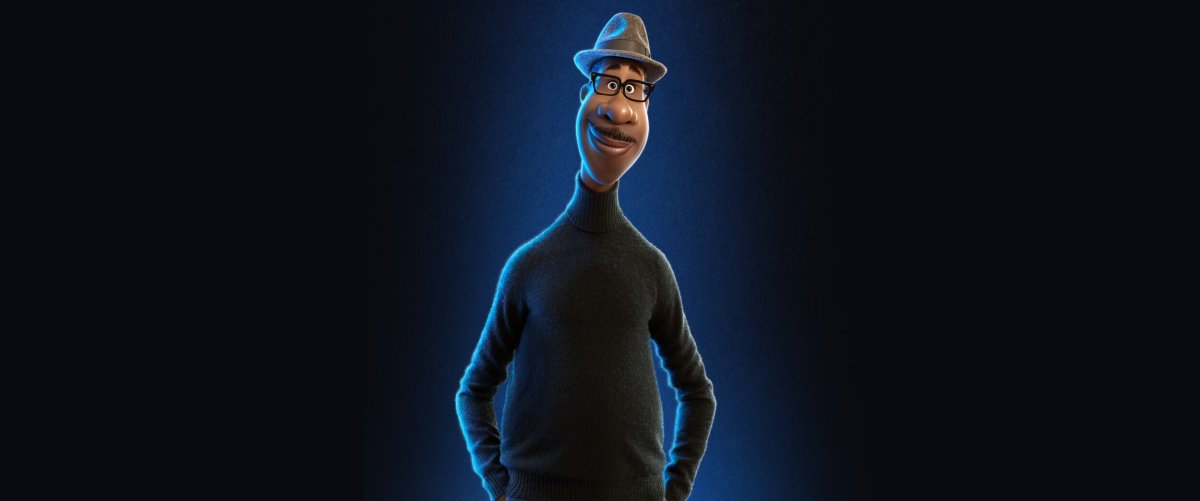
Soul (2020) tells the story of Joe Gardner (Jamie Joxx), a New York middle school teacher who has followed his mother’s desire for him to have a stable income rather than pursue his dreams as a jobbing jazz pianist. One day, there is an unlikely opening in an evening performance with jazz legend Dorothea Williams (Angela Bassett), which gives Joe the opportunity to finally realise his dreams. However, disaster strikes when Joe falls down a manhole and dies. He realises that he is heading slowly towards The Great Beyond. Panicking, he escapes and finds himself in The Great Before, a holding place for souls still awaiting passage to Earth, as soon as they find their spark. There he meets 22, a soul that has thus far never found her spark, despite the best, hilarious efforts of some of the greatest thinkers in the history of humanity.
What follows is a beautiful exploration of life, dreams, failures, missed opportunities and self realisation. It’s an existential triumph, and one that was perfectly timed in its release between Christmas and New Year – just when we all tend to start reflecting on our past year and what we want from the following year.
The animation is stunning. Every note of Jon Batiste’s jazz score is brought to life by what we see on screen. You can feel each press of a piano key, each blow of the saxophone. It is so good, you can almost forget to appreciate exactly how wonderful the achievement is. The high point comes in an emotional crescendo, when Joe eventually gets on stage to perform with Dorothea. It’s like nothing I’ve ever seen before, and will take anyone who has ever been to a proper New York jazz bar straight back to their seat.
To achieve something as beautiful and profound as this, and manage to get it out in a year where it’s likely most of the film staff were forced into unexpectedly isolated circumstances, is a huge achievement. For the second time this year, Disney’s timing is impeccable.
Soul is a film I am desperate to revisit, as soon as my own soul is ready.
Zorrro
The Last Of The Great Navigators
Tiger Lily
Mudslide
One Speed Gearbox
Blood Bubble
Autophilia (or How I Learned To Stop Worrying and Love My Car)
Keep The Home Fires Burning
The Basement Song
Slack Jaw
Emily’s Pine
Setlist 2 – The Hits
After Hours
Bluetonic
Cut Some Rug
Freeze-Dried Pop (Dumb It Up)
Marblehead Johnson
Fast Boy
Never Going Nowhere
Slight Return
If…
Review
The Bluetones arrived in Nottingham in good spirits, as they reached the centre point of the UK leg of their latest tour. This time they were celebrating 20 years since the release of their third album, ‘Science & Nature’, along with a nod to their Singles album that came a few years later.
They took to the stage for their first set of the night dressed in white scientists’ lab coats, a nod to the album title, with the Rescue Rooms roaring in rapturous applause and cheers. They launched into an explosive rendition of ‘Science & Nature’ album opener ‘Zorrro’, the crowd singing along to every word. As frontman Mark Morriss belted the final “Seven levels below”, the first big cheer of the night rang out. Clearly it’s a night for the fans, as is so often the case with The Bluetones gigs.
The fact that Science & Nature wasn’t their most successful album wasn’t lost on Morriss, who was quick to poke fun at its popularity. Explaining the format of the night, the audience learned that they’ll be treated to the entire album in its original order. So, then, he challenges the audience to name the second track on the album. I have to admit I struggled, along with most of the rest of the room. It all came flooding back as they launched into a perfect rendition of ‘The Last Of The Great Navigators’ and then ‘Tiger Lily’.
The self-deprecating humour didn’t stop there. Introducing ‘Mud Slide’, Morriss lets the audience into a secret about the format of the release. It was chosen as the third single from the album, but both the band and the record label Mercury were concerned it might fail to chart due to poor sales. So the solution was to release it as a five-track EP, “thus disqualifying it from the charts altogether”. He claims it was a wise choice because they only sold 27 copies of it. I’m sure that was underplaying it slightly, but I certainly got hold of a copy by nagging Electron in Burnley to get a copy in stock, despite the owner initially denying that the EP existed.
‘One Speed Gearbox’ was next, closing side one of the record, another underappreciated gem from this album that came to life in a rare live outing. It’s a mellow ending to the first side of the record and served as the quiet before the three-and-a-half-minute storm that was awaiting us just around the corner.
This comes in the form of ‘Blood Bubble’, which was stunning. It’s a rare beast for The Bluetones, being a track that features no vocals, but the band just turn the volume up and let rip. Which, as it turns out, is exactly what the crowd do. It’s a song I’ll always strangely associate with the series Spaced (it was used in one of the trailers for the second series, which the band also starred in), so I had to check if I had any Jaffa Cakes in my coat pocket.
‘Autophilia (or How I Learned To Stop Worrying and Love My Car)’, was next. It’s a song I never enjoyed when it was originally released and it hasn’t grown on me since. As I look around the room, I can see I’m in the minority.
Introducing the album’s lead single, ‘Keep The Home Fires Burning’, Morriss declared “This one’s about domestic violence”, before adding after a perfectly-timed delay “Its against it!” If there is one song from this album that could challenge for being their best ever song, it is surely this one. The title of the track is borrowed from an old British patriotic wartime song composed by Ivor Novello, with matching brass backing that sounds like they’re lifted from an advert for baked bread. It’s truly a thing of beauty and sounds as good tonight as it ever has.
The final trio were played out as perfect replicas of their studio-recorded originals. It was a privilege to see a song like ‘Slack Jaw’ live after listening to it for two decades.
After a short break, the band came back on stage to perform, as Morriss put it, “smash after smash after smash”. This set included two tracks from their singles collection: ‘After Hours’ and ‘Freeze Dried Pop’. Both were clearly commercially minded upon release, although the latter never saw the light of day thanks to a fall out with the record label that was explained in detail by Morriss. He joked that the band promised to tell everyone that it was their own decision, despite the fact this was far from the truth.
Their final two tracks – ‘Slight Return’ and ‘If…’ were met with the loudest singing of the night, each audience member desperate to enjoy every last drop of fun from the set. The Bluetones have a dedicated fan base and it didn’t feel like there were many speculative attendees on a night. This was an audience packed with die-hard fans of the band, and they’ll surely be back in full voice again next time the band come to town.
L. S. Lowry once claimed he only ever used five colours: vermilion, ivory black, Prussian blue, yellow ochre and flake white. Mrs Lowry and Son puts Timothy Spall and Vanessa Redgrave together in a film as flatly coloured as any of Lowry’s paintings, with a plot to match. This isn’t to bismirch the overall effect – a film with a different tone would feel like a mis-step.
These are astonishing performances from the two leads.
Spall plays the titular son, famed Lancashire artist Laurence Stephen Lowry. He brings Lowry to life, as he struggles against his own mother’s opinion of his work and allows that to permeate his confidence. It’s a heartbreaking thing to watch play out.
Of course, without Redgrave giving an equally wonderful performance as Elizabeth Lowry, the whole thing would fall flat. It’s well written and delivered perfectly. Redgrave has seldom felt so dislikeable. She has a dedicated son that she completely takes for granted. All she offers is a relentless undermining that only serves to stifle his genius.
The naming of the film tells you all you need to know about how important Redgrave is to the plot. It is arguably more her story than it is his, with her character as overbearing to the story as she was in real life to Lowry’s paintings.
It feels dreary, but this is a portrait of an artist living in Pendlebury in the 1930s. It was a dreary time to live, as families were built around the financial gains of working in the local coal mines.
The film soars when Adrian Noble works some of the more familiar of Lowry’s works into the visuals of the film. As a child who grew up in nearby Burnley, Lowry was revisited many times during art lessons at school. I’m not an expert, but it is a joy to see the masterpieces brought to life.
The joys of this film shouldn’t be limited to those from northern England, nor just to fans of his art. It’s very well executed and is well worth your viewing time.
In an ongoing quest to indoctrinate my child with good cinema and expose her subconscious brain to variety of languages, we sat down and watched a Ghibli feature film for the first time. Well, okay, she didn’t watch it. She was only six-and-half weeks old at the time. I’m hoping the audio filtered through her ears and into her dreams as it played out with her asleep in my arms. At least her bath time music was definitely familiar,
As I watched it, I thought to myself how surprising it is that Porco Rosso isn’t better known and better appreciated. It’s one of only eleven feature-length animated films that Hiyao Miyazaki has directed, and sits directly in the middle of the timeline of releases. It is also, surely, one of his greatest works of art.
The plot revolves around a World War I Italian ex-fighter pilot, who now makes his money as a bounty hunter chasing air pirates. This allows Miyazaki to show off two of his greatest loves. The first is the beautifully-realistic European setting. His version of early 1900s Italy is so authentic you can almost taste the pomodoro. It’s set firmly in the real-world events of the aftermath of the war, with the references to the Great Depression putting it in the 1930s.
Secondly, the over-arching aeronautical theme is again on display. Hayao Miyazaki’s father Katsuji Miyazaki was the director of Miyazaki Airplane, a company responsible for manufacturing aircraft parts during World War II. As you explore his work, time and time again the skies are visited and form a central part of the stories. Never is this more the case than in Porco Rosso.
Indeed, as an entry-level Ghibli film, it’s one of the best places to start. It has a focused, robust plot with a clear start, middle and end. It has elements of fantasy included. It has a wonderful Joe Hisaishi score. Everything you’d expect of a Studio Ghibli feature.
It’s interesting that it still feels very much like a film aimed at children. But what are the themes here? The war? Depression? Lost love? Fascism? The early years of aviation? Somehow these are tied together with such grace and love and packaged in a way that feels perfectly fitting for any child.
Basically, if you’re at all interested in Japanese animation, you need to work out a way to watch this film.
As for my daughter… She didn’t wake up but I’ll be making sure she revisits this one when she’s old enough to understand it a bit more. She’ll certainly recognise the score.
Note: I wrote this article in December but never got around to publishing it. My daughter is now nine months old and still listens to the same music in the bath. She’s yet to watch any television, but she does love her plush Totoro.
Following the completion of filming for Phantom Thread, Daniel Day-Lewis announced that he would be retiring from acting and that his role as 1950s London high-society dressmaker Reynolds Woodcock would be his final role. This can be considered both a figurative and literal bowing out in style. Oozing elegance and beauty in every aspect, it is an absolute triumph of a film.
The story centres around Woodcock, head of the House of Woodcock, a well-regarded craftsman who is seeing his popularity diminish by the beckoning of new fashion from around the world. He baulks at the word “chic”. He is a meticulous and silent worker, unforgiving of those who have the audacity to interrupt his genius in flow. His obsessive nature flows over to his personality, and those close to him are dictated to by his need for control. His closest ally is his sister Cyril (the brilliant Lesley Manville), who manages his business affairs and the staff and running of the house. Their world is flipped upside-down when a chance encounter leads Reynolds to fall into infatuation with a young waitress named Alma (Vicky Krieps), who quickly moves into the house and thus begins her strange relationship with Reynolds.
In 2018, a cinematic year defined by an uprising of oppressed and attacked women finally being given a platform to voice their views on oppressive and controlling men in the film industry, it seems almost perverse that I enjoyed Day-Lewis’s performance so much. I felt at times like he was on the cusp of bursting into tears of laughter, such was the audacity of his character’s actions. In one of the best lines of the film, as shown below, he delivers the cutting “The tea is going out, but the interruption is staying right here with me.” Brilliant.
Jonny Greenwood, one of Paul Thomas Anderson’s most frequent and reliable collaborators, provides the score. It is mesmerising, fitting beautifully with the visuals. In a recent interview with Adam Buxton, Greenwood stated that he wrote it in order for it to be performed along with the film. “I wanted to do it with six or seven players and make it all playable and send out the scores to cinemas and say ‘get some local players to play it live’ and it be a really regular thing. I love the idea of the film arriving and then the book of music arriving and these are the two things you put together and make it quite easy, but Paul kept on asking for bigger and bigger string section sounds to build the romance.” Indeed, this decision was probably the correct one, with the enduring stay-ability of the film benefiting over what could have been simply a nice touch at release. I challenge anyone to find a more perfectly romantic piece of film music this year than ‘House of Woodcock’. [1]
A film that is centred around a celebrated dressmaker almost inevitably has a wonderful display of costumes on show. Mark Bridges is another frequent Anderson collaborator, having worked with him on The Master, Inherent Vice and There Will Be Blood. The costumes here are absolutely stunning, perfectly capturing the essence of 1950s London high society. It is a costumier’s dream of a film, with the intricate efforts of making such beautiful dresses captured in great detail.
The film culminates in a most unlikely ending that absolutely works with the film, underlining the nature of Alma and Reynolds’s relationship to one-another and their desire to stay together. Their dinner table stand-off with a mushroom omelette may not have the intensity of the “I drink your milkshake!” scene in There Will Be Blood, but it swaps intense for tense as the scene plays out. It’s just one of those scenes in cinema that hangs perfectly together. Script, acting, cinematography, lighting, score – everything is just right. A masterclass in filmmaking.
Whilst Day-Lewis may be unlikely to receive an Academy Award for this film, it certainly ranks up there with his most celebrated performances. He is one of this generation’s greatest actors and it is a real loss to the industry that he is walking away. However, it’s a noble decision to leave a profession whilst you’re at the top of your game. He could probably deliver a further three or four top performances, but his decision is clearly based on a balance between his enjoyment of his life as an artist and his enjoyment of his life outside of the industry. If Phantom Thread does prove to ultimately be his final role, then he is definitely leaving us on a high.
[1] Note: Jonny performed an exclusive version of this song on the Adam Buxton podcast (EP.63B, 9th February 2018) alongside a 30-minute interview backstage at the Royal Festival Hall prior to a live performance of the score on 30th January 2018. It’s well worth a listen and can be found here.


 Cinema, etc.