Film review -トウキョウ トライブ / Tokyo Tribe (Sion Sono, 2014)

Movies should aspire to be the best in their genre. There’s no point existing as a movie unless you can at least be better than everything that has gone before in your genre. If you can’t do that, then why not mold yourself a new genre completely?

With that in mind, I am proud to announce that Tokyo Tribe is the best Japanese-language rap-musical in the tribal gang realm.

The story is pretty hard to explain. To summarise, we are let into a highly stylised version of modern Tokyo, where tribal gangs vie to rule the city. Set over one night, we see the heightening tensions as ganglord Buppa (Riki Takeuchi), his henchman Mera (Ryuhei Suzuki) and son Nkoi (Yosuke Kubozuka) declare war on all other tribes in Tokyo, announcing as much by killing the popular peace advocate Tera (Ryuta Sato). The uprising against their power trip is led by central heroine Sunmi (Nana Seino), and multiple stylised battles culminate in a dawn all-out-war.

Sunmi beat the living daylights out of another bunch of extras

Sunmi beat the living daylights out of another bunch of extras


Amazingly, the intertwining of multiple storylines and characters is reminiscent of Love Actually, though the comparisons inevitably end there. In fact, at times it’s simply hard to follow just who the central characters are. About 90% of the dialogue is delivered as rapping, so as an English native who barely speaks any Japanese it is hard to follow what are clearly some very fast and rhythmical lyrics. On this occasion, it really pays to speak the language.
Another issue is the excessive number of characters that are continuously being introduced into the mix. It felt at times like several characters were frivolously being added in too late for us to care about who they are, often getting only a handful of lines to describe who they are, what tribe they represent and a little about themselves before disappearing for the rest of the film.

That said, there is a memorable turn from Cyborg Kaori as a beatboxing servant, which is worth watching out for. She does things with her voice that seem completely unnatural. The results are fascinating and her various YouTube videos are worth checking out. This is an example of a distinct character being given the chance to shine; it’s a shame that the cast wasn’t smaller so more focus could be given to each of the talented artists involved.

Many of the featured actors and actresses, however, are new to the hip hop world and the intriguing on-disc Making Of documentary reveals a lot of the insecurities of the stars, particularly with standout performer Nana Seino. She’s clearly a talented actress but it’s sad she was the focus of such a lot of “fan-service” throughout the film.

Stylisitically, the film is top notch. From start to finish there is no break in the feeling that the characters inhabit this entirely alternate reality and in that sense it is a great success.

The same cannot be said for the storyline.

At times it’s a brilliantly unique film that threatens instant cult-classic status. Often it’s just a complete mess that loses itself in style over storyline. If you know of Sono Shion and liked his previous efforts then you know you’ll enjoy this. If not, then approach with caution.

Tokyo Tribe can be purchased on Blu-Ray in the UK now and was released by Eureka films.

かぐや姫の物語 / The Tale of Princess Kaguya (Isao Takahata, 2013)

The Tale of Princess Kaguya is a faithful interpretation of the classic Japanese fable The Tale of the Bamboo Cutter, one of the oldest folklore tales in the history of the country. It is also Isao Takahata’s fifth film as director for Studio Ghibli, following the dark Grave of the Fireflies, the fun ecological adventure Pom Poko, the episodic comic strip interpretation My Neighbours the Yamadas and romantic drama Only Yesterday.

It tells the story of Princess Kaguya, a tiny girl found inside a stalk of bamboo by an aging bamboo cutter and his wife. She rapidly grows in size into a beautiful young lady, though she hides a secret for which she must, eventually, face the consequences.

The first thing that hits you when watching this film is the breathtaking quality of the animation techniques. Putting aside the great storyline, the film is worth watching just for the fact it is so beautiful to view. It really serves to remind us how effective 2D animation can be and we’re lucky that Studio Ghibli is yet to embrace 3D animation in the same way as Disney has, all but throwing away their heritage (though nontheless still churning out mostly excellent films).

My favourite scene involved the princess running away from her adopted home in panic and fear. At this point the art style subtly changed and became more expressive and less controlled, with darker greats and blacks filling the screen, and it was an intelligent way to channel her emotions into the visuals.

There is an immediacy of beauty in the animation style.

There is an immediacy of beauty in the animation style.

The film arrives in North America and Europe with a lot of endorsements, not least the nomination at this year’s Adademy Awards in the category of Best Animated Feature (it lost out to Big Hero 6). I usually prefer the Japanese voice-overs with subtitles and was lucky to find a screening with this option, but the English-language cast is nothing if not star-studded (including Chloë Grace Moretz, James Caan, Lucy Liu, Mary Steenburgen and Beau Bridges). I look forward to being able to hear this version once it reaches home media later this year.

At 137 minutes it might be too long for most children but if youre looking for an intelligent way to entertain your family this weekend I heartily recommend this film.

The Tale of Princess Kaguya is out now at selected cinemas across the UK.

Mario Party 10 / マリオパーティ10 (Nintendo, 2015)

marioparty10banner

No new Nintendo console system would complete without the release of updates of several mainstays of their library. We’ve had excellent and perhaps definitive versions of Mario Kart and Smash Bros., and a fantastic 3D platformer in the form of Super Mario 3D World. So, what’s next? Mario Party, that’s what. The Mario Party games have been a regular since it debuted on the N64 console in 1998. It was no surprise when Mario Party 10 was announced for the Wii U.

It’s a series that seems to fill everyone with indifference. The releases always get middling sales, probably due to the average reviews each receives. Indeed, the MetaCritic score received by each title had been getting progressively worse since its debut, though Mario Party 9 reclaimed some ground with some innovative gameplay and presentation techniques. The graph below ignores handheld games Advance, DS and Island Tour, but you can see it resembles something of a ski slope.

MetaCritic results for Mario Party franchise (console only)

MetaCritic results for Mario Party franchise (console only)

The following graph shows the sales for the same console games as a percentage of the total console sales. The results are again quite interesting – with the exception of Mario Party 7 the sales of the games on each console peak with the debut release then decrease in popularity with each release (source: Video Games Sales Wiki).

Mario Party sales as a percentage of total console sales

Mario Party sales as a percentage of total console sales

So as we can see, there’s a market for the games, but it’s not particularly massive in comparison to the big hitters like Mario Kart. So what reason has Nintendo given us to invest our hard-earned money in the latest release, given almost everyone who has a Wii U has one of the earlier releases, or did at one point? Well, as it turns out, quite a lot.

One of the big angles is the use of asymmetrical gaming (remember that?) through Bowser Mode, which actually provides a lot of fun, especially if you’re using the gamepad. The fun comes from the fact that you have a real person screwing you over instead of the computer, and it makes it even better when you can hear them laughing away at your misfortune. To play out in this mode you have one person using the gamepad, whilst up to four others control play via remotes and work as a team to try to escape Bowser. Each regular player rolls a die on their go and gets to move a cart forwards and individually reaps the benefit from whatever space they land on. Then Bowser rolls four dice in one and more often than not catches them up, leading to a mini-game.

The mini-games are a lot of fun, and usually leads to a lot of swearing from four people in the room and a lot of laughing from the other one. One drawback to this is the waiting time between mini-games. I think Nintendo got too involved with the animation and activities between the mini-games and didn’t take step back and realise that all it is doing is delaying the time before we get to play more mini-games. You know, the fun bit. 

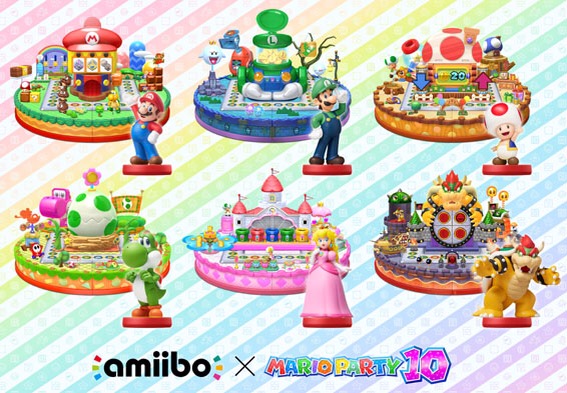
Six Mario Party 10 Amiibo have been released as a tie-in.

Six Mario Party 10 Amiibo have been released as a tie-in.


Another angle Nintendo are employing is the use of Amiibo. This isn’t a unique selling point as much as a way to get people that have already invested heavily in the Amiibos to buy the game. There are six launch Amiibii – Mario, Luigi, Yoshi, Bowser, Peach and Toad, in his Amiibo debut – that interact with the game, though I understand that the Smash Bros. versions of the Amiibo also function in the same way. As I’ve previously discussed, Amiibo are incredibly, almost unfathomably, popular and linking in this game they will be able to increase games sales. Additionally, the Toad Amiibo will function with Captain Toad: Treasure Tracker (which I have previously reviewed) and Yoshi will function with Yoshi’s Woolly World.

The downside of this is that using the Amiibo with the game is a complete pain. The Amiibo Mode involves using your model to unlock a specific character-related board game. Then you and up to three other players battle out around the board to play mini-games to earn coins to buy stars. The winner is the one with the most stars. When playing in this mode, everyone else in the room was able to roll the dice with a quick flick of the remote, whilst I was sat in the corner switching between the gamepad (which had to be plugged in due to the unimpressive battery life), the remote and the Toad Amiibo I was using. The action to get it to register also wasn’t too great and I was the one slowing the game down drastically by using the Amiibo. A quick update would remove the need to use the Amiibo to roll the dice and would severely speed up this process.

The other modes are pretty cool. The standard Mario Party was what you’d expect and a lot of fun, and the Coin Challenge mode simplifies the gameplay a little too by removing the chance aspect and rewarding the one with the most coins at the end of seven mini-games. The mini-games themselves really weren’t repetitive (the box claims there are more than 70 new ones). I think it took about three hours before we encountered a game we’d already played.

Watch out for Bowser - he's a total asshole

Watch out for Bowser – he’s a total asshole


Another big downside is the inability to make a custom playlist where you can select a series of mini-games from the total list with no breaks in gameplay between, which would mean you could select just the ones you enjoy based on difficulty and personal preference. Instead we are in the hands of the console and often have to play through games that are too easy before getting a real challenge.

I have enjoyed my time with Mario Party 10 so far and I’m sure it will be used many times in a party situation soon. However, I think some critically slow loading times and too much between-mini-game faffing will cause the game to be a bit of a drain on the excitement at a party rather than a catalyst for more enjoyment. Couple that with a lack of online multiplayer and you have a game that has potential but falls short. Though I’m sure that will be sorted out when Mario Party 11 is release in 18 months.

Mario Party 10 is available now, along with all six Amiibo (which as usual are rapidly increasing in price due to lack of availability).

Uwasa No Onna / 噂の女 (Kenji Mizoguchi, 1954)

Released as part of the Kenji Mizoguchi Masters of Cinema boxset “Late Mizoguchi”, Uwasa No Onna is an understated film that nonetheless packs a sizeable punch.

The story starts with a girl – Yukiko – returning home from her higher education at a music school in Tokyo, where she is studying piano. She wishes to end her education as she is suffering from a broken heart, and has attempted suicide by overdosing on sleeping pills. Her mother owns a popular geisha house in a small town and so fairly early on in the film an interesting dynamic begins as she is in a position of being the outcast by the other young girls of a similar age, many of whom believe they are effectively working to pay for an education for her that they could only dream of, and that it is selfish of her to drop out in such a fickle manner.

Mizoguchi’s casting of Kinuyo Tanaka in the lead role of Yukiko is no surprise. She was a favourite of his for much of his career, though she later went on to be a director in her own right, which in turn caused an argument that severed her friendship with Mizoguchi. When we first see her she is wearing a contemporary black dress, which gives her an immediately striking appearance, looking somewhat like Audrey Hepburn. This has two effects: in all black she is shown to be in a depressed frame of mind, and she also sets herself apart from everyone else in the film as being from a different culture, in this case contemporary Europe.

2015/01/img_0168.jpg

Mizoguchi has a fascination with brothels that runs throughout many of his films (perhaps most famously in the 1954 classic Akasen Chitai / 赤線地帯). These stories always have a hint of the autobiographical about them – his older sister Suzu was sold off for prostitution soon after 1915 when his mother died, which was a shameful experience for Mizoguchi. Frustratingly for him, the money she earned helped fund his higher education; this background is clearly reflected in Uwasa No Onna.

Elsewhere on the disc, the Tony Rayns bonus discussion about the film is really interesting, though it is the only bonus feature for this particular film (the film itself is a bonus feature for the more popular Chikamatsu Monogatari / 近松物語). In it he discusses Mizoguchi’s use of theatre in his films, in this case drawing a parallel between stage (watching Kyo Byen at the Noh Theatre) and reality. It’s quite an interesting scene in the film as the mother grows in embarrassment. I personally found it – on a basic level – a wonderful way to view what theatre was like in Japan when the film was set. I’ve never known anyone else capture it in such great detail.

It was a joy to hear Rayns, who is well versed in this director’s history, talk so candidly about his other work and background. Yet another reason to endorse Masters of Cinema (by the way, the transfer is excellent… as usual)!

I notice this boxset is now on sale for a ridiculous amount of money (£156 on Amazon). Frankly, it’s not worth the purchase just for this film, nor for the other three exclusives (I haven’t got round to watching them all yet). That’s because no Blu-Ray boxset is worth that amount of money. I’m sure Eureka will see sense soon and re-release the two exclusive discs for those that missed out the first time. Of course, anyone who has already forked out £156 will be fairly disappointed but they’ll have to live with it.

Gate of Hell / 地獄門 (Teinosuke Kinugasa, 1953)

Teinosuke Kinugasa’s film Gate of Hell was a global smash upon its original release, winning the Palme d’Or at the Cannes Film Festival in 1954, plus a couple of Academy Awards. Now re-released sixty years on by Masters of Cinema and Criterion, cinemaphiles are able to enjoy the film all over again, allowing a whole new generation to appreciate a masterful piece of cinema.

Set in 1159 Japan, the plot centres around Morito Endo (played by Kazuo Hasegawa), who is involved with evacuating Sanjō Palace in Kyoto during a revolt. A woman, Lady Kesa (Machiko Kyō) volunteers as decoy for the shogun’s sister, and he is amongst those asked to transport her out of the palace and lure the attackers away from the real princess. The plan is successful, and as a reward for his heroism he is offered a gift of his choosing. Unfortunately, he requests Kesa’s hand in marriage, only to find out that she is already wed. For a proud samurai, this is a disastrous embarrassment, and the film from then on deals with the emotional effect this has on Morito, Kesa and Kesa’s husband Wataru Watanabe (played by Isao Yamagata).

IMG_9354-0.JPG

The film looks and sounds brilliant from the start, with the recently developed Eastmancolor used to bring 12th Century Japan to life. It is an alternative view of the shogun era of Japan, which so often at the time had been detailed in popular films by the likes of Akira Kurosawa and Yasujirō Ozu, but in black and white. I can only imagine what it must have been like to see this film back in 1954 and be blown away by the loud visuals and intricate costumes.

That said, a film wouldn’t endure for sixty years without a fantastic story and excellent acting, and this film has those in abundance. It’s paced perfectly and at 90 minutes there isn’t much in the way of filler. The actors are on top form too, harking back to the recently-diminished silent film era with long periods of silence counteracted with extreme close ups as emotions engulf their faces. It is a clever technique and one that would have helped set it apart when it reached Western audiences.

IMG_9353-0.JPG

Sourced from the 1954 New York Times review of Gate Of Hell, the comments from Jun Tsuchiya, Consul General of Japan, add context to the success of the film and the impact it had on the wider reputation of Japan globally. Speaking at the premiere, he said “The successful entree of Japanese films in the world market, may well have not only cultural, but also, I venture to suggest, economic consequences for both our countries. To me, it is entirely conceivable that the export of superior films will greatly help my country in its present unremitting struggle to become self-sufficient, to rely on trade, not aid.”

It is interesting to think of those comments in terms of the global view of Japan today. Buoyed by the hyper-acceleration of popularity of new technology and most global brands from Japan being technology-based (Sony and Nintendo spring to mind), it is ironic that they pulled themselves out of financial struggles to launch themselves forwards by looking so far into their past, especially when in this case the film’s initial popularity seems to be in part down to the use of cutting-edge film colouring technology.

Gate of Hell is out now on Masters of Cinema and Criterion Blu-ray and DVD.

Giovanni’s Island / ジョバンニの島 (Mizuho Nishikubo, 2014)

Back in July when I initially viewed Miyazaki’s final film The Wind Rises, I commented that it was a story that would have been better told in live action. The subject matter was very serious, there was nothing magical required of the story. It was simply an animation that didn’t need to be an animation.

IMG_9276-0.JPG

Giovanni’s Island, the new anime release from Mizuho Nishikubo, could have had a similar issue. It is a film set on Shikotan, a small Japanese island in 1945, which tells most of the premise in itself. We follow Young brothers Junpei and Kanya Senō as they deal with the island’s occupation by Russian soldiers, the upheaval of life as they know it, their integration with Russian culture at their school and Junpei’s romantic interest with Tanya, a Russian schoolgirl with a high-level military father.

It is overall a very depressing subject matter. By this I’m talking Grave of the Fireflies sort of level of depressing. There were many teary eyes as the film reached its conclusion, and that is testament to what a fantastic job Nishikubo has done here.

The animation style was actually quite intelligent and as the film went on there was a clear reason why animation was the medium of choice to tell this tale. There are three distinct styles on show: very realistic imagery is used for all the modern-day portions of the work; a more childlike design with juxtaposing dull greys are used for the sections covering 1945; and Junpei’s dreams and fantasies are more varied, with styles ranging from basic sketches to star-filled neon visual fireworks. The decision to use all three styles to represent a now much older Junpei’s memory of the events is a smart move, especially when we see the childlike times he spends with his brother overlaying a truly grim memory of the surrounding landscapes.

IMG_9234.JPG

One key theme throughout is the children’s obsessions with trains and railways, inspired by the brothers’ favourite book Night of the Galactic Railroad. According to the director this book used to be extremely popular but has since become just a phrase that is used. In fact, only 10 out of approximately 100 children who auditioned for the film were aware of the contents of the book. Perhaps the choice of this particular book was a comment that the younger generations of Japan are trying to move on from the painful memories suffered by their grandparents. Or perhaps it was just a happy coincidence and I’m reading too much into it.

Nishikubo has come in for criticism for the content of the film. Some Japanese critics thought he should have used the film to make more of a political statement. I tend to disagree. It really is an important and compelling story to simply tell the experience these two young children went through, without being judgemental of any of the parties. Neither the islanders nor the Russians are particularly singled out as being in the wrong. This allows us as viewers to make up our own minds, and it’s a much more balanced approach to allow the story to gain popularity and recognition in the world markets. In so many ways, this does a far better job than being highly favourable to the Japanese islanders, who went through terrible treatment no matter which way you look at it, and I’m sure this is the conclusion most will draw.

Giovanni’s Island has a limited release in UK cinemas in 2014, including the London Film Festival (10th October onwards), Scotland Loves Anime 2014 in Glasgow (12th October), Leeds Vue in the Night (12th October) and Edinburgh Filmhouse (18th October). It will subsequently be released on Ultimate Edition Blu-ray (limited to 1000 copies) and DVD on 8th December, and standard Blu-ray on 26th January 2015. More information on all these releases can be found on the official Giovanni’s Island website.

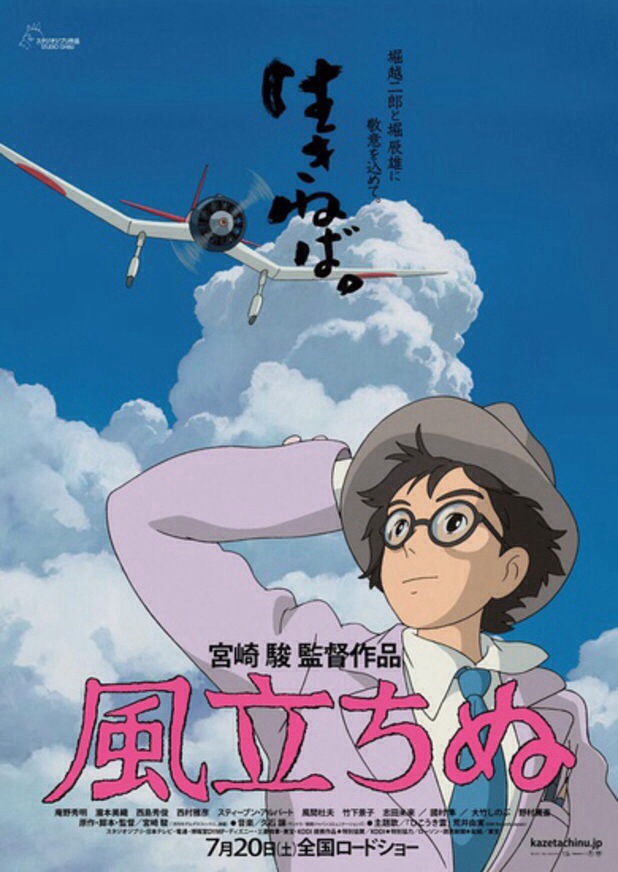
The Wind Rises / 風立ちぬ (Hayao Miyazaki, 2013)

“I am talking about doing something with animation that can’t be done with manga magazines, children’s literature, or even live-action films.”

It’s that last line that really bothers me. That was Hayao Miyazaki talking, in 1978, about what animation means to him. It wasn’t a hard quote to locate. I only started reading his autobiography (of sorts), Starting Point, five minutes ago. It was right there in the third paragraph of the first page.

I don’t think there’s any denying that, when looking back at the career of one of the greatest and most imaginative directors of all time (and I’m not limiting that to animation either), he has created a body of work that surpassed that which would have been capable in any other medium. If you look at Nausicaä, Princess Mononoke, even his work on Sherlock Hound The Detective, it’s difficult to see how any other medium mentioned above could have portrayed his story any better than in 2D animation.

So when I was sat there at the cinema watching The Wind Rises, even before I read that opening quote, I couldn’t help but wish for the magic to ooze back into play. I was with a fellow anime fan and another friend who was unaware of any of his output, and we all agreed that the film could have been better served as a live-action film. There wasn’t really any call for the animation. Yes, it looked visually stunning as usual, but it didn’t add anything to the story.

It’s sad that Miyazaki has chosen to finish his body of work with this film. Don’t get me wrong, it is definitely not a terrible film and it won’t tarnish his reputation. The story is solid, the characters well-realised, the backdrops deep in detail. It’s just a bit of an anticlimax after a series of such amazing films.

One for the completists and die-hard fans, but if you’re new to Miyazaki, you’d be better to start with Howl’s Moving Castle or Spirited Away.

The Wind Rises is out in cinemas in the UK now. Reviewed was the Japanese version with English subtitles.

Godzilla (Ishirō Honda 本多 猪四郎,1954)

Spectacular special effects, a metaphor for nuclear weapons, the start of a still-popular franchise. There are many things that have been repeatedly said about the 1954 original of the Godzilla story by Ishirō Honda. But how does it stand up to viewing sixty years down the line?

I imagine a lot of people will seek the film out ahead of the release of the Gareth Edwards modernisation next month, a task made all-the-more easier by the fact it is out of copyright and there are plenty of copies available for free around the net.

For those not used to watching foreign or classic cinema, it might come as a shock. There are a few things you need to buy into if you’re going to enjoy it.

The use of miniatures at the time probably took most cinema-goer’s breath away, but nowadays you can spot them a mile away. What we are seeing looks very little like the complete destruction of Tokyo, but more like the complete destruction of a very little Tokyo. They’ve not even got the speed of the slowed-down film correct.

It’s also difficult to watch the film without seeing Godzilla as a man in a rubber suit. Haruo Nakajima is clearly putting a lot of effort into his portrayal but it’s hardly convincing by today’s standards. Remember, this is over two decades after King Kong had terrorised the big screen and there must have been some advances in technology in the intervening years.

I have seen this film before, probably around seven years ago. The flimsy conclusion to the film really had slipped my mind. Having annihilated several towns and cities in his reign of terror, we are quickly asked to buy into the concept that putting Dr. Serizawa’s Oxygen Destroyer under water will do the trick. Wait… Hasn’t he spent most of the film breathing fire on people above water? I know he’s sleeping underwater, so I guess he’s amphibious? We already know he can survive for hours above water so why does he die immediately? And why are there no dead floating fish at the surface? If the oxygen has been completely removed then why do the humans live on? I know, I know… He’s a giant fire-breathing dinosaur… Everything else is water under the bridge.

Overall I see this film as entertaining but flawed, historically significant but unbelievable. I enjoyed my time watching it, but I wouldn’t recommend it to someone looking to get into classic Japanese cinema.

And at least it wasn’t directed by Roland Emmerich.