Secret Cinema Presents: The Empire Strikes Back (Irvin Kershner, 1980)

The Secret Cinema Presents: Empire Strikes Back event was easily the most immersive cinema experiences I have ever been involved with, and it will probably never be beaten. Having spent £70 on each of the two tickets, my wife and I understandably had a bit of trepidation. I can honestly say that it was worth every penny.

The event actually kicked off way before the day with a steady trickle of emails about the rebellion, the empire and things like that. We had to fill out a personality test, which resulted in me being a Galactic Explorer. This drove the costume recommendations, which consisted mainly of a white-to-cream loose shirt, beige trousers, a utility belt, boots, goggle and, most importantly, a tan and black shemagh scarf.

We were provided with precise co-ordinates to go to, near Canada Water Tube Station in London. We arrived early and were amazed to see that most cafes were shutting long before the 5:30pm entry time. This was clearly a ridiculous move as hundreds of people descended on the site every day hoping to get something to eat or drink. Never mind. Just a few thousand galactic credits lost there over the summer.

“These aren’t the droids you’re looking for.”

Once there, we were lined up by reasonably aggressive security guards, moved into a holding area and quickly briefed about what the situation was. We were told we were under surveillance by The Empire and they’d released a toxic gas into the atmosphere. We therefore had to cover our faces up with our scarves and keep low as we ran through a couple of corridors into a large hangar, where our phones were heat-sealed [1].

Once in the hangar we received rudimentary training and had a quick physical fitness test before being put into a spaceship (a simulator ride) and transported to the next area. This is where the real fun began as we all realised we were at the space port Mos Eisley on the planet Tatooine.

The moment of realising we were now IN the film at this point was overwhelming. Basically, the plan was to live in A New Hope before we watched The Empire Strikes Back on the big screen. It was impossible to take in at first. My wife is a ridiculous addict to Star Wars and was giddy with excitement for a good twenty minutes. The attention to detail was superb.

We went straight into interacting with actors in character. We chatted with Obi-Wan Kenobi, who informed us where we needed to go to trade spice to board the ship to leave Mos Eisley. We traded our seeds with Luke’s Uncle Ben for a circuit board, which we then traded with a Jawa, who we annoyed by stealing our original circuit board back and re-trading for a second pack of spice. We got cheated out of a game of Sabacc by Lando, before he was busted by a security guard and put in prison. We nipped into the Cantina to see the band playing away and grabbed a glass of some space-themed odd cocktail, before witnessing the famous Han v Greedo scene. We chatted with Han and Chewbacca for a while. I even got taken aside by a guard at one point and had to sing Moon River to get out of trouble. Very bizarre!

It was just great fun to be in there and the fact that everyone was in character and stuck to it just added to the occasion. Very quickly all the general punters were fully in character too.

The reason the scarf was important was that it sort of overruled the exact costume choices – we were given a goal once in there to trade some spice to get onto a spaceship and the trading material was dependent on the colour of your scarf. It was quite a simple means for the actors to identify the faction each person belonged to, especially since some people had made no effort with their clothing.

When the time came, we departed to the Death Star as we neared the end of A New Hope. Apparently the time at which we left drove what we saw when we arrived at Alderaan – we were in the middle so flew straight into an asteroid field (just like the film), though some saw the explosion happen and others arrived to find nothing there. Once on the Death Star, we were put in prison briefly before breaking out and witnessing the end of the film, lightsaber battles and all [2].

When the film began, everyone quickly settled in. Throughout the film actors and actresses appeared on the stage to act out key scenes and segments for us all to enjoy. This was a nice touch. It was a pleasure to be able to watch the film (if you’re interested, it was the 2004 version with Ian McDiarmid as the Emperor) with such a large group of avid Star Wars fans, all cheering and booing at the same time. It created a unique atmosphere that won’t be forgotten for a long time.

The best thing about the event was rejuvenating our love for Star Wars. As soon as we got home, Return of the Jedi was straight on the television (the original theatrical cut, if you’re interested). This Secret Cinema event has done wonders for the interest in The Force Awakens.

There hasn’t been an announcement about the next Secret Cinema event but regardless of the film choice it will be something to look out for next summer.

[1] This was probably the smartest move of all. Sitting there in the Cantina in a completely different world only to look over to see someone uploading a selfie to Facebook would have completely ruined the immersion. Well played Secret Cinema. You pre-empted the douchebag idiots.

[2] A special mention has to be said for the choreography and abilities of the actors during the battles. Perfectly in sync, excellently executed.

Star Wars Week at Cinema, Etc.

The countdown has begun to Star Wars VII: The Force Awakens. It is now just 67 days until the big day. What better time me than now to celebrate the fantastic series with a week dedicated to all things Star Wars? 

Check back tomorrow for the first article – a review of Jon Spira’s excellent documentary Elstree 1976.

Suffragette (Sarah Gavron, 2015)

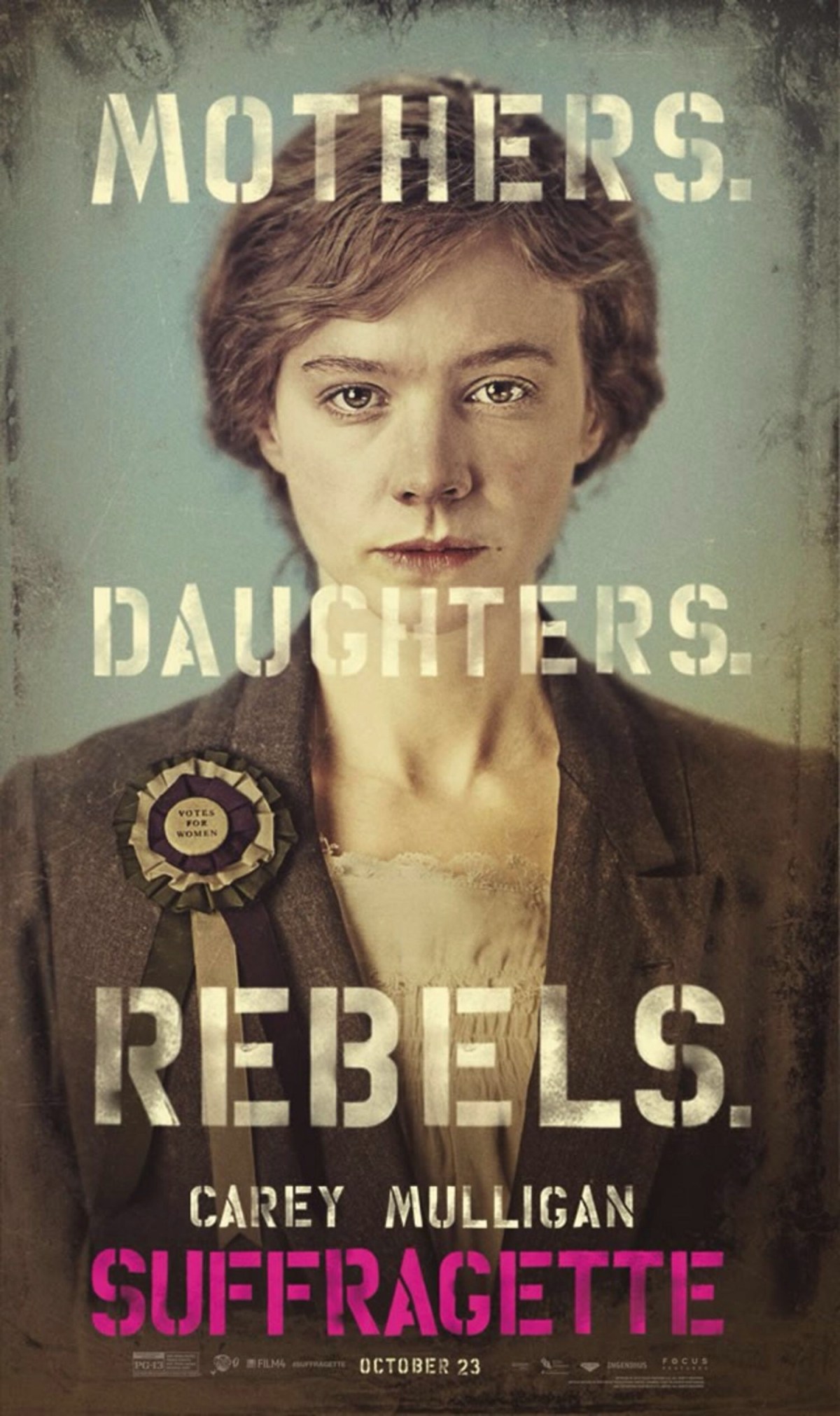
Suffragette opened the London Film Festival in some style tonight, with the stars out in force at the Vue in Leicester Square to bring their film to crowds in what was also the European premiere. The London Film Festival director Clare Stewart said prior to the screening that it was an “urgent and compelling film, made by British women, about British women who changed the course of history.” How right she was.

Carey Mulligan puts in an excellent performance.

The film, directed by Sarah Gavron and written by Abi Morgan, tracks the true story of the early suffragette movements of the late 19th and early 20th century and how their struggles against increasing opposition from all around them got harder as their prominence rose. The focal point is the fictional Maud Watts (Carey Mulligan), a working class washerwoman who gets slowly drawn into the fight for power and ends up losing everything to fight for her equality. She joins the local branch of the suffragette movement after a chance encounter in the West End, and quickly finds her feet alongside Edith Ellyn (Helena Bonham Carter, incidentally the great-granddaughter of H. H. Asquith who was Prime Minister from 1908 to 1916), Violet Miller (a standout performance from Anne-Marie Duff) and Emily Wilding Davidson (Natalie Press), a woman whose life is worthy of a film in her own right.

Just as important to the dynamics of this story are the men. Maud’s husband Sonny Watts is an extremely complex character portrayed magnificently by Ben Whishaw. As Whishaw discussed prior to the screening, Sonny is conflicted by the desire to protect and provide for the family he loves and doesn’t understand the importance of his wife’s involvement. However, as the plot progresses he makes some unforgivable decisions that further drive Maud’s determination. Brendan Gleeson provides depth to the role of Inspector Arthur Steed, a man of authority who is investigating the movement.

However, this is a film about women and made by women. It is extremely refreshing to see a film where the women take centre stage and it isn’t about how in love they may or may not be with a man. Screenwriter Abi Morgan said prior to the premiere that “a film that is fronted by an ensemble of women, and they are not being funny or romantic, is hard. That became a huge obstacle.” It didn’t feel like there were any obstacles in the final product, though the story is a tough one to discover if your only experience is the sanitised version of the suffragettes where everyone sits around drinking tea and waving flags that is much easier to tell and even easier to digest.

Meryl Streep appears as British suffragette leader Emmeline Pankhurst. It is a positive move to use her in the advertising and posters as her popularity will bring punters to this important piece of cinema. However, it will be a great shame if she ends up being overly celebrated for her appearance, especially given it is so brief. There are at least three actresses in this film more deserving of accolades for their supporting roles.

In 2015 34% of women eligible to vote in the United Kingdom failed to vote in the general election. This figure rises to 56% for the under 25s. Overall that’s almost ten million women. So was the suffragette’s fight in vain? For the most part, no. However, these stats do underline that the right the UK has to vote is now taken for granted. As such, the release of Suffragette is as poignant now as it ever could have been.

A postscript identifies the years in which women were given the vote in various countries around the world. It is not surprising to see that several countries are still lagging on this front, though perhaps the popularity of this film will help rectify these issues ever so slightly.

This is a powerful piece of cinema and a relevant work of art. It is essential viewing for all women, any of the 33.9% of the UK public who decided not to vote in the 2015 general election, and anyone with a passion for excellent cinema.

Suffragette will be released in UK cinemas on 12 October 2015.

Catching Up (Spike Wright, 2015)

Catching Up from Spike Wright on Vimeo.

Spike Wright’s latest short film “Catching Up” is a great example of how to get creative with the short medium. Wright has utilised the constraints of the running time to produce something exceptionally moving, led by excellent acting performances by the two leads George Evans and Nicola Northcott.

The end result is remarkable given they only had 60 hours to turn it around and with only two starting points: a particular line of dialogue (“That’s surely too much for this town”) and a prop action that had to occur (“Two ice cubes are taken out of a glass of water and dropped into an empty glass”). The story is conveyed in five minutes without really ever feeling like it was rushed, with a satisfying conclusion to a concise narrative.

There’s no vote to be had but with any luck it should be screened at the 2015 Colchester Film Festival later this month. It certainly deserves to be.

Film review – Begin Again (John Carney, 2013)

If Inside Llewyn Davis is the poisonous view of the hardest and most demoralising sides of the music industry, with all its rejection, squalor and misery, then Begin Again is the antidote. They are from different sides of the tracks and share nothing but a basic premise and the same city (New York) in common.

Begin Again tells the intertwining stories of two people whose lives have been ruined by the music industry. Dan Mulligan (Mark Ruffalo) has been sacked from his own record company by co-founder Saul (Mos Def) and has taken to the bottle to avoid finding focus in his life, much to the detriment of his relationship with daughter Violet (Hailee Steinfeld). He has a chance meeting in a bar with Gretta James (Keira Knightley), who has plenty of talent but no stage presence or confidence. He decides she has enough potential to turn into something more than just a singer at an open mic night, though her reluctance is powered by the recent breakdown of her relationship with Dave Kohl (Adam Levine), now seemingly destined for stardom.

Everything falls into place perfectly easily. Hurray.

Everything falls into place perfectly easily. Hurray.

Begin Again falls down where films like Inside Llewyn Davis or Carney’s last film Once succeeded for the simple reason that the songs and performances simply aren’t as good. Keira Knightley has found herself in an awkward situation. Her fame ultimately puts her as an a-lister actress and celebrity, with the ability to elevate an average film to blockbuster status due to her past successes. As a viewer, subconsciously there is an expectation that her ability as a musical performer should match that. Sadly, the studio has had this well in mind and ensured, through post-production, that her voice and entire backing track is polished to perfection, removing the intimacy seen in Glen Hansard and Markéta Irglová’s raw but powerful performances in Once. It’s an inevitable source of frustration as it is evident she has some talent, though what that is feels hard to decipher.

Ruffalo’s performance lacks conviction and the feeling that he has been really scorned by the music industry never fully materialises. Adam Levine plays his part coolly, almost as an exaggeration of his real-life personality (or what it is perceived to be). Steinfeld provides another assured performance in her supporting role, even though she doesn’t look like she’s ever picked up a guitar before. James Corden makes the most of his limited screen time.

It’s disappointing that overall this film fails to deliver on so many levels. The one thing it will be remembered for is the track “Lost Stars”, which was nominated for the Academy Award for Best Song in 2015. It is the one song here that stands up to those around which Once was built. However, one song does not a musical make; it is very unlikely this will follow its predecessor onto the West End and thus it is destined to be forgotten.

Begin Again is available for purchase now, or can be streamed on Netflix.

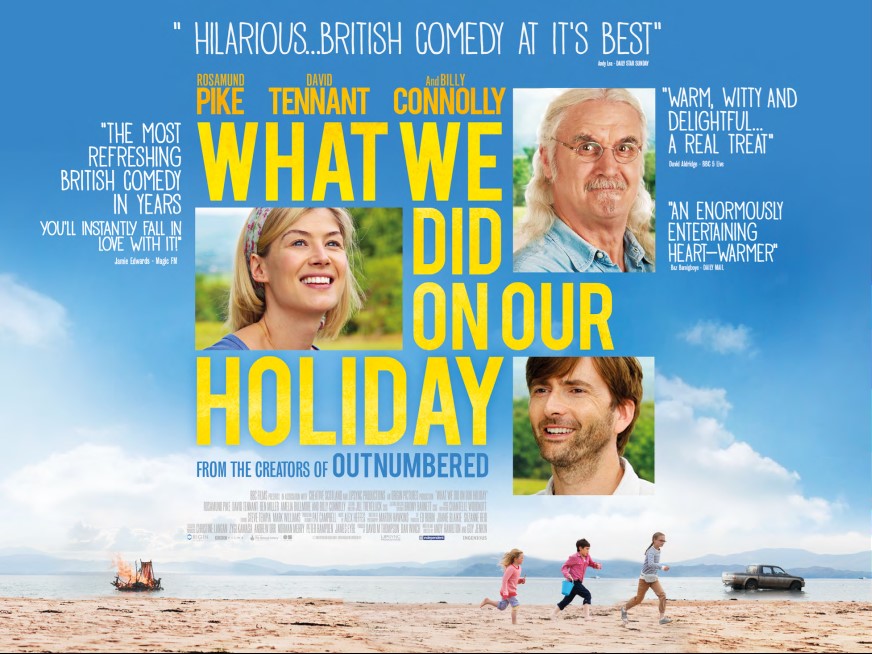
Film review – What We Did On Our Holiday (Andy Hamilton and Guy Jenkin, 2014)

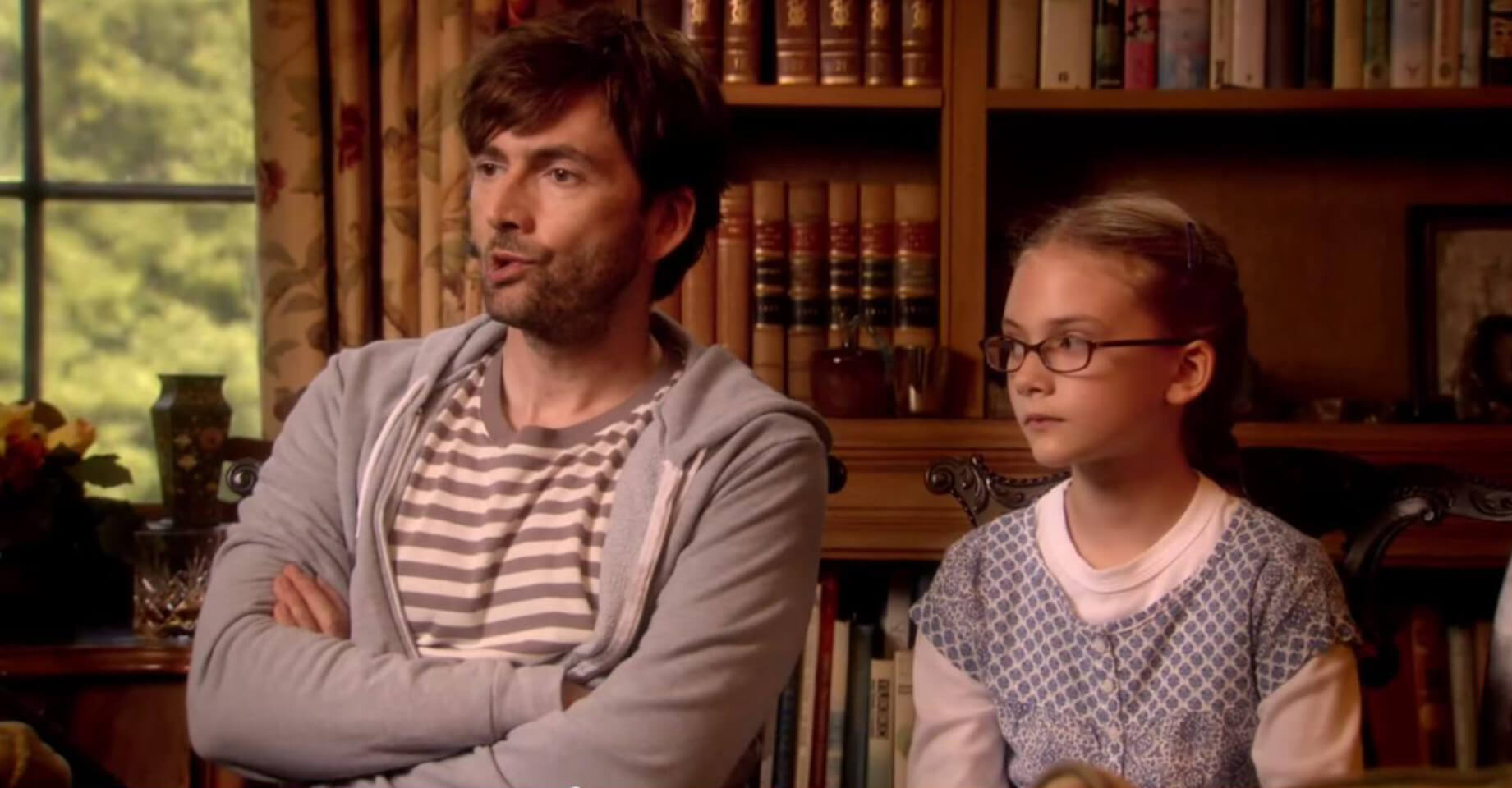
If you’ve ever watched the popular British sitcom Outnumbered then you’ll become immediately outraged by What We Did On Our Holiday. The premise is exactly the same: a dysfunctional London-based family with arguing parents and three young and awkwardly inquisitive children go on a trip to visit their quirky grandfather and the annoying sibling of one of the parents. The dialogue and individual characters seem highly familiar too and it’s difficult to avoid the thought that this could have been done to much greater success with the Outnumbered cast. It’s only after a small amount of research that it becomes evident that this film is indeed written and directed by Andy Hamilton and Guy Jenkin, the creators of Outnumbered. Admittedly, they couldn’t very well have written “By the way, we made Outnumbered and we know this is basically Outnumbered: The Movie but please stick with it.” I would have helped though.

The storyline involves father Doug (David Tennant) and his wife Abi (Rosamund Pike) travelling to see Doug’s father Gordie (Billy Connolly) in the Scottish Highlands. Their marriage is on the cusp of separation, a fact they like to assume their children don’t know. They’re visiting Scotland to celebrate Gordie’s birthday with a party co-ordinated by Doug’s brother Gavin (Ben Miller) and his wife Margaret (Amelia Bullmore), who provide some laughs as a couple attempting to keep up appearances.

A laugh a minute this is not.

A laugh a minute this is not.

Despite what the poster says, this is not British comedy at its best. The reason for this is that only one of the three main cast members is a comedian and the short running time means the children aren’t provided enough space to cultivate any big laughs. The funniest moment in the whole film comes when the son Mickey tries to explain how he managed to discover his parents were getting a divorce, missing out most of the details of what was heard but lengthily revealing his technique to go to the toilet silently so he can eavesdrop. The screen time afforded to Miller and Bullmore is refreshing when it happens, though again this is limited and it feels like there was more on offer.

It’s a bold move to use this as a vehicle to tackle some pretty hefty subjects and for the most part this ambition elevates it to something bordering on a weighty drama with a humorous veneer. The impending death of elderly relatives, the lack of emotional support provided by the close family of these elderly relatives, the denial of innocence of youth due to over-exposure to mass-media, the lack of respect provided by media when the desire to get a good story transcends their own moral compass (the film was written in the immediate aftermath of the publication of the Leveson Inquiry). These are all topics that Hamilton and Jenkin clearly felt were beyond the scope of their beloved sitcom and more deserving of a feature length film. For that they should be applauded, despite an overall feeling of the film being an underwhelming disappointment.

Ultimately, a film marketed as a comedy will succeed or fail on the amount of laughs it elicits. The lack of natural comedic tendencies of both Pike and Tennant mean that the film relies too heavily on three young children playing for cute giggles and a support cast that isn’t seen enough to make up the ground. If you want to laugh a lot for 90 minutes then a better option is to just watch three episodes of Outnumbered, which is a disappointing conclusion to reach.

What We Did On Our Holidays is available on Netflix now and can also be purchased on Blu-ray or DVD.

The Intern (Nancy Meyers, 2015)

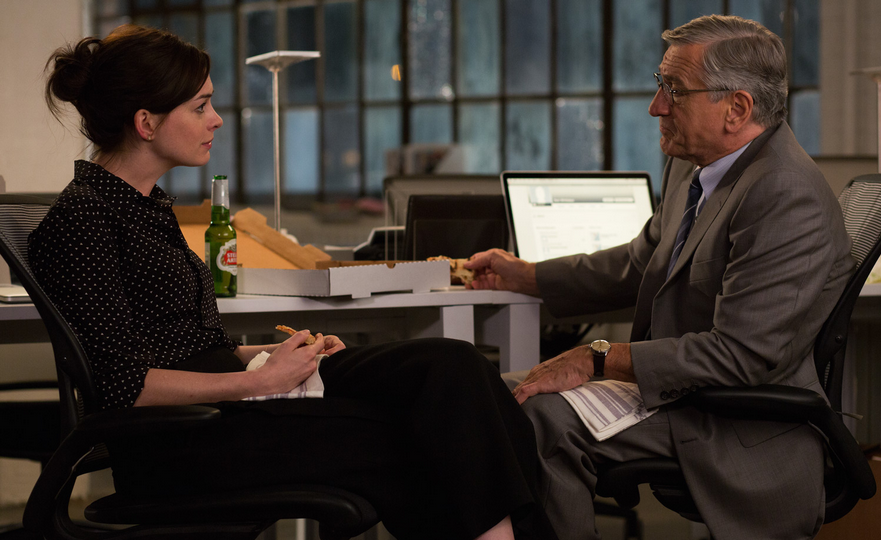
Nancy Meyers has a rich history in crowd-pleasing comedies. Her writing and directing credits include What Women Want, both Father of the Brides, It’s Complicated, The Holiday and Something’s Gotta Give. The basic premise of her latest, The Intern, is that a 70-year-old widower Ben Whittaker (Robert De Niro) signs up the the senior intern programme of a rapidly-growing start-up business, only to be assigned as the personal assistant to company director Jules (Anne Hathaway), a woman seemingly struggling to keep up with the demands of her new-found success whilst balancing it with her house-husband Matt (Anders Holm) and daughter Paige (JoJo Kushner). Initially resistant of Ben, she soon grows to his warm personality and old-fashioned sentiments, leading to doubts over the future of her personal and professional life.

This may sounds like middle-of-the-road schmaltz, but it works. Some softening colour washes, a pleasant-on-the-ear soundtrack, straight-from-GAP outfits, showroom offices and houses. It’s a look at the modern world from the rose-tinted perspective of middle-to-upper-class old people, coming together to appeal to women of anywhere between the age of about 30 upwards. It is easy on the eye and easy on the soul, but to dismiss it as just that would be wholly unfair.

internscreen

By design, Meyers has created a picture that on the surface is just a pleasant and slow-paced monorail ride through the life of Ben and Jules. However, there is quite a lot of power in the messages it is portraying. First of all, it is telling women to not lie down and take the easy road when it comes to business, despite constantly being told that attempting to be the CEO of a business isn’t correct of a woman. Secondly, just because you have a child, don’t assume that you need to forfeit your career to ensure your partner can maintain his whilst you stay at home and look after your child. Thirdly, don’t feel guilty if your partner doesn’t get any of this.

I’m not sure how this film would fair in the Bechdel Test, which scores films on how sexist the content is by checking how many named female characters are involved with conversations with other women about something that isn’t men. Unfortunately, it would probably score low because the film drowns Jules in a sea of men to highlight the isolation she is experiencing in her career (other key female characters in the office are her emotional assistant and a masseuse). It may also be seen as unfortunate that she relies on a father-figure to guide her through her issues rather than working them out herself, but that’s the nature of the beast and it isn’t at all detrimental to the overall impact of the film in the final act.

There are a few failures. Husband Matt completely loses his essence about halfway through and doesn’t seem fixed in reality, undermining the effect of his actions and Jules’s reaction to them. Too often she brings emotion to the forefront of the company – one scene is obviously playing for laughs but when she’s prioritising the retrieval of a personal e-mail over issues that could destroy the company, the thought can’t be avoided that perhaps she isn’t the right person to sit at the top.

Overall, the film is a success and will no doubt please the crowds to which its box office rivals won’t appeal. It’s slightly early for the Christmas crowds and will not be remembered when the awards season is upon us, but it if you need some surprisingly thought-provoking entertainment there are far worse ways to spend two hours.

The Intern is released at cinemas in the UK on 2nd October 2015.

Irrational Man (Woody Allen, 2015)

Another year, another Woody Allen film. It must be getting tiring, all this. Coming up with excellent idea after excellent idea, living with the pressure of high expectations. Sickening then that despite this film being another example of style over substance, the substance is unquestionably absorbing and the style is abundant. Much like all of his other recent films, then.

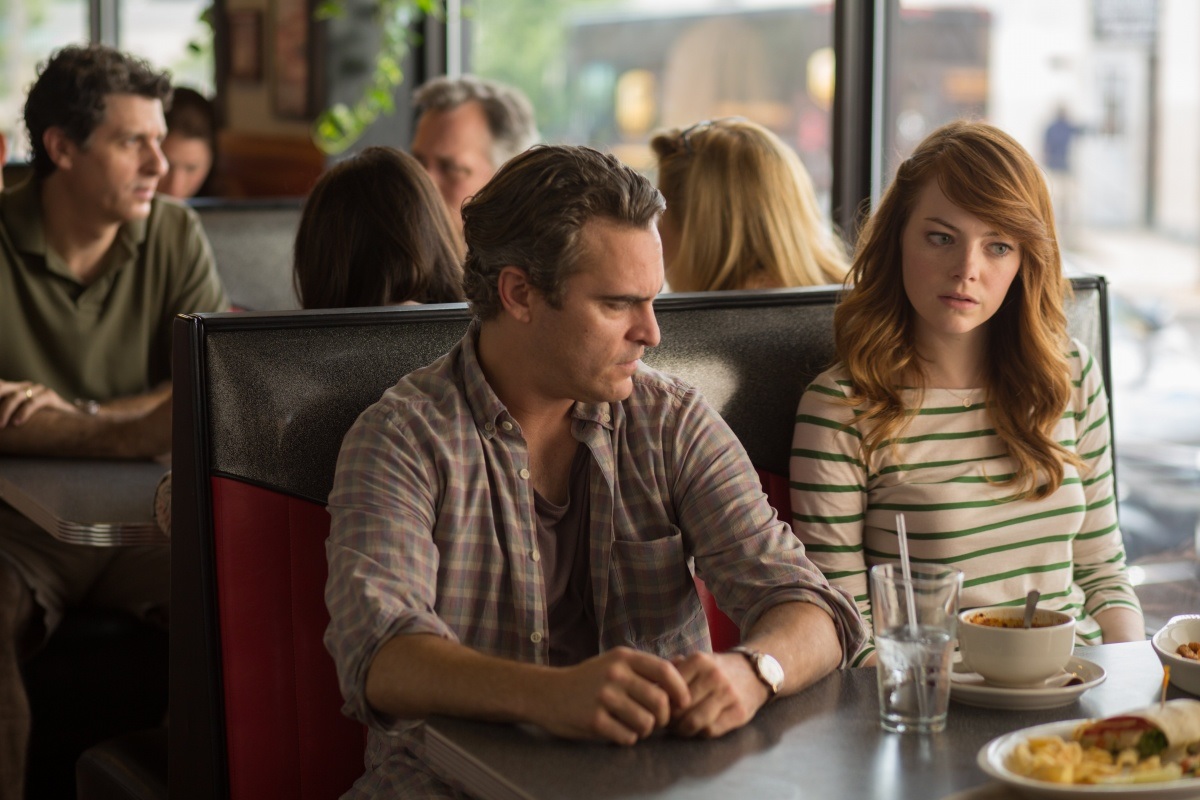
This is the tale of university philosophy professor Abe Lucas, who arrives at a Braylin College, New England with a reputation for being both an alcoholic and a womaniser. He immediately attracts the attention of married chemistry professor Rita (Parker Posey) and philosophy student Jill (Emma Stone), the former of which is married and the latter of which is in a long term relationship to which she is seemingly dedicated. He strikes up  an intellectual friendship with the Jill that eventually leads to the suggestion of more. However, lacking enthusiasm for life, Abe seems lost until an unexpected twist of fate turns his life around and with it his attitude towards it.

A fantastic screen couple.

A fantastic screen couple.

There are six listed cast members here, but there really are only two stars here. Phoenix and Stone make a formidable pairing. He may have put on some weight for this role, but Phoenix’s allure is still very much there and his convincing lost soul act is enough to make his appeal to the much younger Stone quite believable. The conversations she has with her family, friends and an increasingly frustrated boyfriend (Jamie Blackley) are so natural they could be eavesdropping. The ability Woody Allen has to enter the mind of a young and impressionable individual is uncanny. It’s subtle but enchanting.

When the twist arrives there is inevitably a risk that it will derail the film, drawing away from the realism of the first act as it blossoms into a full-blown thriller. Thankfully it doesn’t stray too far from the mark, walking a fine line but concentrating on Abe’s irrational justifications of his actions rather than spiralling out of control, which probably would have been the easier option.

It doesn’t quite reach the joyful heights seen in Midnight In Paris, though is streets ahead of the unfathomably popular Blue Jasmine. Well worth checking out if you can find it.

Irrational Man is at UK cinemas now.

Orion: The Man Who Would Be King (Jeanie Finlay, 2015)

ORION: The Man Who Would Be King (12A), the latest feature documentary from award-winning director Jeanie Finlay (Glimmer Films) is released into UK cinemas from Friday 25 September and has received distribution support to enhance this theatrical release from Creative England and Ffilm Cymru Wales.

Orion tells the story of Jimmy Ellis, an American singer with a natural voice that drew unavoidable similarities to Elvis Presley. In the aftermath of Elvis’s death in 1977, music producer Shelby Singleton of Sun Records played on the conspiracy theories about Elvis having faked his own death and created Orion – a masked singer with a mysterious past who had the look and sound of Elvis whilst never laying claim to being the man himself. For four years success lay in the hands of Ellis as he toured and rode the waves of popularity, but frustrations crept in about the public perception of him and the deals he had signed and he finally broke away from his deal in some style.

This documentary was spawned by a chance purchase at a Nottingham market, where director Jeanie Finlay picked up a copy of the Reborn album on 12″ vinyl, Orion’s debut release. That was where the interest in him started, and between then and now the director has visited almost everyone closely involved in his life to discuss their experience of a man driven by a desire to sing on his own terms. It is excellently put together. It is a story that threatens to be either not very interesting or flawed due to lack of decent source material (the Presley estate provide little footage for these kinds of films and many of the key people in the film were unavailable for interview). Fortunately, neither of these things threaten to creep in and the end product is fascinating.

Oh Ryan.

Oh Ryan.

It goes a long way into intimately portraying a man torn between being forced to hide behind a mask and enjoying the limited success he was achieving. It is balanced and as such avoids over-celebrating Ellis, concentrating on his personality rather than his success. As with most music documentaries, many of the anecdotes bring huge amounts of comedy to the table and Finlay has been careful to interview as many people as were available, no easy task when on such a tight budget.

Orion: The Man Who Would Be King is a documentary worth watching, and it’s an experience enhanced if you know nothing about Ellis. A full list of screenings can be found on the official website.

Keith Richards: Under The Influence (Morgan Neville, 2015)

Keith Richards: Under The Influence is a documentary film by Morgan Neville, the man responsible for the excellent Academy Award-winning 20 Feet From Stardom. Richards has a new album out – Crosseyed Heart – and the timing of this film gives it the feel of being a bit of an extended promotional interview.

Indeed, that’s exactly what it is. Bringing in a few musical friends to offer further insight, the film is actually a series of interview filmed in various locations across the USA. The fact it is just a talking heads film is not to say this is a disappointment as a documentary. Fans of the band and/or the individual will find a lot of joy from watching the series of interviews with a man who knows how to tell a tale. Most avid fans have probably already read his autobiography “Life” and an 80 minute film is never going to cover the depths of a 500-page book.

Keith Richards: Under The Influence is available excusively on Netflix now.