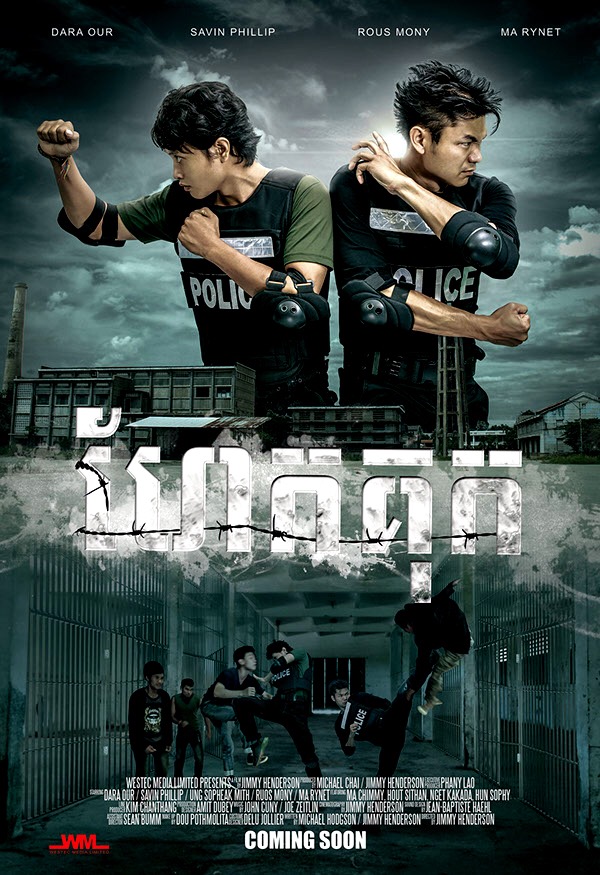
Shot on a budget of just $260,000, Jimmy Henderson’s latest release ‘Jailbreak’ is an impressive and resourceful film that is far beyond the sum of its parts.
The film is set almost entirely in the Phak Kai Prison complex, where a small team of police officers are sent to deliver the notorious criminal Playboy (Savin Phillip) to his cells under the belief he is the leader of the notorious Butterfly Gang. Aware that he is going to reveal her true identity, real gang leader Madame Butterfly (Céline Tran) instigates a prison riot to attempt to capture and murder Playboy, which leaves our team of police – including Jean-Paul Ly, Dara Our and Tharoth Sam – to fight their way out of the prison complex and avoid being killed.
London-based stuntman and actor Jean-Paul Ly was on hand to introduce the film before its screening at the London Film Festival. He has an illustrious stunt career, recently working on Lucy, Doctor Strange and Now You See Me 2. His role in Jailbreak was two-fold. Not only did he star in the picture but he also trained all the stunt team involved. “There is no action film industry in Cambodia, which means that there is no stunt actor industry in Cambodia,” he said, recollecting the project. “I said ‘Where are all the stunt people?’ and (producer Loy Te) said ‘There’s nobody any, so you’ll have to train extras!’, which I thought was a joke but he was deadly serious.” They trained every weekend for sixteen hours and ended up with 80 extras all capable of performing in action films.
The results are incredible, especially considering the background to the production. The bokator fighting style, one of the oldest traditional fighting systems in Cambodia, features heavily in the action sequences.
Te and Henderson enlisted Cambodian MMA champion Tharoth Sam as the sole female police officer. She’s capable of holding her own in a fight and is also responsible for most of the best one-liners, using great comic timing to stop the all-male cast dragging the film back into the 1980s.
Céline Tran also appears in her first action film role, following a successful career in the pornographic film industry. She’s a great antagonist as Madame Butterfly and clearly has a lot of fun in the role, eventually getting a one-on-one fight with Sam towards the end of the film.
The Cambodian action film industry is, essentially, in its infancy. With films like this and Jimmy Henderson’s previous effort Hanuman leading the light, there is every chance that we’ll see an swell of quality films over the coming years that will help to grow the industry.
If they can do this for $260,000, we can only imagine what they could do with a Hollywood budget.
Director/writer Paco Plaza latest horror film Verónica received its UK premiere at the BFI London Film Festival this week. The film’s short running time ensures that there are few dull moments, though a pulsating finalé does its best to make up for a lack of characterisation beyond the titular lead.
Based on a real life police report, the film opens with a frantic emergency call and response. It is June 1991. Madrid. A girl screams down the phone that there is someone in their house. Once there, the police officers discover evidence of paranormal activity and it becomes the first official officer report to corroborate evidence of the occult. It is that real-life report that Plaza uses as a starting point.
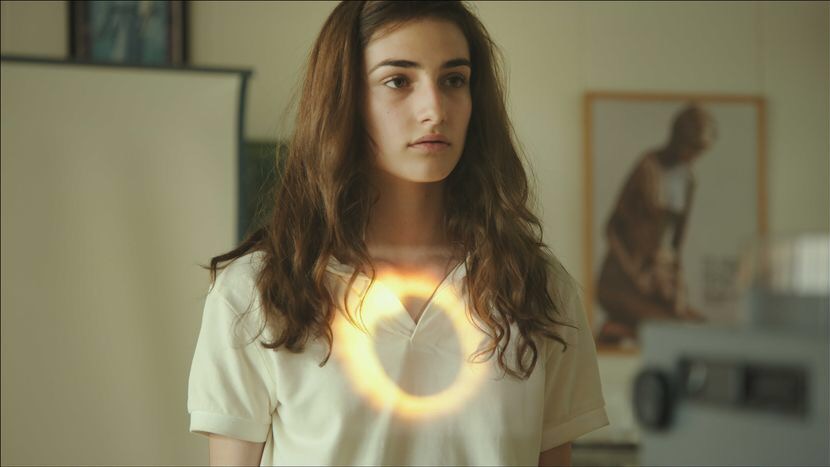
Verónica (debutant Sandra Escacena) is a teenager who is trying to cope with the death of her father. Busy with her school work, looking after her siblings full time (her mother is around but works long hours), but feeling outcast at school, Verónica is a girl mature beyond her years in many respects. However, she seeks an escape from her isolation in the form of a ouija board séance, which she plans to carry out during a solar eclipse with her school friends Rosa (Angela Fabian) and Diana (Carla Campra).
The three girls conduct the séance in a manner that ticks off very much every quintessential horror trope. The glass smashes, the lights go out, the board rips, panic ensues. It’s ticking all the right boxes but doesn’t ever feel like it’s convincing in any of it.
Indeed, throughout the film there are a number of typical plot points that serve to underline Plaza’s love of the genre, which some will see as a love letter to the genre. Many, however, will see it as a lack of ideas.
At times, it felt like there wasn’t enough time to explore the relationships between the main characters. Seemingly pivotal lead characters in the first act are largely forgotten by the end, whilst the mother changes from negligent workaholic to loving mother over the course of three days, without ever feeling like there’s a strong bond between her and her children.
Conversely, there is clearly a playful rapport between all of the children. Twin sisters Lucía and Irene (Bruna González’s and Claudia Placer respectively) have a real bond and it is in some of their natural banter that the film sparks into life. Their younger brother Antoñito inspires a lot of sympathy due to his hopelessness, which Iván Chavero portrays wonderfully. Together the results are great and the scenes they share are entirely believable.
Another positive is Plaza’s deliberate lack of use of CGI effects, which serves the film well. Black, monstrous hands appearing from out of a bed is something that is so easily done as a practical effect, but yet this seems to be something many modern directors would add in the CGI studio at a later date. The terror felt by the children is palpable.
By the conclusion of the film, I couldn’t help but wonder how much of the story had been embellished based on the police report. What we have is an isolated, depressed teenage girl who is obsessed with the occult. The police may have been called to the house, but it would be negligent to blame the occurrences on the occult based on the scant evidence available. This is clearly a girl in need of attention and mourning the loss of a father, unable to find an outlet.
In cinematic terms, that can all be forgiven with a pulsating climax that feels pacy and realistic, making any worries about the plot slightly moot. Sometimes horror is just about delivering thrills and making your audience share in the terror of the main characters. For the last fifteen minutes that’s exactly what we get.
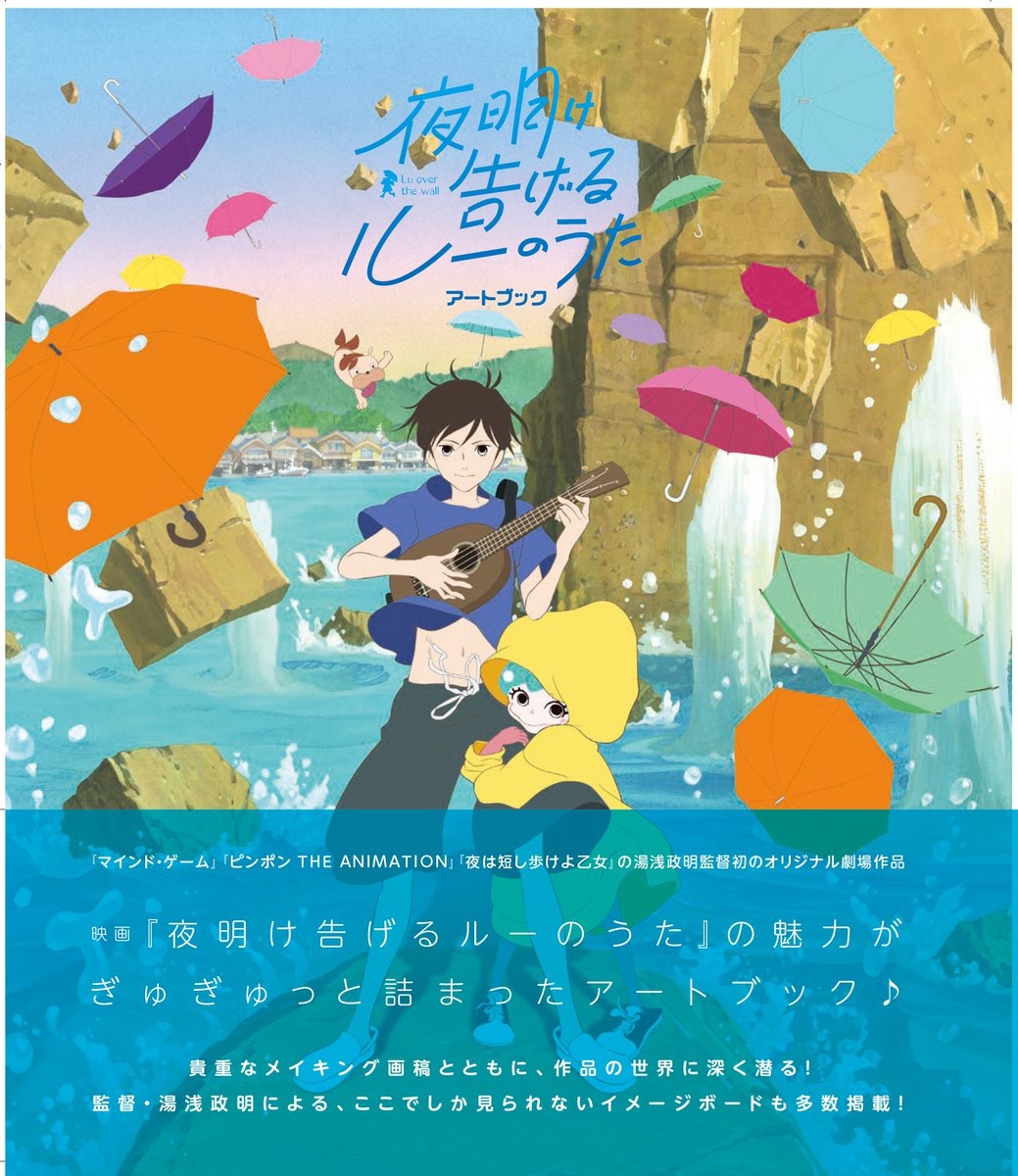
Japanese anime? Quirky soundtrack? Human forms an unlikely bond with a fish person? Yes, it may look on the surface to be just like Hayao Miyazaki’s 2010 film ‘Ponyo’, but Masaaki Yuasa’s ‘Lu Over The Wall’, which received its UK premiere at the BFI London Film Festival this weekend, is far from a simple rip-off.
The second release from the Science Saru Animation studio, after Yuasa’s earlier ‘The Night Is Short, Walk on Girl’, centres around Kai (voiced by Suma Saitō), a gloomy and distant music-creating teenager living in a small fishing town in Japan with his father and grandfather. Kai is pestered into joining a band by two of his schoolmates. Their first rehearsal, on the abandoned Mermaid Island, awakens the interest of Lu (voiced by Kanon Tani), a mermaid who is vulnerable to sunlight but loves to listen to music and dance. Following a confrontation with bullies the band catch illegally poaching fish, Lu comes to the rescue and forms an unlikely bond with Kai and his bandmates as she joins the group and they are handed the opportunity to perform at a local festival.
This is a bizarre film that provides some genuine laughs throughout. The music is quirky, leading to some pretty imaginative reactions from the villagers when they first hear Lu singing. One suspects that this scene was exactly what the director Yuasa had in mind when he started, building the rest of the general idea towards making sure he got the best laughs out of these scenes. It’s daftly entertaining and really hits the spot.
There are more laughs when Lu breaks into a centre for stray dogs and releases them to create a wave of mer-puppies. It’s easy to imagine how much fun the animators and story writers were having when they conceptualised that.
‘Lu Over The Wall’ won the top prize at this year’s Annecy Animation Film Festival, and there is good reason. Park the inevitable comparison to ‘Ponyo’ and seek out this fun and fancy free animation.
Then spend the rest of the day trying to get that music out of your head.
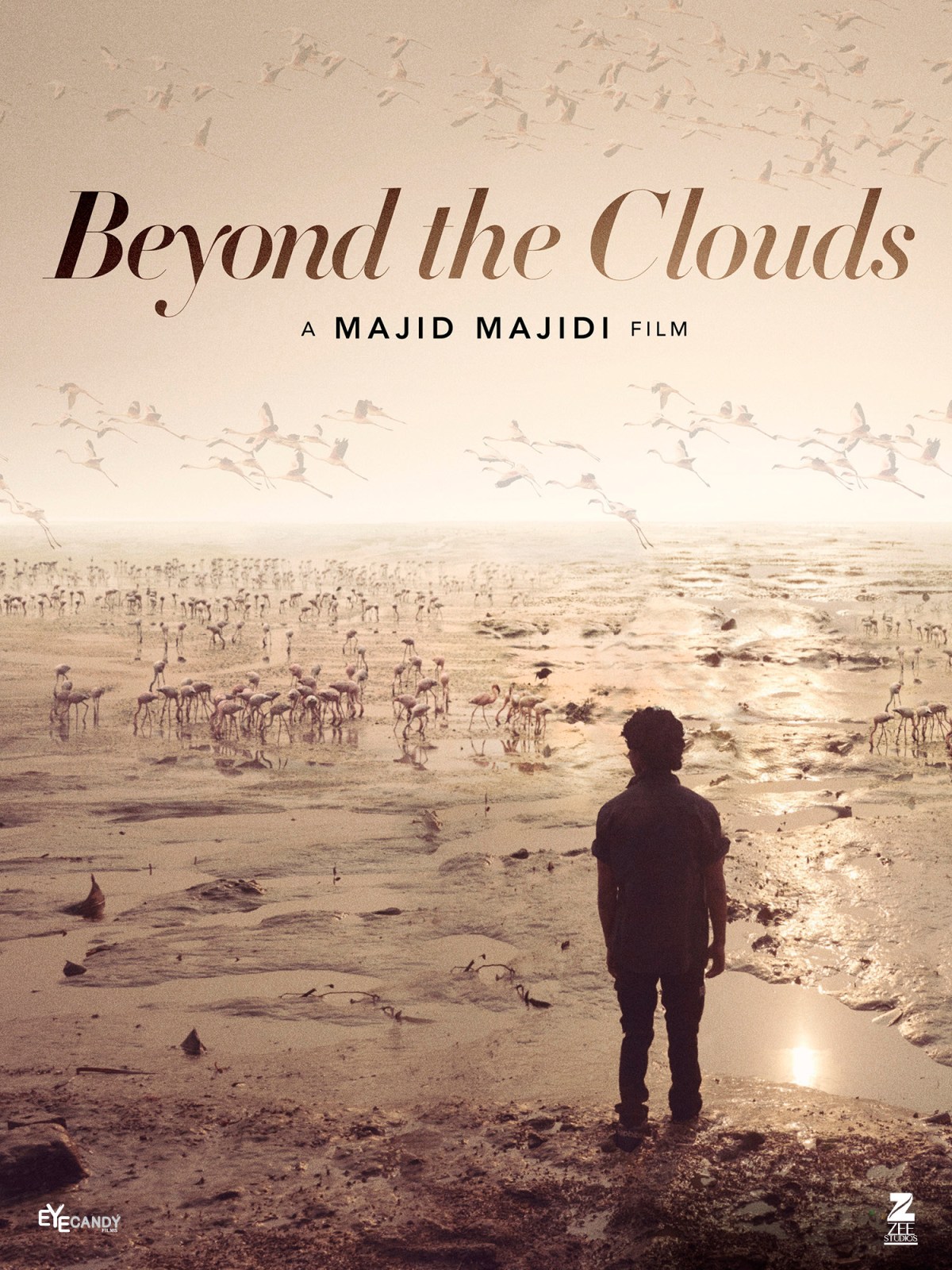
Majid Majidi’s latest film ‘Beyond The Clouds’ received its world premiere on Friday night at the pop-up Embankment Garden Cinema, specially created for the BFI London Film Festival. The director was in attendance to introduce this most brilliant and vibrant of films, alongside cast members Ishaan Khatter and Malavika Mohanan and several members of the crew.
The Mumbai-set tale centres around Aamir (Khatter, in his cinematic debut), a 19-year-old who is making a living of kinds by dealing drugs around the slums and docklands of the city. After a drugs bust leads to a chase with the police, Aamir winds up at the doorstep of his sister Tara (Mohanan). She attempts to protect her brother, but she ends up in prison herself. He must quickly learn to take responsibility to save his sister and their relationship.
In its opening shot, striking in its simplicity, we see the overarching message of the film. We see a busy but cleanly neat overpass, cars flying by. An unknown boy stands at the side of the road. A car pulls up and hands him a package. As we follow this mystery person as the camera pans down, the short one-shot focuses on our protagonist as he takes a package through into the underbelly of the divided city. It is an underbelly littered with street-bound families and forgotten people.
Whilst this separation of classes is made clear, it is a film, first and foremost, about the brother-sister relationship between our two main characters. It is about how they have let their close bond slip, leaving them with nothing but emotional wounds and lost memories of better times before the death of their parents.
Given that getting this chemistry right was such an important piece of the filmmaking puzzle, it seems like a risk that director Majidi cast two relatively unknown actors in the lead roles. Speaking in the Q&A after the film, director Majidi said: “The presence of superstars is crucial for most Indian films, and perhaps particularly in India with 2000 films produced every year. The audience is really keen to see their favourite actors on the screen. Despite the fact that there are so many superstars in India I asked the producers to let me cast people who’d never acted in front of a camera before. I was lucky they agreed to let me do that.”
The actors may not be superstars now but they are clearly destined for greatness, providing two absolutely astonishing debuts to form the backbone to the plot. Mohanan has enjoyed previous successes in Malayalami films, though this is Khatter’s debut. “The casting process was extremely long and we’re very lucky that both main actors come from acting families,” he added.
Lead actress Mohanan was forthcoming in her surprise at the fast turnaround from casting to appearing on set. “I came on set one week before we started filming. The process started and it was incredible… we had so many creative highs.” She is clearly visibly excited to have been given an opportunity by a truly well-respected director, though it didn’t affect her on set. “I don’t think it really hit me until the shoot was over. I had no time to take it in! It was incredible and the journey was so beautiful. So many of my scenes were so intense. I’d never done that before and I didn’t think i could do that.”
Actor Khatter was equally positive about the process, praising the method Majidi used to get the most out of the cast. “He didn’t want to give us time to develop the character. He’d rather we did it on set.”
The results are astonishing.
A. R. Rahman provides the score. Rahman previously worked with Majidi on the film ‘The Prophet Mohammad: The Messenger of God’. In the two years it took to complete that soundtrack, they grew to be close collaborators. The score for ‘Beyond The Clouds’ ebbs and flows, allowing the picture to breathe around it. It is never more apparent than the opening scene, bringing to life an introductory montage that explains fully the character Aamir and illuminating the dark corners of Mumbai that the visuals reveal.
There are several key scenes that use silhouettes, which prove to be a recurring theme and are used to portray contrasting emotional situations. Early in the film Aamir witnessed the trafficking of women through a silhouetted screen, bringing him suspicion. Later on there’s a powerful scene involving an arresting sexual assault on a woman that plays out behind hanging sheets. It’s a simple framing device that runs throughout the film and each shot is captured perfectly by director Majidi working alongside cinematographer Anil Mehta.
Beyond the Clouds is a wonderful film. At 58, Majidi is still taking huge risks that are paying off. The result is a raw and believable story that has plenty of heart and a powerful message. Simply a must see.
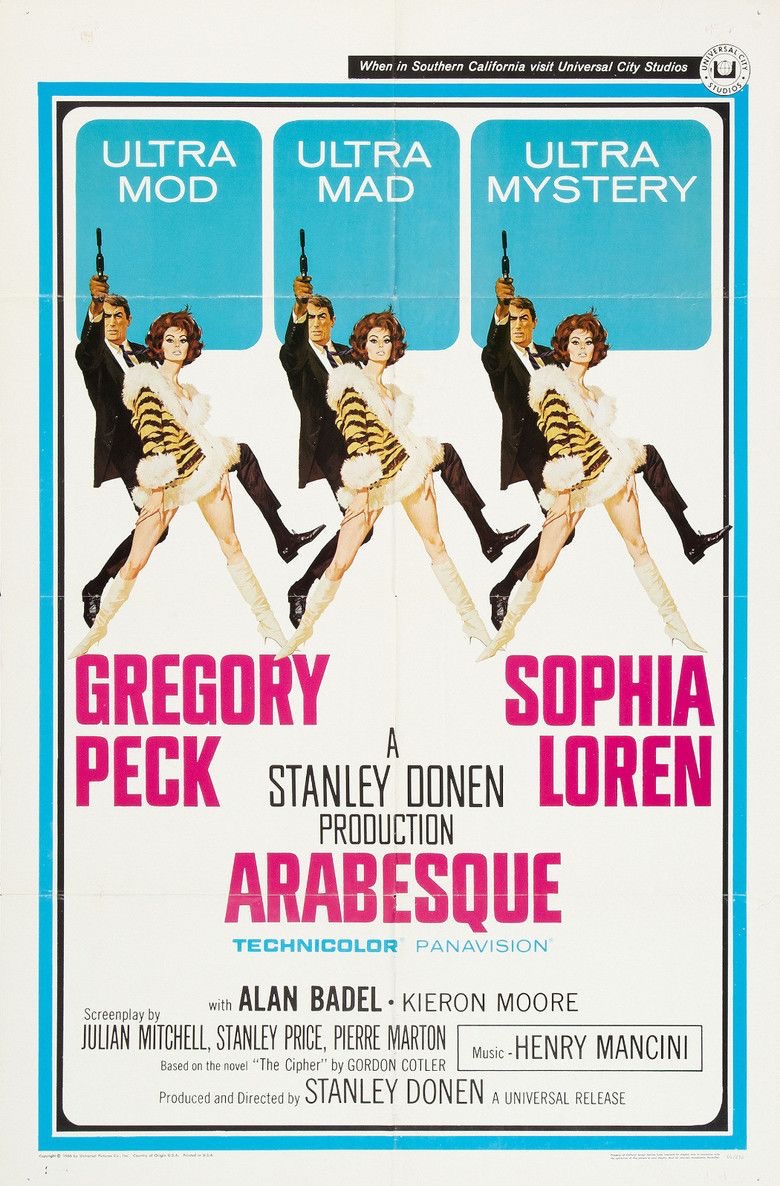
“Our only hope is to make it so visually exciting the audience will never have time to work out what the hell is going on”. This damning statement by director Stanley Donan about the film ‘Arabesque’, as recalled by cinematographer Christopher Challis in his 1995 memoirs ‘Are They Really So Awful?‘, explains quite a lot about the final product. It had reportedly already cost $400,000 to have the script rewritten several times, partly due to the casting of Gregory Peck instead of the preferred choice of Cary Grant in the lead role. The result is a film that is almost the definition of style over substance, with a feeling of a real missed opportunity to something truly special.
The confused and therefore confusing script centres around Professor David Pollack (Grant), an expert in ancient hieroglyphics. He is approached aggressively by Middle Eastern Prime Minister Hassan Jena (Carl During) and his ambassador to Great Britain, Mohammed Lufti (Harold Kasket), who offer him £20,000 to solve a hieroglyph-based riddle, the answer to which is highly urgent. Pollack is forced to work inside the mansion of shipping magnate Nejim Beshraavi (Alan Badel), where he also meets the infinitely distracting Yasmin Azir (Sophia Loren), though he quickly realises that he will be killed once he has solved the riddle and decides to escape, with Yasmin in tow, triggering a chase across the brilliantly-captured 1960s London.
Stanley Donen had risen in popularity in the 1940s and 1950s following a prolonged successful run of musical films, primarily with MGM. Having made his name as a Hollywood choreographer in the 1940s, he helmed such classics as On The Town (1949), Singin’ in the Rain (1952), Seven Brides for Seven Brothers (1954), Funny Face (1957) and The Pajama Game (1957). He was, by the end of the 1950s, regarded as one of the great directors from the golden era of Hollywood.
Donen then set his base in London, a move that coincided with the breakdown of his marriage to Marion Marshall. This film is one of a handful that were produced during Donen’s British period, which defined a decade of his career throughout the 1960s. The period was a fruitful one, yielding such films as 1960 ‘Once More, with Feeling!‘ and ‘Surprise Package’ (both 1960), ‘Charade’ (1963), ‘Two for the Road‘ and ‘Bedazzled‘ (both 1967) and the now-hard-to-find camp comedy ‘Staircase‘ (1969).
‘Arabesque‘ could be seen as Donen’s attempt to make a film in the style of Hitchcock, with the feeling of a political suspense mirror reminiscent of ‘Torn Curtain‘, which had been released in 1966. If it was, it was a failure, with any feeling of suspense being lost amongst a clumsy plot that is tricky to follow.
For all the failings of the plot, the sheer beauty of Sophia Loren cannot be escaped. Dressed in the exquisite fashion of Christian Dior, she is the perfect example of elegance in film. Indeed, it is a point the studio and director were clearly keen to underline, with a special note during the opening credits that reads “Miss Sophia Loren’s wardrobe specially created by Christian Dior”. One can’t help but contrast this with the epic failure of Donen’s final box-office release ‘Blame it on Rio’, which feels comparatively devoid of any artistic merit and relies on smut and nudity to progress the plot.
To begin to enjoy this film, one must suspend the entirely noticeable fact that there are a handful of Arabic characters that feature in the film, none of whom are of Arabic descent. It’s something that simply isn’t commonplace in 2017, which may be jarring to the modern viewer, though cinephiles will surely have to cope with much worse as they explore further back into the history of cinema.
Whilst the first two acts plod from plot twist to excruciating plot twist at a terrifying rate that feels both too fast and too slow to elicit any kind of positive response, the same cannot be said of the final act. It is here that we are finally rewarded for sticking with the film and are rewarded with a chase scene across some famous landmarks that feels as spectacular as any of Donen’s dance routines of his early career.
The question remains whether or not the audience should be made to work for around 90 minutes for such a pay-off, but regardless of this fact there is enough going on here to warrant a viewing. It’s not so much style-over-substance and style-then-substance. If you’re happy for this imbalance as the two factors are tragically compartmentalised, then you’ll find a fairly decent piece of cinema awaits you.
On Thursday 20th September 1973, 55-year-old former male tennis pro Bobby Riggs took on then-current Women’s Wimbledon champion Bille Jean King in a $100,000 winner-takes-all exhibition match. Whilst the prize was significant – King won only £3000 for her Wimbledon title – the ‘Battle of the Sexes’ was more significant in terms of what it meant for the game itself. As King herself put it, “I thought it would set us back 50 years if I didn’t win that match. It would ruin the women’s tour and affect all women’s self-esteem.”
Now, the match and the surrounding attention has been turned into a motion picture, courtesy of the directorial team of Jonathan Dayton and Valerie Faris, their third feature film after debut ‘Little Miss Sunshine’ (2006) and follow-up ‘Ruby Sparks‘ (2012).
And it’s really rather good.
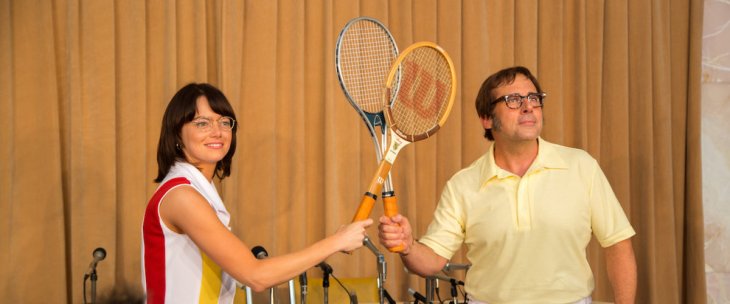
King (Stone) and Riggs (Carrell) pose for the cameras.
The biopic stars Emma Stone as Billie Jean King and Steve Carell as Bobby Riggs. It is clear from the start that both actors are relishing the chance to portray such iconic characters. Both have stories worth telling, which makes the final result feel fast-paced.
Riggs is larger than life, spouting ridiculous phrase after ridiculous phrase in the hope of any kind of attention. Carell is perfect for the role and, as usual, delivers something remarkably entertaining, far beyond the abilities of someone many mistake for a simple comedic actor. It’s amazing that Carell avoids becoming irritating, clearly enjoying with aplomb the misogynistic phrases Riggs became famous for.
King’s agenda is to exact revenge on those who underestimate the abilities of women tennis players, epitomised by Lawn Tennis Association head Jack Kramer (Bill Pullman), and ensure that women tennis players were given a level of respect and pay equal to their male counterparts. It is a more complex role than Carell’s, especially when factoring in her failing marriage to Larry King (Austin Stowell) and her blossoming romance with hairdresser Marilyn Barnett (Andrea Riseborough).
Stone again proves her acting mettle with an absolutely brilliant performance. She truly is an actor at the top of her game. It is her first portrayal of a real person, but she has clearly benefited from time spent with Billie Jean King in getting her mannerisms perfectly nailed down.
Equally, be ready to gasp at the end when you’re reminded exactly how much Steve Carell looks like Bobby Riggs.
This is a story that is as important to the LGBT community as it is to discussions about women’s rights and equality in sport and, more widely, in every profession. Billie Jean King was the first prominent female athlete to publicly acknowledge that she is a lesbian. Whilst this tale isn’t fully explored – it is limited to the reactions of Billie Jean King, Larry King, Marilyn Barnett and rival tennis player Margaret Court (Jessica McNamee) – there is certainly a sense of the impact this would have had at a critical moment in the blossoming of the women’s tennis game.
It is rare that a biopic comes together with such a perfect cast and crew and tells a story so effectively and authentically. ‘Battle of the Sexes’ a fine achievement in filmmaking and one I will undoubtedly enjoy for a second time when it receives its full UK release later this year.
If the thought of a horror-comedy fills you with dread, if not for the scary monsters then more for the fact that they usually fall short of whatever they’re trying to achieve, then fear not. Little Evil may not truly be a great horror film, nor is it a hilarious comedy, but that doesn’t mean it’s a bad film. For those wanting something lighthearted this Halloween there are much worse ways to spend 95 minutes.
Adam Scott stars as Gary, a real estate worker who has married Samantha (Evangeline Lilly), who comes with baggage in the form of her son Lucas (Owen Atlas), who Gary suspects may be the Antichrist. As he unravels the truth behind his new stepson, he is forced to form unlikely bonds in a race against time to save his family and the world.
There are supporting roles from the brilliant Bridgett Everett, Donald Faison, Chris D’Elia, Kyle Bornheimer and a surprising cameo by Sally Field, though this is less surprising when you learn that director Eli Craig is her son. It’s an ensemble cast that are able to provide plenty of humour to keep the wagon rolling without ever feeling like it stutters.
The film is peppered with nods to horror greats, presumably so that fans of the genre will giddily point at the screen and say “Oh, that’s the clown from Poltergeist!” at their less-versed friends. Of course, the more likely reaction is a roll of the eyes and silence, but the references are done in good faith. Sure, giving the child a 6th birthday on 6th June is fairly obvious, but not all comedy has to be subtle to be successful.
There is a worry that the film lacks any memorable gags and also fails to produce any striking horror set-pieces, though the movement of the buried-alive scene to the start of the film provides an impactful opening.
Adam Scott is a great leading man here, producing a relatable everyman who wants to make things work despite obvious signs that something is awry. There’s an art to his delivery of disbelief that only he seems to notice that Lucas is hiding something. It’s good to see him in a more prominent role than he is usually given.
Eli Craig has produced a fine follow up to his breakthrough film Tucker and Dale vs Evil. It has found a suitable home on the VOD service Netflix, which reduces the risk of it being a flop at cinemas and will undoubtedly increase viewership in the October double-header of Friday 13th and Halloween. It is notable, however, that it has quickly vanished from the front page of the service, making foot-fall traffic a little less likely.
Incidentally, Tucker and Dale vs Evil is also available on Netflix. If you’ve seen neither, Little Evil should be the one you approach second.
What do you get if you cross the director of Breakfast at Tiffany’s and The Pink Panther, one of the sexiest women of a generation, the film debut of one of the most bankable actors of all time and a soundtrack by one of the most celebrated film composers in film history?
A steaming pile of cinematic turd, that’s what.
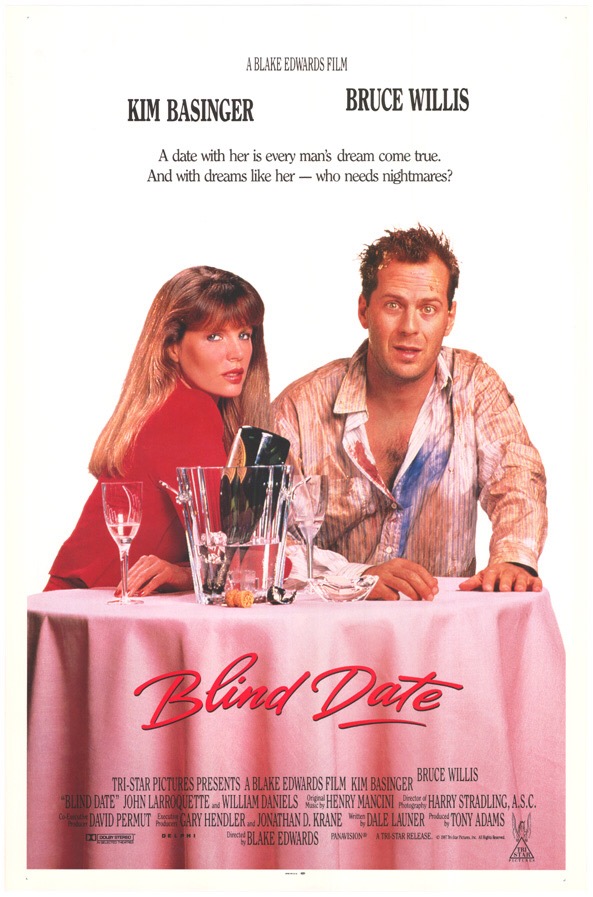
It’s a rare occurrence to find a film with a run time of just 95 minutes that somehow feels like it drags on. But Blake Edwards has managed it with ‘Blind Date’, a turgid effort if ever you’ve seen one.
Bruce Willis does his best as an ambitious and hardworking career man named Walter Davis. Walter must attend an important dinner with his colleagues, boss and the Managing Director of an important business partner from Japan. However, Mr Yakamoto has very traditional values and Walter is advised to take a date to the meal. In desperation, he calls up his friend Ted (Phil Hartman), who recommends he takes his wife’s cousin Nadia, played by the usually irresistible Kim Basinger.
It’s unusual that a rom-com tries to put a shocking twist or genre-challenging break to the norm. Blind Date doesn’t even attempt to change this. The humour derives from the fact that Nadia can’t take her drink and Walter is advised not to let her have even a sip of alcohol. Of course, Walter forgets this and Nadia instantly becomes wild, causing absolute mayhem at the dinner and leading to Walter losing his job.
By the end of the night they are being pursued by Nadia’s maniacal ex-boyfriend and Walter ends up in prison. It feels like a spoiler but the entire plot is played out in the tag line on many of the posters. Plus it is celebrating its 30th anniversary this year so it’s hardly new news.
One of the most remarkable choices is to recolour Basinger’s hair brown and cover up her eyes with a dreadful fringe. This is one of the pin-ups of the 1980s, known for her beautiful blonde hair and striking blue eyes. Here, she loses one and has the other covered up, with no obvious reason for either choice.
Bruce Willis, here billed second to Basinger, is clearly still finding his feet as he made the transition from American sitcom Moonlighters – and that dreadful pop career – to Hollywood A-lister. It’s hard to imagine that by the time this film was released he was already filming Die Hard. Noticeably, Fox Plaza, tbe building that starred as the Nakatomi Towers in that film, can be seen half-built in the background of a scene at Walter’s office.
Remarkably, Madonna was originally cast to star as Nadia in the film. She turned it down because director Blake Edwards refused to accommodate her wish to cast Sean Penn, at the time Madonna’s husband, as Walter. Of the incident, she said, “I was supposed to have approval of… the leading man, but they didn’t tell me they’d already hired Bruce Willis.” In my opinion, this film would have been even worse had the pair been involved, and viewers need only seek out 1986’s ‘Shanghai Surprise’ for evidence of exactly how bad it could have been.
Even Henry Mancini’s score feels bland and half-hearted, which is disappointing from the man who brought us ‘The Pink Panther Theme’ and ‘Moon River’. I do note that a better film could have made me see the score differently.
Fans of The Simpsons will take great pleasure in hearing Phil Hartman produce his best Troy McClure voice when he’s describing Nadia over the phone to Walter. It’s unmistakable and one of the few positives that helped me get through the ordeal.
It’s a film that has been largely forgotten by everyone who saw it and everyone involved with the film. Forgetting it is something I’ll be trying to do too, as quickly as
In 2003, I was in the middle of a hiatus from video games. Having grown up with the thrill of the NES, graduated to the vastly improved SNES and then enjoyed the comparatively mind-blowing PlayStation, by the time the PS2 arrived I’d lost interest. I got my first serious girlfriend in 2001 and with school exams also requiring my attention, I simply didn’t have time to commit to video games.
One of my go-to games throughout my initial gaming tenure was the ever-popular FIFA series. I had the first ever instalment. Titled simply FIFA International Soccer and featuring David Platt on the cover, the isometric visuals seemed like a massive improvement on Sensible Soccer, which I’d invested a dizzying amount of hours into. I didn’t know the word “isometric”, but what I saw was a 3D game of football on my screen for the first time.
The game grew with the consoles and no football pretender got anywhere near the brilliance of the one or two releases every year.
Such was my addiction that I even had a cheat printed for FIFA 2000 in gaming magazine CVG. I never did receive my £5 for that.
So, when I visited my brother at university in early 2004 and he and his housemates were playing a football game called Pro Evo, I was initially dismissive. It didn’t have any of the real team names or play names. It looked different. The controls were back-to-front. It was highly unlikely that in the two years since I’d given up video games that FIFA had been knocked off its crown.
But then I played it.
Instantly I realised why so much praise was being heaped on it. It felt so much more like a real game of football. It was also a lot more fun. It was more balanced. There didn’t seem to be as many cheap ways to score.
I was immediately jealous that I didn’t have access to the game, though I didn’t rectify the issue for another three years when I acquired an Xbox 360 and a copy of Pro Evolution Soccer 6.
I’ve since dallied with both sides of the fence, keeping up with the various merits and failings of both series. Sometimes FIFA has edged ahead, but despite the constants that it will always have – primarily the licences and more players for online modes – the PES series has invariably been much more playable.
Pro Evolution Soccer 2018
So now we’re in 2017 and I’ve picked up a copy of the latest game in the PES series: Pro Evolution Soccer 2018. It’s the first time I’ve picked up a copy of a sports simulator on release weekend for as long as I can remember, so is has been interesting joining in the online buzz.
The FIFA and PES series have converged on a version of events that has landed with an extremely similar setup. There’s an exhibition mode, a training mode, a league mode and a cup mode. There’s also a mode, here called Become A Legend, which involves taking over the career of a single player. There’s myClub mode, which allows you to spend points earned in every game mode on random players to create a team you can take online.
Finally, there’s the ever-popular Master League, a challenge for even the best PES player and a mainstay of the game for well over a decade. In this mode you take over a team of generic and very average players in a lower league and try to progress up the leagues and impress the owner of your club to the point that he will invest in better players for you to challenge for the top trophies.
Every mode has an equivalent in FIFA and neither are particularly better or worse than each other, so comparing the two on game mode alone won’t help anyone.
Where PES wipes the floor is with the gameplay. It has done for years and, having played the demo version of the latest FIFA, continues to do so this year.
Players are responsive and the simple controls allow basic skills to be executed immediately. Trapping the ball and close control when receiving the ball are amongst the simplest skills to master. Guesswork punts up the pitch rarely come off, reflecting real life. Calculated build up and through balls to strikers you know will outpace the defenders will often pay dividends. Try the same attack three times in a row and the defenders will learn from your efforts.
Winning in online modes is obviously never easy, but doing so feels like a huge victory and will be a crowning achievement of your abilities in the game.
There have been a handful of drawbacks I’ve noticed. Online mode has been blighted with either lack of players or poor connectivity, the latter being the first example of poor connection in any game I’ve noticed in well over a year. It’s frustrating to lose a match because of connectivity when it irreparably affects your ongoing ranking.
Player switching can be frustrating. It appears that it will never switch to a player behind the opposition, even if they’re a couple of steps away. That has been the biggest cause of conceded goals for me as I’m forced to bring a well-placed defender out of position to combat an advancing attacker, often then to have the ball played in behind me. That and the fact that the computer almost never concedes a foul will be rectified in an upcoming patch from Konami.
The final downside I’ve found is the inclusion of a handful of Legends in the game. This is great, but every copy of the game comes with Usain Bolt as a player in the myClub mode. When FIFA fans get Ronaldo but PES fans get someone who has never played professional football in his life, it does feel a little on the embarrassing side.
But that’s no problem for the wider game. When the gameplay and intelligent AI is this good, i can forgive the lack of real players. There’s always the extensive editing mode to rectify that anyway.
With an upcoming release of further game modes, including a career-spanning David Beckham career mode, this is a game that still has months of playability left in it and one I won’t be putting down for a long time.











 Cinema, etc.