Paper Moon (Peter Bogdanovich, 1973)

One of the most sure-fire ways of making an enjoyable and effective film is to ensure the chemistry between the two lead characters is strong. What better way to achieve this than by casting a father and daughter in what is essentially a buddy film?

In Paper Moon, we follow the story of tomboy orphan Addie Loggins (Tatum O’Neal) as she is taken under the wing of con-man Moses Pray as he agrees to take her from her mother’s funeral to her aunt’s house in Missouri. She is convinced he is her real father, a point that is hinted at throughout, despite his continued denial of the fact. One thing that they’re both convinced of, however, is that they make a great pair as a scamming duo, going door-to-door convincing recent widows that their recently deceased husbands had ordered them a personalised bible. This serves as an excuse for them to go on a prolonged adventure of dishonesty, an adventure that seems far more appealing than their other limited options.

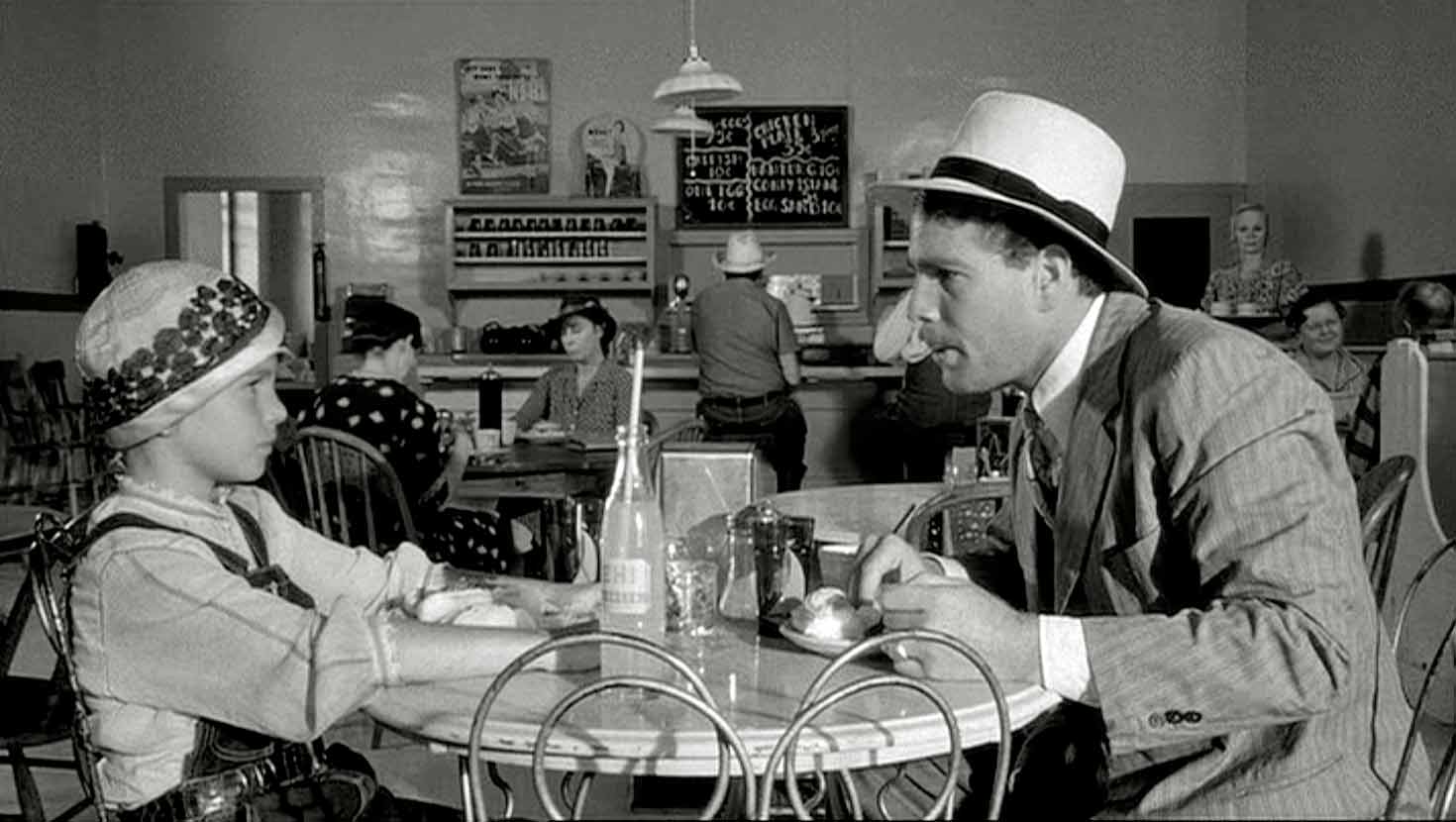
The chemistry between the O'Neals is excellent.

The chemistry between the O’Neals is excellent.

Much was made at the time – and has been since – of Tatum O’Neal’s performance. Indeed, she remains to this day the youngest person to win an Academy Award for Acting. At 1 hour, 6 minutes and 58 seconds, it is also the longest performance to receive a Supporting Actor/Actress Academy Award. It is playful and at times unintentionally comedic, but the playoffs with father Ryan are brilliant to watch. One memorable scene involves a long one-shot as they drive and argue, both livid at each other before turning it around to agree despite their tones still being that of an argument. It’s almost so good it doesn’t feel like they’re acting, although it allegedly took 39 takes over two days to get right.

One thing the film never answers is the question of whether the two are really father and daughter. The decision is made instead to leave it open as they head off into the sunset, presumably to continue much as they did in this film (a relationship explored in a panned TV sitcom spin-off series starring Jodie Foster). It is a nice decision – the fact they need each other, either as a father figure or as a driver to act responsibly, is to them more important than finding out this truth, at least at this stage in their relationship.

The bonus features are worth watching and provide a valuable insight into the making of the picture. The highlight is an anecdote involving Tatum repeatedly fluffing a line, resulting in her father having to eat countless amounts of waffles, much to the delight of Tatum. In fact, this was deemed so important as an example of their chemistry that the outtake was incorporated into the original trailer.

The cinematography by the Hungarian László Kovács adds a great deal to the authenticity of the film and its success in recreating 1935 Kansas. Coupled with a timeless soundtrack and a great attention to detail in the scenery and costumes, the result is that it transports the viewer completely into the environment, adding further embellishment to the excellent performances of both stars and their supporting cast.

A unique film with a lot to offer even the most ambivalent of viewers, this is one of the best re-releases of the year.

Paper Moon is available on Masters of Cinema Blu-ray now.

American Ultra (Nima Nourizadeh, 2015)

American Ultra is far better than it should have been. The basic story – a stoner grocery store assistant (Jesse Eisenberg) is actually an advanced agent from a secret programme that was shut down before his memory was wiped – sounds like pretty standard fare and doesn’t really suggest a great film is in order. A fast pace, short running time and well-judged performances make it an enjoyable romp.

  
Eisenberg is well cast and it’s a wise move to keep him in reluctant stoner character throughout, though it would have been easier to make him magically turn into an alpha male. Kristen Stewart makes another case for the ATL (Anti Twilight League) to take her a little more seriously with a solid performance and there are great turns elsewhere from Bill “Was That Bill Pullman?” Pullman, Topher “That 70s Guy” Grace, John “Luigi Mario” Leguizamo and Tony “Loose Seal” Hale.Perhaps this film doesn’t justify a trip to the cinema, but when it hits the steaming platforms it should be near the top of your list.

American Ultra is out now at cinemas in the UK.

スーパーマリオメーカ / Super Mario Maker (Nintendo, 2015)

The latest excellent game on the Wii U for the majority of the gaming community to ignore is Super Mario Maker, a game that puts the gamer in the driving seat to control the content of Mario levels in one of four skins: Super Mario Bros., Super Mario Bros. 3, Super Mario World and New Super Mario Bros.

As the trailer above shows, the content is quick and easy to activate, meaning a basic level can be created in no time at all. It may be fiddly at first but once the tools are used a couple of times it becomes remarkably intuitive. You simply control the content on the gamepad using the stylus (did you forget you had that?) and a giant hand replicates it on the screen. After a fairly basic tutorial you are ready to go!

Then comes a huge hurdle. One major issue you encounter at this point is the requirement to keep playing on consecutive days in order to unlock the more advanced level features. This means that perseverance is the key – the only key – to unlocking the tools to make the most innovative levels for friends to enjoy. The thinking behind it is clearly to make sure players don’t make a couple of exceptionally tough levels then disappear forever, though for the more dedicated amongst us it is frustrating. For anyone getting the game on day one and trying to put together a cool new course, get ready to be disappointed – all you get are four types of blocks, three enemies, mushroom power ups and pipes.


There wasnt mushroom for anything else in this level. Geddit? Mush room? Oh never mind.

 
As expected, Amiibo functionality is a key feature. When scanned, one of several things might occur, depending on which figuring has been scanned. For the most part a new playable character will be unlocked. This is fun but there is a flaw – the character is allocated at random so you can’t design the level around who you’ve placed in the box. It is quite fun to play as Link or Yoshi progressing through the stages he’s active in, though doesn’t add too much to the game. It’s disappointing that this is only available for the Super Mario Bros. themes and does nothing for the remaining three.

Where the game comes into its own is the ability to access other people’s levels. There is a leader board based on popularity and spending an hour in there was a joy. One level I played was called “Don’t Touch The Shrooms”, a tough level that can only be completed if you can avoid mushrooms due to a carefully placed spring board. When mushrooms are being fired at you from all angles it gets quite stressful!

Feel free to add me on your Wii U account and try out some of my Super Mario Maker creations. My username is Hutchie and I’ll be slowly unleashing increasingly complex levels throughout the weekend.

This game has legs. It might not feel impressive on first look but get the hang of it now and it will reward as more features are unlocked.

Super Mario Maker is available as a Wii U exclusive worldwide now.

How To Change The World (Jerry Rothwell, 2015)

HOW TO CHANGE THE WORLD – Trailer

How To Change The World is a documentary film from director Jerry Rothwell that charts the history of the company Greenpeace, from its humble beginnings as a group of activists in 1971 to the internationally recognised brand it has become today.

The film concentrates on several key moments in the early history of Greenpeace: the attempts to prevent the detonation of nuclear bombs in Amchitka in 1971 (essentially the birth point of Greenpeace); the anti-whaling campaign of 1975 in which Russians fired harpoons over the heads of a boat of Greenpeace activists to kill a whale; and the organisation-dividing seal-dying campaign of 1982, which aimed to prevent the skinning of baby seals for their fur and led to a confrontation with Canadian hunters and a public standoff.

One of the cornerstones of the film is the evolving dynamics of the group. As the Greenpeace movement grows in stature the original members become celebrities and uncontrolled splinter groups popped up globally. Director Jerry Rothwell has clearly decided that the best way to hold the film together is to use Bob Hunter’s writings as the narrative. As he explains, “Greenpeace has a contested history because of what happened to them, this maelstrom of fame. I’ve tried to bring that out in the film. Bob Hunter’s writing had to be the central voice of the film. It is poetic. That needed to be the heart of the story.”

The film is presented stylishly with a great soundtrack of artists that have supported the cause over the years. Indeed, a 1970 Joni Mitchell and James Taylor concert funded the first whaling trip, but that is footage that doesn’t feature here. Instead, she features only over the end credits as Big Yellow Taxi aptly brings the film to a close. “There was a recording of that concert”, Hunter concedes, “but from a narrative point of view we needed to get them out to sea as soon as possible.”

It is a film that almost never existed, because the footage was unknown and ready to be destroyed. It was only when Rothwell had a chance encounter with the footage that he realised there was a film to be made out of it: “I realised there was 1000 canisters of film in Amsterdam. I happened to be in that archive for another project. There were some extraordinary images. For Greenpeace at the time the function of the films was to make campaign films for seals and whales. The cut offs were in a way what I was interested in, as it showed a glimpse of the dilemmas they had faced.”

As documentaries go, the content of the film is fascinating. It doesn’t force the current agendas down the viewers’ throats (there is plenty of information on their website should you care to take a look), instead taking the stance that the history of the organisation is a story interesting enough in itself. The way it is presented is also extremely polished and easy to digest. I’d be surprised if it isn’t at least being mentioned when the awards season kicks off in earnest next year.

How To Change The a World will be released at cinemas worldwide on 11th September 2015.

青春残酷物語 / Cruel Story of Youth (Nagisa Oshima, 1960)

Released in 1960, Nagisa Oshima’s cutting critique of Japanese outsider youth culture was an unexpected success upon its original release, amid controversy and criticism over its content. Viewed now in its glorious 4K scan restoration by Shochiku, it is an enjoyable, if flawed, experience.

It is the story of high-school girl Makoto (Miyuki Kuwano), who we first see being advanced on by a sleazy middle-aged man. She is saved from being sexually assaulted by Kiyoshi (Yusuke Kawazu), a university student. As their unconventional romance blossoms, so too does their alienation from the society around them, running a corrupt business that involves using Makoto to lead men on, only for Kiyoshi to appear and demand payment to keep them from going to the police.

An unusually morose ending to the film.

An unusually morose ending to the film.

Clearly this isn’t an ideal way to build a relationship and it is by no means a traditional love story. It does make for an interesting dynamic for our two leads. At least, it would do but for an underwhelming performance by Kawano. Whilst Kawazu perfectly plays the disillusioned and rebellious student on the cusp of either prison, gang warfare or death, his female counterpart struggles with the dynamics that the role demands.

In a memorable early scene, soon after Kiyoshi saves Makoto, he takes her to the local docklands, forces himself on her, then threatens to drown her. It’s an uncomfortable scene to watch due to the nature of the content, but her efforts to make it look like she’s struggling to swim let the scene down. It’s also not very convincing that she is either desperate to avoid his advances, nor is the contrast to her giving in particularly stark.

This is all filmed in a brilliantly bold colour wash by Ôshima, which creates an unusual but impressive contrast to the wholly depressing content of the film. The negativity contained in the social commentary surrounding outsider youths became a staple of Ôshima’s later films. Whilst it isn’t a masterpiece, it is not without merit.

The package offered by Eureka and Masters of Cinema makes this release another great value for money Blu-ray. The transfer is top class and the booklet and extensive discussion with scholar Tony Rayns give a massive insight into the film. It’s rather like a short film study course on the film. If you can find an equivalent for around £10 then you’re doing well.

青春残酷物語 / Cruel Story of Youth is available on Blu-ray now.

Vacation (Jonathan Goldstein and John Francis Daley, 2015)

The newest addition to the Vacation legacy is an attempt to reboot the previously successful franchise and bring the story to a whole new audience. It’s a shame then that it fails to do either and also tarnishes the memory of the originals in the process.

It stars Ed Helms as the now grown up Rusty, who we know as the son of the old Griswold family. He now has a family of his own to look after. Following in his father’s footsteps, he decides to reboot their family bonds by taking his wife Debbie (Christina Applegate) and two sons Kevin (Steve Stebbins) and James (Skyler Gisondo) to Walley World. Hilarity ensues.

The opening twenty minutes or so as they set up the characters is delivered in a very tedious manner and doesn’t really achieve the desired results of showing a truly dysfunctional family. There are some cheap gags as the four family members conform to some stereotypical character traits before the real action gets going and some fun starts, but to have such a slow start to a big summer comedy is a risky move that contributes to the film’s downfall.


The best moments come when the Griswolds interact with other characters appearing in cameo roles. Most notable are Chris Hemsworth as Stone, the well-endowed brother-in-law, and Charlie Day as Chad, a depressive river rafting guide. Both spawn some great moments that are let down by the punctuating gags between about rim jobs and swimming in poo.

The lowest point is when Chevy Chase appears in a wholly unfunny late scene. Watching him attempt to make the removal of a medium sized guitar from a large cabinet look awkward and clumsy for over ten seconds is simply excruciating.

It’s a valiant attempt to bring the kind of humour that made the originals so successful to a new audience but it actually tarnishes the originals as I’m now questioning whether they were all of this quality. Avoid this film unless your main priorities are familiarity with a rehashed storyline and a lack of anything remotely thought-provoking.

The Walking Dead Week – Overview

Over the last week Cinema Etc. has been dedicated to a range of articles on The Walking Dead. Hopefully you enjoyed it! In case you missed anything, here are some links to the articles:

The Walking Dead: The Board Game (Z-Man Games)
The Walking Dead: The Game – Season One (Telltale Games, 2012)
The Walking Dead: Road To Survival (Scopely, 2015)
Top Moments of The Walking Dead TV Show
The Music of The Walking Dead
The Walking Dead: Weird and Wonderful Merchandise
Fear The Walking Dead: Series 1, Episode 1 (Scott Dow, 2015)

Enjoy!!

The Walking Dead: Road To Survival (Scopely, 2015)

Robert Kirkman has just taken to the official The Walking Dead Twitter account to reveal a new free-to-play game available from the Apple Store and Google Play Store. Titled Road To Survival, it is a global strategy game that focuses on The Governor period of the story timeline. The visuals are a sort of full-colour beefed-up interpretation of the comic book, but looks of the same universe.

Hear Robert Kirkman talking about it here.

Have you played it yet? Is it any good?

The Walking Dead: The Game – Season One (Telltale Games, 2012)

One way to further your total immersion into the Walking Dead universe is to take on the emotionally-tiring episodic video game series from Telltale Games. Be warned: do not attempt if you have a history of heart conditions.

Whilst most modern games push for bigger and better graphics, more epic explosions, larger guns and loud noises, this take on the interactive adventure genre instead induces panic by forcing the player to make incredibly tough decisions in a snapshot of time without much prior warning.

The action takes place in the events immediately after the outbreak of the apocalypse in the same Atlanta locations as the early parts of the comic and TV series. You take control of convicted murderer Lee Everett, a character we are yet to meet in any other canonical Walking Dead media, as he comes to terms with the loss of his family, whilst trying to keep himself and young girl Clementine alive.

The character Clementine is the masterstroke of the game, giving it an emotional edge seldom seen in video games. The decisions made aren’t on the level of which zombie to kill first to keep us alive, but rather how can Lee earn the trust of Clementine to make sure she sides with him and can be kept safe. In this way, whilst there are always choices to be made, there is a tendency to take the moral high-ground and sensible options to ensure the right impression is made at all times.

Decision, decisions.

Decision, decisions.

This is easier said than done. Often the prompt to make a decision flashes on the screen and a button input must be made immediately. There may be four options displayed but there is always the fifth option available too: doing nothing at all often leads to the worst outcome. Mild panic ensues each time the decision prompt appears – a great way to keep players on edge.

There are some nice touches, with several familiar characters appearing to help Lee and Clementine on their early missions. Hershel, his son Shawn and Glenn appear, though these are the only ones seen in the first game.

The game was released as an episodic series in 2012 in five parts, with the 400 Days DLC released soon after. As a result, each episode is left on a slight cliffhanger, a nice touch that makes it necessary to go back for the next part (much like the comic and television series).

Stylistically, it stands on its own away from the designs of the comics and the TV series. Yet, somehow it inhabits both worlds. This is testament to both the design team and the guidance offered by the fully realised world of the source material.

As an immersive experience, The Walking Dead: The Game – Season One is one of the most accomplished video games this genre has ever seen. If you’ve completed it, you can always check out Season Two and the upcoming Michonne DLC, due in December.

The Walking Dead: The Game – Season One is available to purchase as a Game of the Year Edition, featuring all episodes and DLC, now.

Film review – Fed Up (Stephanie Soechtig, 2014)

A lazy and by-the-numbers approach to modern-day documentary making threatened to undermine the message of Fed Up, though the overall result is somewhat satisfying. 

It tells the story of the food industry of North America, focusing on the diets many believe are good for them and the root-causes of the misinformation they base their knowledge on. Several teenagers are used as central figures in the obesity epidemic to add a personal touch to what would otherwise be a rather statistical-based story.

The obesity problems weigh heavy on the scales of America.

As cross-examinations of entire industries go, there have been worse. However, it lays its message down early on and doesn’t really allow any competing points-of-view to be treated with any credibility. The result is that for the undescerning viewer their opinion may be altered quite quickly, though anyone used to this technique (Michael Moore does it very well) it immediately makes anything offered a potential falsety. That’s a shame because the message is one of the most important facing the developed world today.

A missed opportunity.

Fed Up can be watched on Netflix in the UK now.