This week I’m going to make up for my lack of posts in recent weeks with a quick haiku for all the big Oscar nominees, ahead of the ceremony on Sunday night.
Check back at 9 for a slightly spoilery haiku for the brilliant film The Shape Of Water.
This week I’m going to make up for my lack of posts in recent weeks with a quick haiku for all the big Oscar nominees, ahead of the ceremony on Sunday night.
Check back at 9 for a slightly spoilery haiku for the brilliant film The Shape Of Water.

The announcement that ‘Loveless’ was nominated in the Best Foreign Language Film category at this year’s Academy Awards may well have brought welcome attention to both the film and the director, Andrey Zvyagintsev, who underwent a turbulent time last time this happened. The Russian film industry and government championed their new protege, embracing the excitement felt across the world following his pictures The Return, The Banishment and Elena, all of which were nominated for awards at either the Cannes Film Festival or the Venice Film Festival. However, when the state-funded ‘Leviathan’ was released, the government all but disowned the director, owing to the view of Russia he was showing to the world. His is a broken Russia, and it’s something that apparently shouldn’t be celebrated.
‘Loveless’ was recently screened in a special preview at Broadway Cinema in Nottingham, with the audience joined by director Andrey Zvyagintsev and co-writer Oleg Negin. Zvyagintsev looked tired when answering question on his involvement with the Russian government. He has spoken frequently and honestly about his opinion on the matter, and there must be a slight frustration for him having to retread old ground when he is trying to promote his latest project. Quite justifiably too; there is plenty to celebrate from the film alone without concentrating on his dealings with a country that no longer supports him.
‘Loveless’ is a harrowing tale that hangs around two young divorcees who are in the process of separation. Zhenya (Maryana Spivak) is a younger woman obsessed with the material side of life, spending her time in beauty salons and ensuring every key moment of her shallow days are captured on social media. She has entered into a relationship with a rich older man named Anton (Andris Keyshs). Her former husband, career man Boris (Aleksey Rosin), is now involved with a much younger woman named Masha (Marina Vasileva).
Both Zhenya and Boris are desperate to start their respective new lives with their new lovers. Unfortunately, their pre-teen child, Alyosha (Matvey Kovikov), is the one sticking point. He has an anger in him that is typical of a teenager with parents going through an untimely divorce. One night he overhears his parents in a heated debate about his fate, and in the morning skips school to run away. It is this action that forces his parents to work together to try to find him, however tough it may be for them both.
Zvyagintsev has created a film that is really tough to watch, partly because it shows a reasonable account of each of the three central characters. It is sympathetic to each of them to a certain degree, however unreasonable their actions are. The parents married too young and now hate each other and are paying for their mistakes. Alyosha is a young boy who needs the support and stability at home but gets nothing.
The long period between him running away from home and his parents realising is an indictment of both a country that does little to find missing people and a planet growingly obsessed with self-betterment and social media. The former is underlined by the formation of Liza Alert, a not-for-profit organisation that organises volunteers to look for missing people, which is featured prominently in the final third of the film. It’s horrifying to watch both parents living out their day, spend passionate time with their respective lovers, sleep, wake up, go off to work for a second day and only later realise he isn’t there. Alyosha is a real after-thought now in their lives, which in some ways justifies his decision to run away.

It’s beautifully shot by director Zvyagintsev and cinematographer Mikhail Krichman, even if the Russian authorities don’t like what is being shown. It was shot entirely in Moscow, a city that Zvyagintsev is proud of and wanted to show in all its beauty, albeit drenched in more realism than is expected.
It is also a film filled with symbolism, which is left dangling for even the least aware viewers to see. It’s hard to miss the statement being made as self-obsessed Zhenya runs outside on a treadmill, ignoring the beautiful backdrops and juxtaposing political unrest on the television, instead focusing solely on her own agenda of shallow betterment. In case the hint wasn’t too obvious, she wears a full tracksuit with the words “Russia” emblazoned in bold letters across the front.
‘Loveless’ is unique and worthy of its Academy Award nomination. With a meaty storyline and a trio of brilliant performances in the leading roles, it is a worthwhile way to have your mind challenged and your conscience displaced.

A film about a family in mourning following the murder of one of the children really shouldn’t have as many laughs in it as Three Billboards. That’s not to say it’s a hilarious comedy romp, but Martin McDonagh’s smart script contains so much humour that its fictional setting is brought to a more realistic place.
Frances McDormand is Mildred, a mother determined to seek justice following the rape and murder of her daughter Angela (Kathryn Newton). Seven months have passed and the local police have still failed to unearth the killer, which means her mourning has changed to anger. The focal point of her frustration is the leader of the local police, Chief Willoughby (Woody Harrelson), a sympathetic but headstrong man suffering from pancreatic cancer.
She decides to take out the rent of three disused but prominent billboards on the outside of town. The rent is to last for one year and contains a targeted message towards the police force: “RAPED WHILE DYING”, “AND STILL NO ARRESTS?”, “HOW COME, CHIEF WILLOUGHBY?”
Her son Robbie (Lucas Hedges) wants to return to normality, whilst racist policeman Dixon (Sam Rockwell) takes every opportunity to prove right the townspeople’s suspicions that he’s incompetent.
As a whole the film is extremely powerful, not least because of Frances McDormand’s tour de force in the leading role. It’s a dream of a role for an actress like McDormand, who is given free reign to be as offensive and hostile as she likes. It’s easy to get immersively lost in her delivery. She does comedy extremely well so when she needs to turn it on the black comedy is as uplifting as the shocking reality is devastating. For those used to her playing softer roles, be prepared for a pleasantly shocking surprise.
There are a number of outstandingly powerful scenes in Martin McDonagh’s Oscar-worthy drama that stuck with me weeks after I viewed it. The one-shot of Rockwell that follows him from the police station, across the road, up to the billboard rental film’s offices and back again is a bold statement in filmmaking and is executed perfectly. A confrontational scene between Willougby and Mildred turns to intimacy in an instance when he coughs up some blood. The scene when Mildred finds the billboards on fire is devastating.
These are punctuated with moments of pure comedy gold. Right after Mildred drills a hole in a dentist’s thumb after he speaks out of line to her, she returns to her job with a face full of anaesthetic. Few scenes in cinema this year have been as funny has her flatly denying she was at the dentists despite being unable to speak.
Three Billboards has come under some backlash following its initial rave reviews and unanimous praise. As the dust has settled, a second wave of opinion has spread that aims criticism at the film for being overly sympathetic to the character Dixon. Some have noted that Dixon gets redemption by the end of the film, despite his character. In an article on Entertainment Weekly, McDonagh addressed the criticism. “I don’t think his character is redeemed at all – he starts off as a racist jerk,” he reasoned. “He’s the same pretty much at the end, but, by the end, he’s seen that he has to change. There is room for it, and he has, to a degree, seen the error of his ways, but in no way is he supposed to become some sort of redeemed hero of the piece.”
The current climate of filmmaking seems at times to work as a response to the social collective conscious that is so quickly opined online. If a film isn’t intended as such, then it is judged that way nonetheless. There has been a shift in the landscape for the better in recent times, with lead roles going more frequently to women, people of colour and homosexuals. We are not at the end game for this – whilst one of the Power Rangers in 2017 was portrayed as a lesbian, a move to make Tessa Thompson’s Ragnarok character Valkyrie bisexual was quashed when the critical reveal scene was cut from the movie.
That said, not every film can tackle every angle of criticism every time. In the case of Three Billboards, we have a film centred around a woman seeking justice for the rape and murder of her daughter. She’s standing up for her rights and opinions and forcing a male-dominated police force to try harder. It features McDormand as the lead with every other character serving as a supporting device to her own progression.
In this instance, the focus is on the sexual assault of young women by men and the subsequent covering up by authorities, often with men at the top. It is about men hoping that a woman standing up for her beliefs will just go away quietly and forget about something that’s easier to sweep away than it is to pursue a solution to. It is a deliberately provocative film. That Sam Rockwell’s Dixon is a racist, in this instance, is relevant only to his character (a supporting character), but it is not centrally relevant to the plot itself. Dixon is an imbecile and being a racist bigot serves to support and enforce this in him.
As McDonagh concluded in his statement to EW, “It’s supposed to be a deliberately messy and difficult film. Because it’s a messy and difficult world.” Social commentary aside, he’s created his first real masterpiece and it’s a wonder to see it unfold for the first time. It is every bit deserving of the praise and accolades it has received and should not miss out on a fair run at the Oscars as a result of the backlash.
Following the completion of filming for Phantom Thread, Daniel Day-Lewis announced that he would be retiring from acting and that his role as 1950s London high-society dressmaker Reynolds Woodcock would be his final role. This can be considered both a figurative and literal bowing out in style. Oozing elegance and beauty in every aspect, it is an absolute triumph of a film.
The story centres around Woodcock, head of the House of Woodcock, a well-regarded craftsman who is seeing his popularity diminish by the beckoning of new fashion from around the world. He baulks at the word “chic”. He is a meticulous and silent worker, unforgiving of those who have the audacity to interrupt his genius in flow. His obsessive nature flows over to his personality, and those close to him are dictated to by his need for control. His closest ally is his sister Cyril (the brilliant Lesley Manville), who manages his business affairs and the staff and running of the house. Their world is flipped upside-down when a chance encounter leads Reynolds to fall into infatuation with a young waitress named Alma (Vicky Krieps), who quickly moves into the house and thus begins her strange relationship with Reynolds.
In 2018, a cinematic year defined by an uprising of oppressed and attacked women finally being given a platform to voice their views on oppressive and controlling men in the film industry, it seems almost perverse that I enjoyed Day-Lewis’s performance so much. I felt at times like he was on the cusp of bursting into tears of laughter, such was the audacity of his character’s actions. In one of the best lines of the film, as shown below, he delivers the cutting “The tea is going out, but the interruption is staying right here with me.” Brilliant.
Jonny Greenwood, one of Paul Thomas Anderson’s most frequent and reliable collaborators, provides the score. It is mesmerising, fitting beautifully with the visuals. In a recent interview with Adam Buxton, Greenwood stated that he wrote it in order for it to be performed along with the film. “I wanted to do it with six or seven players and make it all playable and send out the scores to cinemas and say ‘get some local players to play it live’ and it be a really regular thing. I love the idea of the film arriving and then the book of music arriving and these are the two things you put together and make it quite easy, but Paul kept on asking for bigger and bigger string section sounds to build the romance.” Indeed, this decision was probably the correct one, with the enduring stay-ability of the film benefiting over what could have been simply a nice touch at release. I challenge anyone to find a more perfectly romantic piece of film music this year than ‘House of Woodcock’. [1]
A film that is centred around a celebrated dressmaker almost inevitably has a wonderful display of costumes on show. Mark Bridges is another frequent Anderson collaborator, having worked with him on The Master, Inherent Vice and There Will Be Blood. The costumes here are absolutely stunning, perfectly capturing the essence of 1950s London high society. It is a costumier’s dream of a film, with the intricate efforts of making such beautiful dresses captured in great detail.
The film culminates in a most unlikely ending that absolutely works with the film, underlining the nature of Alma and Reynolds’s relationship to one-another and their desire to stay together. Their dinner table stand-off with a mushroom omelette may not have the intensity of the “I drink your milkshake!” scene in There Will Be Blood, but it swaps intense for tense as the scene plays out. It’s just one of those scenes in cinema that hangs perfectly together. Script, acting, cinematography, lighting, score – everything is just right. A masterclass in filmmaking.
Whilst Day-Lewis may be unlikely to receive an Academy Award for this film, it certainly ranks up there with his most celebrated performances. He is one of this generation’s greatest actors and it is a real loss to the industry that he is walking away. However, it’s a noble decision to leave a profession whilst you’re at the top of your game. He could probably deliver a further three or four top performances, but his decision is clearly based on a balance between his enjoyment of his life as an artist and his enjoyment of his life outside of the industry. If Phantom Thread does prove to ultimately be his final role, then he is definitely leaving us on a high.
[1] Note: Jonny performed an exclusive version of this song on the Adam Buxton podcast (EP.63B, 9th February 2018) alongside a 30-minute interview backstage at the Royal Festival Hall prior to a live performance of the score on 30th January 2018. It’s well worth a listen and can be found here.

Let me get this straight, right from the start. The Polka King is not a good film. It popped up on my Netflix feed as a recommended watch and I thought I’d give it a go. It didn’t look taxing and I’d had a long day. I had low expectations but still managed to be disappointed.
I now find myself in the embarrassing situation where I’ve never seen The Ten Commandments, Gone With The Wind, The Maltese Falcon, Boyhood, Crash, The Last of the Mohicans, The English Patient, Lawrence of Arabia, On The Waterfront, Unforgiven and Dr Zhivago but I have seen The Polka King.
For that, I should be entirely ashamed.

Jack Black plays Jan Lewan, a real-life polka music band leader from Austria trying to make a living in the USA. He was imprisoned in 2004 for running a Ponzi scheme (or pyramid scheme). That’s pretty much the story. There are some highs and lows.
Importantly, there are very few laughs. In fact, I didn’t laugh once. It is set up like a comedy. Everyone involved is a comedic actor (the supporting cast includes Jenny Slate, Jason Schwartzman and Jacki Weaver). The pacing of the script felt like it wanted to be a comedy.
Yet, as Black phoned in his performance and went through the motions of delivering on a part he was only vaguely interested in, I couldn’t help but cast my mind back to some of the great comedy releases from Red Hour Productions that include Tropic Thunder, Zoolander, Tenacious D in the Pick Of Destiny and DodgeBall, and wonder whether Ben Stiller simply wasn’t available to oversee this production.
There are some great Netflix Originals out there to be watched and enjoyed. This just isn’t one of them.
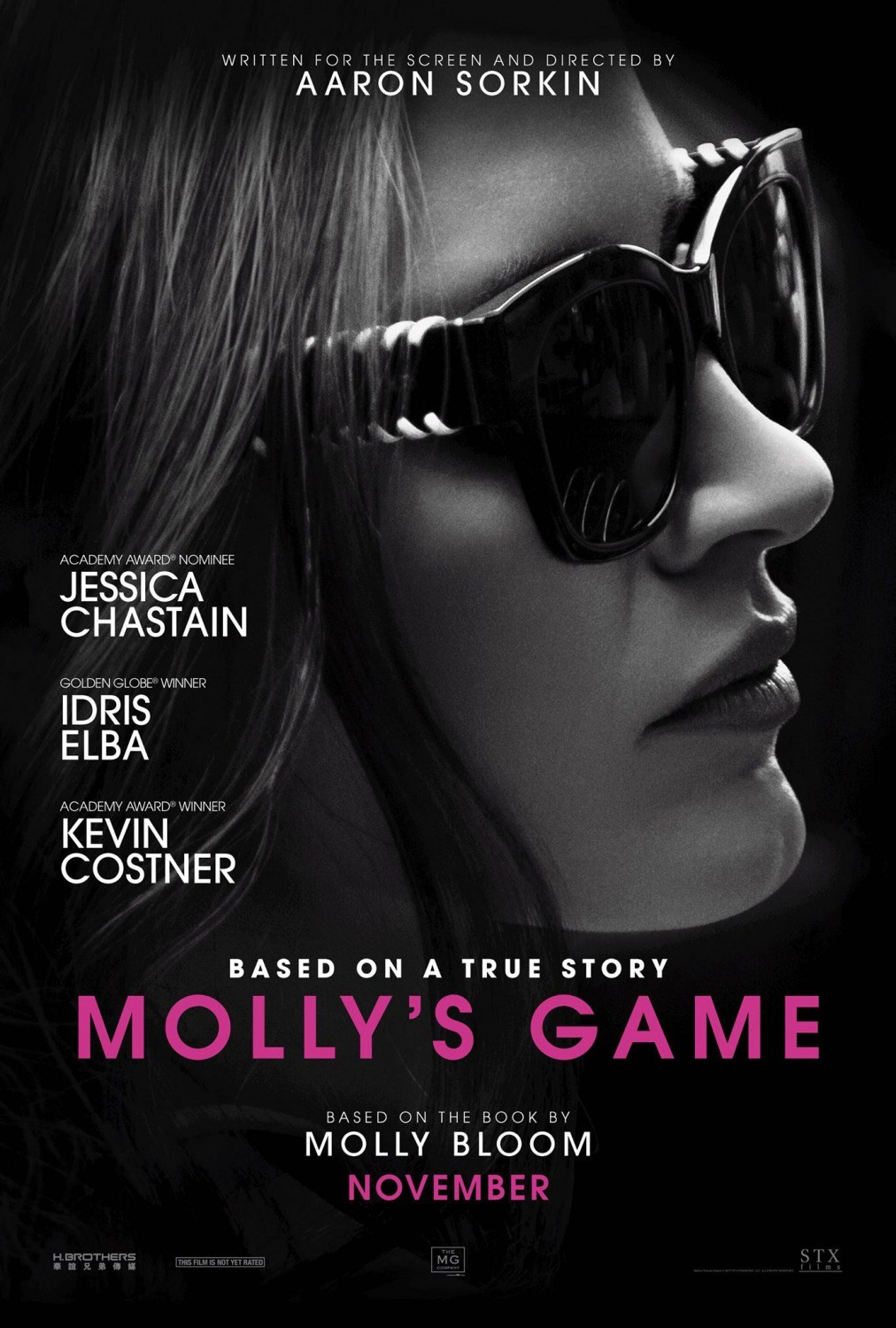
Aaron Sorkin is a name familiar to many film lovers. Having achieved fame with big screen screenplays for the likes of A Few Good Men, The Social Network and Moneyball, his knack of taking complex plots and working his magic to weave something not only palatable but positively gripping gave him unquestionable renown in the industry. He’s also transferred his skills to great television series, most notably with the multi-award-winning political drama The West Wing.
It was with some surprise that I discovered he would be making his directorial debut with underground gambling syndicate drama Molly’s Game. It wasn’t the content of the film that was surprising, more the fact he hadn’t yet directed a film. How could he have a career spanning four decades and not be tempted to direct any of his fantastic screenplays? And what tempted him to make this story his first?
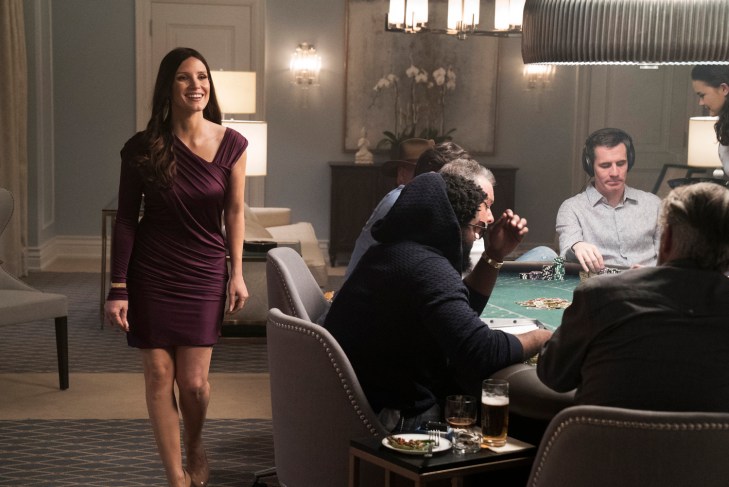
The titular character Molly is Molly Bloom, a former competitive skier until a freak accident curtailed her career [1]. Moving from snowy Colorado to sunny Los Angeles, she spent time as a cocktail waitress before getting involved with a group of highly famous and well-off Hollywood celebrities and millionaires (here given false names), including Player X (Michael Cera), Douglas Downey (Chris O’Dowd), Dean Keith (Jeremy Strong) and Cole (Joe Keery) [2]. First she works as a hostess for a weekly high-stakes gambling match, profiting primarily from the large tips she receives for her efforts. Later, she decides to take control and run her own, putting more at risk but with higher rewards.
The film depicts the build up to a court case following Molly’s arrest, with her lawyer Charlie Jaffey (Idris Elba) untangling her situation and the story told through a series of flashbacks, including the importance of her relationship with her father Larry (Kevin Costner), a professional clinical psychologist.
As expected, the film has a sharp screenplay from Sorkin, who makes sure there’s enough detail to keep the story believable without bamboozling poker novices. The film hovers around topics of sexism and gender imbalance, which makes it a perfectly-timed release, handling the ugly issues as openly as they deserve to be.
Crucially, he proves to be as good at directing as he is at writing. There are some excellent actors involved here, so emotionally-charged scenes involving Chastain and Costner, or Chastain and Elba, are almost bound to deliver (they do). It is the scenes with the lesser-experienced actors that really prove he’s delivered here. Most notably, the role Charie’s daughter Stellar (Whitney Peak) plays in revealing the nature of his character and how he analyses Molly is spot on, with a real camaraderie between Elba and Peak. He is harsh on her, setting her additional homework and relentlessly questioning her thoughts to ensure she is bettering herself.
It is a clear mirroring of Molly’s relationship with her father and brings out one of the most prominent themes of the film: the father-daughter relationship and how that impacts on the daughter in later life.

The emotional crux of the film hangs on the final scene involving Costner and Chastain, with Larry providing his daughter with “three years of psychological therapy sessions in three minutes”. It’s simply a joy to watch unravel – two actors emotionally lost in the characters they are playing, completely understanding of what the scene means to the characters and fully committed to what’s happening. For all the successes Sorkin has managed in the sexiness, seediness and hopelessness of the gambling ring, it is this scene that leaves the biggest impact.
Sorkin lost his father around Christmas 2016 and it is clear that this was dear to his heart when he created this picture. The fathers here operate with an otherworldly integrity to make sure their children achieve the best in life. If that’s how Sorkin remembers his father, and the success of good parenting is judged by the successes of their children, then on this evidence Sorkin has more than done his father justice.
Molly’s Game is an excellent film that delivers in every department.
[1] Note: In reality, this is one of very few pieces of artistic licensing Sorkin has employed in his career. There was no freak accident, simply a decision by Molly that she wanted a new challenge. (http://time.com/5073577/true-story-mollys-game/)
[2] It is rumoured that the real celebrities involved in the poker games include Tobey Maguire, Leonardo DiCaprio, Macauley Culkin, Pete Sampras, Matt Damon, Michael Baxter, Marc Lasrey and Alec Gores. (https://nypost.com/2011/07/10/the-queen-of-secret-celeb-poker/)
The Academy Awards have announced the nominees for the short list of the documentary short category at the 90th Academy Awards. They are listed below in alphabetical order.
Alone
Edith+Eddie
Heaven Is a Traffic Jam on the 405
Heroin(e)
Kayayo – The Living Shopping Baskets
Knife Skills
116 Cameras
Ram Dass, Going Home
Ten Meter Tower
Traffic Stop
This list will be reduced to five on 23rd January 2018.
Those in the UK with access to Netflix can watch Heroin(e) now.
Fifteen films remain in the race to win the Documentary Feature prize at the Academy Awards. The remaining five features will be announced on Tuesday 23rd January 2018.
Abacus: Small Enough to Jail
Chasing Coral
City of Ghosts
Ex Libris – The New York Public Library
Faces Places
Human Flow
Icarus
An Inconvenient Sequel: Truth to Power
Jane
LA 92
Last Men in Aleppo
Long Strange Trip
One of Us
Strong Island
Unrest
Those in the UK with access to Netflix can watch Icarus now.
The nominees for the Visual Effects category for the 90th Academy Awards® are, in alphabetical order:
Alien: Covenant
Blade Runner 2049
Dunkirk
Guardians of the Galaxy Vol. 2
Kong: Skull Island
Okja
The Shape of Water
Star Wars: The Last Jedi
Valerian and the City of a Thousand Planets
War for the Planet of the Apes
The list will be further narrowed down to five, after which the final nominees will be announced on Tuesday 23rd January 2018.
More information can be found here.
Hope you have a great day and get to spend your time with loved ones, close friends and family.

