If the thought of a horror-comedy fills you with dread, if not for the scary monsters then more for the fact that they usually fall short of whatever they’re trying to achieve, then fear not. Little Evil may not truly be a great horror film, nor is it a hilarious comedy, but that doesn’t mean it’s a bad film. For those wanting something lighthearted this Halloween there are much worse ways to spend 95 minutes.
Adam Scott stars as Gary, a real estate worker who has married Samantha (Evangeline Lilly), who comes with baggage in the form of her son Lucas (Owen Atlas), who Gary suspects may be the Antichrist. As he unravels the truth behind his new stepson, he is forced to form unlikely bonds in a race against time to save his family and the world.
There are supporting roles from the brilliant Bridgett Everett, Donald Faison, Chris D’Elia, Kyle Bornheimer and a surprising cameo by Sally Field, though this is less surprising when you learn that director Eli Craig is her son. It’s an ensemble cast that are able to provide plenty of humour to keep the wagon rolling without ever feeling like it stutters.
The film is peppered with nods to horror greats, presumably so that fans of the genre will giddily point at the screen and say “Oh, that’s the clown from Poltergeist!” at their less-versed friends. Of course, the more likely reaction is a roll of the eyes and silence, but the references are done in good faith. Sure, giving the child a 6th birthday on 6th June is fairly obvious, but not all comedy has to be subtle to be successful.
There is a worry that the film lacks any memorable gags and also fails to produce any striking horror set-pieces, though the movement of the buried-alive scene to the start of the film provides an impactful opening.
Adam Scott is a great leading man here, producing a relatable everyman who wants to make things work despite obvious signs that something is awry. There’s an art to his delivery of disbelief that only he seems to notice that Lucas is hiding something. It’s good to see him in a more prominent role than he is usually given.
Eli Craig has produced a fine follow up to his breakthrough film Tucker and Dale vs Evil. It has found a suitable home on the VOD service Netflix, which reduces the risk of it being a flop at cinemas and will undoubtedly increase viewership in the October double-header of Friday 13th and Halloween. It is notable, however, that it has quickly vanished from the front page of the service, making foot-fall traffic a little less likely.
Incidentally, Tucker and Dale vs Evil is also available on Netflix. If you’ve seen neither, Little Evil should be the one you approach second.
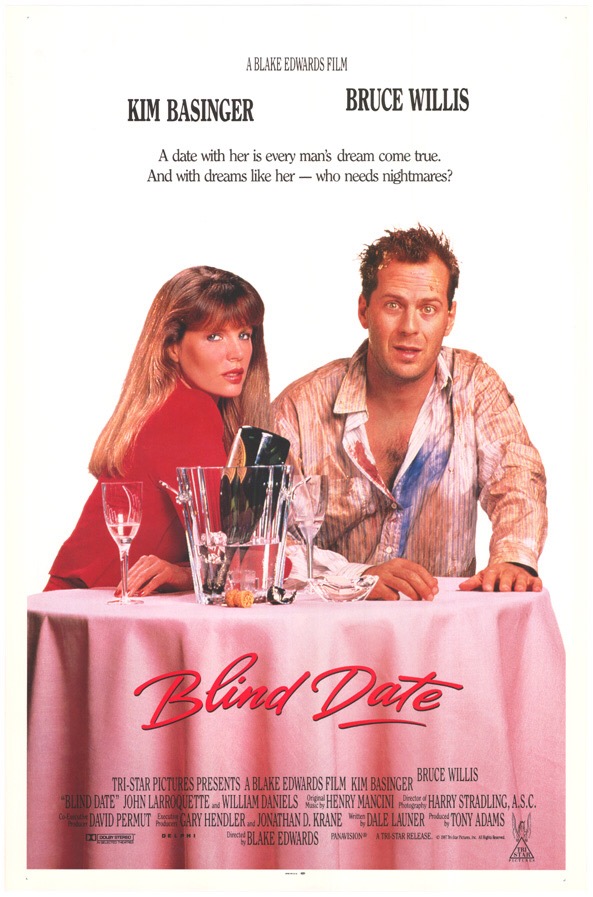
What do you get if you cross the director of Breakfast at Tiffany’s and The Pink Panther, one of the sexiest women of a generation, the film debut of one of the most bankable actors of all time and a soundtrack by one of the most celebrated film composers in film history?
A steaming pile of cinematic turd, that’s what.
It’s a rare occurrence to find a film with a run time of just 95 minutes that somehow feels like it drags on. But Blake Edwards has managed it with ‘Blind Date’, a turgid effort if ever you’ve seen one.
Bruce Willis does his best as an ambitious and hardworking career man named Walter Davis. Walter must attend an important dinner with his colleagues, boss and the Managing Director of an important business partner from Japan. However, Mr Yakamoto has very traditional values and Walter is advised to take a date to the meal. In desperation, he calls up his friend Ted (Phil Hartman), who recommends he takes his wife’s cousin Nadia, played by the usually irresistible Kim Basinger.
It’s unusual that a rom-com tries to put a shocking twist or genre-challenging break to the norm. Blind Date doesn’t even attempt to change this. The humour derives from the fact that Nadia can’t take her drink and Walter is advised not to let her have even a sip of alcohol. Of course, Walter forgets this and Nadia instantly becomes wild, causing absolute mayhem at the dinner and leading to Walter losing his job.
By the end of the night they are being pursued by Nadia’s maniacal ex-boyfriend and Walter ends up in prison. It feels like a spoiler but the entire plot is played out in the tag line on many of the posters. Plus it is celebrating its 30th anniversary this year so it’s hardly new news.
One of the most remarkable choices is to recolour Basinger’s hair brown and cover up her eyes with a dreadful fringe. This is one of the pin-ups of the 1980s, known for her beautiful blonde hair and striking blue eyes. Here, she loses one and has the other covered up, with no obvious reason for either choice.
Bruce Willis, here billed second to Basinger, is clearly still finding his feet as he made the transition from American sitcom Moonlighters – and that dreadful pop career – to Hollywood A-lister. It’s hard to imagine that by the time this film was released he was already filming Die Hard. Noticeably, Fox Plaza, tbe building that starred as the Nakatomi Towers in that film, can be seen half-built in the background of a scene at Walter’s office.
Remarkably, Madonna was originally cast to star as Nadia in the film. She turned it down because director Blake Edwards refused to accommodate her wish to cast Sean Penn, at the time Madonna’s husband, as Walter. Of the incident, she said, “I was supposed to have approval of… the leading man, but they didn’t tell me they’d already hired Bruce Willis.” In my opinion, this film would have been even worse had the pair been involved, and viewers need only seek out 1986’s ‘Shanghai Surprise’ for evidence of exactly how bad it could have been.
Even Henry Mancini’s score feels bland and half-hearted, which is disappointing from the man who brought us ‘The Pink Panther Theme’ and ‘Moon River’. I do note that a better film could have made me see the score differently.
Fans of The Simpsons will take great pleasure in hearing Phil Hartman produce his best Troy McClure voice when he’s describing Nadia over the phone to Walter. It’s unmistakable and one of the few positives that helped me get through the ordeal.
It’s a film that has been largely forgotten by everyone who saw it and everyone involved with the film. Forgetting it is something I’ll be trying to do too, as quickly as
In 2003, I was in the middle of a hiatus from video games. Having grown up with the thrill of the NES, graduated to the vastly improved SNES and then enjoyed the comparatively mind-blowing PlayStation, by the time the PS2 arrived I’d lost interest. I got my first serious girlfriend in 2001 and with school exams also requiring my attention, I simply didn’t have time to commit to video games.
One of my go-to games throughout my initial gaming tenure was the ever-popular FIFA series. I had the first ever instalment. Titled simply FIFA International Soccer and featuring David Platt on the cover, the isometric visuals seemed like a massive improvement on Sensible Soccer, which I’d invested a dizzying amount of hours into. I didn’t know the word “isometric”, but what I saw was a 3D game of football on my screen for the first time.
The game grew with the consoles and no football pretender got anywhere near the brilliance of the one or two releases every year.
Such was my addiction that I even had a cheat printed for FIFA 2000 in gaming magazine CVG. I never did receive my £5 for that.
So, when I visited my brother at university in early 2004 and he and his housemates were playing a football game called Pro Evo, I was initially dismissive. It didn’t have any of the real team names or play names. It looked different. The controls were back-to-front. It was highly unlikely that in the two years since I’d given up video games that FIFA had been knocked off its crown.
But then I played it.
Instantly I realised why so much praise was being heaped on it. It felt so much more like a real game of football. It was also a lot more fun. It was more balanced. There didn’t seem to be as many cheap ways to score.
I was immediately jealous that I didn’t have access to the game, though I didn’t rectify the issue for another three years when I acquired an Xbox 360 and a copy of Pro Evolution Soccer 6.
I’ve since dallied with both sides of the fence, keeping up with the various merits and failings of both series. Sometimes FIFA has edged ahead, but despite the constants that it will always have – primarily the licences and more players for online modes – the PES series has invariably been much more playable.
Pro Evolution Soccer 2018
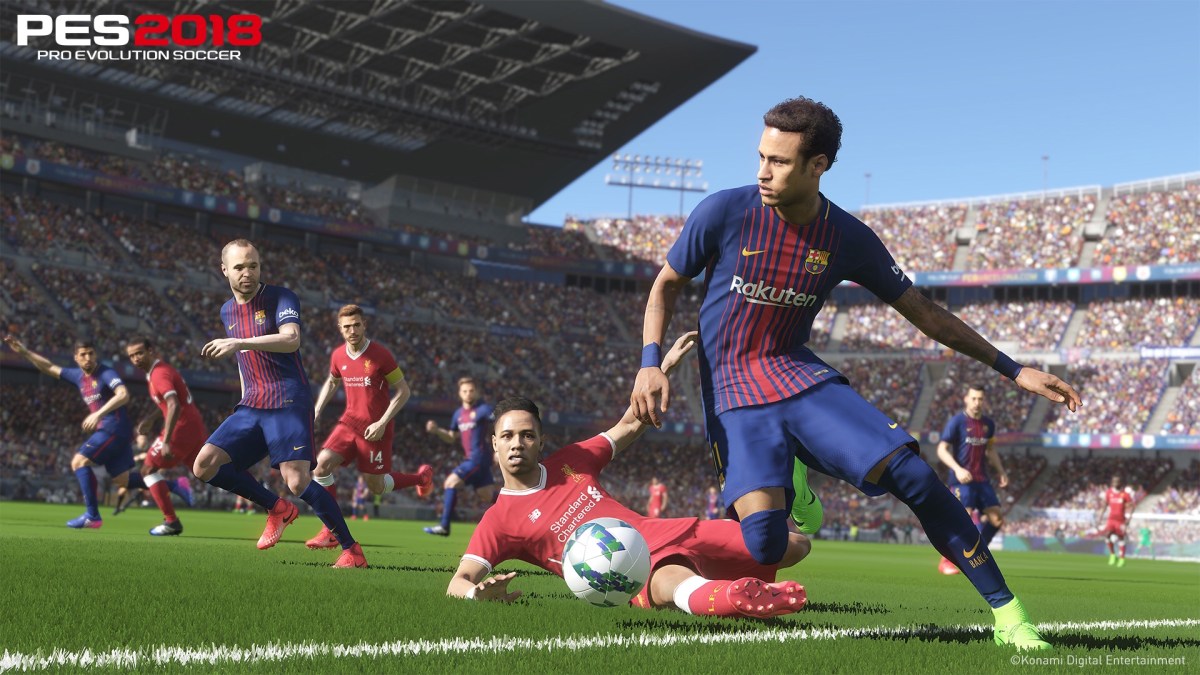
So now we’re in 2017 and I’ve picked up a copy of the latest game in the PES series: Pro Evolution Soccer 2018. It’s the first time I’ve picked up a copy of a sports simulator on release weekend for as long as I can remember, so is has been interesting joining in the online buzz.
The FIFA and PES series have converged on a version of events that has landed with an extremely similar setup. There’s an exhibition mode, a training mode, a league mode and a cup mode. There’s also a mode, here called Become A Legend, which involves taking over the career of a single player. There’s myClub mode, which allows you to spend points earned in every game mode on random players to create a team you can take online.
Finally, there’s the ever-popular Master League, a challenge for even the best PES player and a mainstay of the game for well over a decade. In this mode you take over a team of generic and very average players in a lower league and try to progress up the leagues and impress the owner of your club to the point that he will invest in better players for you to challenge for the top trophies.
Every mode has an equivalent in FIFA and neither are particularly better or worse than each other, so comparing the two on game mode alone won’t help anyone.
Where PES wipes the floor is with the gameplay. It has done for years and, having played the demo version of the latest FIFA, continues to do so this year.
Players are responsive and the simple controls allow basic skills to be executed immediately. Trapping the ball and close control when receiving the ball are amongst the simplest skills to master. Guesswork punts up the pitch rarely come off, reflecting real life. Calculated build up and through balls to strikers you know will outpace the defenders will often pay dividends. Try the same attack three times in a row and the defenders will learn from your efforts.
Winning in online modes is obviously never easy, but doing so feels like a huge victory and will be a crowning achievement of your abilities in the game.
There have been a handful of drawbacks I’ve noticed. Online mode has been blighted with either lack of players or poor connectivity, the latter being the first example of poor connection in any game I’ve noticed in well over a year. It’s frustrating to lose a match because of connectivity when it irreparably affects your ongoing ranking.
Player switching can be frustrating. It appears that it will never switch to a player behind the opposition, even if they’re a couple of steps away. That has been the biggest cause of conceded goals for me as I’m forced to bring a well-placed defender out of position to combat an advancing attacker, often then to have the ball played in behind me. That and the fact that the computer almost never concedes a foul will be rectified in an upcoming patch from Konami.
The final downside I’ve found is the inclusion of a handful of Legends in the game. This is great, but every copy of the game comes with Usain Bolt as a player in the myClub mode. When FIFA fans get Ronaldo but PES fans get someone who has never played professional football in his life, it does feel a little on the embarrassing side.
But that’s no problem for the wider game. When the gameplay and intelligent AI is this good, i can forgive the lack of real players. There’s always the extensive editing mode to rectify that anyway.
With an upcoming release of further game modes, including a career-spanning David Beckham career mode, this is a game that still has months of playability left in it and one I won’t be putting down for a long time.
Where’s he got that leotard from? Why doesn’t he just sleep with the alien girl? Why is he so dedicated to the earth girl when they’ve know each other ten minutes? Why did they do so many tracking shots?
If you’re sat there pondering any or all of these questions, then you may well have been watching Flash Gordon. Maybe, like me, you were on holiday with a VHS player and only a handful of of videos to play on it, of which 80% were James Bond.
On the face of it, this could have been a great film. There’s a classic comic book as the source. The cast is, for the most part, absolutely brilliant. Then there’s the unforgettable titular theme song by Queen.
Yes, it’s easy to be critical of it now. It’s almost 40 years old and time has not been kind to the flimsy costumes or the flimsier scenery. These are of the time and can partly be forgiven.
But there are things that you just can’t get past. Gilbert Taylor acted as cinematographer. This is a man who worked on Star Wars just three years prior. Between him, director Mike Hodges (Get Carter) and editor Malcolm Cooke there was a much more impressive final product to be had. Some clumsy edits reveal mistakes in actors’ takes, whilst tracking shots do little to hold the imagination when it seems a wider angle could have been taken.
The dialogue is intentionally camp but winds up feeling unintentionally humorous. This results in confusion over certain lines that may or may not have been intended as jokes. There’s an excruciating scene between Flash (Samuel J. Jones) and Princess Aura (Ornella Muti) that not only feels embarrassing but also fails to provide any motive for either character. In particular, our hero seems to have developed a sort of honour-bound dedication to Dale (Melody Anderson), a woman he had only met a couple of hours before and knows nothing about.
For campiness, it’s impossible to beat the American Football fight at the start of the film. Why, oh why…
Indeed, overall there is very little in the way of character development and the viewer is left to piece together the well-intended plot from what we are left with.
There are two types of film that become cult classics. Some are under-appreciated gems, or at least were when they were released (see Big Trouble In Little China, The ‘Burbs or Ferris Bueller’s Day Off). Others attain cult status because they flopped or were never that good in the first place (Tommy Wiseau’s The Room, or every film by Ed Wood). Unfortunately, Flash Gordon falls into the latter category.
It’s a real shame because my memory of the film was hazy but certainly positive. It is now somewhat tarnished, just like the VHS copy I watched. Fitting, really.
The year was 1955. Eisenhower was president of the United States. Both Steve Jobs and Bill Gates were born. Bill Haley and His Comets were flying high on both sides of the Atlantic with their hit ‘Rock Around The Clock’, just before the global phenomenon that was Elvis Presley really took hold. It was also the year that the civil rights movement began to take off in the USA, notably including the groundbreaking Rosa Parks bus incident.
Cinema-goers were able to escape to enjoy a range of musical hits including Oklahoma! and Guys and Dolls, whilst the highest-grossing film at the box office was a travel documentary called Cinerama Holiday. Jane Wyman, one of the top 10 highest-grossing film stars of the previous year, was cast in Douglas Sirk’s latest Technicolor romance ‘All That Heaven Allows’. She would be playing opposite Rock Hudson, two years before he’d be at the top of the very same list.
Wyman portrays affluent widow Cary Scott, a woman with two college-aged children and no shortage of men interested in her affections, all of the rich, well-to-do, country club variety. Hudson portrays a much more grounded gardener by the name of Ron Kirby, a man of strong morals and much more appealing looks. Her attraction is palpable, despite being eight years his senior and several rungs higher on the social ladder. As their romance blossoms, so grows the disapproval of their relationship amongst their friends and peers.
It wasn’t the first time Sirk had used them together. 1954’s ‘Magnificent Obsession’ also featured Wyman as a mourning widow and a spoiled playboy played by Hudson accused of contributing to his death. Wyman may have been nominated for an Academy Award for her role in the film, but it is ‘All That Heaven Knows’ that has stood the test of time critically. Indeed, The Guardian placed it at 11th on a list of the greatest romantic films of all time in a critics’ poll released in 2010.
It is not a particularly intellectual film by modern standards, but within the genre and against other films of the same era, there is an emotional punch and considered social commentary running throughout that lifts it above the mire. Wyman may be older, but she is certainly attractive. Sirk dares to question why she shouldn’t be allowed to have an interest in the younger man in her life. Who wouldn’t? This is Rock Hudson after all. The men vying for her attention are all at least ten years her senior. Indeed, Conrad Nagel, whose Harvey eventually receives a well-deserved punch from Hudson’s Ron, is twenty years older than Wyman. That no character questions this is a sad reflection on the state of society in 1955, though it is ten years better than the romance sold to audiences in Billy Wilder’s Sabrina just one year earlier. Sadly, it’s a situation still prevalent in Hollywood some sixty years later.
For all of Rock Hudson’s impressive physicality and charming smile, it is Wyman that wipes the floor with the rest of the cast. Her performance is nuanced and brought to life perfectly by some wonderful mise en scène from Sirk. This is a woman trapped by both society and her own fear of being seen to be selfish. She continuously puts her children first, because that is what is expected of her. The heartbreaking moment when she finally informs her spoiled son Ned (William Reynolds) that she has left her man behind is as frustrating for the viewer as it is for her, with Wyman connecting with us the deflation as her son hangs up on her without a second thought.
Sharp-eared Disney fans may also note an uncredited speaking role for Eleanor Audley, who was both the evil stepmother in Cinderella (1950) and the Maleficent in Sleeping Beauty (1959). She plays a disapproving party-goer in Act 2.
This may not be the high point in the careers of either of its stars, nor that of the director, but it’s worth seeking out nonetheless. Beautifully shot and with a purpose behind its potentially saccharine plot, it offers the chance to enjoy a romance that has slipped under the radar due simply to the passing of time rather than an evident lack of quality.
WARNING: This review contains moderate spoilers of a good film. Just go watch it. Then come back.
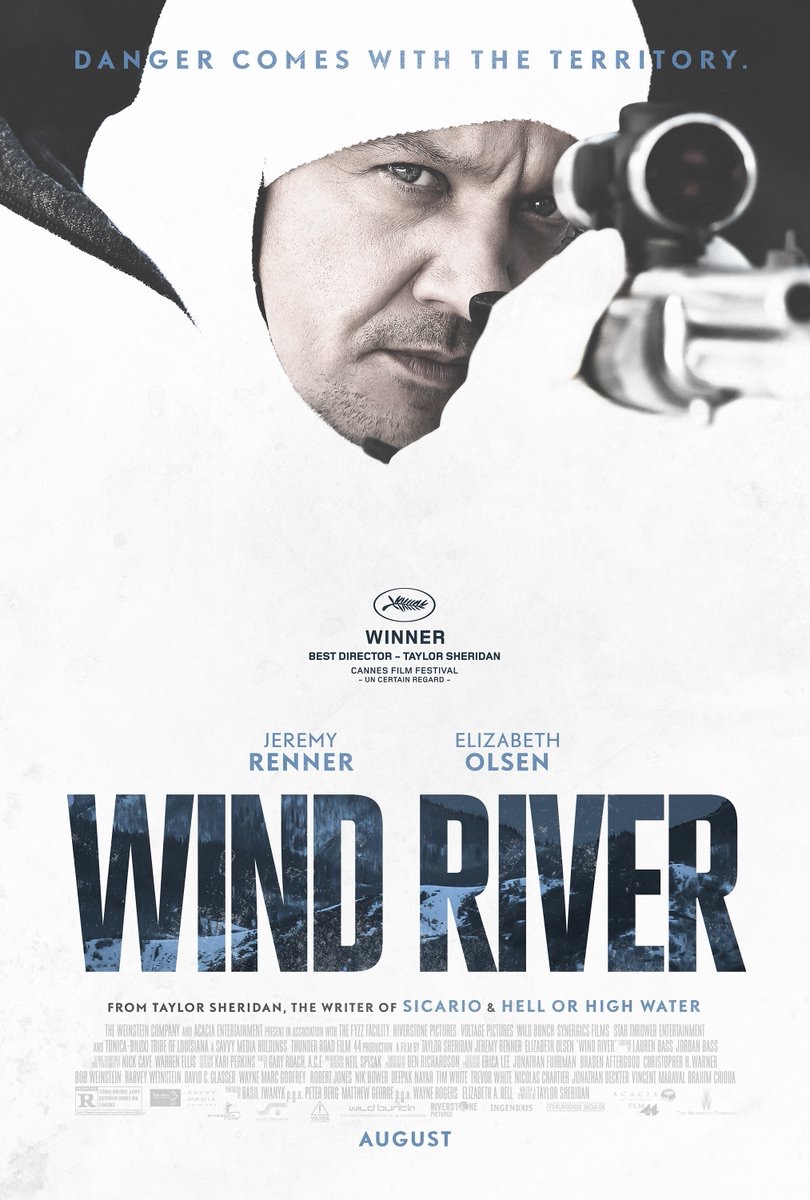
Taylor Sheridan’s first mainstream foray into directing comes in the form of Wind River, a low-budget film that makes good use of some astute casting to harness a subtle script to leave an impact way beyond the sum of its parts.
Part murder mystery, part western thriller, it plods along at a pace that, at times, risks feeling simply like a better-than-average TV investigation drama. Then, with a well-executed flashback as the introduction to the final act, the film turns into a classic western, complete with Mexican stand-off and the resulting bloodbath. It’s the payoff for a steady build-up that is well worth the wait.
The plot centres around an unsettling and mysterious opening sequence, where we follow professional huntsman Cory Lambert (Jeremy Renner) as he discovers the body of Natalie Hanson (Kelsey Chow) on the Wind River Indian Reservation in Wyoming, USA. Her body is frozen in the snow and there are clear signs of rape. She is without shoes. FBI agent Jane Banner is brought in to investigate, quickly forming an unlikely bond with Lambert to trace and track the truth.
Wyoming is the unorthodox setting for the story, captured beautifully by cinematographer Ben Richardson. Much of the film is set in mountainous terrain and the snow-covered land becomes integral to the plot. But as picturesque as the environment is, the bloody and violent story playing over the top trumps it.
Nick Cave and Warren Ellis team up again to provide a moody and fitting soundtrack, shadowing the film rather than becoming overbearing.
It’s a gritty conclusion to Sheridan’s trilogy – following Sicario and Hell Or High Water – and one that absolutely does its predecessors justice. It may not feel as brash and immediate as either film, but the three films feel like they are a strong body of work and wholly played out in the same universe. As a result, Taylor Sheridan is holding his own with both David Mackenzie and Denis Villeneuve – a sign he has the ability to keep delivering the goods.
As I sat alone in the local multiplex chain cinema, watching the fellow viewers trickling in, I couldn’t help but feel sorry for the couple on a date a few rows in front of me. They’d stocked up for the next couple of hours with the standard fare: a popcorn tub bigger than their own heads, a couple of XL soft drinks, a pouch full of chocolate nibbles. They may well have been wearing Star Wars t-shirts, hoping to see lead actor John Boyega in something other than Poe Dameron’s jacket, but I didn’t quite see. The point is, they almost certainly had no idea what they were letting themselves in for. To some extent, neither did I.
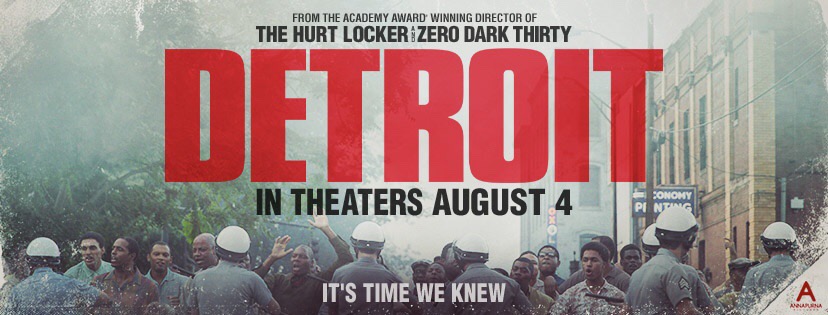
As a British man in his early 30s, the real tragedy of the 1967 Detroit Riots were largely lost on me until the announcement of Kathryn Bigelow’s film. It’s a film seeking to shed light on the events that unfolded at the Algiers Motel as part of the 12th Street Riot. Whilst the motives behind making the film may have been perfectly justifiable when its production was announced in January 2016, the poignancy of its release over the backdrop of the recent events in Charlottesville could only be lost on the most unaware of cinema goers.
The film is split into three acts. The first provides a backdrop to the riots and the status of the never-ending and constantly evolving racial tensions across the USA. This act also serves to introduce some of the key players in the film: Boyega stars as diplomatic security guard Melvin Dismukes; Will Poulter portrays trigger-happy policeman Philip Kraus; Algee Smith is aspiring singer and performer Larry Reed; Hannah Murray features as young female Julie Ann.
The final act is essentially a courtroom drama that covers the fallout from the middle portion, which is a breathtaking piece of cinema that Bigelow has chosen to tell in realtime. Kraus heads up a police operation to discover what is believed to be a sniper rifle fired from the Algiers Motel, with a group of innocent black men standing accused along with two white girls. The racism is evident, driving the policemen’s actions and words to breaking point, leaving several people dead and the remainder with horrific memories of the night.
It is overwhelmingly upsetting and unsettling, made even worse by the fact it is based on accounts of real events. It seems unfathomable that anyone could watch this and not wince. It’s certainly something that has stayed fresh in my mind since I saw the film, which gives me a fraction of an idea of what it must be like for the survivors of the incident.
John Boyega’s performance is perfectly nuanced as he stands by almost helpless, doing what he can to keep the accused alive. As a security guard he is afforded a degree of respect, though it is respect that is only uniform deep. It’s not an easy role to pull off. The scene in the police interrogation room that kicks of Act 3 is almost as horrifying as what has come before, and it is in this scene that Boyega really shows his acting mettle.
Will Poulter is also worth pulling out as the extraordinarily derisible policeman Kraus. It may just be so good that he will suffer typecasting for the rest of his career. The role is written so you can do nothing but hate him, but not every actor can achieve this with such little charm. That’s deliberate and is thus a genuine triumph by Poulter.
Detroit has seemingly fallen away at the box office now, failing to recoup the production costs. In a week where The Emoji Movie continues to run having made a global profit of over $30m, I can’t help but wonder whether escapism is the order of the day for film fans at the moment. Why would we want to see a long film like this when it seems to be on the news every week anyway?







 Cinema, etc.