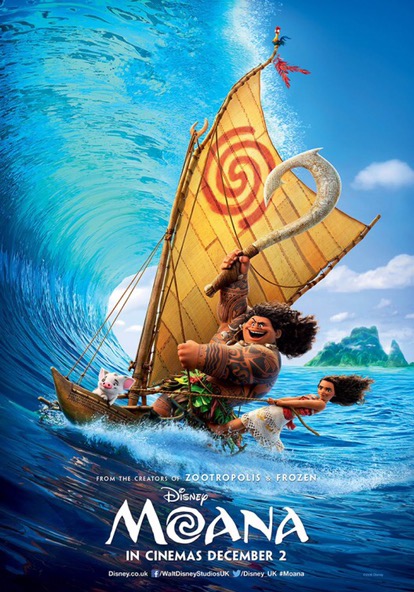
Disney’s Moana as a Video Storybook

I was looking at the videos uploaded onto the Disney YouTube channel and I was surprised at how much content was on there for their latest film Moana. So, I decided to see how much of the story could be pieced together and found there was essentially quite a bit of the first half of the film freely available.

Needless to say, this is full of spoilers. The purpose is to help provide some joy to those of us who’ve seen the film but can’t wait until the home video release later this year to enjoy the various elements. It is truly a wonderful film and you can read my original review here, along with a fact sheet here.

After you’ve read it, make sure to pre-order your copy for home viewing in all its glory here!

Prologue

In a prologue, we learn about the mystical pounamu stone, which is the heart of goddess Te Fiti. Demigod Maui steals the stone to give as a gift to humanity, but as he escapes with the stone he is attacked by Te Kā, a lava demon, in the process losing the pounamu heartstone along with a fishhook that grants him magical powers.

Act 1

1000 years later, our story begins with a small Polynesian island called Motunui. Here we find Moana Waialiki, a small child who is the daughter of Chief Tui and therefore set to become leader of the island tribe. As a baby, she appears to have a mystical connection with the sea.

A montage of Moana growing up occurs throughout the song “Where You Are” (video includes audio only). Her affinity to the sea is reinforced throughout the song, along with the importance of the natural crops and resources the island provides.

The islanders are growing in concern for their crops and fish, which are unexpectedly dying. Unbeknown to them, the cause of this is the missing pounamu heartstone. 

Moana wishes to leave the island to find more fish, but her father wants her to stay on the island. She makes a first attempt at leaving the island via the song “How Far I’ll Go”, along with her trusty pet Pua the pig.

Moana has a chat with Gramma Tala to help decide what to do.

We are further introduced to the ways of Moana’s island via the song “We Know The Way”, which is a celebration of voyaging as the pride the fishermen find in their navigation and fishing skills. This is a musical interpretation of what Moana reads on the inside of a cave in ancient wall paintings.

Gramma Tala reveals that she has had the heartstone and gives it to Moana. She also reveals a hidden cave of boats from the island’s past life as voyagers. 

Sadly, Gramma Tala dies, and with her final breath tells Moana to set sail. She does this, but unbeknownst to her she does this with incompetent chicken Heihei as her only companion. The “How Far I’ll Go” reprise plays.

Act 2

Moana encounters a terrible storm, which throws her from her boat and leaves her unconscious. 

When she wakes, she discovers she is on a deserted island, though one other inhabitant is there: the demigod Maui.

Maui introduces himself, wowing Moana as he sings “You’re Welcome”. This is also a cunning ploy to steal her boat to escape the island, though he leaves her on the island alone and trapped inside a cave.

Moana breaks free from the cave and attempts to swim after Maui. The ocean helps reunite the pair.

They resolve their differences and Moana convinces Maui that to be a true hero he must return the pounamu heartstone to its rightful place to restore harmony to the sea, agreeing also to help him retrieve his magical fishhook on the way.

Shortly after, they encounter the coconut pirates Kakamora, who wish to steal the heartstone.

They then visit the giant crab Taratoa, who has a cave of jewels and gold that he uses to attract fish to his cave to eat them. He is in possession of Maui’s fishhook.

Maui and Moana work together to steal back the fishhook and they set sail again.

Act 3

Shortly after, Maui teaches Moana about “wayfinding” as he realises that she has never sailed before.

They set sail to return the heart to Te Fiti, but when they arrive they are attacked by the fire demon Te Kā, who damages Maui’s fishhook in the process and also repels them in their boat far out to the ocean. Maui leaves for fear of yet more damage to his hook, which will result in him losing his magical powers.

Moana returns to Te Kā alone, and as she does this Maui returns, having had a change of heart. This time Moana asks the ocean to help clear a path between her and Te Kā, and she sings “I Am Moana” to remind the goddess of who she really is, thus allowing her to restore her heart. With Te Fiti restored, she thanks Moana with a new boat and a replacement fishhook for Maui.

Moana says farewell to Maui and returns to her island, which begins to thrive under the new conditions.

Deleted Scenes

Disney have since published some additional scenes, destined for the Blu-ray (due out in March 2017).

Film review – Passengers (Morten Tyldum, 2016)

It’s fun to slam a bad film, isn’t it? Hand us a terrible film and we’re all there ready with our sticks to beat it down. It’s funny, because the filmmakers have no control over it and we get away with having a good laugh at their expense.

Passengers has been that film for the last couple of weeks.

I’ve had an article shared to me with some photos that prove how creepy Chris Pratt is in it. I had another one sent over about how it had failed at the box office after poor reviews. Generally the early reviews were positive, then the consensus changed and everyone has now decided it’s a poor film, so that’s the stance everyone has taken. Even positive reviews have misleadingly negative titles to ensure they don’t buck the trend (News.com.auhad a favourable review but they titled it “What was Jennifer Lawrence thinking?”).

The three people who sent me the above articles have no intention of watching Passengers. That is entirely their loss.

Passengers is an excellent film.

There’s more to this than the reviews have suggested

Spoilers now follow.

At its heart, it is a romantic drama that explores the relationship ship between James Preston (Chris Pratt) and Aurora Lane (Jennifer Lawrence), who are trapped in space on the Avalon spaceship, en route to the planet Homestead II. To make the 120-year journey, the crew and passengers are in hibernation pods, but Preston’s pod opens early and he is forced to fend for himself, physically and mentally.

Trapped in space alone, he eventually starts to consider waking up fellow passengers. As an electrician and mechanic, he can navigate the user manuals of the hibernation pods and is able to select who he wakes up based on video messages left on their personal profiles onboard the ship’s communication devices. He chooses writer Lane, a woman he has fallen in love with, and makes the unforgivable choice to wake her up, sentencing her to the same fate as him – certain death before anyone else wakes up.

The critics have centred on this decision as a blocker to any enjoyment. That is truly unfair. If they were handed the film to edit, presumably it would finish after forty minutes and we’d have a shot of Pratt’s character dying alone as an old man, trapped and miserable, yet having made the morally correct decision. 

In Mark Kermode’s book Hatchet Job, there’s a brilliant passage on how Casablanca would have turned out if it had been shown to test screenings, with one of the greatest love stories of all time likely being changed to a happier yet implausible conclusion. 

The same applies here.

This is a plot that is deliberately divisive, meant to create discussion. Some will argue that Preston was insane, on the cusp of suicide, and his relationship with Lane sustained him long enough to figure out there was a critical error with the ship, this saving the entire ship (with her help – it was a two-person job). Others will side with Lane’s stance immediately after she realises the truth; also quite justifiable due to the fact their entire relationship is based on a fundamental lie.

Either way, director Morten Tyldum fully explores every possible line of thought enough to allow the viewers to make their minds up, with enough space in the pace of the film for those thought processes to go to fruition during the film.

Pair this complex romance with some beuatiful visuals and some stellar performances from the two leads, and you get a film much better than the critics will have you believe.

You will be robbing yourself if you believe the negativity and don’t see this film for yourself.

Video game review – Lego Star Wars: The Force Awakens (TT Fusion, 2016)

TT Games had a surprise hit in 2005 with their video game based on the Star Wars prequel trilogy. It offered fun for all ages, with a blend of humour and in-joke references mixed with gameplay complicated enough to keep grown-ups and youngsters entertained for hours; the perfect gaming experience for parents playing through with their children. This was quickly followed by another based on the original trilogy, which was met with even more success. Then came an Indiana Jones version along with Batman in 2008. Then Harry Potter, Pirates of the Caribbean,, Lord of the Rings, more Star Wars, more Batman, Marvel, Jurassic World… The list goes on. It has to be admitted that the games have gone down in quality since that original triumph, but never has the result been as poorly executed as The Force Awakens.

The problem isn’t just that it’s trying to make too much of a small amount of source material, nor the lack of humour in the script (they chose to use dialogue from the film, a departure from the norm).

BB-8!

No, the biggest crime here is the terrible glitches that blight the entire game. These can derail you at any point, but tended to occur late in the levels with something simply not working, usually meaning the entire level needs to be replayed. One example is on level eight, “Starkiller Base”, which requires Chewbacca to throw an explosive to open a particular set of doors. The only problem was that the bomb couldn’t be thrown, nothing could help the situation and 30 minutes of gameplay had to be redone to progress. Similarly, on the level titled The Finale, there was a glitch whereby Finn snapped to shooting mode too early and couldn’t complete essential actions to progress the main battle between Rey and Kylo Ren. Again, 30 minutes of gameplay wasted.

Elsewhere, there were simple audio glitches with music getting looped or the whole game falling silent. All this contributed to a feeling that any time a puzzle wasn’t easy to figure out (in hindsight one of the best parts of the game) there was an assumption that the game had glitched and a restart was needed.

The fault of this, presumably, lies squarely with the testing team at TT Fusion. Remarkably, the list of individuals involved with the testing, according to the end credits, was huge. This game should never have been signed off from QA testing, but even worse is the fact that no patches have been released to fix these issues despite the number of people complaining across the internet. Just search “Lego Force Awakens glitches” to see how many people are suffering.

Furthermore, having been fairly diligent with retrieving the collectibles in each level, I was met with a score of 27.1% on completion of the main story. This serves to underline the mis-balanced nature of the meaty content of the game and a ridiculous list of collectibles that are clearly there to falsely inflate the amount of gameplay on offer.

The sad thing is that there is a good game here, buried underneath all the complaints and issues. Perhaps TT Games should stop spreading themselves so thinly, because there is no chance that I will be picking any more Lego games in the future unless I know they are glitch-free.