Carol (Todd Haynes, 2015)

The latest Todd Haynes film, his first big screen effort since 2007’s Bob Dylan biopic (of sorts) I’m Not There, has been exceptionally well received by the press and public. An adaptation of the 1952 novel The Price of Salt by Patricia Highsmith, the film tells the story of the relationship between Therese (Rooney Mara), a young aspiring photographer working in a department store, and Carol, an older woman with a penchant for younger girls. It explores their developing relationship as Carol’s marriage to Harge (Kyle Chandler) deteriorates, and the reaction to their behaviour by those close to them in 1950s Manhattan.
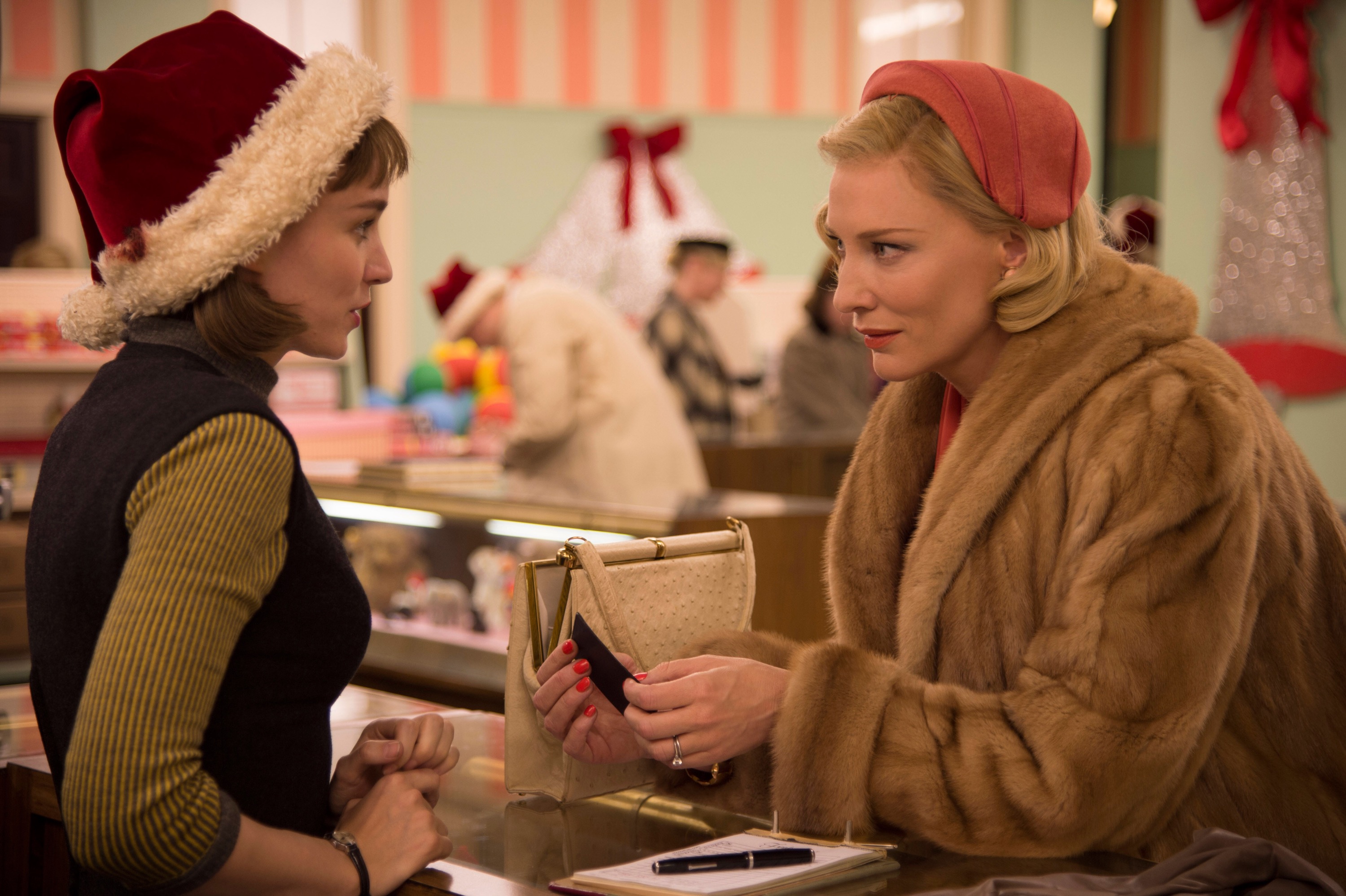
 Not your typical Christmas film. 
The world has gone crazy for this film. It has already picked up a Palme d’Or nomination (losing out to Jacques Audiard’s Dheepan) as well as two wins at the Cannes Film Festival. It also won prizes at a host of other award ceremonies, and will compete with five nominations at the Golden Globes. One can only presume the Academy Awards and BAFTAs will follow suit.

As such, it’s a difficult film to openly ardently dislike. The source material has been, apparently, a very relevant book to the LGBT community for many years, especially in the USA. I am a straight male British man. The fact I didn’t enjoy it gives rise to an enormous fear that I’m too straight-laced to understand a masterful piece of cinematic artistry. It’s the sort of thing I should like. I just didn’t.

For me, the exploration of the controversy of a same-sex relationship in 1950s America wasn’t enough to save the slow pacing and inherently dull storyline. An easy argument is to think along the lines of replacing either of the lead characters with a man, then ask ourselves “Is this still an interesting plot?”

The more unusual channel on this stance would be to have an older woman befriend a younger man, which would bring more dynamics with social disagreement than the oft-covered “older man with younger girl” scenario.

To think like this, however, is to miss the point. There’s no reason why having a female-to-female relationship can’t be explored at face value whilst also looking at the contrasting views of those around them. The fact is that the two female lead characters’ relationships with those around them wasn’t explored enough to warrant any real threat of anguish and being cast out of society. Conversely, there was no apparent chemistry between the two actresses. My suspicion, having not read the book, is that this was all explored in great detail by Patricia Highsmith and there wasn’t enough scope to cover it all in one standalone film.

I’d describe both acting performances as adequate without being exceptional. The desperation of the situation is only truly realised when Kyle Chandler appears as the scene-stealing husband who evidently fears the rejection by his wife as much as he fears the embarrassment and damage to his social standing. It was only in his scenes towards the backend of the picture that there was any great feeling of scandal.

When Carol is announced as an Oscar front runner next month, I will refuse to eat my words. As someone who doesn’t like this film, I will be in the minority.

Carol is on general release at cinemas in the UK now.
Film review – The Good Dinosaur (Peter Sohn, 2015)

Pixar’s latest effort The Good Dinosaur is a by-the-numbers buddy comedy set in an alternative history where the asteroid that would have wiped them out has missed Earth completely, meaning dinosaurs and Neanderthal humans live side-by-side. It concerns a timid dinosaur called Arlo (Raymond Ochoa) who is split up from his family has to befriend a dog-like human called Spot to survive and return home.

The Good Dinosaur was destined for problems before it was released. Originally scheduled for a Christmas 2013 release, it has been put back several times, each time causing confusion and issues for the other Disney films on track for their respective releases. According to Denise Ream, one of the film’s producers, the primary reason for the rescheduling was “the story was not working, period, full stop, it just was not where it needed to be.” The director Bob Peterson, who previously found success with Up, was removed and replaced with Peter Sohn, allegedly because he was too involved with the film.

The upshot of it all is that it has found itself living in the shadow of the excellent Inside Out, which has barely left the cinemas, and is competing for shelf space in the various toy stores across the land with Star Wars: The Force Awakens, which is set for release less than a month after The Good Dinosaur. It was also released in the middle of a school term, drastically reducing the opportunity to go and see it for anyone with children in school. So does that make the target audience parents who aren’t working and have children old enough to go to the cinema but under the age of 4? I guess so… [1]

The film itself feels like an unfinished product. It is the first time I’ve watched a Pixar film and genuinely felt like they’d given up on it. It feels like a last-gasp chance to recoup on a project that will, at best, break even.

The character design is uninspired. None of the dinosaurs offer any of the individuality or appeal audiences have come to expect from a Pixar or Disney film. The beautiful environment goes some way to make up for this, but only Spot himself felt like a fully realised character.

If the reports are to be believed, then the problems with the film lied in the final third. This is, then, presumably where the cavalry came in to take over and save the day. Sadly for Peterson, this is exactly where the film picked up a bit and paid off on some of its promise.

Two scenes stuck out as being particular highlights. The first was a beautiful montage scene where Arlo and Spot ran through an open plane full of birds was vintage Pixar. The second was an emotional scene in which Spot is effectively adopted by another Neanderthal family at the encouragement of Arlo.

Perhaps both of these were Peterson’s work. Will we ever know?

As a 31-year-old man, I know I’m not the target audience for this film. I do have an appreciation for all good animation though and this falls a long way short. The best critics are the children. Four days after its release, the cinema was about 10% full. The children present seemed restless and disinterested. A few parties left. Maybe they went home to watch something more enjoyable. Or, you know, fun.

The Good Dinosaur is currently on release at UK cinemas.

[1] In my local cinemas only one screening was achievable for workers and people at school, which was a 6:30 screening at a Cineworld. I don’t know how many people were at earlier screenings.

Bridge of Spies (Steven Spielberg, 2015)

After a relatively long break, Steven Spielberg is back behind the director’s chair, and it was worth the wait.

Reading the description of Bridge of Spies, his first film since the hugely successful biopic Lincoln, it has all the hallmarks of some of his greatest achievements in cinema. It’s based on a true story. It’s a story about individual battles within a larger situation. It stars Tom Hanks. It would have been a surprise if this wasn’t a huge success.

Set between 1957 and 1960 during the height of the Cold War, the film focuses on James B. Donovan (Hanks), a lawyer tasked with negotiating the release of Francis Gary Powers (Austin Stowell), a pilot whose U-2 spy plane has been shot down over the Soviet Union. The negotiation concerns trading Powers for Rudolf Abel (Mark Rylance), a Soviet KGB spy held captive in the USA who Donovan has previously defended in court. However, tensions rise when Donovan shows his determination to include an additional US citizen – student Frederic Pryor (Will Rogers) – in a move that seemingly only he is keen to see through.

bridgeofspiesscreenshot

The film at times threatens to be sabotaged by a slow pace, though Spielberg keeps it going just enough to avoid it becoming a snooze-fest. The plot is one full of intricacies that reward the attentive viewer, so I’m not sure the modern audiences will get it in the same way they did with Schindler’s List, for example. [1]

This is an ode to traditional storytelling and any movements it makes to remind us of Spielberg’s supreme talents are trumped by its underlining of Tom Hanks as one of the greatest living actors. This is not a story about espionage, politics or the Cold War. It is a film about one man’s unwavering desire to stick to his principles. Hanks portrays Donovan as a totally unassuming man whose aggression is only touched on when he feels the principles for which he stands are threatened. As with most of his best roles, it has a way of pulling you in and asking you what you would do in his shoes.

If it is considered for any awards in the next few months, it will be for Hanks as an actor in a leading role. For all the clever cinematography and attentive set design, they are merely the stage on which Hanks is allowed to fly.

Bridge of Spies is release in cinemas worldwide on 27th November 2015.

[1] I’m well aware that this sounds condescending. It is fueled directly by the woman in front of me who three times during the film decided to have a quick check of her phone next to her pocket. Whilst it was only a minor distraction for me (it wasn’t so bad to warrant me tapping her on the shoulder), she missed two critical plot points and the description of what the characters did next in the final credits. Definitely a justification for the theory that the audience’s participation level is as important as the care put into a film.

Steve Jobs (Danny Boyle, 2015)

The 2015 BFI London Film Festival came to a close this evening with the European Premiere of Danny Boyle’s Steve Jobs. With all the stars out on the red carpet, it had all the hallmarks of a blockbuster finale on the scale of any of the Apple product launches we’ve become so accustomed to.

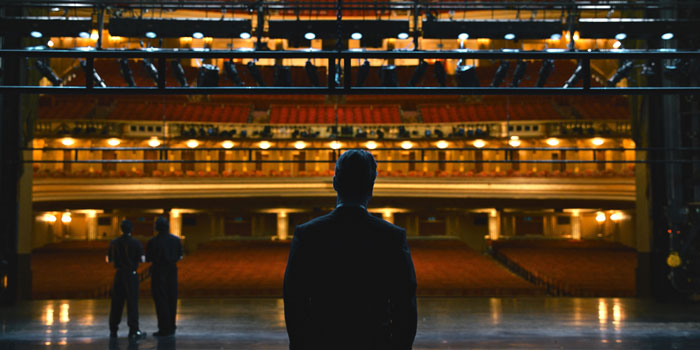
The biopic plays out in three distinct acts, all during iconic Jobs-headed product launches: the 1984 launch of the first Macintosh home computer; the 1988 launch of the NeXT Computer for NeXT Inc. (the company Jobs set up after being forced out of Apple); and ending with the 1998 launch of the first iMac computer.

Jobs worth

Jobs worth

Whilst it may risk being a big advert for Apple, the poor picture painted of the figurehead of the company throughout ensures that is never the case. The Steve Jobs we get to know over the course of the three acts, which play out in real time in the lead up to each of the presentations Jobs is giving, is narcissistic and self-centred, only relenting from the power trip when he finally achieves the success he has been driving for. It shows softer sides of his personality and attempts to justify his unique traits but the focus on his tempestuous relationship with his ex-girlfriend Chrisann Brennan and their child Lisa ensures his best side is never seen.

It is actually a difficult watch throughout. It is basically two hours of arguments, eventually becoming tiring. It does successfully portray the frantic and intense atmosphere of a huge-scale product launch in a very real manner. It fails, however, to convince that this is a good platform for great cinema.

Michael Fassbender plays the Steve Jobs we see here to perfection, capturing the nuances required of someone who is heartless to the extent of being cruel. Kate Winslet’s turn as Joanna Hoffman is steadier than her accent, and Seth Roger puts in an adequate performance as Steve Wozniak. The standout performance is quite minor but nontheless critical: Michael Stuhbarg is exceptional as the bullied inventor Andy Hertzfield.

The biggest success is the genius move to film the picture on era-appropriate equipment. The three scenes were each filmed using totally different techniques: 1984 was captured on beautiful 16mm film, 1988 on 35mm film and 1998 on digital film. The evolution of technology is reflected in the format change and portrays each era in a manner that would have been impossible with digital post-production.

Whilst it isn’t a let down, it will be difficult to find a sustainable market for this film. It’s not a straight biopic, it isn’t hugely in favour of Apple, nor is it against it. It’s a struggle to watch and is unlikely to have people raving about its successes as they leave the cinema. 

It could be Danny Boyle’s Newton moment.

Steve Jobs is released in cinemas in the UK in November.

Further Viewing

If you enjoyed the film so much you’re interested in some further viewing, then check out the below videos. In the film you see the 40 minutes building up to the release of three products, but never get to see the keynotes themselves.

1984 – Original Macintosh home computer

The original keynote:

The Superbowl “1984” advert:

1988 – NeXT

The 1988 keynote speech isn’t available on YouTube, but this ABC news segment is a close fit:

1998 – iMac

The full video in all its glory:

Film review – Begin Again (John Carney, 2013)

If Inside Llewyn Davis is the poisonous view of the hardest and most demoralising sides of the music industry, with all its rejection, squalor and misery, then Begin Again is the antidote. They are from different sides of the tracks and share nothing but a basic premise and the same city (New York) in common.

Begin Again tells the intertwining stories of two people whose lives have been ruined by the music industry. Dan Mulligan (Mark Ruffalo) has been sacked from his own record company by co-founder Saul (Mos Def) and has taken to the bottle to avoid finding focus in his life, much to the detriment of his relationship with daughter Violet (Hailee Steinfeld). He has a chance meeting in a bar with Gretta James (Keira Knightley), who has plenty of talent but no stage presence or confidence. He decides she has enough potential to turn into something more than just a singer at an open mic night, though her reluctance is powered by the recent breakdown of her relationship with Dave Kohl (Adam Levine), now seemingly destined for stardom.

Everything falls into place perfectly easily. Hurray.

Everything falls into place perfectly easily. Hurray.

Begin Again falls down where films like Inside Llewyn Davis or Carney’s last film Once succeeded for the simple reason that the songs and performances simply aren’t as good. Keira Knightley has found herself in an awkward situation. Her fame ultimately puts her as an a-lister actress and celebrity, with the ability to elevate an average film to blockbuster status due to her past successes. As a viewer, subconsciously there is an expectation that her ability as a musical performer should match that. Sadly, the studio has had this well in mind and ensured, through post-production, that her voice and entire backing track is polished to perfection, removing the intimacy seen in Glen Hansard and Markéta Irglová’s raw but powerful performances in Once. It’s an inevitable source of frustration as it is evident she has some talent, though what that is feels hard to decipher.

Ruffalo’s performance lacks conviction and the feeling that he has been really scorned by the music industry never fully materialises. Adam Levine plays his part coolly, almost as an exaggeration of his real-life personality (or what it is perceived to be). Steinfeld provides another assured performance in her supporting role, even though she doesn’t look like she’s ever picked up a guitar before. James Corden makes the most of his limited screen time.

It’s disappointing that overall this film fails to deliver on so many levels. The one thing it will be remembered for is the track “Lost Stars”, which was nominated for the Academy Award for Best Song in 2015. It is the one song here that stands up to those around which Once was built. However, one song does not a musical make; it is very unlikely this will follow its predecessor onto the West End and thus it is destined to be forgotten.

Begin Again is available for purchase now, or can be streamed on Netflix.

The Intern (Nancy Meyers, 2015)

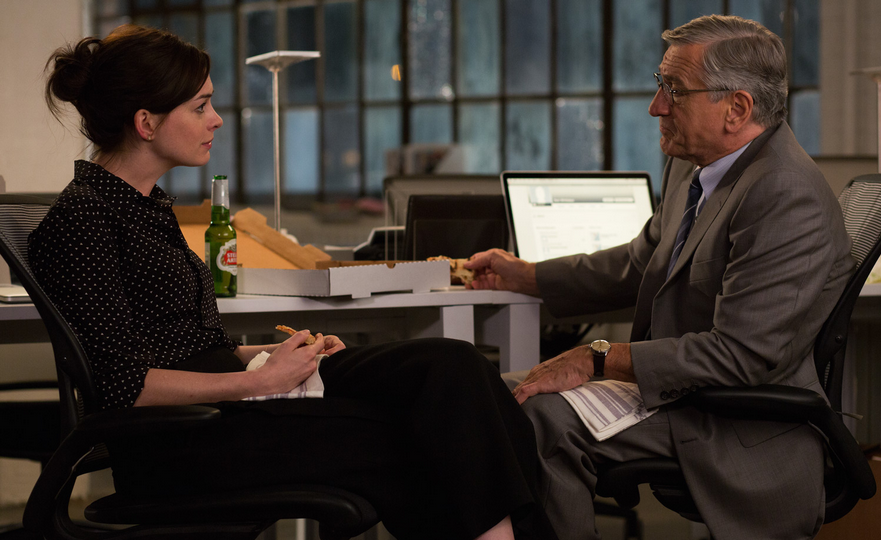
Nancy Meyers has a rich history in crowd-pleasing comedies. Her writing and directing credits include What Women Want, both Father of the Brides, It’s Complicated, The Holiday and Something’s Gotta Give. The basic premise of her latest, The Intern, is that a 70-year-old widower Ben Whittaker (Robert De Niro) signs up the the senior intern programme of a rapidly-growing start-up business, only to be assigned as the personal assistant to company director Jules (Anne Hathaway), a woman seemingly struggling to keep up with the demands of her new-found success whilst balancing it with her house-husband Matt (Anders Holm) and daughter Paige (JoJo Kushner). Initially resistant of Ben, she soon grows to his warm personality and old-fashioned sentiments, leading to doubts over the future of her personal and professional life.

This may sounds like middle-of-the-road schmaltz, but it works. Some softening colour washes, a pleasant-on-the-ear soundtrack, straight-from-GAP outfits, showroom offices and houses. It’s a look at the modern world from the rose-tinted perspective of middle-to-upper-class old people, coming together to appeal to women of anywhere between the age of about 30 upwards. It is easy on the eye and easy on the soul, but to dismiss it as just that would be wholly unfair.

internscreen

By design, Meyers has created a picture that on the surface is just a pleasant and slow-paced monorail ride through the life of Ben and Jules. However, there is quite a lot of power in the messages it is portraying. First of all, it is telling women to not lie down and take the easy road when it comes to business, despite constantly being told that attempting to be the CEO of a business isn’t correct of a woman. Secondly, just because you have a child, don’t assume that you need to forfeit your career to ensure your partner can maintain his whilst you stay at home and look after your child. Thirdly, don’t feel guilty if your partner doesn’t get any of this.

I’m not sure how this film would fair in the Bechdel Test, which scores films on how sexist the content is by checking how many named female characters are involved with conversations with other women about something that isn’t men. Unfortunately, it would probably score low because the film drowns Jules in a sea of men to highlight the isolation she is experiencing in her career (other key female characters in the office are her emotional assistant and a masseuse). It may also be seen as unfortunate that she relies on a father-figure to guide her through her issues rather than working them out herself, but that’s the nature of the beast and it isn’t at all detrimental to the overall impact of the film in the final act.

There are a few failures. Husband Matt completely loses his essence about halfway through and doesn’t seem fixed in reality, undermining the effect of his actions and Jules’s reaction to them. Too often she brings emotion to the forefront of the company – one scene is obviously playing for laughs but when she’s prioritising the retrieval of a personal e-mail over issues that could destroy the company, the thought can’t be avoided that perhaps she isn’t the right person to sit at the top.

Overall, the film is a success and will no doubt please the crowds to which its box office rivals won’t appeal. It’s slightly early for the Christmas crowds and will not be remembered when the awards season is upon us, but it if you need some surprisingly thought-provoking entertainment there are far worse ways to spend two hours.

The Intern is released at cinemas in the UK on 2nd October 2015.

Orion: The Man Who Would Be King (Jeanie Finlay, 2015)

ORION: The Man Who Would Be King (12A), the latest feature documentary from award-winning director Jeanie Finlay (Glimmer Films) is released into UK cinemas from Friday 25 September and has received distribution support to enhance this theatrical release from Creative England and Ffilm Cymru Wales.

Orion tells the story of Jimmy Ellis, an American singer with a natural voice that drew unavoidable similarities to Elvis Presley. In the aftermath of Elvis’s death in 1977, music producer Shelby Singleton of Sun Records played on the conspiracy theories about Elvis having faked his own death and created Orion – a masked singer with a mysterious past who had the look and sound of Elvis whilst never laying claim to being the man himself. For four years success lay in the hands of Ellis as he toured and rode the waves of popularity, but frustrations crept in about the public perception of him and the deals he had signed and he finally broke away from his deal in some style.

This documentary was spawned by a chance purchase at a Nottingham market, where director Jeanie Finlay picked up a copy of the Reborn album on 12″ vinyl, Orion’s debut release. That was where the interest in him started, and between then and now the director has visited almost everyone closely involved in his life to discuss their experience of a man driven by a desire to sing on his own terms. It is excellently put together. It is a story that threatens to be either not very interesting or flawed due to lack of decent source material (the Presley estate provide little footage for these kinds of films and many of the key people in the film were unavailable for interview). Fortunately, neither of these things threaten to creep in and the end product is fascinating.

Oh Ryan.

Oh Ryan.

It goes a long way into intimately portraying a man torn between being forced to hide behind a mask and enjoying the limited success he was achieving. It is balanced and as such avoids over-celebrating Ellis, concentrating on his personality rather than his success. As with most music documentaries, many of the anecdotes bring huge amounts of comedy to the table and Finlay has been careful to interview as many people as were available, no easy task when on such a tight budget.

Orion: The Man Who Would Be King is a documentary worth watching, and it’s an experience enhanced if you know nothing about Ellis. A full list of screenings can be found on the official website.

Keith Richards: Under The Influence (Morgan Neville, 2015)

Keith Richards: Under The Influence is a documentary film by Morgan Neville, the man responsible for the excellent Academy Award-winning 20 Feet From Stardom. Richards has a new album out – Crosseyed Heart – and the timing of this film gives it the feel of being a bit of an extended promotional interview.

Indeed, that’s exactly what it is. Bringing in a few musical friends to offer further insight, the film is actually a series of interview filmed in various locations across the USA. The fact it is just a talking heads film is not to say this is a disappointment as a documentary. Fans of the band and/or the individual will find a lot of joy from watching the series of interviews with a man who knows how to tell a tale. Most avid fans have probably already read his autobiography “Life” and an 80 minute film is never going to cover the depths of a 500-page book.

Keith Richards: Under The Influence is available excusively on Netflix now.

Paper Moon (Peter Bogdanovich, 1973)

One of the most sure-fire ways of making an enjoyable and effective film is to ensure the chemistry between the two lead characters is strong. What better way to achieve this than by casting a father and daughter in what is essentially a buddy film?

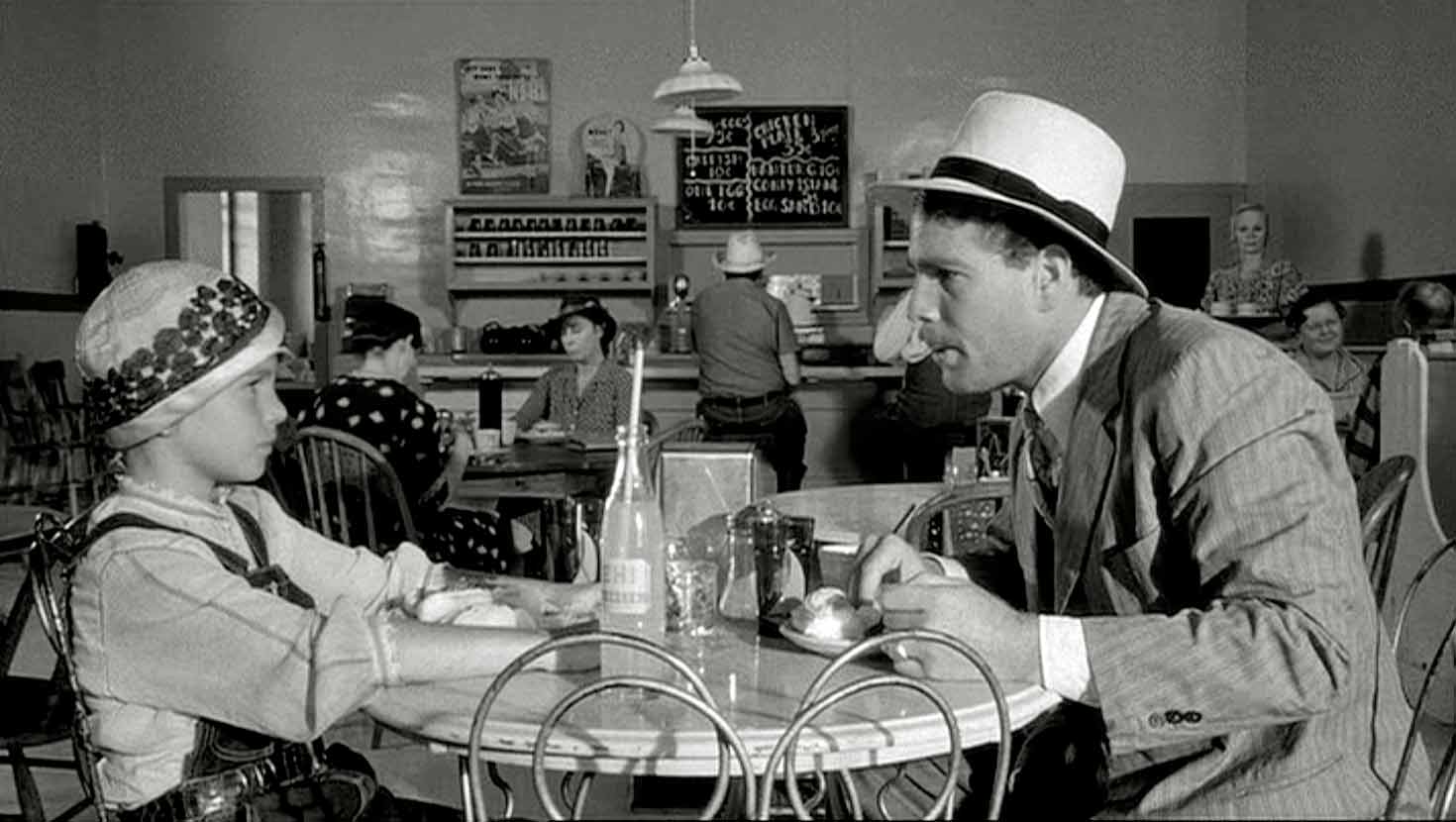
In Paper Moon, we follow the story of tomboy orphan Addie Loggins (Tatum O’Neal) as she is taken under the wing of con-man Moses Pray as he agrees to take her from her mother’s funeral to her aunt’s house in Missouri. She is convinced he is her real father, a point that is hinted at throughout, despite his continued denial of the fact. One thing that they’re both convinced of, however, is that they make a great pair as a scamming duo, going door-to-door convincing recent widows that their recently deceased husbands had ordered them a personalised bible. This serves as an excuse for them to go on a prolonged adventure of dishonesty, an adventure that seems far more appealing than their other limited options.

The chemistry between the O'Neals is excellent.

The chemistry between the O’Neals is excellent.

Much was made at the time – and has been since – of Tatum O’Neal’s performance. Indeed, she remains to this day the youngest person to win an Academy Award for Acting. At 1 hour, 6 minutes and 58 seconds, it is also the longest performance to receive a Supporting Actor/Actress Academy Award. It is playful and at times unintentionally comedic, but the playoffs with father Ryan are brilliant to watch. One memorable scene involves a long one-shot as they drive and argue, both livid at each other before turning it around to agree despite their tones still being that of an argument. It’s almost so good it doesn’t feel like they’re acting, although it allegedly took 39 takes over two days to get right.

One thing the film never answers is the question of whether the two are really father and daughter. The decision is made instead to leave it open as they head off into the sunset, presumably to continue much as they did in this film (a relationship explored in a panned TV sitcom spin-off series starring Jodie Foster). It is a nice decision – the fact they need each other, either as a father figure or as a driver to act responsibly, is to them more important than finding out this truth, at least at this stage in their relationship.

The bonus features are worth watching and provide a valuable insight into the making of the picture. The highlight is an anecdote involving Tatum repeatedly fluffing a line, resulting in her father having to eat countless amounts of waffles, much to the delight of Tatum. In fact, this was deemed so important as an example of their chemistry that the outtake was incorporated into the original trailer.

The cinematography by the Hungarian László Kovács adds a great deal to the authenticity of the film and its success in recreating 1935 Kansas. Coupled with a timeless soundtrack and a great attention to detail in the scenery and costumes, the result is that it transports the viewer completely into the environment, adding further embellishment to the excellent performances of both stars and their supporting cast.

A unique film with a lot to offer even the most ambivalent of viewers, this is one of the best re-releases of the year.

Paper Moon is available on Masters of Cinema Blu-ray now.

American Ultra (Nima Nourizadeh, 2015)

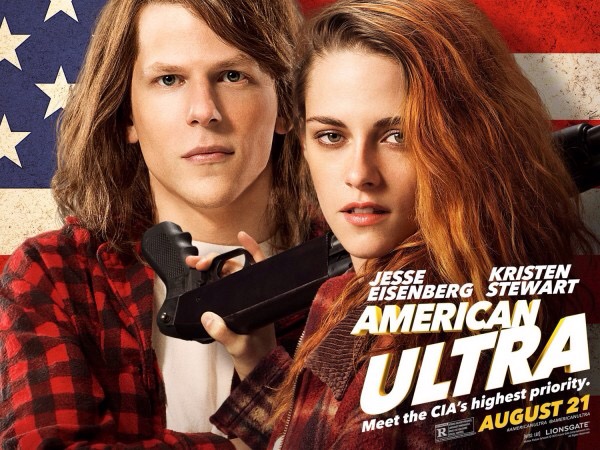
American Ultra is far better than it should have been. The basic story – a stoner grocery store assistant (Jesse Eisenberg) is actually an advanced agent from a secret programme that was shut down before his memory was wiped – sounds like pretty standard fare and doesn’t really suggest a great film is in order. A fast pace, short running time and well-judged performances make it an enjoyable romp.

  
Eisenberg is well cast and it’s a wise move to keep him in reluctant stoner character throughout, though it would have been easier to make him magically turn into an alpha male. Kristen Stewart makes another case for the ATL (Anti Twilight League) to take her a little more seriously with a solid performance and there are great turns elsewhere from Bill “Was That Bill Pullman?” Pullman, Topher “That 70s Guy” Grace, John “Luigi Mario” Leguizamo and Tony “Loose Seal” Hale.Perhaps this film doesn’t justify a trip to the cinema, but when it hits the steaming platforms it should be near the top of your list.

American Ultra is out now at cinemas in the UK.