The Gang’s All Here (Busby Berkeley, 1943)

After listening to the excellent Masters of Cinema Cast discussion on Busby Berkeley’s 1943 musical extravaganza The Gang’s All Here, I knew I had to watch it for myself. I didn’t know what to expect and having watched it now I still don’t really know what I made of it.

I was reminded of a few modern day film-watching woes as the film played out. You know when you’re watching a 2D film at home and for some reason they have these annoying and hard to follow fast-paced sweeping shots following someone through a surprisingly tricky pathway full of things jumping towards you, and you sit there unimpressed because you aren’t at an IMAX screening? There was a great one in the Jim Carrey-starring animation A Christmas Carol. Out of context it just doesn’t wow, because the sole purpose of it is to show off a piece of technology or visual effect.

Another example is the 30-ish minutes of wasted special-effects shots in Star Trek: The Motion Picture. Loads to see, if your thing is watching outdated effects showing a spaceship slowly crawling through space. In the distance. But watched in 2015 you can’t help but drown in the lethargy of it all.

So we have The Gang’s All Here. A work of Technicolor wonder. A flimsy plot serving as a platform for countless big hit parade smashes in state-of-the-art colour film. A picture oozing razzmatazz. A picture that just doesn’t wow, simply because the visuals it spends so long showing off are just something we expect of a modern film.

That’s not to say The Gang’s All Here is the first colour film and a massive surprise to audiences. Indeed, they had been treated to both The Wizard of Oz and Gone With The Wind in 1939, some four years eariler, both shot in Technicolor. This was, however, Berkeley’s first feature to be filmed entirely in Technicolor, which would have been a great honour at the time due to the high production costs associated with the technique. It wasn’t an opportunity he was going to waste, and he certainly made enthusiastic use of his chance to use colour for the first time.

Really, the plot is a duplicate of far too many films of the era: woman and soldier fall in love in a whirlwind romance on the eve of his departure for the war (in this case, he’s off to Japan). It really isn’t important. What the 1943 American audiences wanted was escapism – two hours of over-the-top dance numbers, busy routines, familiar songs and huge stars. And that’s what they got.

There are a few numbers where Berkeley really goes to town. The big opening number “You Discovered You’re In New York” – sung by Brazilian Carmen Miranda – is a sharp comment about wartime shortages. Her other big number “The Lady In The Tutti Fruity Hat” doesn’t hide the fact that it’s full of innuendo (7ft bananas, anyone?) and is probably the most memorable number in the whole film.

There are also moments of total surrealism, none more so than the finale “The Polka-Dot Polka”, which is Berkeley indulging in his big budget and experimenting with the Technicolor medium. It’s kaleidoscopic and hilarious and deserves to be seen.

It’s not at all a perfect musical, and it hasn’t retained its popularity over the years, for one reason or another. There probably won’t be a stage adaptation, owing to the fact the storyline isn’t strong enough and the wow factor on the big number comes from visual effects that couldn’t be recreated on stage. However, it deserves to be seen in full HD, with attention given to the brightly saturated colours of the original print. Inevitably, Eureka and Masters of Cinema have delivered on this release yet again.

The Masters of Cinema release of The Gang’s All Here is available to buy now. Strangely, you can watch the whole film via YouTube below, though the low picture and sound quality just doesn’t do it justice. You can get a flavour of it though.

Whiplash (Damien Chazelle, 2014)

In the history of cinema, there have been a small number of characters so full of evil they barely resemble human beings anymore. We’re talking Louise Fletcher’s Nurse Ratched, Ian McDiarmid’s The Emporer. I think we can add another one to the list after seeing Whiplash.

J. K. Simmons’s portrayal of jazz conductor Terence Fletcher is absolutely remarkable and his Oscar nomination is fully deserved. Channelling his previous performance as newspaper owner Jameson in the 2002-2007 Spiderman trilogy but taking it to another level, removing the caricatured anger and replacing it with psychopathic traits of real malice, we are treated to a truly great cinematic performance.

The story charts 19-year-old Andrew Neimann (Miles Teller) as a first-year jazz student at the prestigious (and fictitious) Shaffer Conservatory music school. He lands a place in Fletcher’s jazz orchestra, an orchestra renowned for both the high performance standard and intense rehearsal conditions. Happy to meet the challenge, Neimann quickly realises he’s going to be pushed beyond the limits to achieve the thing that all aspiring musicians crave: perfection.

Teller’s performance is very assured, showing admiral talents in both his musicianship (he’s a self-taught rock drummer though had lessons to learn jazz drumming) and his portrayal of a young man trying to find the strength to pursue his dream and avoid a nervous breakdown. He has a bright future in the business, and this is an excellent way to announce yourself to the wider industry.

The film has come under criticism from avid fans of jazz for misrepresenting particular anecdotes used in the film and apparently poor musicianship from the lead characters. I’m no fan of jazz so I won’t comment on something I’m not confident on, but from my point of view the abilities of the performers was not something I felt was detrimental to the film at all. Indeed, it made me want to explore jazz a little more. But anyone can see this film is not about jazz. It’s about bullying, using jazz as a medium to tell the story. The jazz industry would do well to not underestimate the audience so much as to assume they wouldn’t get that.

I can’t recommend this enough to fans of great character portrayal. If Simmons isn’t awarded with an Oscar for Best Supporting Actor next month it will be the wrong decision.

Whiplash is on general release globally now.

Sunset Boulevard (Billy Wilder, 1950)

“Alright Mr DeMille, I’m ready for my close-up”.

What a line. It sums up perfectly the fragile mindset of one of the most brilliantly realised characters in cinematic history – Norma Desmond, portrayed by Gloria Swanson. It’s also memorable, quotable (and mis-quotable) and ironically very well delivered considering it is done so by a silent-era star playing a silent era star.

I’d been putting off seeing Sunset Boulevard for such a long time for two reasons. Firstly, I was sure I was going to love it so I wanted to savour the moment. Secondly, there is always a niggling feeling that I might not enjoy it as much as the hype suggested I would, so I was fearful I would be left disappointed. My experience was certainly very much in the former category.

The film opens with a classic film noir feel, a whodunnit of sorts. We are shown the ending at the start, with a convoy of police and news reporters converging on a mysterious man lying dead in the swimming pool of an unknown rich homeowner on Sunset Blvd. (as it is famously written in the film). We don’t know who this is or who owns the pool, but just as we start to ask ourselves that question, the narration continues and we rewind to six months earlier. From here we pick up the main thread of the film – a struggling screenwriter (Joe Gillis, portrayed by William Holden) is trying to write his breakthrough piece whilst avoiding the bailiffs threatening to take his car as payment for his debts. It is a standard but perfectly pitched opening gambit and it really pulled me in as a viewer. You can view this opening scene below:

As the film progresses into the central act, a series of coincidental events leads Gillis into the path of Desmond, a faded silent-era star who takes him under employment as the screenwriter of her comeback film. It is here that the film starts packing its biggest punches and thus I will stop commenting on the plot.

I found the way Wilder and Swanson dealt with the character of Norma Desmond absolutely mind-blowing. There is no detail lacking attention. She is filmed like a silent star. She is simply one of the greatest literary characters ever created. It’s a picture made for Gloria Swanson, with the role so ominously mirroring her real life. It is generally known that she was a hard-working and studious actress and she threw herself into this surprise return to leading actress status. She clearly knew the importance of this role and it shows in her detailed portrayal. It’s a performance that really deserves to be studied frame-by-frame. That is was completely shut out in the acting categories at the 23rd Academy Awards, is one of the greatest tragedies of the awards ceremony, though it faced tough competition from All About Eve and surprising competition from Born Yesterday,

That’s not to say it’s a one-person show. Eric von Stroheim, here playing Desmond’s butler, is also playing a character ominously similar to his real life scenario. A director in his own right, it was actually a film he directed that starred Gloria Swanson that ruined his career (1929’s Queen Kelly which, if you’re really keen, is shown briefly during Sunset Boulevard). Elsewhere, Buster Keaton and Cecil B. DeMille also have memorable appearances, as well as many other huge stars often mirroring their real life selves in one way or another.

The film has also been turned into a hugely successful musical at the hands of Don Black, Christopher Hampton and Andrew Lloyd Webber. Whilst this version really is a completely different take on an unlikely source for a musical, it has many merits and does it justice, though the popularity of Wilder’s film makes it a hard task to topple it as the ultimate telling of such an important story. You have to treat them as separate entities and I’m sure the aim of turning it into a musical wasn’t to attempt to overshadow the original.

I was blown away by this film and it’s one I will enjoy watching again in the near future, along with as many of Wilder’s films I can get my hands on.

Sunset Boulevard is available on Blu-ray now.

Academy Award for Best Original Song – A Closer Look

There are five songs nominated in the shortlist for the Best Original Song Oscar. Here’s my take on them.

Everything Is Awesome (from The Lego Movie)
Music and lyric by Shawn Patterson
Performed by Tegan & Sara feat The Lonely Island


Total YouTube views as of 26/01/2015 = 28,675,867
Well, I think this is the one song on the list that you already know. If you’ve not seen this film, then you can bet someone else you know has. And if they have, they will undoubtedly have sung you some or all of this song. It’s catchy as hell. I’m amazed it has been nominated to be honest, but it is a just nomination and it would be a worthy winner. Before the nominations were released I had never heard of the other four songs on this list and if recent track records are anything to go with then the most popular song always wins (see the wickedly talented, the one and only Adele Dazeem’s “Let It Go” in 2013* and Elvian Conchords Brett McKenzie’s “Man or Muppet” in 2012). The best thing about this winning would be Andy Samberg’s acceptance speech, which, if track record is anything to go by, would be awesome.

Glory (from Selma)
Music and lyric by John Stephens and Lonnie Lynn
Performed by Common and John Legend


Total YouTube views as of 26/01/2015 = 1,613,740
John Legend has provided a quality chorus and backing track here, the “One day, when the glory comes” refrain more than catchy enough to stay in my head for a while. I have to say though, Common’s rapping leaves a lot to be desired. Music lovers in the UK may be forgiven for not knowing Common. He’s really a lot more well known in the US. It’s weird though, because here he has the look and feel of a middling defence lawyer in a low-budget made-for-TV courtroom drama. Don’t get me wrong, the words he has written are powerful enough, but the way they’re delivered just left me feeling a little indifferent. Mind you, I haven’t bought a hip-hop album since Mos Def’s 1999 hit “Black on Both Sides”, so maybe this just isn’t aimed at me.

Grateful (from Beyond The Lights)
Music and lyric by Diane Warren
Performed by Rita Ora


Number of YouTube views as of 26/01/2015 = 331,107
By far and away the worst song on the list. I’ve no idea how this got nominated. If there was a special award for Best Diane Warren Song of 2014 it wouldn’t even win (remember Paloma Faith’s “Only Love Can Hurt Like This” was released in 2014). The film isn’t even very popular. Baffling really.

I’m Not Going to Miss You (from Glen Campbell … I’ll Be Me)
Music, lyric and performance by Glen Campbell


Total YouTube views as of 26/01/2015 = 6,858,585
This would be a good shout for the win. The film Glen Campbell… I’ll Be Me has been making waves across the regions it has been available. It charts Glen Campbell’s journey suffering from Alzheimer’s, which is noble subject matter for a film. I’m yet to see it, but this song (Campbell’s last recording) is staunch reminder of his talents. It isn’t by any means his greatest work, but it is proof that the magic is still there as his condition worsens. It’s sad to listen to and should the Academy want to avoid a popular but jokey winner then this will be the one they go for.

Lost Stars (from Begin Again)
Music and lyric by Gregg Alexander and Danielle Brisebois
Performed by Adam Levine


Total YouTube views as of 26/01/2015 = 20,025,920
There’s a clear reason for this being nominated: TV viewing figures. These award ceremonies are often quite uncomfortable affairs. Neil Patrick Harris will inevitably deliver a well-polished and sharp performance as presenter this year, but more often than not the links and prize giving segments are awkward, silence-filled affairs that leaves the audience begging for reprieve. When Adam Levine takes to the stage we will at least know he’ll nail this song. Taken from Begin Again, a film in which he stars alongside Keira Knightley and James Corden, this is actually a solid power-ballad, the type for which Maroon 5 have become household names. It’s one of the better ones too. It has been included on the reissue of their latest album V, which will help boost sales. I don’t think he’ll be gutted when he finds out he hasn’t won – he’ll be more bothered about how critics react to his first major acting role (quite well, I might add)**. If I were choosing and wanted a serious option, this is the one I’d go for.

* If you’ve not heard this song yet, it’s quite the song. You should check it out. If only it was more popular.

** Critics have been widely accepting-to-encouraging of Levine’s big screen acting debut. That will come as a relief to Levine, who was so desperate to land the role he agreed to do it for free. As a business-minded individual I’m sure it was a calculated risk. He’s singing half of the soundtrack so at worst it will serve as a money-maker for the royalties from he’ll get from the OST, whilst he will also get a welcome boost of interest in their latest album V. Clever boy.

Uwasa No Onna / 噂の女 (Kenji Mizoguchi, 1954)

Released as part of the Kenji Mizoguchi Masters of Cinema boxset “Late Mizoguchi”, Uwasa No Onna is an understated film that nonetheless packs a sizeable punch.

The story starts with a girl – Yukiko – returning home from her higher education at a music school in Tokyo, where she is studying piano. She wishes to end her education as she is suffering from a broken heart, and has attempted suicide by overdosing on sleeping pills. Her mother owns a popular geisha house in a small town and so fairly early on in the film an interesting dynamic begins as she is in a position of being the outcast by the other young girls of a similar age, many of whom believe they are effectively working to pay for an education for her that they could only dream of, and that it is selfish of her to drop out in such a fickle manner.

Mizoguchi’s casting of Kinuyo Tanaka in the lead role of Yukiko is no surprise. She was a favourite of his for much of his career, though she later went on to be a director in her own right, which in turn caused an argument that severed her friendship with Mizoguchi. When we first see her she is wearing a contemporary black dress, which gives her an immediately striking appearance, looking somewhat like Audrey Hepburn. This has two effects: in all black she is shown to be in a depressed frame of mind, and she also sets herself apart from everyone else in the film as being from a different culture, in this case contemporary Europe.

2015/01/img_0168.jpg

Mizoguchi has a fascination with brothels that runs throughout many of his films (perhaps most famously in the 1954 classic Akasen Chitai / 赤線地帯). These stories always have a hint of the autobiographical about them – his older sister Suzu was sold off for prostitution soon after 1915 when his mother died, which was a shameful experience for Mizoguchi. Frustratingly for him, the money she earned helped fund his higher education; this background is clearly reflected in Uwasa No Onna.

Elsewhere on the disc, the Tony Rayns bonus discussion about the film is really interesting, though it is the only bonus feature for this particular film (the film itself is a bonus feature for the more popular Chikamatsu Monogatari / 近松物語). In it he discusses Mizoguchi’s use of theatre in his films, in this case drawing a parallel between stage (watching Kyo Byen at the Noh Theatre) and reality. It’s quite an interesting scene in the film as the mother grows in embarrassment. I personally found it – on a basic level – a wonderful way to view what theatre was like in Japan when the film was set. I’ve never known anyone else capture it in such great detail.

It was a joy to hear Rayns, who is well versed in this director’s history, talk so candidly about his other work and background. Yet another reason to endorse Masters of Cinema (by the way, the transfer is excellent… as usual)!

I notice this boxset is now on sale for a ridiculous amount of money (£156 on Amazon). Frankly, it’s not worth the purchase just for this film, nor for the other three exclusives (I haven’t got round to watching them all yet). That’s because no Blu-Ray boxset is worth that amount of money. I’m sure Eureka will see sense soon and re-release the two exclusive discs for those that missed out the first time. Of course, anyone who has already forked out £156 will be fairly disappointed but they’ll have to live with it.

My Dad (Marcus Armitage, 2014)

Animators – Marcus Armitage, Jonathan Long, Diana Gradinaru, Noriko Ishibe
Voice – Divian Ladwa

Marcus Armitage’s BAFTA-nominated short animation “My Dad” is a story full of social commentary, regarding the way children are influenced by their surroundings. Its powerful message makes it a worthy nominee at this year’s awards.

I caught up with Marcus ahead of the awards night to find out more about the film and his inspirations.

“I started out looking into the relationship between father and son and how opinions are passed down,” he said talking about the inspiration behind the film. In it we see a young child being spending time with his father as they do a series of seemingly innocuous things, but the overlaying of disjointed sound bites from the child (delivered to great effect by Divian Ladwa) reveals the real message of the piece – that children are smothered by a mixture of the media and their parents.

The narration acts as a voice for the child as he attempts to process what he is seeing and hearing. The brilliantly animated oil pastel drawings show a real talent in a medium Armitage clearly enjoys (“I have a stack of around 3000 oil pastel drawings at home!!”). Coupled with the innocence of the words spoken, the sensory overload really belies the powerful message contained underneath.

2015/01/img_0178.jpg

I was taken aback by the ending of the film, as the artwork is literally torn away to reveal a barely glimpsed shot of a terrified child with his father, in the midst of an altercation between an EDL gang and the police.

“The concept was mainly formed but then during research into the subject of inherited racism I found this image taken from an EDL march. I was so struck by its power I had to use it. It changed the film quite a lot but for the better. It is quite a disturbing image but you only get a quick glimpse at the end.”

It’s a really effective way to end the piece and shows Armitage’s intelligence in drawing masses of influence from something he finds intriguing and striking.

So what’s next for Armitage? “My next project is uncertain at the moment. I graduated in June and I’ve since set myself up as a freelance animator and director, which is going well.” He has ideas for his next film, but with time on his side and an increased interest in his work following the BAFTAs, My Dad is just the start of what I expect will be a very busy and exciting period in Marcus’s career.

You can view the trailer for My Dad here. I also recommend Over Dinner, a previously produced animation with a similarly powerful message.

Academy Awards Nominations (Full List)

Best picture
American Sniper
Birdman
Boyhood
The Grand Budapest Hotel
The Imitation Game
Selma
The Theory of Everything
Whiplash

Best director
Alejandro González Iñárritu – Birdman
Richard Linklater – Boyhood
Bennett Miller – Foxcatcher
Wes Anderson – The Grand Budapest Hotel
Morten Tyldum – The Imitation Game

Best actor
Steve Carell – Foxcatcher
Bradley Cooper – American Sniper
Benedict Cumberbatch – The Imitation Game
Michael Keaton – Birdman
Eddie Redmayne – The Theory of Everything

Best actress
Marion Cotillard – Two Days, One Night
Felicity Jones – The Theory of Everything
Julianne Moore – Still Alice
Rosamund Pike – Gone Girl
Reese Witherspoon – Wild

Best supporting actor
Robert Duvall – The Judge
Ethan Hawke – Boyhood
Edward Norton – Birdman
Mark Ruffalo – Foxcatcher
JK Simmons – Whiplash

Best supporting actress
Patricia Arquette – Boyhood
Laura Dern – Wild
Keira Knightley – The Imitation Game
Emma Stone – Birdman
Meryl Streep – Into the Woods

Best original screenplay
Alejandro González Iñárritu, Nicolás Giacobone, Alexander Dinelaris, Jr and Armando Bo – Birdman
Richard Linklater – Boyhood
E Max Frye and Dan Futterman – Foxcatcher
Wes Anderson and Hugo Guinness – The Grand Budapest Hotel
Dan Gilroy – Nightcrawler

Best adapted screenplay
Jason Hall – American Sniper
Graham Moore – The Imitation Game
Paul Thomas Anderson – Inherent Vice
Anthony McCarten – The Theory of Everything
Damien Chazelle – Whiplash

Best foreign film
Ida
Leviathan
Tangerines
Timbuktu
Wild Tales

Best documentary
CitizenFour
Finding Vivian Maier
Last Days in Vietnam
The Salt of the Earth
Virunga

Best animation
Big Hero 6
The Boxtrolls
How to Train Your Dragon 2
Song of the Sea
The Tale of Princess Kaguya

Best original song
Everything Is Awesome (music and lyric by Shawn Patterson, performed by Tegan & Sara feat The Lonely Island) – The Lego Movie
Glory (music and lyric by John Stephens and Lonnie Lynn, performed by Common and John Legend) – Selma
Grateful (music and lyric by Diane Warren, performed by Rita Ora) – Beyond the Lights
I’m Not Going to Miss You (music, lyric and performance by Glen Campbell) – Glen Campbell … I’ll Be Me
Lost Stars (music and lyric by Gregg Alexander and Danielle Brisebois, performed by Adam Levine) – Begin Again

Best documentary short
Crisis Hotline: Veterans Press 1
Joanna
Our Curse
The Reaper
White Earth

Best cinematography
Emmanuel Lubezki – Birdman
Robert Yeoman – The Grand Budapest Hotel
Lukasz Zal and Ryszard Lenczewski – Ida
Dick Pope – Mr Turner
Roger Deakins – Unbroken

Best editing
Joel Cox and Gary D Roach – American Sniper
Sandra Adair – Boyhood
Barney Pilling – The Grand Budapest Hotel
William Goldenberg – The Imitation Game
Tom Cross – Whiplash

Best sound editing
Alan Robert Murray and Bub Asman – American Sniper
Martin Hernández and Aaron Glascock – Birdman
Brent Burge and Jason Canovas – The Hobbit: The Battle of the Five Armies
Richard King – Interstellar
Becky Sullivan and Andrew DeCristofaro – Unbroken

Best Sound Mixing
John Reitz, Gregg Rudloff and Walt Martin – American Sniper
Jon Taylor, Frank A Montaño and Thomas Varga – Birdman
Gary A Rizzo, Gregg Landaker and Mark Weingarten – Interstellar
Jon Taylor, Frank A Montaño and David Lee – Unbroken
Craig Mann, Ben Wilkins and Thomas Curley – Whiplash

Best makeup and hair
Bill Corso and Dennis Liddiard – Foxcatcher
Frances Hannon and Mark Coulier – The Grand Budapest Hotel
Elizabeth Yianni-Georgiou and David White – Guardians of the Galaxy

Best original score
Alexandre Desplat – The Grand Budapest Hotel
Alexandre Desplat – The Imitation Game
Hans Zimmer – Interstellar
Gary Yershon – Mr Turner
Jóhann Jóhannsson – The Theory of Everything

Best production design
Adam Stockhausen and Anna Pinnock – The Grand Budapest Hotel
Maria Djurkovic and Tatiana Macdonald – The Imitation Game
Nathan Crowley and Gary Fettis – Interstellar
Dennis Gassner and Anna Pinnock – Into the Woods
Suzie Davies and Charlotte Watts – Mr Turner

Best Visual Effects
Dan Deleeuw, Russell Earl, Bryan Grill and Dan Sudick – Captain America: The Winter Soldier
Joe Letteri, Dan Lemmon, Daniel Barrett and Erik Winquist – Dawn of the Planet of the Apes
Stephane Ceretti, Nicolas Aithadi, Jonathan Fawkner and Paul Corbould – Guardians of the Galaxy
Paul Franklin, Andrew Lockley, Ian Hunter and Scott Fisher – Interstellar
Richard Stammers, Lou Pecora, Tim Crosbie and Cameron Waldbauer – X-Men: Days of Future Past

Best costume design
Milena Canonero – The Grand Budapest Hotel
Mark Bridges – Inherent Vice
Colleen Atwood – Into the Woods
Anna B Sheppard and Jane Clive – Maleficent
Jacqueline Durran – Mr Turner

Best short film (animated)
The Bigger Picture
The Dam Keeper
Feast
Me and My Moulton
A Single Life

Best short
Aya
Boogaloo and Graham
Butter Lamp
Parvaneh
The Phone Call

Screen 6… With Edith Bowman

If you’re in the UK and want something film-related that’s massively interesting to listen to in the office or on your travels – and free – then head over to the 6 Music website and download the Screen 6 podcasts.

Presented by Edith Bowman, each episode consists of an interview with some massive A-Listers from the world of film. This includes Quentin Tarantino, Simon Pegg, the Coen brothers, Michel Gondry, Wes Anderson and, most recently, Christopher Nolan. They discuss in great detail the choices behind their greatest scoring and soundtracking achievements, inspirations and influences. It’s well worth a listen. The only limitation is that the songs are cut short in podcast format, though if you’re lucky you can get them on the iPlayer and get the whole show.

Every episode can be found here.

Into The Woods (Rob Marshall, 2015)

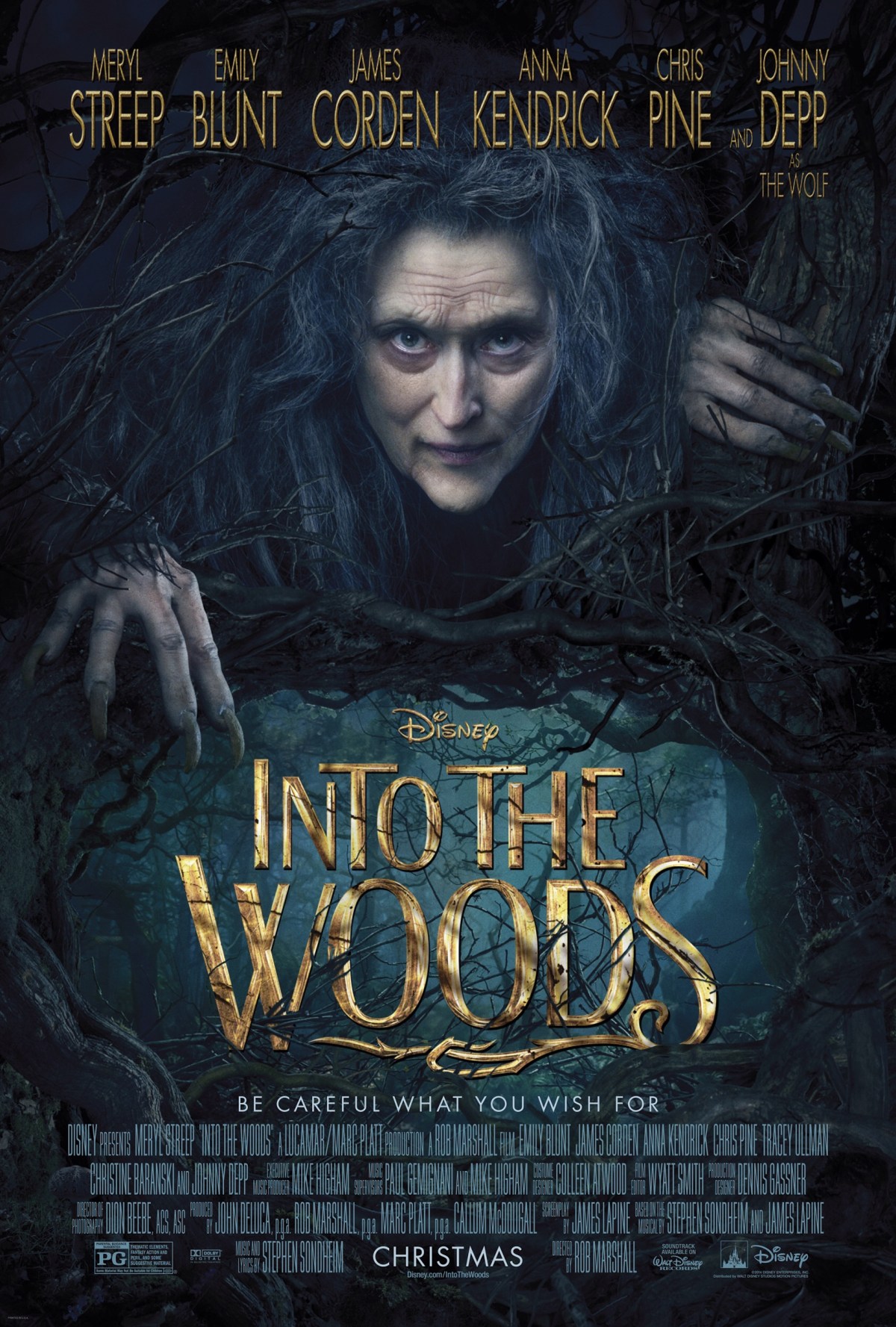
Into The Woods is the big screen adaptation of the classic Sondheim musical of the same name, courtesy of Walt Disney Studios. With a big cast and even bigger budget, it is a film hotly anticipated by fans of musical theatre the world over. So was it any good?

Well, first things first. If you’re thinking of going to see this, you’d better like musicals. If you went to see Tim Burton’s Sweeney Todd and thought “I wish these songs would stop”, then you’ve got to avoid this. This is a Sondheim musical (he also wrote the music for Sweeney Todd) and the songs really aren’t a patch on his best work. Having been part of amateur theatre groups in my time, I’m familiar with picking up songs quickly and memorising their melodies with just one or two listens. I can’t even hum a single song from this. It’s probably because they’re just relentless. It doesn’t break you in easily either. The first song either was 12 minutes long or felt like it was, with characters weaving in and out of each other’s motifs in a really clever but essentially quite annoying manner. It was just too much.

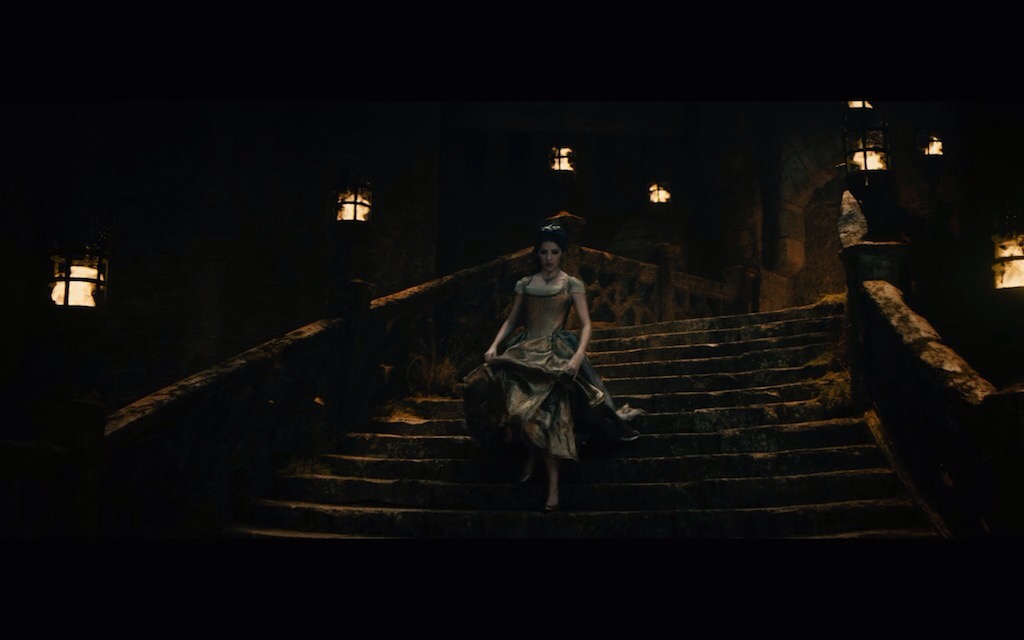
If you don’t know, Into The Woods is a story that inter-weaves the plots from four classic fairy tales: Cinderella, Jack and the Beanstalk, Little Red Riding Hood and Rapunzel. It’s quite clever, although a bit pantomimey at times. However, you have to be willing to go along with the storyline, as with many musicals, and allow yourself to be entertained. As best you can.

2015/01/img_0167-0.jpg

The cast is full of huge stars: James Corden and Emily Blunt play the cursed bakers set a task by Meryl Streep’s evil witch. Anna Kendrick is Cinderella, Chris Pine is the charming but cringeworthy Prince Charming, Tracey Ullman is brilliant as the mother of Jack, and Johnny Depp manages to portray Riding Hood’s Wolf at a notch slightly less creepy than his take on Willy Wonka, despite the first half of the song sounding like he is a paedophile (though this is just a criticism of the quite awful Charlie and the Chocolate Factory if I’m honest).

There are some wonderful moments. If you’ve never seen the quintessential male bravado one-upmanship song “Agony”, then Chris Pine and Billy Magnusson do a mighty fine job of it. Emily Blunt and Anna Kendrick are both excellent in their respective roles and continue to impress me as they develop through their careers. Tracy Ullman, as I’ve already mentioned, was another highlight.

My overarching feeling is that I am well-positioned to really like this. One of my guilty pleasures is a good Disney film when I’m feeling down. I’m a fan of musical theatre. I think all of the cast have been brilliant in plenty of other films and this film doesn’t represent a career-lot for anyone. I just left the cinema feeling indifferent and worn out.

It’s well timed because it goes hand-in-hand with Disney’s other big release in Q1 2015, Big Hero 6, which is due out in just under a month and probably has minimal cross-over with the younger target audience.

It is a faithful but watered down version of the stage musical, aimed squarely at the family audience. It retains some of the darkness and some of the magic, but falls short across the board.

Into The Woods is out now at cinemas across the UK.