I don’t usually post about this kind of thing, but this week’s Humble Bundle is fantastic if you own either a Wii U or 3DS.
Humble Bundle allows you to decide how much you pay for a bundle of download codes for games. The minimum payment is $1, paying more than the average gets you the next tier of games, whilst anything over $13 allows you to secure the whole lot.
The games included this week are as follows.
$1 or more
Retro City Rampage (3DS)
Affordable Space Adventure (Wii U)
Shantae and the Pirate’s Curse (3DS or Wii U)
Above the average amount
Freedom Planet (Wii U)
Rhythm Thief and the Emperor’s Treasure (3DS)
Citizens of Earth (3DS or Wii U)
Pay $13 or more
Super Street Fighter IV: 3DS Edition (3DS)
Darksider II (Wii U)
This is an excellent offer and one that should be taken up if you have these consoles. Shantae on Wii U is certainly worth 70p or whatever it works out at!
I have some spare codes for the 3DS games that are valid in Europe. If you want them just leave a comment below and I’ll forward them on to you.
There have been quite a few reviews posted here this year, so I thought it would be of interest to frequent visitors to find out which were the most popular posts on the website for the year. These are all reviews of new films release in 2015, counting down from ten to one.
I suppose the thing about all these films is that they are slightly less covered in popular media so searches would place each review higher. Football as Never Before has picked up a huge amount of interest over the last couple of months after an article was published about it on a popular British news website. City Lights is a strange one as it’s one of Chaplin’s most popular films, though it was recently rereleased on Blu-ray, which could explain it.
Enjoy catching up on those articles if you missed any of them this year!
There are plenty of candidates for the greatest Star Wars video game ever made. Perhaps Battlefront II, Knights of the Old Republic or The Force Unleashed are high on the list. Or even Empire At War. Maybe Lego Star Wars: The Complete Saga deserves a mention. Not for me. The video game that I will hold up as my favourite will always be the 1991 NES game, simply titled Star Wars.
Firstly, it had a badass trailer. Your mum almost got killed by Darth Vader? Who cares? Because video games.
Secondly, it’s one of the toughest games out there. If you manage to get hold of the game, you’ll immediately see why. The controls aren’t necessarily frustrating, but the sheer length of the game, limited continues and the fact you have to do it all in one sitting (yes, in 1991 nobody had invented a way to save a game) all stack up to make it a tough ask.
The goals of the initial part of the game are fairly simple. Take Luke around Tatooine, retrieve R2-D2 from the Sandcrawler, find Obi-Wan Kenobi in a (really annoying dripping) cave, collect Han Solo from the Mos Eisley cantina (with beautifully recreated 8-bit audio), all whilst collecting shields for the Millennium Falcon. These tasks can be done in any order you wish, though I always found it easier to get Obi-Wan first. Then you take the Millennium Falcon for a spin towards the Death Star. Once inside, you destroy the tractor beam generator, rescue Leia, then destroy the Death Star itself.
Sounds simple, but don’t forget that in 1991 anyone wanting to make a sidescroller game really hard would just throw in more near-impossible jumps and flood the screen with enemies and harmful projectiles.
There’s a great walkthrough of the game here by Heroes of Xanadu – Sloth. Watching it brings back a lot of fond memories. If you want to know just how tricky it got, look at the video around the 26 minute mark.
I’m not saying it’s the best Star Wars game ever. I mean, it doesn’t even allow you to have a dance off with the Emperor. But it was technically advanced for its time and was mesmerizing as my seven-year-old self. I’ve never been as gripped by a Star Wars game as I was for this one.
In researching this article I’m astonished to discover that there was a sequel to this game, again with the simple title of The Empire Strikes Back. I’m not surprised this wasn’t big news for me. I remember the game cost £60 when it was released. That’s a whopping £121 in today’s money! Thanks mum.
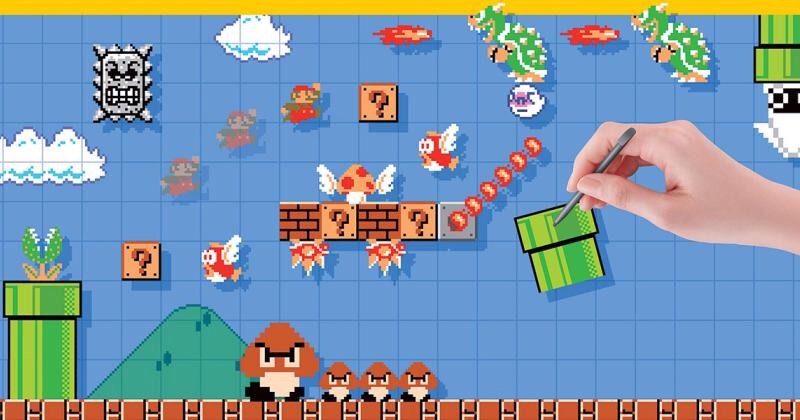
The latest excellent game on the Wii U for the majority of the gaming community to ignore is Super Mario Maker, a game that puts the gamer in the driving seat to control the content of Mario levels in one of four skins: Super Mario Bros., Super Mario Bros. 3, Super Mario World and New Super Mario Bros.
As the trailer above shows, the content is quick and easy to activate, meaning a basic level can be created in no time at all. It may be fiddly at first but once the tools are used a couple of times it becomes remarkably intuitive. You simply control the content on the gamepad using the stylus (did you forget you had that?) and a giant hand replicates it on the screen. After a fairly basic tutorial you are ready to go!
Then comes a huge hurdle. One major issue you encounter at this point is the requirement to keep playing on consecutive days in order to unlock the more advanced level features. This means that perseverance is the key – the only key – to unlocking the tools to make the most innovative levels for friends to enjoy. The thinking behind it is clearly to make sure players don’t make a couple of exceptionally tough levels then disappear forever, though for the more dedicated amongst us it is frustrating. For anyone getting the game on day one and trying to put together a cool new course, get ready to be disappointed – all you get are four types of blocks, three enemies, mushroom power ups and pipes.
There wasnt mushroom for anything else in this level. Geddit? Mush room? Oh never mind.
As expected, Amiibo functionality is a key feature. When scanned, one of several things might occur, depending on which figuring has been scanned. For the most part a new playable character will be unlocked. This is fun but there is a flaw – the character is allocated at random so you can’t design the level around who you’ve placed in the box. It is quite fun to play as Link or Yoshi progressing through the stages he’s active in, though doesn’t add too much to the game. It’s disappointing that this is only available for the Super Mario Bros. themes and does nothing for the remaining three.
Where the game comes into its own is the ability to access other people’s levels. There is a leader board based on popularity and spending an hour in there was a joy. One level I played was called “Don’t Touch The Shrooms”, a tough level that can only be completed if you can avoid mushrooms due to a carefully placed spring board. When mushrooms are being fired at you from all angles it gets quite stressful!
Feel free to add me on your Wii U account and try out some of my Super Mario Maker creations. My username is Hutchie and I’ll be slowly unleashing increasingly complex levels throughout the weekend.
This game has legs. It might not feel impressive on first look but get the hang of it now and it will reward as more features are unlocked.
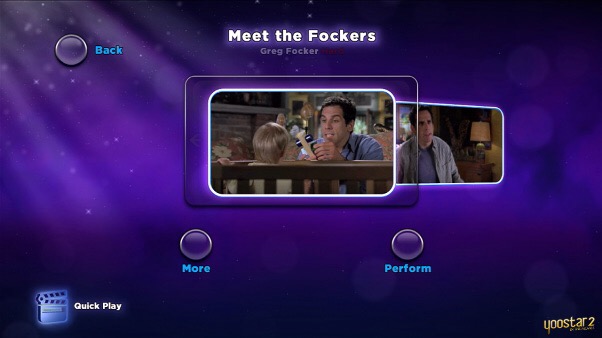
The premise of this game is fantastic. Making use of the Kinect camera controller for the Xbox 360, the disc contains 80 movie scenes from famous films (and Cheech and Chong’s Up In Smoke) for the player to act out, placing their performances over those of the original actor or actress. Sound fun? Well, yes. Kind of.
The thought of acting out scenes from films may appeal to some, but for many even considering standing in front of a room full of people and attempting to deliver an accent-perfect Derek Zoolander just isn’t a good way to spend an evening. It fills them with dread.
Another crowd-pleasing Ben Stiller film scene. Great for crowds of Ben Stiller fans.
For those willing to get involved, enthusiasm doesn’t reward much. The technology causes many issues by just being generally poor: images are low resolution, the background of the playing environment occasionally make their way into the finished scene, the sound is hard to hear when acting and the cue points are really hard to predict.
Both the film choice and the scene selection leaves a lot to be desired. It may be fine if you really like Ben Stiller. Too often there are scenes where your character is looking sideways on. This only works if you know the film off-by-heart or you happen to have a series of strategically-placed mirrors allowing you to read the script as you look away from the screen.
When it goes right it has the ability to cause hilarity. The Terminator is one of the better scenes as Arnie remains relatively still and doesn’t say much. The Casablanca clip works well too, being that it doesn’t require perfect comic timing.
It has the makings of a fantastic party game but unfortunately the flaws mean it never really hits the required heights. Still, it kept my party entertained for about an hour and at the price I paid (£1.33) that is excellent value for money.
Following the success of Super Mario Bros. on the Family Computer in Japan in 1985, Nintendo decided to capitalise and release a sequel using the same game design and graphics. This one, titled Super Mario Bros. 2, didn’t initially see the light of day in Europe or USA, owing to the fact that it was deemed too difficult for gamers outside of the Asian market.
Instead, the Western markets got their own separate game, which might have had the same name but was actually a sprite update of Japanese game Yume Kōjō: Doki Doki Panic. In 1986, nobody in the West cared because hardly anyone knew what had happened. We got a fantastic game in which you could choose to play as Mario, Luigi, Toad or Princess Toadstool. It introduced many gameplay elements and character traits that stuck with series forever more, as well as a host of enemies. It was simply the next in the series and a welcome one at that.
It wasn’t until the the Japanese game was released as part of Super Mario All-Stars on the Super Nintendo in 1993 that the wider Western public became aware of it. What they found when they began to play it was a game full of pitfalls and frustrating game design with the sole purpose of over-challenging anyone who dared continue to see if it got any easier.
The version most readily available nowadays – and the version play-tested here – is available on both the Wii and Wii U virtual consoles. It doesn’t cost the world (500 points) so may well tempt those unaware of its background.
Playing the game now it’s clear why it wasn’t unleashed on the Western gamers of 1986. It may well have killed the franchise. The difficulty picks up at around the same difficulty or World 7 or 8 of the predecessor, meaning that by World 3 the whole game is entirely infuriating.
All the things that might have helped you in the first in the series are either toned down or flipped to trick you. In addition to the 1-UP and power-up mushrooms, there are now poison mushroom that cause you damage. In addition to the Warp Pipes that you’d expect to help you every time, there are additional pipes that take you backwards to earlier worlds, meaning that unless you do your research (remember how difficult that would have been in 1986?) you could end up going backwards. The number of coins available is greatly reduced as well.
The fun-dampening doesn’t end there. Many of the jumps are near-impossible leaps of faith that often don’t leave much confidence prior to trying them out. Doing so is a trial and error situation that can quickly cause you to game over. Trying to speed through a level? Good luck – the game designers have placed a smattering of hidden mystery boxes that usually cause instant death by knocking you off balance. The platform lengths are unforgiving too, meaning both run ups and landing spaces require pin-point precision or else Mario will fall into another pit.
There are also several levels that require a particular pathway to reach the end goal; running from left to right will just cause an infinite loop and the final goal will never be reached. The only solution is to either hope you get it right by chance or give in and search for a solution on YouTube (always a disappointment).
This is the first Mario game to introduce the concept of hidden worlds post-completion. If you manage to complete the game without using a Warp Pipe then you’ll be rewarded with World 9, which is a fantasy world that utilises a psychadelic colour scheme and some bizarre game mechanics. It’s entirely straightforward and requires no concentration whatsoever despite the fact they remove all your hard-earned lives before the start. In additional to World 9 are Worlds A-D, which were also available to anyone willing to persevere. However, anyone that wishes to see how they play (apparently they’re even trickier than the main game) will need to complete the game eight times in the same save file.
Are you FUCKING kidding me!?
The one saving grace is that on the Virtual Console versions there is the opportunity to save at any point throughout the game. This will no doubt be implemented by most quite a lot towards the end of the game, as an absolute necessity. When tackling a single jump takes ten or more attempts, the thought of trying to do this without a save option will fill anyone with dread.
This is what many hours of misery will reward you with
This game will suit die-hard fans and people with sadistic tendencies. It is a form of self-punishment and is seldom enjoyable. Completing the game won’t fill you with joy, but it might give you more confidence to tackle the hardest levels on Mario Maker when it arrives later this year.
Super Mario Bros.: The Lost Levels is available now on the Wii U virtual console.
The latest entry into the Yoshi game series, Yoshi’s Woolly World, has been released in Europe and Japan as a Wii U exclusive. Due to a delay in the release of the Wii U Legend of Zelda game it is also getting a little more focus as one of two big games released by Nintendo this summer, the other being the unexpectedly popular Splatoon, released in May of this year.
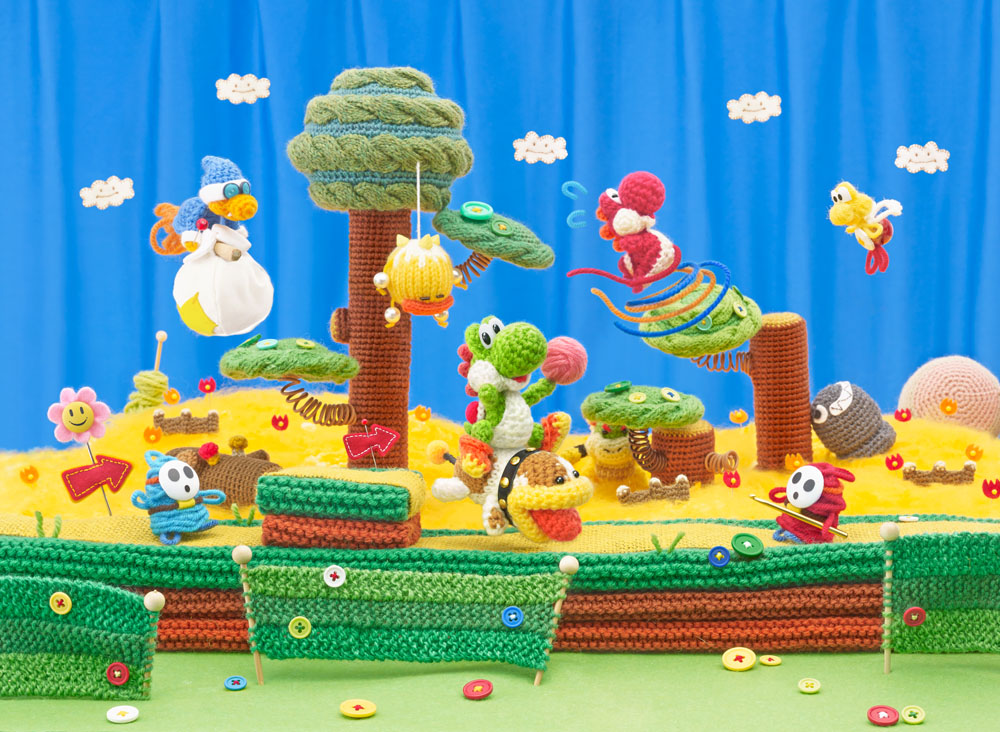
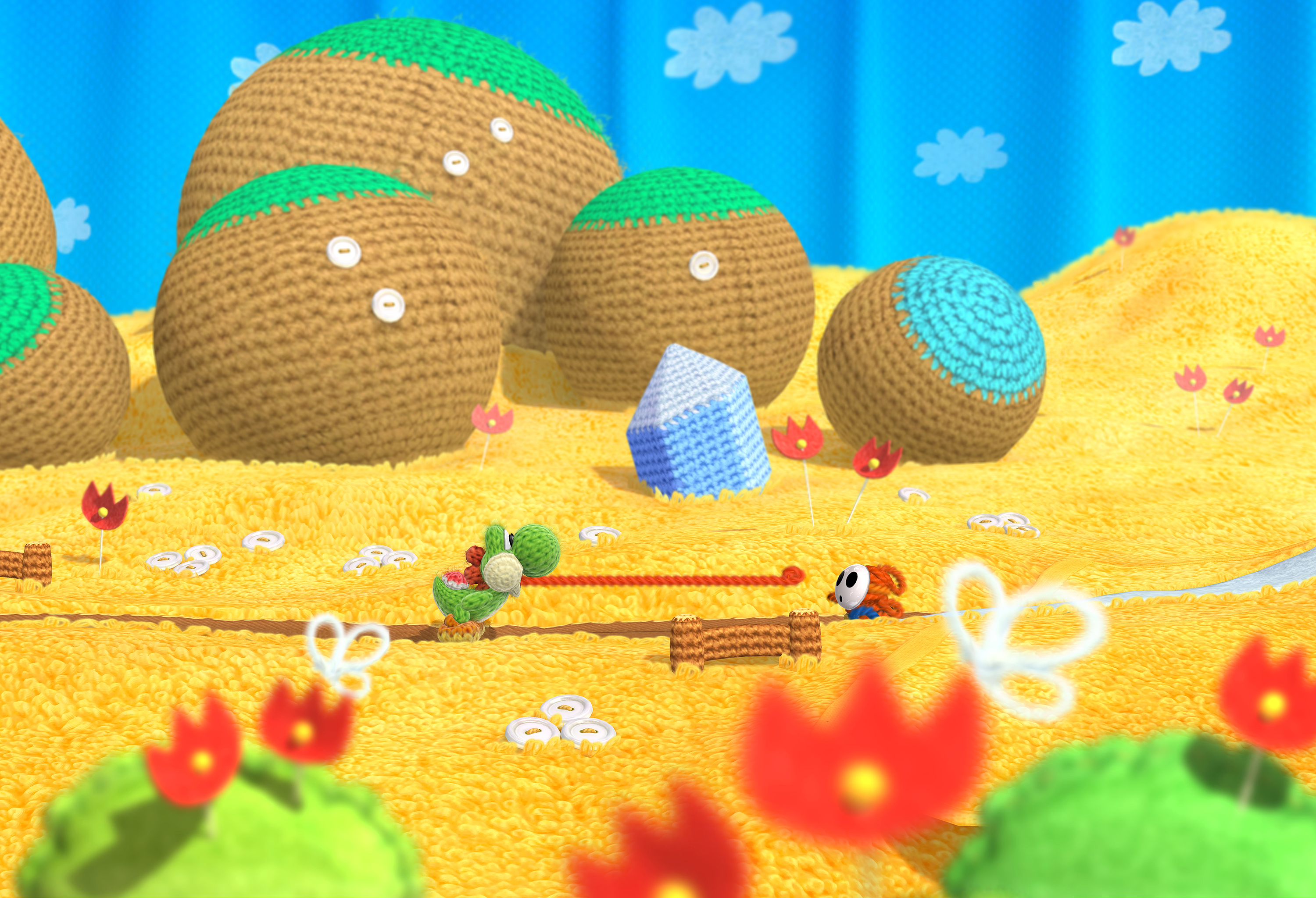
The game is set in a thoroughly gorgeous knitted world made entirely of wool. The aim of the game is to take control of Yoshi and rescue your friends following an attack by the evil wizard Kamek, who has turned the rest of the Yoshi species into balls of yarn.
If you’re looking for a challenge, you’re in the wrong place.
Gameplay
If you’re picking this up as a fan of any of the Wii U Mario games and hoping for a new challenge, you may well be bitterly disappointed. The core gameplay is very slow in pace. The lack of time-limit gives players the opportunity to appreciate the environment around them, which sets it apart from, say, New Luigi Bros U, which gives a 100 second time-limit to each level and ensures you have no time to look around at any point. There is no way to significantly speed up a playthrough, at least not until all the collectables have been discovered.
Another factor that means players have an easy ride is the fact there is no way to die. If Yoshi meets his demise, he simply respawns at a convenient position earlier in the level. This respawning has been commonplace in the increasingly forgiving world of video games – especially those considered to be for hardcore gamers – for the last few years but has been conspicuous in its absence in the Mario franchise. It’s a disappointment to see it here and with no lives to manage it is lacking in any concern for success at all.
Remarkably, there is also an additional Mellow Mode, which allows players to fly through the stages. Literally. Yoshi grows wings and takes flight to find all the collectables and avoid all of the obstacles in half the time. Fantastic.
The only thing keeping this from being a very easy interpretation of a Mario-esque 2D platformer is the inclusion of four different collectables. To fully complete each stage you must collect five balls of yarn, five flower heads, finish the stage with full health (you start each stage with half-health) and collect twenty stamp tokens. It’s quite a lazy way to make a game challenging but it does ensure that there’s a degree of replayability.
With its handmade feel it looks very similar to the Wii game Kirby’s Epic Yarn / 毛糸のカービィ, probably because it is from the same development house, Good-Feel. Indeed, they also share a producer in Etsunobu Ebisu and the same composer in Tomoya Tomita. That game itself was inspired at least in part by Yoshi’s Story on the Nintendo 64, so it’s nice the design has come full circle. If there is one redeeming factor it is the wonderfully realised world it inhabits.
Amiibo Support
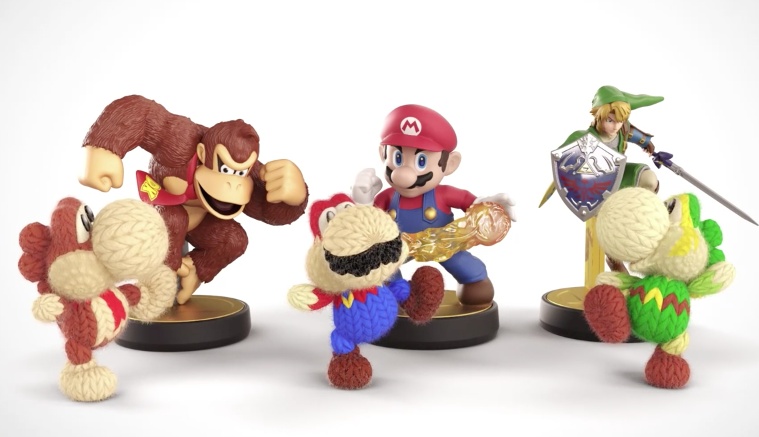
The amiibo support is minimal at best. All that can be accessed is a reskinning of the controlled character with unusual character colours. It’s a nice touch but doesn’t really add much after the initial chuckle (which lasts around two seconds).
The amiibo support is minimal at best.
The amiibo functionality isn’t clearly explained in-game. It is activated by tapping an amiibo on the gamepad (the one with the screen) during the playing of a stage. In single player, this causes an additional second Yoshi to appear to assist Player 1. In Co-op mode, Player 1 Yoshi will simply be reskinned. The amiibo can also be activated in the amiibo hut on the main map.
Summary
It’s difficult to determine how popular this game will be. It definitely has a market out there. It is perfect for younger players and will undoubtedly be enjoyed by parents wanting some entertainment for them to enjoy with their children. For those players who enjoyed the likes of Champions Road in the excellent Super Mario 3D World, there’s not much to be found here.
Yoshi’s Woolly World is available to purchase in Japan and Europe now. It will be released in USA in October 2015.
The Video Game E.T. the Extra Terrestrial is an infamous piece of video gaming history. Everyone knows how it went: in 1983 Howard Scott Warshaw (Yars’ Revenge, Raiders of the Lost Ark) was given five weeks to produce a game for the Atari 2600 system alongside the release of the film and in time for the Christmas market. An over-confident board pushed to produce a market-saturating amount of cartridges based on the game being a best-seller, but when the reviews came in and everyone discovered that the game was terrible, the sales dried up. Atari started getting large amounts of returns of the cartridge and realised they were haemorrhaging money, so (the legend has it) they decided to dump some 700,000 cartridges in a landfill in New Mexico.
This film covers the history of the gaming industry, specifically Atari, the background to the game’s release and Howard Scott Warshaw’s part in the game. The main point of interest, though, was built around the highly anticipated excavation of the landfill to uncover the truth behind the cover-up and see if the burial really happened. I won’t ruin the result of the excavation, though it was a huge news story when it happened.
A happy treasure hunter. I guess he could now “go home”.
The film was of huge interest to me and the subject matter was something I was happy to dedicate an hour of my life to. The director, as the film clearly lays out, is of great stock, having recently help screenwrite several huge Marvel films (including The Avengers). However, in comparison to Blackfish (which I watched in the same sitting), the storytelling failed to get me hooked. It has a short running time so there was no padding, but it just lacked the emotional power that is so evident in the great documentaries or modern cinema. There was nothing terrible about it – there was some good analysis of Atari in their booming year, a great side-story with Ernest Cline (author of the excellent Ready Player One) and a very brief cameo from George R.R. Martin. I just didn’t make the connection I hoped I would.
I perhaps wonder whether the short running time wasn’t enough. there was easily a further ten minutes on each of the two main topics: the history of Atari as a company being the first and the excavation of the landfill site being the second. I left wanting to find out more and though the information is available on the internet I don’t think there was a better platform than this to tell the whole story.
For a more engaging and humorous take on the excavation, check out Angry Video Game Nerd: The Movie, which pays no attention to the facts and spends its time trying to keep us entertained instead. Atari: Game Over counts as a near miss for me.
I remember a couple of years ago when I saw the queues of young girls stood outside the theatre awaiting the release of the latest One Direction Movie, 1D: This Is Us. I’m pretty sure I passed a snide comment to whoever I was with at the time berating the popularity of the film, which was clearly not aimed at me. I wasn’t the “target audience”. Nonetheless, what a bunch of idiots standing there to watch such a rubbish film.
One for the fans
It took me until last night to realise how wrong I was to do this. My wife was out of the house and so I saw it as a perfect opportunity to finally watch the imported copy of Angry Video Game Nerd: The Movie [1]. Alas, my wife returned home and walked in just as The Nerd threw up over a copy of Eee Tee 2 and the woman holding it. As I looked towards the door, I saw myself reflected back: bemusement, disdain and a lack of willingness to understand. I guess that means that I’m a teenage girl and James Rolfe is Harry Stiles. Maybe.
And that’s the point. This is by no means a film for everyone. It is specifically a film for the fans of James Rolfe’s character The Angry Video Game Nerd, the central character in his webisodic (it’s now a word) series in which he reviews terrible old games in a foul-mouthed and occasionally aggressive manner. It’s a film full of references to the series, made for the fans, and a pet project for Rolfe to flex his big-budget muscles and show exactly what he can do once he leaves his underground lair.
The storyline concerns the release of Eee Tee 2, the sequel to Eee Tee, the biggest flop in video game history (and barely hiding the reference to E.T.). The Nerd has always refused to review this game, but when an opportunity arises to go to New Mexico and dig up the infamous New Mexico Atari landfill as a tie in to the sequel, he agrees. The Nerd and his two assistants start the quest but are pursued by federal agent General Dark Onward, who believes The Nerd is trying to investigate Area 51.
It is quite a convoluted plot but it’s not really there to win any awards for screenplays. It’s a platform on which Rolfe bases some quite hilarious moments and I see the film as a success. Yes, it’s probably a little long but I can forgive Rolfe for this – he was bringing his own dream to life and wanted to make sure his fans got the most out of it. Some of the script feels a little like it’s deliberately trying to aspire to be a cult film, and it gets very silly at times, but it’s delivered with enough charm to be forgiven for a few misfires.
There’s a nice bonus at the end, where he finally reviews E.T. The Extra Terrestrial on the Atari, which he has never previously done. The bonus features on the disc are plentiful and give a bit of insight into the film (though many of the featurettes were previously available during the making of the film on Cinemassacre).
Steer clear if you have never heard of The Nerd before but if you want to see what he’s capable of it’s worth the plunge.
[1] For those in the UK, the best option to see the movie in HD is to import from Amazon.com. Be warned though – you will pay through the nose for the postage and then get slapped with import duty when it arrives. It’s expensive and if you aren’t fussed about the HD then you have an option to stream from Cinemassacre for a small fee.
Back in the 80s and 90s, The Nerd was easy to spot. He (for it was almost always a he) was invariably skin and bones, very much into maths and computers, could probably code at least a rudimentary game on his BBC, had glasses and possibly long hair. He was single. He had acne. He was Screech from Saved by the Bell.
This was a great time to be a screenwriter of anything that needed to stereotype a nerd into the story. The stereotype was probably quite realistic, and there were so few nerds around it didn’t really matter if you upset them.
In the intervening years, however, having a home computer has gone from nothing to being the norm. It would be unusual to find someone under the age of 70 without access to some kind of computer at home. Computer literacy isn’t just a niche skill but a requirement of life.
At the same time there has been a prominent increase in the popularity of comic book characters, mainly through the string of highly successful superhero films. This led to a greater increase in comics and graphic novels themselves as people sought out the source material of their screen idols.
Finally, the popularity of video games has grown exponentially, with a different game and platform to suit everyone’s needs, from the experienced MMORPG gamer to those that want to play Kwazy Kupcakes whilst sat on the toilet. Whether we like it or not, almost everyone is a gamer of some kind. Indeed, the biggest market for video games is adult women, thanks in part to the likes of Farmville and Candy Crush Saga. [1]
The point is that everything we associated with nerds from 30 years ago is now a given of everyday life for the majority of people. More and more on nights out, especially with people I don’t really know very well, I’m confident that if conversation dries up I can strike up a conversation about the latest Marvel Studios film, or a big new video game, or some kind of off-mainstream television series. This is becoming my fall-back conversation far more than, say, ten years ago, when I would invariably go to football or another kind of mainstream sport. Just yesterday I was with some work colleagues, most of which I didn’t know, and we chatted for over an hour about the new Daredevil series (which I’m yet to see), Avengers: Age of Ultron, the future of the Marvel Cinematic Universe and the new Mario Kart DLC. Sport wasn’t mentioned once and I don’t think it would have been welcome if it had been.
So, there’s plenty of growth in the nerd-themed markets to come over the next few years and I’m sure the various industries are planning ahead to make money out of them. Maybe Revenge of the Nerds will be remade in a few years as Revenge of the Jocks. Who knows?
[1] Women over 18 made up a 36% share of all video gamers compared to men over 18, who make up 35%. The above comment is only half-true too. Whilst Farmville and Candy Crush Saga have surely helped the over 50s category, I don’t see it being a large contributing factor to the 18-30s at all. I just don’t know many people in that age range playing these kinds of games – male or female – but I do know plenty of young and experienced female gamers who wouldn’t think anything of picking up the latest 1stperson shooter, a genre traditionally associated with male gamers. One of the big wins for this is the de-fragmentation of the market. Making a game specifically designed for men or women is soon going to be a thing of the past because the lines have become so blurred and you simply can’t stereotype gaming preferences by gender any more.







 Cinema, etc.