Tabu: A Story of the South Seas (F. W. Murnau, 1931)

The last of four films Murnau made after moving to America – the others being the Oscar winning Sunrise, the excellent City Girl and the now-lost Four Devils – Tabu marked something of a departure for the master director. He travelled to Bora Bora near Tahiti with documentary filmmaker Robert J. Flaherty. Setting out to make a docufiction film as co-director, it quickly became apparent that Murnau wanted complete control and Flaherty was bought out of his share of the film.

Despite the unusual setting, this has all the hallmarks of a classic Murnau romance.

Despite the unusual setting, this has all the hallmarks of a classic Murnau romance.

The result of this is an opening sequence that seems very much like a documentary film, with native islanders (almost every actor in the film was an untrained native, along with most of the production crew) fishing, playing and acting naturally. According to the extensive booklet notes (thanks again Masters of Cinema), this was the only sequence Flaherty directed before he encountered technical issues with his camera and brought in cameraman Floyd Crosby to assist. The upshot of this was that the rest of the film was the responsibility of Murnau.

Subsequently, we then pick up on a more traditional method of storytelling. A girl named Reri (Anna Chevalier) is chosen by aged emissary Hitu of neighbouring island Fanuma to be the replacement maiden to the Gods. She is to be transported to the island to live there free of any kind of relationship; from this point on she is “tabu”. This is terrible news for both Reri and her lover Matahi, who defy this command and escape the island to a French-colonised island nearby.

The story of two lovers remaining together despite adversity is reminiscent of both Sunrise and City Girl, and other than the unfamiliar setting Murnau is on safe territory. It doesn’t feel stale, but it’s certainly the least dynamic of the three available Hollywood films. Both lead characters give assured performances in their roles despite a lack of experience. Matahi never worked on another film following this release. Anne Chevalier worked on two subsequent films (Polish film Czarna Perla and an uncredited role in John Ford’s The Hurricane) but neither are as fondly remembered as Tabu.

F. W. Murnau’s final film was actually released a week after his death. Whilst working on the sound for the film, Murnau was being driven up the coast from Los Angeles by a 14-year-old Fillipino servant and was involved in a car crash, dying a day later in hospital. It’s a shame that this was his last film and a tragedy that his life was cut short so early, robbing the world of countless more exceptional films. He had actually spent most of his final months on the island Bora Bora, having enjoyed his time there so much.

The definitive version of Tabu is available on Masters of Cinema Blu-ray and DVD dual-format release, packed with extras (deleted scenes, a short film directed by Flaherty using leftover footage, a documentary) and with an immaculate transfer. It also restores scenes that were cut before its original release, as well as those taken out in subsequent cuts over the intervening years (the explanation for all of this is in the extensive booklet that’s included in the box)
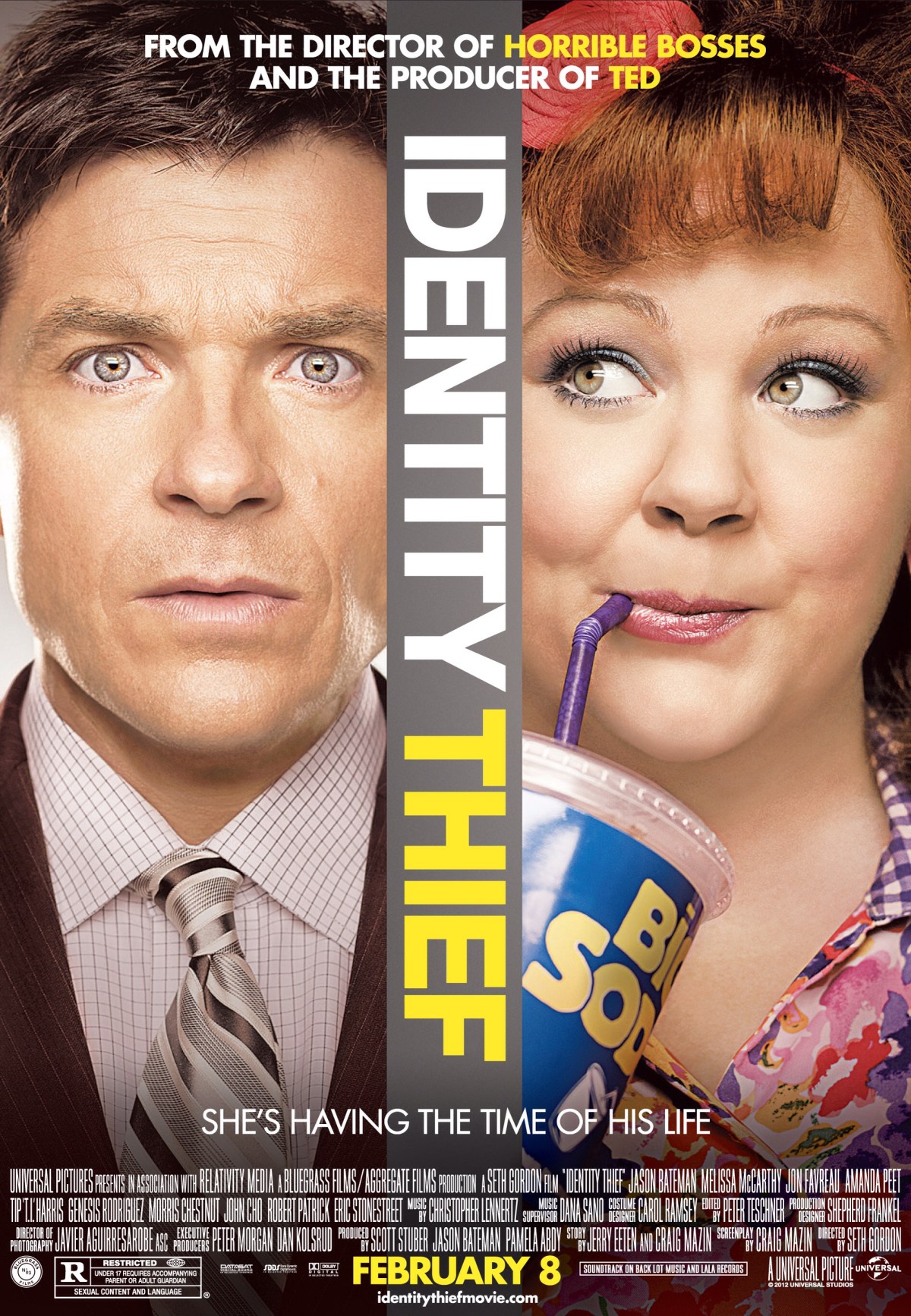
Film review – Identity Thief (Seth Gordon, 2013)

Sandy Patterson (Jason Bateman), an accounts processor from Denver, has his identity stolen by a woman (Melissa McCarthy) from Winter Park, Florida. When his accounts are frozen and the police get involved, his employer (John Cho) threatens to sack him. Realising the police will move too slowly, he chooses to travel to Florida himself to track the thief down, with hilarious consequences.
I imagine that’s how it was sold it anyway. The problem is that despite having an interesting premise and a few laughs at the beginning, it loses its way and sort of stops being funny by about halfway through. Both Bateman and McCarthy end up playing the same characters we’ve seen them play time and time again, in particular Bateman who could be the same character from Gordon’s previous film Horrible Bosses. There’s also some dreadful CGI work on a snake attack to endure.

It must have been a slow month for films in February 2013 as Identity Thief made $150m at the box office despite mainly negative reviews. I guess reviews, word-of-mouth and being entertained don’t count for everything.

Identity Thief is available now on Blu-ray, DVD and Netflix.

F For Fake (Orson Welles, 1973)

Orson Welles film F For Fake (also known as Fake or simply “?”) is a brilliantly bizarre piece of cinema that shows off the art of deception in storytelling. The purpose of the film isn’t to reveal a scandal, despite its superficial attempts to make the viewer think it’s a straightforward documentary. Rather, the ultimate goal is to tie us up in knots, frustrate us and lead us down as many blind alleys as possible in a relatively short running time (85 minutes for this version). In this respect the film is a glowing success and if you keep this in mind the whole thing is absolutely hilarious.


The purported premise of the film involves Welles revealing a huge visual art scandal involving professional forgery at the hands of Elmyr de Hory. A second man, hoax-biographer, reveals all in the role of hoax-biographer Clifford Irving, whilst Oja Kodar also appears in a few critical scenes.

The story it creates is almost believable but for the handful of telltale signs of fakery. The deliberate continuity errors throughout (see “practioners” and Don Amiche); the overuse of the phrases like “of course our story really starts with…”; the ridiculous conversational tone Welles uses when engaging the viewer (or disengaging them by ordering dinner halfway through a scene); swapping out Oja Kodar with her sister for one scene for no reason. There’s a lot going on besides this and I felt it was designed to deliberately deceive. I was on board. I got it. That it succeeds in this is indicative that the film was a huge success, though I’m fairly confident if I wasn’t aware it was itself a hoax I might have found the whole thing a little self-indulgent.

F For Fake is available on Masters of Cinema DVD only, but there are no plans to release it on Blu-Ray so you may as well go for that version.

Film review – Tomorrowland: A World Beyond (Brad Bird, 2015)

The big live-action summer blockbuster for Disney is always hotly anticipated [1]. The previous three summers’ blockbusters were John Carter (2012), The Lone Ranger (2013), Maleficent (2014) [2], and before that there were plenty of Pirates films to chew on. These have all been at worst reasonable sellers but have received middling to good reviews. As long as the basic premise is generally acceptable to cinema-goers and there’s enough advertising involved, they tend to do well. In recent times, it seems Disney’s summer blockbusters have been review-proof.

So how will Tomorrowland fare? It is an action-adventure film with a young female lead (Britt Robertson as the intelligent and headstrong Casey), a child as a prominent supporting character (newcomer Raffey Cassidy as humanoid robot Athena) and a big name alongside them both (guaranteed ticket-seller George Clooney as Frank Walker), so it has a good chance on that front. It is also in good hands with director Brad Bird at the helm. His previous work for Pixar as director includes The Incredibles and Ratatouille, two of my favourite animated films. He’s also responsible for excellent film The Iron Giant, a film which broke him as a director [3].

Visually stunning, but wrapped up in its own spiderweb of overthought plot.

Visually stunning, but wrapped up in its own spiderweb of overthought plot.

However, there has been a distinct lack of the blanket media coverage we’ve come to expect from these kinds of films. It’s almost as if Walt Disney Pictures hasn’t really got faith in it. Inevitably, this disinterest in the film has seeped its way down to the general public, who are simply not checking it out. It is currently on track to lose money, with a global taking of $133.2m against a budget of around $190m. It’s still ploughing on and might break even after Blu-ray sales and merchandise is taken into account.

The premise of the storyline is loosely based on the futuristic area of the Disney Theme Parks, which is also the source of the film’s name (it was originally titled 1952). It’s a time-travelling adventure with absolutely stunning visuals that make the film very easy on the eye. It’s actually very similar visually to The Rocketeer, and I felt as though this is what would have been achieved had that film been released today rather than 1991.

It’s a problematic film, however, and I put this down to the hard-to-follow plot. I don’t think it’s overly complex, I just don’t think it’s explained very well. Alongside Brad Bird as co-scriptwriter is David Lindelof of Lost fame, whose scripts tend to walk a fine line between intrigue and confusion. When he gets it right (the earlier episodes of Lost, Star Trek: Into Darkness), it can be the most gripping sci-fi around. Sometimes, though, he misses the mark and becomes far too confusing to follow. Tomorrowland is certainly in this category.

The problem is that the plot loses the plot, and therefore its own essence. I’ll try to summarise (SPOILER ALERT!). Casey, the daughter of a NASA engineer, finds a magical pin that transports her to a Utopian parallel universe. However, it has a limited lifespan and counts down to expiry, meaning you only get a glimpse of the alternate universe (we later learn it’s an advert). It also means you co-exist in the alternate reality, so if you move around in the alternate reality you might bang your head in the real world. She tries to track down a second pin and finds herself teaming up with Frank, who can access the real universe via a secret rocket inside the Eiffel Tower, and can get them there by a secret teleportation device he invented. When they get there, the Utopia is now derelict, but evil genius David Nix (played by Hugh Laurie) doesn’t want to let anyone else in, even though humanity will end within 60 days.

I won’t ruin the ending but as you can see, it does get quite far-fetched and I do seriously question whether or not the children in the cinema were fully on board with it. Indeed, it took five of us about ten minutes of debating until we settled on what exactly we’d just seen [4]. We still had some questions remaining though. Firstly, I’m assuming the robots that were sent to kill Casey were sent by David Nix. If so, he didn’t seem to know who she was when she arrived. Why weren’t they trying to kill Frank instead? He was the one known entity. Perhaps they assumed she would lead them to him, but I didn’t feel this was explained very well. Following on from this, why weren’t they all killed immediately after they arrived in the Utopia? It seemed there was a “well, they’re here now, let’s give them a shot” sort of vibe going on. I wasn’t buying it. Finally, why had the Utopia got so run down? I feel there was a huge area of the plot to explore here but it wasn’t mentioned. Oh, and why the Eiffel Tower?

In the end, it was just a huge advert for world peace, creativity, Coca-Cola, Chevrolet, and not stifling imagination. And Disney merchandise (yes, you can buy your very own copy of the Tomorrowland pin that is so integral to the plot). It was a missed opportunity. I don’t recommend you avoid it. Perhaps I’m not as intelligent as I once thought and it’s my fault alone that I don’t understand a film aimed at 12-year-olds. It’s visually stunning and is almost worth seeing just for that. Just don’t get your hopes up and don’t try to overthink it.

[1] It doesn’t necessarily mean they’re good.

[2] Despite being classed as a box-office flop, John Carter actually made money on its $263m budget at global box offices alone, pulling in $281m in receipts. Once you factor in sales of merchandise, video games, DVDs, Blu-rays and downloads, it must have made a huge amount. Not bad for a flop…

[3] Surprisingly, he also directed the music video for “Do The Bartman”, right at the start of his career. It’s less of a surprise once you know he was already involved in The Simpsons from earlier on, though this knowledge could help win you a pub quiz one day.

[4] I went to see this one with a couple of good blogger friends, whose blogs can be found at the following addresses: Nesbitt Web and Ahoy Small Fry. They’re both very different blogs but I enjoy them both on a regular basis. Check them out!

The Fireman (Charlie Chaplin, 1916)

The second in the Mutual Comedies series (the first, The Floorwalker, I have previously reviewed), The Fireman is another great example of master craftsmanship from Chaplin. It involves an insurance fraud setup whereby a man (Lloyd Bacon) colludes with a local fire chief (Eric Campbell) to collect on the insurance money. However, things don’t quite go to plan when a real fire breaks out on the other side of town and the whole plot falls over to humorous results. Chaplin plays a fire engine driver who fails at everything he is involved with and this character is the source of most of the humour, especially in his interactions with the fire chief, played by the brilliant Campbell.

It’s not quite Chaplin at his best, nor is it really quite as effective as The Floorwalker, but it has its charm and is worth watching if only for the few big laughs dotted throughout. There are much worse ways to spend 28 minutes of your day.

I preferred the original Fotoplayer music and sound effects as performed by Robert Israel on this one, but both audio tracks compliment the original visuals perfectly well. It comes down to personal preference and I’m more of a traditionalist.

Charlie Chaplin – The Mutual Comedies is out now on BFI Blu-ray and DVD.

The Floorwalker (Charlie Chaplin, 1916)

On 25th February 1916, Charlie Chaplin signed a $670,000 deal with the Mutual Film Corporation to produce a film a month over a one-year period. This made him the highest-paid entertainer in the world. The deal came as a surprise to the film industry; many had expected him to sign with a larger studio and Mutual hadn’t really been considered as an option. However, the money (according to Dollar Times online calculator it was equivalent to $15.2m in 2015) and the creative freedom swayed him and production began in earnest.

The first of these films, all of which were short comedies, was The Floorwalker, released on 15th May 1916. The basic story involves a department store floorwalker (Lloyd Bacon) who is involved with embezzlement of money with the store manager (Eric Campbell). When they receive a letter informing them that detectives are on the way to investigate the finances, they decide to run. However, when the floorwalker spots a near-perfect lookalike in a tramp (Chaplin), he decides to offer to switch personas with him, without realising that the tramp himself is in trouble with the police for property damage in the shop.

The film has a couple of classic Chaplin comedy moments. The first (which is reused throughout to great hilarity) involves the tramp’s inability to go up or down an escalator. It is just pure comedy gold and though it has been imitated many times over, never has it been done so effectively. Another set piece that has had its imitators over the years is the first meeting of the trap and the floorwalker, in which they become intrigued by one-another and begin to mirror the other’s movement. It requires perfect comic timing and is brilliantly executed. It is perhaps more fondly remembered in The Marx Brothers’ comedy Duck Soup, though the gag in that film involved a mirror so isn’t strictly a copy.

All twelve films from the Mutual Film Corporation period are collected in an excellent Blu-ray (and DVD) released by BFI this month. The presentation of each includes two scores (all have one score by Carl Davis and an alternative score by a range of composers), an audio commentary and a brief discussion in the extensive booklet. The restorations are evidently full of care and attention to detail, which I’ve come to expect of BFI releases but will never stop appreciating.

Go out and buy a copy now and support the important restoration projects for classic cinema. You won’t be disappointed with this release.

Charlie Chaplin – The Mutual Comedies is out now on BFI Blu-ray and DVD.

Spy (Paul Feig, 2015)

Earlier today, my wife and I found ourselves walking on the red carpet, alongside Melissa McCarthy, Jason Statham, Jude Law, Miranda Hart and Peter Serafinowicz, for the UK premiere of new film Spy. It was at the ODEON on Leicester Square. Here’s a photo of me on the red carpet.

I’ve been on the red carpet a couple of times before and it’s always a lovely experience. Of course, nobody cares who we are, though that doesn’t mean we didn’t ham it up a little. [1]

There’s been quite bit of interest for the film over the last few weeks and the anticipation was well justified. We laughed so much our faces hurt.

spy02

McCarthy and Law are hilarious throughout.

Spy is an action comedy about office-based CIA data analyst Susan Cooper (McCarthy), who is forced to go out onto the field when her partner Bradley Fine (Law) disappears and the identities of other top field agents – including Rick Ford (Statham) – are compromised. Going undercover to attempt to infiltrate arms dealer Rayna Boyanov (Rose Byrne) with the help of her office friend (Hart), the story is the perfect platform for some caper-based hilarity.

I was a little apprehensive going into it as the premise is quite familiar and hasn’t been done well for a long time. I was immediately pleasantly surprised, with an opening scene that sets the story up well, falsely draws us in to a serious film, then slaps us in the face with a huge laugh.

Jason Statham has never been so likeable. His character can best be described as Jay from the Inbetweeners if he somehow became a CIA agent. You can see he’s flexing his comedy muscles and really trying hard to make his co-stars laugh whilst holding back himself. His character is a highlight.

The real star, of course, is Melissa McCarthy. Her comic timing is impeccable and it’s easy to see this film becoming a critical and commercial success with her out front. She has had several opportunities to show us what she’s got, but she has fallen slightly short on several occasions (see Identity Thief). This is a comic actor at the top of her game.

The rest of the cast are excellent, especially Serafinowicz, and you can see they’re enjoying such a fun script. I can’t recommend it enough. I wouldn’t be surprised if this is the start of a franchise.

[1] About a month ago I speculatively tweeted a review of Furious 7 as an entry to a competition run by Stella Artois and Film4. Actually, it was a review of the trailer. I’ve not seen the film, nor have i seen the trailer. Indeed, of all the films in the series I’ve only seen Tokyo Drift. I didn’t think much of it. Anyway, that’s why I’m here. I’ve included the review here, in case you’re interested.

Atari: Game Over (Zak Penn, 2014)

The Video Game E.T. the Extra Terrestrial is an infamous piece of video gaming history. Everyone knows how it went: in 1983 Howard Scott Warshaw (Yars’ Revenge, Raiders of the Lost Ark) was given five weeks to produce a game for the Atari 2600 system alongside the release of the film and in time for the Christmas market. An over-confident board pushed to produce a market-saturating amount of cartridges based on the game being a best-seller, but when the reviews came in and everyone discovered that the game was terrible, the sales dried up. Atari started getting large amounts of returns of the cartridge and realised they were haemorrhaging money, so (the legend has it) they decided to dump some 700,000 cartridges in a landfill in New Mexico.

This film covers the history of the gaming industry, specifically Atari, the background to the game’s release and Howard Scott Warshaw’s part in the game. The main point of interest, though, was built around the highly anticipated excavation of the landfill to uncover the truth behind the cover-up and see if the burial really happened. I won’t ruin the result of the excavation, though it was a huge news story when it happened.

A happy treasure hunter. I guess he could now "go home".

A happy treasure hunter. I guess he could now “go home”.

The film was of huge interest to me and the subject matter was something I was happy to dedicate an hour of my life to. The director, as the film clearly lays out, is of great stock, having recently help screenwrite several huge Marvel films (including The Avengers). However, in comparison to Blackfish (which I watched in the same sitting), the storytelling failed to get me hooked. It has a short running time so there was no padding, but it just lacked the emotional power that is so evident in the great documentaries or modern cinema. There was nothing terrible about it – there was some good analysis of Atari in their booming year, a great side-story with Ernest Cline (author of the excellent Ready Player One) and a very brief cameo from George R.R. Martin. I just didn’t make the connection I hoped I would.

I perhaps wonder whether the short running time wasn’t enough. there was easily a further ten minutes on each of the two main topics: the history of Atari as a company being the first and the excavation of the landfill site being the second. I left wanting to find out more and though the information is available on the internet I don’t think there was a better platform than this to tell the whole story.

For a more engaging and humorous take on the excavation, check out Angry Video Game Nerd: The Movie, which pays no attention to the facts and spends its time trying to keep us entertained instead. Atari: Game Over counts as a near miss for me.

Atari: Game Over is available now on Netflix.

Films I’m Excited About (Summer 2015)

2015 looks set to be a huge summer for visiting the cinema. I’ve already been blown away several times at the high standard I’ve seen (Birdman, The Tales of Princess Kaguya, Whiplash and The Theory of Everything are all very special films, and Avengers: Age of Ultron blew me away too). Looking forwards, there’s plenty more to be excited about. Here’s some of the film’s I’ve got in my diary.

German Concentration Camps – A Factual Survey

germanconcentrationcampsafactualsurvey

Probably the most historically important film of the decade.

A British documentary film covering the exploration of the Nazi concentration camps. Fourteen locations were visited in Poland, Austria and Germany. The purpose of this film was that it would be shown to all the freed prisoners leaving the concentration camps and sites of atrocity after the fall of the Third Reich. Unfortunately there were delays in production and by 1946 it was deemed to be inappropriate and the footage was shelved.

Thankfully the footage has been finished off and there have been some screenings schedules around the UK (which can be found here). I can’t wait to see this historically important and inevitably moving film.

Jurassic World

Is this going to be the return to form we've been waiting for?

Is this going to be the return to form we’ve been waiting for?

I’m sorry. We’re all thinking it. The Lost World: Jurassic Park and Jurassic Park III were both utter dross. The first in the series was, in my opinion, one of the greatest films ever made. In the action genre it should be held up as a sepcimen of near perfection – its relentless and frequent peaks and troughs take you on an exhausting adrenaline rollercoaster as soon as things start to go wrong. It was also a hugely significant film in terms of advancing special effects. Since the sequels thus far have been huge let downs, the announcement of a new franchise reboot was met with groans across the internet and beyond. Then the trailer dropped and hope was restored. So far there doesn’t seem to be anything to quash the hope.

The release date is set for 10th June. The world is waiting!

Star Wars Episode VII: The Force Awakens

I can't wait for fourth film in the franchise to be released.

I can’t wait for fourth film in the franchise to be released.

I’m a big Star Wars fan. I’m not the kind of person who knows the facts inside-out, certainly not on the same level as some people I know, but the original films are just absolutely fantastic action sci-fi films. It’s a shame that Episodes I-III were so dreadful. I do believe there is one good film to be found within their bloated running times. They just got them wrong.

The Star Wars community groaned when Disney bought the rights to Star Wars, but I immediately knew it would be a positive move. Disney know how to make a great live-action action film. The first three Pirates of the Caribbean films were actually not as bad as people have remembered them (our memories may be tarnished by the lackluster fourth installment). John Carter was actually far better than the first twenty minutes suggested. The Tron reboot wasn’t bad either. With a captive audience ready to give the new films a chance and no George Lucas around to mess things up, we’re set to finally be rewarded with a film worthy of the originals.

Terminator: Genisys

I do hope Arnie says "I told you I'd be back" just one more time.

I do hope Arnie says “I told you I’d be back” just one more time.

I don’t think this will be the return to form as the two franchise reboots above, but it will be good fun to see how it turns out. Since his retirement from politics, Schwarzenegger hasn’t really done any films that fully stand up to his releases in the late 80s and early 90s. I hope this is the one that shows us he’s still got it and with Emilia Clarke (Game of Thrones favourite Daenerys Targaryen) on board we should have something to keep us entertained for a couple of hours.

Ant-Man

Films like this are in short supply.

Films like this are in short supply.

Paul Rudd, Marvel Cinematic Universe, Edgar Wright and Joe Cornish. It’s Ant-Man. It has been a troubled creation process, but I still think this is going to find the balance of comedy and action that was sadly missing from The Green Hornet, the last superhero film that went down the comedy route. I’m hoping it’s successful enough to see him included in future MCU films. I guess time will tell.

Cannes Film Festival – Full List of Winners

Palme d’Or
Jacques Audiard for Dheepan

Grand Prix
László Nemes for Son of Saul

Jury Prize
Yorgos Lanthimos for The Lobster

Camera d’Or
Cesar Acevedo for La tierra y la sombra / Land and Shade

Best Director
Hou Hsiao-hsien for The Assassin

Best Screenplay
Michel Franco for Chronic

Best Actress
Rooney Mara for Carol and Emmanuelle Bercot for Mon Roi

Best Actor
Vincent Lindon for La Loi du Marche

Short Film
Ely Dagher for Waves ‘98

Honorary Palme d’Or
Agnès Varda