Film review – What We Did On Our Holiday (Andy Hamilton and Guy Jenkin, 2014)

If you’ve ever watched the popular British sitcom Outnumbered then you’ll become immediately outraged by What We Did On Our Holiday. The premise is exactly the same: a dysfunctional London-based family with arguing parents and three young and awkwardly inquisitive children go on a trip to visit their quirky grandfather and the annoying sibling of one of the parents. The dialogue and individual characters seem highly familiar too and it’s difficult to avoid the thought that this could have been done to much greater success with the Outnumbered cast. It’s only after a small amount of research that it becomes evident that this film is indeed written and directed by Andy Hamilton and Guy Jenkin, the creators of Outnumbered. Admittedly, they couldn’t very well have written “By the way, we made Outnumbered and we know this is basically Outnumbered: The Movie but please stick with it.” I would have helped though.

The storyline involves father Doug (David Tennant) and his wife Abi (Rosamund Pike) travelling to see Doug’s father Gordie (Billy Connolly) in the Scottish Highlands. Their marriage is on the cusp of separation, a fact they like to assume their children don’t know. They’re visiting Scotland to celebrate Gordie’s birthday with a party co-ordinated by Doug’s brother Gavin (Ben Miller) and his wife Margaret (Amelia Bullmore), who provide some laughs as a couple attempting to keep up appearances.
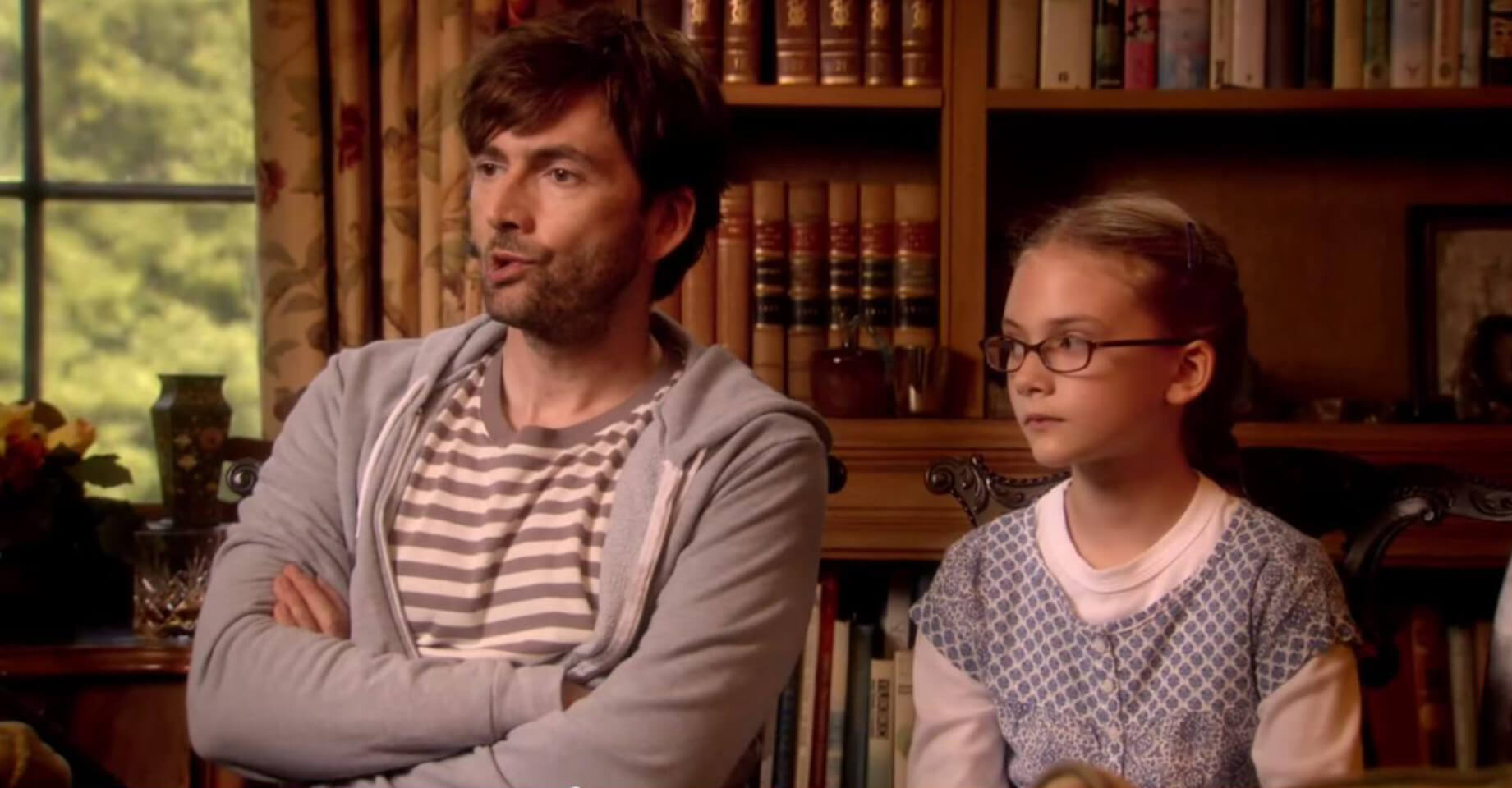
A laugh a minute this is not.

A laugh a minute this is not.

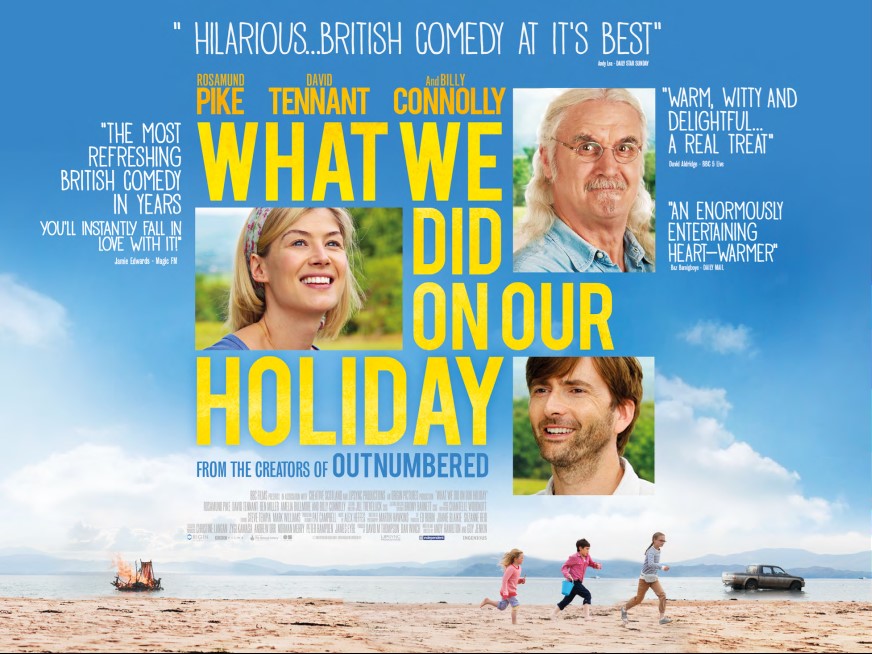
Despite what the poster says, this is not British comedy at its best. The reason for this is that only one of the three main cast members is a comedian and the short running time means the children aren’t provided enough space to cultivate any big laughs. The funniest moment in the whole film comes when the son Mickey tries to explain how he managed to discover his parents were getting a divorce, missing out most of the details of what was heard but lengthily revealing his technique to go to the toilet silently so he can eavesdrop. The screen time afforded to Miller and Bullmore is refreshing when it happens, though again this is limited and it feels like there was more on offer.

It’s a bold move to use this as a vehicle to tackle some pretty hefty subjects and for the most part this ambition elevates it to something bordering on a weighty drama with a humorous veneer. The impending death of elderly relatives, the lack of emotional support provided by the close family of these elderly relatives, the denial of innocence of youth due to over-exposure to mass-media, the lack of respect provided by media when the desire to get a good story transcends their own moral compass (the film was written in the immediate aftermath of the publication of the Leveson Inquiry). These are all topics that Hamilton and Jenkin clearly felt were beyond the scope of their beloved sitcom and more deserving of a feature length film. For that they should be applauded, despite an overall feeling of the film being an underwhelming disappointment.

Ultimately, a film marketed as a comedy will succeed or fail on the amount of laughs it elicits. The lack of natural comedic tendencies of both Pike and Tennant mean that the film relies too heavily on three young children playing for cute giggles and a support cast that isn’t seen enough to make up the ground. If you want to laugh a lot for 90 minutes then a better option is to just watch three episodes of Outnumbered, which is a disappointing conclusion to reach.

What We Did On Our Holidays is available on Netflix now and can also be purchased on Blu-ray or DVD.

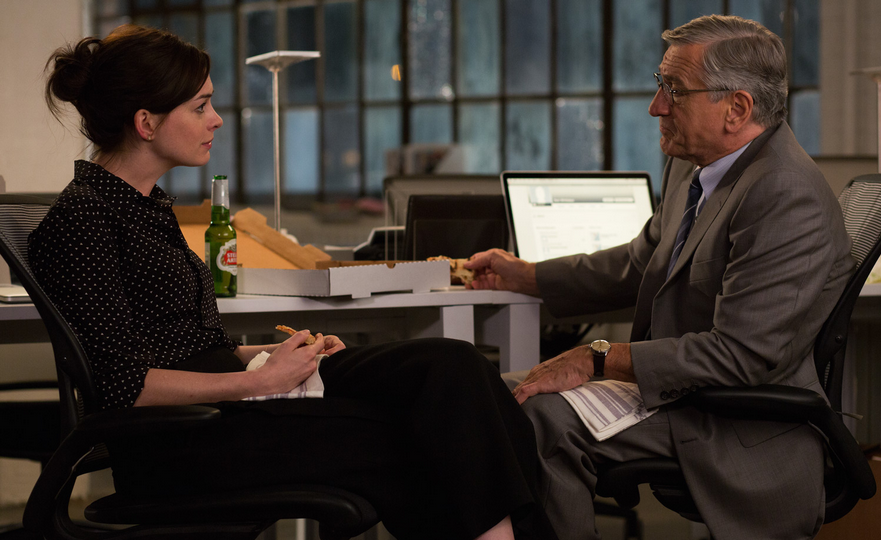
The Intern (Nancy Meyers, 2015)

Nancy Meyers has a rich history in crowd-pleasing comedies. Her writing and directing credits include What Women Want, both Father of the Brides, It’s Complicated, The Holiday and Something’s Gotta Give. The basic premise of her latest, The Intern, is that a 70-year-old widower Ben Whittaker (Robert De Niro) signs up the the senior intern programme of a rapidly-growing start-up business, only to be assigned as the personal assistant to company director Jules (Anne Hathaway), a woman seemingly struggling to keep up with the demands of her new-found success whilst balancing it with her house-husband Matt (Anders Holm) and daughter Paige (JoJo Kushner). Initially resistant of Ben, she soon grows to his warm personality and old-fashioned sentiments, leading to doubts over the future of her personal and professional life.

This may sounds like middle-of-the-road schmaltz, but it works. Some softening colour washes, a pleasant-on-the-ear soundtrack, straight-from-GAP outfits, showroom offices and houses. It’s a look at the modern world from the rose-tinted perspective of middle-to-upper-class old people, coming together to appeal to women of anywhere between the age of about 30 upwards. It is easy on the eye and easy on the soul, but to dismiss it as just that would be wholly unfair.

internscreen

By design, Meyers has created a picture that on the surface is just a pleasant and slow-paced monorail ride through the life of Ben and Jules. However, there is quite a lot of power in the messages it is portraying. First of all, it is telling women to not lie down and take the easy road when it comes to business, despite constantly being told that attempting to be the CEO of a business isn’t correct of a woman. Secondly, just because you have a child, don’t assume that you need to forfeit your career to ensure your partner can maintain his whilst you stay at home and look after your child. Thirdly, don’t feel guilty if your partner doesn’t get any of this.

I’m not sure how this film would fair in the Bechdel Test, which scores films on how sexist the content is by checking how many named female characters are involved with conversations with other women about something that isn’t men. Unfortunately, it would probably score low because the film drowns Jules in a sea of men to highlight the isolation she is experiencing in her career (other key female characters in the office are her emotional assistant and a masseuse). It may also be seen as unfortunate that she relies on a father-figure to guide her through her issues rather than working them out herself, but that’s the nature of the beast and it isn’t at all detrimental to the overall impact of the film in the final act.

There are a few failures. Husband Matt completely loses his essence about halfway through and doesn’t seem fixed in reality, undermining the effect of his actions and Jules’s reaction to them. Too often she brings emotion to the forefront of the company – one scene is obviously playing for laughs but when she’s prioritising the retrieval of a personal e-mail over issues that could destroy the company, the thought can’t be avoided that perhaps she isn’t the right person to sit at the top.

Overall, the film is a success and will no doubt please the crowds to which its box office rivals won’t appeal. It’s slightly early for the Christmas crowds and will not be remembered when the awards season is upon us, but it if you need some surprisingly thought-provoking entertainment there are far worse ways to spend two hours.

The Intern is released at cinemas in the UK on 2nd October 2015.

Irrational Man (Woody Allen, 2015)

Another year, another Woody Allen film. It must be getting tiring, all this. Coming up with excellent idea after excellent idea, living with the pressure of high expectations. Sickening then that despite this film being another example of style over substance, the substance is unquestionably absorbing and the style is abundant. Much like all of his other recent films, then.

This is the tale of university philosophy professor Abe Lucas, who arrives at a Braylin College, New England with a reputation for being both an alcoholic and a womaniser. He immediately attracts the attention of married chemistry professor Rita (Parker Posey) and philosophy student Jill (Emma Stone), the former of which is married and the latter of which is in a long term relationship to which she is seemingly dedicated. He strikes up  an intellectual friendship with the Jill that eventually leads to the suggestion of more. However, lacking enthusiasm for life, Abe seems lost until an unexpected twist of fate turns his life around and with it his attitude towards it.

A fantastic screen couple.

A fantastic screen couple.

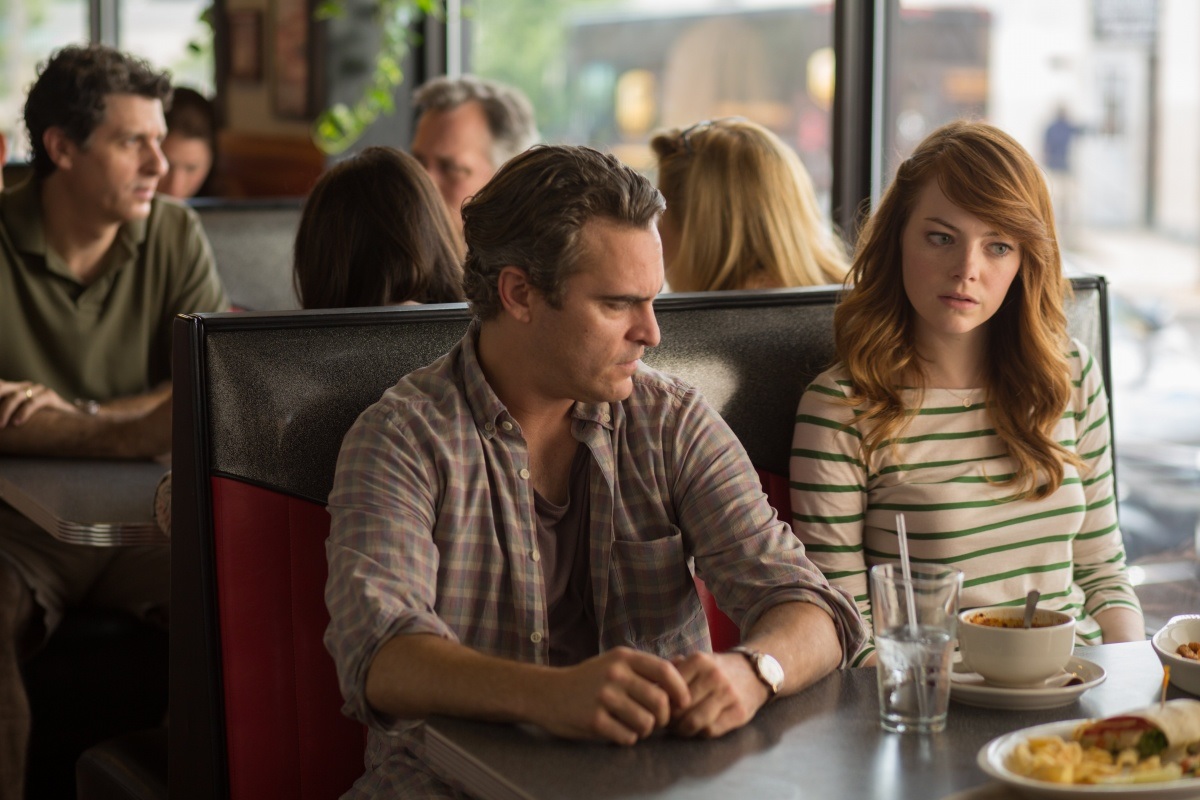
There are six listed cast members here, but there really are only two stars here. Phoenix and Stone make a formidable pairing. He may have put on some weight for this role, but Phoenix’s allure is still very much there and his convincing lost soul act is enough to make his appeal to the much younger Stone quite believable. The conversations she has with her family, friends and an increasingly frustrated boyfriend (Jamie Blackley) are so natural they could be eavesdropping. The ability Woody Allen has to enter the mind of a young and impressionable individual is uncanny. It’s subtle but enchanting.

When the twist arrives there is inevitably a risk that it will derail the film, drawing away from the realism of the first act as it blossoms into a full-blown thriller. Thankfully it doesn’t stray too far from the mark, walking a fine line but concentrating on Abe’s irrational justifications of his actions rather than spiralling out of control, which probably would have been the easier option.

It doesn’t quite reach the joyful heights seen in Midnight In Paris, though is streets ahead of the unfathomably popular Blue Jasmine. Well worth checking out if you can find it.

Irrational Man is at UK cinemas now.

Orion: The Man Who Would Be King (Jeanie Finlay, 2015)

ORION: The Man Who Would Be King (12A), the latest feature documentary from award-winning director Jeanie Finlay (Glimmer Films) is released into UK cinemas from Friday 25 September and has received distribution support to enhance this theatrical release from Creative England and Ffilm Cymru Wales.

Orion tells the story of Jimmy Ellis, an American singer with a natural voice that drew unavoidable similarities to Elvis Presley. In the aftermath of Elvis’s death in 1977, music producer Shelby Singleton of Sun Records played on the conspiracy theories about Elvis having faked his own death and created Orion – a masked singer with a mysterious past who had the look and sound of Elvis whilst never laying claim to being the man himself. For four years success lay in the hands of Ellis as he toured and rode the waves of popularity, but frustrations crept in about the public perception of him and the deals he had signed and he finally broke away from his deal in some style.

This documentary was spawned by a chance purchase at a Nottingham market, where director Jeanie Finlay picked up a copy of the Reborn album on 12″ vinyl, Orion’s debut release. That was where the interest in him started, and between then and now the director has visited almost everyone closely involved in his life to discuss their experience of a man driven by a desire to sing on his own terms. It is excellently put together. It is a story that threatens to be either not very interesting or flawed due to lack of decent source material (the Presley estate provide little footage for these kinds of films and many of the key people in the film were unavailable for interview). Fortunately, neither of these things threaten to creep in and the end product is fascinating.

Oh Ryan.

Oh Ryan.

It goes a long way into intimately portraying a man torn between being forced to hide behind a mask and enjoying the limited success he was achieving. It is balanced and as such avoids over-celebrating Ellis, concentrating on his personality rather than his success. As with most music documentaries, many of the anecdotes bring huge amounts of comedy to the table and Finlay has been careful to interview as many people as were available, no easy task when on such a tight budget.

Orion: The Man Who Would Be King is a documentary worth watching, and it’s an experience enhanced if you know nothing about Ellis. A full list of screenings can be found on the official website.

Keith Richards: Under The Influence (Morgan Neville, 2015)

Keith Richards: Under The Influence is a documentary film by Morgan Neville, the man responsible for the excellent Academy Award-winning 20 Feet From Stardom. Richards has a new album out – Crosseyed Heart – and the timing of this film gives it the feel of being a bit of an extended promotional interview.

Indeed, that’s exactly what it is. Bringing in a few musical friends to offer further insight, the film is actually a series of interview filmed in various locations across the USA. The fact it is just a talking heads film is not to say this is a disappointment as a documentary. Fans of the band and/or the individual will find a lot of joy from watching the series of interviews with a man who knows how to tell a tale. Most avid fans have probably already read his autobiography “Life” and an 80 minute film is never going to cover the depths of a 500-page book.

Keith Richards: Under The Influence is available excusively on Netflix now.

What Happened, Miss Simone? (Liz Garbus, 2015)

What Happened, Miss Simone? is a 2015 documentary about American singer and songwriter Nina Simone. Combining archival footage and interviews with close friends and relatives, the film broadly covers the key periods of her life, building up a picture of her off-stage persona in the process.

Such was the nature of her personality, it is a documentary that was destined to be extremely interesting. Indeed, it is quite easy to accuse it as being a by-the-numbers film: get some footage of her onstage, source a few interviews with her, get the close family on board and let them speak from their point of view and build up a picture of her. That may be the case here, but it doesn’t mean it’s a bad film.

The film was sanctioned by daughter Lisa Simone Kelly, who is also listed as one of the film’s executive producers. This is a wise move. Not withstanding the access to personal diaries this would have undoubtedly provided to Garbus, this is crucial because Lisa is able to provide a unique insight into her mother from a point-of-view nobody else could offer.

There are several other documentaries that cover the same ground, perhaps most notably Nina Simone: The Legend (Frank Lords, 1992), which offer their own viewpoint on her life. What Happened, Miss Simone? stands alone as a film in its own right, though perhaps lacks the detail needed to offer any real insight into any particular point in her life. In particular, her time as a civil rights activist is given around half-an-hour – enough to whet viewers’ appetites but not enough to explore her involvement and impact. Equally, not a single song is allowed to air from start to finish, diminishing the effect of her powerful performances.

Worth a watch, but it serves only as an introduction to the artist as it only really touches the surface.

What Happened, Miss Simone? is available exclusively on Netflix.

[Note] If you’re interested in what she could do at her peak, here’s a majestic performance of her song “Feelings” live at the Montreux Jazz Festival in 1976.

Paper Moon (Peter Bogdanovich, 1973)

One of the most sure-fire ways of making an enjoyable and effective film is to ensure the chemistry between the two lead characters is strong. What better way to achieve this than by casting a father and daughter in what is essentially a buddy film?

In Paper Moon, we follow the story of tomboy orphan Addie Loggins (Tatum O’Neal) as she is taken under the wing of con-man Moses Pray as he agrees to take her from her mother’s funeral to her aunt’s house in Missouri. She is convinced he is her real father, a point that is hinted at throughout, despite his continued denial of the fact. One thing that they’re both convinced of, however, is that they make a great pair as a scamming duo, going door-to-door convincing recent widows that their recently deceased husbands had ordered them a personalised bible. This serves as an excuse for them to go on a prolonged adventure of dishonesty, an adventure that seems far more appealing than their other limited options.

The chemistry between the O'Neals is excellent.

The chemistry between the O’Neals is excellent.

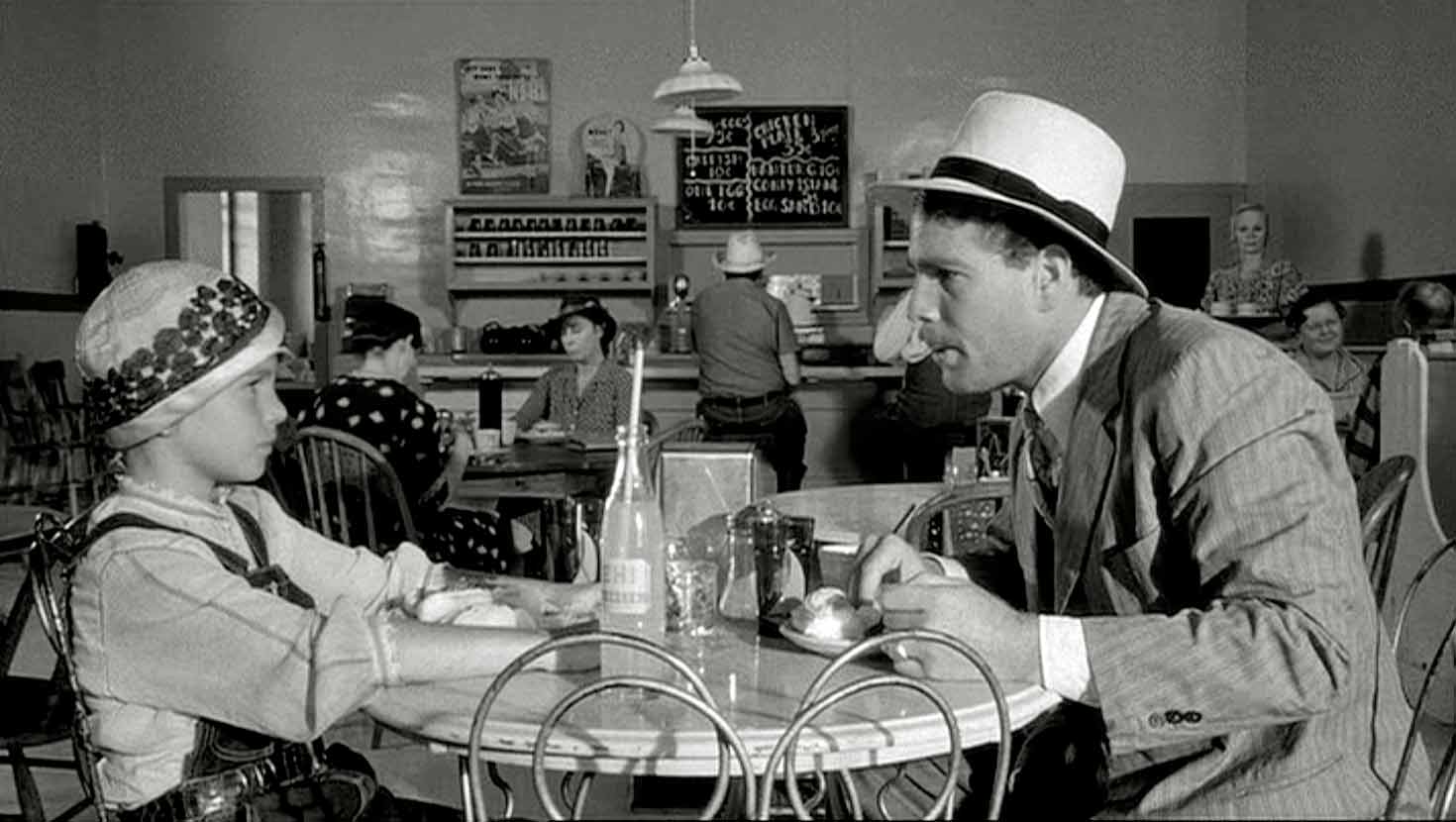
Much was made at the time – and has been since – of Tatum O’Neal’s performance. Indeed, she remains to this day the youngest person to win an Academy Award for Acting. At 1 hour, 6 minutes and 58 seconds, it is also the longest performance to receive a Supporting Actor/Actress Academy Award. It is playful and at times unintentionally comedic, but the playoffs with father Ryan are brilliant to watch. One memorable scene involves a long one-shot as they drive and argue, both livid at each other before turning it around to agree despite their tones still being that of an argument. It’s almost so good it doesn’t feel like they’re acting, although it allegedly took 39 takes over two days to get right.

One thing the film never answers is the question of whether the two are really father and daughter. The decision is made instead to leave it open as they head off into the sunset, presumably to continue much as they did in this film (a relationship explored in a panned TV sitcom spin-off series starring Jodie Foster). It is a nice decision – the fact they need each other, either as a father figure or as a driver to act responsibly, is to them more important than finding out this truth, at least at this stage in their relationship.

The bonus features are worth watching and provide a valuable insight into the making of the picture. The highlight is an anecdote involving Tatum repeatedly fluffing a line, resulting in her father having to eat countless amounts of waffles, much to the delight of Tatum. In fact, this was deemed so important as an example of their chemistry that the outtake was incorporated into the original trailer.

The cinematography by the Hungarian László Kovács adds a great deal to the authenticity of the film and its success in recreating 1935 Kansas. Coupled with a timeless soundtrack and a great attention to detail in the scenery and costumes, the result is that it transports the viewer completely into the environment, adding further embellishment to the excellent performances of both stars and their supporting cast.

A unique film with a lot to offer even the most ambivalent of viewers, this is one of the best re-releases of the year.

Paper Moon is available on Masters of Cinema Blu-ray now.

American Ultra (Nima Nourizadeh, 2015)

American Ultra is far better than it should have been. The basic story – a stoner grocery store assistant (Jesse Eisenberg) is actually an advanced agent from a secret programme that was shut down before his memory was wiped – sounds like pretty standard fare and doesn’t really suggest a great film is in order. A fast pace, short running time and well-judged performances make it an enjoyable romp.

  
Eisenberg is well cast and it’s a wise move to keep him in reluctant stoner character throughout, though it would have been easier to make him magically turn into an alpha male. Kristen Stewart makes another case for the ATL (Anti Twilight League) to take her a little more seriously with a solid performance and there are great turns elsewhere from Bill “Was That Bill Pullman?” Pullman, Topher “That 70s Guy” Grace, John “Luigi Mario” Leguizamo and Tony “Loose Seal” Hale.Perhaps this film doesn’t justify a trip to the cinema, but when it hits the steaming platforms it should be near the top of your list.

American Ultra is out now at cinemas in the UK.

スーパーマリオメーカ / Super Mario Maker (Nintendo, 2015)

The latest excellent game on the Wii U for the majority of the gaming community to ignore is Super Mario Maker, a game that puts the gamer in the driving seat to control the content of Mario levels in one of four skins: Super Mario Bros., Super Mario Bros. 3, Super Mario World and New Super Mario Bros.

As the trailer above shows, the content is quick and easy to activate, meaning a basic level can be created in no time at all. It may be fiddly at first but once the tools are used a couple of times it becomes remarkably intuitive. You simply control the content on the gamepad using the stylus (did you forget you had that?) and a giant hand replicates it on the screen. After a fairly basic tutorial you are ready to go!

Then comes a huge hurdle. One major issue you encounter at this point is the requirement to keep playing on consecutive days in order to unlock the more advanced level features. This means that perseverance is the key – the only key – to unlocking the tools to make the most innovative levels for friends to enjoy. The thinking behind it is clearly to make sure players don’t make a couple of exceptionally tough levels then disappear forever, though for the more dedicated amongst us it is frustrating. For anyone getting the game on day one and trying to put together a cool new course, get ready to be disappointed – all you get are four types of blocks, three enemies, mushroom power ups and pipes.


There wasnt mushroom for anything else in this level. Geddit? Mush room? Oh never mind.

 
As expected, Amiibo functionality is a key feature. When scanned, one of several things might occur, depending on which figuring has been scanned. For the most part a new playable character will be unlocked. This is fun but there is a flaw – the character is allocated at random so you can’t design the level around who you’ve placed in the box. It is quite fun to play as Link or Yoshi progressing through the stages he’s active in, though doesn’t add too much to the game. It’s disappointing that this is only available for the Super Mario Bros. themes and does nothing for the remaining three.

Where the game comes into its own is the ability to access other people’s levels. There is a leader board based on popularity and spending an hour in there was a joy. One level I played was called “Don’t Touch The Shrooms”, a tough level that can only be completed if you can avoid mushrooms due to a carefully placed spring board. When mushrooms are being fired at you from all angles it gets quite stressful!

Feel free to add me on your Wii U account and try out some of my Super Mario Maker creations. My username is Hutchie and I’ll be slowly unleashing increasingly complex levels throughout the weekend.

This game has legs. It might not feel impressive on first look but get the hang of it now and it will reward as more features are unlocked.

Super Mario Maker is available as a Wii U exclusive worldwide now.

How To Change The World (Jerry Rothwell, 2015)

HOW TO CHANGE THE WORLD – Trailer

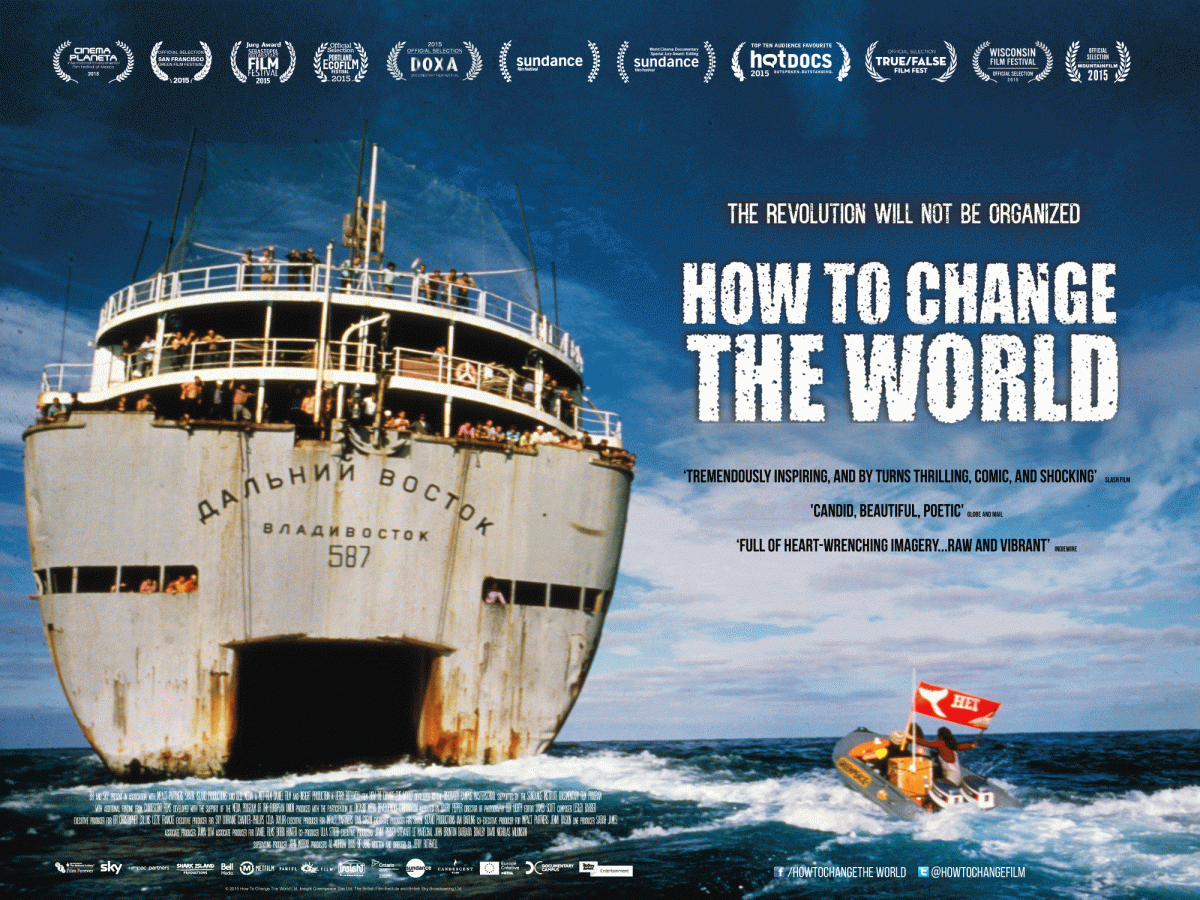
How To Change The World is a documentary film from director Jerry Rothwell that charts the history of the company Greenpeace, from its humble beginnings as a group of activists in 1971 to the internationally recognised brand it has become today.

The film concentrates on several key moments in the early history of Greenpeace: the attempts to prevent the detonation of nuclear bombs in Amchitka in 1971 (essentially the birth point of Greenpeace); the anti-whaling campaign of 1975 in which Russians fired harpoons over the heads of a boat of Greenpeace activists to kill a whale; and the organisation-dividing seal-dying campaign of 1982, which aimed to prevent the skinning of baby seals for their fur and led to a confrontation with Canadian hunters and a public standoff.

One of the cornerstones of the film is the evolving dynamics of the group. As the Greenpeace movement grows in stature the original members become celebrities and uncontrolled splinter groups popped up globally. Director Jerry Rothwell has clearly decided that the best way to hold the film together is to use Bob Hunter’s writings as the narrative. As he explains, “Greenpeace has a contested history because of what happened to them, this maelstrom of fame. I’ve tried to bring that out in the film. Bob Hunter’s writing had to be the central voice of the film. It is poetic. That needed to be the heart of the story.”

The film is presented stylishly with a great soundtrack of artists that have supported the cause over the years. Indeed, a 1970 Joni Mitchell and James Taylor concert funded the first whaling trip, but that is footage that doesn’t feature here. Instead, she features only over the end credits as Big Yellow Taxi aptly brings the film to a close. “There was a recording of that concert”, Hunter concedes, “but from a narrative point of view we needed to get them out to sea as soon as possible.”

It is a film that almost never existed, because the footage was unknown and ready to be destroyed. It was only when Rothwell had a chance encounter with the footage that he realised there was a film to be made out of it: “I realised there was 1000 canisters of film in Amsterdam. I happened to be in that archive for another project. There were some extraordinary images. For Greenpeace at the time the function of the films was to make campaign films for seals and whales. The cut offs were in a way what I was interested in, as it showed a glimpse of the dilemmas they had faced.”

As documentaries go, the content of the film is fascinating. It doesn’t force the current agendas down the viewers’ throats (there is plenty of information on their website should you care to take a look), instead taking the stance that the history of the organisation is a story interesting enough in itself. The way it is presented is also extremely polished and easy to digest. I’d be surprised if it isn’t at least being mentioned when the awards season kicks off in earnest next year.

How To Change The a World will be released at cinemas worldwide on 11th September 2015.