

Just for fun, here’s a free Halloween film quiz for you to use in your office, with your friends, or with your family!
Just print them off or share them on your screen and hey presto – instant fun!
I’ll publish the answers in a separate post.
UPDATE
Just for fun, here’s a free Halloween film quiz for you to use in your office, with your friends, or with your family!
Just print them off or share them on your screen and hey presto – instant fun!
I’ll publish the answers in a separate post.
UPDATE
Georgie lives alone
Dad returns to make amends
They try to steal bikes
The year is 1953. November. Britain is still bouncing from the coronation of Queen Elizabeth II. Winston Churchill was halfway through his second stint as British Prime Minister. Frankie Laine was the undisputed king of the musical landscape, topping the singles charts for well over half the year with three different songs. And, somewhere amongst it all, Charles Saunders crafted one of the most bizarre British comedy films I’ve ever seen.
Love in Pawn stars Bernard Braden and Barbara Kelly as Roger and Jean Fox, a married couple in dire need of financial help. After a fairly slow opening act, they come to the only logical conclusion: to pawn Roger for a then-considerable £5. However, when Jean loses the ticket, Roger is stuck in the pawn shop for longer than expected. This gives him just enough time to begin a flirtatious kinship with the pawnbroker’s daughter Amber, played brilliantly by Jeannie Carson.
That the daughter is not of age (it’s suggested she’s 17) is not even the most unusual part of this strange plot. The main confusion for this viewer was that nobody seems to greatly question why Roger is allowed to be pawned. Even when they get to court the judge has a little confused look and then proceeds as normal.
For such a wild premise, the film itself isn’t particularly hilarious. Plenty of films, across all genres, stand up to the test of time after 70 years, but this doesn’t really hit the mark. Charles Saunders was on the fringes of television and cinema throughout his career, and this does lack the grandeur of a big-screen story. Indeed, it would sit much better as a TV movie with some of the fat cut out of the first twenty minutes.
Perhaps his creativity had reached saturation. Between 1952 and 1954, he rushed through no fewer than eight films and nine episodes of anthology series Douglas Fairbanks Presents. Such a prolific career tends to lead to a formulaic output.
There is a good story here but it feels rushed and unbalanced.
Listen. Schmalzy romcoms are totally not my bag, okay? The whole premise does nothing for me. I don’t think I’ve enjoyed one for years. But there was something about Aline Brosh McKenna’s film that made me want to keep watching. And – whisper it very quietly – I quite enjoyed it.
The film stars Reece Witherspoon as Debbie and Ashton Kutcher as Peter. It opens with them having a one-night stand together in the early 00s. A jump forwards in time reveals that they didn’t end up married, but that they did end up very close friends, despite living on opposite sides of the USA.
So, where is the story taken and how does it end? Well, very similarly to most other rom-coms. There are a few bumps along the way and everyone ends up quite happy at the end.
The beauty in the film comes with its simplicity and charm. The leads have never looked better and make a perfect match. They add life to a solid storyline that feels snappy and well baked. There’s no laziness in the character realisation, especially in Theo (Jesse Williams), for whom it would have been easier to paint as more sinister and manipulative.
It isn’t groundbreaking cinema but it does a very good job of what it set out to do. Sometimes that is enough.
Maybe it is my bag after all.
There is something immediately joyous about Two Way Stretch. The score, supplied by Ken Jones, plays beautifully over some whimsical title cards, typical of British films at the time, and it sets up the tale perfectly.
Set in a British prison, Robert Day’s 1960 comedy tells the tale of a group of three prisoners – Peter Sellers, Bernard Cribbins and David Lodge – who operate their cell like a homely bed and breakfast, with contraband food and drink, a radio, daily newspapers and even a pet cat called Strangeways. They receive a visit from a man purporting to be a vicar (played by Wilfrid Hyde-White), but who is actually a conman who has hatched a plan to use the three prisoners to carry out a large-scale diamond theft. They’ll be broken out of prison, steal the diamonds, then broken back in. A classic farce.
Sellers is brilliant throughout, providing natural comedy at every moment. In 1960, his film career had just taken off with a BAFTA win for his leading role in another British comedy, I’m All Right Jack. By 1962, he was starring in Kubrick’s Lolita before being cast in Pink Panther. This is a perfect opportunity to see Sellers in his prime, fresh from radio, making his way on the big screen. A comedy legend at his best.
There are some moments of real hilarity. A visit from some elderly ladies provides Sellers with the opportunity to play a few tricks, whilst the smuggling of contraband into the prison on visit day is a shambolic hoot. The real gold starts with the arrival of Lionel Jeffries as the officious Chief “Sour” Crout, who brings a real counterpoint for the trio of protagonists. The comedy is all underpinned by a solid plot that keeps things moving forwards.
Two Way Stretch is a pure joy from start to finish and a perfect snapshot of British cinema at the start of the 1960s.

Takeshi Maruyama’s latest is one with an unusual feel. An ensemble piece made up of interrelated tales, the most likely outcome for Spaghetti Code Love would have been a confusing mess of a film. Somehow, despite risking a drop in pace in the middle, the exact opposite happens here and you’re rewarded for sticking with a daunting initial task.
Why daunting? Well, I lost count of how many stories there were. There was a woman at a pachinko arcade, a struggling photographer, an angry model, a nervous busker, a clingy wife, an emotionally distant young couple, two school kids planning their deaths, an even young student planning his entire life, a woman wasting money on a psychic and her neighbour who is addicted to Skippy peanut butter. I certainly missed a few!
Somehow, the film manages to keep you abreast of all of these varied stories, all of which play out in a beautifully shot Tokyo. Not only that, but they build to a crescendo and are somehow tied together in a neatly positive conclusion across the board.
I’m glad I was fairly focused and in the mood to be challenged, but I’m worried that if I’d been cloudy of mind I may have struggled to keep up. For international audiences, the sheer volume of stories might make the film a little inaccessible.
The standout plot thread for me involved the brilliant Tôko Miura (who recently starred in the Oscar-nominated Drive My Car) as a musician grappling with her own self-confidence. In an ensemble cast full of talent, I found her woes hugely relatable and her delivery was highly memorable.
Certainly worth watching.
Note: I watched this as part of the Japan Foundation Touring Film Programme at Broadway in Nottingham, an annual festival that offers British cinema goers a first look at the latest cinematic releases from Japan.
It’s rare that a film with a big-name actor gets as far as being released without me knowing anything about it, let alone being watched. It’s occasionally an indicator that it is a big event film with a special surprise release by the distributor. More often, it means it’s just a terrible film that is trying to be buried.
I watched most of Guns Akimbo wondering which category it fell under. Is it absolutely terrible, or completely genius? It certainly isn’t for the squeamish, with Lei Howden (Deathgasm, Deathgasm 2: Goremegeddon) making sure the adrenaline doesn’t get much rest in the short running time.
The setup is straightforward. Daniel Radcliffe plays Miles, a video game coder living a fairly joyless life. He regrets letting a relationship with Nova (Natasha Liu Bordizzo), his ex, fizzle out. He learns of an illegal online game called Skizm – a survival game where contestants, who are usually criminals or psychopaths, fight to the death. He goes onto their online forums and leaves a few scathing comments. One thing leads to another, and he wakes up with pistols bolted to his hands and is the newest competitor in the game, taking on current champion Nix (Samara Weaving). With limited time and limited ammunition, Miles must choose to kill or be killed, whilst the world watches on.
It’s not an original concept for sure, with televised deathmatches being well explored in cinema. That said, there’s enough going on stylistically and a snappy-enough script to inject a bit of freshness into proceedings.
Daniel Radcliffe goes from strength to strength in his career as he continues to take on risky roles. It’s almost hard to believe he was still starring as Harry Potter a decade ago, when I wasn’t alone in thinking his acting hadn’t really improved over the ten year period he was involved in the franchise.
I’m not going to write about nuances of any of the acting performances. As solid as they are, this isn’t a nuanced film. The characters are caricatures, larger than life, fairly one dimensional affairs. Somehow this doesn’t cause any detriment to the overall impact. Lei Howden doesn’t leave space for the viewer to think about the characters, constantly just pushing forwards with one bloody action set piece after another.
Does it feel a bit too much at times? Maybe. But it’s never not fun, and sometimes that’s just what you need.
I’m a huge fan of The Walking Dead. I’ve watched it from the start and, whilst I’ve sometimes fallen behind on a few episodes, I’m fully up to date and enjoying the anticipation for the upcoming final series.
However, of my countless friends who I have shared conversations with about the iconic series, I am the only person I know who is still watching it. Those that haven’t given up on it have fallen drastically behind on the latest episodes, making conversations about it more of a memory test rather than, as it should be, a group of friends getting excited about a plot line or key cliffhanger. “Where are you up to?” “Erm, Season 7. Maybe 8. They aren’t in the prison anymore. There’s a tiger.”
Here’s a graph, taken from the Wikipedia episode guide, which displays the rise and fall of popularity for The Walking Dead (albeit in the USA but I suspect this reflects its popularity globally).
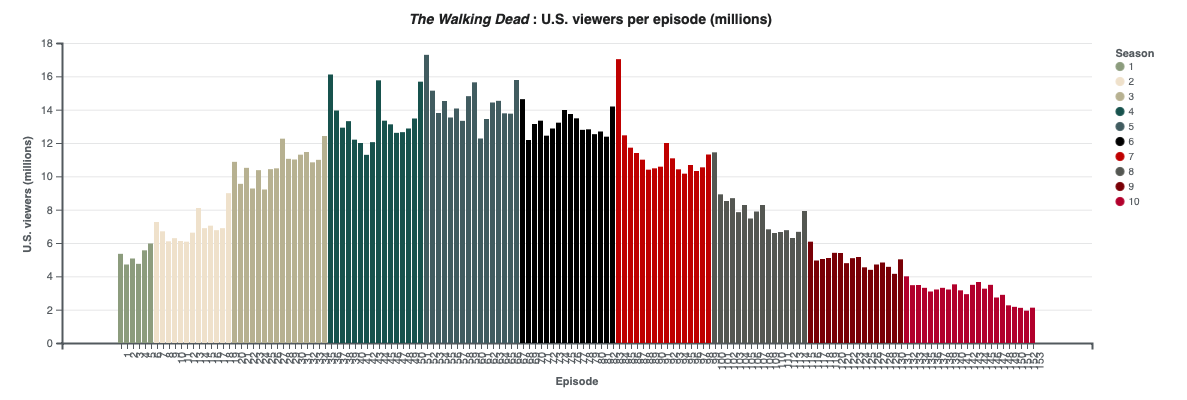
As you can see, there was a clear peak from the start of Season 4 to the first episode of Season 7. This is roughly the immediate aftermath of the Governor story arch, battling with the cannibals, introduction of The Hilltop, battling the Wolves and then the Saviors, right through to the iconic episode in which Negan exacts his horrifying revenge on Glenn and Abraham.
From that point onwards, many things conspired to alienate the viewers. The lack of direction or desire to finally conclude the story. Two canonical spin-off series that may have been essential viewing. Three planned Rick Grimes films. Five Telltale video games. A parallel comic book with differing storylines. The continual killing off of main characters. Disheartening comments from the the show’s creators that implied it would never end. Spending too long focused on secondary characters and ignoring the main characters for several episodes at a time. All these things conspired to lead all but the most enthusiastic away from the show. It was too much to keep up with.
Take the situation in the UK, where I am based. When the first spin-off, Fear The Walking Dead, was announced, I was really excited. Then it was announced it was coming to a new BT-exclusive TV channel called AMC, launching in August 2015, which was fortunate for me because I was a BT subscriber. However, shortly after this announcement (on 1st March 2016), FOX TV was removed from the BT service due to a contractual disagreement. This meant that in the UK you had to choose between watching the main series or the spin-off series – a crazy situation to leave a flagship programme in.
This confusion coincided with the controversial killing of Glenn and Abraham, and the sudden decline in viewership. It was a botched job – too much content, too difficult to access, spread too thin across multiple channels.
Additionally, it was confusing just to keep track over the years exactly where each series was going to be released, or how long it was going to stay on the platform. I had a hilarious situation late last year where I was desperately trying to watch 2-3 episodes of Series 10 every day, just to watch them before Sky deleted them from their service. Fortunately, I found this watching experience to be entirely engaging and exciting, with Samantha Morton putting in a star turn as the series antagonist Alpha and a wonderful Whisperers storyline bringing as much excitement to the story as I’d ever seen.
So, why should you watch it now? Well, for the first time we now definitely know when the end point is going to be. Starting in August 2021 – next month as I write this – the final series is going to start airing. That should mean that the show will pick up significant pace as they aim towards the eventual conclusion. There are rumours that Rick Grimes will be returning, although these are unsubstantiated.
Secondly, you can watch the entire series on a single platform (in the UK at least). For The Walking Dead, go to Disney Plus, work out where you got lost, and dip back in. If you’re enjoying it and want more of a fix, you can go to your Amazon Prime account and watch Fear The Walking Dead. If you’re feeling extremely hungry for more you could also seek out the brilliant The World Beyond, also on Amazon Prime. No longer will you be wondering where you are in the multiple series as it’s all in one place.
You will still need to suffer through some of the most frustrating tropes of the show, the most blatant being the continual desire to put a cliffhanger out in the open that is not mentioned again for two or three episodes. They’ve always been guilty of this and it doesn’t change before the end of Series 10, I’m sorry to say.
But, if you have ever wondered if you’ve missed the boat on it, then now is your time to catch up just in time for the start of the new series.
I’ve had a thoroughly quiet year in terms of posting on here, but I’ve still managed to keep track of all the lovely films I’ve watched.
1917
I’m Thinking Of Ending Things
Jojo Rabbit
On The Rocks
Onward
Parasite
The Peanut Butter Falcon
Portrait of a Lady On Fire
Soul
The Trial of the Chicago 7
And bubbling under are…
Eternal Beauty
Little Women
Pain and Glory
The Roads Not Taken
Rocks
I think this is indicative of my viewing preferences. There’s a huge sway towards uplifting films, including three Disney or Pixar films. I saw a few of the biggest films of the year in 2019, but equally a few 2019 films have found themselves on the list!
A fun little tale
About cutesy tanooki
Wait, are those scrotums?

