Dad’s Army is one of the best-regarded sitcoms to ever come out of Britain. A film would always have two almost certain outcomes: making a lot of money and not living up to the public’s fond memories of the original series. In this sense Oliver Parker’s 2016 effort doesn’t disappoint.
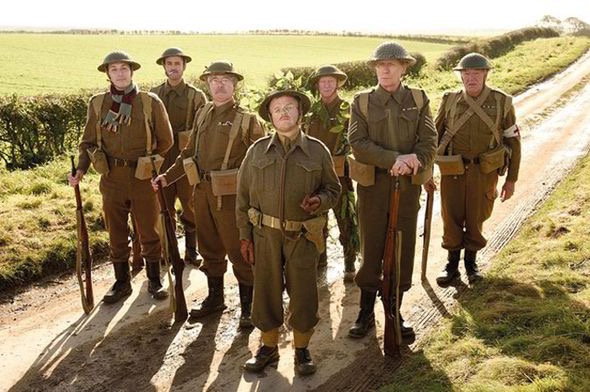
This film adaptation stars Toby Jones as Captain Mainwaring, the leader of a Home Guard [1] platoon the fictional Walmington-on-Sea in England during World War II. His platoon consists of Sergeant Wilson (Bill Nighy), Lance Corporal Jones (Tom Courtenay), Private Godferey (Michael Gambon), Private Pike (Blake Harrison), Private Walker (Daniel Mays) and Private Frazer (Bill Paterson). They are being visited by glamorous journalist Rose Winters (Catherine Zeta Jones), there to report on the Home Guard.
The authenticity of this film is, to the untrained eye, fantastic. The colour washes and costumes give it the feel that you genuinely are watching a Home Guard operation in 1944. There is a clear attention to detail that has gone into this and the film is much better for it.
The plot, generally, is enjoyable. It is pitched at the right level between the series and what is expected of a big-budget film. It puts the Home Guard into a potentially larger plot that is at the centre of the war efforts.
Where this film majorly falls down is the humour, or lack thereof. The writing was on the wall with the trailer, which felt a little flat. Unfortunately, most of the best material was featured in one or more of the trailers, and between these moments the humour was lightly sprinkled in a way that may bring a smile to the audience members’ faces but never succeeds in delivering a belly laugh. In this sense it has been a huge failure in comparison to the original series.
The actors do a wonderful job impersonating the original cast members, to scarily uncanny levels. This is perhaps the only time when all these stars will grace the screen together and it is a real letdown that the material they’ve been served is so underwhelming.
A massive disappointment.
[1] During World War II, those unable to serve on the front line provided a second line of defence on British home soil. Platoons were generally made up of those too old or too young to serve in battles, individuals with injuries or illnesses that prevented them from being on the front line and those with professional occupation that were exempt from joining the front line war effort. It was a significant operation, consisting of around 1.5m volunteers.
Spike Wright’s latest short film “Catching Up” is a great example of how to get creative with the short medium. Wright has utilised the constraints of the running time to produce something exceptionally moving, led by excellent acting performances by the two leads George Evans and Nicola Northcott.
The end result is remarkable given they only had 60 hours to turn it around and with only two starting points: a particular line of dialogue (“That’s surely too much for this town”) and a prop action that had to occur (“Two ice cubes are taken out of a glass of water and dropped into an empty glass”). The story is conveyed in five minutes without really ever feeling like it was rushed, with a satisfying conclusion to a concise narrative.
There’s no vote to be had but with any luck it should be screened at the 2015 Colchester Film Festival later this month. It certainly deserves to be.
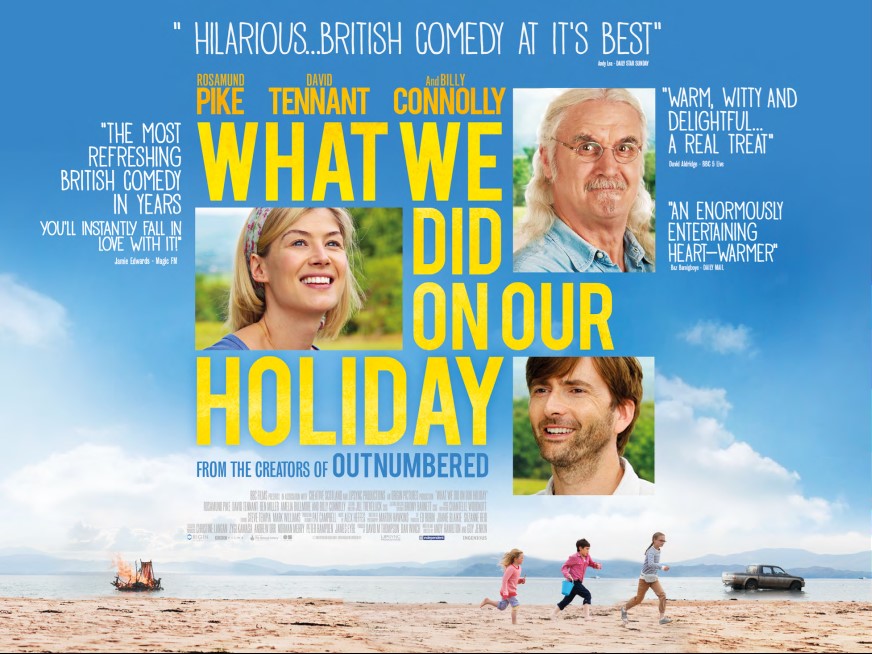
If you’ve ever watched the popular British sitcom Outnumbered then you’ll become immediately outraged by What We Did On Our Holiday. The premise is exactly the same: a dysfunctional London-based family with arguing parents and three young and awkwardly inquisitive children go on a trip to visit their quirky grandfather and the annoying sibling of one of the parents. The dialogue and individual characters seem highly familiar too and it’s difficult to avoid the thought that this could have been done to much greater success with the Outnumbered cast. It’s only after a small amount of research that it becomes evident that this film is indeed written and directed by Andy Hamilton and Guy Jenkin, the creators of Outnumbered. Admittedly, they couldn’t very well have written “By the way, we made Outnumbered and we know this is basically Outnumbered: The Movie but please stick with it.” I would have helped though.
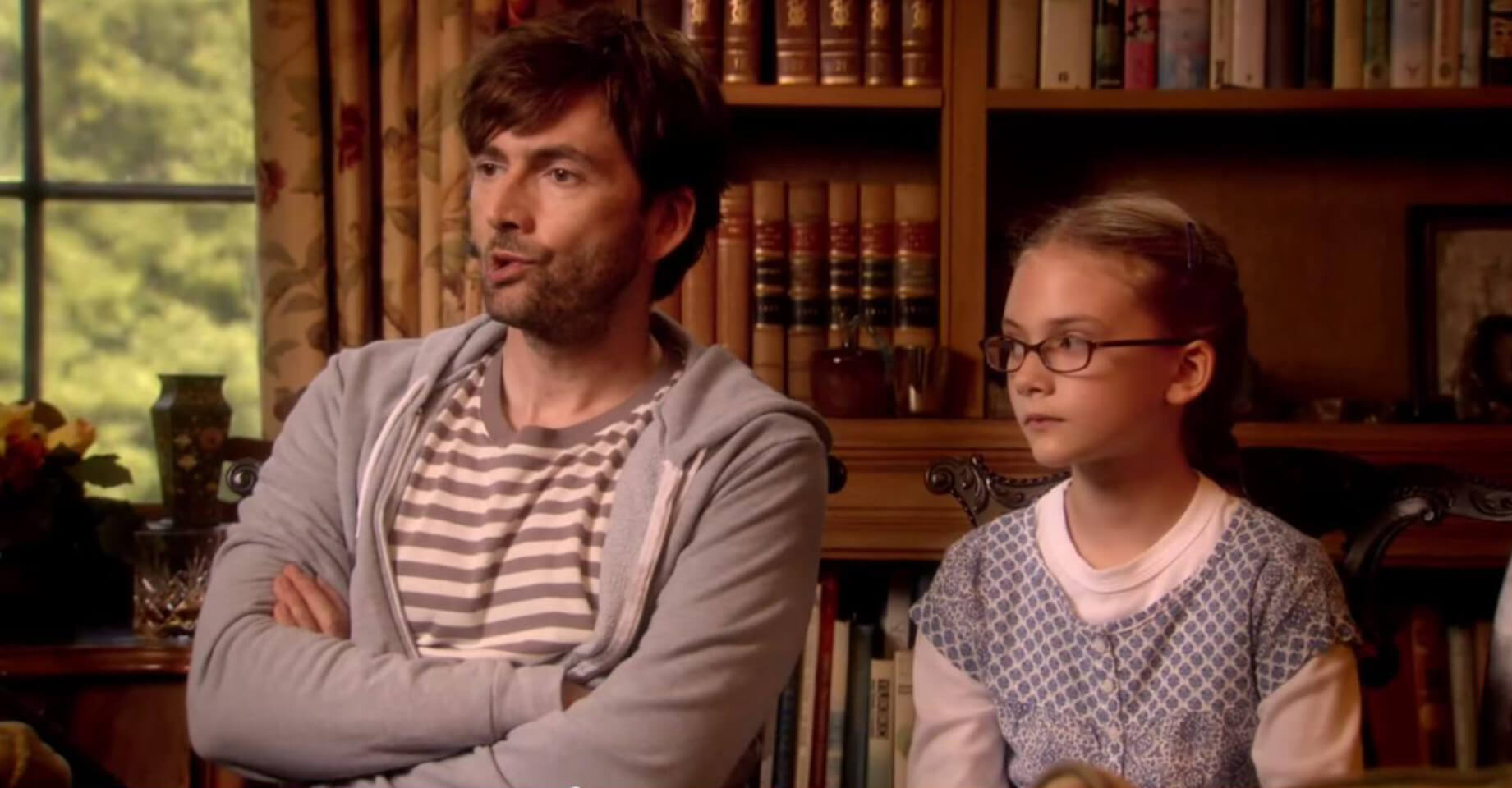
The storyline involves father Doug (David Tennant) and his wife Abi (Rosamund Pike) travelling to see Doug’s father Gordie (Billy Connolly) in the Scottish Highlands. Their marriage is on the cusp of separation, a fact they like to assume their children don’t know. They’re visiting Scotland to celebrate Gordie’s birthday with a party co-ordinated by Doug’s brother Gavin (Ben Miller) and his wife Margaret (Amelia Bullmore), who provide some laughs as a couple attempting to keep up appearances.
A laugh a minute this is not.
Despite what the poster says, this is not British comedy at its best. The reason for this is that only one of the three main cast members is a comedian and the short running time means the children aren’t provided enough space to cultivate any big laughs. The funniest moment in the whole film comes when the son Mickey tries to explain how he managed to discover his parents were getting a divorce, missing out most of the details of what was heard but lengthily revealing his technique to go to the toilet silently so he can eavesdrop. The screen time afforded to Miller and Bullmore is refreshing when it happens, though again this is limited and it feels like there was more on offer.
It’s a bold move to use this as a vehicle to tackle some pretty hefty subjects and for the most part this ambition elevates it to something bordering on a weighty drama with a humorous veneer. The impending death of elderly relatives, the lack of emotional support provided by the close family of these elderly relatives, the denial of innocence of youth due to over-exposure to mass-media, the lack of respect provided by media when the desire to get a good story transcends their own moral compass (the film was written in the immediate aftermath of the publication of the Leveson Inquiry). These are all topics that Hamilton and Jenkin clearly felt were beyond the scope of their beloved sitcom and more deserving of a feature length film. For that they should be applauded, despite an overall feeling of the film being an underwhelming disappointment.
Ultimately, a film marketed as a comedy will succeed or fail on the amount of laughs it elicits. The lack of natural comedic tendencies of both Pike and Tennant mean that the film relies too heavily on three young children playing for cute giggles and a support cast that isn’t seen enough to make up the ground. If you want to laugh a lot for 90 minutes then a better option is to just watch three episodes of Outnumbered, which is a disappointing conclusion to reach.
ORION: The Man Who Would Be King (12A), the latest feature documentary from award-winning director Jeanie Finlay (Glimmer Films) is released into UK cinemas from Friday 25 September and has received distribution support to enhance this theatrical release from Creative England and Ffilm Cymru Wales.
Orion tells the story of Jimmy Ellis, an American singer with a natural voice that drew unavoidable similarities to Elvis Presley. In the aftermath of Elvis’s death in 1977, music producer Shelby Singleton of Sun Records played on the conspiracy theories about Elvis having faked his own death and created Orion – a masked singer with a mysterious past who had the look and sound of Elvis whilst never laying claim to being the man himself. For four years success lay in the hands of Ellis as he toured and rode the waves of popularity, but frustrations crept in about the public perception of him and the deals he had signed and he finally broke away from his deal in some style.
This documentary was spawned by a chance purchase at a Nottingham market, where director Jeanie Finlay picked up a copy of the Reborn album on 12″ vinyl, Orion’s debut release. That was where the interest in him started, and between then and now the director has visited almost everyone closely involved in his life to discuss their experience of a man driven by a desire to sing on his own terms. It is excellently put together. It is a story that threatens to be either not very interesting or flawed due to lack of decent source material (the Presley estate provide little footage for these kinds of films and many of the key people in the film were unavailable for interview). Fortunately, neither of these things threaten to creep in and the end product is fascinating.
Oh Ryan.
It goes a long way into intimately portraying a man torn between being forced to hide behind a mask and enjoying the limited success he was achieving. It is balanced and as such avoids over-celebrating Ellis, concentrating on his personality rather than his success. As with most music documentaries, many of the anecdotes bring huge amounts of comedy to the table and Finlay has been careful to interview as many people as were available, no easy task when on such a tight budget.
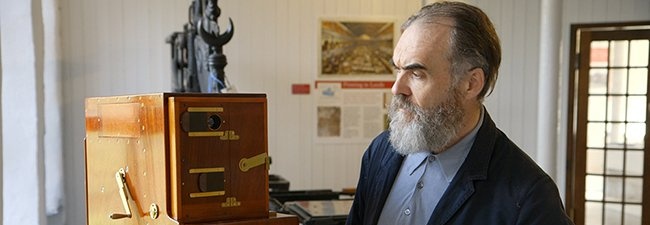
The First Film is an explorative documentary film that follows writer, producer, director and presenter David Nicholas Wilkinson in his quest to determine whether or not the first film footage ever recorded was done so in Leeds on 14th October 1888. The footage at the centre of the film is titled Roundhay Garden Scene, filmed by the Frenchman Louis Le Prince. It lasts only a few seconds but is possibly one of the most important breakthroughs in cinematic history.
Wilkinson explores the background of this footage and its claim to being either the first ever recorded film footage or simply the earliest surviving film footage. He also looks into the strange disappearance of Le Prince on 16th September 1890 on a train from Dijon to Paris, a disappearance that meant the argument of Le Prince being the inventor of the moving image cameras had lost its most important voice, paving the way for Thomas Edison to go down in the history books as the inventor of the movie camera. Things get very suspicious when the death of his son Adolphe in an unusual hunting incident in July 1901 lays his argument to rest.
A groundbreaking piece of cinematic history
When I caught up with David Nicholas Wilkinson to discuss the film, he reflected on the underwhelming appearance of the location as it stands today, a discovery that produces one of the most memorable scenes in the film.
“One of the first shots we filmed was of me finding the original location of the scene. I had to laugh. I had no idea what to expect but a cul-de-sac is about as banal a setting as I could imagine.” His presenting style is infectious even when he encounters disappointments like these, such is his passion for the subject matter. He remains upbeat despite such adversity: “I had hoped for something to be left, even if it was a tree.”
A key fact that the film explores is whether or not a photograph in a French morgue is that of Le Prince. It shows only the face of a deceased man who looks remarkably like the groundbreaking filmmaker, but David is not convinced. “I don’t really think it’s him. In 1890 the average height of a man in France was around 5ft 6in. Le Prince was actually 6ft 4in. In the accompanying notes for the photograph, anything unusual or out of the ordinary had been recorded for each person, though it was very scant in general. If it was definitely him it would have been recorded.”
Only one shot that had to be re-filmed, which meant both David and his co-writer Irfan Shan had to try their hand at acting surprised at discovering Le Prince’s grave. “He never wanted to be in it, but he knew most of the answers and stopped me making mistakes.”
The last-minute curveball
As we come to the end of the film, a late revelation throws the argument up in the air again through a discovery by Laurie Schneider. As David explains, “We had to delay. Everyone wanted me to cut it but once I knew what I’d found out about it I knew it was vital to the story.” The fact David’s discoveries are captured on camera means the audience goes on the journey with him, leaving the story open to these kinds of curveballs throughout.
Whilst the film explores the three most plausible explanations for the disappearance of Le Prince, David explains that there are many more doing the rounds. “There are around ten theories about what happened. One theory is that he was a spy for both Britain and USA during a time when there was a threat of a second French Revolution. Another is that he was filming snuff films with Jack The Ripper…” As he tails off there is something in his voice that gives the impression he doesn’t quite believe these avenues of thought.
It is clearly a labour of love and he has produced a compelling argument on what was likely a relatively small budget. One source of frustration for him came from the British Film Institution. “I went for a BFI distribution loan, which would allow me to visit colleges and universities around the UK. I had agreements with thirty out of a planned fifty and saw it as a great way to get the truth around. I was turned down because it was deemed “too educational”. I’m sure their remit is to promote the British film industry. I can’t come up with a tangible reason for it. Maybe they don’t believe me.”
David’s relentless passion for the project is infectious.
The driving force is Wilkinson himself and it becomes very easy to get wrapped up in his determined narrative. This determination comes despite concerns about the film’s viability. “It was a big worry because it had been rejected so many times. I’d been advised not to do it, but I knew people would be interested in this story.” It appears he is correct in this thought given the amount of coverage it is now getting in national newspapers. “It’s a forgotten story and an important part of our history as a film-making nation. People will now know the Le Prince name. In fact, the widespread coverage means the story is getting out even to people who haven’t seen the film.”
“The film has been thirty-three years in the making”, he states, referring to that point being the first time he pitched it to the BBC in 1982. “I’ve laid it to rest now though. Now that it’s out there I can move on. It’s often the case with filmmakers that the one project we’re really passionate about is the one that never gets made. People go decades without making a project and I often believe that they don’t really want it to get made.” It’s lucky that David’s one project was this one and we’re lucky to be able to hear the story, albeit 125 years late. The story deserved to be told and now it deserves to be seen.
The First Film is on limited release now, with the following cinemas offering screenings over the next month.
July
03.07.15 – Regent Street Cinema London
04.07.15 – Regent Street Cinema London
08.07.15 – Gate Cinema London
11.07.15 – Galway Film Fleadh – Ireland
14.07.15 – Triskel Arts Centre, Cork – Ireland
15.07.15 – IFI, Dublin – Ireland
16.07.15 – Queens Film Theatre, Belfast
20.07.15 – Greenwich Picturehouse London
23.07.15 – Ritzy, Brixton, London
26.07.15 – Cambridge Picturehouse
28.07.15 – Norden Farm, Maidenhead
30.07.15 – Kingston Arts Centre
August
01.08.15 – Bath Picturehouse
03.08.15 – Home Manchester
05.08.15 – Vue Leeds
06.08.15 – City Screen, York
07.08.15 – Sheffield Showroom
09:08:15 – Hebden Bridge Picture House
13.08.15 – Electric Palace, Hastings
18:08:15 – Picture House, Uckfield
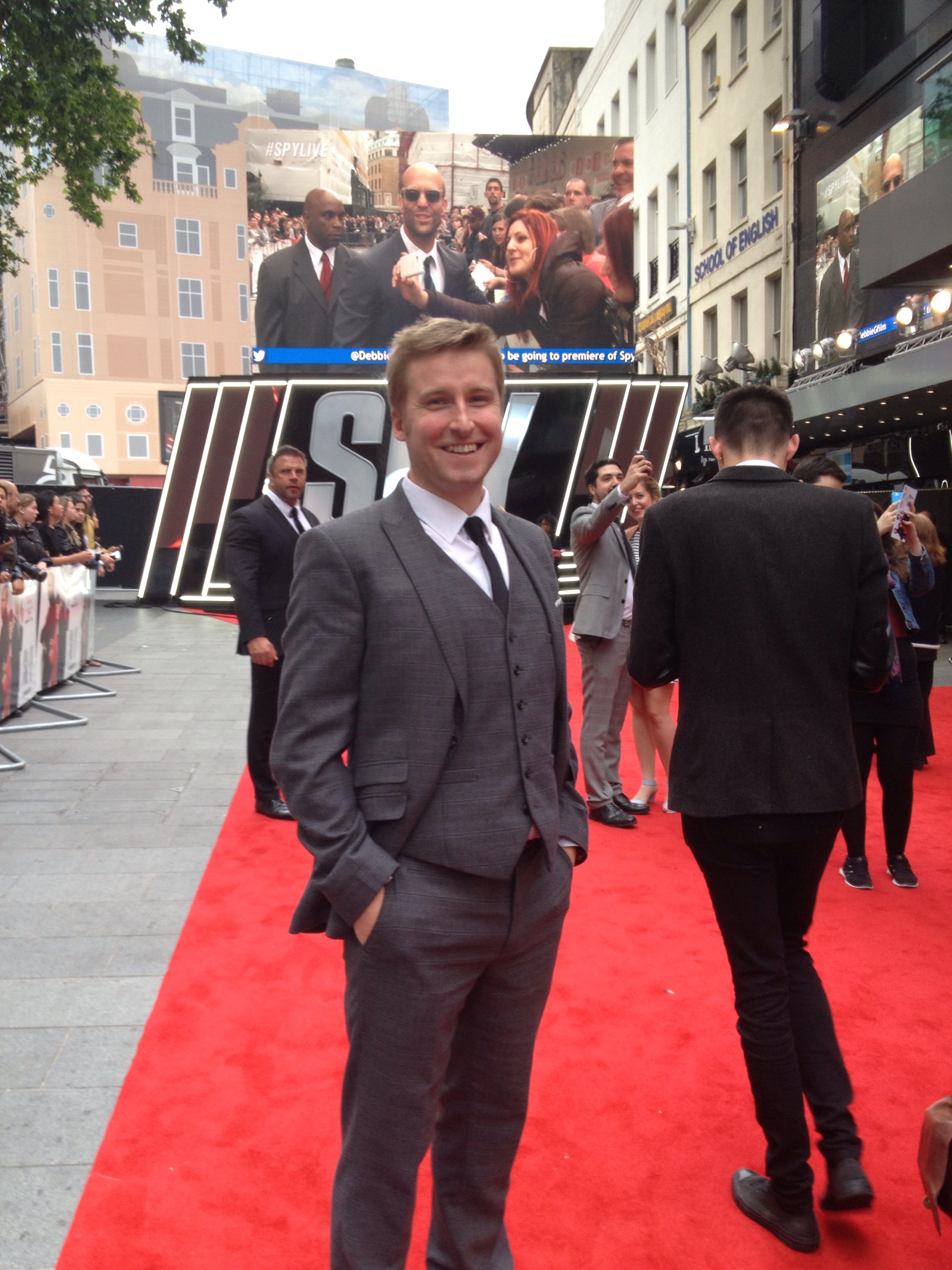
Earlier today, my wife and I found ourselves walking on the red carpet, alongside Melissa McCarthy, Jason Statham, Jude Law, Miranda Hart and Peter Serafinowicz, for the UK premiere of new film Spy. It was at the ODEON on Leicester Square. Here’s a photo of me on the red carpet.
I’ve been on the red carpet a couple of times before and it’s always a lovely experience. Of course, nobody cares who we are, though that doesn’t mean we didn’t ham it up a little. [1]
There’s been quite bit of interest for the film over the last few weeks and the anticipation was well justified. We laughed so much our faces hurt.
McCarthy and Law are hilarious throughout.
Spy is an action comedy about office-based CIA data analyst Susan Cooper (McCarthy), who is forced to go out onto the field when her partner Bradley Fine (Law) disappears and the identities of other top field agents – including Rick Ford (Statham) – are compromised. Going undercover to attempt to infiltrate arms dealer Rayna Boyanov (Rose Byrne) with the help of her office friend (Hart), the story is the perfect platform for some caper-based hilarity.
I was a little apprehensive going into it as the premise is quite familiar and hasn’t been done well for a long time. I was immediately pleasantly surprised, with an opening scene that sets the story up well, falsely draws us in to a serious film, then slaps us in the face with a huge laugh.
Jason Statham has never been so likeable. His character can best be described as Jay from the Inbetweeners if he somehow became a CIA agent. You can see he’s flexing his comedy muscles and really trying hard to make his co-stars laugh whilst holding back himself. His character is a highlight.
The real star, of course, is Melissa McCarthy. Her comic timing is impeccable and it’s easy to see this film becoming a critical and commercial success with her out front. She has had several opportunities to show us what she’s got, but she has fallen slightly short on several occasions (see Identity Thief). This is a comic actor at the top of her game.
The rest of the cast are excellent, especially Serafinowicz, and you can see they’re enjoying such a fun script. I can’t recommend it enough. I wouldn’t be surprised if this is the start of a franchise.
[1] About a month ago I speculatively tweeted a review of Furious 7 as an entry to a competition run by Stella Artois and Film4. Actually, it was a review of the trailer. I’ve not seen the film, nor have i seen the trailer. Indeed, of all the films in the series I’ve only seen Tokyo Drift. I didn’t think much of it. Anyway, that’s why I’m here. I’ve included the review here, in case you’re interested.
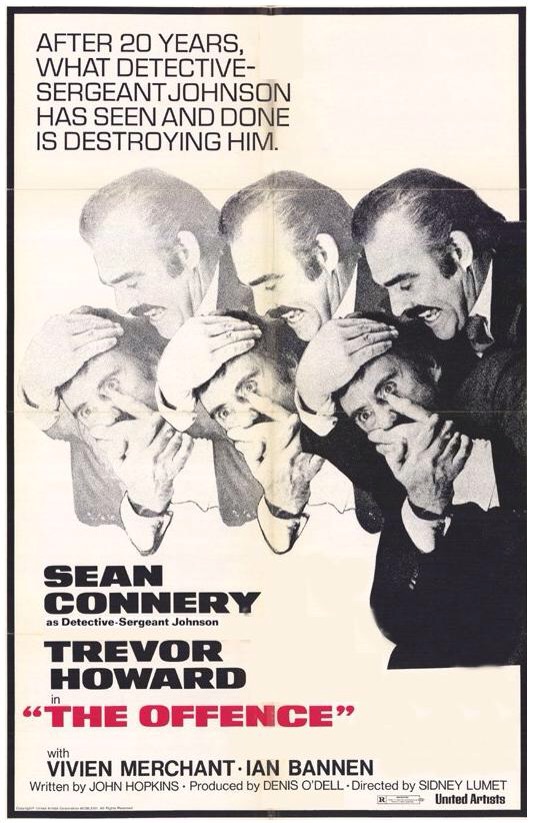
Sean Connery is one of the most renowned British actors of all time. He has starred in so many well regarded and successful films, including The Hunt For Red October, The Untouchables and Indiana Jones and the Last Crusade. He is, of course, remembered most fondly for his performance as the quintessential James Bond, starting with Dr No in 1962 and finishing with Diamonds Are Forever in 1971. He also reprised Bond in 1983 with Never Say Never Again.
His prominent films remain prominent and he will be remembered for these great successes. That said, unless you go out of your way to seek his wider body of work, it’s quite difficult to build up a fuller idea of his talents.
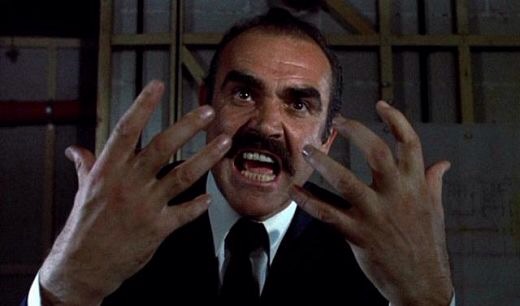
Fortunately, Masters of Cinema are on hand to help us out a little, pointing us in the direction of The Offence, Sidney Lumet’s cross-section of Detective-Sergeant Johnson (Connery) and his struggle to cope with the inner demons he has as a result of the constant horrors he sees in his line of work. Released in 1972, it was one of the earliest post-Bond films he released so was one of his first chances to show the world his full gamut of talents.
The film opens with a bold slow-motion shot of policemen rushing into an interrogation room, where we find Johnson fighting off his colleagues, with the dead beaten body of Kenneth Baxter (Ian Bannen) lying on the floor. Evidently Johnson has killed Baxter and through a series of flashbacks we discover the chain of events that lead to this happening.
This is an excellent performance from Connery, adding weight to a character that has been carefully constructed by screenwriter John Hopkins. The story is told in a non-linear way, which is cleverly executed to ensure the reveals happen at regular intervals. Bannen’s performance kept me second-guessing throughout and ensured it wasn’t just a one-man-show. It’s a stylish and grim view of Britain in the 1970s and it hits home further by being so realistic, which I credit to director Sidney Lumet and his work with cinematographer Gerry Fisher.
It’s a film that warrants a first and indeed second viewing. The latter will undoubtedly come before long. I’ll be devouring the bountiful array of extras first.
The Offence is available on Master of Cinema dual-format Blu-ray and DVD now.
At first, The Trip seems like a terrible proposition. It can be summed up as follows: Steve Coogan and Rob Brydon, playing exaggerated versions of themselves, visit six Michelin-starred restaurants in Northern England to review them for an Observer article, spending most of their time together bickering over who can do better impressions of a number of famous people. Well, about seven famous people.
Somehow, over the course of six episodes in the first series, they make it a success so consistently I was left wondering how such a simple idea could fail to work when the two central characters have so much chemistry together. The whole thing is clearly full of improvisations and no matter how many times we hear Michael Caine, Hugh Grant and Ronnie Corbett, they never fail to disappoint.
Yet at the heart of the show we find that it isn’t just a whimsical improvised comedy that borders on self-indulgence, but rather a dissection of one man’s inner struggle to come to terms with the level and manner of his past successes. Coogan’s desire is to alter his legacy and change the public perception of him as a character comedian to something of more substance by taking on more serious roles. He doesn’t see himself as a comedian but as a character actor. His biggest frustrations come from interchanges with Brydon who discusses their similarities, which is hard to receive from a man who Coogan sees as simply an impressionist.
In many ways, parallels can be drawn with Michael Keaton’s recent performance in Birdman, a role that won Keaton an Oscar. In that film, Keaton pushes himself to the cusp of a breakdown as he ploughs all his remaining money and efforts into a theatrical production that he thinks will completely overhaul the public perception of him. It was ironic that Keaton, in this film, established himself as an actor of serious depth in a role that exaggerated the public’s perception of his own life. Similarly here, Coogan manages to come out of the series with a huge level of credibility for his portrayal of a man striving for more, finishing the six-part series almost completely emotionally broken. It is an excellent performance from Coogan and one I’m sure he’d rather be remembered for than Pauline Calf and Alan Partridge.
On the back of this, Coogan went on to star in the Oscar-nominated Philomena, and duly received critical acclaim for another role of real substance. Perhaps The Trip was the stepping stone onto this, but the fact a follow-up was commissioned in 2014 suggests both Brydon and Coogan know that they hit on something special in the first series.
The Trip is available to watch on Netflix UK and can be purchased on Blu-ray or DVD.
[Note] I can only apologise to the creator of the lovely alternative poster at the top of the page. I can’t give credit as the website from which it was sourced (movieweb) has lost the page. It is lovely though.
Holy motors! I just watched a live-action Street Fighter movie, and it wasn’t bad. In fact, I’d go as far as saying it was… great. Let’s go back in time to justify my surprise.
The year is 1992. I’m seven years old. I’m in possession of a Commodore Amiga and a copy of Street Fighter II: The World Warrior. My brother, channelling every ounce of his O.C.D. nature, has annoyingly mastered the character of Ryu, who everyone knows is the coolest character on the game. This was no mean feat, especially on a Powerplay Cruiser. When I say “mastered”, he was actually untouchable on it. Occasionally the computer A.I. would get into hadouken competitions with him, but couldn’t keep up. He was, at this moment, the coolest kid at school, a height he wouldn’t achieve again until he accidentally set off an alarm and the police showed up at school. As we all know, cheaters never prosper. [1] [2]
This was 1992 though, and any child wasn’t worth his weight in Nerdz if they didn’t have a copy of Street Fighter II: The World Warrior. Or, later, Street Fighter II: Champion Edition. Then Super Street Fighter II. And don’t forget Super Street Fighter II Turbo, if you could convince your parents that the additional £60 spend was worth it for the “thrill” of playing as DeeJay. [3]
Sit down DeeJay. Sit down.
Unfortunately, whilst the games came thick and fast, seemingly adding lots to the gameplay and making sure the improvements were worth the extra investment, the associated media interpretations were mixed to say the least. There were some good things out there. I remember being a huge fan of the comic book, which itself was an adaptation of Street Fighter II: The Animated Movie, a decent-quality anime version of the game.
Unfortunately, all interpretations of the Street Fighter characters’ back stories were immensely overshadowed by the big-budget, star-studded and hugely hyped film titled Street Fighter: The Movie. After I got over the initial dismay at the idiotic titling of the film, it truly started to sink in – this was possibly the worst film I’d ever seen. [4]
Street Fighter: The Movie starred Jean Claude Van Damme as Guile, Kylie Minogue as Cammy, Raul Julia as M Bison in his final cinematic role and a young Ming-Na Wen as Chun Li, almost 20 years before she’d reappear on our screens as Melinda May in Marvel: Agents of Shield. This hotch-potch of acting talent was gelled together by a flimsy plot and some terrible dialogue and it destroyed in an entire generation any interest in the Street Fighter franchise outside of simply playing the games.
By 2009, studios felt safe enough to release a Chun-Li origin story starring Kristen Kreuk, but this went down almost as poorly as the 1994 movie. In fact, arguably worse. It really wasn’t worth the time and effort, but fortunately not many people put either into it.
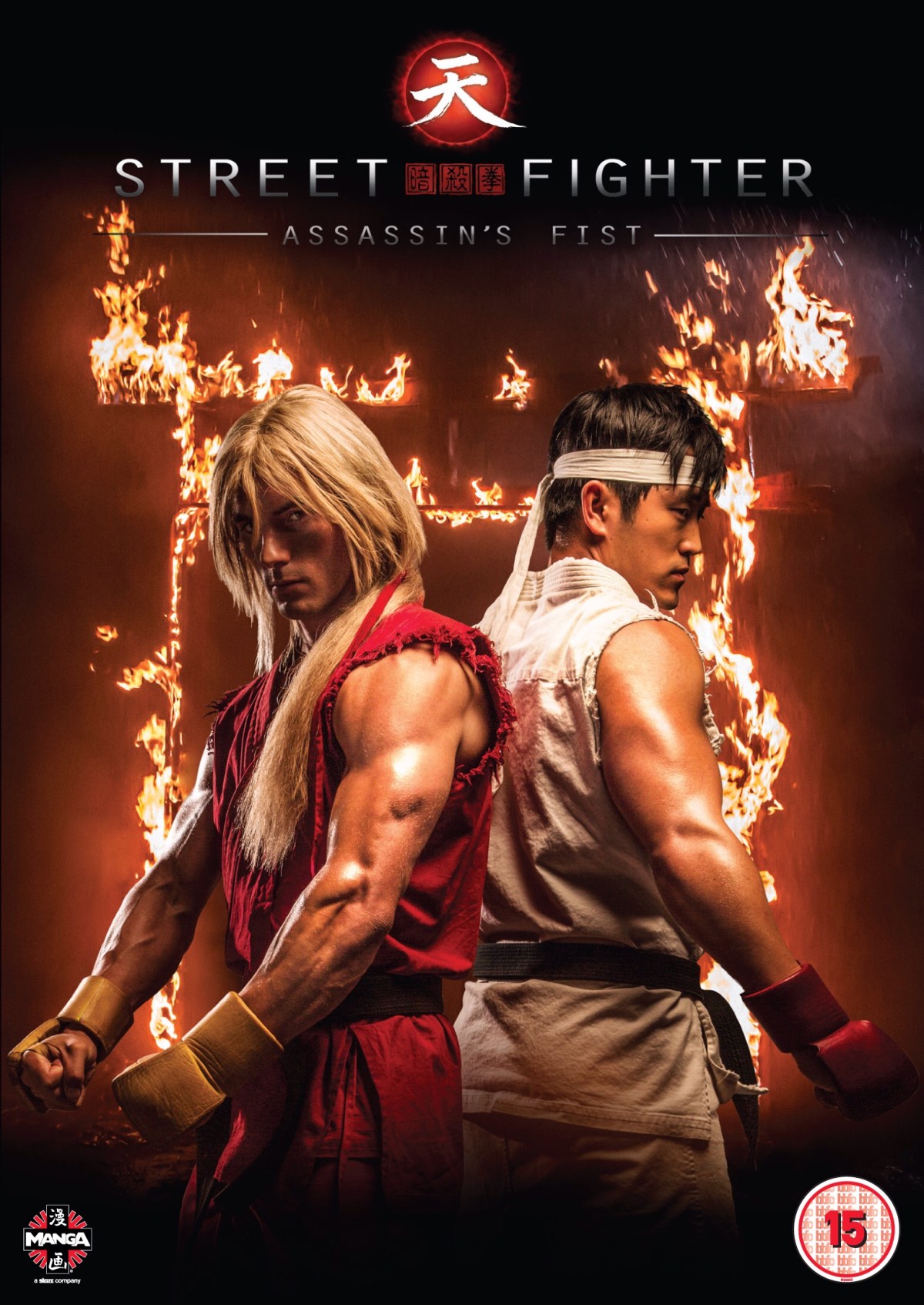
So it’s with great trepidation with which ardent fans approach this latest offering, Street FIghter: Assassin’s Fist. It is essentially the origin story of Ryu and Ken, the main characters of the original Street Fighter game and firm favourites in the Street Fighter II series. I’m happy to say that I wasn’t disappointed at all. I was actually rather impressed.
The story takes place in a secluded area of Japan in 1989 as Ryu and Ken learn the traditional ancient fighter technique of 暗殺拳 / Ansatsuken (Assassin’s Fist) from their 先生 / Sensei (master) 剛拳 / Gouken. Ryu appears to be achieving more than the hot-headed Ken, who is becoming increasingly frustrated by the slow pacing of the training. Through a series of flashbacks we learn the true past of Gouken and his relationship to his younger brother 豪鬼 / Akuma as they both trained in Ansatsuken.
Stylistically they get everything right, both in terms of making a good film and also in terms of being respectful to the original source material. There’s very little in terms of deviation from the back-stories generally considered to be canon, and the only extra embellishments comes in the form of explaining answers to previously unanswered questions, for example how Ken ended up in Japan in the first place.
Stylistically they get everything right.
It seems like such an obvious formula: pick out the key characters that people who played the game found interesting, focus on their back story and pick out the meatiest parts, get the story right and tell it in an interesting way. It’s a far better idea than trying to somehow piece together the fabricated back-stories of sixteen unrelated characters for the completion’s sake. This way we are able to see some good acting breathe life into the characters for the first time. It’s not Oscar-winning acting, but it is as good as anything I’ve seen in a video-game-to-film release.
The original release was actually in the form of thirteen webisodes released via Machinima, which was later edited into a full film. Such was the popularity of this, there is a planned sequel that will focus on the シャドル / Shadaloo organisation, which is headed up by M. Bison and also includes the original remaining three final boss characters of Balrog, Vega and Sagat, and the characters in the original game series that had joined the fighting tournament to bring down the organisation (Guile, Chun Li, Cammy and T. Hawk). This has a lot of potential and could be as successful as long as they give the characters as much space to breathe as in this release. Clearly having eight stories to tell is more difficult than four, and the tone of the film would be a huge departure from Assassin’s Fist should this be the route down which they choose to go.
The entire film can be watched here below, though it is also available in HD on Netflix and is available on Blu-ray.
[1] The “cheaters never prosper” line was something the Amiga version threw at you if you keyed in a cheat for invincibility. You could sail through the game but when it got to the post-game conclusion story screens, you instead were treated to a screen reading “Congratulations, but as we all know, cheaters never prosper.” It was harsh but in a way taught us all a life lesson.
[2] Another thing that spoiled my enjoyment of the Amiga version of the Street Fighter II game was that when you loaded up either Ken or Chun Li, the top halves of their bodies were a scrambled mess of pixels. I never knew why this was the case.
[3] Super Street Fighter II: The New Challengers / スーパーストリートファイターⅡ -The New Challengers was released in 1994 and featured hugely enhanced graphics and four new characters: Cammy, T. Hawk, Deejay and Fei Long. Whilst it was a neat effect to bring in four new characters to milk the popularity of the existing franchise, anyone who regularly picked any of these four characters was generally treated with dismay in my group of friends. It’s a bit like saying your favourite Beatles album is “Band on the Run”.
[4] Bored of the relentless tweaking involved with each iteration of essentially the same game, we eventually tracked down a copy of the original Street Fighter on the Amiga. It featured Ryu, Ken and Sagat – all familiar – but also characters like Birdie, Adon and Gen. Inevitably none of these featured in the film. Obviously the feature film should have been called Street Fighter II: The Movie, or something similar.
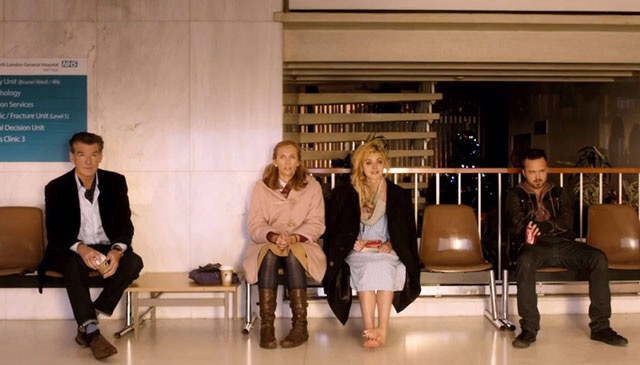
The latest Nick Hornby book to be given the big-screen treatment, The Long Way Down is on the face of it quite a distasteful basis of a comedy drama. The premise is that four people – played by Aaron Paul, Imogen Poots, Toni Collette and Pierce Brosnan – go to the top of a tower on New Year’s Eve with the same intention: the commit suicide. Talking each other out of it, their shared experience brings them closer together and they form an unconventional but essential bond.
It isn’t one of Hornby’s best films. Perhaps it’s the disbelief I found in the unlikely friendship they build with one-another. Perhaps it’s the light-hearted touch with which director Chaumeil has dealt with the source material. Perhaps it’s the fact that all the main characters are annoying in their own special way. Perhaps it’s just that I don’t want to see a comedy about suicide.
That’s not to say that all potentially distasteful comedies have nothing to offer. 50/50 was probably the best comedy I saw in 2011. I guess it just has to be dealt with in the right way.
There are some effective moments. The scene in which Rosamund Pike cameos is a precursor of her sinister turn in Gone Girl. Poots gives an assured performance throughout, giving life to a potentially film-ruining character. There is a heart-wrenching moment near the end with Collette and her son, which adds a lot of depth to her character, albeit late in the day.
I liked the way the film resolved itself. I just didn’t really enjoy the journey that took me there.
The Long Way Down is available on Blu-Ray, DVD and Netflix now.









 Stylistically they get everything right.
 Cinema, etc.