Film review – Tomorrowland: A World Beyond (Brad Bird, 2015)

The big live-action summer blockbuster for Disney is always hotly anticipated [1]. The previous three summers’ blockbusters were John Carter (2012), The Lone Ranger (2013), Maleficent (2014) [2], and before that there were plenty of Pirates films to chew on. These have all been at worst reasonable sellers but have received middling to good reviews. As long as the basic premise is generally acceptable to cinema-goers and there’s enough advertising involved, they tend to do well. In recent times, it seems Disney’s summer blockbusters have been review-proof.

So how will Tomorrowland fare? It is an action-adventure film with a young female lead (Britt Robertson as the intelligent and headstrong Casey), a child as a prominent supporting character (newcomer Raffey Cassidy as humanoid robot Athena) and a big name alongside them both (guaranteed ticket-seller George Clooney as Frank Walker), so it has a good chance on that front. It is also in good hands with director Brad Bird at the helm. His previous work for Pixar as director includes The Incredibles and Ratatouille, two of my favourite animated films. He’s also responsible for excellent film The Iron Giant, a film which broke him as a director [3].

Visually stunning, but wrapped up in its own spiderweb of overthought plot.

Visually stunning, but wrapped up in its own spiderweb of overthought plot.

However, there has been a distinct lack of the blanket media coverage we’ve come to expect from these kinds of films. It’s almost as if Walt Disney Pictures hasn’t really got faith in it. Inevitably, this disinterest in the film has seeped its way down to the general public, who are simply not checking it out. It is currently on track to lose money, with a global taking of $133.2m against a budget of around $190m. It’s still ploughing on and might break even after Blu-ray sales and merchandise is taken into account.

The premise of the storyline is loosely based on the futuristic area of the Disney Theme Parks, which is also the source of the film’s name (it was originally titled 1952). It’s a time-travelling adventure with absolutely stunning visuals that make the film very easy on the eye. It’s actually very similar visually to The Rocketeer, and I felt as though this is what would have been achieved had that film been released today rather than 1991.

It’s a problematic film, however, and I put this down to the hard-to-follow plot. I don’t think it’s overly complex, I just don’t think it’s explained very well. Alongside Brad Bird as co-scriptwriter is David Lindelof of Lost fame, whose scripts tend to walk a fine line between intrigue and confusion. When he gets it right (the earlier episodes of Lost, Star Trek: Into Darkness), it can be the most gripping sci-fi around. Sometimes, though, he misses the mark and becomes far too confusing to follow. Tomorrowland is certainly in this category.

The problem is that the plot loses the plot, and therefore its own essence. I’ll try to summarise (SPOILER ALERT!). Casey, the daughter of a NASA engineer, finds a magical pin that transports her to a Utopian parallel universe. However, it has a limited lifespan and counts down to expiry, meaning you only get a glimpse of the alternate universe (we later learn it’s an advert). It also means you co-exist in the alternate reality, so if you move around in the alternate reality you might bang your head in the real world. She tries to track down a second pin and finds herself teaming up with Frank, who can access the real universe via a secret rocket inside the Eiffel Tower, and can get them there by a secret teleportation device he invented. When they get there, the Utopia is now derelict, but evil genius David Nix (played by Hugh Laurie) doesn’t want to let anyone else in, even though humanity will end within 60 days.

I won’t ruin the ending but as you can see, it does get quite far-fetched and I do seriously question whether or not the children in the cinema were fully on board with it. Indeed, it took five of us about ten minutes of debating until we settled on what exactly we’d just seen [4]. We still had some questions remaining though. Firstly, I’m assuming the robots that were sent to kill Casey were sent by David Nix. If so, he didn’t seem to know who she was when she arrived. Why weren’t they trying to kill Frank instead? He was the one known entity. Perhaps they assumed she would lead them to him, but I didn’t feel this was explained very well. Following on from this, why weren’t they all killed immediately after they arrived in the Utopia? It seemed there was a “well, they’re here now, let’s give them a shot” sort of vibe going on. I wasn’t buying it. Finally, why had the Utopia got so run down? I feel there was a huge area of the plot to explore here but it wasn’t mentioned. Oh, and why the Eiffel Tower?

In the end, it was just a huge advert for world peace, creativity, Coca-Cola, Chevrolet, and not stifling imagination. And Disney merchandise (yes, you can buy your very own copy of the Tomorrowland pin that is so integral to the plot). It was a missed opportunity. I don’t recommend you avoid it. Perhaps I’m not as intelligent as I once thought and it’s my fault alone that I don’t understand a film aimed at 12-year-olds. It’s visually stunning and is almost worth seeing just for that. Just don’t get your hopes up and don’t try to overthink it.

[1] It doesn’t necessarily mean they’re good.

[2] Despite being classed as a box-office flop, John Carter actually made money on its $263m budget at global box offices alone, pulling in $281m in receipts. Once you factor in sales of merchandise, video games, DVDs, Blu-rays and downloads, it must have made a huge amount. Not bad for a flop…

[3] Surprisingly, he also directed the music video for “Do The Bartman”, right at the start of his career. It’s less of a surprise once you know he was already involved in The Simpsons from earlier on, though this knowledge could help win you a pub quiz one day.

[4] I went to see this one with a couple of good blogger friends, whose blogs can be found at the following addresses: Nesbitt Web and Ahoy Small Fry. They’re both very different blogs but I enjoy them both on a regular basis. Check them out!

The Fireman (Charlie Chaplin, 1916)

The second in the Mutual Comedies series (the first, The Floorwalker, I have previously reviewed), The Fireman is another great example of master craftsmanship from Chaplin. It involves an insurance fraud setup whereby a man (Lloyd Bacon) colludes with a local fire chief (Eric Campbell) to collect on the insurance money. However, things don’t quite go to plan when a real fire breaks out on the other side of town and the whole plot falls over to humorous results. Chaplin plays a fire engine driver who fails at everything he is involved with and this character is the source of most of the humour, especially in his interactions with the fire chief, played by the brilliant Campbell.

It’s not quite Chaplin at his best, nor is it really quite as effective as The Floorwalker, but it has its charm and is worth watching if only for the few big laughs dotted throughout. There are much worse ways to spend 28 minutes of your day.

I preferred the original Fotoplayer music and sound effects as performed by Robert Israel on this one, but both audio tracks compliment the original visuals perfectly well. It comes down to personal preference and I’m more of a traditionalist.

Charlie Chaplin – The Mutual Comedies is out now on BFI Blu-ray and DVD.

The Floorwalker (Charlie Chaplin, 1916)

On 25th February 1916, Charlie Chaplin signed a $670,000 deal with the Mutual Film Corporation to produce a film a month over a one-year period. This made him the highest-paid entertainer in the world. The deal came as a surprise to the film industry; many had expected him to sign with a larger studio and Mutual hadn’t really been considered as an option. However, the money (according to Dollar Times online calculator it was equivalent to $15.2m in 2015) and the creative freedom swayed him and production began in earnest.

The first of these films, all of which were short comedies, was The Floorwalker, released on 15th May 1916. The basic story involves a department store floorwalker (Lloyd Bacon) who is involved with embezzlement of money with the store manager (Eric Campbell). When they receive a letter informing them that detectives are on the way to investigate the finances, they decide to run. However, when the floorwalker spots a near-perfect lookalike in a tramp (Chaplin), he decides to offer to switch personas with him, without realising that the tramp himself is in trouble with the police for property damage in the shop.

The film has a couple of classic Chaplin comedy moments. The first (which is reused throughout to great hilarity) involves the tramp’s inability to go up or down an escalator. It is just pure comedy gold and though it has been imitated many times over, never has it been done so effectively. Another set piece that has had its imitators over the years is the first meeting of the trap and the floorwalker, in which they become intrigued by one-another and begin to mirror the other’s movement. It requires perfect comic timing and is brilliantly executed. It is perhaps more fondly remembered in The Marx Brothers’ comedy Duck Soup, though the gag in that film involved a mirror so isn’t strictly a copy.

All twelve films from the Mutual Film Corporation period are collected in an excellent Blu-ray (and DVD) released by BFI this month. The presentation of each includes two scores (all have one score by Carl Davis and an alternative score by a range of composers), an audio commentary and a brief discussion in the extensive booklet. The restorations are evidently full of care and attention to detail, which I’ve come to expect of BFI releases but will never stop appreciating.

Go out and buy a copy now and support the important restoration projects for classic cinema. You won’t be disappointed with this release.

Charlie Chaplin – The Mutual Comedies is out now on BFI Blu-ray and DVD.

Angry Video Game Nerd: The Movie (James Rolfe, 2014)

I remember a couple of years ago when I saw the queues of young girls stood outside the theatre awaiting the release of the latest One Direction Movie, 1D: This Is Us. I’m pretty sure I passed a snide comment to whoever I was with at the time berating the popularity of the film, which was clearly not aimed at me. I wasn’t the “target audience”. Nonetheless, what a bunch of idiots standing there to watch such a rubbish film.

One for the fans

One for the fans

It took me until last night to realise how wrong I was to do this. My wife was out of the house and so I saw it as a perfect opportunity to finally watch the imported copy of Angry Video Game Nerd: The Movie [1]. Alas, my wife returned home and walked in just as The Nerd threw up over a copy of Eee Tee 2 and the woman holding it. As I looked towards the door, I saw myself reflected back: bemusement, disdain and a lack of willingness to understand. I guess that means that I’m a teenage girl and James Rolfe is Harry Stiles. Maybe.

And that’s the point. This is by no means a film for everyone. It is specifically a film for the fans of James Rolfe’s character The Angry Video Game Nerd, the central character in his webisodic (it’s now a word) series in which he reviews terrible old games in a foul-mouthed and occasionally aggressive manner. It’s a film full of references to the series, made for the fans, and a pet project for Rolfe to flex his big-budget muscles and show exactly what he can do once he leaves his underground lair.

The storyline concerns the release of Eee Tee 2, the sequel to Eee Tee, the biggest flop in video game history (and barely hiding the reference to E.T.). The Nerd has always refused to review this game, but when an opportunity arises to go to New Mexico and dig up the infamous New Mexico Atari landfill as a tie in to the sequel, he agrees. The Nerd and his two assistants start the quest but are pursued by federal agent General Dark Onward, who believes The Nerd is trying to investigate Area 51.

It is quite a convoluted plot but it’s not really there to win any awards for screenplays. It’s a platform on which Rolfe bases some quite hilarious moments and I see the film as a success. Yes, it’s probably a little long but I can forgive Rolfe for this – he was bringing his own dream to life and wanted to make sure his fans got the most out of it. Some of the script feels a little like it’s deliberately trying to aspire to be a cult film, and it gets very silly at times, but it’s delivered with enough charm to be forgiven for a few misfires.

There’s a nice bonus at the end, where he finally reviews E.T. The Extra Terrestrial on the Atari, which he has never previously done. The bonus features on the disc are plentiful and give a bit of insight into the film (though many of the featurettes were previously available during the making of the film on Cinemassacre).

Steer clear if you have never heard of The Nerd before but if you want to see what he’s capable of it’s worth the plunge.

[1] For those in the UK, the best option to see the movie in HD is to import from Amazon.com. Be warned though – you will pay through the nose for the postage and then get slapped with import duty when it arrives. It’s expensive and if you aren’t fussed about the HD then you have an option to stream from Cinemassacre for a small fee.

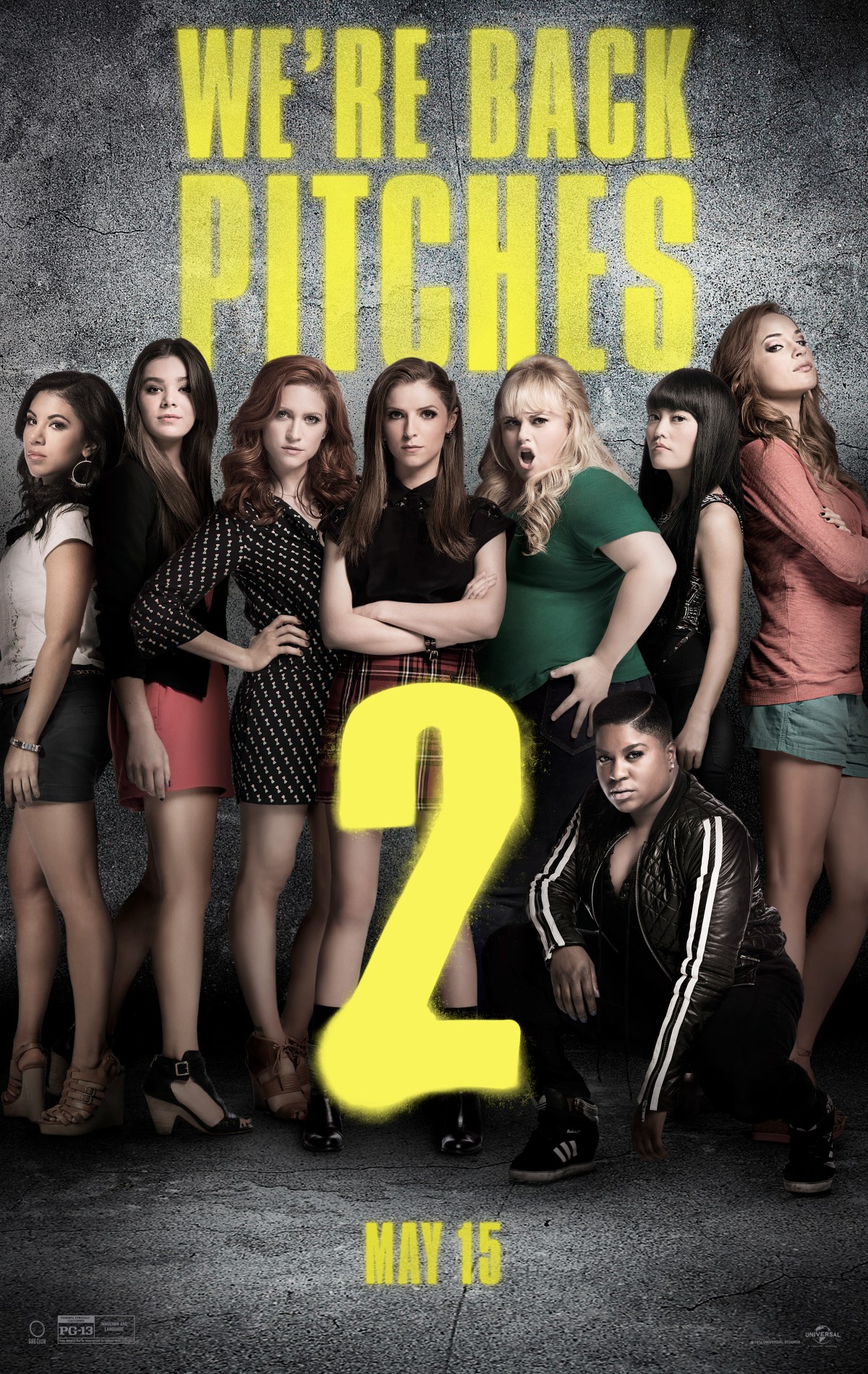
Pitch Perfect 2 (Elizabeth Banks, 2015)

The sequel to the smash hit musical comedy Pitch Perfect, covering Anna Kendrick, Rebel Wilson et al. as they struggle to break down boundaries and show the world that a capella singing is actually really cool… Wait, what? In their world, a capella is already cool? They just aren’t cool enough to do it because they’re outcasts. Okay…

I have a slight vested interest in this film, on at least one level. I myself am in an a capella group and also take part in local theatrical productions so performing on stage has always been in my life. From memory, though, I don’t ever recall a capella singing being this popular. When there’s a tournament in Pitch Perfect World, the whole town drops everything to show their support for their favourite group. For me, I’m usually pulling in favours just so my closest family members turn up. Maybe I just don’t have the right acca-skills.

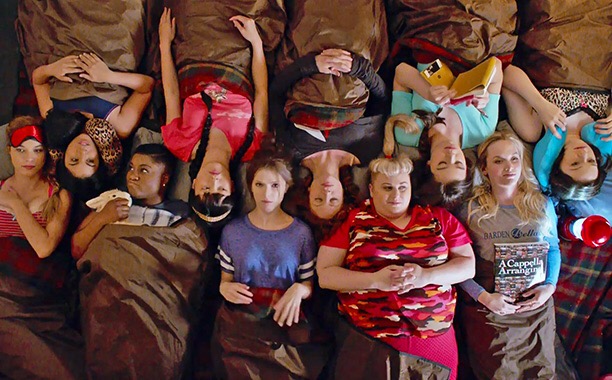
Pitch Perfect 2 has plenty of big laughs but you may have already seen them all in the trailer.

Well, this is a chick flick and it doesn’t have to have a watertight storyline. However, despite throwing away any grasp on reality to accept the film for what it is doesn’t necessarily mean it’s a great film. It’s basically a rehash of the first film – pretty much the same cast going through very similar personal struggles but pulling it together because their dedication to their friends supercedes anything else in life. It’s sweet, and I buy into the basic principal.

Unfortunately, outside the handful of really hilarious moments – most of which you’ve already seen in the trailer – the jokes consistently fall flat. Chrissie Fit’s Guatemalan character is just plainly not funny and every line she delivered felt like it was about forty years out of date. Likewise, Cynthia-Rose (portrayed by Ester Dean) is a really throwaway lesbian character that doesn’t really add anything to the storyline other than some cheap gags based on rudimentary stereotyping.

It was nice to see Hailee Steinfeld – who I know only from her Oscar-nominated performance in the Coen Brothers’ remake of True Grit – in a comedic role but, like the more established Kendrick, she almost seems a little above the content. I’m not sure whether the plan is to keep her in line to do Pitch Perfect 3. I guess time will tell.

So what can I say? It passed the time and I enjoyed parts of it. I wanted to see Mad Max but the majority of the seven other people I was with preferred this. I won’t rush to see it again, but I doubt my indifference towards it will change the fact that its target audience (basically the millions of people who loved the first film) will buy tickets and love it.

Pitch Perfect 2 is out now at cinemas worldwide.

Film review – While We’re Young (Noah Baumbach, 2015)

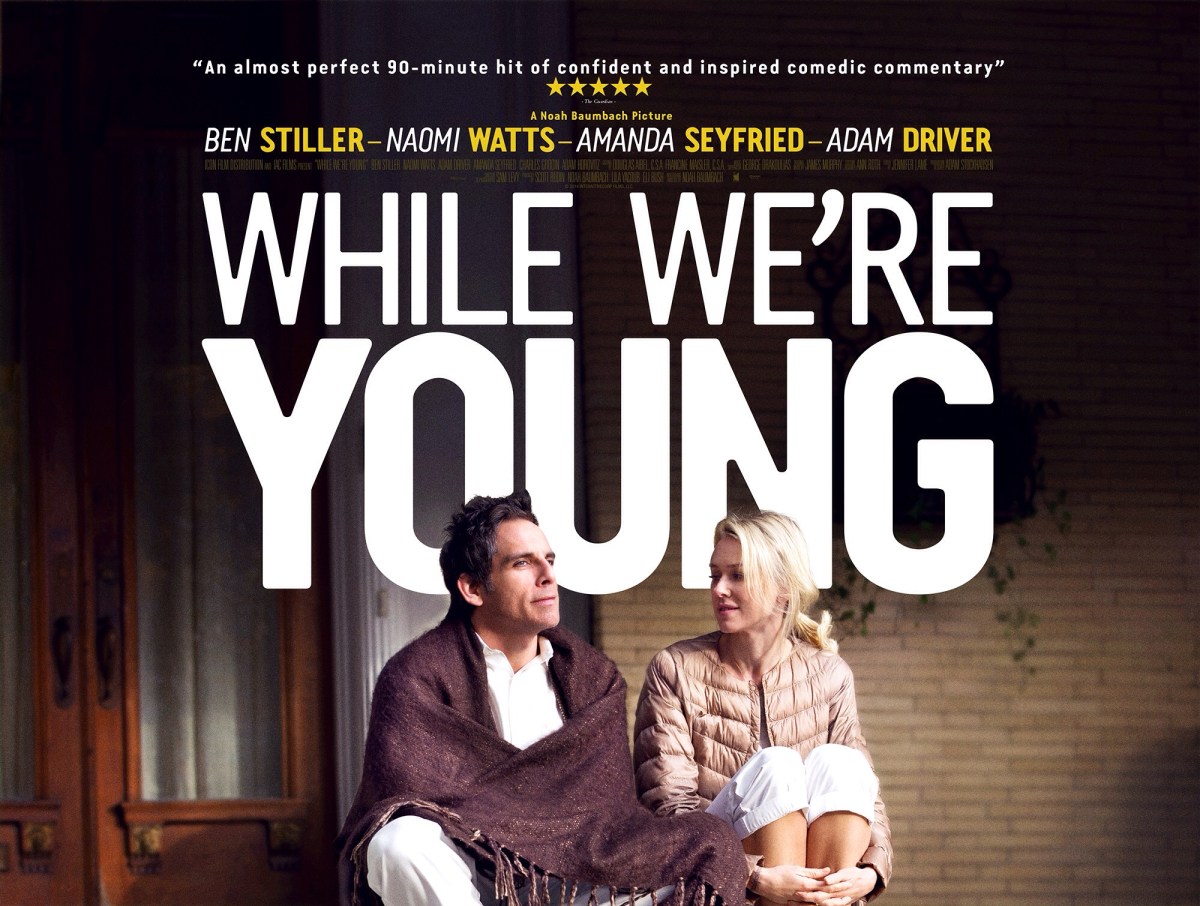
While We’re Young is the latest film from Noah Baumbach, following the recent critical successes of 2010’s Greenberg and 2012’s Frances Ha. The film stars Ben Stiller as established documentary filmmaker Josh, now struggling to find the inspiration and money to finish his current project, and Adam Driver as young aspiring documentary filmmaker Darby, who seemingly hits on endless streams of ideas without much effort. Naomi Watts and Amanda Seyfried also star as Josh’s wife Cornelia and Darby’s wife Jamie, respectively, though the men take centre-stage as the focal point of the slow-reveal story.

This is an excellent film with an intelligent theme. As is often the case with films about filmmaking, the central characters are extremely rich in backstory and well-realised. Ben Stiller himself is an actor, director, producer and writer (his last feature as director being 2013’s admirable The Secret Life of Walter Mitty) and I’m sure he drew on his experiences to add depth to his character. He brilliantly paints the frustrated picture of a man desperate to stay true to the values of filmmaking whilst at the same time reacting in disbelief that nobody else wants to follow that same journey with him. It’s yet another example of Stiller at the top of his game and it’s a shame that the box office receipts for his more serious roles are inevitably dwarfed by those of, for example, the Night at the Museum franchise.

Naomi Watts and Ben Stiller co-star in While We're Young

Naomi Watts and Ben Stiller co-star in While We’re Young.

Both couples give the impression of aspiring to live out of their own time and the emotional plot devices are driven by the fact that the elder couple is far less comfortable trying to fit in with the younger generations than vice-versa. For Darby and Jamie, attempting to remember a morsel of information they’d forgotten is the source of great fun; they are determined to avoid becoming reliant on modern technology when it is to the detriment of thought-provoking discussion. Conversely, Josh and Cornelia are much quicker to jump onto their tablet device to find their answers as they would rather find the solution as quickly as possible. This was initially a clever role-reversal to aide character development, though it becomes a key part of the plot further down the line (and one which I won’t go into here).

One of my favourite aspects of the film is the excellent soundtrack. James Murphy (of LCD Soundsystem fame) provides the original score and has compiled a playlist of original songs, including Paul McCartney and Wings, David Bowie and Haim. The song choices mix the old and new in a way that underlines how little the musical landscape has changed, but it also serves to reflect the dovetailed lives of our four main characters. The songs sit side-by-side with one-another and the particular choices are all artists that would be deemed fashionable by the Topshop generation, either in a serious or ironic way.

It is a critical time in Adam Driver’s career. Regardless of whether the upcoming Star Wars films are successes or flops, it is inevitable that the careers of the main stars will be defined for the foreseeable future by such a massive franchise. Both Driver and his co-star Oscar Isaac have been rapidly adding to a varied list of assured performances in the last year or two, though less has been happening with John Boyega and Daisy Ridley, who are being touted as the main stars. This could potentially be seen as a risky strategy. Driver can be happy that he can add this excellent performance alongside his roles in Lincoln and Inside Llewyn Davis as prime examples of his acting ability. Oscar Isaac is already well-established with plenty of huge roles under his belt. Time will probably prove that this was a wise move for their post-Star Wars careers.

This film is highly recommended and should be sought out if you get the chance. You simply can’t argue with such an intelligent script, especially when it’s delivered in a package like this.

While We’re Young is on general release at cinemas in the UK now.

Frank (Lenny Abrahamson, 2014)

Frank tells the story of Frank Sidebottom, the comedic persona of Chris Sievey who performed as a musician and entertainer for over 25 years from 1984 to Sievey’s death in 2010. At least, I thought that’s what it was going to be, mainly because I didn’t read the synopsis. I was quite confused when one of the main characters started Tweeting.

It turns out that it’s a story only partly inspired by the Frank Sidebottom story, but any fans of the infamous persona will be sadly disappointed. It is based on the memoirs of Jon Robson (author of The Psychopath Test), covering his time in the Oh Blimey Big Band with Sidebottom. Frank in this film is a distant relative of the real Frank, and the action is set firmly in modern Ireland and USA rather than 1980s Greater Manchester.

Frankly a disappointment

Frankly a disappointment

It is a big-name cast for what is essentially quite a small story. Michael Fassbender plays the unstable titular role; Domhnall Gleeson plays the ambitious musician Jon (the equivalent of Jon Ronson); and Maggie Gyllenhall plays Clara, a pivotal band member. There are two Academy Award nominees there and the film at times risks feeling a little like it had been over-cast.

I didn’t really enjoy much of it, if I’m being brutally honest. The music around which the story is built seemed a little contrived. I get that they had to replace the original Frank Sidebottom songs for the modern settings, which have ended up occupying a similar plane without using the songs in any way, and I suppose there isn’t a place for “I’m In Love With The Girl On A Certain Manchester Megastore Checkout Desk” in a film like this. Yet it begs the question: was it relevant to feature the likeness of Frank Sidebottom when the final result has nothing to do with the character? I find it unfair that Chris Sievey worked his whole life to create a celebrated persona, only for the world view of it to be irreparably altered by a film release that essentially has nothing to do with the subject.

Thankfully, a truer reflection of the man inside the mask will be available when Steve Sullivan’s crowd-funded film Being Frank: The Chris Sievey Story is released later this year. Inevitably it won’t be as popular – it won’t have Michael Fassbender to help sell it – but at least a truer reflection of the story will be told.

Frank is available on Blu-ray and DVD now, as well as on Netflix.

Film review – The Out-of-Towners (Arthur Hiller, 1970)

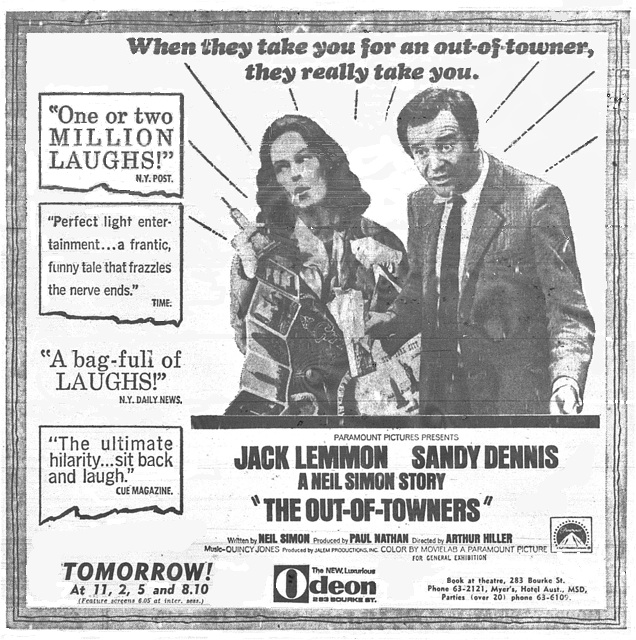
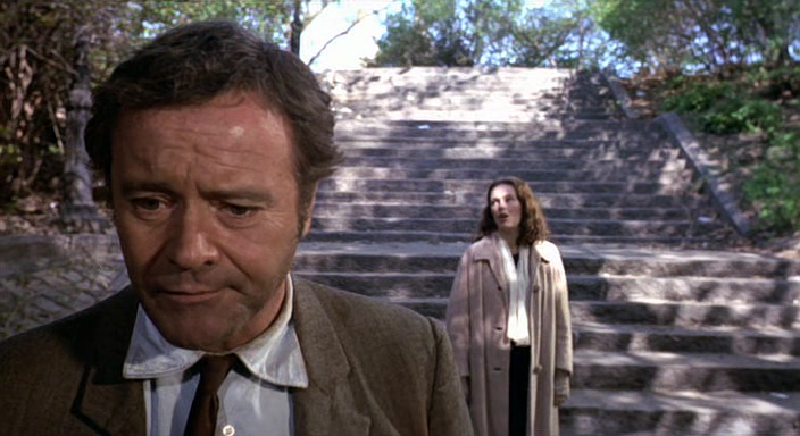
George Kellerman (Jack Lemmon) and his wife Gwen (Sandy Dennis) travel from Twin Oaks, Ohio to New York City so that George can attend an interview for a promotion within his own plastics company. Though the trip is planned to perfection by the meticulous George, the plans quickly unravel when the plane is held up in landing and from then on everything that can go wrong, does go wrong.

The Out-of-Towners was the second time Lemmon worked on a Neil Simon film, the first being The Odd Couple (released two years prior to this release). It’s a shame that The Out-of-Towners doesn’t quite live up to its predecessor in terms of number of laughs delivered, though it is not without merits.

Jack Lemmon is at the forefront of most of the laughs.

Jack Lemmon is at the forefront of most of the laughs.

Jack Lemmon is in fantastic form as the increasingly irate George, who just wants everything to go according to plan. Ne it the delayed plane, the lost hotel booking or the missed reservation at The Four Seasons Restaurant, Lemmon delivers on a journey of frustration that I’m sure every viewer can associate with.

Sandy Dennis’s Gwen, though, contrasted George with a matter-of-fact interpretation of events, not allowing her anger to show aside from her disappointment with how George was handling the situations presented. It serves as more of a feeder character for more laughs from Lemmon, as her persona understandably makes George even more irate.

I watched this film because it was recommended to me by a close friend. It isn’t going to be something I rush to watch again but I certainly did enjoy it for the most part. At times I found Sandy Dennis highly annoying, but that was the point of her characterisation. I’ll never say no to a Jack Lemmon comedy though, and I can’t imagine the 1999 remake starring Steve Martin and Goldie Hawn is a patch on this.

The Out-of-Towners is available on DVD now, though the steep price tag for a PAL version may put most people off. It can also be seen currently on Netflix UK for those with accounts.

Dear White People (Justin Simien, 2014)

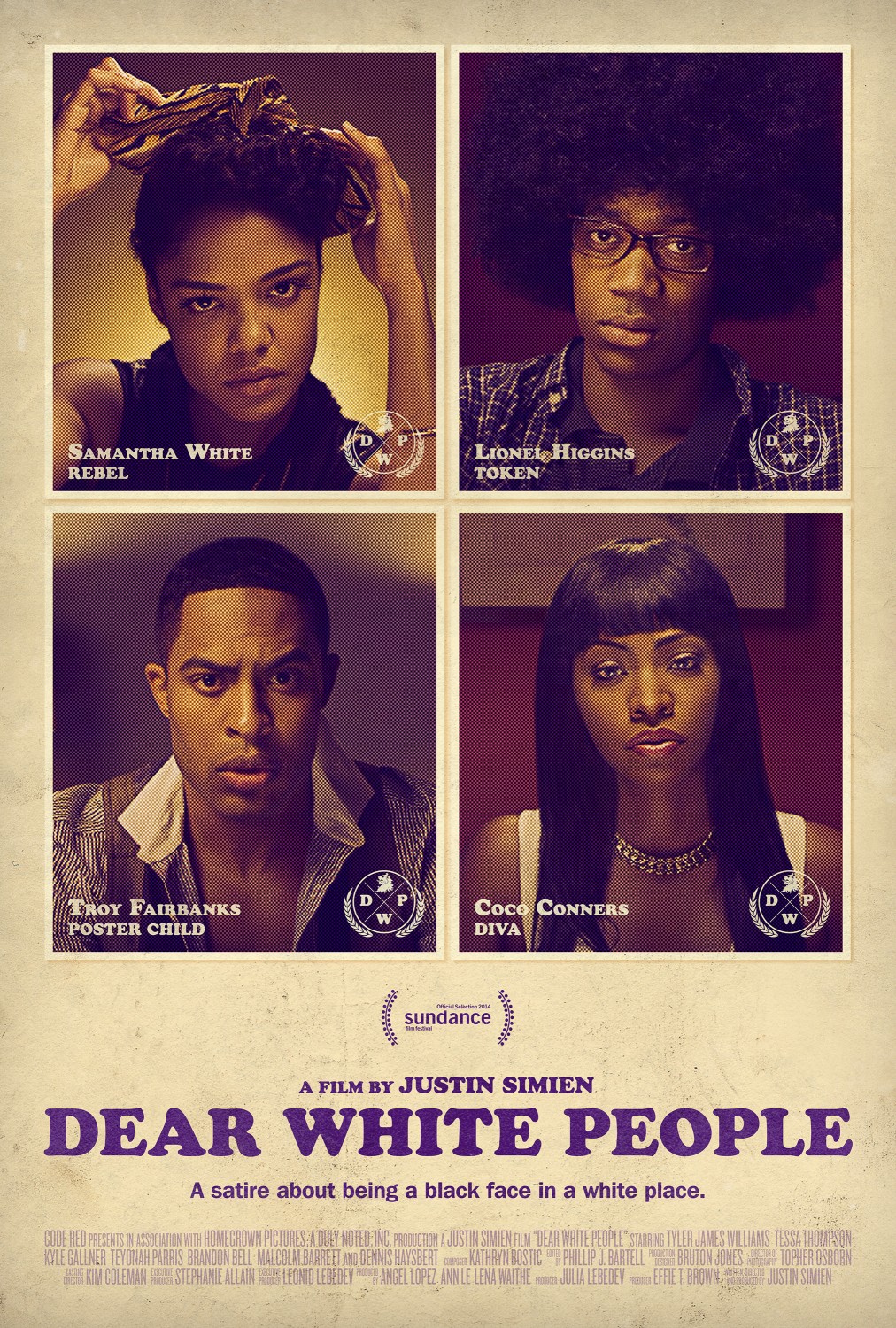
The second of two films I saw at this year’s BFI Flare Festival, Dear White People is an American satirical comedy set on Ivy League Winchester University campus. It centres around several students who attend the predominantly white university, in particular: Sam White (Tessa Thompson), a sharp-tongued mixed-race film production major who runs a popular campus radio show called Dear White People, which challenges the university policies and mind-sets of both the school administration and the students in a humorous but cutting manner; Lionel Higgins (Tyler James Williams), a homosexual black student struggling to fit in and find his voice as an aspiring journalist; Coco Conners (Teyonah Parris), a black student who is secretly trying to land a role on a reality TV show set around campus, whilst simultaneously trying to garner fame through her video blog; Troy Fairbanks (Brandon P Bell), Sam’s ex-boyfriend and current school head of Armstrong/Parker, the all-black house on campus; Kurt (Kyle Gallner), a white student and son of the school’s president, who organises a controversial Hallowe’en party with a blackface theme in response to Sam’s outspoken radio show; and Gabe (Juston Dobies), Sam’s white boyfriend.

Tessa Thompson is a revelation in her performance as Sam White.

Tessa Thompson is a revelation in her performance as Sam White.

I was lucky to see this film. It was the subject of an online petition to raise awareness of the film and increase the pitiful number of screenings it received last year in the UK – just two at the BFI London Film Festival. These Flare screenings were again over-subscribed, which begs the question – why hasn’t it received a wider release? Perhaps it’s the fact it deals with some pretty hard-hitting issues whilst not losing its ability to entertain. Maybe the questions posed were deemed as too sensitive for a large distributor to pick it up. Either way, it’s a massive shame. This is a film that needs to be seen, not just because of its important content but also because it’s a fantastic and hilarious film.

Praise is due for both Tyler James Williams and Tessa Thompson. The former, fresh from his recent role in The Walking Dead as Noah puts in an assured performance as someone who himself isn’t very self-assured for most of the film. However, I’m surprised he is the cover-star of the film as, for me, the central storyline and most interesting character was Sam White. Tess Thompson (recently of Selma) is a revelation in this role, playing the angry student to perfection. It’s a character with some important opinions and without her it would have risked being just a good campus comedy, but without the hard-hitting message. When the cracks in her prickly character reveal her fragility, the results are astounding. As a character, Sam galvanises the same provocative thoughts in the students within the film as it does the viewers of the film, and there aren’t many teen-comedy characters in recent years that I remember asking such important questions of the viewer. Frankly, the performance is a revelation.

IMG_0870

The excellent acting performances reach throughout the large cast.

Elsewhere, I felt the tones and cinematography added a lot to Simien’s well crafted script and impressive performances. Topher Osborn channeled elements of Wes Anderson in the beiges and attention to detail that are clearly evident in these well-composed shots.

If you get a chance to see this film, then I heartily recommend it. As a white heterosexual British man, I inevitably felt discomfort as I sat in the cinema being challenged to think about the questions posed by the film. In many ways that was the ultimate goal and it will be a shame if the wider cinema-going public doesn’t get to see this fantastic story.

Dear White People does not currently have a wide UK release date.