Film review – Logan (James Mangold, 2017)

THIS ARTICLE IS FULL OF SPOILERS

Hugh Jackman is, in the superhero film world, a living legend. There has never been a single actor or actress that has achieved relentless success across so many different films in this genre, making a character his own and developing it into one of the big guns instead of just part of a team. Like the character Wolverine, the actor behind him seems like he’ll play the part forever.

And yet we come to Logan, a wisely-timed and fitting ending to the franchise and Jackman’s input into the character. It’s hard to believe it but this is the tenth time we’ve seen the character – seven X-Men films have now been made, along with three Wolverine-focussed standalone films. It seems impossible to think anyone will fill the role, meaning this could be the last time we see the character for many years, possibly ever.

It could well be the best superhero/mutant-hero film ever made.

Set in the world 2029, the film finds Logan worlds apart from his former self. Hiding out in a disused smelting plant in New Mexico, he is working as a chauffeur whilst hustling for prescription drugs for Professor X (Patrick Stewart), whom he lives with alongside Caliban (a surprisingly sincere Stephen Merchant). He is tracked down by a mysterious woman named Gabriella (Elizabeth Rodriguez) who is trying to get him to take a young mutant girl named Laura (the brilliant Dafne Keen) to specific co-ordinates in South Dakota before Transigen finds her to either kill her or take her back into their shady mutant development programme. The company, which we have previously glimpsed in X-Men: Apocalypse, is headed up by Zander Rice (Richard E. Grant), whilst they are hotly pursued by head of security and leader of the Reavers Donald Pierce (Boyd Holbrook).

Jackman reportedly took a pay cut to ensure this film received an R-Rating in USA. The result is certainly the most brutal cinematic portrayal of Wolverine yet, with no holding back on any of the gruesome details. It is certainly not a kids’ film. Jackman looks battle-worn from the start, the reasoning given that the adamantium is now poisoning his body and losing its regenerative abilities. His best cure is to drink alcohol, which may mask the pain but won’t cover the endless scars across his body.

The perfect muse for Jackman’s final turn as Logan is Patrick Stewart, reprising one last time his Professor X character. Now in the midst of a horrific battle with dementia, he struggles to keep control of his telepathic abilities. What is really interesting here is that it is a study of people at the end of their life who are losing their usefulness to society. Okay, this is shown in the most extreme manners when someone has superpowers, but the poignancy is still there for everyone to see.

To add extra emotional weight to the film, the young girl is revealed to be the kind-of-daughter of Wolverine, in that she shares some of his genetic make-up. In the greater comic book storylines she is X-23, who first appeared in 2003. Whilst not strictly his daughter, this is a clever plot device as it means the two characters are immediately drawn to one another, despite their tendency to mistrust those around them.

It may be masquerading as a film about mutants but this is so much more – a character-driven drama about old age and retirement.

Inevitably, the ending is upsetting, as we see our titular hero sacrifice himself to ensure the safe passage of his daughter. The final scene, especially the final shot, is absolutely perfect.

A fitting end to one of the greatest film characters of our time.
Film review – 20th Century Women (Mike Mills, 2017)

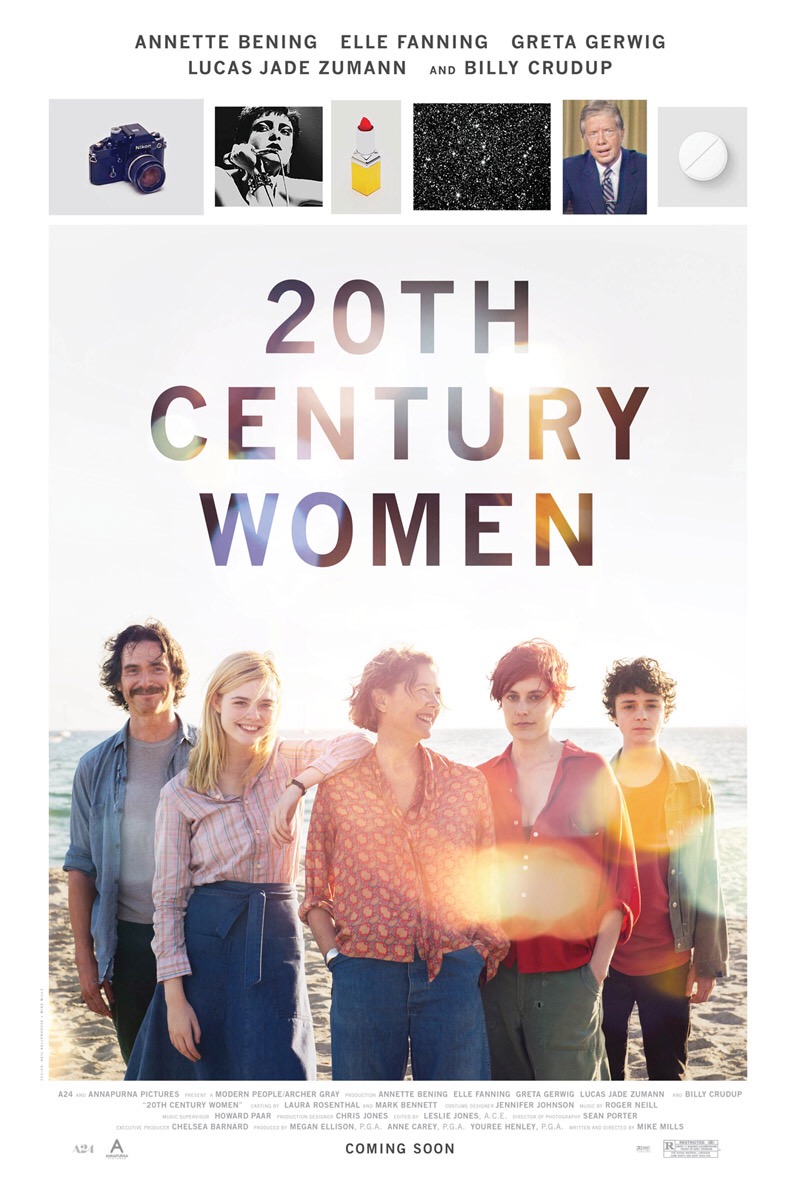
To mark 2017’s International Women’s Day, I dropped into the cinema to catch 20th Century Women, a film with three powerful and independent women at the heart of its plot. A triple Bechdel Test passer, the film indeed avoids the usual cinematic tropes and instead explores how men are often defined by the women around them.

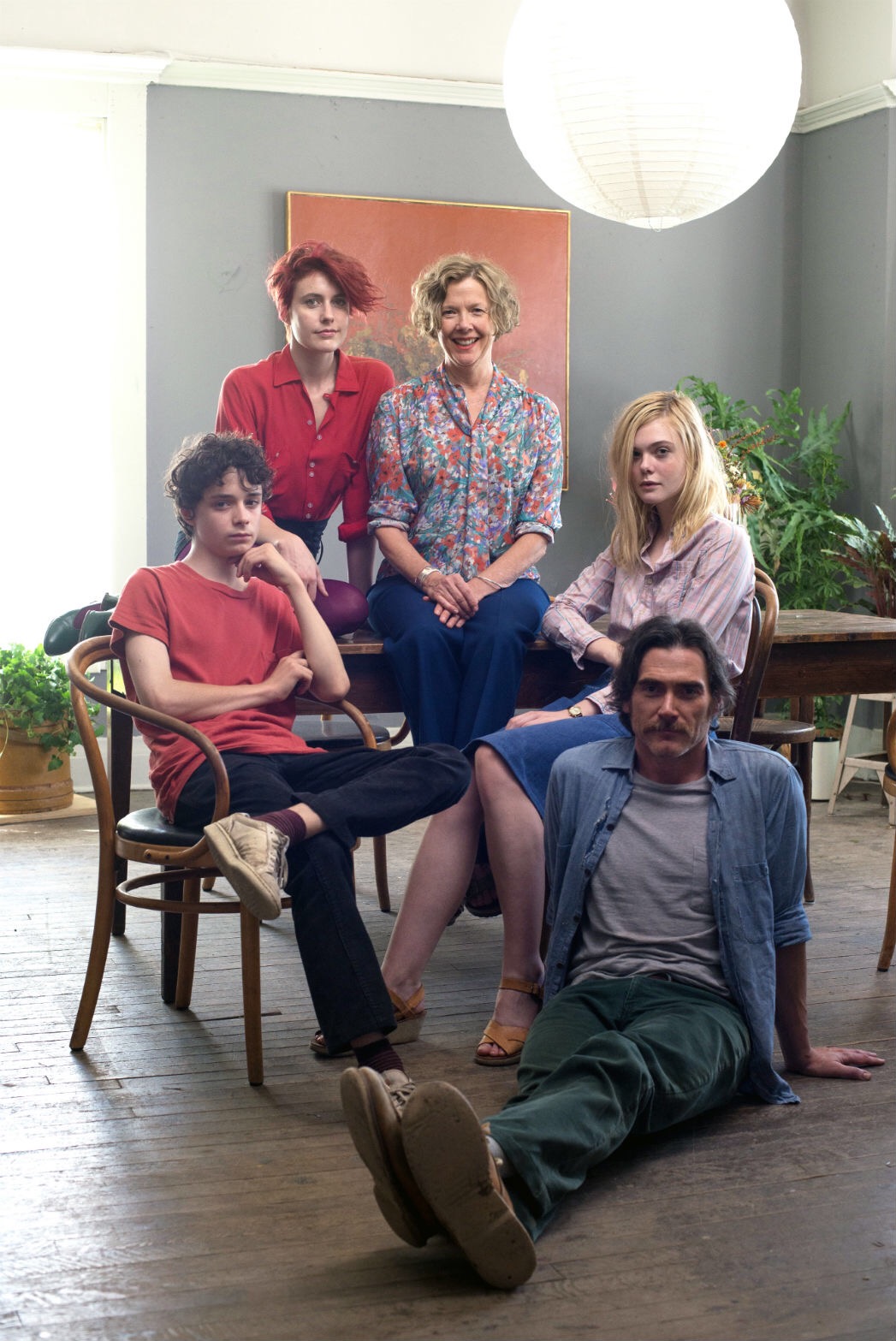
In 1979 in Santa Barbara, California, Jamie (Lucas Jade Zumman) is a 15-year-old boy who is lacking a father figure in his life. His mother Dorothea (Annette Bening) has been long-single, but lives in a luxuriously huge house that she has converted into a sort of commune, in which lives a young female photographer Abbie (Greta Gerwig) and an emotionally-detached carpenter and handyman William (Billy Crudup) who is renovating the house for her. Julie (Elle Fanning) is a girl with whom Jamie is unrequitedly besotted; she wishes for him to remain as a friend only whilst she has a series of never-seen male sexual partners.

Mike Mills has cultivated an intelligent film from his own original script, describing it as a love letter to the women who raised him.

It’s the sort of quirky and intimate story that can only be crafted from ones own experiences, with two fingers up to the notion that boys need fathers and girls need mothers in order to be raised properly. Interestingly, whilst there are innumberable films that explore fathers being thrust into the role of both mother and father figures to both boys and girls, the concept of a group of women creating a support network for growth of a teenage boy feels wholly fresh and quite important.

The standout performance in a solid cast comes from Greta Gerwig, who I have seen in several films previously and never been excessively impressed with. This time, she is absolutely mesmerising as a young woman who is recovering from cervical cancer. We learn that the cancer was probably linked to her mother’s Diethylstilbestrol (DES) drug treatment during her pregnancy. She has been effectively disowned by her guilt-stricken mother, unable to cope with the fact she feels responsible for causing her daughter’s cancer. As a role, this is no light task, and Gerwig is at times totally breathtaking in her performance.

It is strange that the boy whose life the story revolves around eventually turns out to be a supporting character to the three leads. It is a lovingly-created film that is as relatable to mothers as it is to sisters of brothers and as it is to sons. With characters this believable and brilliant performances across the board, this is a film well worth seeing.

Film review – Saludos Amigos (Norman Ferguson, Wilfred Jackson, Jack Kinney, Hamilton Luske, Bill Roberts, 1942)

Saludos Amigos is a comporomise film. It’s a feature-length film, but only just; a mere 42 minutes and you’ll be done on this one. It’s a film that also only exists as a product of a good-will tour of Latin America, with Walt Disney acting as an ambassador for the USA to counter-act the popularity of the Nazi Party in certain countries when it was produced in the middle of World War Two. 

The film consists of four segments, all of which are a mixture between documentary films and short animated sequences. The animators, technicians and filmmakers were sent to countries such as Peru, Argentina, Bolivia and Brazil and observe what they saw, making sketches and jotting down any ideas they had. It is therefore a wonderful work that captures the beauty of the landscapes and cultures of 1940s Latin America, whilst also serving as a brilliant piece of political evidence when viewed some 75 years later.


Of the four segments, the standout is Aqualero  do Brasil, which introduces José Carioca – a well-dressed Brazilian green parrot who speaks fast and smokes a cigar. He befriends Donald Duck and shows him some cultural highlights of Rio de Janeiro, with a great sequence involving the samba.

José may have been a bit of a flash in the pan outside of Brazil but in his homeland he’s still as loved today as he ever has been, happily sitting alongside Donald and Mickey as the face of Disney.
It’s nothing that will wow modern audiences. It’s simply not as entertaining as the five animated features that proceeded it. It is, put simply, a quirk.

Film review – Wake of Death (Phillipe Martinez, 2005)

I was recently enjoying a holiday in a Spanish beach resort. It was a great week, with brilliant weather and loads to do. One quirk of such holidays is the small selection of English-language television channels available. They’re always different and always extremely limited. This holiday was no different: BBC1, BBC2, BBC4 and ITV. And then there was movies4men.

Movies4men is a channel I steer clear of. Why? Because frankly it sounds like a pornography channel. It’s actually a terrible name for a fairly reasonable channel, with war and western genre films throughout the day and some action films in the evening. The name is, at best, a little sexist. But it sort of makes sense once you get used to it.

Anyway, if you turn it on at around 11pm on any night there is a fantastic chance you’re going to be stuck watching a poorly-executed Jean Claude Van Dämme film. And that’s where I was every night at 11pm. And that is how I came to watch Wake of Death.

It’s okay darling. It will be over soon.


“After his wife is brutally murdered, an ex-cop wages war against the Chinese triads,” reads the brief plot on IMDB. It tells you pretty much everything you need to know. It may well be one of the worst films I’ve ever watched.

The acting does nothing for a script written by a group of screenwriters – there were four – that probably knew that the script wasn’t particularly important for this film. Why? Because there would be no sequels. Because it had JCVD on the poster and the people who watch it will tend to only care about the action, fighting, martial arts, car chases and explosions. Because it’s hard to screenwrite “JCVD does typical JCVD stuff” without sounding nonchalant about the whole affair.

No matter what the result of the filmmaking process was, the audience would come. They would have been satisfied, albeit devoid of any kind of betterment.

They will have also been treated to a surprising number of JCVD sex scenes, which would probably have been more than they bargained for.

Van Damme has never been a great actor. Heck, he even used it as a defence in a lawsuit back in the 1996. Coincidentally, he has acted in 39 films since that comment from his lawyer was made. None of them appear to have really challenged the notion. 

The only time he tries to really act in ‘Wake of Death’ is a scene where he has to cry as he drunkenly remembers his dead wife. It’s as poorly-executed as that scene in one of the Taken films where Liam Neeson jumps over a fence, with about 10 different camera cuts along the traumatic rollercoaster ride. Someone is kind enough to throw water on Jean-Claude’s face between shots, but that’s still not enough to stop the director giving up and breaking the tension with a random Chinese triad bursting through the window and having a quick fight before running away.

If Van Damme has done some great cinema this millennium I am yet to see it. But his fans will seldom have been disappointed. 

Film review – Revolt at Fort Laramie (Lesley Selander, 1957)

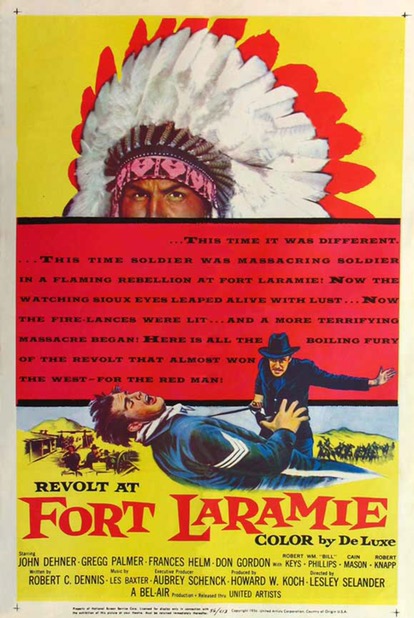
12 Angry Men, 3:10 to Yuma and The Bridge on the River Kwai may be more fondly American films from 1957, but Lesley Selander’s Civil War drama isn’t without its merits, even if the production values and a slightly generic premise make it just short of enjoyable.

The story is set in 1861 at the titular Fort Laramie in Wyoming, an outpost at which a cavalry of northern and southern USA soldiers await a trade with Native Americans of gold as part of a peace deal. However, just before the deal is completed, the American Civil War breaks out. At this point, the inner rivalries within the outpost threaten to bubble over and cause a mini civil war to rival that breaking out throughout the country.

There is a decent cast assembled to play out the film. John Dehner portrays Maj. Seth Bradner, a southerner in charge of the outpost, whilst the two factions are led by Confederate Sgt. Darrach (Robert Keys) and Federal Sgt. Serrell (Bill Phillips). Northern Captain Jamie Tenslip (Gregg Palmer) is in love with the major’s daughter Melissa (Frances Helm). There’s enough complexity to make for an engrossing storyline that should bring with it excitement.

Where it falls down is that the cast seem like they’re going through the motions. They’re delivering their lines, but for some reason the performances are devoid of any emotion. The film should really be much longer to flesh out the various storylines to bring them to life, but I’m not convinced the actors had it in them. The result is that even at 70 minutes the film feels like it’s dragging.

Harry Dean Stanton makes an early appearance in the film as a character called Rinty. The only thing less convincing than his acting is his fake harmonica playing. 

However, the worst performance in the film is from Don Gordon as a Sioux scout. I spent ten minutes wondering why there was a Mexican mixed up in a civil war issue. Fortunately, a Native American accent wasn’t required when he delivered brilliant performances in the likes of The Towering Inferno, Bullitt and Papillon.

It’s not a brilliant film, it’s not the best film about the subject matter and it’s not top of many of the actor’s greatest performances. It’s fine. Just an average western film from a time when the cinema market was flooded with them.

Revolt at Fort Lamarie can be bought on DVD now. Or you can simply watch the entire film online using the link above.

Film review – Jackie (Pablo Larraín, 2016)

One of the most shocking moments of the 20th Century was the assassination of U.S. President John F. Kennedy on 22nd November 1963. Driving along Dealy Plaza in the early afternoon, two shots were fired by a single assassin. The enduring image is that of his wife, First Lady Jackie Kennedy, as she scrambles to protect her husband, head in lap, striving to comprehend what had just happened to her. It was a tragedy.

Portman delivers a stunning performance


Central to Pablo Larraín’s biopic of Jackie Kennedy is a stunningly affecting performance from Natalie Portman. She’s capable of being both isolating and isolated within moments, in one of the most complex performances you could ever wish to take on as an actor. Portman doesn’t need to remind us of her capabilities, which we’ve known about since her debut as a 13-year-old in Luc Besson’s Léon: The Professional. 

The film is delivered in the form of Jackie Kennedy in an open interview to a nameless Time Magazine reporter (Billy Crudup). She reminisces about her television programme “Inside the White House with Mrs John F. Kennedy”, in which she effused about her collection of presidential memorabilia (as well as her abilities as an interior designer) though the story predominantly focuses on the fateful day in Dallas and the immediate aftermath as she reinvents herself as the director of her husband’s funeral, an event she hopes will rival – or at least evoke the memory of – Abraham Lincoln.

There are some solid supporting roles from the likes of Richard E. Grant, Peter Sarsgaard and the late John Hurt. Greta Gerwig also appears, though I can’t say she is in the same category.

One jarring aspect of the film is the unusual score, provided by the usually brilliant Mica Levi. It’s surprisingly sinister and usually doesn’t match the onscreen visuals, tonally or stylistically. This isn’t Levi’s fault. She’s just doing what she does best (see Under the Skin for her best scoring work). It’s jarring and made me long for something a little more conforming. I’m amazed that it has been nominated for an Academy Award for Best Score.

Portman, though, is very much deserving of her nomination. It’s a strong year of competition, but she has every chance of taking home her second statue at the 89th Academy Awards.

A must see.

Short film review – The Ugly Duckling (Jack Cutting and Clyde Geronimo, 1939)

This Walt Disney Productions short animation fell under the Silly Symphony banner when it was released in 1939. It went on to win the Academy Award for Best Animated Short, the eighth in a run of eight Walt Disney films to do so.

It’s a fine little episode that tells the tale of a swanling that somehow ends up in a nest of ducklings, and is immediately shunned and ridiculed for being different to his surrogate brothers and sisters. 

A duck? Nah you must be quackers.

It curtails the original Hans Christian Andersen story by removing the whole extended pain of being without a family for around a year, skipping straight to the point where he is found by a swan family, presumably his own. In doing so, they miss out the point where he turns into an adult swan and the ducks are in awe of his beauty.
In its short sub-nine minute running time, it manages to fit in a surprising amount of substance. This is, for the whole part, a tale about an orphan who is unwanted by his new family. This would surely resonate with anyone in any element of this situation, and there is no holding back when the mother and father have a full-blown argument in front of the innocent swanling. Indeed, there’s a suggestion from the drake that since he looks nothing like the swan then perhaps his duck wife has been sleeping around. Or perhaps I’m reading too much into it.

The animation is, inevitably, a thing of beauty. Two of Disney’s Nine Old Men were on animation duty (Milt Kahl and Eric Larson) and it certainly has the feel of one of their classic films (it was released between Snow White and the Seven Dwarves and Pinocchio). There’s a certain amount of warmth you find in these old animations that has never been replicated.

It’s probably not the best short releases around this time from Walt Disney Studios, but it is deserving of all the praise it has received over the years. Why not revisit it? You’re only 78 years late to the party!

Short film review -Steamboat Willie (Walt Disney, 1928)

If you’ve seen a Disney Animation Studios film recently, then you’ll have noticed a short clip of the beloved Mickey Mouse captaining a boat, whilstling a little tune and looking like the happiest little mouse you’ve ever seen. It’s quintessential Mickey, summing up everything about what we know and love about him, in what were the first moments the world ever shared with him.

The year was 1928 and Walt Disney was reeling from a fall out with his business partners that had left him without his prize asset – the increasingly-popular Oswald the Lucky Rabbit.

Walt Disney was determined that his comeback would be the first cartoon to synchronise pictures and sound, and this determination was rewarded with unprecedented popularity. The rest, for want of a better phrase, is history.

The film itself is a sweet little vignette that sees Mickey get musical on a group of farmyard animals, and is mostly harmless, slapstick fun. Aside from the opening scene, this isn’t really a Mickey we’re used to in the 21st Century, though it is a much more savoury offering than what was just around the corner with the follow up films (the most shocking of which is the smoking and drinking version of Mickey portrayed in The Gallopin’ Gaucho, released later in 1928.

It’s hard to believe that from this point onwards it was built into one of the greatest icons of the 20th Century, but seeing is essential viewing for anyone who sees themself as a fan of Disney.

Film Review – Vaiana (Ron Clements and John Musker, 2016)

Walt Disney Animation Studios have released their 56th animated film, the musical Moana. I’m going to whisper this quietly, but it might actually be better than Frozen.

The story follows 16-year-old girl Vaiana as she defies her passage to become the leader of the tribe on the fictional island Motunui. Her father Chief Tui, leader of her island tribe, and her mother Sina are fearful of the water and want her to remain on the island, but her outgoing grandma Tala encourages her to leave and hunt down the demigod Maui to solve a mysterious curse that she believes has led to a poor harvest.

Vaiana and Maui


The basics of the story are, on the face of it, quite by-the-numbers. There’s a teenage protagonist, which makes it relatable for the younger viewers. She goes on a quest that has a practical purpose but also helps her develop as a person. She teams up with an unlikely buddy to help her in her journey. We’ve seen it many times before but the familiarity doesn’t hamper its success.

Where the story excels is threefold. Firstly, it has a brilliantly sharp and humorous script, which the actors are clearly having a lot of fun with. Secondly, the animation of both the characters and the surroundings is absolutely stunning. Finally, the music, which was written by Hamilton’s Lin-Manuel Miranda, Mark Mancina and Opetaia Foa’i, is outrageously good, and goes much further than simply one great flagship song (in this case “How Far I’ll Go”, sung by the lead and effectively Vaiana’s answer to “Let It Go”).

Indeed, it is unfortunate that the film has been unleashed in the same year as La La Land, which is destined to sweep up at most of the award ceremonies, at least in the Best Song categories. Miranda may have to have another attempt in a less competitive year.

There are a couple of nice smaller roles that are grasped by those involved. Alan Tudyk may be more famed for his turn as K-2SO in Rogue One this year, but he’s equally hilarious as Hei Hei the Rooster here, constantly stealing scenes with sound effects that match the ridiculousness of the island’s most endearingly stupid bird. Elsewhere, there’s a hilarious scene featuring Tamatoa, a giant kleptomaniacal crab who has a penchant for all things shiny.

Vaiana is a must see this holiday season and should be top of your list if you need to entertain any younger relatives over the coming weeks.

Check out the reviews of other Disney animated features and shorts here:

Zootropolis
Kronk’s New Groove
The Emperor’s New Groove
Destino
Melody Time
Big Hero 6
Frozen

Note: This article was originally published for the English-language version of the film and has since been adapted. You can find the original version here.

Why La La Land probably won’t clean up at this year’s Academy Awards

The critical enthusiasm for La La Land has been matched, for good reason, by the audience’s outpouring of affection. The music is now firmly stuck in the heads of everyone who has seen it, with many of its devotees wondering what the odds are for it to clean up at the Oscars.

Here I’ll explain why this probably won’t be the case.

What’s the current record?

Three films have won 11 Oscars: Ben Hur, (1959), Titanic (1997) and Lord of the Rings: The Return of the King (2003). Titanic managed these with 14 nominations, whilst the final Lord of the Rings film achieved a clean sweep, winning 11 out of 11 awards. Elsewhere, All About Eve (1950) received 14 nominations, though it only won 6 of these.

For La La Land to get close to this, it’s therefore going to need 11 or more nominations, and win almost all of them.

Which awards does it have a good chance of winning?

La La Land has a great chance at winning in many or all of the categories available to it: Best Picture; Best Director; Leading Actor and Actress; Original Song; Original Score; Best Writing (Original Screenplay) will certainly be places it will be nominated, so assuming the swell of enthusiasm continues it will probably do well in what are considered to be the major categories.

So where will it fall down?

There are 24 categories that the Academy awards prizes in, but that doesn’t mean that a film can win in 24 categories. There are two awards for animated films, two for documentary films, one for a film in a foreign language and one for a live action short film. So that’s six prizes that can’t be won.

There are two prizes for Best Writing: one is for an original screenplay and one is for an adapted screenplay. Since La La Land is an original script, it is excluded from the adapted screenplay category. That’s another one down.

Perhaps the most glaringly-obvious problem it faces is that there are only two characters in the film: Mia and Sebastian. So whilst they will probably get the nominations for leading actress and actor, there isn’t anyone of note in the film that could be classed as a supporting actor or actress. The closest would be John Legend’s portrayal of Keith, the frontman for the jazz band Seb joins halfway through the story, followed by Rosemarie DeWitt as Laura (Sebastian’s sister). It seems unlikely to pick up nods in these categories. Two more down.

Finally, a few categories have already been announced and La La Land doesn’t feature in any of them. The long-lists Best Makeup and Hairstyling and Best Visual Effects excluded La La Land from their lists. Two more down.

So where does that leave it?

It only has access to 13 awards and will need a nomination in each of the categories if it is going to break records. It’s not unrealistic for it to achieve this, but it will require nods in the likes of Best Production Design (awarded for interior design for the sets) and Best Costume Design to get there.

However, with a weak field to compete against, it is quite possible that it will do. this anyway! Here’s hoping!!