Star Wars Episode VII: The Force Awakens (J. J. Abrams, 2015)

Warning – this review contains spoilers.

Well, here it is. The new Star Wars film. The first film in the series for a decade. The first good film in the series for three decades. Well, that’s what we’ve all been hoping for anyway. But once the lights go down at the cinema and everyone settles in, there’s nothing the hype train can do about it except sit back with everyone else and hope it lives up to the hype. So does it deliver? For me, the answer to that is a resounding “Yes”.

From the opening crawl, it sets its stalls out on a far more approachable basis than the prequels. It’s quite basic really. Luke Skywalker (Mark Hamill) is missing. There are two groups doing everything they can to locate him: the evil First Order, borne out of the remnants of the fallen Empire; and the Resistance, a military operation led by General Leia Organa (Carrie Fisher) and backed by the Republic.

As the action opens on the planet Jakku, we see starfighter pilot Poe Dameron (Oscar Isaac) on a mission at the behest of Leia, meeting with old ally Lor San Tekka (Max von Sydow). Tekka gives him information about Luke’s whereabouts moments before the First Order arrive and start wiping out everything in sight. It is a brutal opening sequence.

Shortly after storing the information in a small droid called BB-8, Poe himself is captured and taken in for heavy-handed interrogation by the sinister First Order leader Kylo Ren (Adam Driver). BB-8, now stranded on Jakku, is befriended by scavenger Rey (Daisy Ridley) and they are subsequently joined by defector stormtrooper Finn (John Boyega) and set off on a fate-driven mission to get the plans into the right hands.

forceawakensscreen01

Vast and expansive contribute to a wholly immersive experience.

Whilst The Force Awakens is not a perfect film, in comparison to the prequel trilogy it is a breath of fresh air to the extent that any shortcomings can be overlooked. The things that J. J. Abrams has got right here are enough to ensure its popularity will be maintained for years to come.

The most immediate element of success is one that directly combats one of the biggest criticisms of the prequels: the real-world setting. One of the great shots of the opening third of the film is the first time we see Rey. Having scavenged the inside of a derelict ship, she steps out into the open desert planes of Jakku, then slides down a large sand dune on a creatively-fashioned slide mat towards her Landspeeder. This shot achieves several things. Firstly, it underlines her solitude by showing her to be a small spot in such a vast open space. Secondly, there is an implied playful innocence in the way she slides down such a huge dune. Thirdly, it plants the action very much in a palpable and believable setting. This scene is also the first time the action is truly slowed down after the action of the opening sequence, forcing the viewer to take stock of what we’ve already seen and be immediately awed by the spectacular landscapes.

It is a long time before there is any obvious CGI in the film, particularly the characters inhabiting the screen. In direct response to the negative feedback for Episodes II and III, and the remastered editions of all six films where everything was perceivable ruined by over-zealous use of computer imagery, this is kept to the bare minimum for as long as possible. Indeed, when it is used, it feels like a juxtaposition against all the other good work seen throughout. In particular, the character Maz Kanata (Lupita Nyong’o) is as a real let down. Here we have an Oscar-winning actress in a small but critical role and they’ve needlessly realised her with computers when her diminutive size and colour seemingly have no relevance to what her character is doing. My guess is that they were going for a new Yoda-type character and got lost along the way. Similarly, there was a definite feeling of disappointment when Supreme Emperor Snoke first appeared – it felt like something we’d seen previously in the Marvel Cinematic Universe and lacked the sort of dread we were being showered with by Kylo Ren.

forceawakensscreen02

The Force is strong in this one.

Which brings us nicely on to the next point. If any of the performances needs to be singled out for excellence, it has to be Adam Driver as Kylo Ren. Sinister and powerful from the start, Ren’s emotionally unstable and rage-filled actions are a real highlight, revealing a side to Driver’s acting ability little-seen before. There is almost nothing to like about him, which is perfect for such a pivotal villain. When he showed his emotional frailties towards the end of the film, before making an about turn and doing that thing, it really packed a punch (no matter how much we thought it might happen). It puts the likes of General Grievous to shame.

Another star performer is Daisy Ridley, in her first cinematic role of note. It can’t be easy to step into a universe this large with almost no experience and deliver a performance to the standard she has achieved. She flexes the emotional depths of a character scared by her new surroundings and scarred by guilt for leaving behind her former life to pursue the adventure she has in front of her. At times cocky and mixing in humour, she is something of a blend of Han and Leia and is well placed to combat the future of her character in the next installment.

Completing the trilogy of excellent performances is John Boyega, proving that this film is one for the new guard rather than those from the original trilogy. His portrayal of Finn is quite a departure from his performance as gang leader Moses in 2011’s Attack The Block, bringing in a lot more comedic aspects to the film following an intense opening sequence that gives his predicament gravitas.

In the final battles we get to see both Finn and Rey fighting Kylo individually in a much rawer manner than the polished choreography of the previous six films. It’s a refreshing take and appropriate to the story, but every time a hit is landed on Kylo there was a huge feeling of achievement – an indication of the successful portrayals of all three characters.

Where the film gains in pacing successes it loses its way in lacking clarity and a few presumptuous jumps in character development and inter-character relationships. One example of this is when Poe and Finn reunite towards the end of the film. They had previously successfully escaped from the Starkiller Base, which would undoubtedly have brought them together to some extent. However, when they are reunited later in the film they act like the oldest of friends with a lifetime of shared history. It was one thing that had to be taken at face value.

However, it’s difficult to compare this character development to that of the previous films. Surely once we have seen the next two installments of the main storyline their relationships will grow further and therefore this won’t seem so over-friendly. If the compromise is that we got to see a tightly-packed and intensely entertaining action film, then it’s an agreeable trade-off.

The biggest criticism the film should expect will come from the biggest fans of the original. The way this film deals with the Force is bound to upset a few people. It took Luke a whole film to develop his Jedi powers in The Empire Strikes Back. Anakin took an entire trilogy. Both were at the side of two great Jedi masters. In this film we’re being asked to accept that Rey was able to gain this knowledge and understanding… how, exactly? Just by touching Luke’s lightsaber? It’s bound to be seen as disrespectful to the franchise but to develop properly the film needs to find its own space to breathe. This route was far more convenient to create a fast-paced finale.

These are minor criticisms of a film that will inevitably be over-analysed forever more. They shouldn’t detract from the overwhelming feeling of joy I had when I left the cinema. The film finishes on a cliffhanger,with a hugely rewarding two hours tying itself together to a reasonable position before dangling a thread of things to come for our main hero Rey.

J. J. Abrams has managed to pull off a minor miracle. In just over two hours he has erased most of the memories of the prequel trilogy, reminded us of the best of the original trilogy and set up a new storyline that has the whole world anticipating where the next steps will take us. The prospects for the future of the franchise all of a sudden look extremely rosy.

The Force Awakens is showing at cinemas worldwide for the foreseeable future. 3D IMAX is well worth the additional price to experience the full effects of the Force.

Bridge of Spies (Steven Spielberg, 2015)

After a relatively long break, Steven Spielberg is back behind the director’s chair, and it was worth the wait.

Reading the description of Bridge of Spies, his first film since the hugely successful biopic Lincoln, it has all the hallmarks of some of his greatest achievements in cinema. It’s based on a true story. It’s a story about individual battles within a larger situation. It stars Tom Hanks. It would have been a surprise if this wasn’t a huge success.

Set between 1957 and 1960 during the height of the Cold War, the film focuses on James B. Donovan (Hanks), a lawyer tasked with negotiating the release of Francis Gary Powers (Austin Stowell), a pilot whose U-2 spy plane has been shot down over the Soviet Union. The negotiation concerns trading Powers for Rudolf Abel (Mark Rylance), a Soviet KGB spy held captive in the USA who Donovan has previously defended in court. However, tensions rise when Donovan shows his determination to include an additional US citizen – student Frederic Pryor (Will Rogers) – in a move that seemingly only he is keen to see through.

bridgeofspiesscreenshot

The film at times threatens to be sabotaged by a slow pace, though Spielberg keeps it going just enough to avoid it becoming a snooze-fest. The plot is one full of intricacies that reward the attentive viewer, so I’m not sure the modern audiences will get it in the same way they did with Schindler’s List, for example. [1]

This is an ode to traditional storytelling and any movements it makes to remind us of Spielberg’s supreme talents are trumped by its underlining of Tom Hanks as one of the greatest living actors. This is not a story about espionage, politics or the Cold War. It is a film about one man’s unwavering desire to stick to his principles. Hanks portrays Donovan as a totally unassuming man whose aggression is only touched on when he feels the principles for which he stands are threatened. As with most of his best roles, it has a way of pulling you in and asking you what you would do in his shoes.

If it is considered for any awards in the next few months, it will be for Hanks as an actor in a leading role. For all the clever cinematography and attentive set design, they are merely the stage on which Hanks is allowed to fly.

Bridge of Spies is release in cinemas worldwide on 27th November 2015.

[1] I’m well aware that this sounds condescending. It is fueled directly by the woman in front of me who three times during the film decided to have a quick check of her phone next to her pocket. Whilst it was only a minor distraction for me (it wasn’t so bad to warrant me tapping her on the shoulder), she missed two critical plot points and the description of what the characters did next in the final credits. Definitely a justification for the theory that the audience’s participation level is as important as the care put into a film.

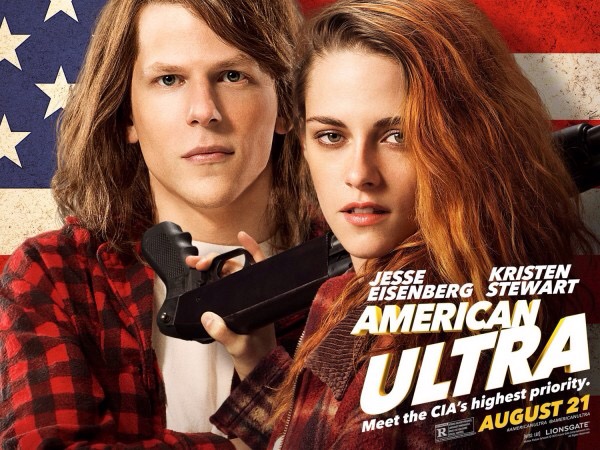
American Ultra (Nima Nourizadeh, 2015)

American Ultra is far better than it should have been. The basic story – a stoner grocery store assistant (Jesse Eisenberg) is actually an advanced agent from a secret programme that was shut down before his memory was wiped – sounds like pretty standard fare and doesn’t really suggest a great film is in order. A fast pace, short running time and well-judged performances make it an enjoyable romp.

  
Eisenberg is well cast and it’s a wise move to keep him in reluctant stoner character throughout, though it would have been easier to make him magically turn into an alpha male. Kristen Stewart makes another case for the ATL (Anti Twilight League) to take her a little more seriously with a solid performance and there are great turns elsewhere from Bill “Was That Bill Pullman?” Pullman, Topher “That 70s Guy” Grace, John “Luigi Mario” Leguizamo and Tony “Loose Seal” Hale.Perhaps this film doesn’t justify a trip to the cinema, but when it hits the steaming platforms it should be near the top of your list.

American Ultra is out now at cinemas in the UK.

Film review – Ant-Man (Peyton Reed, 2015)

The problem that many British viewers of this film will have when viewing this film is a pining for what could have been. Edgar Wright and Joe Cornish had for a long time both been attached to the film, the former as director and both as co-writers. Both are extremely well-known amongst the geeks of Britain and the fact they were teaming up was an absolute dream. Edgar Wright proved what he could do when given the freedom of the source material when he directed the excellent Scott Pilgrim vs The World in 2010. Whilst the Ant-Man series wasn’t as well known as the likes of X-Men and Spiderman, in the right hands it had the potential to be a great film.

Phenomenal powers, itty bitty living space.

Phenomenal powers, itty bitty living space.

However, it slowly became apparent that Marvel had a different idea of the direction it should take. In an interview with Mike Ryan of the Huffington Post, Edgar Wright said “It is pretty standalone in the way we’re linking it to the others. I like to make it standalone because I think the premise of it needs time. I want to put the crazy premise of it into a real world, which is why I think Iron Man really works because it’s a relatively simple universe; it’s relatable.” Clearly Marvel wanted the film to be set in the Marvel Cinematic Universe and the compromises required to slot it in with Thor, Iron Man and the clan didn’t sit well with Wright and Cornish. With not long to go before release date – 420 days to be precise – the pair (along with director of photography Bill Pope) co-announced with Marvel Studios that they were leaving the project, citing “differences in their vision of the film”.

So what are we left with? Well, Peyton Reed has come on board as emergency director. His previous work has been pretty much exclusively romantic comedies (Down With Love, The Break-Up) and the impression is that he was brought in to do what the studio needed rather than drive his own vision of the narrative. Ironically that makes him a kind of yes man. [1]

What’s really frustrating is that the script has some very Wright/Cornish-esque humour in there. One of the large scale fights near the climax of the film happens around a Thomas the Tank Engine toy train track. Anyone familiar with Joe Cornish’s route to fame in the 90s will see the likelihood that this was one from him. Or maybe Peyton Reed is a big fan of Series 2, Episode 18 of the original Thomas the Tank Engine series “Thomas Comes To Breakfast”, which first aired in the UK in October 1986.

The one saving grace of the film is Paul Rudd doing and excellent job as Scott Lang, the thief-turned-hero who wants to make up for lost time with his daughter. His humour and sharp wit make the journey through the film entirely pleasurable. He is a great comedic actor and the film has benefited from his presence on the rewriting team.

However, for all the good that is done by some great work in the cast (Michael Peña is hilarious throughout), we keep getting reminders that this is two films woven into one. The worst moment of the film comes when there’s an oblique reference to The Avengers, which sticks out like a sore thumb. Just as we are forgetting about it, Falcon arrives on the scene. Yes that’s right, Anthony Mackie has his very own cameo role in everyone’s eleventh-favourite Avenger (12th if you include Ant-Man, 13th if you include Nick Fury… who knows where by the time Civil War is released). It’s so pointless and so clearly an afterthought that it not only doesn’t help fit it in with the Marvel Cinematic Universe but rather actually just causes a detrimental effect on the absorbing world that was almost being created in this film.

It’s a shame that we will never see that Wright/Cornish film that never was. It must be said that it was unlikely to ever see the light of day without some serious compromises, but as two huge fans of Marvel comic books that was never going to happen. Instead we’re left with a reasonable film with some rewarding moments, which never really gets going because it is so disjointed.

Ant-Man is out at cinemas globally now.

[1] Yes I went there.

Jurassic World (Colin Trevorrow, 2015)

One of my earliest cinema memories involves Jurassic Park, the 1993 action blockbuster directed by Steven Spielberg that has gone down in history as one of the greatest action films of all time. Sat at my local cinema – Apollo / Unit Four Cinemas in Brierfield in the heart of Lancashire [1] – with my brother and mum, we were all on the edge of our seats as Dr Alan Grant attempted to get Alexis and Timothy over a soon-to-be-electrified fence. As the shots flicked between the party on the fence and Ellie Sattler in the control room re-powering the park, the alarms start to blast out and the suspense was way too much for my brother. With perfect timing, he stood up with clenched fists and shouted “JUST JUMP!” at the top of his voice. It’s a story that is still retold at family functions to this day. Occasionally I just send him a text saying “JUST JUMP!”. It never gets old.

Actually, what is interesting about this highly memorable scene is the fact it doesn’t really involve any dinosaurs. It doesn’t require any special effects or CGI until an entirely believable puppet raptor bursts through a wall over Sattler’s shoulder. It’s just a bit of tense music and some mild panic for some characters we all really care about.

Throughout the whole film the exhilarating pacing was always there and the effects were obviously well thought out to ensure a realistic and believable option was utilised. This kind of intelligent movie making was sadly missing from the two installations we’ve had to endure in the intervening years. Fans of the original were hopeful that this would all be corrected with this year’s franchise reboot. Sadly their hopes won’t be realised with Jurassic World.

Despite Chris Pratt's great performance, he can't save the film from its underachievements.

Despite Chris Pratt’s great performance, he can’t save the film from its underachievements.

The premise is excellent. Twenty-two years after the events of the first film, Isla Nublar, an island off the coast of Costa Rica, has been converted into the visionary park that Dr Hammond always dreamed of. Led by Dr Wu (the returning B. D. Wong) at the behest of Simon Masrani (Irrfan Khan), the scientific research team has secretly been working on genetic splices of dinosaurs in an attempt to turn around dwindling attendance figures. When their prize creation – an Indominus Rex – escapes from its enclosure, it is down to velociraptor trainer Owen Grady (Chris Pratt) and clueless park operations manager Claire Dearing (Bryce Dallas Howard) to rescue Dearing’s two visiting nephews Gray and Zach Mitchell (Ty Simpkins and Nick Robinson respectively).

Much has been made about Dearing as a weak role model for girls. I have to say that when I stumble across these kinds of articles I tend to roll my eyes, but in this case the anger is very much justified. As operations manager for such a huge island resort, she is immediately shown as weak-minded and out of her depth in her job, lacking in the basic facts required for her position and wholly reliant on people around her to bail her out. When she finally decides to knuckle down and help out the cause, she decides to keep her high-heels on. In the end she spends the remainder of the film hiding behind her alpha male counterpart, being rescued and generally not being much use. The only other prominent female is Zara Young, Dearing’s personal assistant, who is too engrossed in her phone to do her job. When the original film had two very likable and head-strong female characters, this comes as a bit of a disappointment.

Indeed, there are only two characters of any substance. Chris Pratt’s Owen Grady is a blast from the past, no nonsense hero who makes decisions by taking matters into his own hands and has superior knowledge of pretty much everything in the park. He is a little cliched, but it’s something that can be forgiven when everyone around him is so difficult to get behind. Ty Simpkins’s Gray Mitchell, the younger of the siblings, follows up assured performances in Iron Man 3 and the Insidious series with a solid turn as the know-it-all excited teenager. He may be Tim Murphy reincarnated but in comparison to his wooden older brother he is a breath of fresh air.

The only thing less believable than the majority of the cast is the woeful CGI. There were a couple of moments that impressed, though these were generally in the dark and in short bursts. For the most part and especially in the day time shots, the effects were a distraction and this is a sin in the art of storytelling through film. The best films take you into a world and fully immerse you in what you are experiencing. An overarching question hanging over this film is how they managed to actually make the dinosaurs less believable than Jurassic Park, despite the fact they spent more money doing it. The mind baffles.

Jurassic World is certainly better than Jurassic Park III, and perhaps on a par with The Lost World, but for all the hype around it, it never quite lives up to the expectation.

Jurassic World is in cinemas worldwide now.

[1] From my childhood home in Burnley, the Brierfield Apollo was definitely the closest to get to. It was the setting for almost all of my earliest cinema memories: Teenage Mutant Ninja Turtles (a hugely exciting 6th birthday treat in November 1990), The Never Ending Story II (December 1990), Robin Hood Prince of Thieves (July 1991), Hook (April 1992), Aladdin (another birthday trip in November 1992) and Jurassic Park (July 1993). The cinema shut down in 1997 upon the opening of Apollo Cinema in my home town Burnley, which then became the home of my teenage year’s of cinema (I think I saw two of the opening four films available in the first week – Batman and Robin then Beavis and Butt-head Do America – because there was a promotional offer to get people through the door). I think, however, all of these were preceded by a trip to see a re-release of Snow White and the Seven Dwarves at Loughborough’s Curzon Cinema in July 1987, which was abandoned because my grandma was ill.

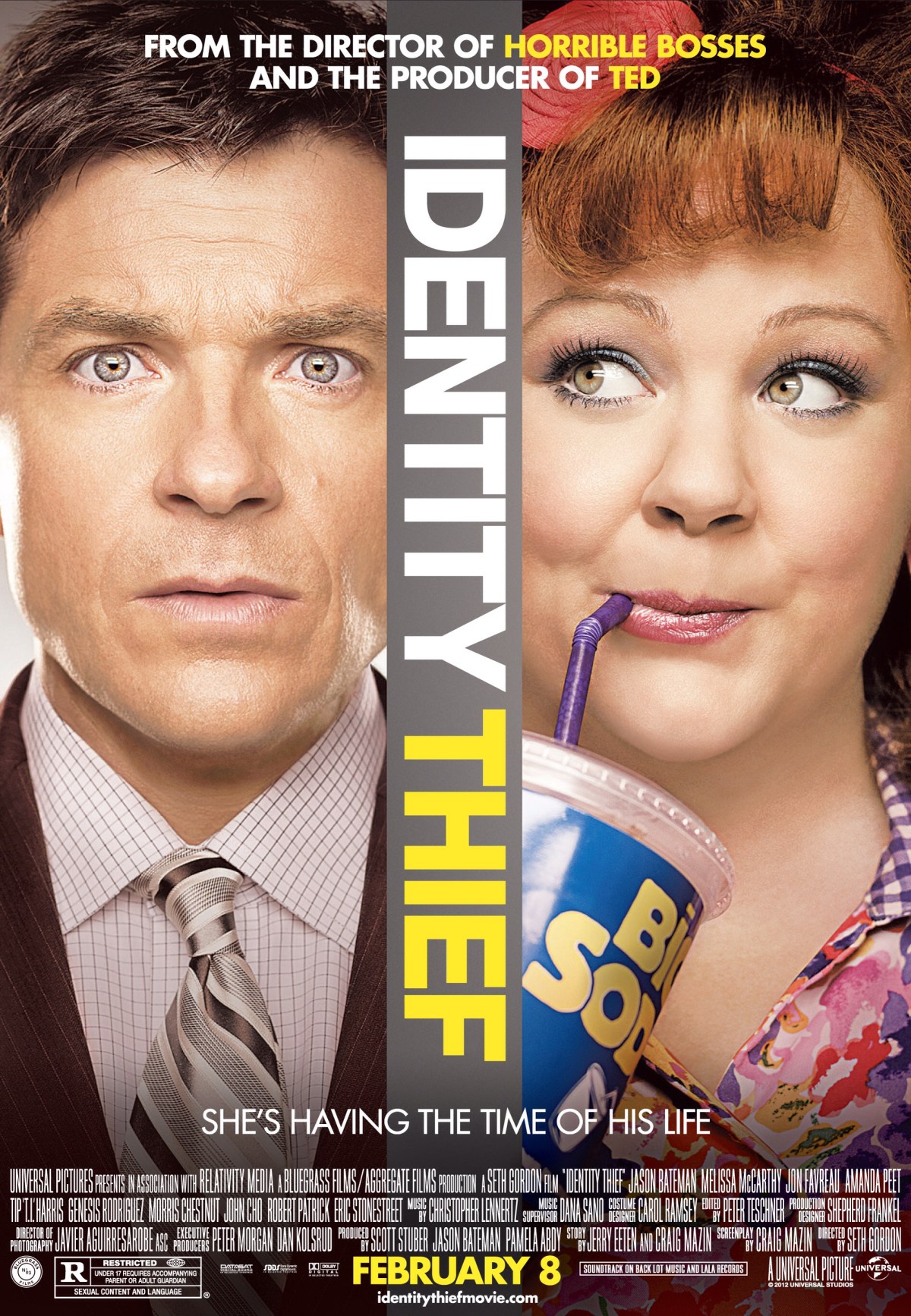
Film review – Identity Thief (Seth Gordon, 2013)

Sandy Patterson (Jason Bateman), an accounts processor from Denver, has his identity stolen by a woman (Melissa McCarthy) from Winter Park, Florida. When his accounts are frozen and the police get involved, his employer (John Cho) threatens to sack him. Realising the police will move too slowly, he chooses to travel to Florida himself to track the thief down, with hilarious consequences.
I imagine that’s how it was sold it anyway. The problem is that despite having an interesting premise and a few laughs at the beginning, it loses its way and sort of stops being funny by about halfway through. Both Bateman and McCarthy end up playing the same characters we’ve seen them play time and time again, in particular Bateman who could be the same character from Gordon’s previous film Horrible Bosses. There’s also some dreadful CGI work on a snake attack to endure.

It must have been a slow month for films in February 2013 as Identity Thief made $150m at the box office despite mainly negative reviews. I guess reviews, word-of-mouth and being entertained don’t count for everything.

Identity Thief is available now on Blu-ray, DVD and Netflix.

Film review – Tomorrowland: A World Beyond (Brad Bird, 2015)

The big live-action summer blockbuster for Disney is always hotly anticipated [1]. The previous three summers’ blockbusters were John Carter (2012), The Lone Ranger (2013), Maleficent (2014) [2], and before that there were plenty of Pirates films to chew on. These have all been at worst reasonable sellers but have received middling to good reviews. As long as the basic premise is generally acceptable to cinema-goers and there’s enough advertising involved, they tend to do well. In recent times, it seems Disney’s summer blockbusters have been review-proof.

So how will Tomorrowland fare? It is an action-adventure film with a young female lead (Britt Robertson as the intelligent and headstrong Casey), a child as a prominent supporting character (newcomer Raffey Cassidy as humanoid robot Athena) and a big name alongside them both (guaranteed ticket-seller George Clooney as Frank Walker), so it has a good chance on that front. It is also in good hands with director Brad Bird at the helm. His previous work for Pixar as director includes The Incredibles and Ratatouille, two of my favourite animated films. He’s also responsible for excellent film The Iron Giant, a film which broke him as a director [3].

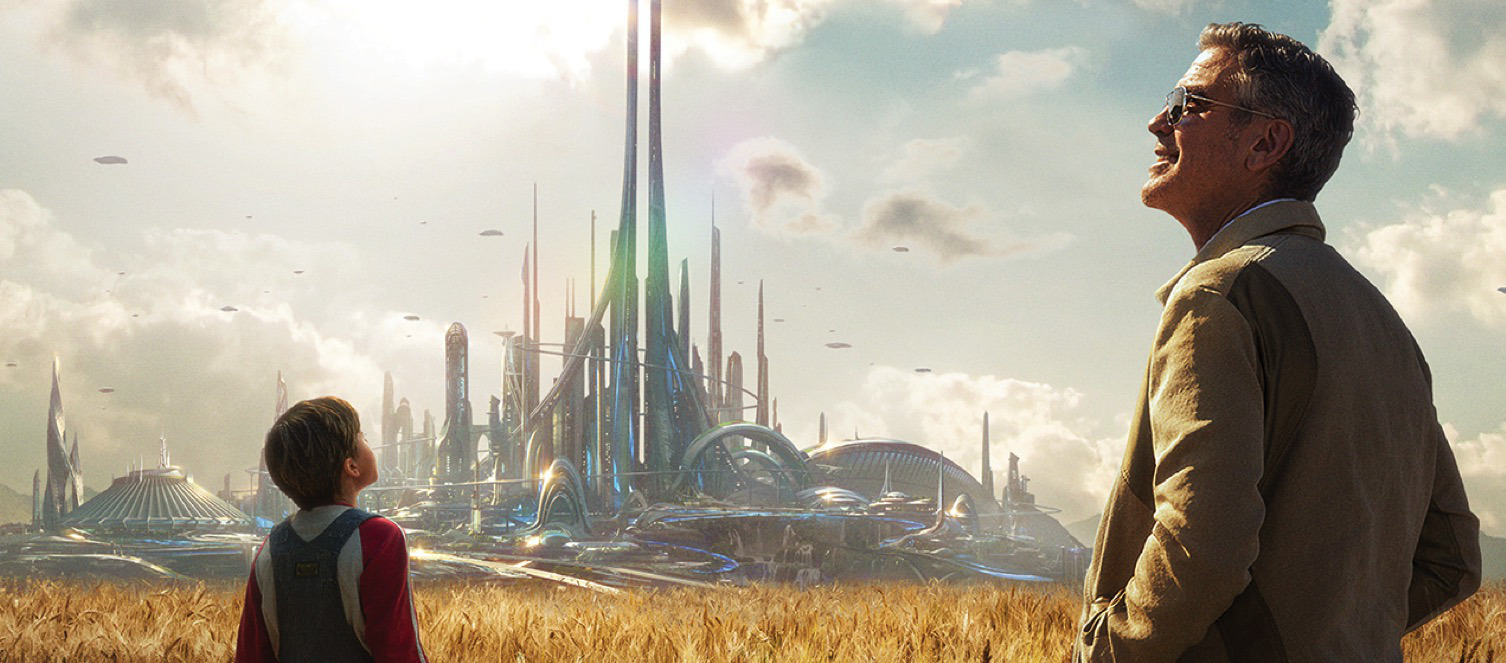
Visually stunning, but wrapped up in its own spiderweb of overthought plot.

Visually stunning, but wrapped up in its own spiderweb of overthought plot.

However, there has been a distinct lack of the blanket media coverage we’ve come to expect from these kinds of films. It’s almost as if Walt Disney Pictures hasn’t really got faith in it. Inevitably, this disinterest in the film has seeped its way down to the general public, who are simply not checking it out. It is currently on track to lose money, with a global taking of $133.2m against a budget of around $190m. It’s still ploughing on and might break even after Blu-ray sales and merchandise is taken into account.

The premise of the storyline is loosely based on the futuristic area of the Disney Theme Parks, which is also the source of the film’s name (it was originally titled 1952). It’s a time-travelling adventure with absolutely stunning visuals that make the film very easy on the eye. It’s actually very similar visually to The Rocketeer, and I felt as though this is what would have been achieved had that film been released today rather than 1991.

It’s a problematic film, however, and I put this down to the hard-to-follow plot. I don’t think it’s overly complex, I just don’t think it’s explained very well. Alongside Brad Bird as co-scriptwriter is David Lindelof of Lost fame, whose scripts tend to walk a fine line between intrigue and confusion. When he gets it right (the earlier episodes of Lost, Star Trek: Into Darkness), it can be the most gripping sci-fi around. Sometimes, though, he misses the mark and becomes far too confusing to follow. Tomorrowland is certainly in this category.

The problem is that the plot loses the plot, and therefore its own essence. I’ll try to summarise (SPOILER ALERT!). Casey, the daughter of a NASA engineer, finds a magical pin that transports her to a Utopian parallel universe. However, it has a limited lifespan and counts down to expiry, meaning you only get a glimpse of the alternate universe (we later learn it’s an advert). It also means you co-exist in the alternate reality, so if you move around in the alternate reality you might bang your head in the real world. She tries to track down a second pin and finds herself teaming up with Frank, who can access the real universe via a secret rocket inside the Eiffel Tower, and can get them there by a secret teleportation device he invented. When they get there, the Utopia is now derelict, but evil genius David Nix (played by Hugh Laurie) doesn’t want to let anyone else in, even though humanity will end within 60 days.

I won’t ruin the ending but as you can see, it does get quite far-fetched and I do seriously question whether or not the children in the cinema were fully on board with it. Indeed, it took five of us about ten minutes of debating until we settled on what exactly we’d just seen [4]. We still had some questions remaining though. Firstly, I’m assuming the robots that were sent to kill Casey were sent by David Nix. If so, he didn’t seem to know who she was when she arrived. Why weren’t they trying to kill Frank instead? He was the one known entity. Perhaps they assumed she would lead them to him, but I didn’t feel this was explained very well. Following on from this, why weren’t they all killed immediately after they arrived in the Utopia? It seemed there was a “well, they’re here now, let’s give them a shot” sort of vibe going on. I wasn’t buying it. Finally, why had the Utopia got so run down? I feel there was a huge area of the plot to explore here but it wasn’t mentioned. Oh, and why the Eiffel Tower?

In the end, it was just a huge advert for world peace, creativity, Coca-Cola, Chevrolet, and not stifling imagination. And Disney merchandise (yes, you can buy your very own copy of the Tomorrowland pin that is so integral to the plot). It was a missed opportunity. I don’t recommend you avoid it. Perhaps I’m not as intelligent as I once thought and it’s my fault alone that I don’t understand a film aimed at 12-year-olds. It’s visually stunning and is almost worth seeing just for that. Just don’t get your hopes up and don’t try to overthink it.

[1] It doesn’t necessarily mean they’re good.

[2] Despite being classed as a box-office flop, John Carter actually made money on its $263m budget at global box offices alone, pulling in $281m in receipts. Once you factor in sales of merchandise, video games, DVDs, Blu-rays and downloads, it must have made a huge amount. Not bad for a flop…

[3] Surprisingly, he also directed the music video for “Do The Bartman”, right at the start of his career. It’s less of a surprise once you know he was already involved in The Simpsons from earlier on, though this knowledge could help win you a pub quiz one day.

[4] I went to see this one with a couple of good blogger friends, whose blogs can be found at the following addresses: Nesbitt Web and Ahoy Small Fry. They’re both very different blogs but I enjoy them both on a regular basis. Check them out!

Spy (Paul Feig, 2015)

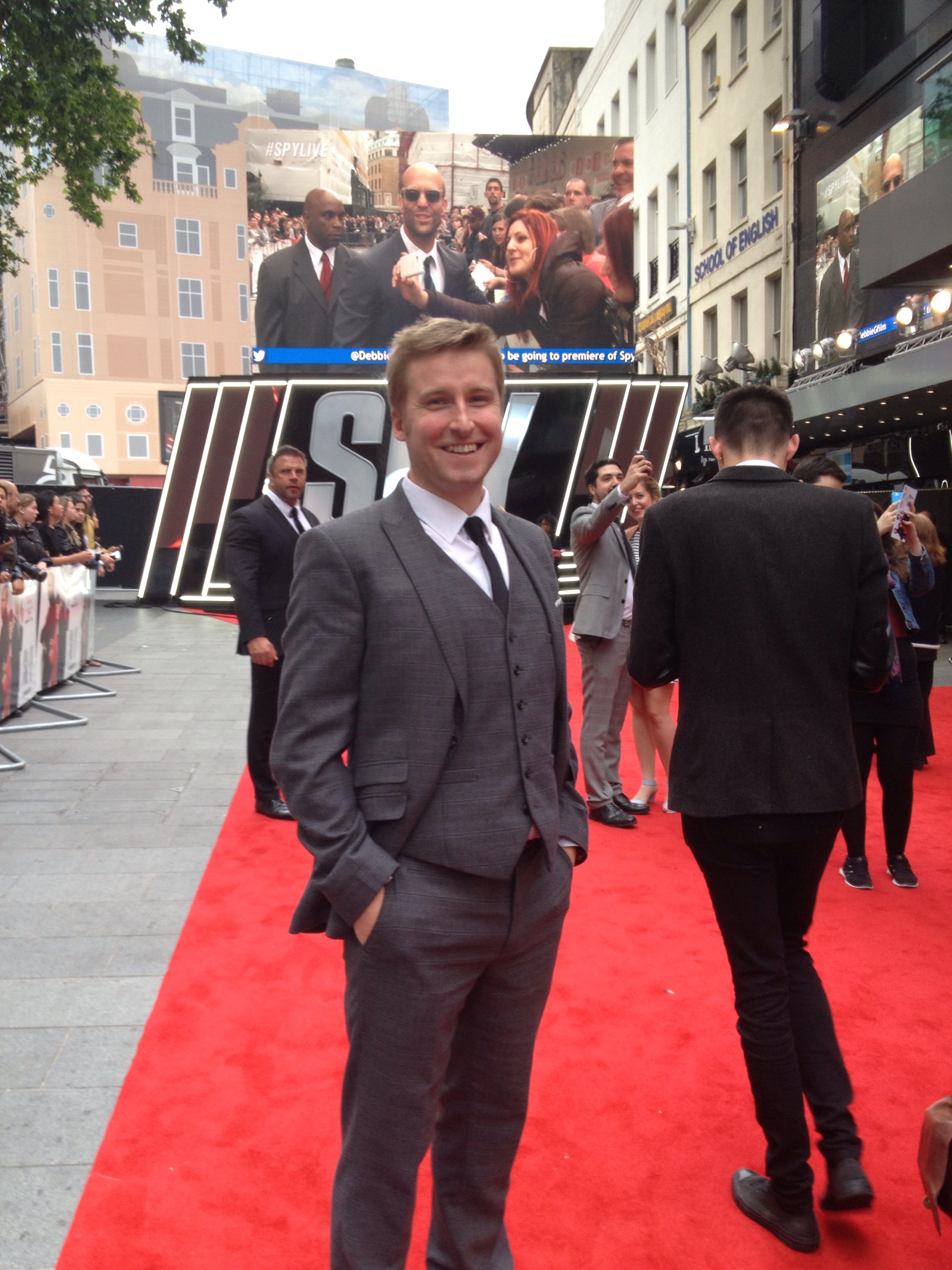
Earlier today, my wife and I found ourselves walking on the red carpet, alongside Melissa McCarthy, Jason Statham, Jude Law, Miranda Hart and Peter Serafinowicz, for the UK premiere of new film Spy. It was at the ODEON on Leicester Square. Here’s a photo of me on the red carpet.

I’ve been on the red carpet a couple of times before and it’s always a lovely experience. Of course, nobody cares who we are, though that doesn’t mean we didn’t ham it up a little. [1]

There’s been quite bit of interest for the film over the last few weeks and the anticipation was well justified. We laughed so much our faces hurt.

spy02

McCarthy and Law are hilarious throughout.

Spy is an action comedy about office-based CIA data analyst Susan Cooper (McCarthy), who is forced to go out onto the field when her partner Bradley Fine (Law) disappears and the identities of other top field agents – including Rick Ford (Statham) – are compromised. Going undercover to attempt to infiltrate arms dealer Rayna Boyanov (Rose Byrne) with the help of her office friend (Hart), the story is the perfect platform for some caper-based hilarity.

I was a little apprehensive going into it as the premise is quite familiar and hasn’t been done well for a long time. I was immediately pleasantly surprised, with an opening scene that sets the story up well, falsely draws us in to a serious film, then slaps us in the face with a huge laugh.

Jason Statham has never been so likeable. His character can best be described as Jay from the Inbetweeners if he somehow became a CIA agent. You can see he’s flexing his comedy muscles and really trying hard to make his co-stars laugh whilst holding back himself. His character is a highlight.

The real star, of course, is Melissa McCarthy. Her comic timing is impeccable and it’s easy to see this film becoming a critical and commercial success with her out front. She has had several opportunities to show us what she’s got, but she has fallen slightly short on several occasions (see Identity Thief). This is a comic actor at the top of her game.

The rest of the cast are excellent, especially Serafinowicz, and you can see they’re enjoying such a fun script. I can’t recommend it enough. I wouldn’t be surprised if this is the start of a franchise.

[1] About a month ago I speculatively tweeted a review of Furious 7 as an entry to a competition run by Stella Artois and Film4. Actually, it was a review of the trailer. I’ve not seen the film, nor have i seen the trailer. Indeed, of all the films in the series I’ve only seen Tokyo Drift. I didn’t think much of it. Anyway, that’s why I’m here. I’ve included the review here, in case you’re interested.

Angry Video Game Nerd: The Movie (James Rolfe, 2014)

I remember a couple of years ago when I saw the queues of young girls stood outside the theatre awaiting the release of the latest One Direction Movie, 1D: This Is Us. I’m pretty sure I passed a snide comment to whoever I was with at the time berating the popularity of the film, which was clearly not aimed at me. I wasn’t the “target audience”. Nonetheless, what a bunch of idiots standing there to watch such a rubbish film.

One for the fans

One for the fans

It took me until last night to realise how wrong I was to do this. My wife was out of the house and so I saw it as a perfect opportunity to finally watch the imported copy of Angry Video Game Nerd: The Movie [1]. Alas, my wife returned home and walked in just as The Nerd threw up over a copy of Eee Tee 2 and the woman holding it. As I looked towards the door, I saw myself reflected back: bemusement, disdain and a lack of willingness to understand. I guess that means that I’m a teenage girl and James Rolfe is Harry Stiles. Maybe.

And that’s the point. This is by no means a film for everyone. It is specifically a film for the fans of James Rolfe’s character The Angry Video Game Nerd, the central character in his webisodic (it’s now a word) series in which he reviews terrible old games in a foul-mouthed and occasionally aggressive manner. It’s a film full of references to the series, made for the fans, and a pet project for Rolfe to flex his big-budget muscles and show exactly what he can do once he leaves his underground lair.

The storyline concerns the release of Eee Tee 2, the sequel to Eee Tee, the biggest flop in video game history (and barely hiding the reference to E.T.). The Nerd has always refused to review this game, but when an opportunity arises to go to New Mexico and dig up the infamous New Mexico Atari landfill as a tie in to the sequel, he agrees. The Nerd and his two assistants start the quest but are pursued by federal agent General Dark Onward, who believes The Nerd is trying to investigate Area 51.

It is quite a convoluted plot but it’s not really there to win any awards for screenplays. It’s a platform on which Rolfe bases some quite hilarious moments and I see the film as a success. Yes, it’s probably a little long but I can forgive Rolfe for this – he was bringing his own dream to life and wanted to make sure his fans got the most out of it. Some of the script feels a little like it’s deliberately trying to aspire to be a cult film, and it gets very silly at times, but it’s delivered with enough charm to be forgiven for a few misfires.

There’s a nice bonus at the end, where he finally reviews E.T. The Extra Terrestrial on the Atari, which he has never previously done. The bonus features on the disc are plentiful and give a bit of insight into the film (though many of the featurettes were previously available during the making of the film on Cinemassacre).

Steer clear if you have never heard of The Nerd before but if you want to see what he’s capable of it’s worth the plunge.

[1] For those in the UK, the best option to see the movie in HD is to import from Amazon.com. Be warned though – you will pay through the nose for the postage and then get slapped with import duty when it arrives. It’s expensive and if you aren’t fussed about the HD then you have an option to stream from Cinemassacre for a small fee.