Film review – Wings (William A. Wellman, 1927)

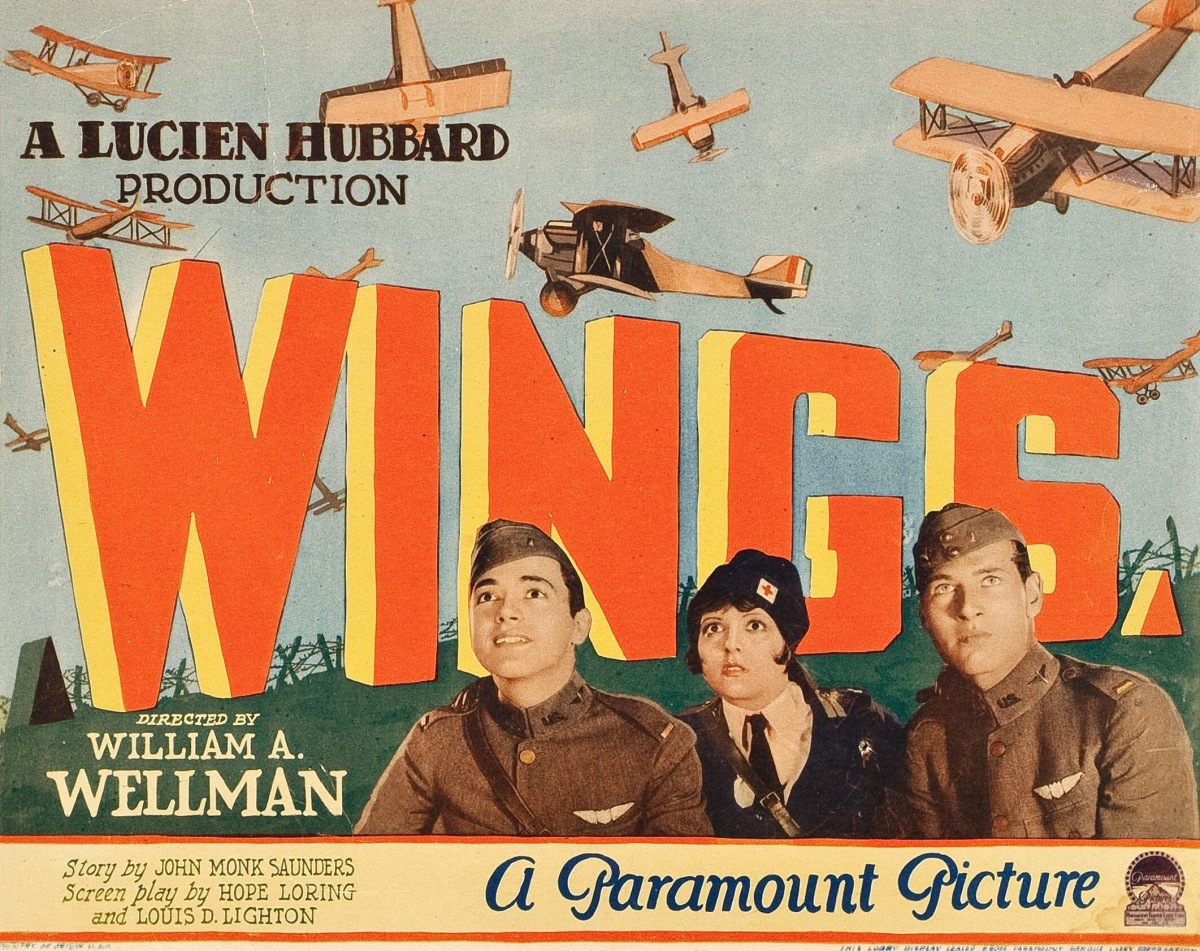
For all its technological achievements and successes as a great tale, William A. Wellman’s 1927 cinematic epic is remembered for one thing – it’s the first film to win the Best Picture Academy Award.

The ceremony was far removed from what we know today. The winners were announced three months before the ceremony and it was a much smaller affair than the modern interpretation, with the awarding of prizes taking around fifteen minutes to complete. Wings actually won a prize called “Outstanding Picture”, later renamed to Best Film, making it famous at the expense of F. W. Murnau’s Sunrise. The latter won the similarly-named “Unique and Artistic Picture” on the same night, though on the night it is unlikely this was treated as a runner-up prize.

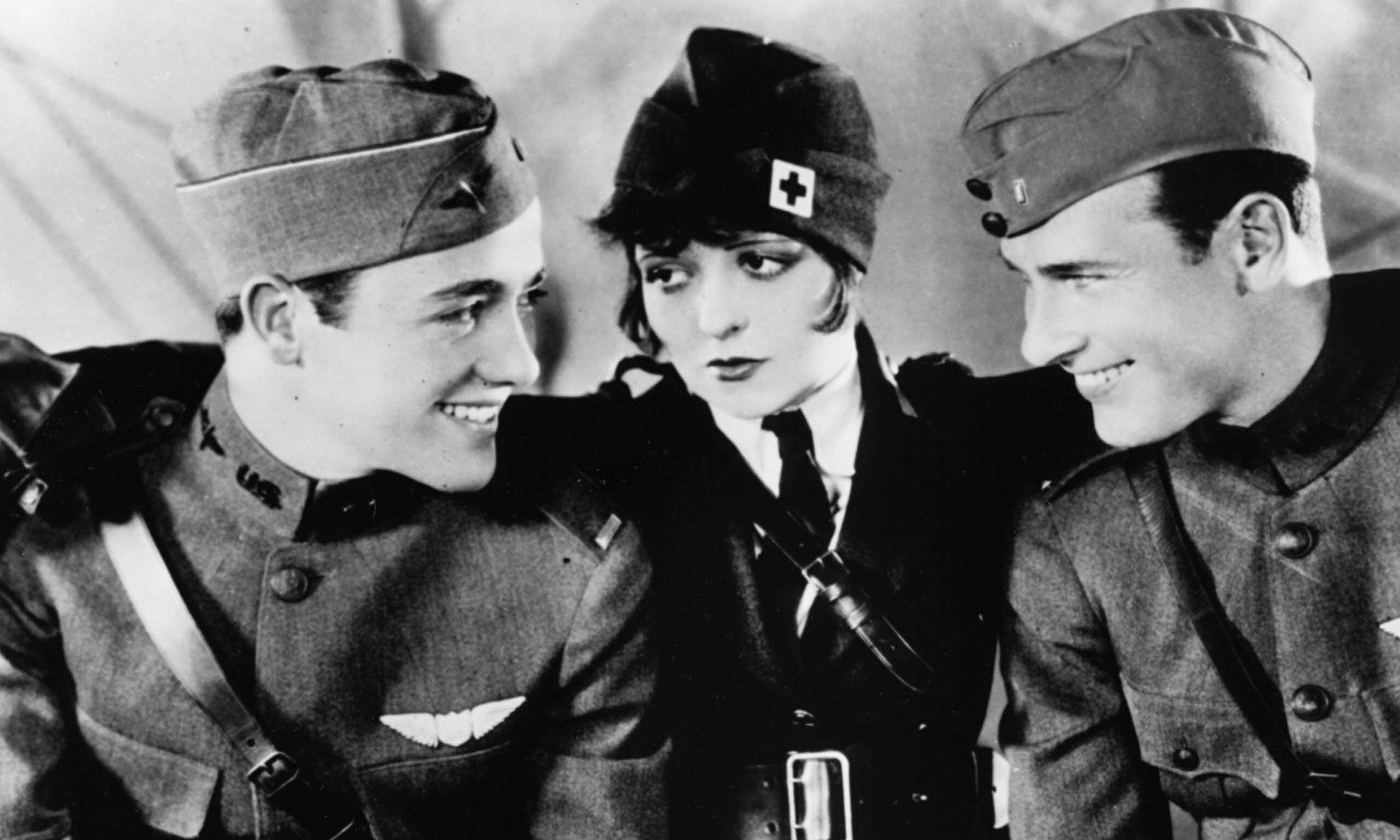
Wings concerns two love rivals – Jack Powell (Charles “Buddy” Rogers) and David Armstrong (Richard Arlen) – who are fighting for the attention and affection of Sylvia Lewis (Jobyna Ralston). Jack’s persistence is so committed that he fails to notice his tomboyish next-door neighbour Mary Preston (Clara Bow), despite her continuous effort to get him to notice her. They enlist in the Air Service as trainee fighter pilots. It covers their time in World War I as they complete training, launch into their first battles and become close friends.

It is perhaps a simple plot by today’s standards, but it’s often not the premise that makes a film great but the delivery. This is close to perfection.
Films like this may have been wonders when they were released, but few stand the test of time and allow enjoyment and excitement for the viewers today. Indeed, we are now 90 years further on in cinematic technological advancements and there isn’t a single person involved with the film that is alive today.

The world of cinema should be eternally grateful that Paramount decided to invest £900,000 in restoring this picture. The results are worth considering so you know exactly what you’re seeing and hearing.

On the positive, the picture is absolutely crystal clear. Many segments of the film were unseen for years by the general public, and whenever Wings did surface it was in a severely compromised form. A duplicate negative was found in Paramount’s archives, though this too suffered from significant damage baked into the print. However, digitising the original negatives and painstakingly restoring the film has done wonders for the visual experience. Credit must be given to Executive Director of Restoration Tom Burton and the team at Technicolor Creative Services for such a wonderful result, utilising tinting techniques of the era for added authenticity.

This has been matched up with a new recording of J. S. Zamecnik’s original score by Dominik Häuser and Michael Aarvold. The score was for a 14 reel version of the film that was edited down to 13 reels for the theatrical and roadshow release. Therefore there was a portion of freedom given to the scoring pair, but it is clear the right decisions have been made at each step, as evidenced by the moving results contained on the restored masterpiece. 

Controversially, the sound features sound effects that match to the visual image. Will McKinley has written a fantastic article about the positives and negatives of this, arguing both sides of the toss in a far more eloquent way than I could manage. It’s well worth a read. For me, these additional sounds are 100% in the score and I can see the restoration team’s predicament. If they omitted them it would sound more “authentic”, but only in as much as it’s what a modern audience expects from a 1920s sound film. This score was steeped in innovation and, like the technological risks taken in shooting the visuals, was way ahead of its time. I’m happy the music sticks to the original score, and if you don’t like it you can try an alternative option on the disc (provided by Gaylord Carter), or even mute the whole thing!
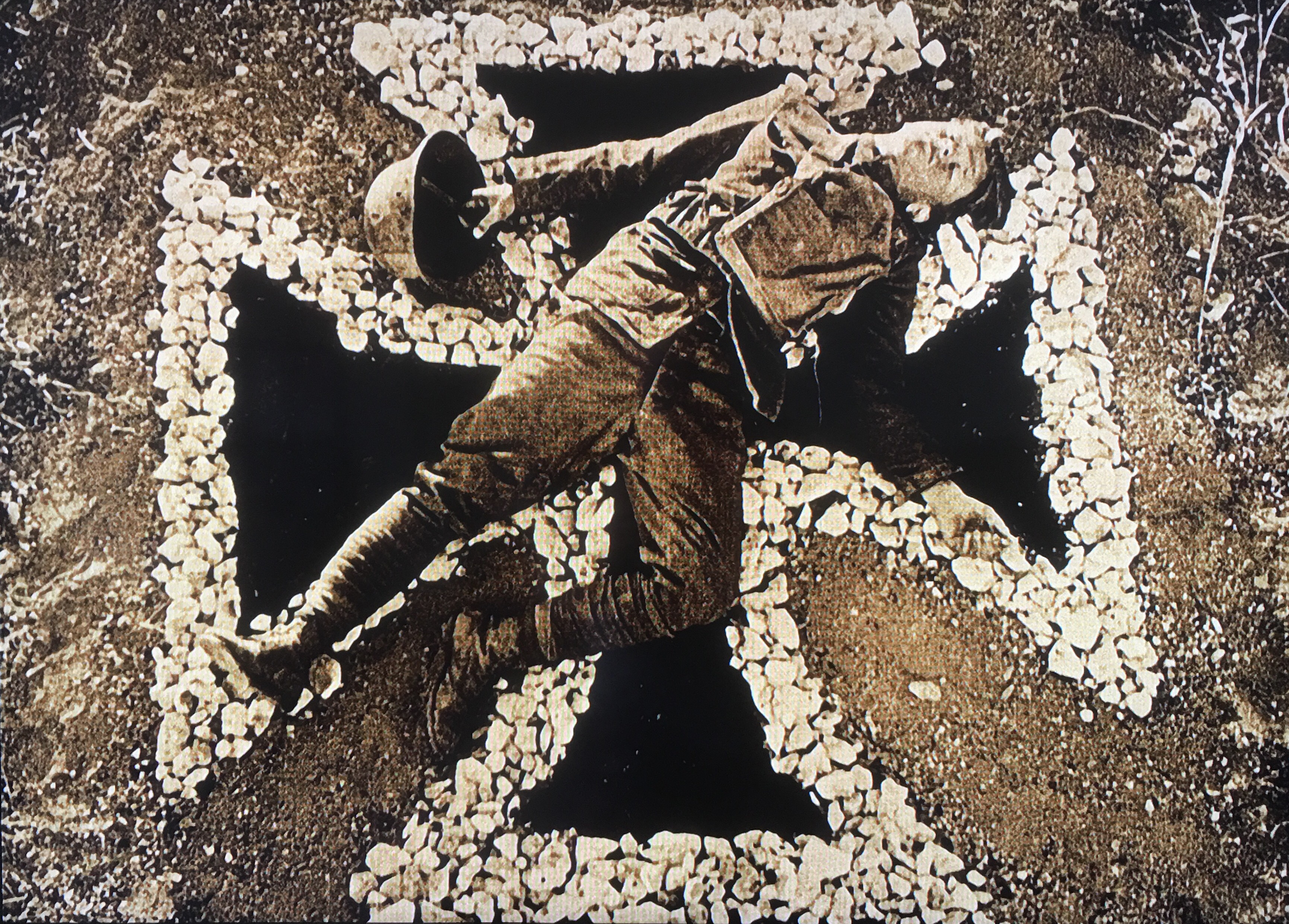
Utilising the trainee pilot angle, director Wellman was able to draw on his experience as a First World War pilot to create some absolutely astonishing sequences. They were all filmed on brilliantly blue but cloudy days, which gives the planes some scale and improves the dynamic nature of the dogfights. 

There is also a cinematic first in the film, with the first onscreen man-to-man kiss. It comes in one of the most heartbreaking scenes I’ve ever seen in a film. David has become stranded behind enemy lines and steals a plane to return home. Jack, already believing his friend has died, is on a suicide mission to take down as many enemy pilots as possible to help the war efforts, in careless abandonment of his own safety. Miraculously he survives his plan, shooting down innumerable enemy aircrafts. On returning, he spots one last pilot heading towards the Allied base. He goes in for the kill, without knowing that it is in fact his best friend David. When he lands and seeks the enemy to seal his victory, he realises what he has done. As David dies in Jack’s arms, the complex emotions get the better of them and there on screen is the first same-sex kiss, albeit perhaps accidental. It simply couldn’t have been cut or reshot – it’s integral to the plot and seals their respective positions in their friends’ lives.

The Masters of Cinema team are the perfect choice to take control of such a historic release. There are three bonus features on the Blu-ray disc: one covering the restoration, one that puts the flight aspects of the film into context and one that covers the legacy of the film. The accompanying booklet is full of additional information and essays on the film and director. It just fits the gravitas deserved of the film.

That we can now sit in our front rooms and see a film of this importance in such high quality is a wonderful feeling. The history of cinema is too important to simply let go. It’s fantastic that an entire new generation have the opportunity to see where cinema started and Wings certainly represents a significant piece of the puzzle.

Film review – Logan (James Mangold, 2017)

THIS ARTICLE IS FULL OF SPOILERS

Hugh Jackman is, in the superhero film world, a living legend. There has never been a single actor or actress that has achieved relentless success across so many different films in this genre, making a character his own and developing it into one of the big guns instead of just part of a team. Like the character Wolverine, the actor behind him seems like he’ll play the part forever.

And yet we come to Logan, a wisely-timed and fitting ending to the franchise and Jackman’s input into the character. It’s hard to believe it but this is the tenth time we’ve seen the character – seven X-Men films have now been made, along with three Wolverine-focussed standalone films. It seems impossible to think anyone will fill the role, meaning this could be the last time we see the character for many years, possibly ever.

It could well be the best superhero/mutant-hero film ever made.

Set in the world 2029, the film finds Logan worlds apart from his former self. Hiding out in a disused smelting plant in New Mexico, he is working as a chauffeur whilst hustling for prescription drugs for Professor X (Patrick Stewart), whom he lives with alongside Caliban (a surprisingly sincere Stephen Merchant). He is tracked down by a mysterious woman named Gabriella (Elizabeth Rodriguez) who is trying to get him to take a young mutant girl named Laura (the brilliant Dafne Keen) to specific co-ordinates in South Dakota before Transigen finds her to either kill her or take her back into their shady mutant development programme. The company, which we have previously glimpsed in X-Men: Apocalypse, is headed up by Zander Rice (Richard E. Grant), whilst they are hotly pursued by head of security and leader of the Reavers Donald Pierce (Boyd Holbrook).

Jackman reportedly took a pay cut to ensure this film received an R-Rating in USA. The result is certainly the most brutal cinematic portrayal of Wolverine yet, with no holding back on any of the gruesome details. It is certainly not a kids’ film. Jackman looks battle-worn from the start, the reasoning given that the adamantium is now poisoning his body and losing its regenerative abilities. His best cure is to drink alcohol, which may mask the pain but won’t cover the endless scars across his body.

The perfect muse for Jackman’s final turn as Logan is Patrick Stewart, reprising one last time his Professor X character. Now in the midst of a horrific battle with dementia, he struggles to keep control of his telepathic abilities. What is really interesting here is that it is a study of people at the end of their life who are losing their usefulness to society. Okay, this is shown in the most extreme manners when someone has superpowers, but the poignancy is still there for everyone to see.

To add extra emotional weight to the film, the young girl is revealed to be the kind-of-daughter of Wolverine, in that she shares some of his genetic make-up. In the greater comic book storylines she is X-23, who first appeared in 2003. Whilst not strictly his daughter, this is a clever plot device as it means the two characters are immediately drawn to one another, despite their tendency to mistrust those around them.

It may be masquerading as a film about mutants but this is so much more – a character-driven drama about old age and retirement.

Inevitably, the ending is upsetting, as we see our titular hero sacrifice himself to ensure the safe passage of his daughter. The final scene, especially the final shot, is absolutely perfect.

A fitting end to one of the greatest film characters of our time.

Film review – Free Fire (Ben Wheatley, 2017)

Ben Wheatley returns this month with his latest feature film Free Fire, which blends brutal action and sharp humour to create a roaring success of a film that will keep audiences entertained way beyond the 90 minute running time.

The premise of the film for Wheatley stemmed from Wheatley reading online of various police stand-offs throughout history. He found one that lasted 45 minutes because neither party could hit their targets, despite years of training to do precisely that (sadly I can’t find the article to link to). This tickled a nerve with Wheatley, who thought it would be brilliant to see it on the big screen – especially since most stand-offs in films last no more than a minute.

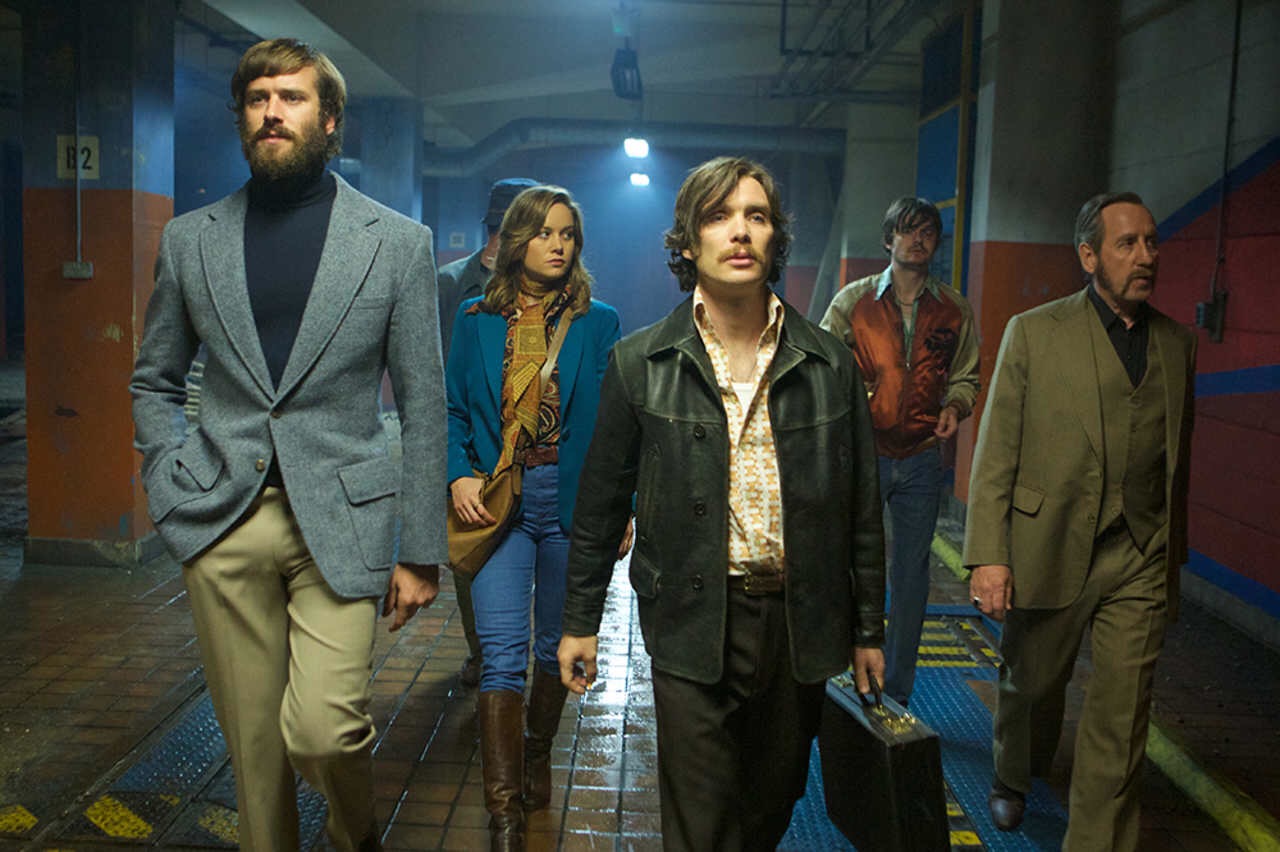
Set in the 1970s, the story revolves around two gangs meeting in a warehouse to make a trade for some arms. One group includes Chris (Cillian Murphy) and Frank (Michael Smiley), both presumably sourcing their weapons for IRA-related activities (though this is never explicitly mentioned), along with headstrong Justine (Brie Larson), idiotic junkie Stevo (Sam Riley) and even-more-idiotic Bernie (Enzo Cilenti). Providing the weapons are a group including bearded negotiator Ord (Armie Hammer), the sharp-tongued South African Vernon (Sharlto Copley), the intelligent Martin (Babou Ceesay), driver Harry (Jack Reynor) and Gordon (Noah Taylor) alongside a handful of support characters.

Speaking after the film at a preview at Broadway Cinema in Nottingham, Wheatley offered a brilliant insight into some of the production decisions on the film.

Hilariously, to get a feel for the environment and ensure the people were in realistic positions throughout to communicate properly, he had the entire set built in video game Minecraft. This allowed him to walk around the factory and get a feel of where he’d be once production started. A simple but brilliant solution, but also necessary as he stated this is the only 3D modelling tool he knows how to use.

On a similar note, the shoot-outs themselves were partly inspired by Wheatley’s experience of playing video games, a medium he is a fan of enjoying even though he is yet to be involved with the creation of one (sadly his comment about writing an adaptation of 1980s video game Gauntlet was probably tongue-in-cheek).

One issue they could have faced was in the continuity for the bullet shots. Clearly with 1000s of bullets flying around, there was a risk of wounds being out of place, or disappearing and reappearing between shots. The simple solution was to film it in sequence, which also plays into the building of tension at the start and exhaustion for the characters as the story plays out.

Learn from Vern

Of the many great performances here, the highlight is Sharlto Copley as Vern. Initially annoyed about his Savile Row suit getting damaged, his whitty one-liners had the audience in creases. He’s a complete jerk and Copley plays it brilliantly, his irritating mannerisms making the heightened-tension all the more believable. 
The result is a film that consists almost entirely of a shoot-out that feels far more realistic than anything we’ve become accustomed in Hollywood films. People aren’t simply experts in shooting guns and it takes practice and skill to be any good at it. The characters in this film aren’t experts and that’s why the film plays out as it does. It’s grim, gritty, exhausting and hilarious.

Seek it out and watch it.

Film review – Wake of Death (Phillipe Martinez, 2005)

I was recently enjoying a holiday in a Spanish beach resort. It was a great week, with brilliant weather and loads to do. One quirk of such holidays is the small selection of English-language television channels available. They’re always different and always extremely limited. This holiday was no different: BBC1, BBC2, BBC4 and ITV. And then there was movies4men.

Movies4men is a channel I steer clear of. Why? Because frankly it sounds like a pornography channel. It’s actually a terrible name for a fairly reasonable channel, with war and western genre films throughout the day and some action films in the evening. The name is, at best, a little sexist. But it sort of makes sense once you get used to it.

Anyway, if you turn it on at around 11pm on any night there is a fantastic chance you’re going to be stuck watching a poorly-executed Jean Claude Van Dämme film. And that’s where I was every night at 11pm. And that is how I came to watch Wake of Death.

It’s okay darling. It will be over soon.


“After his wife is brutally murdered, an ex-cop wages war against the Chinese triads,” reads the brief plot on IMDB. It tells you pretty much everything you need to know. It may well be one of the worst films I’ve ever watched.

The acting does nothing for a script written by a group of screenwriters – there were four – that probably knew that the script wasn’t particularly important for this film. Why? Because there would be no sequels. Because it had JCVD on the poster and the people who watch it will tend to only care about the action, fighting, martial arts, car chases and explosions. Because it’s hard to screenwrite “JCVD does typical JCVD stuff” without sounding nonchalant about the whole affair.

No matter what the result of the filmmaking process was, the audience would come. They would have been satisfied, albeit devoid of any kind of betterment.

They will have also been treated to a surprising number of JCVD sex scenes, which would probably have been more than they bargained for.

Van Damme has never been a great actor. Heck, he even used it as a defence in a lawsuit back in the 1996. Coincidentally, he has acted in 39 films since that comment from his lawyer was made. None of them appear to have really challenged the notion. 

The only time he tries to really act in ‘Wake of Death’ is a scene where he has to cry as he drunkenly remembers his dead wife. It’s as poorly-executed as that scene in one of the Taken films where Liam Neeson jumps over a fence, with about 10 different camera cuts along the traumatic rollercoaster ride. Someone is kind enough to throw water on Jean-Claude’s face between shots, but that’s still not enough to stop the director giving up and breaking the tension with a random Chinese triad bursting through the window and having a quick fight before running away.

If Van Damme has done some great cinema this millennium I am yet to see it. But his fans will seldom have been disappointed. 

Film review – Ghosts of Mars (John Carpenter, 2001)

John Carpenter’s history as a filmmaker may have many blemishes on it. For every Assault on Precinct 13, there was a Village of the Damned. For every time Kurt Russell escaped from New York, he also escaped from L.A. Yet few of his films have stunk as badly as Ghosts of Mars, which, unlike most of his other films, hasn’t got better with time.

Set on a remote Martian mining town, the plot concerns police woman Melanie Ballard (Natasha Henstridge) transporting dangerous criminal “Desolation” Williams (Ice Cube). However, upon arrival she realises that the planet has become infected, essentially, by zombies. She has to team together with a group of survivors including Jason Statham, Pam Grier and Clea DuVall.


The film was a box office bomb, making back just $14m of its $28m budget (global sales, according to Box Office Mojo). It’s hard to see why. Why it cost so much, that is. Conceptually, the mining town should look gritty, desolate and run down. It actually ends up looking more like a half-baked Crystal Maze set that was abandoned half-way through.
The plot isn’t terrible, and good movies have been carved out of much worse starting points. The soundtrack, provided by John Carpenter, is brilliantly varied.

What lets it down is dated visuals – they’re very 2001 – and an unreliable script. The actors do their best with it, but it simply doesn’t hit the marks.

It must be tough to turn down an offer to work with someone as great as John Carpenter. One can only assume that those involved looked at the script and were reminded of his best work. 

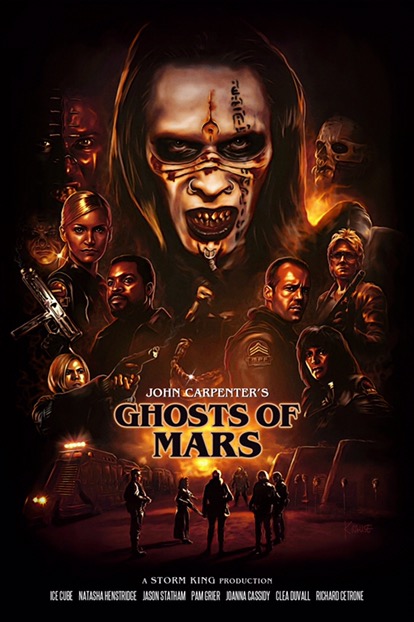
[Note] I hated all the official posters for this film, but unearthed the brilliant poster by Ralf Krause on the website AlternativeMoviePosters.com. Check out the website for more great alternative movie posters and order some to decorate your wall with something wonderful!

Film review – Passengers (Morten Tyldum, 2016)

It’s fun to slam a bad film, isn’t it? Hand us a terrible film and we’re all there ready with our sticks to beat it down. It’s funny, because the filmmakers have no control over it and we get away with having a good laugh at their expense.

Passengers has been that film for the last couple of weeks.

I’ve had an article shared to me with some photos that prove how creepy Chris Pratt is in it. I had another one sent over about how it had failed at the box office after poor reviews. Generally the early reviews were positive, then the consensus changed and everyone has now decided it’s a poor film, so that’s the stance everyone has taken. Even positive reviews have misleadingly negative titles to ensure they don’t buck the trend (News.com.auhad a favourable review but they titled it “What was Jennifer Lawrence thinking?”).

The three people who sent me the above articles have no intention of watching Passengers. That is entirely their loss.

Passengers is an excellent film.

There’s more to this than the reviews have suggested

Spoilers now follow.

At its heart, it is a romantic drama that explores the relationship ship between James Preston (Chris Pratt) and Aurora Lane (Jennifer Lawrence), who are trapped in space on the Avalon spaceship, en route to the planet Homestead II. To make the 120-year journey, the crew and passengers are in hibernation pods, but Preston’s pod opens early and he is forced to fend for himself, physically and mentally.

Trapped in space alone, he eventually starts to consider waking up fellow passengers. As an electrician and mechanic, he can navigate the user manuals of the hibernation pods and is able to select who he wakes up based on video messages left on their personal profiles onboard the ship’s communication devices. He chooses writer Lane, a woman he has fallen in love with, and makes the unforgivable choice to wake her up, sentencing her to the same fate as him – certain death before anyone else wakes up.

The critics have centred on this decision as a blocker to any enjoyment. That is truly unfair. If they were handed the film to edit, presumably it would finish after forty minutes and we’d have a shot of Pratt’s character dying alone as an old man, trapped and miserable, yet having made the morally correct decision. 

In Mark Kermode’s book Hatchet Job, there’s a brilliant passage on how Casablanca would have turned out if it had been shown to test screenings, with one of the greatest love stories of all time likely being changed to a happier yet implausible conclusion. 

The same applies here.

This is a plot that is deliberately divisive, meant to create discussion. Some will argue that Preston was insane, on the cusp of suicide, and his relationship with Lane sustained him long enough to figure out there was a critical error with the ship, this saving the entire ship (with her help – it was a two-person job). Others will side with Lane’s stance immediately after she realises the truth; also quite justifiable due to the fact their entire relationship is based on a fundamental lie.

Either way, director Morten Tyldum fully explores every possible line of thought enough to allow the viewers to make their minds up, with enough space in the pace of the film for those thought processes to go to fruition during the film.

Pair this complex romance with some beuatiful visuals and some stellar performances from the two leads, and you get a film much better than the critics will have you believe.

You will be robbing yourself if you believe the negativity and don’t see this film for yourself.

Film review – Sully: The Miracle on the Hudson (Clint Eastwood, 2016)

“No one told us. No one said you are going to lose both engines at a lower altitude than any jet in history.”

A defiantly memorable line from a triumphant film, delivered with all the finesse of one of the greatest living actors being directed by another. It is a coming together to be cherished, especially with results this good.

Clint Eastwood’s latest film has all the vigour of his heyday performances, despite the fact he has now reached the grand age of 86. Whilst many would have been thinking about retirement decades earlier – nobody would have blamed him for waving goodbye after what would have been a fitting farewell in 2009’s Gran Torino – he continues to surprise film lovers with yet more tremendous creative flourishes. In a year that has been tarnished by far too many deaths of icons of film, music, television and beyond, Sully is a much-welcomed gift from one of the greats.

Hanks and Eckhart are in fine form

Tom Hanks is in fine form as the titular Chelsey “Sully” Sullenberger, a former US Air Force pilot turned passenger plane captain who literally bet 155 lives on his own instinct when a flock of Canada geese destroyed both engines of US Airline Flight 1549 as it departed from LaGuardia Airport. Sully’s instinct led him to successfully land the plane in the Hudson River. Heralded by the media, along with his copilot First Officer Jeffrey Skiles (Aaron Eckhart), as a hero, the National Transport Safety Bord (NTSB) weren’t as happy, opening up an investigation into what happened with a pre-determined plan to pin the damage to the aircraft on Sully due to pilot error, which would end his career. Their argument pivoted on the feasibility that the aircraft could have been landed at any of the nearby runways, the best option of which was nearby Teterboro Airport.

The film’s story plays out in a non-linear fashion, flitting between the aftermath of the landing and build up to the court hearing, Sully’s recollection of the incident (and bouts of post-traumatic stress) and some flashbacks to his pilot training in his youth.

There is little in the way of artistic licensing from Eastwood, largely sticking to a realistic and human story. Indeed, where it really makes an impact is that it never simplifies the technicalities of the aircraft or the arguments of either side for the benefit of those who aren’t paying attention. This is an intellectual film that respects its audience. The only worrying thing is that it felt so fresh – a matter that is simply indicative of the state of Hollywood in the present day.

This film may not make great waves at the box office as it battles out against Fantastic Beasts, Doctor Strange and Rogue One, but in years to come it will stand up alongside any of the films that Eastwood and Hanks have been involved with and will be seen as a work of art.

Star Wars: The Force Awakens – Bonus Features

I received my copy of The Force Awakens in the post earlier today and have busied myself watching a handful of the bonus features.

For fans of the film, or of Star Wars in general, there is plenty on offer to warrant a purchase. All the things imaginable are covered and have details galore far beyond what you’d have heard before.

The deleted scenes are largely disappointing. There’s no Constanble Zuvio and Chewbacca doesn’t rip anyone’s arms out of their sockets. There is a nice little scene with a chase on a snowspeeder, complete with Phantom Menace-level CGI. There’s also a cool clip featuring Kylo Ren searching the Falcon and sensing Han Solo.

Watching them and their limited nature makes me feel like there are some more completed scenes out there that might surface as an Extended Edition at a later date.

The centre point of the disc is by far the one titled ‘Secrets of The Force Awakens: A Cinematic Journey’. It’s a four part, hour-long documentary feature that takes you on the journey from concept to final product. Do yourself a favour and make sure you watch this. Treat it like a proper film.

The first read-through feature is a little disappointing. It’s nice enough but with a title like that you might be forgiven for expecting video footage of the whole script read. It is less than five minutes and is just the cast reminiscing on that special first day.

Elsewhere, there’s a mini feature on BB-8 and another on the creatures from the film, plus ones covering the music and ILM.

Overall a disc worthy of your time if you’re the type of person who wants to learn as much as possible about such a fantastic film.

Film review – 刺客聶隱娘 / The Assassin (Hou Hsiao-hsien, 2016)

Set in 8th century China during the Tang Dynasty, the film revolves around assassin Nie Yinniang (Shu Qi) who has been ordered to murder a variety of government officials by her master Jiaxin (Fang-Yi Sheu). After taking mercy on those she has been ordered to kill, she is given a much greater task to take down Ti’an Jian (Chang Chen), her cousin to whom she was once betrothed and now a military governor in the Weibo district.

The story is, apparently, an essential tale in wuxia folklore, unique in that it featured a female heroine. It is clear why this is such an enduring tale in Chinese history, especially given its importance as an early example of women’s literature. In this sense it is perfect for a motion picture adaptation.


It would be a great success but for the director losing touch with the flow of the movie. In a recent Variety interview, director Hou Hsiao-hsien said “It’s not easy for people to grasp the film fully the first time around, but you can’t wait for the audience. I can’t help but make films the way I do.” I can’t subscribe to this kind of thinking. In my opinion, it is not outside a director’s job to challenge his or her audience, but this shouldn’t be at the deliberate expense of telling a succinct story.

At times, the film feels like an extended advertisement for the tourist board of the Hubei Province in which it was filmed. There are some truly beautiful shots in there that instantly transported me to thoughts of traditional Chinese paintings. It is a triumph of cinematography at its absolute best, courtesy of Mark Lee Ping Bin.

The way the camera lingers on some of the actors and actresses long after they’ve finished what they are saying is also striking and feels deliberately daring. For this reason it should be seen as a success, at least in terms of artistic beauty. 

However, the overarching feeling that the film itself didn’t really have much substance can’t be excused. It’s tricky. The source material is well-loved and recognisable and could hardly have been altered drastically, but it really needed it to achieve greatness. Most notably, the lead character Nie Yinniang, the eponymous assassin, doesn’t actually kill anyone. True, this is the whole point of the film and is central to the plot, but there’s something wholly unsatisfying about having a continuous string of disappointing battles where people get their clothes sliced a little or a couple of hairs trimmed, especially when each shot looks so stunning.

It’s almost a wonderful experience, but falls just short.

Film review – The Hateful Eight – 70mm Ultra Panavision Presentation (Quentin Tarantino, 2015)

Tarantino and controversy seem to go hand in hand these days. Django Unchained, his last release, was shrouded in negative press. Firstly there was criticism for over-use of racial slurs in the film. This led to a range of action figures being pulled from shelves (now worth a small fortune if you have any). Then he “shut down” an interview with Krishnan Guru-Murthy on Channel 4 News when he was questioned about overuse of violence in his films (see below).

The Hateful Eight has been just as rocky in the run up to release. Firstly, he pulled the film because the script was leaked, an act that Tarantino described as a “personal betrayal”, publicly naming either Bruce Dern, Tim Roth or Michael Masden as the perpetrators. There was some “brouhaha” (his word not mine) involving the American police forces that have led several states’ police forces to boycott the film. More recently, several UK-based cinema chains – Cineworld, Picturehouse and Curzon –  have announced they won’t carry Tarantino’s eighth film due to the distributors Entertainment opting for Odeon as the exclusive screener of the 70mm extended roadshow version of the film.

Now, whether this is the definitive version of the film will remain open for debate. Tarantino is saying this is the case, so as such the hardcore fans of his films are keen to see this hard-to-find version. Indeed it’s so hard to find that if you’re in the UK you can only see it at one screen for four weeks. That screen is Odeon’s Leicester Square screen, which is where I journeyed to for my screening.

The Film

The film opens around a decade after the American Civil War with a powerful Ennio Morricone score coupled with a mysterious wagon stuck in a snow storm. Inside is bounty hunter John Ruth (Kurt Russell), on his way to Red Rock, Wyoming with a bounty in tow: gang member Daisy Domergue (Jennifer Jason-Leigh). With a $10,000 reward on her head, he is suspicious when they happen upon second bounty hunter Major Marquis Warren (Samuel L. Jackson) and later Red Rock Sheriff Chris Mannix (Walton Goggins) before arriving at the isolated outpost Minnie’s Haberdashery. It is there we come across the final four main characters in the film: hangman Oswaldo Mobray (Tim Roth), Bob The Mexican (Demián Bichir Nájera), former Confederate General Sanford Smithers (Bruce Dern) and cowboy Joe Gage (Michael Masden) waiting out the storm. Set for the likelihood of two days holed up in this outpost, tensions rise as the characters’ personalities and history slowly reveal themselves and friendliness gives way to suspicion.

It is easy to see why this film is being considered for an adaptation to the stage. It is mainly set inside the interior of the Haberdashery, giving the focus back onto actors and actress. True, it is a violent and bloody film, but it is also extremely enthralling because of some wonderfully colourful performances across the whole cast. Jennifer Jason Leigh is almost unrecognizable as she snarls and spits her way through her lines, spending most of the film bloodied and beaten.

hatefuleightscreenshot

It is also important not to take for granted two other roles around which the film is built. Jackson’s Warren is a man with a layered past and the portrayal is very well balanced – somehow making him an almost likable character despite his many flaws. He has been doing this for years now, often with Tarantino, and it would be easy to forget how much quality he puts into each performance. Elsewhere, Goggins is pitifully dislikable in his role as Mannix, though offers enough to ensure his character enjoys equal status with some of the films more prominent stars as he takes his character on a tangible personal journey. It’s a shame he was overlooked at the Academy Awards, but it has been a year of tough competition for supporting actors.

This is a psychological mystery that isn’t afraid to maintain the whole story in complete isolation. It intertwines some laugh-out-loud moments with shocking gore in a way that only Tarantino knows how. It may not be his greatest achievement but it certainly doesn’t disappoint.

70mm Ultra Panavision Presentation – is it worth it?

Seeing the roadshow version added a huge amount to the experience. The inclusion of an overture meant that the audience was truly settled by the time the film started in earnest – most of the much-needed extra large popcorn was all but finished by the start of the film. The intermission was quite unique as it meant the group I went with had fifteen minutes to reflect on the first half and a pretty crucial cliffhanger we’d just been served up.

There are apparently an additional four minutes of footage somewhere along the lines, but it wasn’t obvious where they came in. Certainly nothing felt expendable.

The traditional feel of the screening served the content really well. This is, after all, a Western at heart and the theatre and screening method both hark back to the late 1940s and early 1950s when Westerns ruled the silver screen. It added an authenticity to the experience, though the additional cost  may have the studio executives wondering if it was all worth it.

It is a great way to remind the audience of the beauty of the experience of going to the cinema. In a time when 200,000 people think it’s okay to illegally download a film when it has been leaked online, it takes something like this to prove that films are not just a commodity.

I’m just about to watch the standard version at a nearby screening, so that gives a fair indication of how much I enjoyed it.