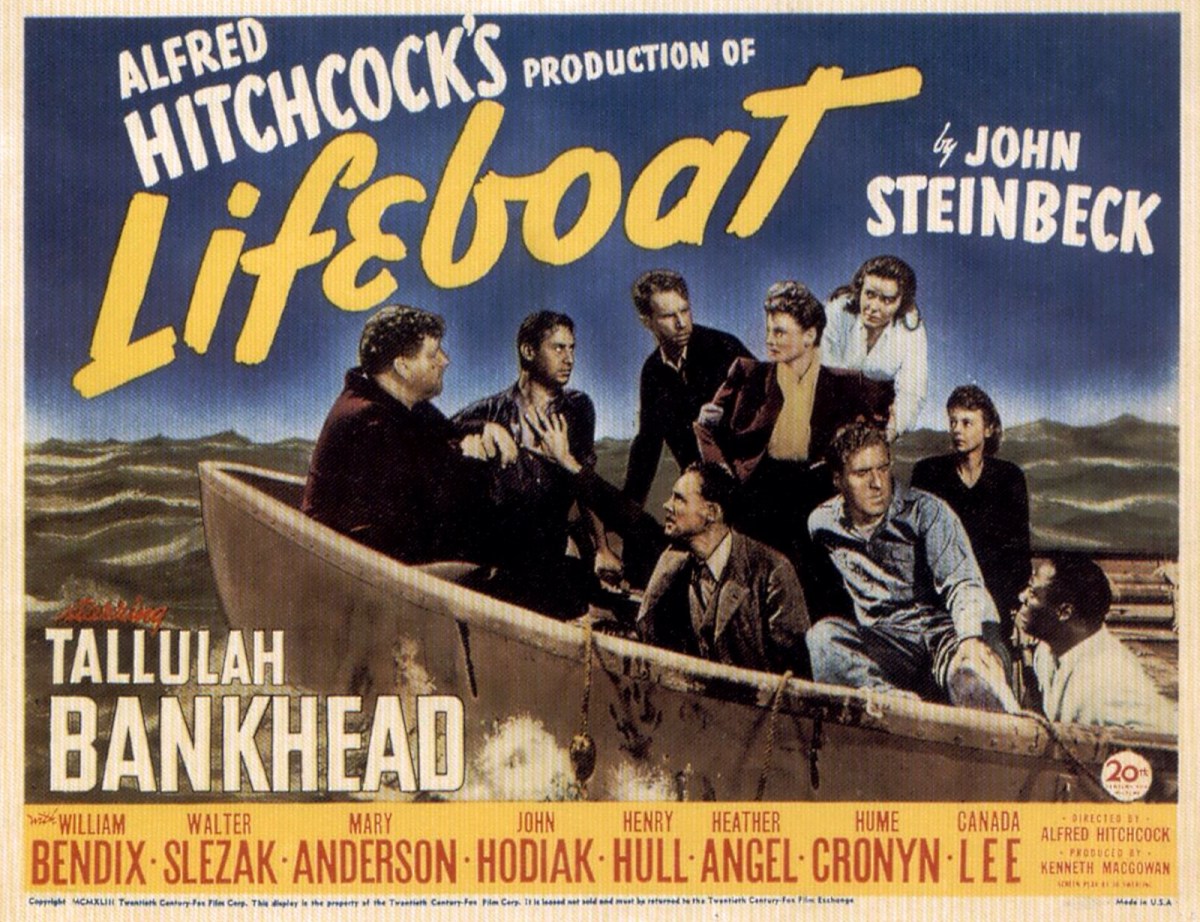
Lifeboat, the first of Hitchcock’s limited-setting pictures, follows the story of British and US civilians, merchant marines and service members in the aftermath of a battle that sees the sinking of their boat and a German U-Boat. When a German man Willi (Walter Slezak) is also rescued, the tension on the boat increases and coping with the harsh environment and the claustrophobic arrangement takes its toll. Pretty soon suspicion and accusations take the place of compassion and reasoning, with a plot that keeps the audience guessing way beyond the final scene.
Released towards the end of World War II, the film was shrouded in controversy due to the seemingly fair portrayal of a German man who turns out to be a Nazi soldier. This was enough to make the studio give it only a limited release – a surprise given that Rebecca, Saboteur and Shadow of a Doubt had all been box office successes in the immediately preceding years. Furthermore, John Steinbeck (who wrote the original novel) distanced himself from the adaptation, unhappy with the way Hitchcock had dealt with his work.
It is perhaps only years later that we can appreciate this film for what it is – a good film heavily influenced by the times and heaped with elements of propaganda. In that sense it’s as much a film as it is a historical document. In a way, all cinema is the same.
Lifeboat isn’t amazing, certainly not one of Hitchcock’s finest. I had hoped that the lack of popularity was because of the controversy surrounding its release, but in truth it’s probably because it just doesn’t pack as many punches as the likes of Vertigo and Psycho. It’s worth watching out of interest and worth buying the Masters of Cinema release for the detailed bonus features and two additional little-seen Hitchcock shorts Bon Voyage and Aventure Malgache, though these are more for the avid fans, even more so than the main feature. It’s worth watching, but not as a Hitchcock starting point.
Lifeboat is available on Masters of Cinema and SteelBook Blu-ray now.
I’ll be heading down to the BFI Flare LGBT Film Festival later this month. I’ve tried to pick a couple of films that look really interesting and no set wide release date in the UK, as follows:
– Tiger Orange – Dear White People
Both look fantastic and I’m looking forward to soaking up the atmosphere at the hub of British Film on London’s Southbank. See you there!!
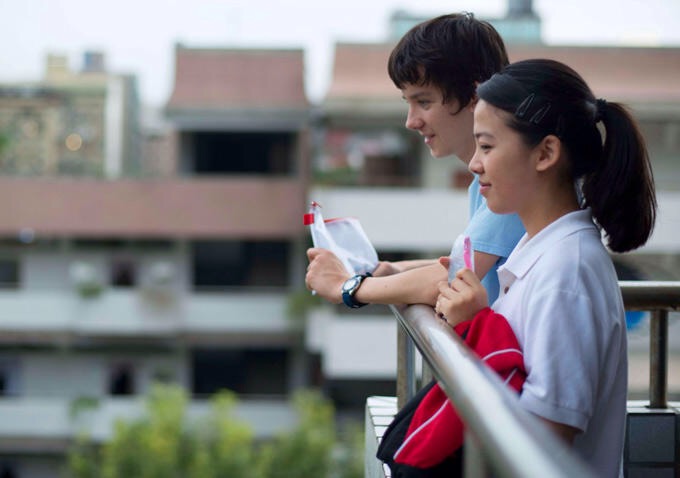
X+Y is a British film from BBC Films that follows the story of Nathan (Asa Butterfield), a teenage mathematics prodigy who is more comfortable dealing with numbers than he is with people. When he is selected to represent Great Britain on the International Mathematical Olympiad, he is forced to travel to Taiwan. As pressure to perform in the tournament grows and he finds an unlikely source of romance in Zhang Mai (Jo Yang), he soon finds that being out of his comfort zone is the starting point for a challenging journey of self-realisation.
One thing I was worried about as I sat there in the cinema waiting for it to start, was how they were going to portray autism. Inevitably we’re going to compare lead character Nathan to Dustin Hoffman in Rain Man or Russell Crowe in A Beautiful Mind, probably the two most iconic on-screen portrayals of people on the autistic spectrum. Unfortunately for sufferers of autism, this drastically sells the condition short to people who aren’t overly aware of it. Autism is a condition that affects those close to someone on the spectrum as much as the person themselves, and to assume that they will simply be a bit awkward around people and good at maths is doing it a misjustice. Many sufferers find comfort in the strict rules set out in maths – it’s an emotionless interest. However, others find the same solace in a regimented interpretation of music, with its repetitive patterns and melodies and set mathematics behind complimentary frequencies of notes. Others become obsessive over lists and facts, whatever the topic might be. Others just don’t. There are mild forms of autism and severe forms, which is why diagnosis can be tricky as early signs can’t be placed on the spectrum by someone unfamiliar with the condition.
So it’s unfortunate that autism has been portrayed on screen by means of a maths genius yet again, even though the director has previous work on autism (2008’s Beautiful Young Minds), which covers it in a more factual manner. However, X+Y is by no means just a light-hearted walk in the park and I enjoyed the fact a lot of time was spent with Nathan’s mother Julie (Sally Hawkins) as she came to terms with the loss of a close relative with no emotional support from her son. This was an important portion of the film that gave the right emphasis to the right areas and should be applauded.
I felt Butterfield’s portrayal of a child suffering from autism was very accurate, and I felt the frustration seeping through his inability to understand others. He has become a very accomplished actor throughout the three or four major films he has been part of so far, and as long as he keeps his feet on the ground for a couple more years he will continue to be successful for a long time.
Another great performance was from Jake Davies as Luke, whose character was a much more acute sufferer of autism. One scene involving a dead prawn stuck out for me and I’m sure we’ll be seeing more from him in the future.
The comradery of the maths students didn’t ring true for me. From first hand experience (I partook in mathematics competitions as a child, to some success), these competitions are far from a sociable affair, with most children very much “in the zone” and either unable or unwilling to communicate with their peers. It was a case of get in, do maths, win. Anything else was just unneccesary. So when there’s laughing and joking and, most notably, a cringeworthy rap session (including an awful rhymical recitation of Pi), I just thought back to the suits and classical music I had to endure and wondered how much it really could have changed.
I felt let down by the end. I’m not going to go into details as the film is yet to be released, but it just didn’t ring true to me and seemed to undo a lot of hard work they’d put in earlier in the film in a manner that suggests to me they got lost with the message they wanted to send out. I’ll let you make your own mind up on that one.
Overall it’s a very accomplished film and has many enjoyable points, but I didn’t feel it quite fulfilled its potential.
Release date: 21st December 2014 Publisher: Nintendo Platform: Nintendo Wii U Players: 1
I’m not much of a gamer any more. I probably play about two or three games a year. Last year it was Mario Kart 8, Bayonetta 2 and South Park: The Stick of Truth. I also bought Earthbound and never got ’round to playing it. This year is looking about as quiet on the gaming front – I’m interested in a couple of the new Wii U releases and I’ve still got The Walking Dead games to play, but nothing set in stone. I moved in with my fiancé in May last year, we got married in June and then both moved jobs within two months. Between DIY and redecorating, and working to pay for everything in the house, we don’t have the time or money to invest in games. When we do, we try to get co-operative titles we can enjoy together.
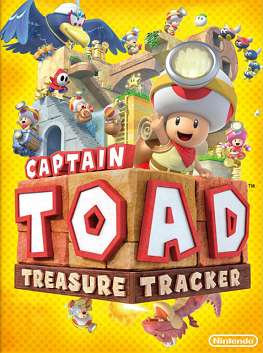
So when Captain Toad: Treasure Tracker was announced, we immediately decided it wasn’t for us. Captain Toad’s levels were our least favourite part of Super Mario 3D World game, and these were clearly just more of the same, set in the same universe and using the same visuals and engine to power it. It was only when I realised I had a significant amount of points on a supermarket card that I decided to take the plunge, and I have to say that we were pleasantly surprised.
Each of the 70 levels takes the 3D jumpless platforming and puts a unique twist on the action, be it moving blocks with a press on the controller screen, getting through a pitch-black haunted house or traversing platforms that disappear on a timer. Completing each level requires a decent amount of brain power that is achievable by all but not so easy to make it feel condescending.
Special mention has to go to composer Mahito Yokota, whose score is just brilliant. He’s a regular fixture now with Nintendo, and it’s easy to hear why. You could easily listen to it in isolation from the game and thoroughly enjoy it. To be fair, almost all of the songs are recycled from its parent game Super Mario 3D World, but if you’ve heard that then you know how special it is.
There is one huge disappointment though, and that is the total playing time. You get several different tasks in each level: collecting the star concludes the level, collecting three diamonds helps unlock further levels, completing a unique one-off challenge (such as taker no damage, find a hidden gold mushroom, kill all enemies or collect a certain amount of coins) gives you 100% completion. Even so, some of the levels are extremely short and are done in a matter of minutes. I felt like I had to put the controller down after five completed levels just to drag it out a little.
Does it work as a co-op game? Well, obviously only one person is controlling at any given time. However, a little like Braid and Limbo, the puzzle elements led to a lot of excited shouting and guided discussions as we worked out the solutions together. Perfect for a couple of engineers.
The reduced price point will help with sales (without the points I used it would have been £28, but it can be found for £25), so the length of the game isn’t such a terrible thing. If you enjoyed the Captain Toad sections of Super Mario 3D World, or you’re in desperate need for a Mario fix ahead of Mario Party 10 next month (or Yoshi’s Woolly World or The Legend of Zelda later in the year) then you’ve got a perfect stop-gap solution in this game.
Something weird is happening in the world of video games. That thing is called Amiibo.
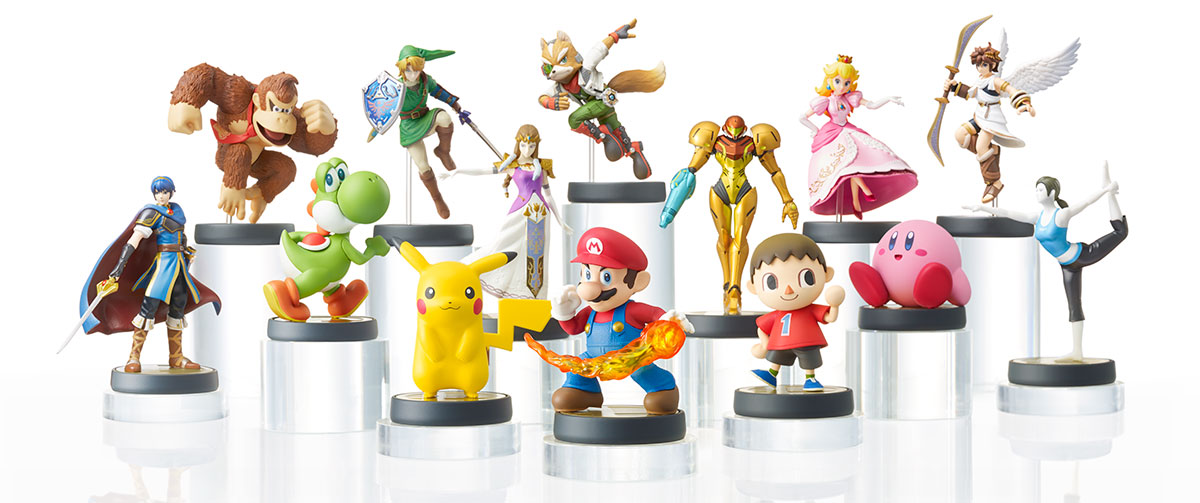
If you’ve missed these, they can be summarised quite quickly thus: Skylanders for Nintendo. But what do they really mean? Well, frankly, a huge hole in people’s wallets. Amiibos are simply small physical 2″ tall models of in-game characters that can either sit on your shelf looking cool or interact with certain titles on the console and save the development progress of your character, opening up RPG elements to games and also special features and DLC in other games.
Eighteen months ago, Nintendo was in serious trouble. Whilst their handheld console the DS (and the 3DS and 2DS and the XL versions and everything else) was still going strong, their latest home console – the Wii U – was sinking fast. On the shelves for a year, the console was still lacking a really strong title they could legitimately use as a selling point. Probably their best game was either New Super Mario Bros U, which is an 8/10 at best and only on a par with its predecessor on the Wii, or Nintendoland, a 12-mini-game compilation whose main purpose was to show off the functionality of the console’s new controller.
So they came up with a mini-masterplan:
– December 2013: release Super Mario 3D World, the best all-round multiplayer platformer ever released.
– May 2014: release Mario Kart 8, the best ever iteration of their über-successful racing franchise, along with an extremely tempting free game offer where people got a code for registering their game online, which could be used to download any of ten titles already released on the console.
– October 2014: release Super Smash Bros simultaneously on the Wii U and 3DS platforms, along with the first wave of Amiibos, just in time for Christmas and designed to milk dry the pennies of anyone willing to start collecting them.
It was a fantastic plan and this triple-whammy of excellent must-have games has pulled the Wii U back on track and places it as the only current-gen console with several games worth investing the time and money in. There’s only one thing that sells video games consoles and that’s video games, no matter how much the “entertainment system” side of things is sold to us.
Not content with three games flying off the shelves and a first set of twelve characters (including Mario, Pikachu, Donkey Kong, Link, Fox McCloud, Kirby and other huge franchise favourites) Nintendo decided to release more and more waves of Amiibos, seeing the desire of the completionist in both the children with rich parents and the 20- and 30-something gamer with more money than sense. What happened next was probably way beyond their expectations.
What we are seeing now is that whilst the first wave was in plentiful supply, the subsequent waves have been less available. A mixture of poor predictions of popularity from Nintendo, a frenzy of excitement about new waves and, strangely, an issue with a port strike in North America has led to a serious under-supply of many of the more recent models. Bearing in mind the RRP for the models is £10.99, a quick look at Amazon has returned the following:
– Rosalina £49.99
– Captain Falcon £29.95
– Shulk £84.99
– Meta Knight £57.97
– King Dedede £57.97
– Little Mac £44.99
The fun doesn’t stop there. Plenty more are simply out of stock and unavailable, including those up for pre-order in Wave 4 at the end of March. Ridiculously, one man has bought $10000-worth of Amiibos out of spite because he doesn’t like certain characters. People are going on wild-goose hunts when a rumour surfaces online that a particular Toys “R” Us has got a stock of Toon Link (I made this one up but it probably happened). It has all got quite out of hand.
The terrible thing is that having read stories online about them, I don’t think it’s kids that are after them. The people buying Amiibos are fully-grown adults, usually men, trying to complete a set. Think about it… even if you’ve managed to get them all at face value, you’re still going to need to spend over £400 before you’ve thought about a game. I’ve got friends who bought Super Smash Bros. and picked up a couple of Amiibos to try them and have decided it isn’t for them… because they don’t really do much. They’re just nice to haves. I thought we were in a recession!?
The worst story I heard was about a man going in to buy all of a particular store’s stock on release, then walking out past a child and refusing to part with any of them, even as the child begged him for just one of the toys. So not only are you buying up toys (they’re not models really, they’re toys), you’re also now breaking the hearts of children. Way to go.
I don’t own Super Smash Bros., so I don’t see much point in investing in any. If I had one of the games that they are useful for, I might consider buying one or two, but only if they’re cheap. By the sounds of things, Nintendo won’t miss my business!
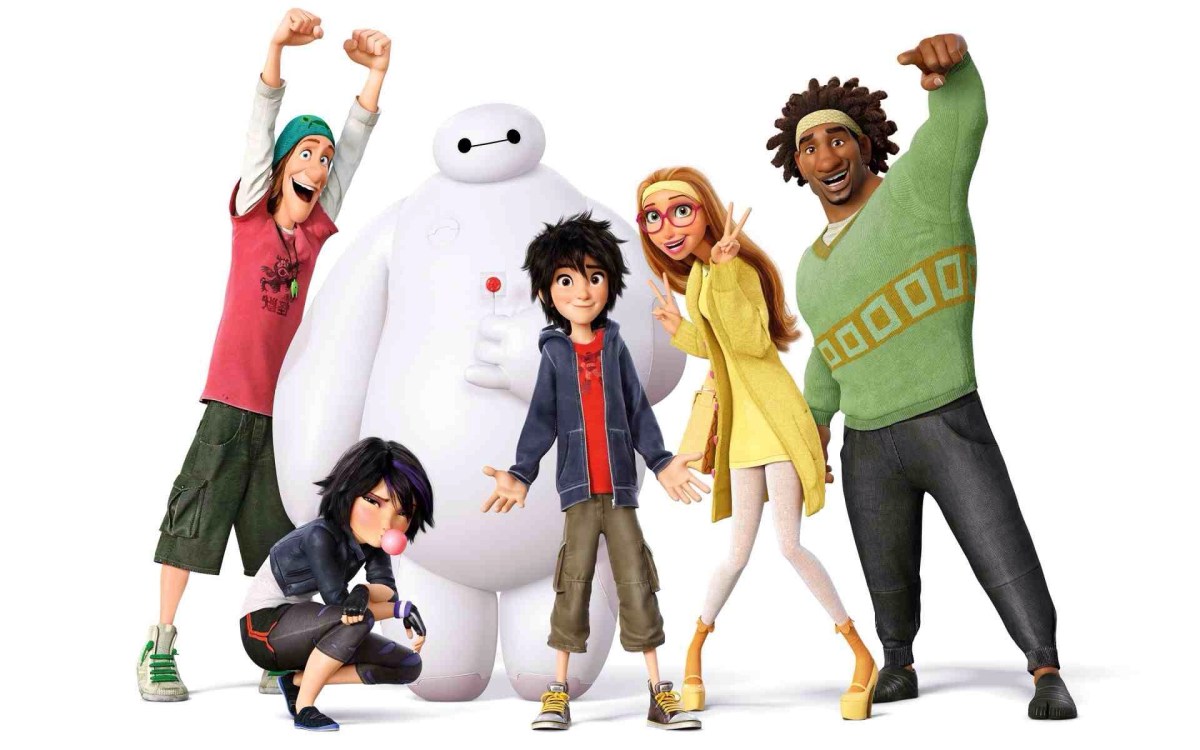
As the first Disney-animated motion picture based on Marvel IP, Big Hero 6 was always going to be carefully scrutinised by both extremes of the target audience. At one end you have the die-hard Marvel comics fans, keen to see their beloved heroes done justice on the big screen. At the other end you’ve got fans of Walt Disney Studios, worried that hot on the heels of Frozen, Tangled and Princess and the Frog, Big Hero 6 might not be for them [1].
For the uninitiated (you mean you never read the comics!?), the story focuses on 12-year-old parentless robotics genius Hiro, who is being looked after by his aunt, along with his older brother and sort-of-guardian Tadashi, who also studies robotics at the local university. When further tragedy strikes through the death of his brother, he is left to pick up the pieces with the help of his brother’s greatest work – healthcare-robot Baymax. Banding together with Tadashi’s fellow student friends, Hiro goes on an adventure of vengeance and self-development as he finds taking matters into your own hands can lead to some shocking revelations.
So the first thing to clarify is that the Big Hero 6 comics were never very popular. Very few people had heard of them before the film was announced, sparking a huge clamber across the internet to find the comics, read them, then form an opinion on why Disney was going to ruin them. They weren’t completely unknown, but they were nowhere near as popular as, say, Spider-man or X-Men. It was interesting to see the negative reaction the series got when it was announced. It’s amazing how many experts on everything we see now that people can form their arguments in one window whilst Google is open in another. I was one of the people who bought post-announcement – I managed to pick up all five of the 2008 comics and I read straight away (the original three-part series was by then already prohibitively expensive, much like the five-parter is now). They were obviously aimed at children, but were reasonably fun and easy to read. I thought they were a good choice for Disney to tackle, with plenty of characters and merchandising opportunities.
Secondly, I don’t know if you’ve seen any of the recent Marvel Animation films, but they are by-and-large terrible. I picked up the Ultimate Avengers steelbook about a year ago and watched one of the films, but couldn’t get through the second. The animation is really poor and the voice acting is clumsy and difficult to listen to. So if you’re a Marvel fanboy and want to square on an animated film that doesn’t do your source material justice, you should start there.
Finally, the recent films have been very successful, and I’m sure Frozen’s enduring popularity caused a delay to the release of Big Hero 6. I mean, it’s now on the West End in sing-along form! They just play the film on loop there all day. It has been out for 18 months! Princess and the Frog and Tangled were very successful too. But so was Wreck It Ralph, and that definitely wasn’t aimed at the female market. Neither was Bolt (directed by Chris Williams, by the way). Nor were half of the Pixar releases. Or, say, How to Train Your Dragon or Despicable Me. What I’m saying is – who knows what is going to capture the imagination of the children. Probably the main thing to go for is a great storyline, great characters and some top-drawer visuals. You get all three in abundance here.
I think the animation is the really mind-blowing element of a film that scores highly across the board. It’s fast-paced without ever feeling like it’s trying to lose you in action. The detail given to the plethora of uniquely designed characters is notable, too, and this serves to make each character feel worthy of your investment. If they’re going to spend that long making Hiro’s hair look so awesome, he must deserve a bit of attention on an emotional level too.
The storyline, to be fair, isn’t particularly original. I didn’t feel it was too detrimental overall. Its target audience is definitely under 12 years of age, and it was pitched perfectly.
There was, of course, a post-credits sequence that gave us some juicy details and opened the door to a sequel. I really hope this becomes a reality. I’m sure there are plenty more storylines to be told about these characters yet.
Big Hero 6 is out in cinemas in the UK now, and it has also just this week been released on Blu-ray and DVD in USA. If you’re quick and keen, you could buy the 3D Blu-ray steelbook from Zavvi.
[1] Anatomy of an unprofessional reviewer – I’ve deliberately put in several sweeping and largely incorrect statements in the first paragraph to allow me to argue against them later in the review. Oh how clever I am.
Version reviewed: The Park Circus UK Region B/2 2010 Blu-ray/DVD dual format release as part of The Charlie Chaplin Collection.
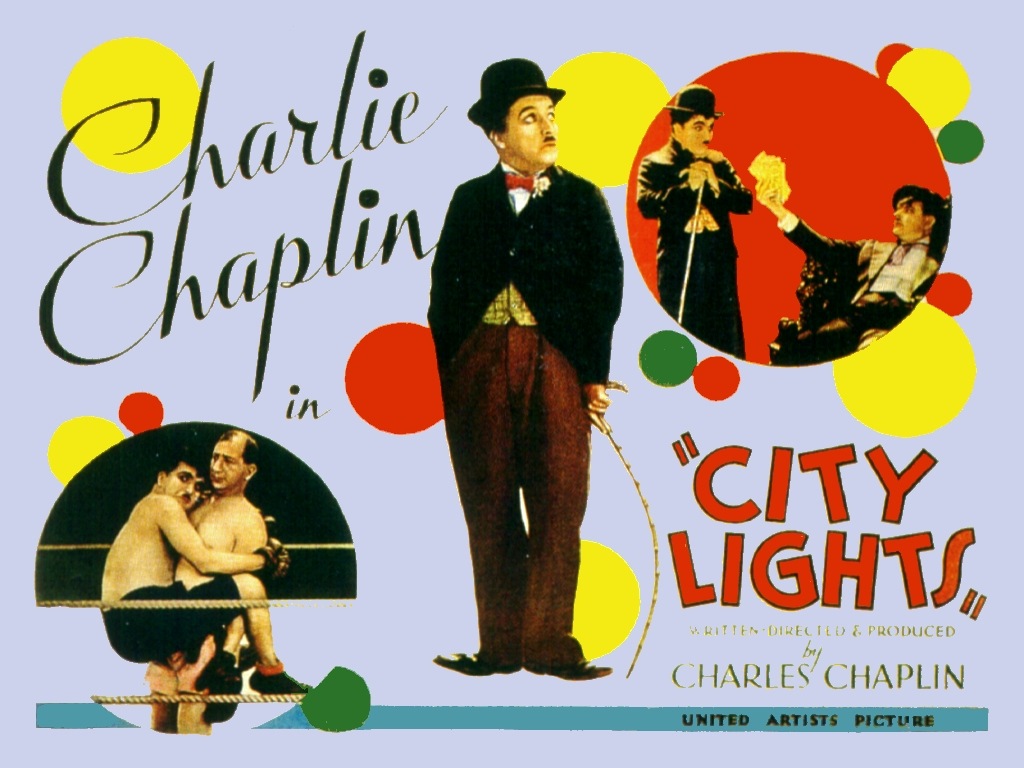
Considered by critics as not only one of Chaplin’s greatest films, but also one of the greatest films of all time, City Lights is a wonder to behold. Fantastic from start to finish, equally hilarious and touching, wonderfully scored and acted, it’s a film that needs to be seen and the continued praise is more than justified.
The (spoiler-free [1]) storyline goes something like this: A tramp (Charlie Chaplin) falls in love with a beautiful blind flower girl, who is in dire financial trouble. The chance befriending of a wealthy and frequently drunk man plus a series of money-making schemes play out as the tramp attempts to find the money that will help the girl’s family and pay for an operation to fix her blindness.
The storyline is the perfect basis for some hilarious moments, including a legendary boxing match and the following clip I found on YouTube. Is there a more hilarious way to introduce his most well-known character?
It’s not just a series of old-fashioned silent pantomime comedy routines, though. I’ve seen a handful of Chaplin’s most popular films and anyone who has even dipped their toes in will know that he’s way more than just a performer of slapstick comedy. There are moments throughout his films that really pack an emotional punch, with his tramp rarely getting a fair deal in life. Equally, when it comes to romance, Chaplin is nothing short of astonishing, never more so than in the final sequence of City Lights film. Despite the film being over 80 years old, I’m going to avoid any spoilers. Just watch it.
The film is classed as a silent film and for the most part it is, though there are some parts where the audio and visuals synchronise up, most notably when the tramp accidentally swallows a whistle. I’m not going to sit here and claim to be all-knowing about what is a silent film and what isn’t, but it was nice to see Chaplin making use of the more advanced audio-recording techniques that had become available after his last film’s release, 1928’s The Circus.
It is fortunate that we are even able to see City Lights as we do today. Following the release of Al Jolson’s The Jazz Singer in 1927 (which featured large sections of synchronised audio, though was not entirely a talkie), the end of the silent era of films was put into motion. By 1931, when City Lights hit cinemas, the major studios had stopped producing silent films and were following the desires of the cinema-goers by producing talkies. As Chaplin was the producer, writer, director and star, he was able to follow his instincts and released another silent film, a decision which was vindicated by the exceptional box office receipts (it turned a profit of around $3.5m, and was the fourth-highest grossing film of the year). It is somewhat strange that its popularity has maintained given it was technically behind the times upon release, though that is just a sign of its timeless quality.
Speaking of timelessness, I found it remarkable how little the content of the film had aged. Indeed, I wonder how the top-grossing comedic actors of 2015 would handle the content of the film. With a blind woman as the main love interest, would Adam Sandler have been able to resist a cheap joke at the expense of her disabilities? Indeed, Will Ferrell touched on blindness in a sequence in Anchorman 2, which, whilst pretty funny, lacked a little tact. There is no suggestion here that Chaplin was going to undermine blindness – this woman is beautiful and that’s all that matters.
Chaplin’s Tramp with his nameless love interest
There are some bonus features on this release, however they are limited to the DVD version as they are standard definition. I haven’t got to them yet, but they look interesting: video footage of Winston Churchill visiting the set, seven minutes of outtakes, an introduction by David Robinson (Chaplin biographer), a 26 minute documentary about the film called Chaplin Today: City Lights and a photo gallery. What I would say is this – the video quality on the Blu-ray is not so exceptional that there is no room left on the disc for the bonus features on the DVD, though I wonder whether this is more due to the source material than anything else. I plan to write a separate blog charting my frustrations with buying Chaplin in the UK, but that’s for another day. To summarise: I wish Criterion releases were cheaper to buy outside of the US.
As a side note, I was looking for a featured image for this article and came across a wide variety of English-language and foreign alternative posters for the film. Some of them are really impressive and are a good indicator of how studios used their perception of the local markets to gauge the tone of the poster. The following is one I found from Germany that I found particularly interesting.
Alternative German poster for City Lights (or Lichter der Gross Stadt)
[1] I class any description that can be deduced from the DVD/Blu-ray box or trailer, or that only covers events in the opening sequence of the film, as spoiler-free.
Here’s a simple list of all the winners of Oscars at the 87th Academy Awards last night. I’ve not included the other nominees as I think the lists elsewhere have become cumbersome. Keep it simple!
So there you go. I was really disappointed that “Everything Is Awesome” from The Lego Movie didn’t win Best Song, not least because the eventual winner was pretty dreadful (I talk about them here). I was happy about the Disney double of Big Hero 6 and Feast – both are excellent and I’ll no doubt be reviewing them on here when I get around to it. The really obvious ones won, of which for me there was only three: Eddie Redmayne for Best Actor, J. K. Simmons for Best Supporting Actor and Birdman for Achievement in Cinematography. That’s how tight it was elsewhere.
I’m thrilled that Birdman won Best Film over Boyhood and American Sniper. Birdman is a seriously effective piece of cinema and a work of art. It has things that appeal to the Academy: the struggling actor struggling to cope with his own relevance, a technically excellent piece of cinematography that (sort of) uses one shot, some fantastic performances from a range of excellent actors and actresses.
So today is for everyone to digest the results and look back on a fantastic year for cinema. Here’s to the next one.
The BFI Flipside series is, according to the back of the Blu-ray box, dedicated to “rescuing weird and wonderful British films from obscurity and presenting them in new high-quality editions.” I picked up a few of them when my local Zavvi finally closed down a couple of years ago (yes, there really did used to be Zavvi shops that you could walk into), meaning a lot of Masters of Cinema and BFI releases were reduced to about £7-8. One that I picked up and put at the bottom of my “to watch” list was The Party’s Over, Guy Hamilton’s 1963 controversial release.
Opening with a drunken Chelsea party, we’re immediately introduced to Oliver Reed’s pack leader Moise (pronounced “Mo-Eece”). He’s a handsome and popular guy, not afraid of being the centre of attention but equally happy to slip into the background. He shows off a bit and everyone looks on in admiration. This is then juxtaposed by a painfully cool opening sequence as Melina (Luoise Sorel) walks towards the camera, brilliantly soundtracked by Annie Ross and John Barry.
A shot from the painfully cool opening sequence
It’s obviously a film that isn’t afraid to glamorise its subject matter and candidly display every part of their lives, and I suspect that was one of the reasons it was withheld from release subject to several cuts and changes. This was 1963 after all, and censor John Trevelyan perhaps thought an audience besotted by a young new group called The Beatles were unnerved enough without this kind of film further rotting their brain. In short, the world wasn’t quite ready for the subject matter [1].
Despite a decent range of characters, it is Oliver Reed who steals the show throughout. His is a character that snaps his fingers and gets what he wants immediately, such is the influence he has over his beatnik and largely non-descript gang members. As the plot develops through some shocking developments – including sexual assault and suicide – it is Reed that maintains his position as the driving force of the narrative, much as Moise is the driving force of the gang.
It is a shame that there are several lacklustre performances. The supporting cast look like they’re straight out of acting school and don’t look overly comfortable in front of the camera. Several of the leading cast either overact or lack conviction, which is quite an achievement in itself when you think about it. Carson (Clifford David), Meilna’s fiancé, provides a solid performance and rescues the film from being a poor one-man-show.
BFI Flipside has been responsible for a number of excellent releases, with as much care given to their release as any famous film. Whilst the audience is undoubtedly more niche, it’s great that we are able to watch a film like The Party’s Over without any edits as the production team originally intended [2]. It’s not a film that has changed my life, but it might have had a much greater impact on the landscape of cinema had the censors not got involved some 50 years ago [3].
The Party’s Over is out now on BFI dual-format Blu-Ray and DVD.
[1] This release contains extensive words on both the censoring of the film and the director’s recollection of making and editing the film in line with the increasing pressure from Trevelyan.
[2] According to the booklet, one edit was made at the request of the director, with the removal of the credits over the opening sequence. It is unnoticeable unless, I suspect, you vividly remember to original.
[3] The Wikipedia page suggests the film was made in 1965. It was eventually released in 1965, but I’ve decided to list the film as a 1963 release. This was done because the version presented is as close as we’ve ever got to a version director Guy Hamilton’s pre-censor vision. The film was completed in 1963 and this is the version I have reviewed. For completionists, the 1965 version is also included on the Blu-Ray disc.
I may create a separate one listing them in chronological order (of the original release of the film). That’s something for another rainy day. Can you tell I’m unable to walk at the moment and stuck at home all day?







 Cinema, etc.