Film review – The Good Dinosaur (Peter Sohn, 2015)

Pixar’s latest effort The Good Dinosaur is a by-the-numbers buddy comedy set in an alternative history where the asteroid that would have wiped them out has missed Earth completely, meaning dinosaurs and Neanderthal humans live side-by-side. It concerns a timid dinosaur called Arlo (Raymond Ochoa) who is split up from his family has to befriend a dog-like human called Spot to survive and return home.

The Good Dinosaur was destined for problems before it was released. Originally scheduled for a Christmas 2013 release, it has been put back several times, each time causing confusion and issues for the other Disney films on track for their respective releases. According to Denise Ream, one of the film’s producers, the primary reason for the rescheduling was “the story was not working, period, full stop, it just was not where it needed to be.” The director Bob Peterson, who previously found success with Up, was removed and replaced with Peter Sohn, allegedly because he was too involved with the film.

The upshot of it all is that it has found itself living in the shadow of the excellent Inside Out, which has barely left the cinemas, and is competing for shelf space in the various toy stores across the land with Star Wars: The Force Awakens, which is set for release less than a month after The Good Dinosaur. It was also released in the middle of a school term, drastically reducing the opportunity to go and see it for anyone with children in school. So does that make the target audience parents who aren’t working and have children old enough to go to the cinema but under the age of 4? I guess so… [1]

The film itself feels like an unfinished product. It is the first time I’ve watched a Pixar film and genuinely felt like they’d given up on it. It feels like a last-gasp chance to recoup on a project that will, at best, break even.

The character design is uninspired. None of the dinosaurs offer any of the individuality or appeal audiences have come to expect from a Pixar or Disney film. The beautiful environment goes some way to make up for this, but only Spot himself felt like a fully realised character.

If the reports are to be believed, then the problems with the film lied in the final third. This is, then, presumably where the cavalry came in to take over and save the day. Sadly for Peterson, this is exactly where the film picked up a bit and paid off on some of its promise.

Two scenes stuck out as being particular highlights. The first was a beautiful montage scene where Arlo and Spot ran through an open plane full of birds was vintage Pixar. The second was an emotional scene in which Spot is effectively adopted by another Neanderthal family at the encouragement of Arlo.

Perhaps both of these were Peterson’s work. Will we ever know?

As a 31-year-old man, I know I’m not the target audience for this film. I do have an appreciation for all good animation though and this falls a long way short. The best critics are the children. Four days after its release, the cinema was about 10% full. The children present seemed restless and disinterested. A few parties left. Maybe they went home to watch something more enjoyable. Or, you know, fun.

The Good Dinosaur is currently on release at UK cinemas.

[1] In my local cinemas only one screening was achievable for workers and people at school, which was a 6:30 screening at a Cineworld. I don’t know how many people were at earlier screenings.

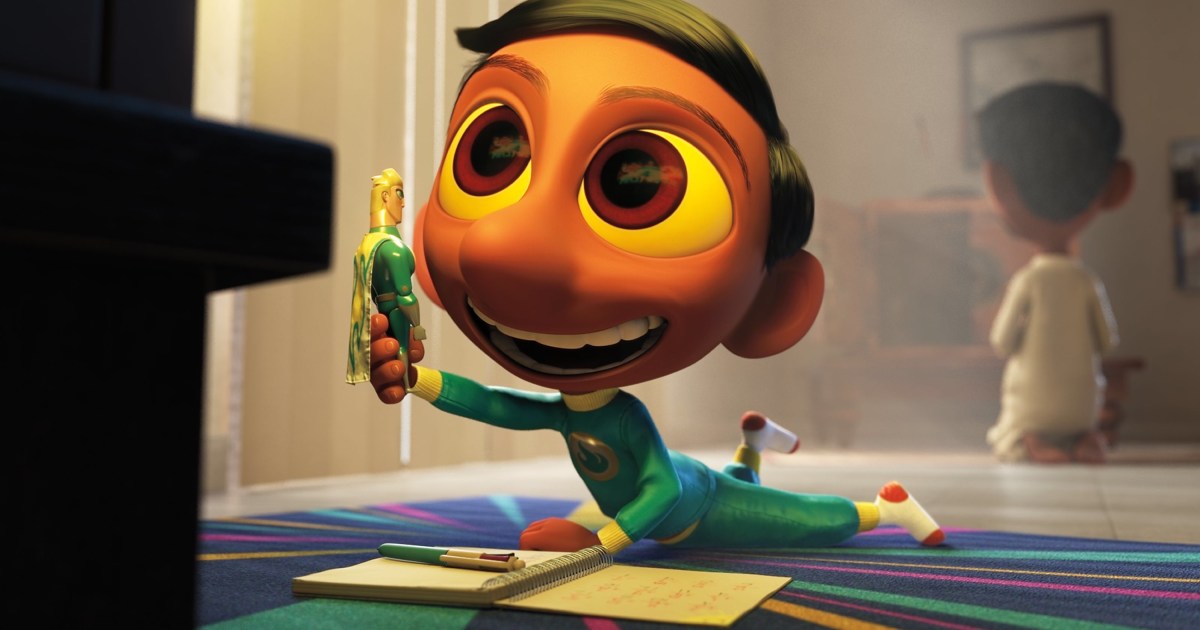
Sanjay’s Super Team (Sanjay Patel, 2015)

If you were keen enough to get to the cinema early enough before The Good Dinosaur, one of the worst Pixar feature films thus far, you’ll have been treated to Sanjay’s Super Team, one of the worst Pixar short films thus far.

Sanjay realises just how bad The Good Dinosaur is.

The story, based on the true memories of director Sanjay Patel, revolves around him as a young child and the conflict between him wanting to enjoy a superhero TV show and his father wanting him to join him in prayer. Frustrated when his father turns the TV off and forces him to pray, Sanjay uses his time of reflection to daydream into a strange world where his Hindu gods are more like superheroes.

The cel-shading technique used in the daydream sequences is a bit of a let down and feels like a quick solution, despite the best efforts to make it look as colourful as possible. I couldn’t help but imagine how good it would have looked with more attention to detail.

This is a film about a child having doubts over his beliefs and a clash of cultures. Whilst many won’t understand the precise religious and cultural aspects at play, most will appreciate the story from the position of a child not wishing to have to follow in the footsteps of the parents. In principal I don’t agree with using religion as a basis of children’s entertainment, but it works well in this case to create a story for the older audience members.

Unfortunately, the overall result is a bit bland. There was no dialogue, the brilliantly coloured dream sequence lacked any real wow factors and it didn’t move fast enough to make use of the lengthy running time for a short film. The children in the audience voted with their restlessness and disinterest. 

In this sense, it was the perfect warm up for the main feature.

Riley’s First Date? (Josh Cooley, 2015)

If you loved the Pixar animated feature film Inside Out then chances are you’ll… like “Riley’s First Date?”, the short included as a bonus feature on the various Blu-ray versions of the release.

It centres around a mysterious boy showing up at Riley’s household to take Riley out, with most of the jokes coming from the parents’ reactions to interacting with him. If you’ve seen Inside Out itself, it is essentially an extension of the final sequences of the film, popping in and out of the characters’ heads in rapid succession for quick laughs.

It lacks any of the emotional pull that made the film a huge success over the summer, but it does succeed in getting a few jokes that make it worth a watch. It can’t go down as a reason to purchase the Blu-ray – you don’t need any more reasons than the fact it’s the best Pixar films released for years.

Bridge of Spies (Steven Spielberg, 2015)

After a relatively long break, Steven Spielberg is back behind the director’s chair, and it was worth the wait.

Reading the description of Bridge of Spies, his first film since the hugely successful biopic Lincoln, it has all the hallmarks of some of his greatest achievements in cinema. It’s based on a true story. It’s a story about individual battles within a larger situation. It stars Tom Hanks. It would have been a surprise if this wasn’t a huge success.

Set between 1957 and 1960 during the height of the Cold War, the film focuses on James B. Donovan (Hanks), a lawyer tasked with negotiating the release of Francis Gary Powers (Austin Stowell), a pilot whose U-2 spy plane has been shot down over the Soviet Union. The negotiation concerns trading Powers for Rudolf Abel (Mark Rylance), a Soviet KGB spy held captive in the USA who Donovan has previously defended in court. However, tensions rise when Donovan shows his determination to include an additional US citizen – student Frederic Pryor (Will Rogers) – in a move that seemingly only he is keen to see through.

bridgeofspiesscreenshot

The film at times threatens to be sabotaged by a slow pace, though Spielberg keeps it going just enough to avoid it becoming a snooze-fest. The plot is one full of intricacies that reward the attentive viewer, so I’m not sure the modern audiences will get it in the same way they did with Schindler’s List, for example. [1]

This is an ode to traditional storytelling and any movements it makes to remind us of Spielberg’s supreme talents are trumped by its underlining of Tom Hanks as one of the greatest living actors. This is not a story about espionage, politics or the Cold War. It is a film about one man’s unwavering desire to stick to his principles. Hanks portrays Donovan as a totally unassuming man whose aggression is only touched on when he feels the principles for which he stands are threatened. As with most of his best roles, it has a way of pulling you in and asking you what you would do in his shoes.

If it is considered for any awards in the next few months, it will be for Hanks as an actor in a leading role. For all the clever cinematography and attentive set design, they are merely the stage on which Hanks is allowed to fly.

Bridge of Spies is release in cinemas worldwide on 27th November 2015.

[1] I’m well aware that this sounds condescending. It is fueled directly by the woman in front of me who three times during the film decided to have a quick check of her phone next to her pocket. Whilst it was only a minor distraction for me (it wasn’t so bad to warrant me tapping her on the shoulder), she missed two critical plot points and the description of what the characters did next in the final credits. Definitely a justification for the theory that the audience’s participation level is as important as the care put into a film.

Nightmare City (Umberto Lenzi, 1980)

Nightmare City falls under the category of “so bad it’s good”. Umberto Lenzi manages to pull off some ridiculous scenes but gets away with it through consistency and dedication.

First off, if you’re new to Italian horror, you need to know that it can be quite off-putting watching a film in Italian with English subtitles, especially when it’s obviously been dubbed from English into Italian. If you’re quick you can read the sentence then lip-read the actors and realise they’re actually saying what is written. It can take getting used to but once you’re past that you’ll quickly realise that the acting is about as bad as you initially thought it was.

The plot doesn’t stray far from the norm for a zombie horror film. A group of humans have been subject to nuclear contamination, leaving them with superhuman strength. They are running riot in an unnamed city and television news reporter Dean (played by Hugo Stiglitz) is trying to survive as the city falls apart. As each person is killed, of course, the victim joins their cause, meaning their strength is ever-growing.

This film contains a number of hilarious shots and it worked exceptionally well in a packed and jovial cinema. A frequent feature is the appearance of young women’s breasts. You never quite know when the next pair is going to appear. The frequency of it was a source of great amusement. I’m not sure if this was common at the time but it definitely seemed out of place.


She certainly had an eye for detail.

 
Equally, barring the main characters, everyone was completely stupid. Getting attacked by zombies? Let’s just run from left to right panicking, then run from right to left doing the same thing until we get attacked. Brilliant.

Our hero, Dean, wasn’t very supportable and lacked the charisma required to get away with the things he was doing. He regularly screws over fellow survivors, at one point he punches his girlfriend in the face, he leaves a group of people trapped in an elevator. It made it hard to get behind him, even when it seemed he was the only one set to survive and we were forced to follow his story alone.

SPOILER ALERT!! The ending was the kind that all ten-year-olds go for when they run out of time and ideas in a story-writing class. Yes that’s right, it was all just a dream. It was disappointing and was rightly met with groans across the crowd. Nobody’s story was tied up. They just must have ran out of money.

It’s a bit of lighthearted old-fashioned gory horror that will no doubt entertain you, but probably won’t change your life. The ending is so disappointing it unravels any of the successes it has managed to pull off.

Nightmare City is available on Arrow Video Blu-ray now.

Maggie (Henry Hobson, 2015)

Post-apocalpyptic zombie horror film Maggie was screened as the opening film of the UK Festival of Zombie Horror Culture at Phoenix Cinema in Leicester in November 2015. The film stars Arnold Schwarzenegger as Wade, a man whose daughter Maggie, played by Abigail Breslin (best known for her performance in Little Miss Sunshine), has been infected by a zombie virus. Having been bit, she has fled home to protect the rest of her family. The film opens with Wade finding his daughter, who has been missing for two weeks, and taking her home to his wife. It then follows her slow transformation towards “the turn”, and the affect that has on her and her mother and father.

Drop Undead

Drop Undead

One thing we’ve come to expect when watching an Arnie film is an over-the-top performance with lots of one-liners and a handful of big set pieces. These are not present here. Instead, we get Arnie in an extremely restrained mood, and the result is perhaps the most convincing performance of his career. As one of the first films announced after his return to film from his political career, this was a perfect choice and is a great advert for more roles in a similar vain as he moves into the next phase of his career.

Breslin also shines in a complicated role where a girl is facing certain death. Having attempted to go through this on her own, she is desperately in need of her father. This complexity isn’t easy to pull off but she does it well, showing an increasing amount of fear as she gets further infected.

Where the film falls down is its slow pacing. It draws us in at first, but a slow pace clearly designed to explore the emotional side of the key characters paves the way for a few too many “switch off” moments. Admittedly, there is no room for a big stand-off and that kind of thing would have been out of place, but montages of time passing are easy to put together and allow the viewer to disingage for a couple of minutes.

Overall, well worth watching for the chance to see Arnie’s acting credentials and as an interesting angle on the genre.

Maggie is available on Blu-ray and DVD now.

Film review – THX 1138 (George Lucas, 1971) – Asian Dub Foundation Re-score

A long time ago, precisely ten years before Star Wars hit the big screen in 1977, George Lucas was a young and experimental college student at film school at The University of Southern California. Packed with rich ideas and concepts of science fiction and Orwellian futures, he set about making the short film that would first bring him to the attention of Stephen Spielberg – Electronic Labyrinth: THX 1138 4EB. This short won prizes and accolades, including first prize at the National Student Film Festival in 1968.
Soon after Lucas left college, production began on a feature length adaptation of the story, using the short film as a basis of the climax to the film and providing a backstory and richer background to the concept.
The film stars Robert Duvall as THX 1138, a worker at a factory that manufactures android police officers. His roommate LUH 3417 (Maggie McOmie, in her only major film role) is a CCTV operative. After she switches their mind-controlling pills, they disobey strict rules and have sexual intercourse, which is a punishable crime. Imprisoned with SEN 5241 (Donald Pleasance), LUH’s co-worker, and fuelled by the fear of being trapped for the rest of his life, THX launches an attempt to escape from this underground dystopian prison.

At times overwhelming

At times overwhelming

I have to confess that this live scoring event was the first time I’d seen THX 1138. This is a film that is itself much less immediate than the Lucasfilms pictures we are now more familiar of, and one that requires a level of concentration to follow the plot. Unfortunately, Asian Dub Foundation’s live scoring was somewhat relentless and unforgiving. On several occasions it simply drowned out the limited dialogue, making understanding the film almost impossible. Not only that, but the music didn’t really match up with what was happening on the screen. It felt like an Asian Dub Foundation gig for which they’d decided to use the film as a backdrop for their performance.

Sadly for the film and the musicians, a large portion of the crowd decided they weren’t on board with either element and left before the end. Perhaps it was a victim of clashing with the opening night of the latest Bond film Spectre, and maybe some of the attendees decided to catch a late showing instead of seeing how THX’s escape plan player out.

Where it did work, it was very impressive. The car chase in the final act of the film was excellent and the music added a lot to the scene. This is one of the most exhilarating car chases I’ve ever seen and is a worthy pay-off the often times slow paced story development in the preceding hour of film.

I’ll be seeking out the original version of the film to see if I enjoy it more without the distracting score.

THX 1138 is available on Blu Ray and DVD now. Of course, this is a George Lucas release so it is impossible to see the original film in its originally planned state. It has been tampered with. Since most probably never saw it in its original form, however, there shouldn’t be many issues here.

Steve Jobs (Danny Boyle, 2015)

The 2015 BFI London Film Festival came to a close this evening with the European Premiere of Danny Boyle’s Steve Jobs. With all the stars out on the red carpet, it had all the hallmarks of a blockbuster finale on the scale of any of the Apple product launches we’ve become so accustomed to.

The biopic plays out in three distinct acts, all during iconic Jobs-headed product launches: the 1984 launch of the first Macintosh home computer; the 1988 launch of the NeXT Computer for NeXT Inc. (the company Jobs set up after being forced out of Apple); and ending with the 1998 launch of the first iMac computer.

Jobs worth

Jobs worth

Whilst it may risk being a big advert for Apple, the poor picture painted of the figurehead of the company throughout ensures that is never the case. The Steve Jobs we get to know over the course of the three acts, which play out in real time in the lead up to each of the presentations Jobs is giving, is narcissistic and self-centred, only relenting from the power trip when he finally achieves the success he has been driving for. It shows softer sides of his personality and attempts to justify his unique traits but the focus on his tempestuous relationship with his ex-girlfriend Chrisann Brennan and their child Lisa ensures his best side is never seen.

It is actually a difficult watch throughout. It is basically two hours of arguments, eventually becoming tiring. It does successfully portray the frantic and intense atmosphere of a huge-scale product launch in a very real manner. It fails, however, to convince that this is a good platform for great cinema.

Michael Fassbender plays the Steve Jobs we see here to perfection, capturing the nuances required of someone who is heartless to the extent of being cruel. Kate Winslet’s turn as Joanna Hoffman is steadier than her accent, and Seth Roger puts in an adequate performance as Steve Wozniak. The standout performance is quite minor but nontheless critical: Michael Stuhbarg is exceptional as the bullied inventor Andy Hertzfield.

The biggest success is the genius move to film the picture on era-appropriate equipment. The three scenes were each filmed using totally different techniques: 1984 was captured on beautiful 16mm film, 1988 on 35mm film and 1998 on digital film. The evolution of technology is reflected in the format change and portrays each era in a manner that would have been impossible with digital post-production.

Whilst it isn’t a let down, it will be difficult to find a sustainable market for this film. It’s not a straight biopic, it isn’t hugely in favour of Apple, nor is it against it. It’s a struggle to watch and is unlikely to have people raving about its successes as they leave the cinema. 

It could be Danny Boyle’s Newton moment.

Steve Jobs is released in cinemas in the UK in November.

Further Viewing

If you enjoyed the film so much you’re interested in some further viewing, then check out the below videos. In the film you see the 40 minutes building up to the release of three products, but never get to see the keynotes themselves.

1984 – Original Macintosh home computer

The original keynote:

The Superbowl “1984” advert:

1988 – NeXT

The 1988 keynote speech isn’t available on YouTube, but this ABC news segment is a close fit:

1998 – iMac

The full video in all its glory:

Film review – Star Wars Holiday Special (Steve Binder, 1978)

There was a time about fifteen years ago when very few people had heard of the Star Wars Holiday Special. George Lucas was no doubt thanking his lucky stars as what is generally considered an abomination had disappeared off everyone’s radars, the VHS copies in the hands of the general public were slowly deteriorating and there was little opportunity for the story to proliferate.

Unfortunately for Lucas, however, the internet happened. Nowadays, the average adult fan of Star Wars has very much heard of The Holiday Special and has probably made an attempt to watch it, given that it’s so readily available on the likes of YouTube.

If you haven’t heard of it, the basic backstory is that in 1978, one year after the release of the first film, the rights to the Star Wars franchise were temporarily handed over to Smith-Dwight Hemion Productions, Winters Hollywood Entertainment Holdings Corporation and 20th Century Fox Television to make a Christmas variety programme with a loose story used as a platform for several musicians and comedians to entertain the viewers.

The general consensus is that the Nelvana-produced Boba Fett animated segments are the only parts of the film worth watching it for. It has to be said that the ten minute cartoon titled “The Faithful Wookiee” is of an exceptionally high standard and if you haven’t seen it yet then seek it out. It is the first time Boba Fett was seen (note that the release was two years prior to The Empire Strikes Back). There is slightly more to it than just this though.

First of all, you do get to see all of the original cast together, which is a pretty rare occurrence outside the original trilogy and the odd fan convention. Mark Hamill is clearly caked in make-up to cover up scarring from the motorcycle accident he had a year earlier.

With the fact it’s a variety show in mind, it is easier to accept the performances from the various musical acts. Jefferson Starship’s song “Light The Sky On Fire” is actually very entertaining. Who doesn’t want to find out if Carrie Fisher can sing? [1]

Unfortunately, the negatives far outweigh the positives. “This Minute Now”, sung by Diahann Carroll, is a segment in which she appears as the fantasy of Chewbacca’s father (or father-in-law) and comes across as if she’s auditioning for one of those late night television programmes we’re told to stay away from as children. The Wookiee segments are embarrassing with far too much dialogue, none of which is subtitled. Anything featuring Harvey Korman, Art Carney, Bea Arthur or acrobatic jugglers is extremely difficult to sit through and take it away from the realms of enjoyment.

So, as a Star Wars fan should you watch it? Well, that’s your call. Just because you’re a huge fan of the original trilogy (or indeed the more recent films) it doesn’t mean you have to watch everything ever produced, but all the toys and read all the canon and non-canon fiction. However, you shouldn’t take other people’s opinion as gospel without trying to give it a try.

Star Wars Holiday Special has never been released on home media, although “The Faithful Wookiee” was an Easter Egg on the Star Wars: The Complete Saga Blu-ray boxset released in 2011. You can watch this segment below in lower than SD.

[1] She can, though she never won a Tony Award like Mark Hamill.

Star Wars (Lucasgames, 1991)

There are plenty of candidates for the greatest Star Wars video game ever made. Perhaps Battlefront II, Knights of the Old Republic or The Force Unleashed are high on the list. Or even Empire At War. Maybe Lego Star Wars: The Complete Saga deserves a mention. Not for me. The video game that I will hold up as my favourite will always be the 1991 NES game, simply titled Star Wars.

Firstly, it had a badass trailer. Your mum almost got killed by Darth Vader? Who cares? Because video games.

Secondly, it’s one of the toughest games out there. If you manage to get hold of the game, you’ll immediately see why. The controls aren’t necessarily frustrating, but the sheer length of the game, limited continues and the fact you have to do it all in one sitting (yes, in 1991 nobody had invented a way to save a game) all stack up to make it a tough ask.

The goals of the initial part of the game are fairly simple. Take Luke around Tatooine, retrieve R2-D2 from the Sandcrawler, find Obi-Wan Kenobi in a (really annoying dripping) cave, collect Han Solo from the Mos Eisley cantina (with beautifully recreated 8-bit audio), all whilst collecting shields for the Millennium Falcon. These tasks can be done in any order you wish, though I always found it easier to get Obi-Wan first. Then you take the Millennium Falcon for a spin towards the Death Star. Once inside, you destroy the tractor beam generator, rescue Leia, then destroy the Death Star itself.

Sounds simple, but don’t forget that in 1991 anyone wanting to make a sidescroller game really hard would just throw in more near-impossible jumps and flood the screen with enemies and harmful projectiles.

There’s a great walkthrough of the game here by Heroes of Xanadu – Sloth. Watching it brings back a lot of fond memories. If you want to know just how tricky it got, look at the video around the 26 minute mark.

I’m not saying it’s the best Star Wars game ever. I mean, it doesn’t even allow you to have a dance off with the Emperor. But it was technically advanced for its time and was mesmerizing as my seven-year-old self. I’ve never been as gripped by a Star Wars game as I was for this one.

In researching this article I’m astonished to discover that there was a sequel to this game, again with the simple title of The Empire Strikes Back. I’m not surprised this wasn’t big news for me. I remember the game cost £60 when it was released. That’s a whopping £121 in today’s money! Thanks mum.

Find it, play it, cry.