Film review – Nocturnal Animals (Tom Ford, 2016)

Whilst Nocturnal Animals may be one of the most stylish and effecting pieces of cinematic art released in 2016, it may also suffer from being the second biggest Amy Adams film released in the month of November (Arrival is set to hit cinemas later this month). The films are targeted at a completely different audience, and if you’re interested in seeing Tom Ford’s latest then you need to know what you’re getting yourself in for. It’s a veritable misery-fest. And it’s absolutely breathtaking.

The film stars Adams as Susan Morrow, a hugely successful art gallery curator married to a handsome but unrelatable husband (Armie Hammer). Feeling like her life is unfulfilled, she unexpectedly receives a manuscript for a novel through the post from her ex-husband Eddie Sheffield (Jake Gyllenhaal). The book, titled ‘Nocturnal Animals’, is dedicated to her. As she delves deeper into the grippingly horrific story – which plays out for the viewers with fabulous turns from Gyllenhaal, Aaron Taylor-Johnson and Michael Shannon – we come to discover the history between Susan and Eddie and the inspiration for the story.

There were long periods of the film where I was so absolutely gripped by the fictional tale Gyllenhaal’s character was spinning – the film within a film – that I almost dated to forget that we were reading it with Adams’s Susan as she struggles with her insomnia. The meta-tale is brutally horrific, with the male central character experiencing the some of the worst experiences imaginable in life. It takes until quite near the end of the film to realise why he has written this story, and at this point we also remember the times Susan has thrown the book down in disgust. It’s easy enough to play out a story and leave a reveal until the very end. It’s quite something else to leave the audience so gripped in the journey.
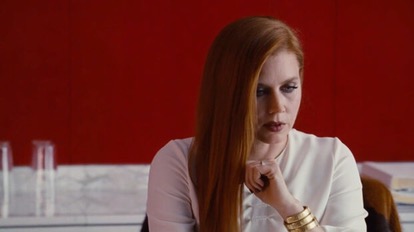
Tom Ford executes every moment of the film with an unrivalled stylishness that was evident in his debut feature ‘A Single Man’. It is in the L.A. art scene that we see the characters inhabit the sort of regal living spaces most people can only dream of, despite their thin veneers here only acting as a cover for a desperately hollow existence.

The resoundingly successful final scene is an absolutely devestating act by Eddie. Susan is left emotionally drained following the reading of the manuscript that finally reveals his potential as a brilliant writer. It is also laced with accusations at Susan. She is left with no resolution. This is a clearly a reflection of how he felt after their relationship originally broke down. The answer is never clearly spelled out, with the audience left as smartly frustrated as Susan. This is a really intelligent move that epitomises the ability of Ford to sit the viewers firmly in the position of the people on the screen and ask themselves how they really feel.

It is a wonderful piece of cinema that I’ll be recommending to anyone who will listen.

Film review – Absolute Beginners (Julien Temple, 1986)

Panned on its original release and a complete commercial failure [1], Julian Temple’s musical Absolute Beginners is a film that is often cited as the cause of a partial collapse of the British film industry. Looking at it with fresh eyes, the criticisms are undoubtedly harsh, but the film still has too many flaws to warrant anything more than cult status.

The musical charts the on-off romantic relationship between aspiring model Crepe Suzette (Patsy Kensit) and unestablished photographer Colin (Eddie O’Connell) as they try to make their way in 1950s London. Weaving elements of gang warfare, race riots and youth culture in a way that is almost brilliant, but largely incoherent.

It wuzza strange casting choice

The film starts with the familiar sound of David Bowie’s title track, which was a global hit at the time and proved to be one of his most enduring songs. If, like me, you were made aware of it solely because David Bowie has a named role in the film, then prepare to feel shortchanged. Bowie stars as Vendice Partners, a sales and marketing man who first appears about halfway through the film. By all accounts, his prominence in the film was more a marketing choice than an artistic choice, but his scenes breathe life into a stagnant portion of the film as it threatens to grind to a halt.

Temple was famed for his music videos and by the time this film was released he’d been responsible for some of the most celebrated music videos of the 1980s, including efforts for the likes of The Beat, Culture Club, The Sex Pistols, Depeche Mode, The Kinks and Sade. Some of the best moments in Absolute Beginners are the standalone tracks that could be lifted straight out of the film and placed on MTV. The two best examples are Ray Davies’s ‘Quiet Life’ and David Bowie’s ‘That’s Motivation’, the latter of which has Bowie tap dancing around a giant typewriter.

The film’s lack of focus is its downfall. When Colin gets caught up in the Notting Hill race riots in the final third of the film, he takes a wrong turn to avoid danger and ends up in a neo-Nazi war rally. This is a scene that creates some really powerful imagery but the themes had been underplayed in the build up, making its inclusion neither relevant nor integral to the plot. Indeed, the threat of violence is imminent all around the city without ever feeling anything more than a light touch suggestion. Yes, it’s a musical, but I can’t help think that if they’d just cut a couple of needless scenes earlier in the film there could have been a better balance struck between the romantic side and the social commentary. It is hard to believe that the die-hard fans of the book don’t feel the same way.

It was a troubled film to develop and the brilliant 53-minute documentary now included in the Blu-ray release is enough justification to pick up a copy. It’s also a curiosity for fans of any of the stars in this bizarrely-assembled cast. It is, however, not a good piece of cinema.

[1] Absolute Beginners took £1.8m at the box office in the UK and $930k in the USA against a budget of £8.4m.

Film review – Frantz (François Ozon, 2016)

Set primarily in Germany in the immediate aftermath of the First World War, François Ozon’s latest film is an emotional story portrayed almost entirely in black and white. It revolves around Anna (Paula Beer), a woman who is living with the parents of her lost lover and supporting each other in their collective grief. That man is the titular Frantz (Anton von Lucke), who we learn has lost his life in battle during the war. When a Frenchman by the name of Adrien (Pierre Niney) shows up at Frantz’s grave to give his respects, he tells them of his close friendship to their mutually lost friend.

Adrien (Niney) and Anna (Beer)

Ozon is something of a prolific filmmaker on almost the same level as Woody Allen. Since his celebrated debut feature length film Sitcom in 1998, he has written and directed sixteen films, amongst them the critically acclaimed Swimming Pool and the highly successful Potiche. Yet Frantz is, by all accounts, a departure in style for him and sees him in relatively unfamiliar territory with a historical war drama.

It is based on the play ‘L’homme que j’ai tué’ by Maurice Rostand. Before writing his script, Ozon was unaware that the play had already been adapted by legendary filmmaker Ernst Lubitsch as the film Broken Lullaby in 1931, though when he watched the film he realised that it was a completely different treatment to the direction he wanted to go with Frantz. He wanted to give the focus of the film to Anna, who was on the losing side of the war, providing more empathy to her as the central character.

There is an interesting chemistry between Beer and Niney, both of whom are playing extremely complex characters. They share this individual that has had a huge affect on their respective lives and begin to grow closer. Providing convincing characterisations of such  conflicting emotions is a challenge both rise to and it is this that elevates the film above being a wartime drama.

It was amazing to learn that this was Beer’s first performance acting as a French-language character. Many successful actresses couldn’t achieve what she has here in their first language let alone their second one. She revealed in a post-screening discussion that she had to learn and develop the script twice. Initially she developed the emotional responses to the words in her native German, before relearning the entire segments in French to ensure her delivery wasn’t lacklustre.

This is a truly moving film that gives an interesting point of view to the fallout from war that hasn’t often been explored before. Superb delivery from the two complex central characters means this comes highly recommended.

Film review – La La Land (Damien Chazelle, 2016)

WARNING: This review is effusively positive. If you’re a misery-guts then please look away now.

Every once in a while you will go into a film knowing almost nothing about what you’re going to see and get absolutely blown away by a surprisingly perfect masterpiece. As you get further into your film-watching life, enjoying these moments becomes increasingly rare, so when a film like ‘La La Land’ comes along, you can’t help but be overcome by giddy excitement.

Damien Chazelle shot to fame in 2014 with his critically acclaimed and rather special jazz-bully drama ‘Whiplash’. ‘La La Land’ shares very few similarities with it, bar an affinity to jazz that also featured prominently in his debut feature ‘Guy and Madeline on a Park Bench’. It does expand on a topic explored in ‘Whiplash’: the ongoing internal conflict of artists pursuing their dream at the expense of every other aspect of their life.

If you enjoyed his first two feature films but thought he couldn’t “do” mainstream, then prepare to be proven absolutely wrong seconds into the start. It opens with an over-the-top musical song and dance number set amidst a traffic jam. It’s an explosive one-shot (though there may have been some clever linking between extended shots) that received a round of applause at the end from an appreciative audience. Rightly so – it was jaw-dropping.

‘La La Land’ is, at heart, a homage to traditional musicals, with a joyful soundtrack matched by a couple of mesmerising performances from the lead performers Ryan Gosling and Emma Stone. Gosling stars as Sebastian, a struggling jazz pianist going from poor gig to poor gig in LA, with dreams of owning his own jazz club to fend off the death of jazz. Stone is Mia, a young actress moonlighting as a barista at the Warner Brothers Studio sets who can’t get a break she deserves in the film industry. After a number of serendipitous meets, Seb and Mia start to fall for each other and, with both a figurative and a literal song and a dance, their romance explodes.

With Seb being a jazz expert/enthusiast/nerd and them both being performers, Chazelle has given himself the platform on which to produce a naturalistic musical that will doubtless make it more acceptable to those who don’t normally class themselves as musical fans. There is also evidence of a significant amount of effort put in by Gosling to perfect the piano shots, which were impressively all performed by him.


It’s a film so visually stunning it’s hard to take your eyes away from it. There is, however, never a risk that it was simply a platform to reference more familiar films of old. In a breathtaking final segment, we take a walk through memory lane with nods to a number of classic musicals, but they are simply nods in what amounts to one of the most perfectly-balanced final sequences I’ve seen in cinema. Gasps were audible around the auditorium.

The soundtrack is destined to stick around for years to come. Gosling/Stone duets “City of Stars” and “A Lovely Night” are both standouts, but it will be “Audition (The Fools Who Dream)” that will be vying for an Oscar early next year. A beautiful number written by Justin Harwitz, Benj Pasek and Justin Paul, it is left to Emma Stone to deliver an emotionally raw live performance.

The only downside for me is that I have to wait for another two months to see it again. A must see.

Film review – 偽りの隣人 / Creepy (Kiyoshi Kurosawa, 2016)

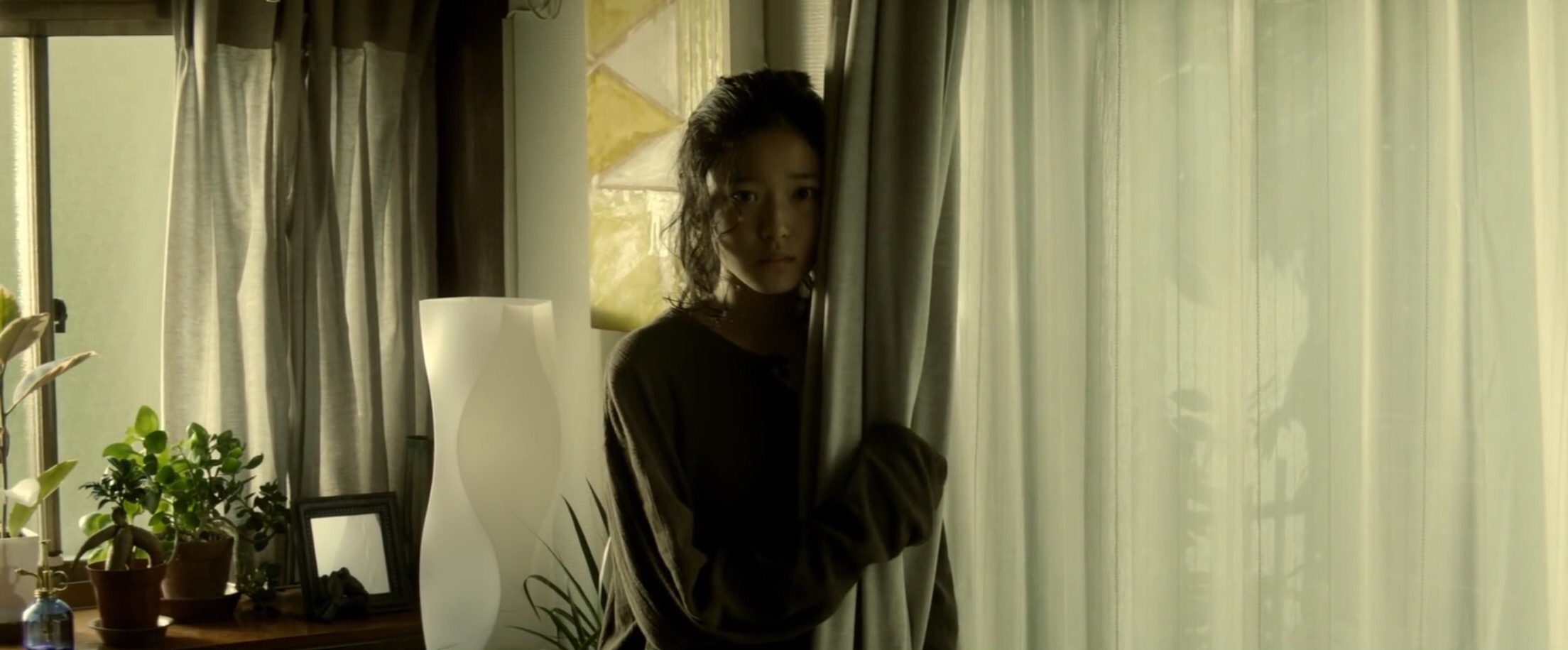
Kiyoshi Kurosawa’s latest release Creepy received its U.K. premiere tonight as part of the London Film Festival. It blends elements of police drama, suspense and mild horror to create an intriguing film that achieves much but ultimately falls down due to a lack of ruthlessness in editing that would have helped the pacing.

Set in approximately 2009, it tells the story of a retired policeman Takakura (Hidetoshi Nishijima) who has changed careers to work as a criminology professor at a local university. Having moved to a new part of town with his wife Yasuko (Yūko Takeuchi) and dog Max, they begin to become suspicious of the titular creepy neighbour Nishino (Teruyuki Kagawa) and his daughter Mio (Ryoko Fujino), whilst Takakura attempts to solve an old case that has come out of the woodwork.

Creepy Nishino

The casting of the genuinely creepy Kagawa is a solid choice. Director Kurosawa is on familiar ground, having worked with him on 2009’s Tokyo Sonata, though this role is very much a departure from the jobless family man we saw previously. When the results are this good there’s no need to change.

Kurosawa, working again with cinematographer Akiko Ashizawa, achieves a lot with natural lighting to create darkness for the lead characters as they delve into their inner-most thoughts. This was an effective technique used previously by the pair in Journey To The Shore and is mined more subtly here to arguably better effect, especially in one particular witness interrogation scene.

However, there are flaws. The ending could genuinely have happened about twenty minutes prior to when it finally occurs, and when the story is finally resolved the relief I felt wasn’t for any of the particular characters but more for the fact it signalled the end was in sight. It’s unfortunate that the ending is so shocking and powerful with some great acting that was undermined by the preceding needless plot extension.

There were a few ideas throughout the film that seemed to fizzle out. Saki (Haruna Kawaguchi) was really prominent for a good portion of the film but was clumsily written out before the resolution of her storyline; her family went missing but she doesn’t seem to care why in the end. A police chief is written into the key part of the story to get Takakura out of a dead end in the plot. There’s a mind control element to the story that isn’t ever fully explained, instead expecting the viewer to just go with it. 

After a long setup, this film is genuinely exhilarating for about an hour. With a shorter ending and a little more clarity, it could have been much better than the final result. For me, it is a missed opportunity.

Film review – Hunt for the Wilderpeople (Taika Waititi, 2016)

SPOILER ALERT – There’s a spoiler pretty much immediately in the first paragraph of this review. Sorry, it just turned out that way. Come back when you’ve seen the film and rejoice in its excellence with me. General  and spoile-free review: it’s excellent and well worth watching.

Here we go…

There is a moment, about twenty minutes into Hunt for the Wilderpeople, where the laughs start rolling in and the set up falls into place, proving that very good things come to those who wait. That this happens in the middle of the funeral of one of the lead characters, who is unexpectedly killed-off in the middle of the opening act, proves the point that comedy doesn’t have to be routine to be absolutely hilarious.

Indeed, looking at the two lead actors, there is nothing to suspect they would work on a comedy duo level. Sam Neill has been doing fantastic work for years, delivering memorably serious performances in the likes of The Hunt for Red October, Dead Calm, The Piano and Jurassic Park. His partner in crime in Hunt for the Wilderpeople, Julian Dennison, is pretty much a newcomer to the industry, having starred in 2015’s Paper Planes and not much else (at least not much that has troubled the international market).

It’s strange then that they have formed a bizarre chemistry around which this film’s many successes hang, taking turns to be the straight man when the time is right. It’s a successful combination and one that takes what could have been a simple live-action remake of Pixar’s Up and turns it into an enjoyable romp through the New Zealand countryside.

Dennison is, ultimately, the real find of the film. As the rebellious youth that nobody wants, he is privy to some of the best lines in the film. His delivery is natural and faultless.

Taika Waititi may be in the process of directing the upcoming next instalment of the Thor film series (set for release in late 2017), but he is staying rooted to what he knows best for as long as possible. One can only hope that Marvel allow him to finish his journey with the film rather than lose faith at the eleventh hour as they did with the last quirky comedy director they went with: Edgar Wright.

On this evidence, they would be wise to not make the same mistake twice.

Hunt for the WIlderpeople is available now on DVD.

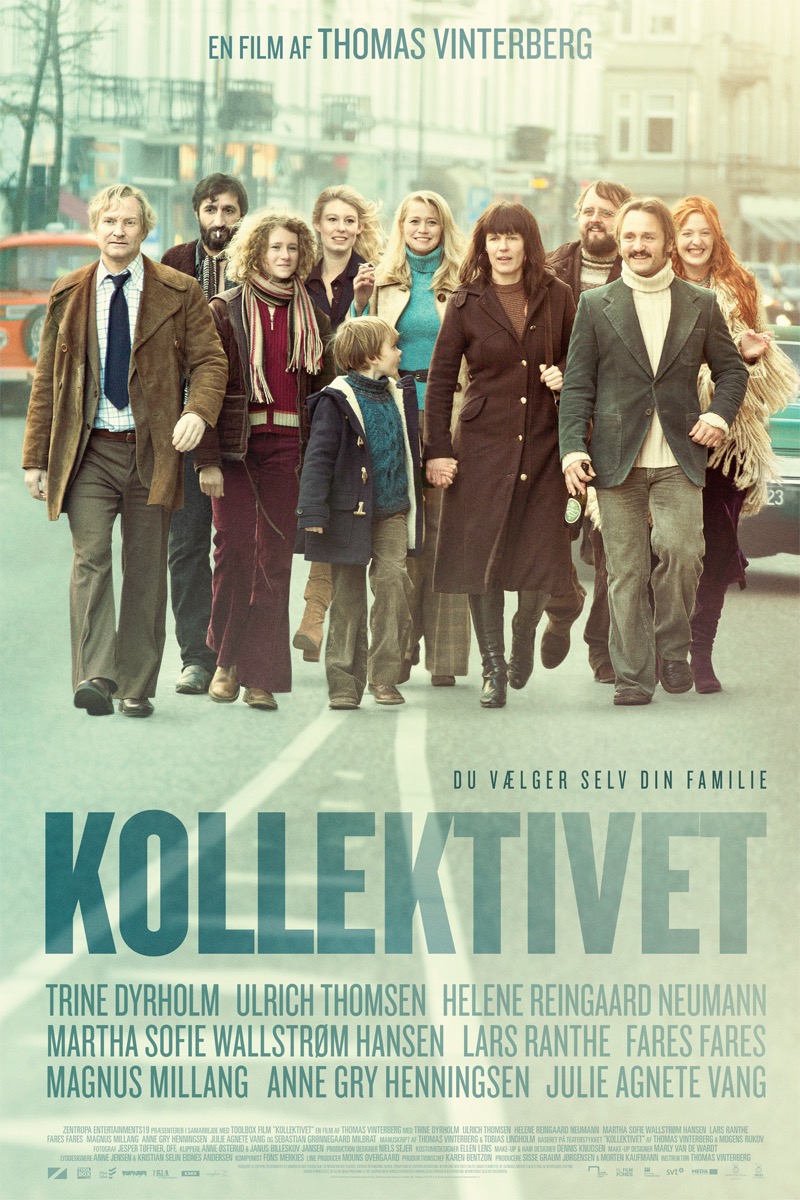
Film review – Kollektivet / The Commune (Thomas Vinterberg, 2016)

Danish director Thomas Vinterberg returns with his latest film Kollektivet, known as ‘The Commune’ in English-speaking countries. Set in 1970s Copenhagen, it revolves around architecture professor Erik (Ulrich Thomsen) and his wife Anna (Trine Dyrholm), who have inherited Erik’s gigantic childhood family home. The building has prohibitively high living costs and the pair fear it would feel empty, so Anna suggests inviting some friends and acquaintances to share the space (and costs) with them. And so they end up with a total of ten people in the house, turning it into the titular commune.

Inevitably, the unusual way of living takes its toll on all those involved, be it their shy daughter Freja (Martha Hansen) sneaking out to see her new boyfriend, emotionally unstable Allon (Fares Fares), or Ditte (Anne Gry Henningsen) and Steffen (Magnus Millang) who have a son with an increasingly threatening heart condition. Every time these characters hit a low, the other people are there to ensure spirits don’t stay too low for too long.

Where the story avoids feeling slightly convenient, it is instead overly contrived. The setup of the commune concept is abrupt and simply has to be accepted by the viewers to avoid a complete disappointment. It never felt credible to me that Erik would have not only accepted the strangers into his home but also sign the ownership away to them. This could have been resolved by indicating that they were financially sound and using another means to justify their actions, but money is given as the primary purpose of bringing more people in.

Of the ten lead characters, at least five seem to be shallow to the point of superfluity. It felt to me that having ten people in close proximity would have been the perfect platform for friction that never truly surfaced. Perhaps Vinterberg, who based the story on his real-life experiences, was too rooted in sticking to reality to throw in something to spice the plot up. Or perhaps two hours isn’t enough time to successfully explore so many characters.

The real engine of the story is Anna, portrayed brilliantly by Dyrholm. When Erik starts having an affair with one of his students, we are taken on an emotional journey with Anna that serves as the driving force of the final third of the film. Her only support network is through the people in the commune, but being there means she has to live alongside her husband’s new lover. It is an uneasy watch, at times heartbreaking, as Dyrholm is allowed to flex her acting muscles with a powerhouse of a performance. The heartbreaking moment when her daughter takes matters into her own hands is as powerful as anything I’ve seen at the cinema this year.

It is a film fundamentally about family and community spirit and how effective that can be despite an unconventional setup. Vinterberg isn’t afraid of allowing the story to take bold turns, even if it doesn’t setup the happy ending many cinema-goers would hope for.

Matching up a strong storyline with a handful of top-level performances is always a recipe for success. A flawed but thoroughly gratifying film.

Film review – The Neon Demon (Nicolas Winding Refn, 2016)

Danish director Nicolas Winding Refn has been carving out his own route to the forefront of spectacularly stylised cinema, oozing with what can only be described as Refnisms. His films all inhabit the same universe in a way that all great genre film makers do. So it is with his latest, The Neon Demon, which has all the hallmarks of a hedonistic night in a stae-of-the-art nightclub whilst not giving up on the brutal bloodbaths we’ve come to expect of Refn’s work.

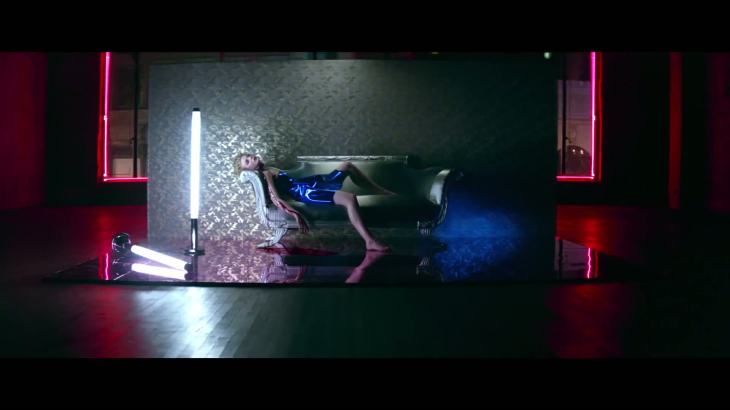
The opening shot is breathtaking – a slow dolly-out on a female model who sits motionless with a sliced throat. That girl is Jesse (an initially unrecognisable Elle Fanning). We learn quite quickly that she is in the middle of her first photo shoot, but this shot lingers long enough to have us right in the palm of the hands of the storytellers. It is simple yet brilliant film making.

neondemonscreenshot1

Elle Fanning as Jesse

The film takes us on a journey with Jesse, an orphan who has moved to Los Angeles soon after her 16th birthday to pursue a modelling career. Bright eyed and innocent in every way, she has no time to learn who she can and can’t trust. As the focal point of a powerful story she is brilliant in the way she carries the film on her shoulders.

The supporting cast are excellent. Abbey Lee and Gigi Bella Heathcote put in a great turn as the jealous models Sarah and Gigi. Keanu Reeves’s Hank is reminiscent of his abusive husband Donnie in The Gift, full of brutality and intimidation. It is Jena Malone’s portrayal of doting makeup artist Ruby that really comes close to stealing the show, her face betraying everything she says throughout to brilliant effect.

The Cliff Martinez soundtrack feeds into the visuals perfectly. A frequent NWR collaborator, Martinez’s sparse electronic score blends the contemporary setting with the horrific events that are unfolding on screen. This is a work of art for which he won best soundtrack at the Cannes Film Festival. It’s easy to see why.

This is a sensational film with a powerful leading performance from a girl just seventeen at the time of filming. Pairing this with such bold film making and the result was never going to be anything but an overwhelming success.

Film review – The Hard Stop (George Amponsah, 2016)

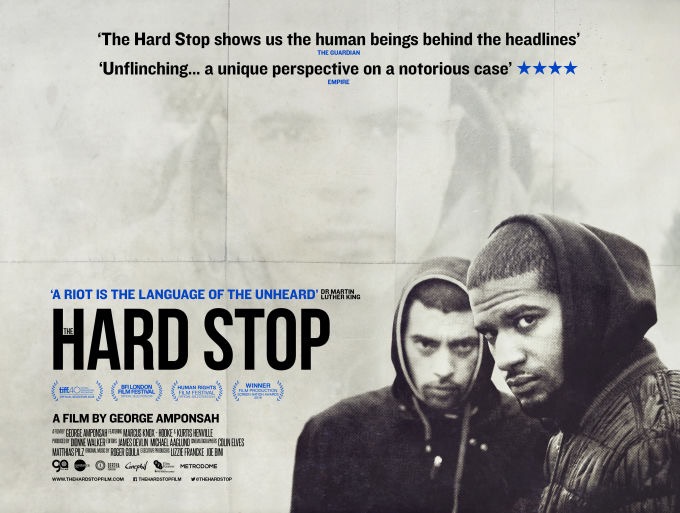
‘The Hard Stop’ documents the 2011 London riots that erupted in the aftermath of the police shooting of Mark Duggan, a 29-year-old black British man. Given the current events in Dallas, Texas, the release of the film couldn’t have been more relevant.

The film concentrates on Marcus Knox-Hooke and Kurtis Henville. Both were close friends of Duggan for many years prior to his death, and both were members of the Tottenham Man Dem, a gang formed out of the Broadwater Farm housing estate in Tottenham. Broadwater Farm was the setting for a brutal riot in 1985 that was believed to be caused by the police raiding a home and causing the heart attack of resident Cynthia Barrett. The main reason it is remembered across the UK is the death of PC Keith Blakelock, the first policeman to die in a riot in the UK since 1833.

The film paints a balanced view of both Marcus and Kurtis. Growing up in the aftermath of the 1985 riots, the two are family-oriented men with their home community at the centre of their make-up. Their upbringing – and that of Mark Duggan – has clearly been one overshadowed by suspicion and resentment for a police force that should be there to protect them, but instead seem to constantly be at odds with their community.

the hard stop screenshot

It is an unsettling film for a number of reasons. The media portrayal of the 2011 riots (that quickly spread around the country) seldom touched on the root cause, instead focusing on the looters and chancers that saw it as an opportunity to make some money out of the pandemonium. The anger from the black community in London at the injustice of what happened to Duggan was completely suppressed. I am sorry to say that as a white man, the underlying cause of the riots was not apparent to me and none of the many news outlets I have touch-points with exposed me to the full picture.

The reveal of the eventual findings of the inquest into his death was the most shocking moment of the film. The inquest found that, whilst it was unlikely that Duggan was carrying a gun, the killing was unfathomably still deemed lawful. The emotional response of the community in which Duggan lived was one of absolute devastation and was captured in a moment of brilliant documentary film-making by director Amponsah. This is not a community that wants to fight, but as the opening quote of the film states, “A riot is the language of the unheard.”

‘The Hard Stop’ is one of the most important documentary films to hit the big screens this year. Out of necessity, it is rough around the edges. It has, at the heart of it, some of the greatest social themes facing Britain today. A riveting watch.