Film review – Ghostbusters (Paul Feig, 2016)

Coming off the back of the unprecidented success of Bridesmaids, Feig looked to have carved a path as the director of female-led lighthearted comedies, following as he did with The Heat and Spy (both of which were well-received by both audiences and critics).  The safe move would have been to deliver more of the same until either the audiences or the actresses got bored, cashing the cheques as they exited stage right.

Rebooting the Ghostbusters franchise with women taking the lead roles, therefore, seemed like an unnecessarily bold move. Taking on the beloved franchise of an entire generation of cult film cinephiles has fallen flat many, many times recently. Total Recall. Robocop. the Terminator sequels. Vacation. The Karate Kid. A Nightmare on Elm Street. Conan the Barbarian. Oldboy. Please stop ruining our childhoods!

Fortunately, this time there’s enough talent involved to ensure that Ghostbusters is a success. It isn’t a remake so much as a reboot. There are some knowing nods back to the originals, but this is a film that stands on its own two feet and comes out with its head held high.

Ghostbusters2016

Busting makes ’em feel good!

Kristen Wiig and Melissa McCarthy are both on fine form as the childhood friends turned ghost-hunters Dr. Erin Gilbert and Dr. Abby Yates, but it is Kate McKinnon as scientist and pyrotechnics enthusiast Dr. Jillian Holtzmann that is the real success story here. This should serve as a starting point for her career to truly take off. Another SNL-favourite, Leslie Jones, completes the cast as Patty Tolan, a New York subway clerk who knows her way around the city.

Sadly, it doesn’t sail through without disappointing from time to time. The ham-fisted cameos of the original actors were completely unnecessary and would have meant nothing to newcomers to the story. They just weren’t worked well and I can imagine younger audience members wondering why so much attention was given to the taxi driver as the pace of the film took a minor detour.

The casting of Leslie Jones attracted criticism in the run up to the release of the film from some who suggested that the portrayal of a street-smart African-American amongst three white scientists bordered on racism. This wasn’t something I particularly picked up on during the film – she was well cast in a role that suited her and had good chemistry with her SNL cohorts.

Fortunately, the ones most disappointed with this film will be the ones who had written it off before it had even started. The trailer was one of the most disliked in YouTube history, which serves only to underline how collectively vindictive some sections of the Internet can be. The only shame is that they probably won’t give this film a chance and as a result they will be missing one of the funniest summer blockbusters of the year.

Film review – The Lost Bladesman (Felix Chong / Alan Mak, 2011)

The Lost Bladesman is a historical biopic that portrays the story of Guan Yu (Donnie Yen), a general in the Three Kingdoms period of Chinese history. During this period, the land of China was divided into three main states: Wei (魏), Shu (蜀), and Wu (吳).

The kingdoms are at war, and China is in turmoil. Guan Yu has sworn himself to the warlord Liu Bei, but is taken prisoner by opposing warlord Cao Cao (Jiang Wen). Forced to fight for his enemy, Guan Yu leads the Cao army to victory. He is granted freedom but amongst Cao Cao’s supporters he is seen as too great a threat to remain alive. Six of Cao Cao’s most capable supporters embark to kill Guan Yu.

The film is not a traditional telling of the Cao Cao-Liu Bei-Guan Yu story, as director Felix Chong describes in the bonus features: “We wanted to avoid the pre-established image of Guan Yun Chang. We have lots of stories about how he charged into battles, but this time we see him fight his way out of one entrapment after another… The film also concerns itself with his internal struggles and disillusions.” This is certainly something that Donnie Yen pulls off with ease, with the payoff being the drive in the battle sequences – you really believe this is a man unwilling to give up or give in.

thelostbladesmanscreen.jpg

Donnie Yen in one of the more memorable action sequences.

It is, admittedly, a story you either need to know the historical relevance of before watching, or something you need to concentrate on in great detail for the first half of the film. As an English-speaker with no knowledge of the Chinese language, trying to keep up with the names of the characters was nigh-on impossible.

Fortunately, pretty soon we are treated to some beautifully-choreographed battles as Guan Yu rips his way through hundreds of men sent to kill him, driven by his loyalty to Liu Bei and his secret passion for the woman betrothed to Liu Bei: Qilan (Sun Li).

The pairing of Donnie Yen and Jiang Wen in this film means it is now of great interest to any fans of Star Wars, with both set to appear in the upcoming Rogue One: A Star Wars Story as characters Chirrut Imwe and Baze Malbus, respectively. Certainly Donnie Yen was brought on board for his martial arts capabilities – not only is he regarded as one of the greatest martial arts actors in film, he is also his own choreographer and is an ex Wushu world champion.

Those martial arts talents are shown in abundance in The Lost Bladesman and anyone looking for a masterclass in the variety of styles of martial arts on show here won’t be disappointed.

For anyone unfamiliar with Chinese cinema, this is a great example of the kinds of high-budget productions typical of the region. The large-scale battle sequences are truly epic and stand up to anything coming out of Hollywood at the present time. Cinematographer Chan Chi-ying clearly works well with the director pairing to deliver shots that are both true to the setting and appealing to the modern audiences.

The climax of the film is, however, a complete anti-climax. Unexpectedly, a paragraph of text appears to wrap up one element of the story, before a brief clip of Cao Cao precedes a second paragraph of text. I couldn’t help but think the money had run out and they were forced into this ludicrous ending, robbing us of a final stand-off or battle of some kind.

Pacing issues aside, the Donnie Yen action sequences make this a film well worth picking up and are a fantastic introduction to his capabilities as a martial arts expert.

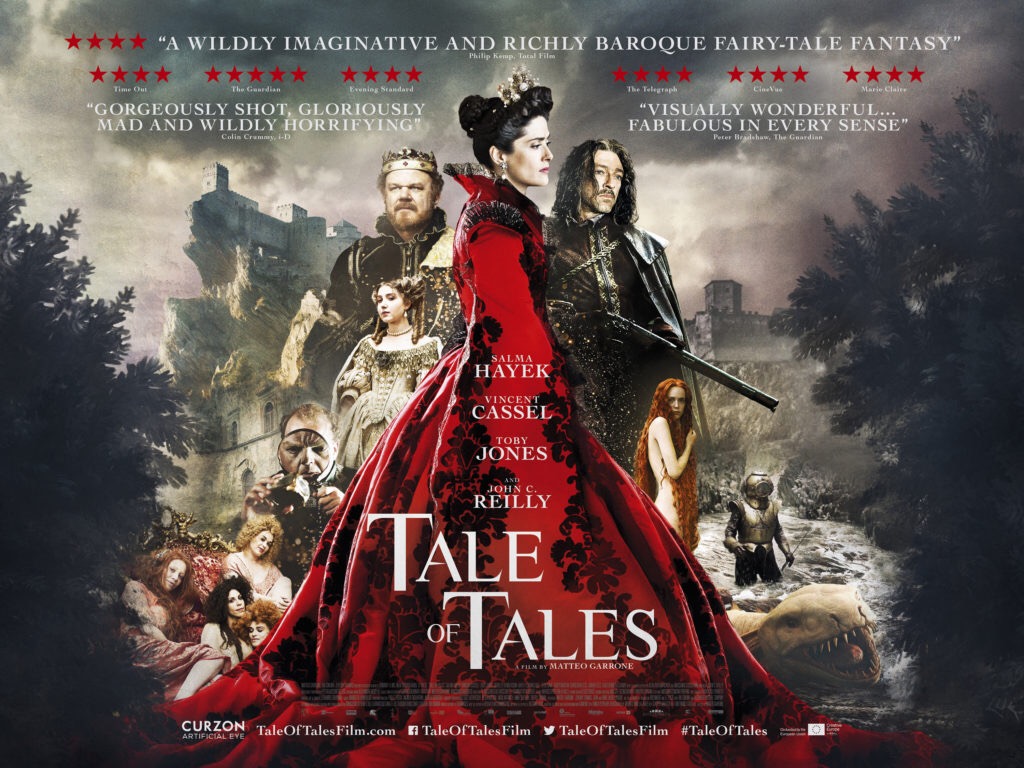
Film review – Il racconto dei racconti / Tale of Tales (Matteo Garrone, 2016)

Tale of Tales is a film that merges three fantasy tales from Italian storyteller Giambattista Basile’s book Pentamerone. The results are mixed.

The first, The Enchanted Doe, stars Salma Hayak as the Queen of Darkwood, who is struggling to have a child with her King, played by John C. Reilly. Taking the advice from a necromancer, the King sets off to capture the heart of a sea monster for his Queen to eat. Doing so brings her the child she desires, but this comes at a cost.

The second tale, The Flea, stars Toby Jones as a king seemingly reluctant to find a husband for his daughter Violet (Bebe Cave). Secretly, he is nurturing a flea in his chambers, growing it to an enormous size, but in doing so neglects his daughter. 

The final tale, The Flayed Old Woman, stars Vincent Cassel as a king with an insatiable lust for all women he lays eyes on. He is attracted by one woman (Hayley Carmichael), however, that he cannot see but can hear. As she sings a beautiful lament from the shadows of the streets of his kingdom, so begins an addiction to seeking her out to fulfil his desires. Fearful of him seeing her true form, she tries to push him away, only for his desire to grow stronger.

The three stories run entirely separately until the final scene, which is sort of a throwaway tidbit that attempts but fails to tie it all together. The overall result is something akin to a highbrow fantasy take on ‘Love, Actually’, whereby several separate storylines weave in and out of one another without significantly benefiting from it. Indeed, the sum may well be less than the parts.

The opening scenes concentrate almost exclusively on Salma Hayak’s unfolding story, to the point where when we first see Vincent Cassel it’s confusing to work out how he fits into the rest of the story. A few moments later it becomes obvious (sort of) that he’s the king of another kingdom, though we have to deduce that ourselves. Perhaps I’m just used to being spoon-fed too much, but I was confused.

The Flea segments are painfully slow, with Toby Jones feeling a little wasted as he tries and fails to inject some life into a largely lifeless story.

Hayley Carmichael rises above the dross to give a starring turn as the old woman Dora, with segments largely full of wit and humour. Vincent Cassell adds a lot to these scenes, lifting them with a knowing amount of irony that just about makes the film bearable.

It is interesting that the director Matteo Garrone has stated that he had worked on ideas for a few other stories from the same source material. In my opinion, these tales would work significantly better broken up and serialised. There is some good work here but it’s hard to get sucked in by one faltering tale, let alone three.

A visually stunning film that fails to ignite the interest, an issue I blame mainly on poor editing and a disappointing adaptation of some highly respected source material.

Film review – Green Room (Jeremy Saulnier, 2016)

From a fairly clunky and drawn-out start, Green Room quickly becomes a truly shocking horror film, made all the more horrific by a believable plot line and some relatable characters.

It delivers a lot in just over 90 minutes. Punk band The Ain’t Rights (including Anton Yelchin as Pat, Alia Shawkat as Sam, Joe Cole as Reece and Callum Turner as Tiger) are living food-to-mouth and on the edge of calling it quits due to lack of funds. A particularly bad gig in Seaside, Oregon leads to the promoter setting them up with a more lucrative performance in an out-of-town area of Portland. What they don’t know is that the gig is for a group of Nazi extremists, and when one of the band members witnesses the aftermath of a murder, things take a turn for the worse and a standoff ensues between the four band members (and another bystander Amber, portrayed by Imogen Poots) and the owners of the club, led by Darcy Banker (Patrick Stewart).


“Now, whatever you saw or did is no longer my concern. But let’s be clear, it won’t end well.” So says Patrick Stewart in an uncharacteristically sinister turn as Darcy. Despite a spine-tingling turn, it’s a character that never really shows his worth as a truly horrific antagonist, instead allowing some fairly useless goons to try and largely fail at his handy work. He’s got 100s of neo-Nazis under his thumb – but why? It would have been much more satisfying to get a taste of his evil mind.

Far more relatable are the four band members, who we join in this rollercoaster of misery and trauma. There are a couple of gruesome moments when the film starts to get really bloody, and it is in these moments that the film shows its excellence. Having successfully placed the viewers in the shoes of the band members, the film unravels into a slasher horror and there are some truly shocking moments to shake up the audience. What unfolds feels like a very personal experience despite being something that (hopefully) hasn’t happened to many people.

Imogen Poots is a fantastic actress, though her appearance some time into the film seemed like an after thought. Joining at a point where the band members were already well established is a factor they just about get away with, though I never really felt the same compassion as I did for the band themselves.

If you like your horrors slashy, then this will reward you. If horror to you is a CGI ghost in a mirror, then you may well be sadly disappointed.