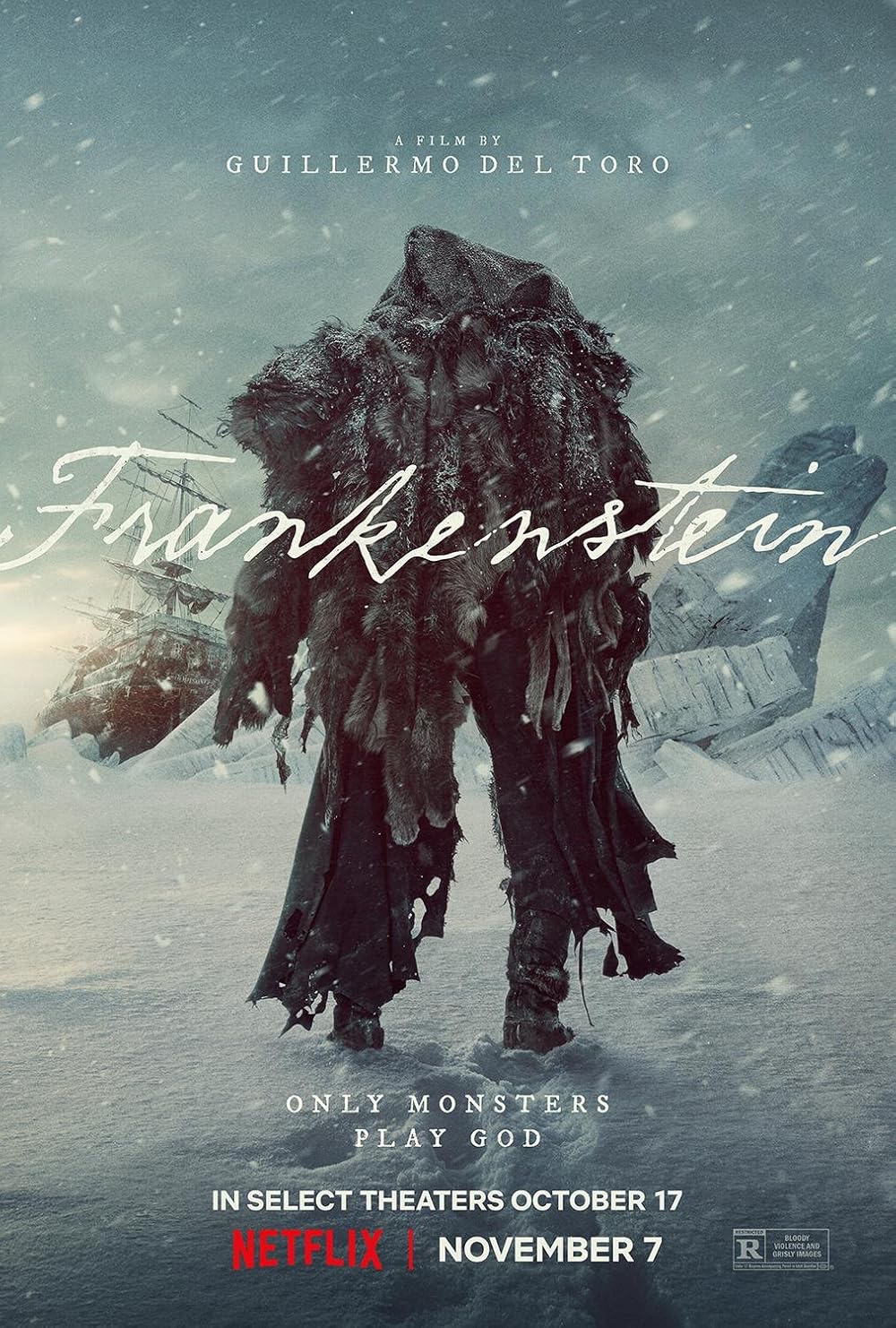
Film review: Frankenstein (Guillermo Del Toro, 2025)

Frankenstein is a gothic novel, first published over 200 years ago. It remains Mary Shelley’s best known and most celebrated work, with an estimated 400 feature films having been made with the character as a central or supporting role. Filmmakers such as Danny Boyle, Kenneth Branagh and Mel Brooks have put their own spin on the character, and there seems to be an insatiable appetite for movie makers and cinema goers to revisit the monster.

And so, in 2025, master of gothic horror Guillermo Del Toro has blessed us with his own interpretation of the work. Screening as part of the 2025 London Film Festival, it’s an interpretation that feels luxurious in scale.

The story is told in a way that remains faithful to the original novel, mixing up the ordering to create a much more effective narrative for the purpose of the big screen, much in the same way as the 1994 Kenneth Branagh adaptation did. This version opens at the original ending, with a mysterious one-legged man (Oscar Isaac) appearing out of nowhere at a shipwrecked expedition to the North Pole, chased down by an even more mysterious hooded monster (Jacob Elordi), seemingly impossible to be halted in his pursuit of vengeance. The rest of the story is told through flashbacks to how they got there, with some very strong performances across a talented and varied ensemble cast that includes Charles Dance, Mia Goth and Christoph Waltz.

Following Pacific Rim (2015), a film that many consider a misstep in his career, Del Toro has had four exceptional critically acclaimed features: the daring gothic romance Crimson Peak, Oscar-winning The Shape Of Water, psychological thriller Nightmare Alley, and his first foray into feature animation with the beautifully realised Pinocchio. Adding this powerful fifth film into the mix will only cement his position as one of modern cinema’s true masters.

At 150 minutes, it isn’t for the fainthearted. It’s hard to condense it into anything less, without losing a lot of the story. When it arrives on Netflix later in the year, I’m sure many will take the opportunity to have a break at the start of Act II. However, this is a film that deserves to be seen on the biggest of screens, to allow the total immersion into something quite grand.

Glorious.

Film review: The Lost Bus (Paul Greengrass, 2025)

The Lost Bus is an intense action thriller based on the 2018 Camp Fire incident in Paradise, California. The action focuses on bus driver Kevin (Matthew McConaughey), who volunteers to retrieve and carry 22 children and their teacher Mary (America Ferrera) to safety.

At 130 minutes this film has plenty of time to explore sub-plots and give backgrounds to the main characters. Despite the length, it doesn’t feel like it drags at any point. Part of this is due to a careful mixture of suspense building as the town of Paradise is engulfed in the red-orange mist of the wildfire, with intimate camerawork and a relentless score from James Newton Howard working in unison to heighten the unfolding disaster.

Paul Greengrass is a master of this kind of film now, having established and honed his skills in the Bourne franchise, along with films like Green Zone and Captain Phillips. His last film, Western drama News of the World, also made its way to Apple TV+, and it was a happy partnership that led to multiple Oscar nominations in 2021. Whether this film will also be recognised in the same way remains to be seen, but it would hardly be undeserving.

What’s the deal with the Wes Anderson and Roald Dahl Netflix collaboration?

You may have noticed on Netflix recently a handful of sepia-tinged thumbnails popping up in your Trending Now or Recommends lists. Based on the lack of advertising generally, all you are left with is the titles alone: Poison, The Rat Catcher, The Swan and The Wonderful Story of Henry Sugar.

These curiosities make up a series of four adaptations of Roald Dahl short stories by the distinctive director Wes Anderson. Bringing together a wonderful ensemble cast – including Rupert Friend, Richard Ayoade, Benedict Cumberbatch, Ben Kingsley, Dev Patel and Ralph Fiennes – the four shorts really are quite special. Marrying the distinctive styles of two great storytellers from very different eras, there is a high-art uniqueness that lands in a place that feels fresh and intriguing.

As I finished watching my favourite of the bunch – the sharp-scripted Poison, about a man struggling under the threat of an imminent deadly poisonous snake bite – I wondered whether these could have been made twenty years ago. Or even ten years ago? I could only think of one outlet for them, which would be as part of the festive programming of a terrestrial channel, probably on Boxing Day, when the rigidities of multi-part series and familiarities are relaxed as the nation forgoes its own schedules to Quality Street and sherry.

I’m thrilled these four short films have seen the light of day, although I also wonder whether they’ve been done a disservice in the manner of release. With little fanfare, they’ve just appeared in the faces of the casual scroller, with more than a little whiff of that U2 x iPhone collab we all loved so much. I know someone who accidentally watched the longest of the bunch – The Wonderful Story of Henry Sugar – and wondered what on Earth was going on. With no explanation, it’s easy to see why the unfinished stylings of Wes Anderson could confuse. Actors look at the camera, the prop department hand items to the scenes apologetically, the elaborate sets are shifted as if they were part of an experimental theatre piece. These quirks that elevate the experience for fans of Anderson risk perturbing casual viewers, or indeed fans of Roald Dahl’s more popular output.

With results this good, perhaps Netflix decided that was a risk they were willing to take.

Firebird (Peeter Rebane, 2022)

Peter Rebane’s wartime romance Firebird courted controversy in the run up to the release, with Russian attempts to silence the film in the country. It is also being released into a market with little or no interest in a story showing any aspect of the Russian military, given the recent invasion of Ukraine. 

Watching it objectively is, therefore, an art in itself. 

It stars Tom Prior and Oleg Zagorodnii as two military men – Sergey and Roman – who develop a secret romance, in spite of its illegality in Soviet Russia at the time. It’s a beautifully written piece of romantic drama, with the two leads doing well to portray the kind of electricity only found in such forbidden passions.

I won’t be looking into how much of the film is true to life and how much has been fabricated for the film. Doing that usually makes it far less enjoyable!

I did fail to deal with my utter dislike of any English-language film that sets itself in a foreign country, but then asks the actors and actresses to speak in English but with a hint of an accent. Tom Prior sounded close enough in the more placid scenes but as soon as there was any intense emotion in his wording, you could hear his Dorchester accent much clearer. In fairness to the wider film, the cast is primarily made up of Estonian actors and actresses, with a handful of the lead roles being taken by British actors.

Russian actress Diana Pozharskaya puts in a powerhouse performance as Luisa, a friend and lover caught in the middle of the two men. She turns in a particularly impactful scene at the end, which I can’t discuss without spoilers!

This is a film worth seeking out, even if you’re put off by the Russian/Soviet setting. Romance done well is always a joy to watch and this is no exception.

Film review – Mrs Lowry & Son (Adrian Noble, 2019)

L. S. Lowry once claimed he only ever used five colours: vermilion, ivory black, Prussian blue, yellow ochre and flake white. Mrs Lowry and Son puts Timothy Spall and Vanessa Redgrave together in a film as flatly coloured as any of Lowry’s paintings, with a plot to match. This isn’t to bismirch the overall effect – a film with a different tone would feel like a mis-step.

These are astonishing performances from the two leads.

Spall plays the titular son, famed Lancashire artist Laurence Stephen Lowry. He brings Lowry to life, as he struggles against his own mother’s opinion of his work and allows that to permeate his confidence. It’s a heartbreaking thing to watch play out.

Of course, without Redgrave giving an equally wonderful performance as Elizabeth Lowry, the whole thing would fall flat. It’s well written and delivered perfectly. Redgrave has seldom felt so dislikeable. She has a dedicated son that she completely takes for granted. All she offers is a relentless undermining that only serves to stifle his genius.

The naming of the film tells you all you need to know about how important Redgrave is to the plot. It is arguably more her story than it is his, with her character as overbearing to the story as she was in real life to Lowry’s paintings.

It feels dreary, but this is a portrait of an artist living in Pendlebury in the 1930s. It was a dreary time to live, as families were built around the financial gains of working in the local coal mines.

The film soars when Adrian Noble works some of the more familiar of Lowry’s works into the visuals of the film. As a child who grew up in nearby Burnley, Lowry was revisited many times during art lessons at school. I’m not an expert, but it is a joy to see the masterpieces brought to life.

The joys of this film shouldn’t be limited to those from northern England, nor just to fans of his art. It’s very well executed and is well worth your viewing time.

Film review – Toy Story 4 (Josh Cooley, 2019)

It’s lovely to see the gang back again. After three 5* films, this is the first one that, for me, drops the standard a little.

Woody, Buzz and Jessie have never looked so good. What a difference 24 years makes. In the opening scene there’s a rescue mission that involves Woody leaving the playroom and being exposed to rain. It is nothing short of stunning. You feel every drop off water hitting him, soaking into the materials of his clothes, bouncing off his hat and face. One can only wonder what Ralph Eggleston and John Lasseter would have made of this all those years ago.

Whilst the visuals are as close to perfection as 2019 will allow, I couldn’t help but get distracted by the voice acting. Of course, each of the actors have aged with the fans of the movies, but I could definitely hear that in their acting performances. If there’s another nine years until they decide to make a 5th installment, Tom Hanks will by then be 72 years old. I honestly just don’t want to hear Woody in his eighth decade.

The storyline lacks the oomph and coherence expected of other Pixar films. Whilst it’s somewhat predictable, it also has the feeling of a team trying to add in about 25 minutes to a film they’d crafted but realised didn’t run long enough. It just went around in circles for a little too long when the end was in sight, with an antagonist in the form of Gabby Gabby (Christina Hendricks) that was played too softly throughout to ever leave us worried that she’d be a genuine threat.

It’s not a bad film and doesn’t ruin the series, but I think they need to draw a line under it now. It’s an addendum to the perfect ending of Toy Story 3, and it only just gets away with it.

Film review – Photograph (Ritesh Batra, 2019)

Photograph is a sweet film that has the feel of being a western take on what Indian cinema is. It’s doesn’t have any large set pieces or emotional pyrotechnics, the character development is sparse and the ending is fairly predictable, but despite these the overall effect is largely positive.

Director Ritesh Batra has returned to ground familiar to anyone who saw his soaring debut The Lunchbox, which brought him to prominence in 2013. The concept of an unlikely friendship blossoming into an even unlikelier romance is revisited here, with a beautifully-shot Mumbai serving as the backdrop for both. Fans of his debut expecting another uplifting romance will feel a little shortchanged, so it’s best to appreciate with a fresh palate.

With Nawazuddin Siddiqui as Rafi and Sanya Malhotra as Miloni Shah, the film is in great hands. These are two complex characters and they’ve clearly thought through every move under the guidance of director Batra. Rafi has an underlying anger that is fully realised without he need to clumsily explore his past through flashbacks irrelevant to the main plot. He plays it perfectly – a man frustrated by the pressures of arranged marriages that are being compounded by the arrival of his meddling but well-meaning grandma (Dadi).

Equally, Sanya Malhotra negotiates her role delicately. Hers is a character who goes a long way to keep those around her happy, so starting a relationship with someone unknown to her family is a huge step. It’s a role relevant to so many global movements to ensure better rights for women, though some may question if her stance is a little too understated. Or perhaps it’s just more realistic in her situation than if she’d openly displayed anger.

The ending is effective, even though it was signposted from about ten minutes in. Yes, it’s a poor man and a rich girl falling in love, which is tried and tested ground for so many films – a fact they mention in the climactic scene – but it’s certainly not handled clumsily. Just because we’ve seen it before doesn’t mean it’s not enjoyable.

It isn’t a groundbreaking film, but not every piece of cinema has to be to leave a lasting effect.

Film review: The Big Melt (Martin Wallace, 2013)

For National Yorkshire Day, I opted to watch this documentary I impulse bought about half a decade ago in FOPP. It has been sat on my shelf since then, with a brief period inside a box, probably wondering if it would ever be unwrapped and why it was bought in the first place.

I was doubtless attracted to it due to Jarvis Cocker’s involvement, which to be honest was the rewarding side of it. I’ve been a fan of his music since my formative years – I was 11 when the seminal Different Class was released – and appreciate his intelligent take on life.

The Big Melt is essentially 70 minutes of carefully-selected archive footage of Sheffield, mainly involving the steel industry, backed by music performed live by a number of Sheffield-related musicians (and some of their friends).

It has the ability to impress but the overall impact is one you have to concentrate on and commit to if you want to get anything out of it. The music keeps on playing but there’s no narrative, so it’s easy to let your mind slip out of focus.

Often I realised I’d been watching the screen and listening to the music, but not actually absorbing what was going on. It had a meditative effect. Maybe that’s what they were going for.

There are interesting segments, including a young woman working in a bomb factory and a short animated film imagining a world without steel, but I’m struggling to deploy an alternative adjective to interesting, despite my misgivings of its use.

For a special occasion is was perfect, and it gave me the impetus to get my surround sound system fixed to enjoy the music properly.

It’s not without merit but only for people who have a genuine interest in the city.

Film review – The Great Hack (Jehane Noujaim and Karim Amer, 2019)

Unless you’re 100% informed about Cambridge Analytica, you really need to watch this film. It covers a lot of what is already known to those who followed the Facebook-Cambridge-Analytica scandal at the time, as covered in The Guardian by Carole Cadwalladr in her whistle-blowing article “The Great British Brexit Robbery”.

Cadwalladr is interviewed here, along with Cambridge Analytica’s ex-director Brittany Kaiser and ex-employee of Cambridge Analytica Christopher Wylie. Kaiser does her best to paint a sympathetic picture of herself, though I struggled to forget that she was at the heart of everything that happened (thanks to the reminders in the film). As a source, Wylie’s credibility is questioned, though he features lightly. It is an example of how well the film does at keeping the viewpoint as balanced as possible.

Importantly, the film doesn’t end trying to imply that the earth-shattering revelations brought about by the Cambridge Analytica scandal have been resolved. The implications of this scandal and the continued work that seems to be going on at so many of the large technology companies feels like it’s getting worse by the day.

It’s a slightly disjointed film that, at times, doesn’t know what it wants to do with the subject matter. It may have been better-served as a four-part series, focusing on each of the subjects for an hour. The story of the New York media professor David Carroll and his hunt for his own personal information is probably the most interesting but isn’t mentioned for a long portion of the film.

I’d also like to see more prodding of current or ex-Facebook employees, who are clearly implicated in the accusations but continue to avoid the spotlight.

Regardless of its shortcomings, this is an important film to watch. It’s also one you might need to see quickly in case it unexpectedly disappears from Netflix. It might well be the most disturbing horror film of the year.