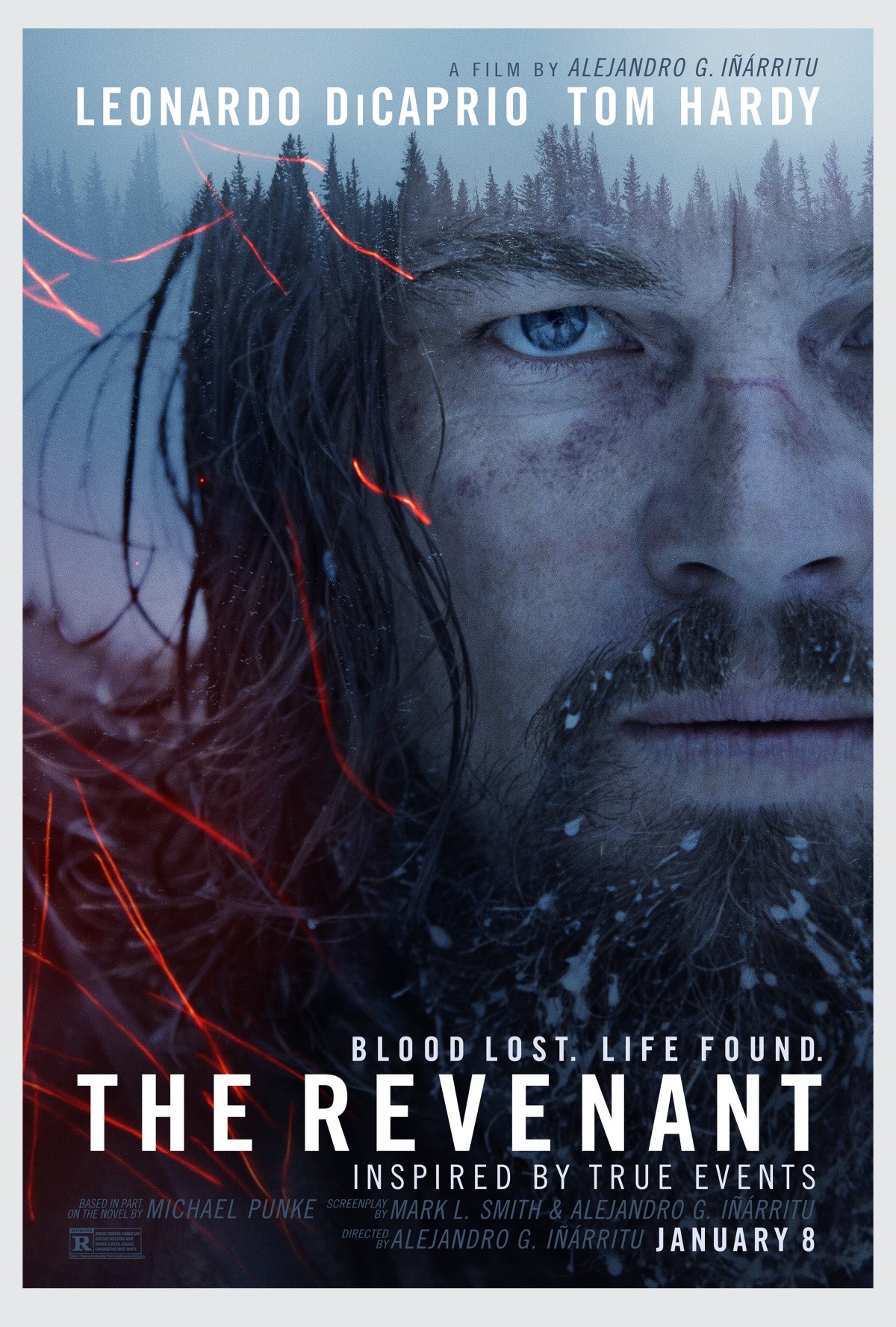
Watching The Revenant was an ordeal. Realistically gritty, putting the viewed in the centre of the action at all times and not afraid to show a bit of gore, that I felt so uncomfortable was inevitably a deliberate choice and will be one of the reasons it inevitably wins big at the awards ceremonies this year.
The story is set in 1823 in Louisiana Purchase, which the modern world now knows as North and South Dakota. It opens with a good old-fashioned Western movie standoff: the hunters are in the woods stockpiling pelts when they are ambushed by a group of Arikara Native Americans. The scene is one of the grittiest and most brutal opening battle sequences since Saving Private Ryan. People from both sides are blown up, arrows pierce any and every body part and nothing is watered down or censored.
The hunters are led by Captain Andrew Henry (Domhnall Gleeson), whilst the team includes hostile John Fitzgerald (Tom Hardy) and the experienced Hugh Glass (Leonardo DiCaprio). Hostility is felt between Fitzgerald and Glass; the former has been partially scalped by Native Americans and the latter has a son, Hawk, from his relationship with a native.
Come on guys. He’s done enough for the award this year.
The most famous scene from the film, in which Glass is brutally attacked by a female bear as he tried to hunt her cubs, is almost betrayed by a lack of convincing CGI. Fortunately if you believe in it enough, DiCaprio saves the day with a wholly convincing portrayal of a man desperately fighting for his life. It’s really difficult to watch but strangely mesmerizing, every grimace making you want to turn away and look closer in equal parts.
Tom Hardy is completely unlikeable as John Fitzgerald, just as he should be. There is literally nothing good about his character and it’s another huge achievement in Hardy’s young career.
As the final shot plays out, DiCaprio looks straight down the barrel of the lens and into our eyes. In the film, Glass is showing a whole range of spoilery emotions. In the real world, it felt like DiCaprio was saying to us “I’ve been attacked by a bear, had valleys dug into my back, been left for dead, thrown off a cliff, almost drowned, shot at, climbed inside a dead horse, eaten raw meat, learned the native Arikara language and almost frozen to death… so can I have an Oscar this year please?” I don’t think anyone who sees this could deny him of it. Not this time around.
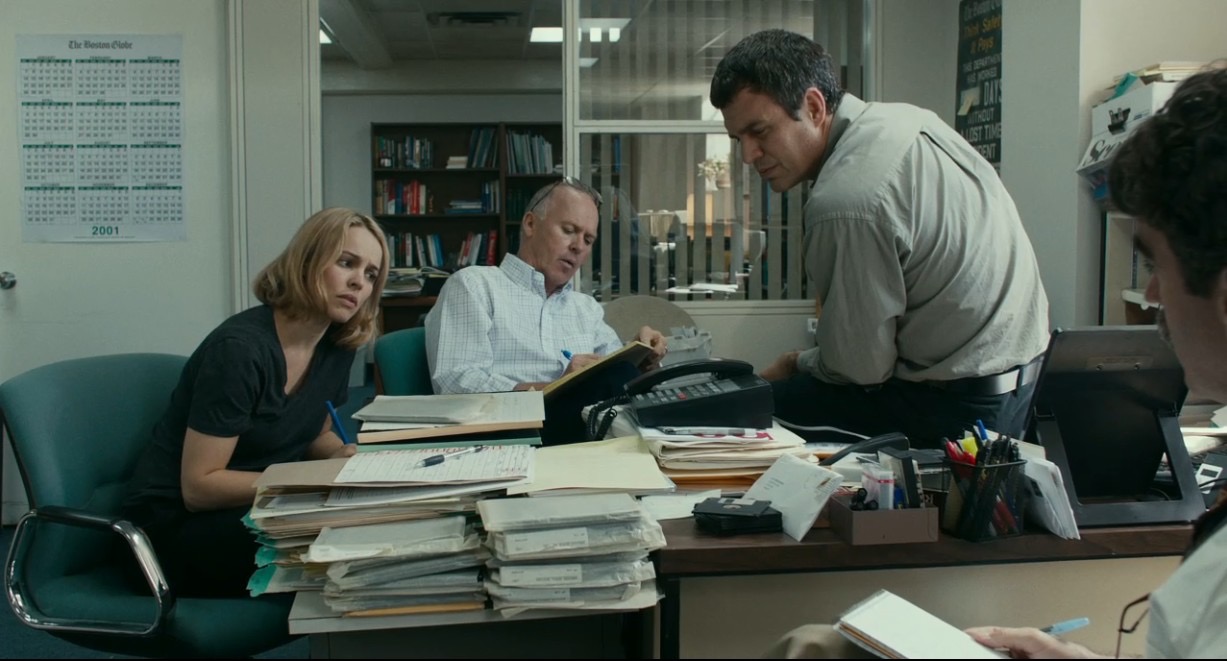
There are obvious paths to go down to tell a story about victims of child abuse. This film eschews the story of the individuals who have suffered the abuse, instead concentrating on the journalistic team that fought hard to uncovered the abuse. It deliberately attempts to portray just how difficult it was to reveal the truth about something when nobody wants to listen and everybody involved is trying to cover up what has happened. It is an effective but devastating success.
The title of the film is taken from an investigative journalistic unit that tackles stories it deems of necessary interest to the readers of The Boston Globe. In 2002 it published an exposé on Roman Catholic priests in the Boston area, offering evidence of not only child molestation and rape, but also of the systemic cover-up of the evidence by the church. The truths they found were horrific in both nature and magnitude.
Whilst the movie is truly an ensemble piece, there are three wonderfully nuanced performances that help make this film so effective.
The first comes from Stanley Tucci as the attorney Mitchell Garabedian. Tucci is a really special actor and he’s in fine form here. Garabedian has represented innumerable victims of the abuse and each time has been unable to affect change, with critical documents being suppressed by the church. Reminiscent of his role in Margin Call as Eric Dale, he is a man with knowledge of the wider secret dying for those around him to find out what’s truly going on.
A smaller but memorable turn comes from Neal Huff as Phil Saviano, head of the Survivors Network of those Abused by Priests. Based on a real person going by the same name, he makes the most of his limited screen time when he provides a harrowing monologue the first time he meets the Spotlight team. A frustrated picture of a man that likely represents the emotions felt by each and every survivor.
The finest performance, however, is from Michael Keaton as the Chief Editor of Spotlight, Walter “Bobby” Robinson. Throughout the story Bobby is a man wrestling with his conscience. He knows that to make the story as effective as possible he needs to wait for all the facts to be in place and make a thorough, damning article that cannot be ignored. However, doing this means sitting on the information whilst the abuse continues in the city. Late in the picture when he finds out he was actually tipped off about the scandal twenty years previously, he must conclude that he is finally bringing justice to the city despite potentially having the power to prevent generations of systemic abuse. Keaton nails it, reminding us all once again how great it is to have him back on the big screen in a role of substance.
I’m surprised Mark Ruffalo and Rachel McAdams have been selected for an Oscar nomination ahead of those they share the screen with. Fine actors though they are, it must have been a tough call to select two from a long list of solid performances. Ruffalo seemed to be holding back slightly, though that was perhaps a deliberate choice I didn’t pick up on fully.
It is rare that a whole audience is left in absolute silence at the end of a screening, but even on a busy Saturday afternoon there didn’t seem to be anyone that felt anything other than stunned. The reason for this was a devastating list of all the locations they have uncovered scandals in since the publishing of the initial article in 2002, firstly in the USA, then globally.
For this reason the film is now serving the same purpose as the original article: to shine a spotlight on a diabolical scandal that should have been eradicated decades ago. It is possibly the most important film you will see this year.
Setlist
Everything At Once
Writing To Reach You
Love Will Come Through
Driftwood
Paralysed
Side
Re-Offender
Animals
Where You Stand
Three Miles High
More Than Us
Closer
Turn
Flowers in the Window
Sing
Blue Flashing Light
Encore
Good Feeling
Why Does It Always Rain On Me?
Back in 1999, Travis were on top of the world. They’d enjoyed moderate success with their debut album ‘Good Feeling’, but with ‘The Man Who…’ they had become relentlessly popular. Songs such as ‘Writing To Reach You’, ‘Turn’, ‘Driftwood’ and ‘Why Does It Always Rain On Me?’ were hard to avoid that summer, and they cemented their success with a glorious headlining slot at Glastonbury in 2000.
They may not still be considered mainstream, but those that have stuck with them know their form has never really dropped. The intervening years have given us a plethora of excellent album releases, from the radio-friendly ‘The Invisible Band’ in 2001, through the politically-driven ’12 Memories’ in 2003 to ‘Where You Stand’ in 2013, which is arguably their strongest set to date. Indeed, only 2008’s ‘Ode to J. Smith’ failed to trouble the top five of the UK album charts, showing that the plentiful die-hard fans kept coming back for more.
With 2016 promising new album ‘Everything at Once’, and with a couple of well-received singles in the bag, Travis decided to go out on a mini-tour to road-test the new material for these fans. I was there for the first of these gigs, at the Roadmender in Northampton, to catch their return to the stage.
The 850-strong crowd were in fine voice as they smashed their way through the first handful of songs. Opening with new track ‘Everything At Once’ was a brave move that paid off and it has already clearly been well received. However, it wasn’t until ‘Writing To Reach You’ kicked in that the audience really got going. A couple more hits followed before the next new track ‘Paralysed’ was given its first airing. It sounded good but singer Fran Healy admitted it would take five or six listens before any new material would truly sink in.
With an audience such as this – most were members of the mailing list that had been tipped-off about a ticket pre-sale – the more obscure songs will always be appreciated. Both ‘More Than Us’ and ‘Good Feeling’ from their debut album received huge cheers, as did ‘Blue Flashing Light’ as it closed the main set. It was this set closer that proved to be perhaps the highlight of the night, clearly now a fan favourite despite being buried as a secret track on ‘The Man Who…’.
And so the night came to a close with their signature song ‘Why Does It Always Rain On Me?’, sung at full volume by everyone present. It was a night for Travis to get back into the swing of things in safe and welcoming surroundings, knowing they would receive a much-deserved warm response from their most dedicated fans. They are set to take their new album on the road this summer (an announcement is set to be made tomorrow morning at 7am). Whilst they might not win any new fans over, they certainly won’t disappoint those already converted.
Of all the stories of all the people that have ever existed on this planet, perhaps one of the last you’d think to turn into a film would be that of Joy Mangano, inventor and telesales presenter. It’s not that she’s unremarkable or boring, but she is far from a controversial character. What she does encompass, however, is both a traditional tale of the American dream and a figurehead for strong-minded women that have ever felt oppressed in work or at home.
If you’re wondering what Joy Mangano looks like in real life, there’s a popular video below of her selling her first major breakthrough invention: The Miracle Mop. From then on she became a self-made millionaire, invented many more successful products and created a business empire.
It has to be said that whilst she may be a household name across the USA, the rest of the world remains unaware of her background. Or at least they did. That was until the film Joy came along. Starring Jennifer Lawrence in the title role alongside the likes of Robert De Niro, Isabella Rossellini and Bradley Cooper, the film reveals the journey she went on to get to where she is today – from divorced mother-of-two working for Eastern Airlines right up to her first business successes.
The first forty-ish minutes of the film try really hard to give us a potted history of the causes of Joy’s personality traits, actions and outlook. It usually works on a scene-by-scene basis but the pacing causes issues and seems to lack direction until Joy herself finds a focus in her life.
From this point on the film has hit its stride and she breaks free from the oppression and the doubters. There are moments of humour (which surely explains the Comedy Golden Globe nomination, no?), edge-of-the-seat excitement (her first sell on QVC springs to mind) and fist-pumping success (I recall here a scene near the end set in a California hotel room). This is all driven by a remarkable performance by Jennifer Lawrence, reminding the world again that she isn’t just the girl from The Hunger Games but rather a girl with acting talent far beyond her years.
So whilst this film has its merits, the scatter-gunned first act and lack of consistency mean it won’t go down as one of the great films of the year, though Lawrence’s performance is worth the ticket money.
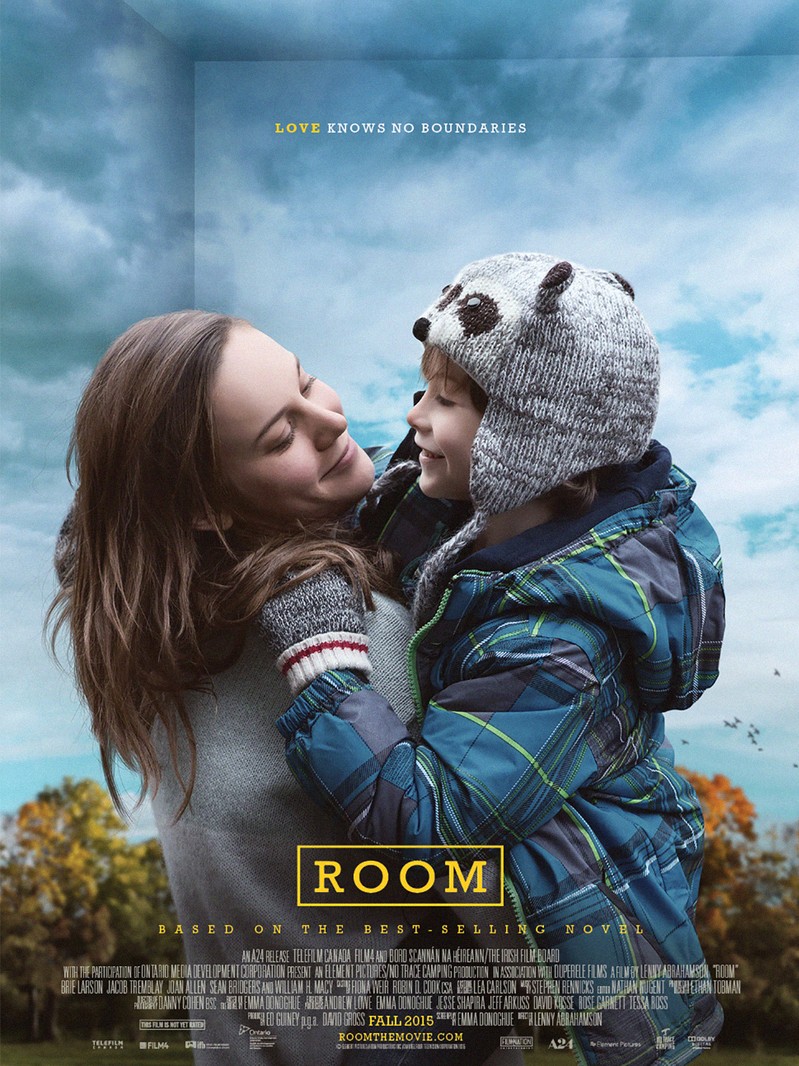
Much more understated in its promotional campaign than its awards season rivals – and a much harder film to describe with any vigor and make it sound interesting – Room is a film that simply needs to be seen. It may not seem it but it’s a wonderful hidden gem, the quality of which will only become apparent once you’ve seen it.
It is a film set in two distinct acts. The first act is based entirely in the room in which a woman known as Joy (Brie Larson) and her five-year-old son Jack (Jacob Tremblay) have been held captive by the mysterious Old Nick (Sean Bridgers). Following their release, they are reunited with Joy’s family and the outside world – a world that has left Ma behind and that Jack has never even experienced. Overwhelmed by their new freedom and affected by their psychological damage, we follow Joy and Jack as they try to find any kind of normality in their new life.
Jacob Tremblay and Brie Larson in Room.
The tiny room is suffocating in its lack of space and the feeling of being trapped is never more convincingly portrayed than when Jack is hiding in his cupboard. Looking primarily from his point of view in this first act, the room comparatively seems quite large – to him it is the whole world as he knows nothing else.
Through the unavoidable depressing nature of the situation, there are moments included that are truly uplifting. Seeing Jack finally open up to a family member is a beautiful moment. Indeed, it is surprising that Jacob Tremblay hasn’t been singled out for his stunning performance as Jack, a child who has gone through an impossible first five years of life. He has either been coached really well or is a true natural.
That said, Brie Larson can rightfully take the praise for her leading performance. Her character has taken the journey from childhood to motherhood within the confines of one small room and has remained strong for the sake of her child. The emotional turmoil is all there to be seen. It is deliberately difficult but equally rewarding to witness.
An early contender for one of my top films of the year.
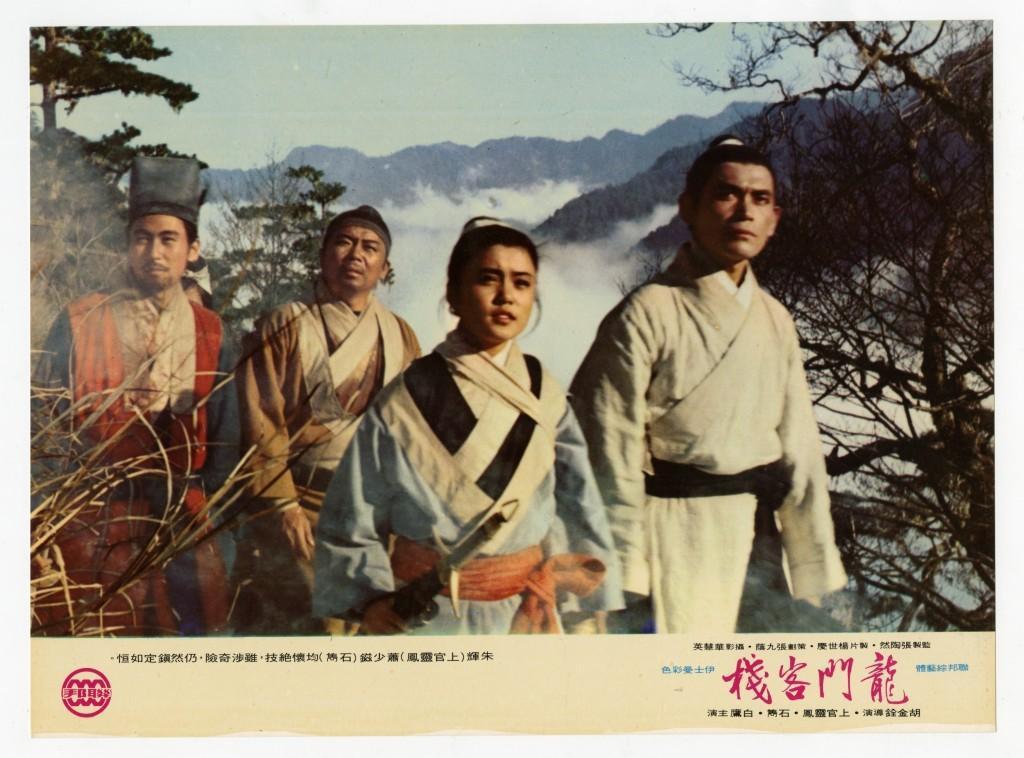
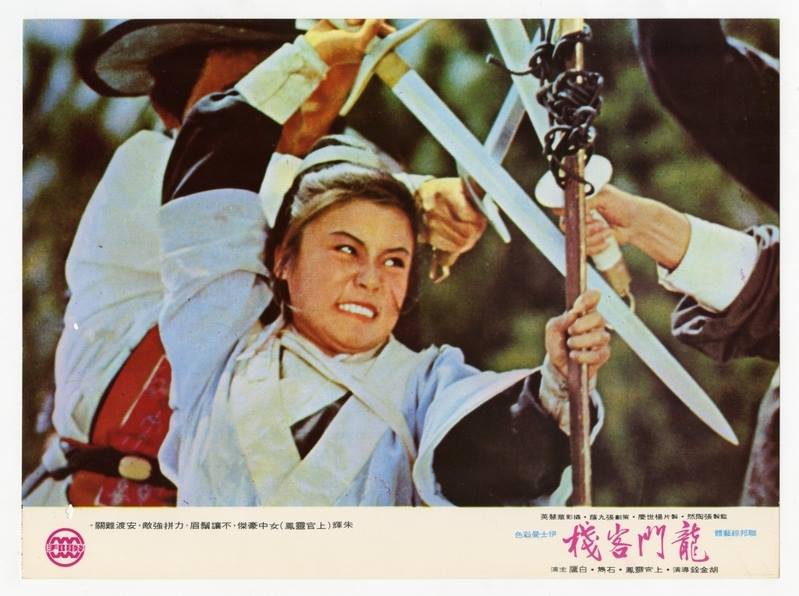
Recently released by Eureka as part of the Master of Cinema series, Dragon’s Inn is a beautifully-restored, rediscovered gem. The Taiwanese film is full of wonderfully-choreographed sword fights that go some way to make up for the gaps in a flawed but entertaining film.
To enjoy the film, you’ll first need to navigate the opening sequence – a sternly narrated dry prologue giving information regarding the political background to the story. Set in China during the Ming Dynasty, the film eventually concerns the Wu family. General Wu Ning (Cho Kin), the Minister of Defence, has recently been executed by the Emperor on the false advice of chief eunuch Tsao (Pao Ying). The leader has also ordered that all of the remaining members of the Wu family must live in exile.
Tsao has other plans, plotting for them to be murdered. He has sent a small gang to find them, landing them at Dragon Inn where his landlord cousin is expecting Wu’s son and daughter to arrive soon. As the story stirs up it becomes a classic martial arts stand-off film. The resistance by the family to the gang serves as a perfect platform on which to build both intense psychological battles and huge fighting set pieces, with the action all set around a solitary inn – a frequent element in King Hu’s films (so much so that this film forms part of his ‘Inn Trilogy’).
Watching Dragon’s Inn today it is clear it has been a huge influence on modern martial arts films, particularly Ang Lee. More pertinent this month are the similarities to Tarantino’s The Hateful Eight, though there have been elements of King Hu’s style woven into several of Tarantino’s films over the years (amongst dozens of other legendary filmmakers).
Our heroes possess powers bordering on that of superheroes. They can disarm their lower-level enemies by hitting them anywhere on their body. They can catch arrows or daggers in midair. It’s an invincibility that is now replicated from a distance in firearm combat by most modern Hollywood blockbusters but it is nonetheless quite a spectacle. It is a joy to watch.
The gore shown is way ahead of its time, with most of the lead characters getting sliced or diced at one time or another. King Tu is not afraid to show blood either, adding some much needed realism to the situation.
Stop dragon me into this.
Where the film excels is actually in the intensity of the standoffs. The first really gripping scene involves an attempted poisoning of Xiao Shaozi (Chun Shih), the first of the Wu family to arrive on the scene. Not much fighting is required when the playoff between the two parties is like a game of chess.
A discussion of this film wouldn’t be complete without mentioning the lead female actress Lingfeng Shangguan. The standout standoff is a hard-fought battle between her character (Chu Huei) and main antagonist Tsao, which is given life by the screen time afforded to turn it into a serious struggle rather than just a formality. It is unusual to see such a prominent and headstrong female fighting character in a film released in 1967. It’s refreshing to see her fighting for the honour of her family and not get tangled up in a romantic distraction. She’s there to fight, and fight she does.
Dragon’s Inn is available on Masters of Cinema dual format Blu-ray and DVD now.
Tarantino and controversy seem to go hand in hand these days. Django Unchained, his last release, was shrouded in negative press. Firstly there was criticism for over-use of racial slurs in the film. This led to a range of action figures being pulled from shelves (now worth a small fortune if you have any). Then he “shut down” an interview with Krishnan Guru-Murthy on Channel 4 News when he was questioned about overuse of violence in his films (see below).
The Hateful Eight has been just as rocky in the run up to release. Firstly, he pulled the film because the script was leaked, an act that Tarantino described as a “personal betrayal”, publicly naming either Bruce Dern, Tim Roth or Michael Masden as the perpetrators. There was some “brouhaha” (his word not mine) involving the American police forces that have led several states’ police forces to boycott the film. More recently, several UK-based cinema chains – Cineworld, Picturehouse and Curzon – have announced they won’t carry Tarantino’s eighth film due to the distributors Entertainment opting for Odeon as the exclusive screener of the 70mm extended roadshow version of the film.
Now, whether this is the definitive version of the film will remain open for debate. Tarantino is saying this is the case, so as such the hardcore fans of his films are keen to see this hard-to-find version. Indeed it’s so hard to find that if you’re in the UK you can only see it at one screen for four weeks. That screen is Odeon’s Leicester Square screen, which is where I journeyed to for my screening.
The Film
The film opens around a decade after the American Civil War with a powerful Ennio Morricone score coupled with a mysterious wagon stuck in a snow storm. Inside is bounty hunter John Ruth (Kurt Russell), on his way to Red Rock, Wyoming with a bounty in tow: gang member Daisy Domergue (Jennifer Jason-Leigh). With a $10,000 reward on her head, he is suspicious when they happen upon second bounty hunter Major Marquis Warren (Samuel L. Jackson) and later Red Rock Sheriff Chris Mannix (Walton Goggins) before arriving at the isolated outpost Minnie’s Haberdashery. It is there we come across the final four main characters in the film: hangman Oswaldo Mobray (Tim Roth), Bob The Mexican (Demián Bichir Nájera), former Confederate General Sanford Smithers (Bruce Dern) and cowboy Joe Gage (Michael Masden) waiting out the storm. Set for the likelihood of two days holed up in this outpost, tensions rise as the characters’ personalities and history slowly reveal themselves and friendliness gives way to suspicion.
It is easy to see why this film is being considered for an adaptation to the stage. It is mainly set inside the interior of the Haberdashery, giving the focus back onto actors and actress. True, it is a violent and bloody film, but it is also extremely enthralling because of some wonderfully colourful performances across the whole cast. Jennifer Jason Leigh is almost unrecognizable as she snarls and spits her way through her lines, spending most of the film bloodied and beaten.
It is also important not to take for granted two other roles around which the film is built. Jackson’s Warren is a man with a layered past and the portrayal is very well balanced – somehow making him an almost likable character despite his many flaws. He has been doing this for years now, often with Tarantino, and it would be easy to forget how much quality he puts into each performance. Elsewhere, Goggins is pitifully dislikable in his role as Mannix, though offers enough to ensure his character enjoys equal status with some of the films more prominent stars as he takes his character on a tangible personal journey. It’s a shame he was overlooked at the Academy Awards, but it has been a year of tough competition for supporting actors.
This is a psychological mystery that isn’t afraid to maintain the whole story in complete isolation. It intertwines some laugh-out-loud moments with shocking gore in a way that only Tarantino knows how. It may not be his greatest achievement but it certainly doesn’t disappoint.
70mm Ultra Panavision Presentation – is it worth it?
Seeing the roadshow version added a huge amount to the experience. The inclusion of an overture meant that the audience was truly settled by the time the film started in earnest – most of the much-needed extra large popcorn was all but finished by the start of the film. The intermission was quite unique as it meant the group I went with had fifteen minutes to reflect on the first half and a pretty crucial cliffhanger we’d just been served up.
There are apparently an additional four minutes of footage somewhere along the lines, but it wasn’t obvious where they came in. Certainly nothing felt expendable.
The traditional feel of the screening served the content really well. This is, after all, a Western at heart and the theatre and screening method both hark back to the late 1940s and early 1950s when Westerns ruled the silver screen. It added an authenticity to the experience, though the additional cost may have the studio executives wondering if it was all worth it.
There are five songs nominated in the shortlist for the Academy Award for Best Original Song Academy Award. Here’s a complete list with the videos.
“Earned It” from the film Fifty Shades of Grey
Music and lyric by Abel Tesfaye, Ahmad Balshe, Jason Daheala Quenneville and Stephan Moccio; performed by The Weeknd
“Manta Ray” from the film Racing Extinction
Music by J. Ralph; lyric by Antony Hegarty; performed by J. Ralph and Antony
“Simple Song #3” from the film Youth
Music and lyrics by David Lang; performed by Sumi Jo
“Til It Happens to You” from the film The Hunting Ground
Music and lyric by Diane Warren and Lady Gaga; performed by Lady Gaga
“Writing’s on the Wall” from the film Spectre
Music and lyric by Jimmy Napes and Sam Smith; performed by Sam Smith
BEST PICTURE
The Big Short Bridge of Spies
Brooklyn
Mad Max: Fury Road
The Martian
The Revenant
Room
Spotlight
BEST ACTOR
Bryan Cranston, Trumbo
Matt Damon, The Martian
Leonardo DiCaprio, The Revenant Michael Fassbender, Steve Jobs
Eddie Redmayne, The Danish Girl
BEST ACTRESS Cate Blanchett, Carol
Brie Larson, Room
Jennifer Lawrence, Joy
Charlotte Rampling, 45 Years
Saoirse Ronan, Brooklyn
BEST SUPPORTING ACTOR
Christian Bale, The Big Short
Tom Hardy, The Revenant
Mark Ruffalo, Spotlight
Mark Rylance, Bridge of Spies
Sylvester Stallone, Creed
DIRECTING
Adam McKay – The Big Short
George Miller – Mad Max: Fury Road
Alejandro G. Iñárritu – The Revenant
Lenny Abrahamson – Room
Tom McCarthy – Spotlight
ADAPTED SCREENPLAY
The Big Short
Brooklyn Carol
The Martian
Room
DOCUMENTARY SHORT
Body Team
Chau, Beyond the Lines
Claude Lanzmann
A Girl in the River: The Price of Forgiveness
Last Day of Freedom
MAKEUP AND HAIR STYLING
Mad Max: Fury Road
The Hundred-Year-Old Man Who Climbed Out the Window and Disappeared
The Revenant
ORIGINAL SONG
The Weeknd’s “Earned It” (from the film Fifty Shades of Grey)
J. Ralph and Antony’s “Manta Ray” (from the film Racing Extinction)
David Lang’s “Simple Song #3” (from the film Youth)
Lady Gaga’s “Til It Happens to You” (from the film The Hunting Ground)
Sam Smith’s “Writing’s on the Wall” (from the film Spectre)







 Cinema, etc.