Year six at Hogwarts.
Harry hunting horcruxes.
Snape kills Dumbledore.
Category / Cinema
Haiku film review #031 – Harry Potter and the Order of the Phoenix
Umbridge at Hogwarts.
Dumbledore fights Voldemort.
Sirius is killed.
Haiku film review #030 – Harry Potter and the Goblet of Fire
Three magical schools.
Three dangerous challenges.
Wait, is that Edward?
Haiku film review #029 – Harry Potter and the Prisoner of Azkaban
Wizard flees prison.
He was wrongly convicted.
Shit gets Sirius.
Haiku film review #028 – Harry Potter and the Chamber of Secrets
Harry Potter and
the Flying Ford Anglia…
And knock-off Gollum
Haiku film review #027 – Harry Potter and the Philosopher’s Stone
Orphaned child Harry
Gets headhunted by Hogwarts
Starts wizard training
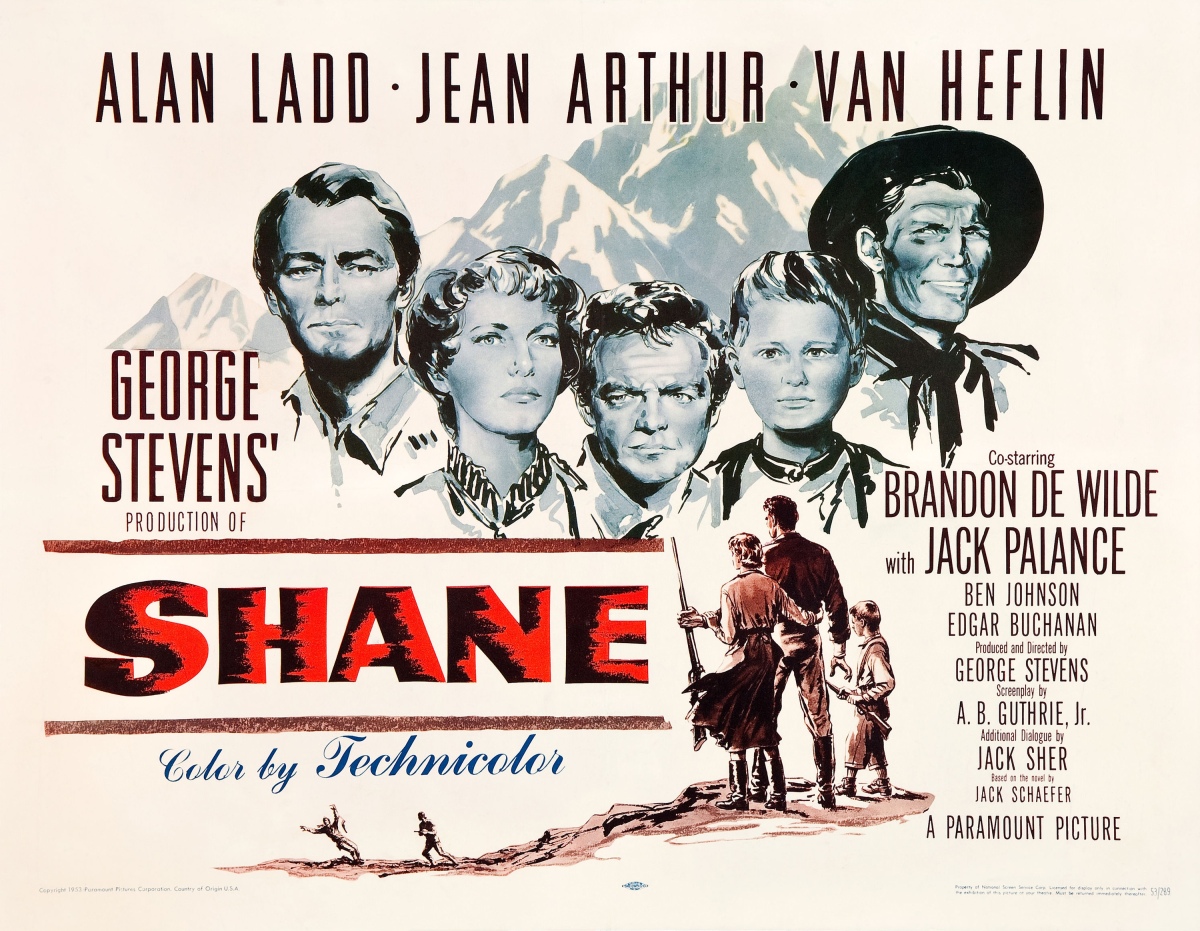
Film review – Shane (George Stevens, 1953)
I’ve never been a huge fan of Westerns. It’s a slight bugbear of mine and I hate to be so sweepingly dismissive of an entire genre, but until recently they’ve always seemed so formulaic and lacking in unique characters.
That’s not to say I don’t have many fond memories of Westerns. My grandfather was a huge fan of any films with cowboys in. Growing up, I lived away from most of my family and so getting to my grandparents’ house was a long journey that would usually have us arriving in the early afternoon, by which point my grandfather would often be settling in to watch a good Western. At the time, the subtleties of the character development or the most intense of standoffs was undoubtedly lost on my pre-teen self.
With the trusted Master of Cinema label now lovingly releasing a select few Western films (with the typical smorgasbord of bonus material to help put the films into context), I’m giving the genre a second chance, if nothing else to prove my smarmy little 10-year-old self that he was wrong all along.
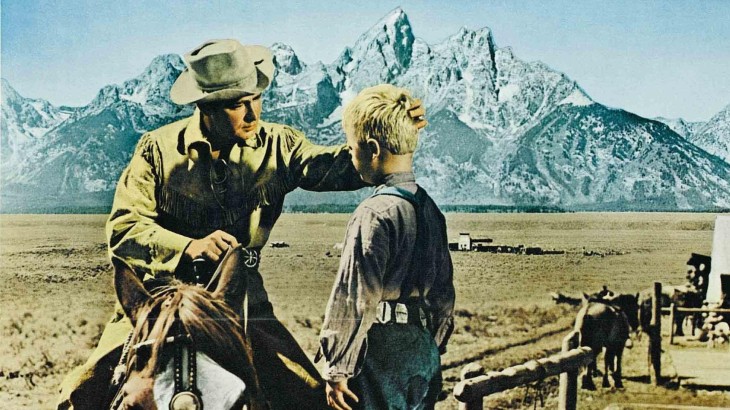
Shane tells the story of the titular hero, played by Alan Ladd. As the opening credits play out, he rides into a small isolated town in Wyoming to meet the Starrett family. He has a mysterious past but quickly wins their favour before the father Joe (Van Heflin) invites him to stay on their property to help out on the ranch.
Over dinner, he learns that the entire town is being terrorised by Rufus Ryker (Emile Meyer) and his gang, who are driving out families one-by-one to gain total control over the land in the area in order to better herd their cattle.
Thus, the story plays out with Shane and Joe forming a stern partnership to rally against the gang and save the town for those families already settled. As the conflict escalates, Shane emerges as the classic lone gunman hero in which the whole town’s hopes lie.
Whilst the story itself is quite familiar, befitting of any good cowboy or samurai film, director George Stevens gets away with the over-idolisation of Shane as the all-American hero by the inclusion of the young Joey Starrett (Brandon deWilde). It is through his eyes that we see everything happen. This has one of two effects. Firstly, it allows Shane to be as formulaic as he needs to be by virtue of the fact that the story can be considered as a retelling of the tale through Joey’s memory of the fact. If that doesn’t sit well as an interpretation, then at the very least the saintly actions of Shane can be seen as a means to leave a positive impression on the child – which he certainly does.
He is clearly a man wrestling with the wrongs of his past, and spends most of the film trying to hide this from the Starrett family. When he finally reveals his gunslinging credentials in front of the Joey, he decides it’s time to move on, presumably to the next place he stumbles upon that needs rescuing.
Whether he makes it to that next town is open to interpretation. Indeed, in the final shootout, he does take what looks like a fairly serious wound to the torso. He plays this down for his final leaving speech for Joey, but as he rides off I couldn’t help but wonder whether he was going to survive. After all, he’s spent the best part of two hours putting a brave face on for every other aspect of his life – he certainly wouldn’t let on to Joey that he was about to die.
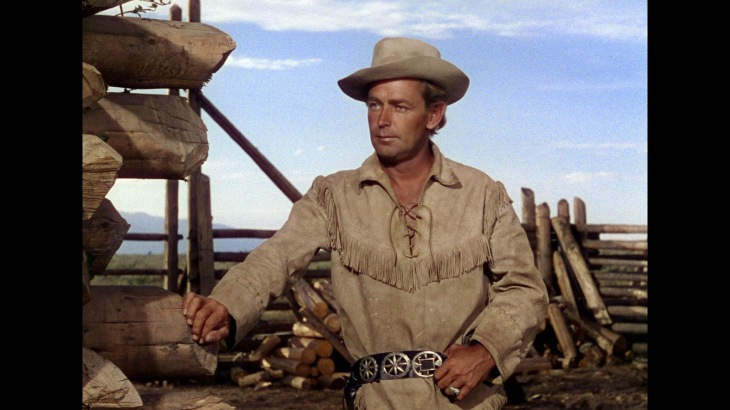
The romantic subplot between Shane and Joe’s wife Marian (Jean Arthur) adds an interesting subtext to the situation. Clearly she is pining for him, and her interest is underlined in every scene they share. It feels a little shallow, and does nothing for Marian as a character as she follows every stereotype in cinematic history. Alas, it was typical of the time and her only purpose is to add some sex appeal to Alan Ladd’s handsome hero.
Shane may be a typical Western, but it is a fine and pure example of the genre that is rightly being held up as one of the best of its kind.
[Note 1] The second screenshot in this review is how the film should look on your widescreen television, with black bars down the left and right sides of the picture. This is due to the aspect ratio used (1.37:1). There is a second aspect ratio available on the disc, though as Adam Naymar explains in the booklet note “Don’t Fence Me In” this is a controversial version of the film. I’ll let you read it for yourselves should you make the purchase.
[Note 2] Below is the theatrical trailer for Shane. It is proof that cinema goers in 1953 cared not for spoilers, as the critical climax of the final scene of the film is included. Quite why this was done is a mystery to me as it completely ruins the entire film, but since the film is now 63 years old I don’t feel it is fair to be angry towards me for including it in this article. After all, I’ve given you fair warning…

Film review – The Program (Stephen Frears, 2015)
In the midst of the Lance Armstrong doping scandal, Sunday Times journalist David Walsh published his book Seven Deadly Sins. The sole purpose of the book was to blow the cover on Lance Armstrong and reveal the truth about the complex doping program he was involved with during his supremacy in cycling, specifically the Tour de France. Whilst Armstrong was banned for life from cycling in October 2012, two months prior to the release of the book, vindicating David Walsh and the contents of his book.
The Program re-tells this story, with Chris O’Dowd as David Walsh and Ben Foster as Lance Armstrong.
There are narrow margins in its portrayal of Armstrong. Frears gives a fair portrayal of the man, allowing room within the character to justify his actions. It doesn’t shy away from the fact he spearheaded this complex program of systematic doping, on a level so widespread that USADA (U.S. Anti-doping Agency) referred to it as “the most sophisticated, professionalized and successful doping program that sport has ever seen“. However, to fully represent him, it must also be shown that he used a significant amount of his own time alongside the money earned to aide cancer research. The Program just about lands perfectly in the middle without feeling like it is sitting on the fence, only tipping into an out-and-out negative portrayal when he loses sight of his goal to beat cancer and instead gets addicted to winning at all costs.
When a massive scandal such as this is at the forefront of the public eye, it is easy to forget how successful and inspiring Lance Armstong was for both cyclists and cancer sufferers. It must be remembered that Lance Armstrong started doping, like most cyclists, because he couldn’t win a race without it. In this version of events, he was driven by the fact that doping was already widespread in the sport when he first considered it. It doesn’t strike me that Spears was condoning his actions; he wasn’t the first, nor was he the last. He was simply the most successful.

In hindsight, it was a win-win-win situation for everyone involved. Lance Armstrong won medals and tournaments every season, cancer research programs gained a lot of money and the profile of the sport was raised due to the success story playing out in the public’s eye. The only real losers were the honest cyclists who were unable to compete on the same level.
In time, this film won’t prove to be the definitive biopic on this subject, but with the media pursuit of truth as the approach it offers a unique angle on the situation. One wonders whether its success wasn’t hindered somewhat by the similarly-themed Spotlight, which was busy on the festival circuit at the same time as this. Spotlight may have not been everyone’s favoured choice for the Best Picture Academy Award in January, but it was certainly a more powerful film than The Program.
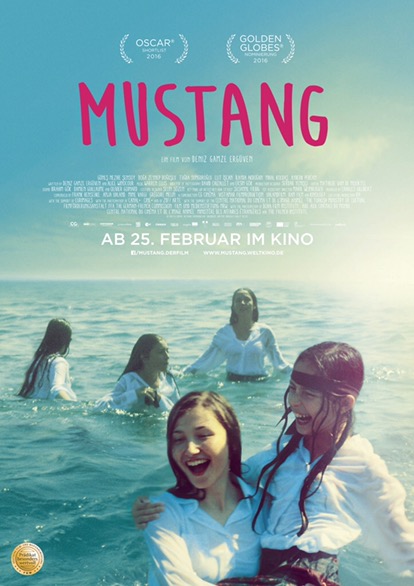
Film review – Mustang (Deniz Gamze Ergüven, 2016)
First-time director Deniz Gamze Ergüven’s Mustang is an astonishing debut. Dealing directly with women’s rights and the oppression of women in Islamic states, it’s bound to court controversy in many areas of the world, not least the country in which it’s set: Turkey.
The story revolves around five sisters. The central character Lale (Güneş Şensoy) is the youngest of the five and serves as the innocent viewpoint through which the story is told, a storytelling method reminiscent of Scout from To Kill A Mockingbird. Her sisters -Nur (Doğa Doğuşlu), Ece (Elit İşcan), Selma (Tuğba Sunguroğlu) and Sonay (İlayda Akdoğan as Sonay – are living with their traditionalist uncle Erol (Ayberk Pekcan) and fearful grandmother (Nihal Koldaş). After an incident at a beach that Erol deems to be too risqué, the five are effectively held on house arrest, taught to be “proper wives” and must wait their turn until a suitor is found.

The premise of the plot is one that brings out dormant anger towards the premise of pre-arranged marriages. The idea of this still happening to so many women in the modern world is an alien concept to those outside the most conservative of countries. Whilst it is known that this happens, Mustang manages to drive home a powerful message by focusing on just one tight family unit, in this case a close-knit group of girls who will likely never see each other again once they have been paired off. Perhaps it’s easier to pretend it doesn’t happen, or perhaps it’s easier to forget on a day-to-day basis as it is so uncommon in the Western world. All this just results in Mustang being a more shocking film.
It is hard to watch the storyline unfold without being reminded of Sophia Coppola’s 1999 indie flick ‘The Virgin Suicides’. Both films deal directly with the psychological effects of a group of five attractive teenage sisters being held under house arrest at the behest of their overbearing parents/guardians. I can’t see a situation where Ergüven hasn’t been influenced on some level by that film, but the repositioning of this basic plot makes it different enough to not dismiss its achievements.
Güneş Şensoy is a revelation in the lead role, playing perfectly the inquisitive innocence that the character demands. At such a young age and this being her debut performance, she is certainly one to watch in the future.
Mustang is a powerful film deserving of he widest of audiences. It’s at times heartbreaking, but there can never be enough attention shone on such a pressing humanitarian matter.
Cannes Film Festival 2016 – Winners in Full
Ken Loach has become the eigth filmmaker in history to win the Palme d’Or on more than one occasion, for his film ‘I, Daniel Blake’.
Here’s a list of winners in full.
Palme d’Or
Ken Loach’s ‘I, Daniel Blake’
Grand Prix
Xavier Dolan’s ‘It’s Only the End of the World’
Jury Prize
Andrea Arnold’s ‘American Honey’
Camera d’Or
Houda Benyamina’s ‘Divines’
Best director (tied)
Olivier Assayas for ‘Personal Shopper’
Cristian Mungiu for ‘Graduation’
Best screenplay
Asghar Farhadi for ‘The Salesman’
Best actress
Jaclyn Jose for ‘Ma ‘Rosa’
Best actor
Shahab Hosseini for ‘The Salesman’
Short film
‘Timecode’, Juanjo Jimenez
Honorary Palme d’Or
Jean-Pierre Léaud

