Star Wars Celebration Europe 2016 – Day 1

So day one of the Staw Wars Celebration Europe in London is complete and it has been a ridiculously good day. 

Whilst the highlight was the Rogue One trailer reveal and panel discussion, the rest of the day was literally a joy for all those in attendance.

Cosplay Competition

Cosplay is a mixture of costume dress-up and role playing, and has become a permanent fixture of the Celebration events and similar weekenders.

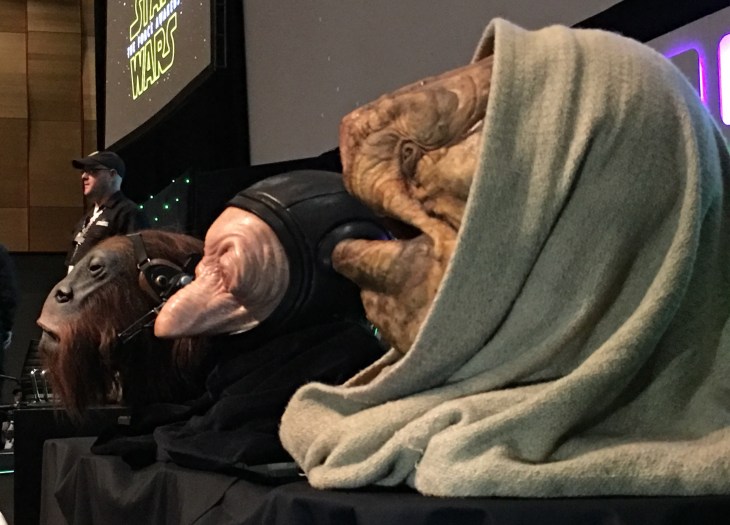
The cosplay competition was this year won by an excellent 9ft take on Grungar. I spoke to the creators and it took over 100 days to complete. In many ways, it is better than the costume from the movie, which itself couldn’t stand up and be moved around.

Across the board, it was phenomenal to comprehend how much time had collectively been poured into the competition. Even those that weren’t in the top 3 in their categories were great efforts, especially a near-perfect Kylo Ren.

An Hour With Mark Hamill 

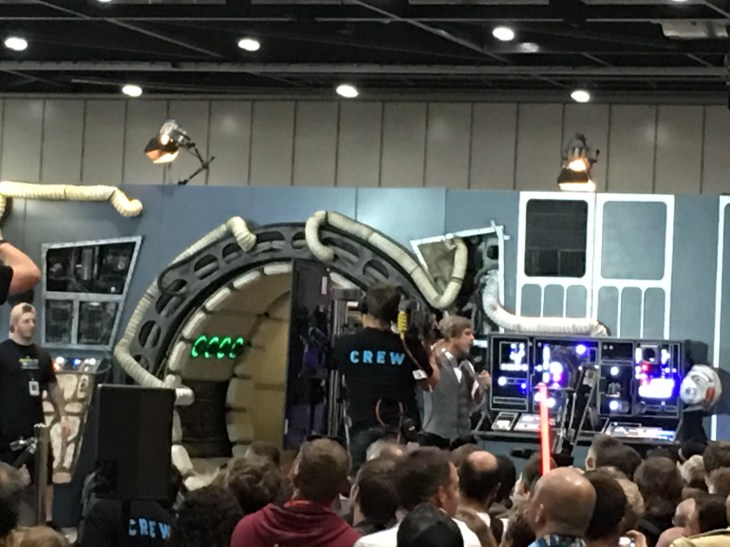
An hour with Hamill was never going to be enough and it was sad to see him go. The format was simple – he just had people line up and ask him questions until we ran out of time.

There were some fascinating questions, not just about Star Wars but also his successful voice acting career, and his responses were candid and revealing.

At one point he confirmed the long-standing rumour that the opening scene of Episode VII was his hand floating through space holding a lightsaber. Cool? I think so.

I hope the whole discussion is made available some day soon.

Freebies

Want cool free things? Just walk around. There’s plenty there. My favourite was a Dengar Top Trumps card. I’m evidently easy to please.

I did spend some money too. I’ll be wearing my awesome German-language The Empire Strikes Back (or is that Das Imperium Schlägt Zurück?) t-shirt tomorrow for day two!!

What did we learn from the Rogue One: A Star Wars Story panel?

The Rogue One: A Star Wars Story panel took place earlier today at the Star Wars Celebration in London, and it has opened the floodgates on a plethora of information on the upcoming standalone film.

Here we run through some of the highlights.

What are the character names and who are they?

Jyn Erso

Felicity Jones as Sergeant Jyn Erso


Felicity Jones takes the leading role as Sergeant Jyn Erso. Jyn was described by Jones as a lead character distinct from the others in the Star Wars universe in that she is already an established character and as such we don’t go on a journey of discovery with her. This is perhaps because it’s a standalone film and there simply isn’t time to develop a serious character arc whilst delivering an entertaining blockbuster film.

Jones is most famous for her Oscar-winning role as Jane Hawking in the 2015 film The Theory of Everything, for which she was nominated for an Academy Award. She also featured in Like Crazy, Breathe In and Cemetery Junction

Cassian Andor

Diego Luna as Cassian Andor


Diego Luna will play a prominent role as Cassian Andor. We learned today that he is a Rebel Intelligence officer. It appears that he will be the second-in-command to Jyn within the film. He has a close relationship with droid K-2S0.

Eagle-eyed viewers may remember Andor’s small but powerful role as Jack Lira in Milk.

K-2S0

Alan Dudyk as K-2S0


One of the most entertaining discussions was with Alan Tudyk, who features as the now-obligatory droid in the film. He is a former Imperial droid that has been reprogrammed by Cassian. However, the reprogramming hasn’t really taken 100% and he has quite a few gaps in his personality. One scene showed him refusing to carry Jyn’s luggage because it wasn’t in his new protocol.

Also, it’s not K-250, it’s K-2S0. Subtle difference.

Tudyk has a rich history as a voice actor for animated films, including Big Hero 6, Wreck-It Ralph, Zootopia and Frozen, as well as starring in Firefly.

Bodhi Rook

Riz Ahmed as Bodhi Rook


We knew Riz Ahmed’s character name a long time ago, after he accidentally leaked it on his online CV. Bodhi is an imperial craft pilot who is also a member of the rebel alliance. His explanation of this caused much hilarity from the crowd: “You know, people work at big organizations… but they don’t agree with everything they do.”

Ahmed is one of Britain’s finest young actors, having excelled in roles in Four Lions, Ill Manors and Nightcrawler. His presence in this film will doubtless be a huge enhancement to the conviction of the rebel team.

Chirrut Îmwe

Donnie Yen as Chirrut Îmwe


“I can’t see but I can feel with my heart and believe in the Force,” said Donnie Yen of his character Chirrut Îmwe. The clips showed him kicking-ass in some beautifully-choreographed fight scenes, with a distinct hint of Jediism in his grace. I’d be surprised if he wasn’t a Jedi.

Unfortunately, a huge spoiler was dropped about this character by co-actor Jiang Wen. I won’t perpetuate it here.

Yen may be vaguely familiar to Western audiences following small roles in Blade II and popular martial arts film Hero, though he should be more fondly remembered for Ip Man.

Baze Malbus

Jiang Wen as Baze Malbus


Baze has a big gun. That’s the line Jiang Wen took when he decided he wasn’t going to reveal much about his character. Yes Wen, keeping the eventual fate of characters close to your chest is very much a good idea when dealing with such a huge franchise.

Wen doesn’t have much in the way of credits that are familiar to the West, other than a directorial position for a segment of ‘New York, I Love You’. If you’re desperate to see him in action, 2011’s The Lost Bladesman would be a perfect place to start as it co-stars fellow Chinese actor Donnie Yen.

Saw Gerrera

Forest Whittaker as Saw Gerrera


Forest Whittaker is a man who needs no introduction, but I’ll give him one anyway. At just 55, he has had a career spanning four decades and has received plaudits throughout his career for mesmerising turns in the likes of The Last King Of Scotland, Platoon and The Butler. His credentials are certainly not in doubt.

Saw Gerrera is a character that has featured heavily in The Clone Wars TV series. His character was very headstrong and a natural leader, regardless of whether or not this was wanted by those around him.

Galen Erso 

Mads Mikkelson as Galen Erso


Mads Mikkelson stars as Galen Erso, whom it was revealed is Jyn’s father. He is also a scientist that “invented something so beautiful, so fantastic, that it might change the universe.” Whatever that means.

Mikkelson will be familiar to anyone that enjoyed Casino Royale back in 2006, though he is perhaps better known for his lead role in TV series Hannibal, which has been around for 3 years.

Orson Krennic 

Ben Mendelsohn as Orson Krennic


Australian Ben Mendelsohn is currently troubling the Netflix airwaves with his starring role in Bloodlines, which recently won him an Emmy. He also featured in The Dark Knight Rises and Starred Up, the latter of which is well worth a watch.

His character is the main protagonist in the film, trying to become the Emperor’s new right hand man at the expense of Darth Vader.

What else did we learn?

Familiar characters?

Alan Dudyk was chatting about how nice it was to meet Anthony Daniels once at the Episode VII wrap party, to which the Rogue One cast were invited. That indicates that C-3P0 is not in film, or they would have more than likely met at some point in the filming or script reading process. 

Whilst this may mean that our favourite droids and other original trilogy characters have been left out this time, we did get a glimpse of Darth Vader at the end of an exclusive short trailer. James Earl Jones will return to voice him. It was very cool.

Familiar Faces?

Warwick is a big fan favourite and has been all over the Celebration event, hanging out with fans and keeping people happy. It was a great moment when he was glimpsed in the behind-the-scenes footage, much like the brief appearance a couple of years ago by Simon Pegg in the Episode VII sneak preview.

That takes his film tally up to four, which means he still has some catching to do to overtake Peter Mayhew, Kenny Baker and Anthony Daniels.

Gareth Edwards likes George Lucas…

… And so should we. It was great to see him offer his support to Lucas, whose name has been mud for the last 17 years. It’s easy to forget that he created this massive universe and has brought joy to millions of people worldwide for the last 40 years.

Star Wars Celebration Europe 2016

I’ve just arrived at the Star Wars Celebration Europe event in London, a weekend of fun for anyone who loves all things Jedi!

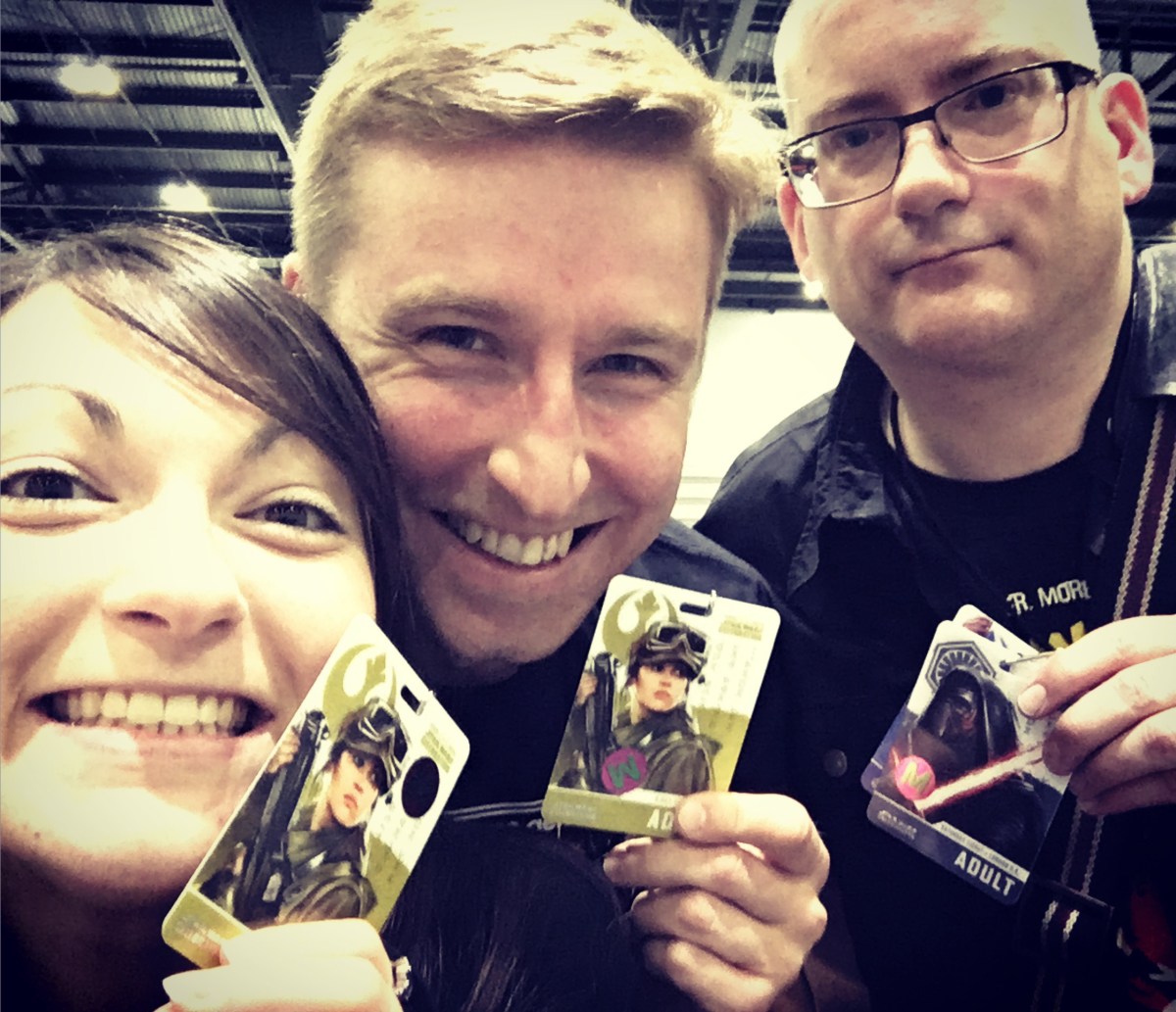
It was a bit of a rush this morning but we’ve managed to get on site, pick up our tickets and get wristbands for two popular events:

– An Hour With Mark Hamill

– Rogue One: A Star Wars Story

With about an hour to go until the pandemonium that is the opening of the hall, we couldn’t be more excited. Our group is setting each other small trivia questions, most of which result in a correct answer (eventually). Apart from any answered by me – I couldn’t even tell a Magnaguard from an Imperial Guard.

I just feel sorry for the guy who came dressed as adult Anakin for the cosplay event. Why?!

See you around here.

Film review – A New Leaf (Elaine May, 1971)

A New Leaf, the 1971 debut feature film from Elaine May, tells the story of Henry Graham (Walter Matthau), a wealthy man who finds himself broke through misfortune and bad money management. Striking a deal with his rich uncle Harry, he borrows $50,000 to help facilitate a temporary extension to his rich lifestyle, with the hope that in the time he has to pay Harry back he can find a rich single woman to marry and regain financial security. He happens upon Henrietta Lowell (Elaine May), a shy and clumsy botanical professor who may well provide the solution to his problems.

The film is definitely a black comedy, even though its light on the latter. Much of the humour here is based on Matthau being in situations of discomfort or unfamiliarity. Initially suicidal after realising he has now money, then more so at having to say farewell to his favourite upper class haunts, his pain is worsened by having to act like he has feelings of affection and compassion for a woman he has little interest in. Driven solely by money, he is shocked at how poorly her finances are managed, sacking her entire house staff team in one memorable scene.

The film plays out like an extended and scripted episode of Curb Your Enthusiasm. It’s hard to think that Larry David hasn’t seen this and been influenced by it in some way, though admittedly the comedy in David’s work is much more realised.

However, as a one-trick pony the joke tends to wear thin as we progress towards the inevitable climax of the film. According to the extensive liner notes – a gift we come to expect with the Masters of Cinema releases – there was a much extended version of A New Leaf (running at a whopping 180 minutes) that never saw the light of day, and probably never will. Whilst it’s always a shame to think a director’s vision hasn’t been fully realised, and the normal response from film enthusiasts is that the director’s cut is the ultimate version of a film, it appears that what we do have access to is probably as good as it gets. Indeed, Matthau preferred the shortened version, which cuts out a murder subplot and provides a happy resolution at the end.

That’s not to say that May’s vision is unworthy of viewing. Certainly, as a writer-director-star she succeeded in creating a solid picture. Her character in the film is by far the most interesting. She is a scientific professor, despite seemingly not needing to work (having inherited her wealth). She is essentially a philanthropist if we look at the way she treats her overpaid and underworked house staff. She is a loving and dedicated wife to her new husband, despite getting nothing in return for her devotion. In many ways, despite her introverted geekiness and inherent clumsy nature, she is a strong female role model. Subtly, the plot of the film is a slight on men in general, which was unusual for the era.

Unfortunately, however, it’s a little known film for a reason. It’s not groundbreaking or unique enough to warrant any kind of extensive praise. It has its fans and at times we are watching vintage Matthau, but the pacing, lack of a cutting script and predictable plotline undermine what could have been a much better end product.

Film review – Elvis and Nixon (Liza Johnson, 2016)

The one-off meeting between President Richard Nixon and Elvis Presley is a story that deserves a dramatisation, such is the bizarre nature of how it came about. Elvis and Nixon does a good job of it, partly due to some fanciful embellishment, but fails to realise its full potential due to a number of unforgiveable flaws.

The background is fairly straightforward. Elvis Presley (played by Michael Shannon), on the morning of 21st December 1970, showed up unannounced at The White House and requested a one-to-one meeting with Preseident Nixon (Kevin Spacey). He had one request: to become a Federal Agent-at-Large and receive a badge for his efforts. This would help him fight an undercover war on drugs that he felt was a huge issue in USA at the time. At first resistant to the idea, Nixon eventually gave in and the monumental meeting took place.

elvisandnixonscreen1

The first thing you’ll be disappointed about with this film is the lack of Elvis on the soundtrack. It seems like a simple point to get around, but every time the music kicked in I was left wanting the real deal, a constant reminder that the contents of the film presumably weren’t endorsed by Graceland. The soundtrack certainly evokes the era, making good use of Creedance Clearwater Revival and Otis Redding, but Elvis is Elvis.

Secondly, whilst Spacey does a wonderful impression-cum-caricature of President Nixon, Shannon fails to invoke even the slightest hint of The King. A fantastic actor in his own right (see Revolutionary Road, 99 Homes), I couldn’t help feel like this was a miscast. Visually, his appearance is far from the mark, with the angry and aggressive facial expressions implying an Elvis unfamiliar to most of his fans. This is compounded by a scene with an Elvis impersonator that’s played for laughs but left me thinking “Well, go on then Michael… Do your impression.” I appreciate that singing isn’t the point here, but Elvis is an iconic artist and the film’s success rests on how convincing the portrayal is. At least, that’s the case for the first half of the film.

Which brings us to the third and final shortcoming of the film – the criminal underuse of Kevin Spacey. The editors realised he wasn’t in it enough and tried to patch a bit of a scene with him in at the beginning, but essentially he doesn’t re-appear until well beyond the halfway point of the film. By this point the film was already at risk of being a complete failure. Spacey, somehow, succeeds in rescuing the film with a performance that’s truly exciting, the play-off between him and everyone he interacts with proving to be the film’s one major saving grace. It is just a shame we didn’t get to see more of him. There’s a time and place to leave Kevin Spacey out of your film until the climactic scene and this isn’t it.

So, whilst I was pleasantly surprised that I left the cinema having enjoyed this film, there were three fatal flaws too many to leave me wanting to recommend this to anyone but the most ardent blockbuster avoider. There are simply too many good films out at the moment to see this taking flight.

Film review – Il racconto dei racconti / Tale of Tales (Matteo Garrone, 2016)

Tale of Tales is a film that merges three fantasy tales from Italian storyteller Giambattista Basile’s book Pentamerone. The results are mixed.

The first, The Enchanted Doe, stars Salma Hayak as the Queen of Darkwood, who is struggling to have a child with her King, played by John C. Reilly. Taking the advice from a necromancer, the King sets off to capture the heart of a sea monster for his Queen to eat. Doing so brings her the child she desires, but this comes at a cost.

The second tale, The Flea, stars Toby Jones as a king seemingly reluctant to find a husband for his daughter Violet (Bebe Cave). Secretly, he is nurturing a flea in his chambers, growing it to an enormous size, but in doing so neglects his daughter. 

The final tale, The Flayed Old Woman, stars Vincent Cassel as a king with an insatiable lust for all women he lays eyes on. He is attracted by one woman (Hayley Carmichael), however, that he cannot see but can hear. As she sings a beautiful lament from the shadows of the streets of his kingdom, so begins an addiction to seeking her out to fulfil his desires. Fearful of him seeing her true form, she tries to push him away, only for his desire to grow stronger.

The three stories run entirely separately until the final scene, which is sort of a throwaway tidbit that attempts but fails to tie it all together. The overall result is something akin to a highbrow fantasy take on ‘Love, Actually’, whereby several separate storylines weave in and out of one another without significantly benefiting from it. Indeed, the sum may well be less than the parts.

The opening scenes concentrate almost exclusively on Salma Hayak’s unfolding story, to the point where when we first see Vincent Cassel it’s confusing to work out how he fits into the rest of the story. A few moments later it becomes obvious (sort of) that he’s the king of another kingdom, though we have to deduce that ourselves. Perhaps I’m just used to being spoon-fed too much, but I was confused.

The Flea segments are painfully slow, with Toby Jones feeling a little wasted as he tries and fails to inject some life into a largely lifeless story.

Hayley Carmichael rises above the dross to give a starring turn as the old woman Dora, with segments largely full of wit and humour. Vincent Cassell adds a lot to these scenes, lifting them with a knowing amount of irony that just about makes the film bearable.

It is interesting that the director Matteo Garrone has stated that he had worked on ideas for a few other stories from the same source material. In my opinion, these tales would work significantly better broken up and serialised. There is some good work here but it’s hard to get sucked in by one faltering tale, let alone three.

A visually stunning film that fails to ignite the interest, an issue I blame mainly on poor editing and a disappointing adaptation of some highly respected source material.

Film review – Journey to the Shore (Kiyoshi Kurosawa, 2015)

‘Journey to the Shore’ won director Kiyoshi Kurosawa the Un Certain Regard prize at last year’s Cannes Film Festival. It is also the Masters of Cinema label’s latest foray into the new release market; the label is more frequently associated with the restoration of forgotten classic cinematic releases but has enjoyed success with the likes of ‘Listen Up Philip‘ and ‘Life of Riley‘ in recent years.
The film tells the story of Mizuki, a young female piano teacher mourning the death of her husband Yusuke, who we learn has drowned at see three years prior to the start of the film. However, when his ghost appears mysteriously at home one day, she is less surprised at his presence and more annoyed as he has forgotten to take his shoes off.

The reunited couple set off on a journey together as he takes her to visit the people who have helped him journey home from his point of death, with Mizuki’s resulting spiritually cathartic journey being the focal point of the story.


It’s a story that is rooted in Japanese culture, with the human grieving process following the death of a loved one a typical starting point for its fair share of Japanese films in recent years. Where this sets itself apart is in the very blatant separation from reality afforded by the seamless interaction between the living and the dead. There doesn’t seem to be any hard and fast rule about who can talk to whom, nor does there seem to be any surprise or shock experienced by the living seeing a close departed friend or family member. Indeed, Yusuke is portrayed as a living, breathing being with he ability to fully interact with his surroundings. It’s a unique spin on the matter (pun intended).

There are some really effective cinematographic techniques employed to reflect the mood of the scenes, most notably in the dimming of the lights when a darker story is being retold. The credit here lies with director Kurosawa and his cinematographer Akiko Ashizawa. It was subtle enough to have an impact before I realised what had happened, as key characters revealed their darkest of memories, and it added considerably to the picture.


Whether it really works as a whole is something I’m still not totally sure about. Certainly it is delivered with conviction, though the overall effect is something entirely morose. There seemed to be a relentlessness to the depression involved that, whilst perhaps reflective of the mood of the characters involved, seemed to offer nothing in the way of a positive escape for anyone watching looking to be guided by the grieving process.

The film achieves its aims and carries everything off to perfection. It’s just not a very pleasant experience to sit through.

Film review – 思い出のマーニー / When Marnie Was There (Hiromasa Yonebayashi, 2016)

The latest film released from the Japanese animation powerhouse Studio Ghibli is also the final feature film they will ever release. At least, that’s the line they’re taking. There doesn’t seem to be any indication that this isn’t true, although secretly most Ghibli fans – myself included – hope there will be something else around the corner. 

A glimmer of hope has come in the suggestion that more short films will be produced for the Saturn Theatre, the small cinema that resides inside the Ghibli Museum in Tokyo. Unfortunately for those of us outside Japan, seeing the existing ones is quite the task – you’ll need at least a return plane ticket to Japan and some forward planning to get tickets to the museum itself. Oh, they only screen one film a day and you can only see it once. There isn’t any plan to screen any of them anywhere else in the world, so seeing the sequel to Totoro might not be something to add to your bucket list.

All this sadly leaves us with only one more Studio Ghibli film to enjoy at the cinema, finally seeing the light of day almost two years after its release in Japan. When Marnie Was There is based on the original novel of the same name by British author Joan G. Robinson, with many of the details changed from the original novel. Most notably, the location has been changed from Norfolk in England to Sapporo in Hokkaido, Japan.


The storyline deals with a young girl, Anna, who suffers from anxiety and asthma. A loner at her school and lacking in confidence, she is sent away to live with family friends in Sapporo on the advice of her doctor, who suggests that leaving the city for the clearer air and change of scenery will cure her ailments.

Once there, she struggles to settle until she happens on a mysterious building called The Marsh House, inside which a beautiful young girl name Marnie is living, a girl with whom she strikes up an immediate and very close friendship.

So how does When Marnie Was There fit into the greater Ghibli catalogue? Instantly it will strike you that it’s just as beautifully animated as anything we’ve seen before, with hand-drawn drawings taking us on the typically personal, solitary journey of the main character. Animation has seldom looked this good, and I include Disney’s output in this statement too.

The storyline will be familiar to those fans of previous Ghibli works. A young girl sent away from her comfort zone to new surroundings dealing with a secretive and mysterious occurrence, via an unlikely friendship. It is ground well worn, but that shouldn’t be a reason to dismiss it. 

Anna herself is a wonderfully realised creation. The sense of isolation as she sits at school having an asthma-induced panic attack is heartbreaking and as realistic as any live-action portrayal of anxiety I’ve ever seen. This is a critical achievement – get it wrong and we’re dealing with a whiny self-obsessed teenager for two hours.

It is perhaps not as immediate as some of the more celebrated works. It’s a frustrating time to be a Ghibli fan. It’s probably the last film to hit the big screen, but it’s not the best place to start if you’re unfamiliar with the studio. If you can, watch My Neighbour Totoro and Spirited Away straight away, then head to the cinema to catch this before you run out of time.

Live music review – Elton John at Leicestershire County Cricket Club, 11th June 2016

Setlist:
Funeral for a Friend / Love Lies Bleeding
The Bitch Is Back
Bennie and the Jets
I Guess That’s Why They Call It the Blues
Daniel
Looking Up
A Good Heart
Philadelphia Freedom
Piano Improv
Rocket Man (I Think It’s Going to Be a Long, Long Time)
Tiny Dancer
Levon
Goodbye Yellow Brick Road
Have Mercy on the Criminal
Sorry Seems to Be the Hardest Word
Your Song
Burn Down the Mission
Sad Songs (Say So Much)
Don’t Let the Sun Go Down On Me
All the Girls Love Alice
I’m Still Standing
Your Sister Can’t Twist (But She Can Rock ‘n Roll)
Saturday Night’s Alright for Fighting

Encore:
Candle in the Wind
Crocodile Rock


Elton John returned to Leicester for the first time in 40 years to play to a packed crowd of eager middle-aged middle-class concert goers. The day was geared towards his fanbase – all tickets were seated and it the whole thing was wrapped up well before 10pm. The main flaw was a vast underestimation of how popular fish and chips would be with a crowd who arrived before 5pm.

Elton didn’t waste any time getting stuck into his biggest hits, blasting into an epic take on Funeral For A Friend / Love Lies Bleeding, before picking up the pace with The Bitch Is Back.

These concerts can always run the risk of such a well-established artist like Elton John just going through the motions. His touring band has been together for a while and have been playing these songs for decades, but it didn’t show. The important thing was that they all looked thrilled to be there, a sentiment that transferred directly to the audience. It wasn’t until he got into the slow-paced A Good Heart from his latest album Wonderful Crazy Night that the crowd died down and took a breather.

The mood was only soured when Elton launched a tirade towards some over-zealous security guards at the front of the stage, who appeared to be forcing the crowd to stay seated. Elton refused to continue until they sat down themselves, and this confrontation caused a slight break in the fun.

It must be difficult to stay in a bad mood, however, when your songs are being sung word-for-word by 1000s of adoring fans, and as the drinks flowed and the night drew in, the crowd fell in love with the superstar all over again. With songs this good, it’s easy to see why.