Dear White People (Justin Simien, 2014)

The second of two films I saw at this year’s BFI Flare Festival, Dear White People is an American satirical comedy set on Ivy League Winchester University campus. It centres around several students who attend the predominantly white university, in particular: Sam White (Tessa Thompson), a sharp-tongued mixed-race film production major who runs a popular campus radio show called Dear White People, which challenges the university policies and mind-sets of both the school administration and the students in a humorous but cutting manner; Lionel Higgins (Tyler James Williams), a homosexual black student struggling to fit in and find his voice as an aspiring journalist; Coco Conners (Teyonah Parris), a black student who is secretly trying to land a role on a reality TV show set around campus, whilst simultaneously trying to garner fame through her video blog; Troy Fairbanks (Brandon P Bell), Sam’s ex-boyfriend and current school head of Armstrong/Parker, the all-black house on campus; Kurt (Kyle Gallner), a white student and son of the school’s president, who organises a controversial Hallowe’en party with a blackface theme in response to Sam’s outspoken radio show; and Gabe (Juston Dobies), Sam’s white boyfriend.

Tessa Thompson is a revelation in her performance as Sam White.

Tessa Thompson is a revelation in her performance as Sam White.

I was lucky to see this film. It was the subject of an online petition to raise awareness of the film and increase the pitiful number of screenings it received last year in the UK – just two at the BFI London Film Festival. These Flare screenings were again over-subscribed, which begs the question – why hasn’t it received a wider release? Perhaps it’s the fact it deals with some pretty hard-hitting issues whilst not losing its ability to entertain. Maybe the questions posed were deemed as too sensitive for a large distributor to pick it up. Either way, it’s a massive shame. This is a film that needs to be seen, not just because of its important content but also because it’s a fantastic and hilarious film.

Praise is due for both Tyler James Williams and Tessa Thompson. The former, fresh from his recent role in The Walking Dead as Noah puts in an assured performance as someone who himself isn’t very self-assured for most of the film. However, I’m surprised he is the cover-star of the film as, for me, the central storyline and most interesting character was Sam White. Tess Thompson (recently of Selma) is a revelation in this role, playing the angry student to perfection. It’s a character with some important opinions and without her it would have risked being just a good campus comedy, but without the hard-hitting message. When the cracks in her prickly character reveal her fragility, the results are astounding. As a character, Sam galvanises the same provocative thoughts in the students within the film as it does the viewers of the film, and there aren’t many teen-comedy characters in recent years that I remember asking such important questions of the viewer. Frankly, the performance is a revelation.

IMG_0870

The excellent acting performances reach throughout the large cast.

Elsewhere, I felt the tones and cinematography added a lot to Simien’s well crafted script and impressive performances. Topher Osborn channeled elements of Wes Anderson in the beiges and attention to detail that are clearly evident in these well-composed shots.

If you get a chance to see this film, then I heartily recommend it. As a white heterosexual British man, I inevitably felt discomfort as I sat in the cinema being challenged to think about the questions posed by the film. In many ways that was the ultimate goal and it will be a shame if the wider cinema-going public doesn’t get to see this fantastic story.

Dear White People does not currently have a wide UK release date.

The Long Way Down (Pascal Chaumeil, 2014)

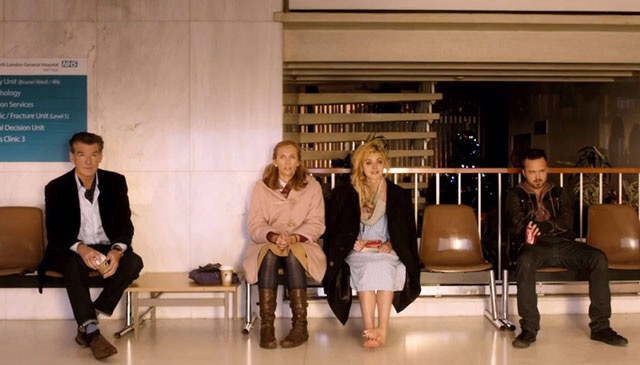
The latest Nick Hornby book to be given the big-screen treatment, The Long Way Down is on the face of it quite a distasteful basis of a comedy drama. The premise is that four people – played by Aaron Paul, Imogen Poots, Toni Collette and Pierce Brosnan – go to the top of a tower on New Year’s Eve with the same intention: the commit suicide. Talking each other out of it, their shared experience brings them closer together and they form an unconventional but essential bond.

It isn’t one of Hornby’s best films. Perhaps it’s the disbelief I found in the unlikely friendship they build with one-another. Perhaps it’s the light-hearted touch with which director Chaumeil has dealt with the source material. Perhaps it’s the fact that all the main characters are annoying in their own special way. Perhaps it’s just that I don’t want to see a comedy about suicide.


That’s not to say that all potentially distasteful comedies have nothing to offer. 50/50 was probably the best comedy I saw in 2011. I guess it just has to be dealt with in the right way.

There are some effective moments. The scene in which Rosamund Pike cameos is a precursor of her sinister turn in Gone Girl. Poots gives an assured performance throughout, giving life to a potentially film-ruining character. There is a heart-wrenching moment near the end with Collette and her son, which adds a lot of depth to her character, albeit late in the day.

I liked the way the film resolved itself. I just didn’t really enjoy the journey that took me there.

The Long Way Down is available on Blu-Ray, DVD and Netflix now.

Film review – St. Vincent (Ted Melfi, 2014)

Note: This is a review that is full of spoilers. If you are yet to see the film then I suggest you don’t read on.

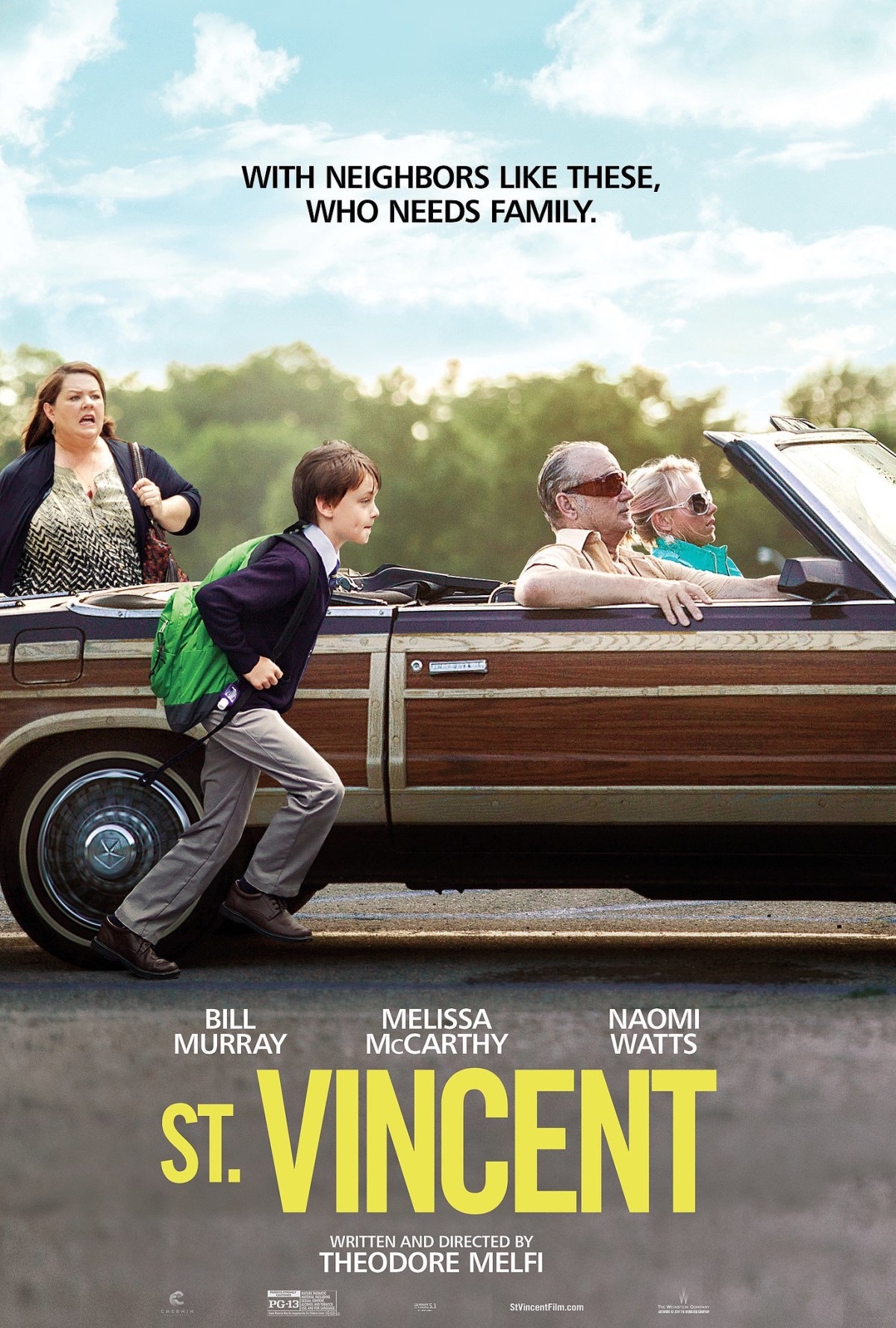
St Vincent is an indie film that charts a small-town tale of a young boy Oliver (Jaeden Lieberher), his mother Maggie (Melissa McCarthy) and their neighbour Vincent (Bill Murray), as they compete with their various individual struggles. Maggie is going through a divorce with her husband and has had to move away and start a new job to support herself and her son. Oliver is being bullied at his new school and is finding his way in a new neighbourhood without a father-figure (or indeed mother-figure) to guide him. Vince is an unlikely companion to Oliver, as he battles addictions to gambling and alcoholism.

Whilst Murray isn’t playing out of his comfort zone as a grumpy old man who is as sarcastic as he is rude, seeing him re-tread old ground is hardly a painful experience. Indeed, it’s exactly what we love him for and why he has been so successful in his career. It’s a little like when a band you love plays your favourite song as the encore – everyone is much older that the first time it came around but we all play along as it’s something we love experiencing.

There are some pretty unforgiveable plot holes in the film that really let it down and make it impossible to enjoy wholeheartedly. Whilst Naomi Watts is dong a fantastic job as the heavily pregnant dancer and “lady of the night”, it seems unfathomable that she’d have kept the baby and her jobs for so long. Whilst her being pregnant served as a humorous point for some good physical comedy, it was at the expense of the realistic façade Melfi had worked so hard to create.

It was confusing trying to rationalize Vince’s actions when they were eventually revealed to be revolving around keeping his wife in such an expensive care home. She has Alzheimer’s, which is a terrible condition, but since he wasn’t working and didn’t have any other responsibilities (children are never mentioned), if he truly loved his wife maybe he could have kept her at home instead of spending all his time with a Russian sex worker.

The most irrational decision was the choice of Maggie to palm off her son to a neighbour she knows only through arguments. It is convenient for both Maggie as a character and also as a key plot point around which to bend the storyline, but it would never happen. She also seems too quick and easy with her money, even though she is evidently struggling to make ends meet. Any of Vince’s personality traits would have set alarm bells ringing for a single mother, yet she chooses to ignore them all and employ him as a babysitter, essentially to serve the plot.

I also find it unlikely that the divorce would have been settled with joint custody of the child, when the evidence was clearly stacked against Maggie. If her husband was creating an equally bad environment for Oliver, then he would surely have gone into a foster home since neither parent was fit to care for their own child.

I forced myself to see past these flaws in order to enjoy the film, but a truly great film wouldn’t have asked so much of its audience.

St Vincent is out now at cinemas in the UK.