Mandella: Long Walk To Freedom (Justin Chadwick, 2013)

Mandela: Long Walk To Freedom is a biopic of the life of Nelson Mandella, a rich and vibrant story that has been crying out for a big screen adaptation for years. It’s pulled off in great style by director Chadwick. The story becomes even more poignant with the recent news of his passing, but makes the timing of the release of the film perfect.

The first thing you’ll notice when the film starts is that Idris Elba, famous for his roles in Luther, Prometheus and more recently Pacific Rim, looks absolutely nothing like Nelson Mandella. Many people assumed there would only ever be one man for the job: Morgan Freeman. Yet, the ambitions of this film were to cover Mandella’s whole life, and the meat of the story required a younger man to take the role. That Elba doesn’t look like him doesn’t really matter; his mannerisms and ability to convey the emotion of this rich story are of far greater importance.

The story moves at a terrific pace – it has to so it can cover everything. At times I wondered whether they could have spent longer on certain sections, and maybe a two part film would have been more suitable (this worked to great effect in Steven Soderbergh’s Ché). It didn’t detract from my enjoyment too much, but I feel like there’s more to tell – especially on his time as the president, which is a massive part of his life that was barely touched on.

Some of the prosthetics used to make Elba age were also a bit lacklustre. The first scene we see him as an old man is seriously undermined by the fact it looks a bit cheap. I wonder whether they thought they could get away with Elba’s appearance as a younger Mandela because we were less familiar with him, but panicked with his latter years under the knowledge that Madella’s face and appearance are so familiar.

Overall, this is a film that deserves to be seen and the box office will no doubt swell because of the timing of the release. It’s also a film heaped with responsibility that treats his legacy with due respect. Some reviewers have said that, because of this, it plays it safe. I disagree whole-heartedly. How else could this story have been told? It’s a fantastic work of art that is certainly worth seeing.

Mandella: The Long Road To Freedom is released at cinemas in the UK on 6th January 2014.

20131223-223121.jpg

20131223-223407.jpg

Frozen 3D (Chris Buck, 2013)

Walt Disney Studios. Hans Christian Anderson. Chris Buck. Idina Menzel, Kristen Bell and a voice cast full of talent and experience. It’s almost a kids’ Christmas blockbuster by numbers. Yet something isn’t quite right.

The character design for the two lead females – Anna (Bell) and her older ice-cursed sister Elsa (Menzel) – is superb. They’re fantastically realised and will be great additions to the Disney princess catalogue I’m sure. Outside of these though, the men are beyond generic. Indeed, Kristoff – the man of the mountain who helps Anna in her quest to find Elsa – could just be an extension of Flint from Tangled, complete with wisecracking animal sidekick Sven. The award for worst design goes to Olaf the snowman. This is a shame because he is responsible for some of the film’s biggest laughs, the best of which is the song “In Summer” – a song about how much he longs to experience the joys of the hot season. It’s undermined because he looks like a cheaply produced character from the early days of digital 3D animation.

The music is also, largely, a let down; bland and forgettable. I remember liking the opening song and the Olaf song (as mentioned earlier), but it’s a far cry from when I first watched Aladdin or The Lion King and was singing the songs for days. Only one song has a chance of going down as a classic and that’s “Let It Go”, sung by Menzel. It was the only serious song of any quality, but whether that’s enough to stand the test of time remains to be seen.

Despite this, one thing that distracted me was Menzel’s voice. She is in possession of one of the best singing voices to grace musical theatre in the last twenty years but the character she is playing, by my best guess, is about 21 years of age. Menzel is 42 and it must be said that when she is belting out the songs, she sounds like she’s 42. Not that any of the kids in the theatre would have noticed. I must reiterate that her voice is outstanding and she nails the songs, but there are plenty of great young female singers out there that could have done a tremendous job. It baffles me why they made this choice.

If there’s one thing the film should be applauded for, it’s pulling off the difficult task of finding space to develop not one but two extremely strong female lead characters. It would have been very easy to let one of them fall into the background but they do get the balance right. This is important move for the Disney merchandising departments, with a predominantly boy-centric year coming up in 2014 (Both Big Hero 6 and Star Wars VII will dominate the big screens next year).

Overall, the film ticks all the boxes and the younger generation will be thoroughly entertained throughout. In comparison to the non-Disney animated features that have been released in 2013 it wipes the floor, but this isn’t any old studio. It’s Disney, and we’ve come to expect much much more.

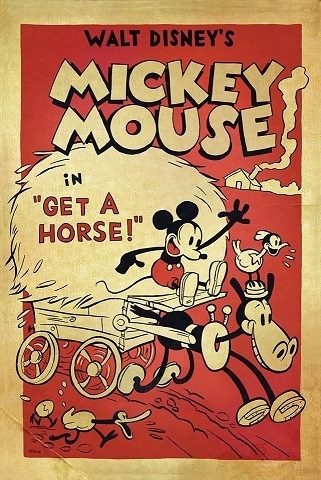
If you want to find some real Disney magic, then you’ll get that before the main feature itself. Get A Horse! Is a fantastic short film, featuring Mickey, Minnie and Peg Leg Pete. It’s a mixture of black and white and colour, 2D and 3D, and it mixes them to good effect. It’s seriously entertaining, fast-paced stuff and only served to underline so much that was missing from Frozen.

Frozen is released in cinemas in the UK on 6th December 2013.

20131130-224518.jpg

20131130-224529.jpg

Saving Mr Banks (John Lee Hancock, 2013)

I was inevitably sceptical about watching this. It’s a film that was created, in part, by Walt Disney Studios and stars family-favourite actor Tom Hanks as family-favourite animator, voice-actor and business magnate Walt Disney. If there’s ever any story that’s going to sugar-coat the facts, it is this.

Fortunately for Saving Mr Banks, Walt Disney is not the main character. That honour goes to Emma Thompson’s portrayal of Mary Poppins author P. L. Travers. Even more fortunately, her portrayal is up there with the finest of her career.

The story centres around Disney’s ongoing pursuit of producing a film adaptation of Poppins, something that Travers had resisted for years due to her apparent hatred of everything the company has ever been associated with.

In particular, we pick up the main thread story as she embarks on a short two-week trip to the studio headquarters to meet with a small creative team consisting of music legends the Sherman brothers (brilliantly portrayed by Jason Schwarzman and B. J. Novak) and Don DaGradi (Bradley Whitford). Her main intent is seemingly to sabotage every ounce of creativity in the hopes that the film is never made, lest the essence of her perfectly sculpted tale be destroyed.

This is intertwined with flashbacks to her time growing up in 1907 Queensland. These are the real standout portions of the film, and they shy away from the watered-down story we are unravelling in 1961 Los Angeles. Colin Farrell‘s turn as Traver’s alcoholic father is exceptional and this story is key to understanding how she acts in later life. I wished we had been treated to longer in Australia, but this tale was never going to be a three hour epic.

Back in LA, the story moves along at a reasonable pace, adding enough humour to the mix to ensure we don’t forget how magical the film making process is when Walt is driving it. This often works, but I shook my head in disbelief at the scene in which Travers finally changes her mind and starts to support the film. I won’t spoil it, but I’d love to know whether or not this really happened. I suspect not. It is somewhat ironic that a story centring on someone’s dislike of the Disney filmmaking process should be treated in exactly that manner.

Hanks didn’t have a lot to work with and that’s to be understood. That said, he still gives a stellar performance and he can’t be faulted. He will be considered for the awards season regardless, but not for this film – Captain Phillips is a much meatier role for him to be proud of, and one that will doubtless be featured heavily when the awards nominees are announced in January.

The praise in this film, rather, should be heaped upon Thompson for successfully portraying what must have been an immensely difficult character to master. That she makes us warm so much to a person that was evidently so emotionally cold is something worth admiring, even if everything around her is so sugar-coated.

Saving Mr Banks is released in cinemas in the UK on 29th November 2013.

20131117-131220.jpg

Computer Chess (Andrew Bujalski, 2013)

The appearance of the Masters of Cinema logo at the start of this film came as a pleasant – and stirring – surprise. My interest for the series was kindled when I bought a copy of Fritz Lang’s M on Blu-ray a few years ago and noticed the #9 on the spine, which was an ingenious way of making someone like me find out more. If this is number nine, then where are the previous eight?! Are they all Lang masterpieces? Maybe it branches out into other early-20th Century German filmmakers…

Actually, the series has no rules, just great films with careful consideration to the packaging, booklets, title screens, bonus features and, crucially, ensuring the transfer of the film itself is of the highest quality. More recently, Masters of Cinema have branched out into the distribution of new films, the latest of which is Andrew Bujalski’s mumblecore triumph Computer Chess.

Admittedly, seeing a mumblecore film I had purposefully avoided reading anything about prior to watching it could have been disastrous, especially considering it was the fourth in a series of seven films I was watching at the London Film Festival over a four-day-period. It didn’t matter a bit.

The film kicks off with a press conference to introduce the key competitors in a computer chess tournament in 1983, all of whom think they have the most advanced computer programme. Running the show is the host of the tournament Henderson (played by Gerald Peary in his acting debut) who lays down the gauntlet of a grand final human-against-computer chess match to whomever wins the tournament. Traversing the chasm to the unfamiliar world we are eavesdropping on is filmmaker John (played by another debutant Jim Lewis), who finds the whole thing both side-splitting and bizarre in equal measure. It is shot so authentically using carefully sourced low-grade home video technology from the period, that I’m sure that the uninformed amongst the audience (myself included) thought they were in fact watching a potentially very boring documentary. It is in this scene that we are also introduced to Michael Papageorge, played by Myles Paige (Funny Ha Ha), the standout performer in the early parts of the film who is clearly happy to ruffle some feathers and show he means business.

As the film progresses, we are indulged with many nods to the early 1980s – be it the naturally delivered chauvinistic comments made by the host or the now absurd general feeling amongst everyone there that the future had finally arrived in the form of their prized personal computers that could almost outsmart a human if programmed correctly. Meanwhile, Paige busies himself falling into a David Lynch-esque subplot and in turn passes the focus to Patrick Reister, whose character Peter Bishop is so excruciatingly introvert you wonder how anyone would dare make him the centre-point of a film for such a long period. Yet Reister is brilliant in teasing out the audience’s emotions as someone we just wish would come out of his shell more and live life outside of the world the players have carved out for themselves. He does this almost entirely through body language and facial expression as his shy character is afforded only infrequent passages of nervously delivered dialogue. It is a first class performance.

Not all of the film works quite as well. The tournament is sharing the hotel space for the weekend with a meditation escape weekend and to be honest it feels like these passages just get in the way. Equally, the scenes in the latter part of the film that appear in colour really stand out as far too polished and detract from the indulgent escapism of the rest of the film.

I left the film feeling like the story hadn’t really been tied together properly. As an authentic ode to the joys of early-‘80s home video recording, though, it was the only way it could have ended.

Computer Chess is released in cinemas in the UK on 22nd November 2013.

20131115-150403.jpg