Film review – 思い出のマーニー / When Marnie Was There (Hiromasa Yonebayashi, 2016)

The latest film released from the Japanese animation powerhouse Studio Ghibli is also the final feature film they will ever release. At least, that’s the line they’re taking. There doesn’t seem to be any indication that this isn’t true, although secretly most Ghibli fans – myself included – hope there will be something else around the corner. 

A glimmer of hope has come in the suggestion that more short films will be produced for the Saturn Theatre, the small cinema that resides inside the Ghibli Museum in Tokyo. Unfortunately for those of us outside Japan, seeing the existing ones is quite the task – you’ll need at least a return plane ticket to Japan and some forward planning to get tickets to the museum itself. Oh, they only screen one film a day and you can only see it once. There isn’t any plan to screen any of them anywhere else in the world, so seeing the sequel to Totoro might not be something to add to your bucket list.

All this sadly leaves us with only one more Studio Ghibli film to enjoy at the cinema, finally seeing the light of day almost two years after its release in Japan. When Marnie Was There is based on the original novel of the same name by British author Joan G. Robinson, with many of the details changed from the original novel. Most notably, the location has been changed from Norfolk in England to Sapporo in Hokkaido, Japan.


The storyline deals with a young girl, Anna, who suffers from anxiety and asthma. A loner at her school and lacking in confidence, she is sent away to live with family friends in Sapporo on the advice of her doctor, who suggests that leaving the city for the clearer air and change of scenery will cure her ailments.

Once there, she struggles to settle until she happens on a mysterious building called The Marsh House, inside which a beautiful young girl name Marnie is living, a girl with whom she strikes up an immediate and very close friendship.

So how does When Marnie Was There fit into the greater Ghibli catalogue? Instantly it will strike you that it’s just as beautifully animated as anything we’ve seen before, with hand-drawn drawings taking us on the typically personal, solitary journey of the main character. Animation has seldom looked this good, and I include Disney’s output in this statement too.

The storyline will be familiar to those fans of previous Ghibli works. A young girl sent away from her comfort zone to new surroundings dealing with a secretive and mysterious occurrence, via an unlikely friendship. It is ground well worn, but that shouldn’t be a reason to dismiss it. 

Anna herself is a wonderfully realised creation. The sense of isolation as she sits at school having an asthma-induced panic attack is heartbreaking and as realistic as any live-action portrayal of anxiety I’ve ever seen. This is a critical achievement – get it wrong and we’re dealing with a whiny self-obsessed teenager for two hours.

It is perhaps not as immediate as some of the more celebrated works. It’s a frustrating time to be a Ghibli fan. It’s probably the last film to hit the big screen, but it’s not the best place to start if you’re unfamiliar with the studio. If you can, watch My Neighbour Totoro and Spirited Away straight away, then head to the cinema to catch this before you run out of time.

Film review – Zootropolis (Byron Howard and Rich Moore, 2016)

Zootropolis is the latest in the Disney Animated Studios classics range that certainly holds its own alongside its older brothers and sisters, with a well realised universe and some extremely likeable characters. It may not have the staying power of the greatest films of the studio, but serves as a fun way to entertain children for a couple of hours in the earl summer.

The film stars Ginnifer Goodwin as Judy Hopps, a tiny rabbit that has aspirations to go to Zootropolis to become a police officer. Driven on by a childhood incident, she finally reaches her goal via a fairly snappy montage sequence. Dsappointingly assigned parking duty by her new boss Chief Bogo (Idris Elba, providing a voice that doesn’t really match the character), she sets out to prove she is more than a small fish in a big pond. Striking up an unlikely love-hate friendship with sly fox Nick Wilde (Jason Bateman in an impressive role), she uncovers a clue to solving one of the city’s biggest mysteries: the location of a missing otter and a growing number of other missing predator mammals in the city.

Goodwin’s portrayal of Judy Hopps is delightful. Her voice is perfect and brings some distinctive characterisation to life. There’s clearly a lot of chemistry between her and the well-cast Bateman. When they fall out midway through the second act, you feel it, and the target audience will too. She has an unmistakable likability in her voice that’s hard to pin down – perfect for this kind of role.

The film excels in its underlying messages of racism and stereotyping, making it a timely release. Each main character’s driving force is as a result of some kind of prejudice they’ve had to fight against. Make no mistake – there is little effort to hide it, to the point of it feeling a little ham-fisted. Anyone who wants their cinematic experiences compartmentalised by separating pure entertainment from thought-provoking commentary may need to double-check the age rating on this film. 

Where it falls down is its lack of foresight in terms of future generation’s appreciation of it. The greatest animated films have been enjoyed for almost a century by parents and children alike. They always have a timeless quality to them, much like fairy-tales, allowing a Snow White or Cinderella to be picked up now and not feel of-its-time. For Zootropolis, one has to wonder how the children of 2040 will feel about the overused phone apps that are featured, or indeed the Breaking Bad and Frozen references that are thrown in for cheap laughs.

For now, however, Disney will sit back and count this as a huge success. It is now the highest-grossing film of 2016 and the 28th of all time (as of 16th May 2016).

Film review – The Peanuts Movie (Steve Martino, 2015)

Before I start, I must confess that I’m a closet Peanuts fan. The comic strip wasn’t something I grew up with and outside the odd Snoopy t-shirt or pencil case, I wasn’t particularly affectionate towards the series.

Sometime during my university years, I discovered the brilliance of the comic strips first, then the films and TV specials. I don’t think it was something I was particularly vocal about, but I was secretly picking up compendiums of the originals strips and box sets of the films that I still watch to this day.

There is something wholly endearing about the characters that has somehow stood the test of time. I’m sure studies could be conducted on why it remains so popular despite most definitely being most definitely of the era it was created in.

I wasn’t overly thrilled when I saw the trailer for this franchise reboot, with the brilliant colours and perfectly rendered faces seemingly betraying the source material. However, I was willing to give it a chance and see what direction the estate was happy for it to go in in 2015, some fifteen years after the death of its creator Charles M. Schulz.

Thankfully, for the most part, the film is a success. The use of modern graphics doesn’t really detract from the fact that it genuinely sits well next to any other instalment. Indeed, the storyline could well be a rehash of an older film, with Charlie Brown spending the entire film trying to win the affections of the Little Red-Haired Girl whilst Snoopy lives in his imaginary world as a fighter pilot in World War II. This is a smart move – taking these familiar characters out of their comfort zone and attempting something unusual can be saved for another time.

When efforts are made to openly appeal to the younger demographics, the film does lose its way somewhat. When Meghan Trainor’s ‘Better When I’m Dancing’ kicked in and the kids started dancing away, the sudden urge to turn off came over me. Heck, even Snoopy! The Musical didn’t stoop this low.

Peanuts aficionados will also berate the fact that Charlie Brown talks to the Little Red-Haired Girl. Then they will be positively irate when she responds and we hear her speak for the first time ever. Or was it just me?

There have been better interpretations of Peanuts in moving pictures and there have been worse, but this should place the characters in the minds of at least a few children for the next few years and, in that sense, the film has achieved what it likely set out to. Just don’t watch it expecting it to wow you.

Short film review – やどさがし / Looking For A Home (Hayao Miyazaki, 2006)

Looking For A Home is a short film that was written, produced and directed by Hayao Miyazaki for Studio Ghibli. It is shown exclusively at the Studio Ghibli Museum in Mitaka, Tokyo, Japan [1].

The film follows a girl as she sets out from her home on a trip away from her busy city dwelling to the calmer countryside, through forests and into a tiny cottage she discovers along the way. At each point she thanks the aspects of nature she experiences (a fish, the trees, etc.) with an apple. Everything is represented by a unique human-voiced sound which are also written out on the screen to humorous effect.

This is a perfect short film to experience at the Studio Ghibli Museum for non-Japanese speakers, because the whole thing is very visual and the audio can be enjoyed without any understanding of Japanese. It is a sweet film aimed at children but, as with most of the output from Studio Ghibli, it is equally enjoyable for adults too.

[1] The Ghibli Museum has a small cinema called The Saturn Theatre. In this, they show one of nine short films for visitors on each day. Each visitor gets one ticket to the short film selected for that day so there is no chance of seeing more than one per visit. It is complete pot luck what you’ll see on your visit.

Film review – 千と千尋の神隠し / Spirited Away (Hayao Miyazaki, 2001)

Whilst Studio Ghibli has been a powerhouse of cinema in the East for many decades – since being born of the release of 風の谷のナウシカ / Nausicaä of the Valley of the Sea in 1984 – many Western cinema-goers weren’t introduced to the wonders of the animation house until 2003. This was the year that Spirited Away reached the wider audiences after being nominated and winning the Academy Award for Best Animated Feature.

Those whose interest was peaked enough were rewarded with a fantastic picture realised in beautiful 2D traditional animation. Its use magically imaginative turns that seemed uniquely Eastern mesmerised the audiences, allowing its popularity to grow through word of mouth and causing a renewed interest in the studio’s back catalogue. 

The story itself follows ten-year-old girl Chihiro who is moving house to a new and unfamiliar location with her parents (a familiar opening gambit in a Ghibli picture). Accidentally stumbling upon an abandoned amusement park, her mother and father greedily consume some mysterious but luxurious food whilst Chihiro investigates the surroundings. By the time she returns, her parents have turned into pigs and she cannot escape, forcing her to go deeper into the mysterious world to try to work out how to turn her parents back to humans and allow her life to return to normality.

SpiritedAwayscreenshot

In its most basic form, it is a coming of age tale akin to Alice in Wonderland, with a setting that is just as supernatural as the western equivalent. She is forced to find her identity as an adult after having her childhood identity removed from her – including her name – and only by doing so can she bring back her parents.

Whether this means the film is set in a supernatural world, or the middle portion of the film is simply a figment of her imagination is open to debate. Certainly the possibility is there that she has slipped into a dream and this is a manifestation of her fears and resistance to growing up. However, Miyazaki clearly decided to show that Zeniba’s hair band was still in her hair after her return to the “normal” world, a move to clearly show this wasn’t a dream at all. A subtle but sweet reveal.

It was a reminder of how to do it properly. Disney was yet to move away from traditional animation in favour of the 3D animation being celebrated by the likes of Pixar and Dreamworks, instead releasing both Lilo and Stitch and Treasure Planet in the year this reached western cinemas.

In contrast, Studio Ghibli wasn’t afraid to aim squarely at a more adult audience, and hadn’t been for years. Spirited Away was just the tip of the iceberg – representative of a rich body of work but standing out as one of their greatest achievements.


TV review – Teenage Mutant Ninja Turtles – Season One (Vincent Davis, 1987)

The year was 1989. Turtle Power had taken over the planet and, more importantly, my school. The turtles were everywhere. Everyone had to have a favourite of the four hero turtles (I’m from the UK so our heroes were called “Heroes” not “Ninjas”). It was not optional. Mine was always Raphael, though I had to occasionally be Michaelangelo despite not really being a party dude. Probably because I was five years old.

The appeal of the Turtles was far and wide. Initially it was just the action figures. Then it was colouring books, cereal and lunch boxes. Then it was colour-changing t-shirts, sticker books, video games and pizzas. Underpinning the whole mess of parent bankruptcy was the television show.

Cowabungaaaaahhhh!

If you were a British child at the time, you were probably introduced to the Turtles by Andi Peters from the inside of a broom cupboard. It’s more normal than it sounds. Whilst the cartoons were generally of a very high standard for the height of their popularity, often riffing in unexpected ways on old horror films, nothing ever quite touched the first season – a five-episode masterpiece that functioned as well as an episodic release as it does in hindsight as a one-off special.

The story itself is reasonably close in plot to the original Eastman-Laird comics on which it is based, only slightly softer in tone. The Turtles are chanced upon by news reporter April O’Neill, who the four heroes save from a gang attack. They take her back to their sewer-based hideout to recover and upon her waking they tell her their backstory along with that of their ninja master Splinter.

From their we follow them as they defend New York City from the evil Shredder, acting at the behest of the literal brains of the operation Krang, along with their two bumbling goons Bebop and Rocksteady and a clan of Footsoldiers and Mousers.

The standard of animation was perhaps so good it was unsustainable for a weekly animation. The show was essentially a means to peddle the merchandise and action figures, so the quicker they churned episodes out the more outfits we could see the Turtles in and the more friends and foes they could encounter. Each ended up with their own action figure – never more apparent than the Ace Duck TV hero who literally appeared on screen for less than ten seconds but was exceptionally popular as a toy.

The first season was also much darker in tone than the future seasons, at least until the popularity was faltering and they tried to take it in a new direction. Writer David Wise always preferred this earlier darker tone but the lighter and more comedic direction played into the hands of the popularity of the show. After all, the parents were the ones buying the toys.

This van runs on Turtle Power yey! Oh no wait it runs on petrol.

This five-episode story arc remained untouchable for my younger self, desperate but unable to see the sort of serious animation coming out of Japan at the time. It was an interest sparked by my brother’s subscription to Manga Mania, though we didn’t get to enjoy the Akira feature film until it aired on BBC Two on 8th January 1994.

I can’t recommend this original series enough. Almost three decades later the story and animation hold up and it brings back a heap of memories of a misspent childhood. Seek it out.

Film review – The Good Dinosaur (Peter Sohn, 2015)

Pixar’s latest effort The Good Dinosaur is a by-the-numbers buddy comedy set in an alternative history where the asteroid that would have wiped them out has missed Earth completely, meaning dinosaurs and Neanderthal humans live side-by-side. It concerns a timid dinosaur called Arlo (Raymond Ochoa) who is split up from his family has to befriend a dog-like human called Spot to survive and return home.

The Good Dinosaur was destined for problems before it was released. Originally scheduled for a Christmas 2013 release, it has been put back several times, each time causing confusion and issues for the other Disney films on track for their respective releases. According to Denise Ream, one of the film’s producers, the primary reason for the rescheduling was “the story was not working, period, full stop, it just was not where it needed to be.” The director Bob Peterson, who previously found success with Up, was removed and replaced with Peter Sohn, allegedly because he was too involved with the film.

The upshot of it all is that it has found itself living in the shadow of the excellent Inside Out, which has barely left the cinemas, and is competing for shelf space in the various toy stores across the land with Star Wars: The Force Awakens, which is set for release less than a month after The Good Dinosaur. It was also released in the middle of a school term, drastically reducing the opportunity to go and see it for anyone with children in school. So does that make the target audience parents who aren’t working and have children old enough to go to the cinema but under the age of 4? I guess so… [1]

The film itself feels like an unfinished product. It is the first time I’ve watched a Pixar film and genuinely felt like they’d given up on it. It feels like a last-gasp chance to recoup on a project that will, at best, break even.

The character design is uninspired. None of the dinosaurs offer any of the individuality or appeal audiences have come to expect from a Pixar or Disney film. The beautiful environment goes some way to make up for this, but only Spot himself felt like a fully realised character.

If the reports are to be believed, then the problems with the film lied in the final third. This is, then, presumably where the cavalry came in to take over and save the day. Sadly for Peterson, this is exactly where the film picked up a bit and paid off on some of its promise.

Two scenes stuck out as being particular highlights. The first was a beautiful montage scene where Arlo and Spot ran through an open plane full of birds was vintage Pixar. The second was an emotional scene in which Spot is effectively adopted by another Neanderthal family at the encouragement of Arlo.

Perhaps both of these were Peterson’s work. Will we ever know?

As a 31-year-old man, I know I’m not the target audience for this film. I do have an appreciation for all good animation though and this falls a long way short. The best critics are the children. Four days after its release, the cinema was about 10% full. The children present seemed restless and disinterested. A few parties left. Maybe they went home to watch something more enjoyable. Or, you know, fun.

The Good Dinosaur is currently on release at UK cinemas.

[1] In my local cinemas only one screening was achievable for workers and people at school, which was a 6:30 screening at a Cineworld. I don’t know how many people were at earlier screenings.

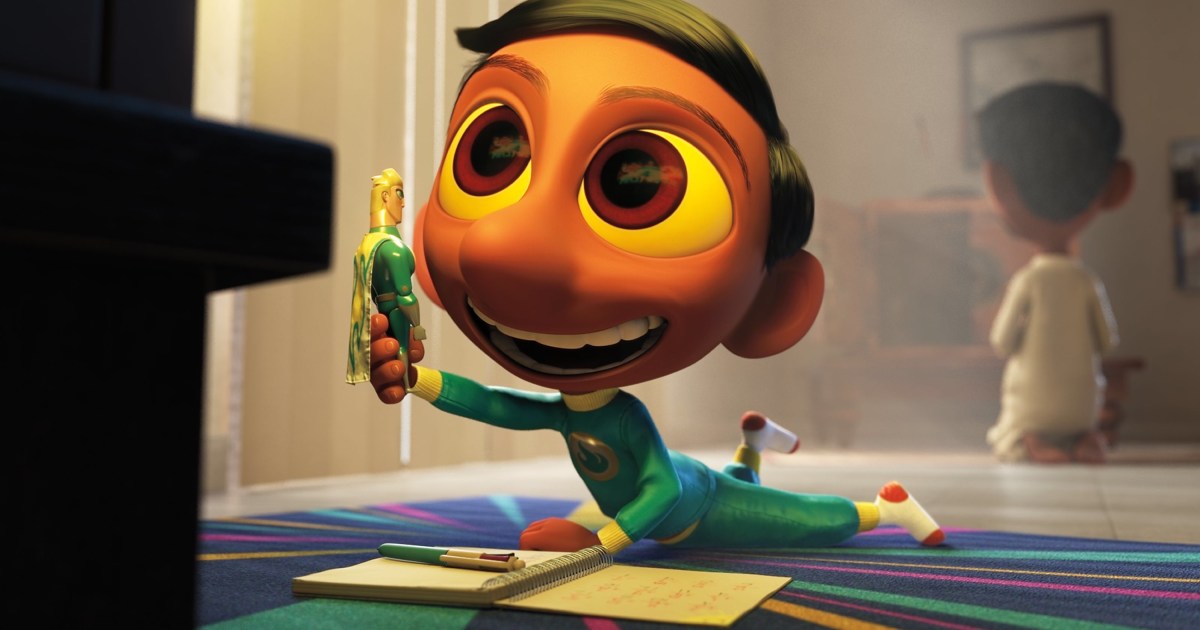
Sanjay’s Super Team (Sanjay Patel, 2015)

If you were keen enough to get to the cinema early enough before The Good Dinosaur, one of the worst Pixar feature films thus far, you’ll have been treated to Sanjay’s Super Team, one of the worst Pixar short films thus far.

Sanjay realises just how bad The Good Dinosaur is.

The story, based on the true memories of director Sanjay Patel, revolves around him as a young child and the conflict between him wanting to enjoy a superhero TV show and his father wanting him to join him in prayer. Frustrated when his father turns the TV off and forces him to pray, Sanjay uses his time of reflection to daydream into a strange world where his Hindu gods are more like superheroes.

The cel-shading technique used in the daydream sequences is a bit of a let down and feels like a quick solution, despite the best efforts to make it look as colourful as possible. I couldn’t help but imagine how good it would have looked with more attention to detail.

This is a film about a child having doubts over his beliefs and a clash of cultures. Whilst many won’t understand the precise religious and cultural aspects at play, most will appreciate the story from the position of a child not wishing to have to follow in the footsteps of the parents. In principal I don’t agree with using religion as a basis of children’s entertainment, but it works well in this case to create a story for the older audience members.

Unfortunately, the overall result is a bit bland. There was no dialogue, the brilliantly coloured dream sequence lacked any real wow factors and it didn’t move fast enough to make use of the lengthy running time for a short film. The children in the audience voted with their restlessness and disinterest. 

In this sense, it was the perfect warm up for the main feature.

Riley’s First Date? (Josh Cooley, 2015)

If you loved the Pixar animated feature film Inside Out then chances are you’ll… like “Riley’s First Date?”, the short included as a bonus feature on the various Blu-ray versions of the release.

It centres around a mysterious boy showing up at Riley’s household to take Riley out, with most of the jokes coming from the parents’ reactions to interacting with him. If you’ve seen Inside Out itself, it is essentially an extension of the final sequences of the film, popping in and out of the characters’ heads in rapid succession for quick laughs.

It lacks any of the emotional pull that made the film a huge success over the summer, but it does succeed in getting a few jokes that make it worth a watch. It can’t go down as a reason to purchase the Blu-ray – you don’t need any more reasons than the fact it’s the best Pixar films released for years.