What’s Moana’s favourite Neil Young song?
Hai-hai, My My

What’s Moana’s favourite Neil Young song?
Hai-hai, My My

Note: This is a review of a preview of Hello, Dolly! Out of respect for the performance I only published it after the opening night.
The first time I saw Hello, Dolly! was when I was 27 and preparing for an amateur production of the great musical in England. I had been cast in the role of Cornelius Hackl, the employee of Horace Vandergelder who has just been promoted from impertinent fool to chief clerk. Popping out of the store room box in the opening scene is exciting for all Cornelius-portrayers the world over – for two reasons. Firstly, you get to deliver your hotly-anticipated opening line in the show and finally get a glimpse of the audience. Secondly, it means you can breathe properly for the first time since lights down – you’ve been trapped with your assistant Barnaby in a tiny box for the last 15 minutes as the rest of the characters are introduced to the audience at a seemingly excruciatingly slow pace.
I was relaying this information to the perfectly lovely gentleman who was stood next to me at Broadway’s Shubert Theatre on Friday night when I asked him “So are you involved in this production at all?”. “Why yes,” he responded, “I’m the director.”
That would be four-time Tony Award-winning director Jerry Zaks. [1]

Outside the theatre
The opening number “Call On Dolly” is full of bright and wonderful costumes with perfectly-precise movement from the ensemble. Warren Carlyle’s choreography at this point is nothing too complicated, but there’s a certain beauty in its simplicity – a matter counterbalanced with “The Waiters’ Gallop” in the second half.
The real star of the show, inevitably, is Bette Midler. As the titular character she is able to sweep from playful to heartbroken in the space of a song. Done correctly, it is a surprisingly nuanced character. She is larger than life when she’s entertaining guests, putting on a show for the cast and the audience in equal measures. However, when she is alone she reveals what drives her throughout the story – her lost love and former husband Ephram Levi. Midler may have the audience in stitches when she’s slowly eating a delicious chicken dinner, but they’re eating the palm of her hand when she’s speaking from her heart.
David Hyde Pierce is a great counterpoint for Midler as the angry shop owner and “half-millionaire” Horace Vandergelder. He is a seasoned Broadway star, winning a Tony Award in 2008 for his role in Curtains. It was great to finally see “Penny in my Pocket” restored and performed in front of the curtain at the start of the second act. It’s a song that’s great for someone like Pierce – full of characterisation and expression. It was cut from previous Broadway runs to shorten the second half.
Gavin Creel (Cornelius Hackl), Kate Baldwin (Irene Molloy), Taylor Trensch (Barnaby Tucker) and Beanie Feldstein (Minnie Fay) are all brilliant in their Horace-avoiding storyline, with “Elegance” a particular highlight in the second half. Creel’s rendition of “It Only Takes A Moment” with Baldwin was simply beautiful; a clear sign that musical director Andy Einhorn can get the best out of his performers.
The tickets for this production may well sell because Bette Midler is such a huge star and is massively popular on Broadway, with David Hyde Pierce also offering added interest. However, what audiences will find is a musical that is excellent across the board, from the back row of the ensemble to the lead star, with not a thread on a costume out of place.
To think that what I saw was supposed to be a preview, I only wish I could see it when it hits the full run.
It will be a smash.
[1] It was to my shame that I didn’t recognise Jerry Zaks. He was the perfect gentleman. By the time we had started chatting he had already noticed that we hadn’t got a Playbill and found an usher to retrieve a couple for us. What kind of director does that?! He seemed genuinely interested in whether we were enjoying the show, seeking us out at the end to garner our opinion before signing our programme. Great job sir and thank you for finding the time to talk to us.

Park Chan-wook’s latest release is a twisting psychological thriller steeped in eroticism and oozing class that works its audience brilliantly. The only drawback was that I didn’t have time to see it a second time.
Set in Japan-occupied South Korea, the film tells the story of an elaborate plot to rip-off a rich Japanese heiress named Lady Izumi Hideko (Kim Min-hee), who is living in an extravagant and luxurious mansion under the authoritarian Uncle Kouzuki (Cho Jin-woong). The plot is being masterminded by a conman calling himself Count Fujiwara (Ha Jung-woo), and involves him marrying Lady Hideko and subsequently committing her to an asylum to steal her inheritance. To do this, he brings in Sook-hee (Kim Tae-ri), who is a professional pick-pocket, to work as Lady Hideko’s handmaiden in order to get close to her and influence her feelings towards the Count.
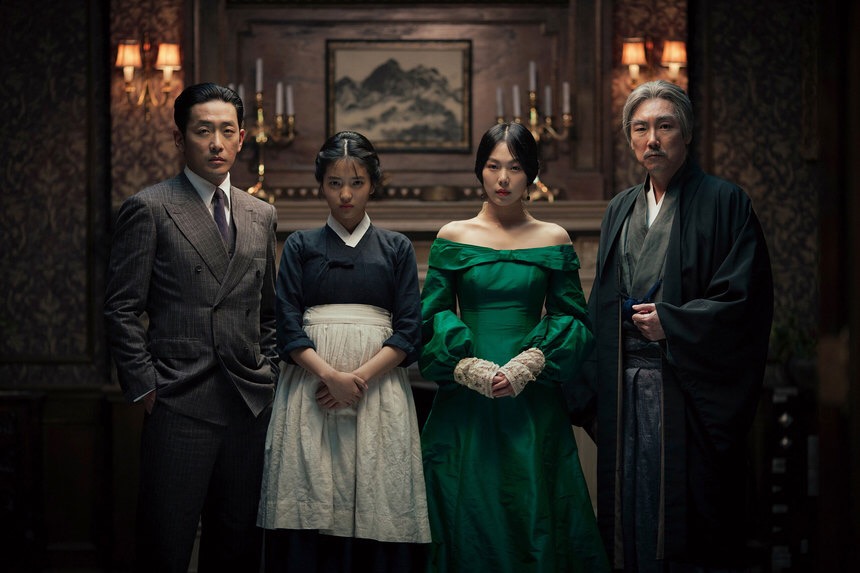
This fantastic plot is based on English novel “Fingersmith” by Sarah Waters. It is brought to life with perfect execution by director Chan-wook. As is typical of his films, The Handmaiden inhabits a uniquely-realised world that features traditional elements mixed in with gothic undertones. It’s a stunning visual achievement and one that is completely absorbing.
Central to the plot is Uncle Kouzumi’s outlandish book collection, mainly erotic in nature and all extremely rare. He is producing forgeries of the books but is involving Lady Hideko in highly-exclusive book readings of the most sought-after novels, usually for an all-male audience who each will bid on the books in auctions after the readings. Whilst the forgeries provide an additional reason to hate Kouzumi – other than his generally disgusting appearance and the contents of his mysterious basement – it is the contents of the book that also serve to further the sexual drive of the story.
The scenes where Lady Hideko reads excerpts from the books whilst the audience listens intently are some of the best moments of the film, creating suspense with nothing more than an authoritative delivery from Min-hee and some attentive camerawork.

Indeed, the sly glances and subtle reactions are what makes the acting performances so believable. This is a game of tension, both mentally and sexually. The two central female characters are falling in love with each other, but they are also engulfing their desires in a sexual lust that makes Soo-kee’s original plan increasingly difficult to carry out. It is surprising as an English viewer that this traditional period drama setting doesn’t portray this desire with mere suggestion and topped-and-tailed sexual encounters. There is literally no holding back, which I’m sure many will find crass, but I found it essential to the plot and executed with enough artistic integrity to not be considered as superfluous.
This is simply one of the best films I’ve seen all year and one I can’t wait to see again once the extended cut is released on home media later this year. I can’t recommend it enough.
Another reveal at Star Wars Celebration Orlando 2017 is the sequel the to popular Star Wars Battlefront game from EA. It looks absolutely epic!
The greatest addition for me and my wife is the local co-op playing mode. It’s exactly what we need to get the most out of a game like this and could make it an instant purchase on day one.
Check out the video above!!

When the live-action remake of Ghost in the Shell was announced, the online rhetoric centred around the fact that the remake was in itself completely unnecessary, whilst also questioning why lead Japanese character Major Kusanagi was being portrayed by Scarlett Johansson. The studios’ responses at the time were that they wanted a bankable star and that was the main reason she was cast, but that word was out there. Whitewashing. Once it’s there, it’s hard to shake.

A similar issue befell the 2011 film Under The Skin, also starring Scarlett Johansson. True, there was no need accusations of racism, but Johansson was cast for similar reasons. It later emerged in an interview with Gemma Arterton that the British actress had been first choice by the director Jonathan Glazer. However, Johansson was eventually cast in order to secure the funding to complete the film to the director’s vision.
In both cases, it is a sad reflection on the current state of cinema and its attitudes towards so-called non-bankable stars. Clearly the studios involved were nervous about a film being able to sell based on a high quality script, good direction and a solid marketing campaign. Instead they brought in Johansson, and presumably part of their reasoning was that they didn’t have faith in the audience to see past the lead character. Perhaps this is correct.
However, in neither case was the film damaged as a result of the casting. Both plots lend themselves to having an otherworldly-essence to the lead female.
Crucially, Johansson isn’t just a bankable star. She’s a truly phenomenal actress at the top of her game.
In Under The Skin, the fact that Scarlett Johansson was driving around the streets of Glasgow and getting real reactions from the general public whilst speaking in an emotionless English accent played into her role. She was, ambiguously, an alien preying on men, so her not being British gave a mysterious element to her performance that justified her casting.
Equally in Ghost in the Shell, the fact she isn’t of Asian origin doesn’t necessarily play against the script. She is a cybernetic being, with the brain of a human inside a robotic body. This is a future where cybernetic modifications are a part of normal life. The brain inside her body is that of a Japanese girl, but her body is Scarlett Johansson.
I don’t agree with the feeling that her casting is whitewashing of the original story. The studio saw a way to make the plot more appealing to American audiences in a way that didn’t compromise the story – the wider lead cast covers a wide variety of races, primarily either American or Asian. They would have been foolish not to go down that route.
Clearly, the Japanese market doesn’t seem overly bothered by her casting. Nor do the South Korean and Chinese markets. In China, for example, they currently have a total box office taking of $23.39m (as of 09/04/2017), approximately a quarter of the global takings. This is a total which pushed a disappointing US box office performance into a profitable outcome.
Ironically, one of the primary reasons offered by the studio for its domestic failure was that Scarlett Johansson doesn’t have an online presence.
The humour of this entire situation shouldn’t be lost and I can’t help but feel that the backlash against this is looking for an argument where there isn’t one. At the very worst, the filmmakers can be accused of bringing in a superstar to sell the film and this deviates it from the original vision from 1996. The faithfulness to the original story is so strong though that this change shouldn’t be held against it. Certainly no complaints can be levelled at Johansson, who puts in a stellar performance in her starring role.

The environment the characters inhabit is rich and believable, with a mix of CGI and real shots used to create a new universe. It is visually stunning, a full 3D remodelling of the vision created in 2D by Mamoru Oshii and the original animation team from 1995.
The city is modelled on Hong Kong, but it feels like it lives in the same universe as Ridley Scott’s Blade Runner, with spawling cityscapes and futuristic advertisement boards threatening to submerge the life within it.
Indeed, the musical cues that Clint Mansell and Lorne Balfe provide are clearly influenced by Vangelis. This I see as an indication of how much of an influence Vangelis has had on futuristic science fiction cinema, rather than a lazy bit of theft from the musical pairing. Mansell is very much carrying the Vangelis baton as evidenced by his excellent scores for the likes of High-Rise, Black Swan and Stoker.
If the action sequences seem a little dated, it is because Sanders has been put in a near-impossible situation by the Wachowskis. There are rumours that the only reason The Matrix was made was because they wanted to make a live-action Ghost in the Shell but couldn’t get the rights. Whilst there are similar themes in both films, it is the action sequences that were so iconic that The Matrix is remembered for. These were lifted straight from Oshii’s masterpiece. So, heaping this remake with too much of them would make casual audiences feel like they were utilising a technique that debuted two decades ago and has been parodied ever since. If anything, Sanders has probably underused it, but it is nonetheless a visual spectacle.
Taking on a film that is seen as a defining point of the genre is always going to be tough. The original really wasn’t a box office success in its original release, making just $2.28m globally. It did eventually become a cult classic. This 2017 remake has already made its money back ($130m and counting), but will doubtless also be considered a box office flop by its detractors.
This is not a masterpiece of a film, but it is extremely impressive and engrossing. Arguably, the plot is much clearer than the original too. It’s a shame that it looks unlikely to be given a chance by most a large portion of the potential market.
Note: the version watched was 3D IMAX.

So the truth is finally out there. The Handmaiden was this year’s Secret Cinema X film, as predicted in an article published here a month ago.
The official Twitter account finally announced the truth in a reveal video here. I’m gutted I didn’t get chance to go but it looked absolutely amazing. I’ll make do with Moulin Rouge next week instead.
I managed to watch The Handmaiden earlier today and the film is simply a must-see. Park Chan-wook is a masterful director and he has produced another work of wonder with his latest film. Check it out if you can!
You can order Secret Cinema X exclusive poster prints here, including the one featured in the header of this article.
It’s here! Why are you reading this? You’re wasting time! Watch it again!!
Kathleen Kennedy introduced a special panel yesterday at Star Wars Celebration Orlando 2017 yesterday. The entire day can be streamed online, as can today’s as it happens in Orlando, but the panel above is well worth a watch.
Why?
Well, I’m glad you asked…
George Lucas was there! Harrison Ford was there! Mark Hamill was there!!! Oh, there’s also Dave Filoni, Liam Neeson, Ian McDiarmid, Hayden Christensen, Samuel L. Jackson, John Williams, Anthony Daniels, Peter Mayhew, Billie Lourd and Billy Dee Williams. All hosted by Warwick Davis.
Just watch it. The atmosphere looks electric.
This year’s Star Wars Celebration got underway in Orlando yesterday. The highlight of the day for many was the tribute to Carrie Fisher. For fans of Star Wars, it’s a must-watch.
Just press play and enjoy!
English Fingersmith,
But with a Korea change.
Shock and sex ensue.
 Cinema, etc.