What’s the deal with the Wes Anderson and Roald Dahl Netflix collaboration?

You may have noticed on Netflix recently a handful of sepia-tinged thumbnails popping up in your Trending Now or Recommends lists. Based on the lack of advertising generally, all you are left with is the titles alone: Poison, The Rat Catcher, The Swan and The Wonderful Story of Henry Sugar.

These curiosities make up a series of four adaptations of Roald Dahl short stories by the distinctive director Wes Anderson. Bringing together a wonderful ensemble cast – including Rupert Friend, Richard Ayoade, Benedict Cumberbatch, Ben Kingsley, Dev Patel and Ralph Fiennes – the four shorts really are quite special. Marrying the distinctive styles of two great storytellers from very different eras, there is a high-art uniqueness that lands in a place that feels fresh and intriguing.

As I finished watching my favourite of the bunch – the sharp-scripted Poison, about a man struggling under the threat of an imminent deadly poisonous snake bite – I wondered whether these could have been made twenty years ago. Or even ten years ago? I could only think of one outlet for them, which would be as part of the festive programming of a terrestrial channel, probably on Boxing Day, when the rigidities of multi-part series and familiarities are relaxed as the nation forgoes its own schedules to Quality Street and sherry.

I’m thrilled these four short films have seen the light of day, although I also wonder whether they’ve been done a disservice in the manner of release. With little fanfare, they’ve just appeared in the faces of the casual scroller, with more than a little whiff of that U2 x iPhone collab we all loved so much. I know someone who accidentally watched the longest of the bunch – The Wonderful Story of Henry Sugar – and wondered what on Earth was going on. With no explanation, it’s easy to see why the unfinished stylings of Wes Anderson could confuse. Actors look at the camera, the prop department hand items to the scenes apologetically, the elaborate sets are shifted as if they were part of an experimental theatre piece. These quirks that elevate the experience for fans of Anderson risk perturbing casual viewers, or indeed fans of Roald Dahl’s more popular output.

With results this good, perhaps Netflix decided that was a risk they were willing to take.
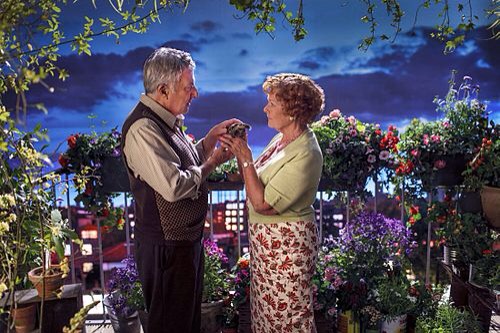
Esio Trot (Dearbhla Walsh, 2015)

There have been many adaptations of Roald Dahl’s many novels and short stories. Some were great: Matilda, Willy Wonka and the Chocolate Factory and, surprisingly, Gremlins (yes, I know*) were all brilliant. Others were just awful (I may just be thinking about Tim Burton’s Charlie and the Chocolate Factory, which is frankly beyond creepy and really is an abomination to the source). It was quite a surprise to realise that Esio Trot has never been made into any kind of feature film, though based on the cast and the time slot this aired (6:30pm, New Year’s Day, BBC1), I was expecting a soft and faithful take on what was always a whimsical story. This is exactly what I got.

/home/wpcom/public_html/wp-content/blogs.dir/002/60589995/files/2015/01/img_0116.jpg

This television adaptation stars Dustin Hoffman as Mr Hoppy, an older man who lives alone in a flat in London with nothing much to keep his interest except his love of traditional jazz and a meticulously maintained flower garden terrace. This is all turned upside down when Mrs Silver (Dame Judi Dench) moves into the flat below and he is immediately overcome with feelings of love and excitement. He hatches an elaborate plan involving the growth of her beloved pet tortoise Alfie knowing it will bring her happiness, in the belief that she will fall in love with him as a result.

The supporting cast, including James Corden as narrator and Richard Cordery as the annoying neighbour Mr Pringle (a new character created especially for this adaptation), worked their parts well, though this really was a tale of two hearts.

It was a faithful take on the classic Dahl book, one of the last of the seventeen children’s novels he wrote. By this I don’t mean just in the details (and there were one or two deviations made by the writers Richard Curtis and Paul Mayhew Archer, mainly because the original book was so short), but also in the tone.

It isn’t an easy book to tackle in comparison to the likes of Matilda and Charlie and the Chocolate Factory. Dahl’s books are always firmly aimed at children, and many of his most enduring successes are stories that prominently feature relatable young characters. In Esio Trot, however, we are presented with two much older individuals, and thus a conundrum for the filmmakers. I am pleased to say they were able to maintain the quintessential Dahlness we have grown to love over the years. It would have been far easier to adapt the story to one aimed at the older generation, those the same age as Hoppy and Silver.

/home/wpcom/public_html/wp-content/blogs.dir/002/60589995/files/2015/01/img_0117.jpg

Looking back, I’m not sure why I loved this story so much as a child. It is essentially a love story between two lonely and wrinkled septuagenarians. Perhaps it was the ridiculous mischief of the plan Hoppy executed. I’m not entirely sure. In many ways, Esio Trot is the biggest vindication of Roald Dahl’s status as one of the greatest children’s authors that ever lived. How else could he have made this one work?

Esio Trot is available for purchase on DVD now.

* The 1984 film Gremlins is loosely based on the characters developed by Dahl for his 1943 book The Gremlins, which were to be the basis of a Walt Disney Studios animated film until plans were shelved. The gremlins in his book derived from the mythical creatures that British Air Forces pilots blamed unknown faults with their aircrafts on.