Secret Cinema: 28 Days Later Preview

It’s back and it’s hungry for flesh!!

Secret Cinema have announced their next big event. It’s a good one! Read on for more details.

What is Secret Cinema?

Secret Cinema is a company that specialises in totally immersive cinema experiences. You spend an evening totally absorbed in surroundings typical of the film on which the night is based.

There are two types of event Secret Cinema organises. Both are highly similar but with subtle differences.

Secret Cinema: Tell No One (not this event)

The first is the kind they made their names doing – completely secret smaller events for films many would consider to be cult classics. Nobody knows the film until they show up, and from then on anything can happen. 

When they tackled The Shawshank Redemption, for example, people were snarled at by an angry police officer who informed them they were all convicts. He then walked them, single-file, through a busy shopping centre to their transport to a local high-security prison. It’s all good-spirited and great fun for those with an interest in surprises and adventure. The recent Tell No One event falls into this category (and is still going on so the name of the film won’t be revealed). 

Secret Cinema Presents (this event)

The second type tend to be larger in scale and the film is announced well in advance. This is the category last year’s Empire Strikes Back event falls into, along with the previous year’s Back to the Future. Both were excellently received and left people wanting more large-scale events.

The latter type is better for those unfamiliar with more obscure films who want to know that they’ll enjoy the night before they attend and pay for the tickets.

Either way, whatever they do the nights are always highly immersive experiences and well worth the money. They have carved out a massive area of the market that most people didn’t even think existed.

What’s the next event?

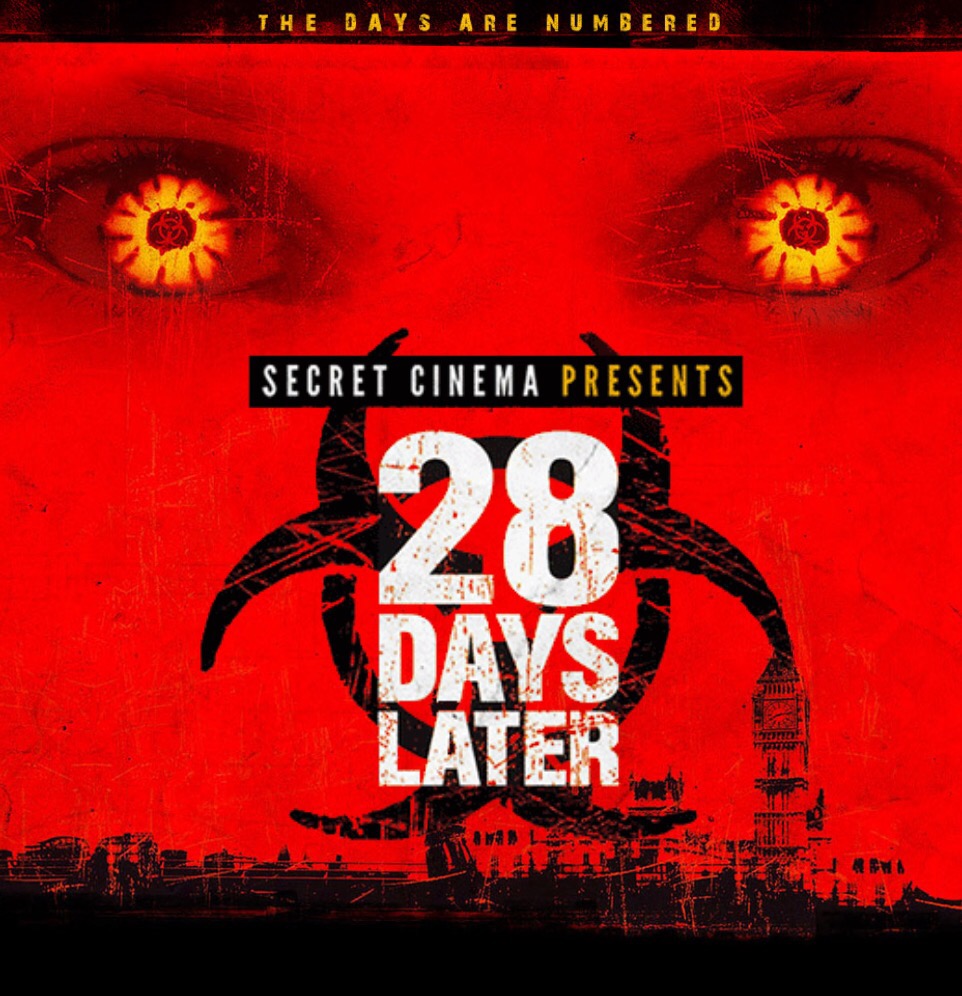
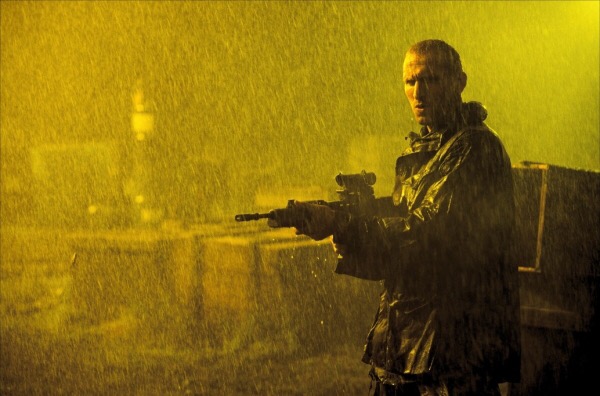
This next event in their calendar is Danny Boyle’s zombie survival horror 28 Days Later. It is a Secret Cinema Presents night, so the film is common knowledge. No surprises this time around!

What’s the film like?

28 Days Later revolutionised the popularity of zombie films as a genre. It was a shift in terms of the technology used. Boyle used Canon XL1 digital video cameras to allow the manoeuvrability to shoot the desolate London scenes, but they had a knock-on effect that gave the film a sort of CCTV-type feeling to it, like it was recovered footage. It starts with the lead character Jim (Cillian Murphy in his breakthrough role) waking up from a coma in a hospital with no knowledge of how he got there.

We learn what’s happening as he does, finding fellow survivors along the way and hoping to reach some kind of freedom. It captured the imagination of cinema-goers during its original release, instantly becoming a hit in both the UK and USA.


What can we expect?

It would be easy to jump to the conclusion that it is really just any excuse to do a zombie-themed event. Anyone who has experience of Secret Cinema will know that this is very unlikely.

The event will, inevitably, involve hoards of zombies. One way that the film kept us gripped is the constant use of impending terror. It was the first film to use running zombies, so expect these to be present at the event too. Better take your running shoes!

I imagine it will incorporate the military as a key element. In the film they weren’t necessarily to be trusted, and there’s a fantastic scene in a fortified mansion that could utilise the open-air quite well if that’s the path they choose to go down.

Whether or not we’ll be killing zombies or just avoiding them remains to be seen. If we are doing that, it will need to be reasonably safe or there could be some serious injuries. No head-shots people!

Clothing is always a key part of the events and advice on outfits will be sent out in advance. It’s possible that it will be one of the easiest Secret Cinema events to dress for. The film is set in the present day (or ten years ago at least) and presumably we won’t be asked to dress up as zombies. I’d imagine it will be a case of wearing anything for once rather than trying to get hold of any specific costumes. No desperate searches for tan and black scarves required this time! Perhaps a medical outfit will be required for some people.

It will be a great experience to witness a modern cult classic on a massive screen with an enthusiastic audience.


How do I buy tickets?

Tickets are on sale for the event right now and are selling fast. Head to the official webpage for more details.

Film review – Hail, Caesar! (Joel Coen and Ethan Coen, 2016)

Hail, Caesar!, the new film from the Coen Brothers, is a film heavy on nostalgia and authenticity but light on focus to moving along the central plot. It has so many fantastic elements that seeing the final product fall short is a huge disappointment.

The film tells the story of Eddie Mannix (Josh Brolin), head of production at Capitol Pictures whose job involves firefighting the many problems created by the studio’s roster of stars who seem to have an uncanny ability to mix themselves up in controversy. The studio’s next big film will be Hail, Caesar!, a biblical epic in which Baird Whitlock (George Clooney) will star. However, when a prop wine goblet is spiked by an extra on the set, he is kidnapped by a group of communist scriptwriters called The Future and held to ransom for a then significant total of $100,000, putting pressure on Mannix at a time when he is considering a career change to join the aviation industry with the Lockheed Corporation.

  
It felt at times that the Coen Brothers were so hell bent on fitting in a plethora of big-star cameos that they didn’t care that each time they did so they completely derailed the focus of the story. Take, for example, Frances McDormant’s studio film editor CC Calhoun. Her hammed-up effort is a nice comedy turn introduced at a critical point of the film. She could have easily turned into a key character, but never reappeared and thus there didn’t really seem to be much point to her appearance.

A bigger offender comes in the form of a more significant subplot featuring pregnant star Dee-Anna Moran (Scarlett Johansson) and surety agent Joe Silverman (Jonah Hill). It’s a huge eater of time but in the end resolves itself with little input from Mannix at a time when he is deciding that he needs to stay in the film industry, presumably because he is so critical to it.

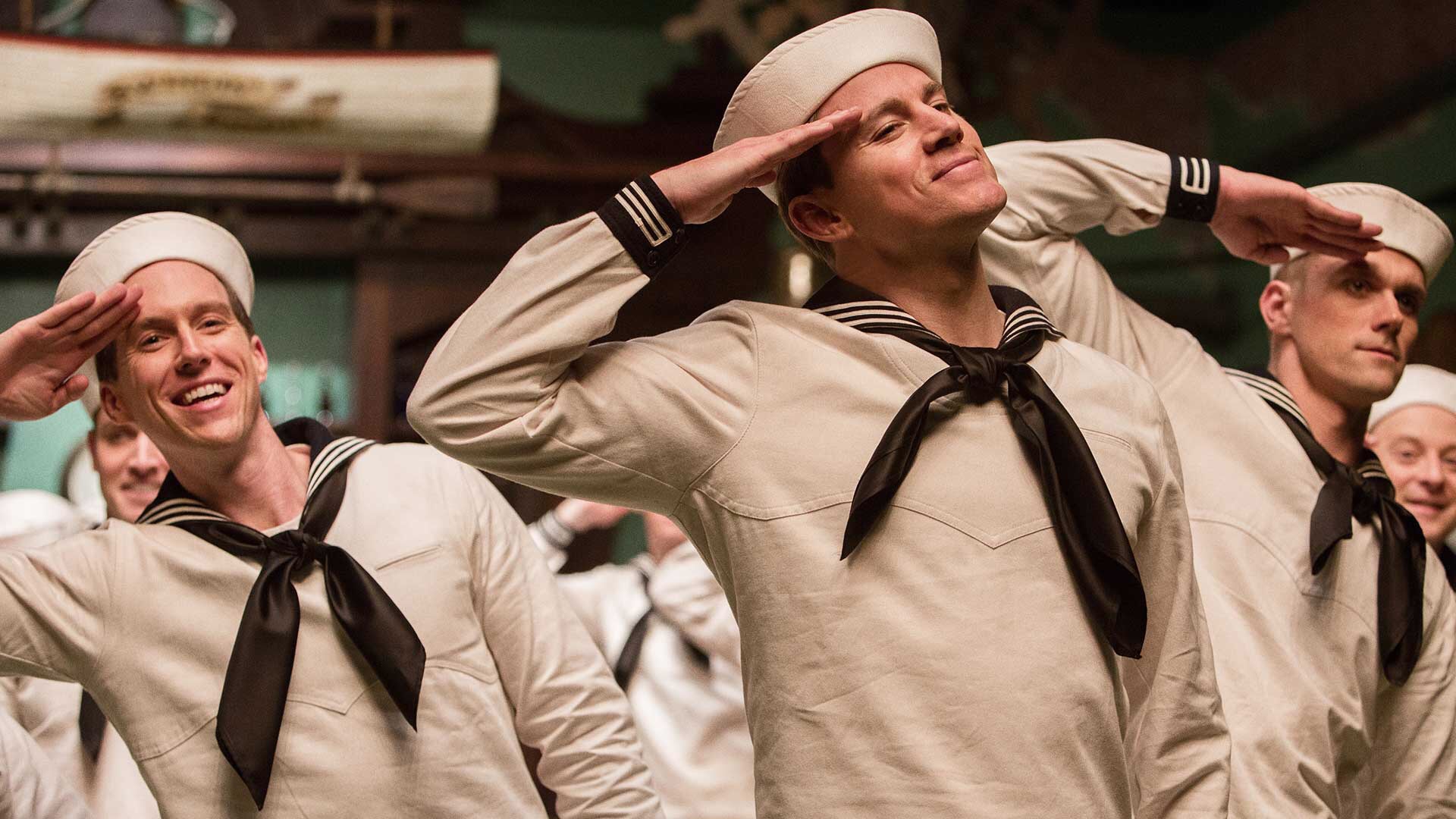
Similarly, Channing Tatum, who features as Burt Gurney, gets a great song and dance scene – a real highlight to the film – but is probably only in three scenes in total. The time spent with Johansson and Hill may have been better served with Tatum. Instead, none of the three characters really feel significant enough to elicit the response they could have achieved had more time been spent with them.

  
One character that does end up getting fully fleshed-out is the Western star Hobie Doyle (Alden Ehrenreich). He is introduced as a big studio star that has got where he is by his ability to perform massive stunts rather than any of his acting qualities. There are some fun scenes with Laurence Laurentz (Ralph Fiennes) as he tried to get the best out of his acting abilities or lack thereof. Near the end of the film there is some subtle symbolism involving him figuratively lassoing Baird Whitlock and taking him back to the studios from the communists, a nod to the cowboy as an upholder of traditional American values. Whether or not they needed to spend so long in the film emphasising his cowboy skills to set this up is another question, but at least this character takes us on a journey and proves to be critical to the resolution of the story.

At the heart of the story is Josh Brolin’s Mannix, a man who is essentially a fixer for the studio. It is an interesting character and, along with Clooney’s bumbling Whitlock, he carries the film. His climactic scene with Whitlock underlines why his decision was made – he sees the communist issues surrounding the film industry as a huge threat to America and something he can have a significant impact on from his position. He takes what he considers to be the harder option but in doing so gives his future life more worth. 

There is an underlying message about the wider issues facing Holllywood at the time this film is set (1951) and how easy it was for people like Whitlock to get involved with communist cells. The discussions on such topics is outside the intended remit of this review, though the recent film Trumbo is a good starting point.

Hail, Caesar! offers a lot to fans of the Coen Brothers, though it feels like a hugely missed opportunity due to failings of an over-complicated plot that could have been significantly trimmed to focus the story on the most relevant characters. Fun in parts but overall a disappointment.

Film review – Deadpool (Tim Miller, 2016)

Deadpool may be many things. Some call it a superhero film. Some will call it an action film. Some will call it a romance. Some will call it a comedy. It may be all of these things, but one thing it doesn’t do is take itself seriously.

Deadpool has opened with the largest first weekend takings of an R-rated movie ever ($132.7m). Both the taking and the rating are well deserved. Where its superhero counterparts have sanitised the violence portrayed, Deadpool plays to it. There are beheadings. There are dead human carcasses splattered at high speed into road signs. There is terrible, offensive and graphic language. The violence is non-stop. There’s even more after the opening scene. Later, we visit a strip club. Indeed, there’s a sex montage that lasts about five minutes and is played for laughs. Nothing is off-limits.

It never loses its sense of humour, and at the centre of this achievement is Ryan Reynolds who proves that he’s the right guy for the job after all. We have seen Reynolds’s take on Deadpool once before, albeit in what is generally regarded to be a butchered take on the comic book character. His first appearance as the chatty bad ass was in 2008’s X-Men Origins: Wolverine, in which he was inexplicably not able to talk once he became Weapon XI / Deadpool. It was seen at the time as a missed opportunity by fanboys of the comics, though in hindsight it is hard to pin the blame on Reynolds. What else could he do with a silent character, especially acting alongside will.i.am?

This time around he is actively encouraged to pastiche other superhero films. Several times the fourth wall is broken to humorous effect, usually to take a poke at the previous Marvel films, the messy timeline involved in the X-Men franchise, Hugh Jackman himself and, most frequently, that underwhelming Origins film.

It’s refreshing to see a superhero film not taking itself very seriously. It was also great to see a director – a first-time director at that – given the ammo to do exactly what he wants with a film and not be told to fit it into a larger universe. We can only wonder if Ant-Man could have been this good if Edgar Wright was allowed to finish it.

Tim Miller has directed one short film prior to Deadpool. It was an animated short film from 2004 called Gopher Broke. You can view it here:

Supporting Cast

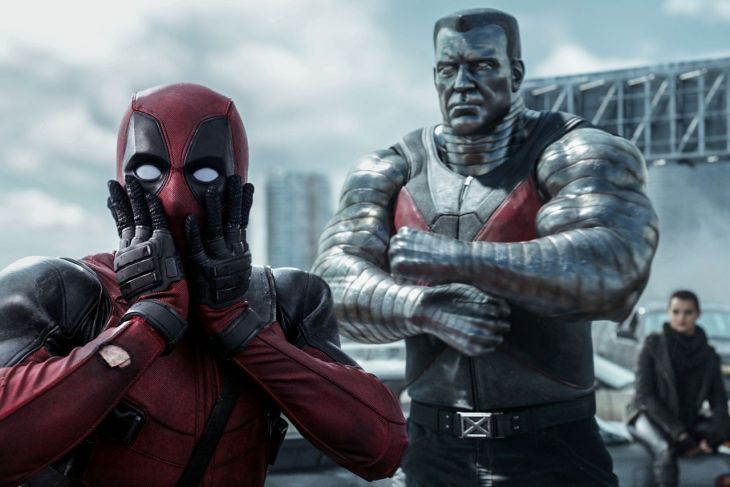
One of my favourite X-Men characters as a child was Collossus (Stefan Kapicic). Here he is given yet another outing on the big screen in a CGI creation that is well realised visually if not in terms of characterisation. He is present as one of Deadpool’s sidekicks solely for comic relief rather than to provide any real threat, and as a result it’s difficult to see him having any room to manoeuvre in future X-Men films.

The other sidekick character making up the lead trio is Negasonic Teenage Warhead (Brianna Hildebrand). An emo-styled young mutant, she at least has some potentially useful strength. However, she is also on the receiving end of some great one-liners from Deadpool and doesn’t offer much to suggest she might ever become a fan favourite.

deadpoolcolossus

These two supporting X-Men were clearly only ever seen as a bit of background built around the requirement for a subplot in the final battle sequence. A joke is made at one point about the studio not being able to afford any more X-Men. There is doubtless some truth in this.

Elsewhere, the supporting cast also includes the annoyingly evil Ed Skrein, who does a good job of making the fairly generic character Ajax quite dislikable. Morena Baccarin is well cast as the romantic interest, though it’s a shame we saw yet another an initially headstrong female character dissolve into a damsel in distress. Hopefully she will be given more prominence if a sequel is made – if they stick to the comic books she will become the mutant Copycat.

Conclusion

It is a very good film, almost a great film. It’s brash, it’s offensive and it’s graphic. It’s almost like a superhero film from an alternate reality, where the primary goal isn’t to sell action figures and lunchboxes. Its failings are more than made up for by how refreshing it was to see a completely different take on the genre.

If nothing else, at least now we can say a film has done justice to the Deadpool franchise.

Deadpool is out now at cinemas globally.

Film review – A Bigger Splash (Luca Guadagnino, 2016)

A Bigger Splash tells the story of Marianne Lane (Tilda Swinton), an ageing rock star taking a resting vacation on the remote Italian island Pantelleria with her boyfriend Paul (Matthias Schoenaerts), a filmmaker. Their vacation is disrupted when Marriane’s larger-than-life ex Harry (Ralph Fiennes) arrives with his daughter Penelope (Dakota Johnson).

Watching A Bigger Splash is a little like watching a car crash in agonisingly slow motion. As the tensions rise and tempers are frayed, you see the action unfolding and there’s nothing you can do about it. Even though you want to look away you just can’t.

abiggersplashscreen.png

An interesting choice attributed to Swinton herself was that Marianne is recovering from an operation on her vocal folds. It means that her abundant acting abilities risk going to waste. This isn’t the case at all. Indeed, that she is able to command her scenes whilst not even speaking highlights her presence in front of a camera. Her frustration at not being able to shut Harry up is evident. This, mixed with Paul’s desire to not be drawn into arguments and Penelope’s apparent disinterest in just about everything, means Harry is able to be the centre of attention at all times, much to the bemusement of the three people whose lives he is engulfing.

It’s a tremendous performance from Fiennes. He is most certainly an annoying person to watch on screen, let along imagine being on holiday with. He’s a tragic man desperate to avoid the realisation that nobody cares anymore. We all know someone like Harry in our lives, but none of us like him. Unfortunately, whilst the performance is fantastic and it plays out beautifully, it doesn’t necessarily make for great cinema. Achieving a cinematic goal doesn’t justify it.

One thing this film shares with La Piscine, the 1969 French film on which this is based, is the gratuitous nudity. It didn’t really feel integral to the plot, and lacked any kind of eroticism that it may have been angling for, feeling instead to be overly sleazy.

The political setting didn’t really give any edge to the film either. Set amid a backdrop of illegal migrants landing on Pantelleria, it just felt like a shallow attempt to date the film without adding much to the plot. This could have been rectified if we’d seen the migrants sooner, but by the time they were first mentioned it felt like an irrelevant afterthought.

The film also feels about twenty minutes too long, with the action seeming to reach a climax only to drag  on far beyond the point it held my attention. As with all car crashes, it’s not very enjoyable to watch. The elements are all there – great acting, beautiful scenery, fantastic plot development – it’s just that the overall effect doesn’t deliver on its component parts.

A Bigger Splash is out at cinemas now.

Film review – Day of the Outlaw (Andre De Toth, 1959)

Andre de Toth’s unusually complex Western ‘Day of the Outlaw’ has found its way onto the Master of Cinema label this month as a dual-format release. A forgotten and under-appreciated film, shining the spotlight on it will hopefully mean it finds a much-deserved wider audience.

The film is set in an isolated town called Bitter in Wyoming. The story opens with a couple of men on horses riding towards the camera in a frosty snow storm. It is a clever opening scene by De Toth, setting up the rugged main character Blaise Starrett (Robert Ryan) with the ominous line, “I’m through with being reasonable.” We know he’s got a bone to pick with someone, with the assumption that we’re going to find out who and why pretty quickly. That we do.

What is essentially a boundry dispute about the location of a barbed wire fence reveals a hidden layer of complication when we learn that Blaise is having an affair with Helen Crane (Tina Louise), wife to Hal (Alan Marshal) of said boundry dispute. She seems absolutely loyal to her husband despite evidently being in love with Blaise.

As tensions continue to rise, the two men end up in a standoff that will likely lead to one or both being killed. This is poleaxed by the arrival of an out-of-town gang headed up by Jack Bruhn (Burl Ives), who pose a much greater threat to the men, their wives, their land and their livelihood.

dayoftheoutlawscreen

At 92 minutes long and a reported budget of just $400,000 (a little over $3m in 2016), De Toth has to work with what he has and work fast. It’s a great achievement that this was done so well, especially in what appears to be torrid weather conditions. Characters are fully realised despite often not being afforded enough screen time to develop them. A good example of this is young gang member Gene (David Nelson), who goes through an internal psychological journey in what amounts to about 10 minutes of screen time.

The film was cited by Quentin Tarantino as a reference point in the run up to The Hateful Eight and it’s easy to see the resemblance [1]. The opening sequence was a direct homage to Day of the Outlaw, with a long shot allowing the lead character(s) to naturally approach through a snow storm to join the viewer at the front of the screen. The secluded setting in increasingly worse weather, high tensions, conflicting characters having to live side-by-side whilst the story unfolds. Nothing is stolen, but it is clearly a film Tarantino rates.

Ryan’s Blaise makes a fantastic focal point around which the film plays out. He is a man who stands by his own morals. His affair with Helen is justified by him essentially saying he has no respect for her husband and thinks she deserves better. He undertakes an openly noble act of self-sacrifice for the good of the townspeople he thinks little of, though refuses to take any credit for it. He is the film’s only hero and he plays it coolly throughout. It isn’t Ryan’s most celebrated role but one worthy of a second look if you’re a fan.

Day of the Outlaw may be a flawed film but there’s enough on offer for fans of the anti-Western subgenre that seems to have found its way back to popular interest following the likes of Django Unchained, The Hateful Eight and The Revenant. If you liked any of these films then this is worth checking out.

[1] In an interview with Entertainment Weekly, Tarantino stated, “I can definitely say that as bleak as our movie is, we are definitely the funniest snow Western ever made. This is funnier than The Great Silence, it’s funnier than Day of the Outlaw.” Quite what he means by this isn’t exactly clear. There isn’t much humour in Day of the Outlaw.

Film review – みな殺しの拳銃 / Massacre Gun (Yasharu Hasebe, 1967)

A stylish yakuza film originally released in 1967, みな殺しの拳銃 / Massacre Gun has received a lovingly-created remastering by Arrow Video that’s well worth picking up for fans of the genre.

The plot concerns three brothers. Ryûichi (Joe Shishido) is the eldest; he’s level-headed but he’s also a member of the Akazawa yakuza gang, turning on his employees when he is forced to murder his lover. Eiji (Tatsuya Fuji) is the middle brother – hot-headed but loyal to his siblings. The youngest, Saburo (Jiro Okazaki), is an aspiring boxer who over-exerts himself at a training session to prove his worth, infuriating the yakuza bosses who now have an injured star fighter. When the yakuza seek retaliation on him and ruin his career, this is the catalyst for their feud to quickly get out of control. Tensions rise as the stand-off escalates to full-blown gang warfare and a brutal final shootout.

The film oozes style. The sultry jazz soundtrack provided by Naozumi Yamamoto is almost a character in itself, providing an edge to the sharply-dressed brothers and the gritty world they inhabit. The monochromatic tones serve the film in a way that full-colour just wouldn’t have achieved.

massacre gun still

There’s a unique edge to everything that happens in the film, which is clearly an attempt by Yasharu Hasebe to mirror typical American film noirs. The world these characters isn’t a world that a typical viewer is familiar with outside of cinema, though the dedication to the genre is so absolute that it becomes absorbing. True, there are better film noirs out there, though few give themselves so absolutely to the concept of film noir itself.

However, there is something extraordinarily off-putting about the appearance of lead actor Joe Shishido. His cheeks seem puffed-up and almost chipmunk-like. Apparently, and I only found this out after seeing the film, this was by choice. He had his cheekbones enhanced to give himself a more masculine appearance. This really isn’t the case. In this particular film he looks like the most unlikely of lead actors, especially alongside his two brothers. It is an unnatural appearance, though it has the unintentional affect of providing Shishido with a heightened sense of being the underdog, which plays into the plot wonderfully.

This is a mere minor annoyance in an otherwise perfectly good film. It lacks the notoriety of the more popular Shishido yakuza film noir released in the same year – Branded To Kill – but both seems to inhabit the same world and will reward fans of the genre willing to seek it out.

Massacre Gun is out now on Arrow Video dual format Blu-ray and DVD, limited to 3000 copies.

Film review – The Revenant (Alejandro González Iñárritu, 2016)

Watching The Revenant was an ordeal. Realistically gritty, putting the viewed in the centre of the action at all times and not afraid to show a bit of gore, that I felt so uncomfortable was inevitably a deliberate choice and will be one of the reasons it inevitably wins big at the awards ceremonies this year.

The story is set in 1823 in Louisiana Purchase, which the modern world now knows as North and South Dakota. It opens with a good old-fashioned Western movie standoff: the hunters are in the woods stockpiling pelts when they are ambushed by a group of Arikara Native Americans. The scene is one of the grittiest and most brutal opening battle sequences since Saving Private Ryan. People from both sides are blown up, arrows pierce any and every body part and nothing is watered down or censored.

The hunters are led by Captain Andrew Henry (Domhnall Gleeson), whilst the team includes hostile John Fitzgerald (Tom Hardy) and the experienced Hugh Glass (Leonardo DiCaprio). Hostility is felt between Fitzgerald and Glass; the former has been partially scalped by Native Americans and the latter has a son, Hawk, from his relationship with a native.

revenant screenshot

Come on guys. He’s done enough for the award this year.

The most famous scene from the film, in which Glass is brutally attacked by a female bear as he tried to hunt her cubs, is almost betrayed by a lack of convincing CGI. Fortunately if you believe in it enough, DiCaprio saves the day with a wholly convincing portrayal of a man desperately fighting for his life. It’s really difficult to watch but strangely mesmerizing, every grimace making you want to turn away and look closer in equal parts.

Tom Hardy is completely unlikeable as John Fitzgerald, just as he should be. There is literally nothing good about his character and it’s another huge achievement in Hardy’s young career.

As the final shot plays out, DiCaprio looks straight down the barrel of the lens and into our eyes. In the film, Glass is showing a whole range of spoilery emotions. In the real world, it felt like DiCaprio was saying to us “I’ve been attacked by a bear, had valleys dug into my back, been left for dead, thrown off a cliff, almost drowned, shot at, climbed inside a dead horse, eaten raw meat, learned the native Arikara language and almost frozen to death… so can I have an Oscar this year please?” I don’t think anyone who sees this could deny him of it. Not this time around.

The Revenant is on general release now.


Film review – Spotlight (Tom McCarthy, 2016)

There are obvious paths to go down to tell a story about victims of child abuse. This film eschews the story of the individuals who have suffered the abuse, instead concentrating on the journalistic team that fought hard to uncovered the abuse. It deliberately attempts to portray just how difficult it was to reveal the truth about something when nobody wants to listen and everybody involved is trying to cover up what has happened. It is an effective but devastating success.

The title of the film is taken from an investigative journalistic unit that tackles stories it deems of necessary interest to the readers of The Boston Globe. In 2002 it published an exposé on Roman Catholic priests in the Boston area, offering evidence of not only child molestation and rape, but also of the systemic cover-up of the evidence by the church. The truths they found were horrific in both nature and magnitude.

Whilst the movie is truly an ensemble piece, there are three wonderfully nuanced performances that help make this film so effective.

The first comes from Stanley Tucci as the attorney Mitchell Garabedian. Tucci is a really special actor and he’s in fine form here. Garabedian has represented innumerable victims of the abuse and each time has been unable to affect change, with critical documents being suppressed by the church. Reminiscent of his role in Margin Call as Eric Dale, he is a man with knowledge of the wider secret dying for those around him to find out what’s truly going on.

A smaller but memorable turn comes from Neal Huff as Phil Saviano, head of the Survivors Network of those Abused by Priests. Based on a real person going by the same name, he makes the most of his limited screen time when he provides a harrowing monologue the first time he meets the Spotlight team. A frustrated picture of a man that likely represents the emotions felt by each and every survivor.

The finest performance, however, is from Michael Keaton as the Chief Editor of Spotlight, Walter “Bobby” Robinson. Throughout the story Bobby is a man wrestling with his conscience. He knows that to make the story as effective as possible he needs to wait for all the facts to be in place and make a thorough, damning article that cannot be ignored. However, doing this means sitting on the information whilst the abuse continues in the city. Late in the picture when he finds out he was actually tipped off about the scandal twenty years previously, he must conclude that he is finally bringing justice to the city despite potentially having the power to prevent generations of systemic abuse. Keaton nails it, reminding us all once again how great it is to have him back on the big screen in a role of substance.

I’m surprised Mark Ruffalo and Rachel McAdams have been selected for an Oscar nomination ahead of those they share the screen with. Fine actors though they are, it must have been a tough call to select two from a long list of solid performances. Ruffalo seemed to be holding back slightly, though that was perhaps a deliberate choice I didn’t pick up on fully.

It is rare that a whole audience is left in absolute silence at the end of a screening, but even on a busy Saturday afternoon there didn’t seem to be anyone that felt anything other than stunned. The reason for this was a devastating list of all the locations they have uncovered scandals in since the publishing of the initial article in 2002, firstly in the USA, then globally.

For this reason the film is now serving the same purpose as the original article: to shine a spotlight on a diabolical scandal that should have been eradicated decades ago. It is possibly the most important film you will see this year.

Live music review – Travis live at The Roadmender, Northampton, 25/01/2016

Setlist
Everything At Once
Writing To Reach You
Love Will Come Through
Driftwood
Paralysed
Side
Re-Offender
Animals
Where You Stand
Three Miles High
More Than Us
Closer
Turn
Flowers in the Window
Sing
Blue Flashing Light

Encore
Good Feeling
Why Does It Always Rain On Me?

Back in 1999, Travis were on top of the world. They’d enjoyed moderate success with their debut album ‘Good Feeling’, but with ‘The Man Who…’ they had become relentlessly popular. Songs such as ‘Writing To Reach You’, ‘Turn’, ‘Driftwood’ and ‘Why Does It Always Rain On Me?’ were hard to avoid that summer, and they cemented their success with a glorious headlining slot at Glastonbury in 2000.

They may not still be considered mainstream, but those that have stuck with them know their form has never really dropped. The intervening years have given us a plethora of excellent album releases, from the radio-friendly ‘The Invisible Band’ in 2001, through the politically-driven ’12 Memories’ in 2003 to ‘Where You Stand’ in 2013, which is arguably their strongest set to date. Indeed, only 2008’s ‘Ode to J. Smith’ failed to trouble the top five of the UK album charts, showing that the plentiful die-hard fans kept coming back for more.

With 2016 promising new album ‘Everything at Once’, and with a couple of well-received singles in the bag, Travis decided to go out on a mini-tour to road-test the new material for these fans. I was there for the first of these gigs, at the Roadmender in Northampton, to catch their return to the stage.

The 850-strong crowd were in fine voice as they smashed their way through the first handful of songs. Opening with new track ‘Everything At Once’ was a brave move that paid off and it has already clearly been well received. However, it wasn’t until ‘Writing To Reach You’ kicked in that the audience really got going. A couple more hits followed before the next new track ‘Paralysed’ was given its first airing. It sounded good but singer Fran Healy admitted it would take five or six listens before any new material would truly sink in.

With an audience such as this – most were members of the mailing list that had been tipped-off about a ticket pre-sale – the more obscure songs will always be appreciated. Both ‘More Than Us’ and ‘Good Feeling’ from their debut album received huge cheers, as did ‘Blue Flashing Light’ as it closed the main set. It was this set closer that proved to be perhaps the highlight of the night, clearly now a fan favourite despite being buried as a secret track on ‘The Man Who…’.

And so the night came to a close with their signature song ‘Why Does It Always Rain On Me?’, sung at full volume by everyone present. It was a night for Travis to get back into the swing of things in safe and welcoming surroundings, knowing they would receive a much-deserved warm response from their most dedicated fans. They are set to take their new album on the road this summer (an announcement is set to be made tomorrow morning at 7am). Whilst they might not win any new fans over, they certainly won’t disappoint those already converted.

Film review – Joy (David O’Russell, 2016)

Of all the stories of all the people that have ever existed on this planet, perhaps one of the last you’d think to turn into a film would be that of Joy Mangano, inventor and telesales presenter. It’s not that she’s unremarkable or boring, but she is far from a controversial character. What she does encompass, however, is both a traditional tale of the American dream and a figurehead for strong-minded women that have ever felt oppressed in work or at home.

If you’re wondering what Joy Mangano looks like in real life, there’s a popular video below of her selling her first major breakthrough invention: The Miracle Mop. From then on she became a self-made millionaire, invented many more successful products and created a business empire.

It has to be said that whilst she may be a household name across the USA, the rest of the world remains unaware of her background. Or at least they did. That was until the film Joy came along. Starring Jennifer Lawrence in the title role alongside the likes of Robert De Niro, Isabella Rossellini and Bradley Cooper, the film reveals the journey she went on to get to where she is today – from divorced mother-of-two working for Eastern Airlines right up to her first business successes.

The first forty-ish minutes of the film try really hard to give us a potted history of the causes of Joy’s personality traits, actions and outlook. It usually works on a scene-by-scene basis but the pacing causes issues and seems to lack direction until Joy herself finds a focus in her life.

joyscreenshot

From this point on the film has hit its stride and she breaks free from the oppression and the doubters. There are moments of humour (which surely explains the Comedy Golden Globe nomination, no?), edge-of-the-seat excitement (her first sell on QVC springs to mind) and fist-pumping success (I recall here a scene near the end set in a California hotel room). This is all driven by a remarkable performance by Jennifer Lawrence, reminding the world again that she isn’t just the girl from The Hunger Games but rather a girl with acting talent far beyond her years.

So whilst this film has its merits, the scatter-gunned first act and lack of consistency mean it won’t go down as one of the great films of the year, though Lawrence’s performance is worth the ticket money.

Joy is on general release globally now.