Burke made a bad call.
Aliens started killing.
She put her in charge?
Tag / Film Review
Haiku film review #002 – Room
In preparation for my upcoming trip to Japan, I will be putting out haiku film reviews every Friday.
For those unaware, a haiku is a form of Japanese poetry with a 17-syllable structure set up as 5-7-5.
My second attempt is for Room.
A room with a view.
Of a solitary leaf.
Is not very fun.
Haiku film review #001 – The Revenant
In preparation for my upcoming trip to Japan, I will be putting out haiku film reviews every Friday.
For those unaware, a haiku is a form of Japanese poetry with a 17-syllable structure set up as 5-7-5.
The first one is a film I reviewed properly just yesterday, The Revenant.
Leo’s in fine form.
Almost gets killed by a bear,
Should win an Oscar.

The Seven Year Itch (Billy Wilder, 1955)
Billy Wilder’s 1955 romantic comedy The Seven Year Itch has proved to be one of his most popular films. It was his first pairing with Marilyn Monroe and whilst it fails to hit the peaks of 1959’s Some Like It Hot, it still has enough redeeming qualities to warrant its popularity.
The film concerns married man Richard Sherman (Tom Ewell), who is experiencing what psychologists refer to as the seven year itch – after seven years of marriage many experience discomfort brought on by extended monogamous relationships. Richard becomes infatuated with a girl (Monroe) living above his apartment whilst his wife and child visit Maine for the summer to escape the Manhattan heat. As he tangles himself up in his own mind his tendency to daydream takes over, a matter exacerbated by his increasing closeness to his new friend.

Marilyn Monroe is a breath of fresh air when she first appears.
It is these daydreams that provide most of the laughs. As the film progresses they become more surreal and the window into Richard’s mind becomes a portal to a place full of fear and panic. Ewell’s performance can feel a little forced at times and the actor fails to endear Sherman to the viewers, an essential requirement when we’re watching him attempt to commit adultery. Perhaps his acting was better suited to the Broadway stages where the subtleties of emotion need to be overplayed to ensure the back row sees it. After an estimated 900 performances in the role it would be hard to unlearn that. This would ultimately prove to be his defining role.
The script is the perfect platform for Monroe to unleash the naïve and bubbly persona that served her so well throughout her career. It works on this level and she’s a breath of fresh air when she first appears.
A discussion about this film can’t go very far without mentioning the famous subway air vent scene, where Monroe’s dress flies up in the breeze created by the train passing by underneath. It is perhaps one of the most iconic shots in any film ever released. It doesn’t quintessentially add or detract from the story itself, so if you’re watching just for that scene you may be a little underwhelmed. Indeed, you may never see what you hope for – the famous full-length photo the world is familiar with was taken at the original shoot, which was unusable due to crowd commotion. The scene later had to be recreated in a studio. At no point does the full-length shot appear.
The film was actually name-checked in Sabrina, Billy Wilder’s previous film released a year earlier. It’s hard to resist comparing the two films. Side-by-side, this doesn’t really come close to the magic audiences had seen when Audrey Hepburn wowed the world by pairing her timeless beauty with a sublime acting performance. Monroe was never an actress of the same calibre as Hepburn and this isn’t helped by a much more shallow script.
The Seven Year Itch is available to buy on Blu-Ray now.
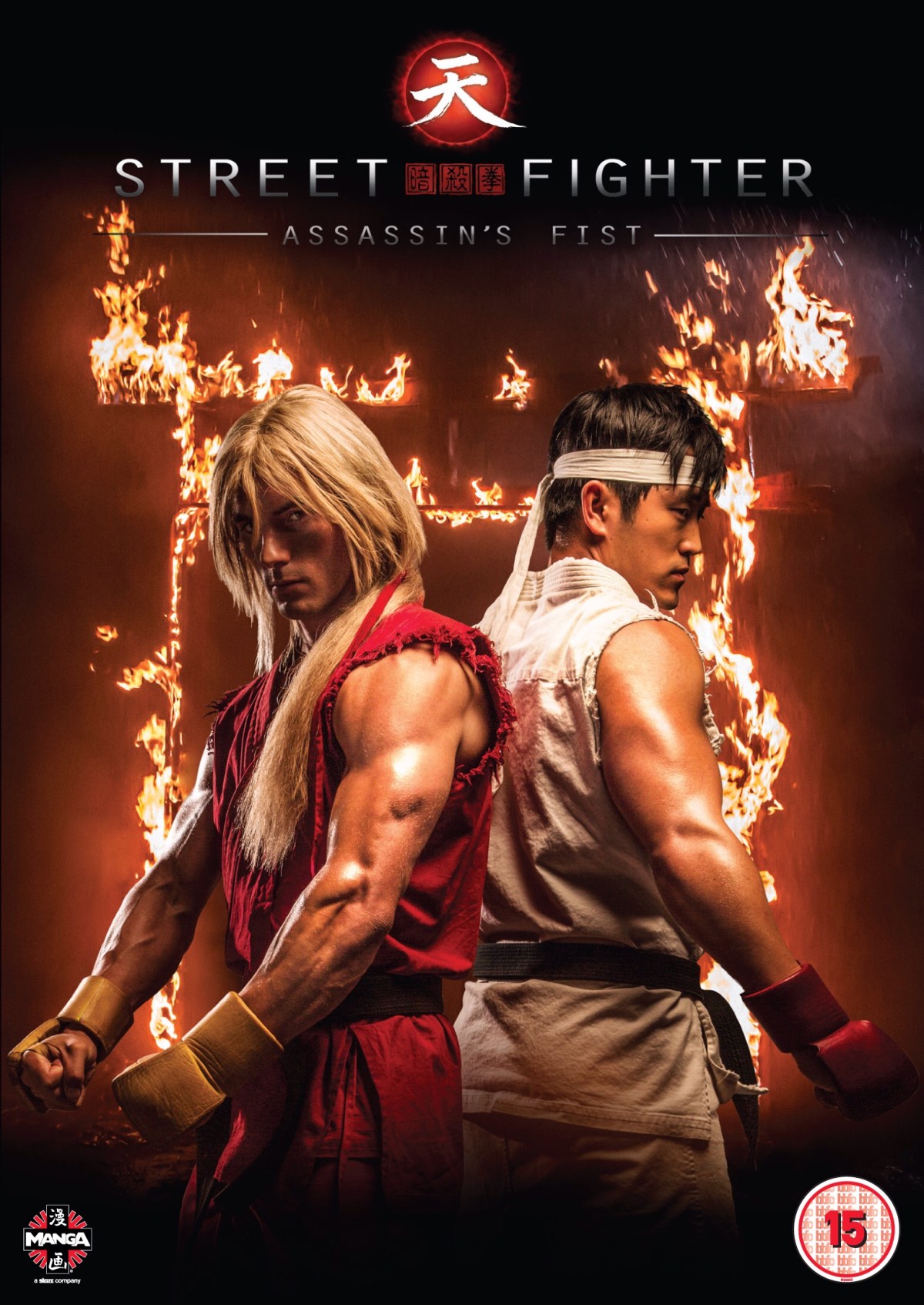
Street Fighter: Assassin’s Fist (Joey Ansah, 2014)
Holy motors! I just watched a live-action Street Fighter movie, and it wasn’t bad. In fact, I’d go as far as saying it was… great. Let’s go back in time to justify my surprise.
The year is 1992. I’m seven years old. I’m in possession of a Commodore Amiga and a copy of Street Fighter II: The World Warrior. My brother, channelling every ounce of his O.C.D. nature, has annoyingly mastered the character of Ryu, who everyone knows is the coolest character on the game. This was no mean feat, especially on a Powerplay Cruiser. When I say “mastered”, he was actually untouchable on it. Occasionally the computer A.I. would get into hadouken competitions with him, but couldn’t keep up. He was, at this moment, the coolest kid at school, a height he wouldn’t achieve again until he accidentally set off an alarm and the police showed up at school. As we all know, cheaters never prosper. [1] [2]
This was 1992 though, and any child wasn’t worth his weight in Nerdz if they didn’t have a copy of Street Fighter II: The World Warrior. Or, later, Street Fighter II: Champion Edition. Then Super Street Fighter II. And don’t forget Super Street Fighter II Turbo, if you could convince your parents that the additional £60 spend was worth it for the “thrill” of playing as DeeJay. [3]

Sit down DeeJay. Sit down.
Unfortunately, whilst the games came thick and fast, seemingly adding lots to the gameplay and making sure the improvements were worth the extra investment, the associated media interpretations were mixed to say the least. There were some good things out there. I remember being a huge fan of the comic book, which itself was an adaptation of Street Fighter II: The Animated Movie, a decent-quality anime version of the game.
Unfortunately, all interpretations of the Street Fighter characters’ back stories were immensely overshadowed by the big-budget, star-studded and hugely hyped film titled Street Fighter: The Movie. After I got over the initial dismay at the idiotic titling of the film, it truly started to sink in – this was possibly the worst film I’d ever seen. [4]
Street Fighter: The Movie starred Jean Claude Van Damme as Guile, Kylie Minogue as Cammy, Raul Julia as M Bison in his final cinematic role and a young Ming-Na Wen as Chun Li, almost 20 years before she’d reappear on our screens as Melinda May in Marvel: Agents of Shield. This hotch-potch of acting talent was gelled together by a flimsy plot and some terrible dialogue and it destroyed in an entire generation any interest in the Street Fighter franchise outside of simply playing the games.
By 2009, studios felt safe enough to release a Chun-Li origin story starring Kristen Kreuk, but this went down almost as poorly as the 1994 movie. In fact, arguably worse. It really wasn’t worth the time and effort, but fortunately not many people put either into it.
So it’s with great trepidation with which ardent fans approach this latest offering, Street FIghter: Assassin’s Fist. It is essentially the origin story of Ryu and Ken, the main characters of the original Street Fighter game and firm favourites in the Street Fighter II series. I’m happy to say that I wasn’t disappointed at all. I was actually rather impressed.
The story takes place in a secluded area of Japan in 1989 as Ryu and Ken learn the traditional ancient fighter technique of 暗殺拳 / Ansatsuken (Assassin’s Fist) from their 先生 / Sensei (master) 剛拳 / Gouken. Ryu appears to be achieving more than the hot-headed Ken, who is becoming increasingly frustrated by the slow pacing of the training. Through a series of flashbacks we learn the true past of Gouken and his relationship to his younger brother 豪鬼 / Akuma as they both trained in Ansatsuken.
Stylistically they get everything right, both in terms of making a good film and also in terms of being respectful to the original source material. There’s very little in terms of deviation from the back-stories generally considered to be canon, and the only extra embellishments comes in the form of explaining answers to previously unanswered questions, for example how Ken ended up in Japan in the first place.
 Stylistically they get everything right.
It seems like such an obvious formula: pick out the key characters that people who played the game found interesting, focus on their back story and pick out the meatiest parts, get the story right and tell it in an interesting way. It’s a far better idea than trying to somehow piece together the fabricated back-stories of sixteen unrelated characters for the completion’s sake. This way we are able to see some good acting breathe life into the characters for the first time. It’s not Oscar-winning acting, but it is as good as anything I’ve seen in a video-game-to-film release.
The original release was actually in the form of thirteen webisodes released via Machinima, which was later edited into a full film. Such was the popularity of this, there is a planned sequel that will focus on the シャドル / Shadaloo organisation, which is headed up by M. Bison and also includes the original remaining three final boss characters of Balrog, Vega and Sagat, and the characters in the original game series that had joined the fighting tournament to bring down the organisation (Guile, Chun Li, Cammy and T. Hawk). This has a lot of potential and could be as successful as long as they give the characters as much space to breathe as in this release. Clearly having eight stories to tell is more difficult than four, and the tone of the film would be a huge departure from Assassin’s Fist should this be the route down which they choose to go.
The entire film can be watched here below, though it is also available in HD on Netflix and is available on Blu-ray.
[1] The “cheaters never prosper” line was something the Amiga version threw at you if you keyed in a cheat for invincibility. You could sail through the game but when it got to the post-game conclusion story screens, you instead were treated to a screen reading “Congratulations, but as we all know, cheaters never prosper.” It was harsh but in a way taught us all a life lesson.
[2] Another thing that spoiled my enjoyment of the Amiga version of the Street Fighter II game was that when you loaded up either Ken or Chun Li, the top halves of their bodies were a scrambled mess of pixels. I never knew why this was the case.
[3] Super Street Fighter II: The New Challengers / スーパーストリートファイターⅡ -The New Challengers was released in 1994 and featured hugely enhanced graphics and four new characters: Cammy, T. Hawk, Deejay and Fei Long. Whilst it was a neat effect to bring in four new characters to milk the popularity of the existing franchise, anyone who regularly picked any of these four characters was generally treated with dismay in my group of friends. It’s a bit like saying your favourite Beatles album is “Band on the Run”.
[4] Bored of the relentless tweaking involved with each iteration of essentially the same game, we eventually tracked down a copy of the original Street Fighter on the Amiga. It featured Ryu, Ken and Sagat – all familiar – but also characters like Birdie, Adon and Gen. Inevitably none of these featured in the film. Obviously the feature film should have been called Street Fighter II: The Movie, or something similar.
Frank (Lenny Abrahamson, 2014)
Frank tells the story of Frank Sidebottom, the comedic persona of Chris Sievey who performed as a musician and entertainer for over 25 years from 1984 to Sievey’s death in 2010. At least, I thought that’s what it was going to be, mainly because I didn’t read the synopsis. I was quite confused when one of the main characters started Tweeting.
It turns out that it’s a story only partly inspired by the Frank Sidebottom story, but any fans of the infamous persona will be sadly disappointed. It is based on the memoirs of Jon Robson (author of The Psychopath Test), covering his time in the Oh Blimey Big Band with Sidebottom. Frank in this film is a distant relative of the real Frank, and the action is set firmly in modern Ireland and USA rather than 1980s Greater Manchester.

Frankly a disappointment
It is a big-name cast for what is essentially quite a small story. Michael Fassbender plays the unstable titular role; Domhnall Gleeson plays the ambitious musician Jon (the equivalent of Jon Ronson); and Maggie Gyllenhall plays Clara, a pivotal band member. There are two Academy Award nominees there and the film at times risks feeling a little like it had been over-cast.
I didn’t really enjoy much of it, if I’m being brutally honest. The music around which the story is built seemed a little contrived. I get that they had to replace the original Frank Sidebottom songs for the modern settings, which have ended up occupying a similar plane without using the songs in any way, and I suppose there isn’t a place for “I’m In Love With The Girl On A Certain Manchester Megastore Checkout Desk” in a film like this. Yet it begs the question: was it relevant to feature the likeness of Frank Sidebottom when the final result has nothing to do with the character? I find it unfair that Chris Sievey worked his whole life to create a celebrated persona, only for the world view of it to be irreparably altered by a film release that essentially has nothing to do with the subject.
Thankfully, a truer reflection of the man inside the mask will be available when Steve Sullivan’s crowd-funded film Being Frank: The Chris Sievey Story is released later this year. Inevitably it won’t be as popular – it won’t have Michael Fassbender to help sell it – but at least a truer reflection of the story will be told.
Frank is available on Blu-ray and DVD now, as well as on Netflix.
 Cinema, etc.