浪華悲歌 / Osaka Elegy (Kenji Mizoguchi, 1936)

浪華悲歌 / Osaka Elegy, now eighty years old, came midway into director Kenji Mizoguchi’s career. Despite this, it is one of the earliest examples of Kenji Mizoguchi’s work readily available to view by the general public and has just been restored and released by Artificial Eye as part of a boxset titles The Mizoguchi Collection.

By today’s standards, it has a strange narrative that seemingly unravels itself from a reasonably happy place to a completely unhappy place for everyone unlucky enough to be wound up in the story. It is built around telephone operator Ayako (Isuzu Yamada), a girl who uses manipulation out of desperation for her own family. Her father is struggling to keep afloat financially after finding himself unemployed and owing 300 JPY. Her brother is also in desperate need of money to pay for his tuition fees or he will be thrown off his course. A solution presents itself in the form of Sumiko Asai (Yoko Umemura), the owner of a successful drugs company who has taken a shine to Ayako. Agreeing to be his mistress to solve the financial issues, she soon realises that the solution isn’t quite as simple as she had hoped.

The topics covered by the film are explored and exploited. It’s a clever technique as the initial story seems quite bland. As the reality is revealed to those involved Ayako comes out as the only person to be perceived to be in the wrong. Several men have had an affair with a girl under half their age, effectively buying her time, but they are above the law due to their standing in society. Since she is perceived to be of a lower class, it is on her that the blame is left.

She was in fact trying to live by her giri morals – the duty to do right by ones family. Whilst her methods may be unorthadox, she never sways far from these morals. The most upsetting part is her final line in the film, revealing that she believes herself to be a delinquent.

The quality of the film is lost slightly by the poor condition of the remaining footage. Throughout the film there are issues with sound – the constant background hiss is quite off-putting, there’s the odd loud pop and the dialogue can feel muffled. It’s not inaudible, but a far cry from perfect.

Similarly, the picture quality is poor, particularly in the darkened interiors of the traditional Osakan houses where the blacks appear muddy. This, like the sound, is not the fault of Artificial Eye. They’ve clearly made a decent job of some imperfect source material. It’s a shame, but realistically this is a business venture and spending the money to restore relatively obscure Mizoguchi films would be hard to justify.

As I understand, the other three films in this box set (The Story of the Last Chrysthanthemum, Utamaro and His Five Women, Sisters of the Gion) are all in the same boat, with imperfections in both audio and visuals (I haven’t watched them yet). That these films have surfaced at all is enough to be grateful for and those looking for more Mizoguchi after enjoying the Master of Cinema releases will be well served. As such, despite the flaws this box set is a recommended purchase.

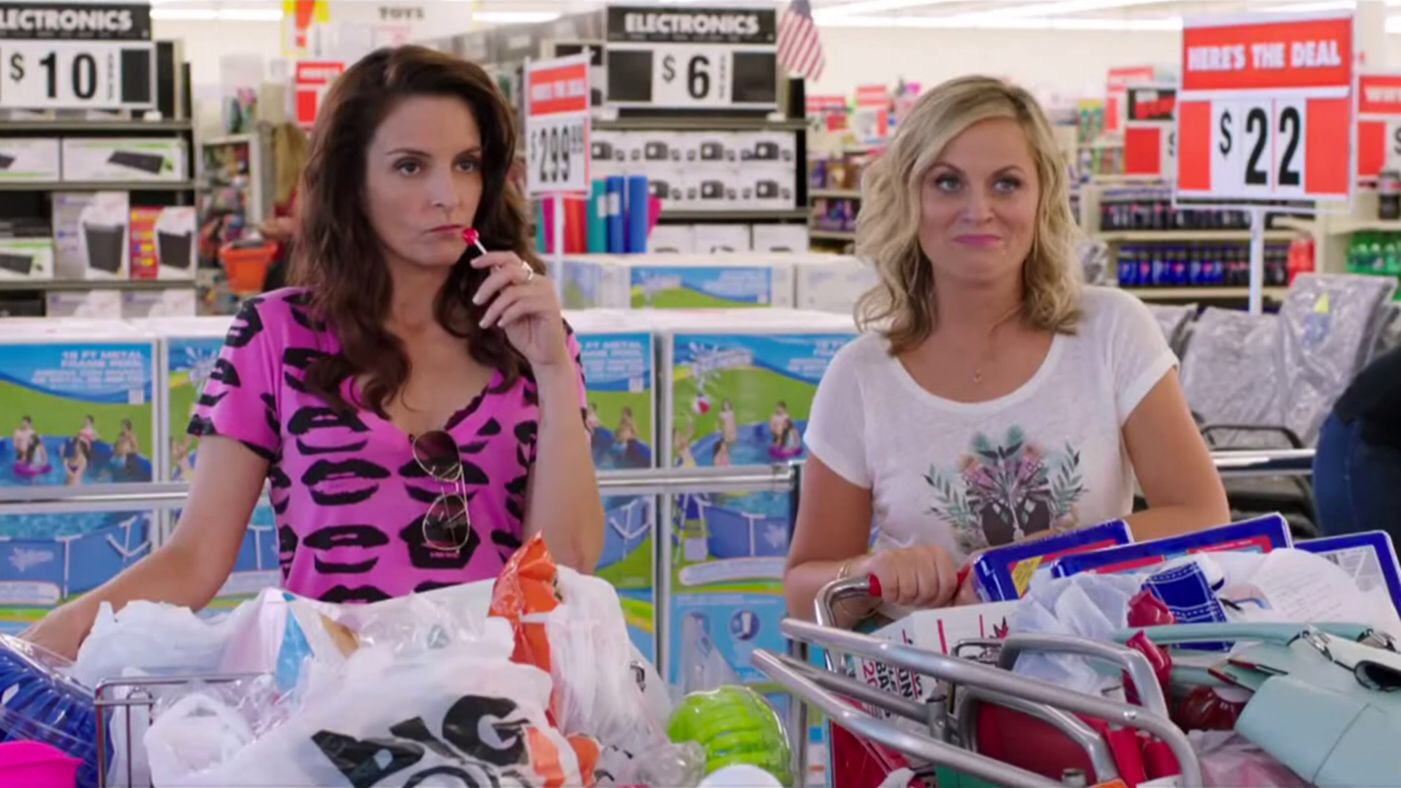


Sisters (Jason Moore, 2015)

Sometimes cinematic events so huge occur that they transcend cinema and infiltrate the wider global conversation. To not see a film, occasionally, is to almost deliberately stand out from the crowd and, in some cases, refuse to be a sheep. Because everyone else is in love with a film but perhaps didn’t get it at first, the desire to take a stand gets in the way of allowing yourself to be interested.

If you’re in that boat and have taken a stance against Star Wars: The Force Awakens, then perhaps Sisters is the film for you. It is in so many ways the antithesis of an epic and excellent space opera. Yes, it isn’t very good. Yes, it vastly underused its two lead stars. But someone had to take the hit and be THAT film that was released the same week as the film that looks set to be the most successful in box office terms since Avatar.

The story is as banal as the majority of the jokes. Sisters Maura (Amy Poehler) and Kate (Tina Fey) find out that their parents are selling their childhood home and have to go home to clear out their rooms. They do just that, but in the process decide to throw a huge house party. Things get out of hand and they wreck the house, though in doing so learn some valuable lessons.

It isn’t without merit. Some jokes are downright hilarious. However, these appear to be the ones that were ad libbed by the two leads. There are a few examples of this is when they are trying on dresses ahead of the party. Additionally, the scenes with Maya Rudolph are all highlights and almost give a feeling of a rewarding experience. Most of the remainder, however, falls disappointingly flat.

A truly entertaining time was had by all. Just not in this screen.

After about half-an-hour I found myself in such deflated amazement that I started to enjoy it out of disbelief that it was such a waste of their talent. This twisted enjoyment sustained until the final section when it started to feel protracted – the party kept going slightly too long and the joke was wearing thin.

The final segment, which awkwardly ties it to Christmas and thus tried to justify it as a festive film doesn’t really convince with conviction. This was clearly an afterthought to a film that was obviously intended for a summer market but that the studios didn’t dare release into clear air when excuses would have been harder to come by than the Star Wars card.

Sisters is on general release worldwide now.

Film review -トウキョウ トライブ / Tokyo Tribe (Sion Sono, 2014)

Movies should aspire to be the best in their genre. There’s no point existing as a movie unless you can at least be better than everything that has gone before in your genre. If you can’t do that, then why not mold yourself a new genre completely?

With that in mind, I am proud to announce that Tokyo Tribe is the best Japanese-language rap-musical in the tribal gang realm.

The story is pretty hard to explain. To summarise, we are let into a highly stylised version of modern Tokyo, where tribal gangs vie to rule the city. Set over one night, we see the heightening tensions as ganglord Buppa (Riki Takeuchi), his henchman Mera (Ryuhei Suzuki) and son Nkoi (Yosuke Kubozuka) declare war on all other tribes in Tokyo, announcing as much by killing the popular peace advocate Tera (Ryuta Sato). The uprising against their power trip is led by central heroine Sunmi (Nana Seino), and multiple stylised battles culminate in a dawn all-out-war.

Sunmi beat the living daylights out of another bunch of extras

Sunmi beat the living daylights out of another bunch of extras


Amazingly, the intertwining of multiple storylines and characters is reminiscent of Love Actually, though the comparisons inevitably end there. In fact, at times it’s simply hard to follow just who the central characters are. About 90% of the dialogue is delivered as rapping, so as an English native who barely speaks any Japanese it is hard to follow what are clearly some very fast and rhythmical lyrics. On this occasion, it really pays to speak the language.
Another issue is the excessive number of characters that are continuously being introduced into the mix. It felt at times like several characters were frivolously being added in too late for us to care about who they are, often getting only a handful of lines to describe who they are, what tribe they represent and a little about themselves before disappearing for the rest of the film.

That said, there is a memorable turn from Cyborg Kaori as a beatboxing servant, which is worth watching out for. She does things with her voice that seem completely unnatural. The results are fascinating and her various YouTube videos are worth checking out. This is an example of a distinct character being given the chance to shine; it’s a shame that the cast wasn’t smaller so more focus could be given to each of the talented artists involved.

Many of the featured actors and actresses, however, are new to the hip hop world and the intriguing on-disc Making Of documentary reveals a lot of the insecurities of the stars, particularly with standout performer Nana Seino. She’s clearly a talented actress but it’s sad she was the focus of such a lot of “fan-service” throughout the film.

Stylisitically, the film is top notch. From start to finish there is no break in the feeling that the characters inhabit this entirely alternate reality and in that sense it is a great success.

The same cannot be said for the storyline.

At times it’s a brilliantly unique film that threatens instant cult-classic status. Often it’s just a complete mess that loses itself in style over storyline. If you know of Sono Shion and liked his previous efforts then you know you’ll enjoy this. If not, then approach with caution.

Tokyo Tribe can be purchased on Blu-Ray in the UK now and was released by Eureka films.

Quiz of the Year 2014

Here’s a bit of fun for you – a quiz of the last year in film. Answers some time next week. No prizes. Enjoy!

1. The Golden Globes took place on 12th January in Beverley Hills. What edition of the Golden Globes was this?
2. Set in Paris and directed by McG, what was the name of Kevin Coster’s critically-panned action film released in February?
3. According to John Travolta, who won the Academy Award for Best Song in March?
4. British acting legend Bob Hoskins sadly passed away on 29th April, leaving behind a legacy of excellent performances throughout a busy career in cinema. But in which 2012 film did we see Hoskins in his final role?
5. Which top-billed character was cut from the film X-Men: Days of Future Past for timing purposes, sparking a furore amongst fans demanding a recut version, now set for release in summer 2015?
6. Released in June, which film went on to be the highest grossing of the year despite featuring hardly any dinosaurs at all?
7. What was the name of Michel Gondry’s quirky romantic film, released in July and starring Romain Duris and Audrey Tautou.
8. Which film, released in August, featured minor performances from Rob Zombie, Peter Serafinowicz and Josh Brolin?
9. Which stop-motion animated film, released in September, featured the voice talents of Sir Ben Kingsley, Simon Pegg and Nick Frost?
10. On 18th October 2014, which Andrey Zvyagintsev film was awarded Best Film at the London Film Festival?
11. Which Oscar-winning actor had a posthumous role in The Hunger Games: Mockingjay, Part One as Plutarch Heavensbee?
12. What was the scientific explanation offered in Ridley Scott’s Exodus: Gods and Kings for the parting of the Red Sea?
13. Which 10-hour Claude Lanzmann documentary about the Holocaust is set for release by Masters of Cinema in January 2015, the first time it will be available on Blu-Ray in the UK?
14. Name any five of the nine films released by Walt Disney Pictures in 2014 (not including Marvel Studios releases).

Marks out of 18.

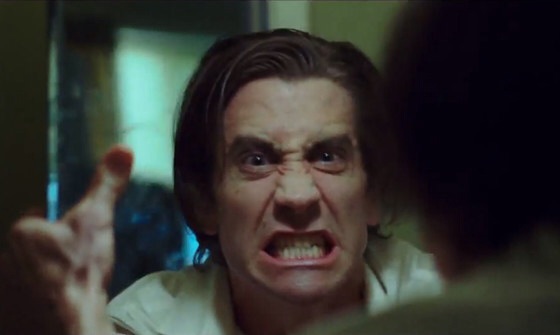
Nightcrawler (Dan Gilroy, 2014)

“The closer you look, the darker it gets” declares the poster for Dan Gilroy’s directorial debut Nightcrawler. And so it was. As I sat in the cinema wondering how far Jake Gyllenhaal’s character would take it, the answer tended to be “Oh, that far.”

The film is a bildungsroman tale of Lou Bloom (Gyllenhaal), a young man driven by money and success, and willing to go to any lengths to achieve it. He gets hooked on the idea of freelance crime journalism, specifically filming violent crimes and accidents with a personal camcorder, with the plan to sell them on to local news station KWLA manager Nina (Rene Russo). However, as his business grows and the stakes are raised, he goes to great lengths to ensure he rises to the top of the pile and stays there, no matter what the consequences are.

IMG_9506.JPG

Gyllenhaal is a wonder to watch in a film like this. He has chosen his films wisely over the years and has a body of work he can already be very proud of, including Donnie Darko, Jarhead, Brokeback Mountain, Zodiac and Source Code. This is definitely amongst his best overall, and I’d go as far as say that Lou is his most defined character yet. He plays sinister very well and clearly knows how to make his audiences tick. At times it’s a real joy to watch, at times it made me want to cover my eyes; both responses indicative that I was hooked.

The plot works as a game of oneupmanship unto itself, and this operates across the board. The characters become fuller and more dislikable as the time progresses, the gore gets gorier, the action gets more explosive and by the final act the whole movie had me whipped up into a frenzy of disbelief. Well played Gilroy.

IMG_9507.JPG

The supporting cast includes a top-form Bill Paxton (whoopee-fuckin’-do) as a rival video journalist, and a further emerging Riz Ahmed, who Brits may remember from the excellent Four Lions. Ahmed is one of my favourite British actors and it was a nice surprise to see him with such a big role in an American blockbuster.

As the finale approached, I found myself getting increasingly engrossed by Lou’s actions. His morals become so loose by the end that there is nothing remaining. His actions are fuelled by a desire to earn money, which is only possible because the viewers of KWLA are hungry to see the gruesome truth of their city. It’s an intelligent method of storytelling that we are enticed in the same manner into Lou’s own story, and by the end I found myself questioning my own morals, sitting on the edge of my seat, watching in excited disbelief.

This is an excellent film and it’s well worth seeking out whilst it’s still in cinemas. Check it out!

Nightcrawler is in cinemas worldwide now.

Ruggles of Red Gap (Leo McCarey, 1935)

Having recently watched McCarey’s excellent Make Way For Tomorrow, I thought I’d dig below the surface and watch some of his other films. I came into Ruggles of Red Gap knowing nothing about Charles Laughton and the other members of the cast, and very little about McCarey. I have to say that on first impression, I am very disappointed.

Laughton portrays Ruggles, an English valet who is working in Paris but is transferred to America to work for a brash American (confusingly portrayed by Charlie Ruggles). Once in Washington, our valet develops as a character and grows in confidence, going from obedient servant to full independence, eventually deciding to open his own Anglo-American restaurant.

Laughton biographer Simon Callow, in a key bonus feature on the UK Masters of Cinema release, discusses in great detail his opinion on the performance and his disappointment having watched it. In context, he was comparing him to his great performances as the Hunchback of Notre Damme and as Henry VIII, to name a couple. I have not seen these, but I wholeheartedly agree with everything he says. I’d go further – as an Englishman, the whole thing is utterly insulting.

The Ruggles that is portrayed is a bumbling Brit that would leave any aristocratic servant-employer worried for their own safety. Indeed, I’d probably ask for a different waiter if I was served by Ruggles in a restaurant. The portrayal leaves the viewer with an air of discomfort. There’s something going on between his flickering eyes and his awkward body language that made me want to look away. In hindsight, I think it was Laughton’s attempt at comedy. Perhaps it was “of the time”, but it really hasn’t aged well.

That he can’t find any route out of servitude until he goes to America, which is patriotically portrayed here – unashamedly – as the land of the free, is undermining of Britain. With very little knowledge of Laughton as a person, I’m willing to guess that he must have been very anti-British to accept such a role.

The film was hugely popular amongst American viewers and very much not popular in Britain, and for the reasons just mentioned I can understand why. Having listened to Callow speak so fondly of Laughton and McCarey, I’m really keen to seek out something that justifies their enduring popularity. I’ll gladly welcome any suggestions!

Ruggles of Red Cap is available now in the UK on Blu-ray and DVD.

The Book Thief (Brian Percival, 2014)

I’m a massive fan of foreign films. If a small film from an unknown director or studio outside of the US or UK has reached cinemas in the UK then it’s a pretty good indicator that it’s a film has something special about it. I managed to get hold of some preview tickets for this film and felt pretty excited at the start when the subtitles started and I thought “Thankfully, they’ve got it right”.

Then Emily Watson and Geoffrey Rush started talking and that’s where it all fell apart.

Why oh why would you pull in two hugely successful English actors and have them put on hammy German accents whilst speaking English, when Germany is full of excellent actors who would surely have been desperate for a big role in such a widely released film. I’m sure Christopher Waltz, Diane Kruger and Daniel Bruhl aren’t the only ones available. I have never ever understood why studios refrain from subtitles in this situation. Most people watching aren’t so stupid they can’t follow it. Heck, we English-speakers might even learn a language or two in the process. Please please please stop ruining films with this approach. If you want to see how to get it right then just watch the first ten minutes of Inglourious Basterds.

That said, the story is told well and there’s a fantastic performance from both the leads: 13-year-old Sophie Nelisse starring as book-obsessed Liesel, and her friend Rudy played by Nico Liersch (hurray a German!). I enjoyed it once I got past the annoying language distraction. It’s visually pretty if a little dull and soft. The John Williams score is beautifully emotive (as you’d expect from one of the greatest film composers of all time).

I’m sad that it didn’t quite hit the mark for me and I wonder whether I would have enjoyed it more if they had gone with a more realistic approach to the dialogue.

The Book Thief is released in UK cinemas on 26th February 2014.

Only Lovers Left Alive (Jim Jarmusch, 2014)

Once in a while a film comes along and disappoints you so much you forget what ever made it appeal to you in the first place. The last time this happened to me was when I saw INLAND EMPIRE back in 2006. I was desperate to see it and couldn’t find anyone to go with me so walked on my own for over an hour to the nearest cinema showing it and watched the whole three hour spectacle unravel on my own. Actually was it six hours? It felt like it. And so it was with the latest Jarmusch film. I’m just sorry I forced the experience on my equally underwhelmed fiancé.

The film sets its pace deliberately slowly. Opening with a spiralling bird’s eye camera shot of our two main characters – played by Tom Hiddlestone (Thor, War Horse) and Tilda Swinton (The Beach, We Need To Talk About Kevin) – it matches the evocation of the interspersed antique record player. It’s intelligent camera work. We’re definitely spinning at the lower end of the 33 rpm spectrum, but it sets the scene pretty well with the slow and dirty rock music that accompanies it.

The story goes something like this. Our central characters (named Adam and Eve) are both vampires, they need blood to stay alive and source it from a sort of underground illegal blood trading market. Oh and Adam is also a reclusive rock star. And Eve has the power to touch things and say how old they are (I think this was sourced from the Superuseless Superpower blog, but I can’t be sure).

John Hurt (The Elephant Man, Alien) plays a very old vampire who it turns out is actually most of the greatest writers in the history of humanity. Chekov from Star Trek is Adam’s roady. Felix from Casino Royale makes an appearance. Later in the film, Eve’s younger sister arrives on the scene but it’s ambiguous as to exactly how old she is. I mean, there were long periods of the film where there was no dialogue and as I was drifting in and out of consciousness, and I got to wondering how old she really was. If Adam and Eve are about 600 years old and look like they’re about 40, she looks like she’s about 20 so must be about 300, but yet she acts like she’s about 14. So, do vampires mature at an extremely slow rate too? I don’t get it.

Anyway it rambles along for about two hours before getting to the point where something happens and they go abroad and have to look for new sources of blood. As my fiancé pointed out, it’s the sort of thing that would usually take about 20 minutes to develop in most films. It’s deliberately paced excruciatingly slowly and sometimes it works, but mainly it falls short.

It’s admirable that Jarmusch is bold enough to stick to his guns and allow conversation to take centre stage as he did so well with Coffee and Cigarettes, but this isn’t a film about having a conversation whilst smoking and drinking coffee. It’s a story about a rock star vampire, his wife who has a super power, a man who is secretly almost every important writer ever, Chekov from Star Trek and a seedy underground market for blood. Isn’t this a recipe for a really quite exciting film?

No. Apparently it isn’t.

Only Lovers Left Alive is out in UK cinemas on 21st February 2014.

American Hustle (David O’Russell, 2014)

Director David O’Russell has had a sudden upsurge in fortune. With his last film – Silver Linings Playbook – he finally realised the promise hinted at with his earlier attempts at cinematic quirky humour. It was both critically lauded and a commercial triumph. It was a must-see film. If you hadn’t seen it you wanted to, and once you’d seen it once you probably wanted to see it again. O’Russell’s stock had never been higher.

It was important, then, that he chose his next film wisely. I’d say American Hustle was exactly that – a wise choice. It’s a film set in 1970s New Jersey, and this allowed a lot of fun to be had with costuming and recreating an authentic world in which the characters can play. To bring the characters to life, he enlisted three key actors from last year’s triumph: Robert De Niro, Jennifer Lawrence and Bradley Cooper. Added to this he also brought Amy Adams, Jeremy Renner and Christian Bale. That is a formidable lead cast if ever you saw one.

The music is spot on. Mixing a superb score from Danny Elfman with some choice cuts from the era (think Elton John, America, Chicago), it all blends together to further enhance the authentic experience.

Yet, after 138 minutes of buying in to the story, I left the cinema feeling a little short changed. There’s enough humour to keep us smiling, some great playoffs between Adams and Lawrence who are at each other’s throats throughout, and the mild twists and turns in the plot are entertaining if not thrilling. I admired the solid performances from the all-star cast, none of whom underperformed but at the same time didn’t shine. The film had the feeling of playing it safe, and I thought there could have been more to it. The final payoff was predictable and in turn disappointing.

The main problem for me was that none of the characters were likeable. Adams and Bale are both untrustworthy con artists, Cooper is an FBI career man who wants a quick rise to the top, Lawrence is a degenerate waster who’s slow on the uptake, De Niro is a mafia overlord. Renner’s Mayor Polito is the only one I felt sympathy for, getting mixed up with the wrong people for the right reasons, but he’s not really a central character. I didn’t have anyone I felt the urge to back and for me that’s a flaw in the scriptwriting. I understand that the aim of the film may have been to portray the fact that nobody in this circle is likeable, but it just wasn’t carried off successfully. With so much time to develop the characters and such an amazing array of talent on offer, it could have been so much more.

American Hustle is out now in UK cinemas.

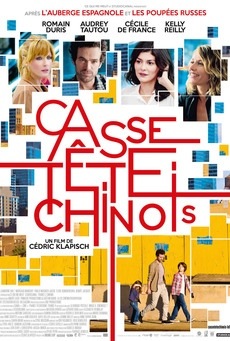
Casse-tête Chinois [Chinese Puzzle] (Cedric Klapisch, 2014)

I have to confess that I saw Casse-tête Chinois (Chinese Puzzle) at the 2013 London Film Festival and knew nothing about it. It was picked on a whim when I had a gap to fill in my schedule and I wasn’t able to put any research into it beforehand. During the post-film Q&A with director Klapisch, I learned that it is in fact the third installment of what is known as the Spanish Apartment trilogy, following L’Auberge Espagnole (2002) and Les Poupées russes (2005).

It stars Romain Duris as Xavier, a novelist whose ex-wife and children have moved to New York. The story concentrates on the complicated web of relationships that surround him as he tries to find an apartment, a job and some kind of life. Included in this web are his ex-wife Wendy (Kelly Reilly, now with her new husband), his ex-girlfriend Martine (Audrey Tautou) and her children, his best friend Isabelle (Cecile de France) and her partner Ju (Sandrine Holt) who are trying to have children of their own (with Xavier’s help), and many more bit players, all full of character. It’s a great ensemble cast and it’s clear they had a fantastic time filming together.

20140117-171746.jpg

The film is a joy to watch, with laugh-out-loud moments littered throughout. It’s unusual and quirky. It did not matter one bit that I didn’t know any of the background; the characters are well defined and it works very well as a standalone film. The hilarious business meeting where Martine has to speak Chinese, the sham marriage Spanish Xavier goes through with a Chinese girl to become American, and the crescendo where they all come together in one edge-of-the-seat hilarious finale – the balance is spot on. There are some more serious moments too, not least Isabelle’s affair with her au pair, but these tend to (eventually) be dealt with in a light-hearted manner.

It’s probably not going to make massive waves outside France, which is a shame because there are some lovely romantic comedies being made in that country at the moment and they deserve a little more attention. It may well also be the last installment in the series, with the director alluding to the fact it was difficult to convince some of them – especially Tautou – to come back for the third chapter.

I’d recommend it if you fancy a humorous and whimsical journey through someone else’s very complicated problems and need an emotional lift. It certainly won’t disappoint you.

Casse-tête chinois is released later in 2014 in the UK.

Watch the trailer here.

20140117-171738.jpg