Collide
Craving
When We Were On Fire
If You Ever Want to Be in Love
Need The Sun To Break
Let It Go
Scars
Move Together
Best Fake Smile
Get Out While You Can
If I Ain’t Got You
Hold Back the River
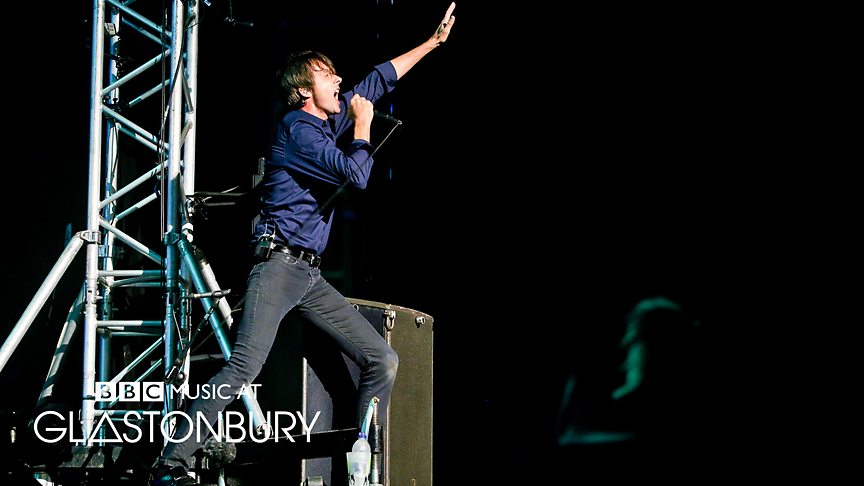
On 28th June 2013 I went to see Jake Bugg perform a set on the Pyramid Stage at Glastonbury Festival. As the hot new acoustic folk kid on the block, there was a lot of anticipation around his performance. He walked out boldly, with just himself and a guitar, and launched into the romantic “Fire”. As the set progressed, it became increasingly obvious that he wasn’t going to interact with the audience. Indeed, his body language just didn’t have any command to it. Whilst he had the tunes, he didn’t have the charisma to fill such a big stage.
Two years on, 2015’s JB found himself in a similar situation. He has been something of a revelation this year – he has been playlisted frequently on both BBC Radio 1 and 2 and his last few singles have all troubled the Top 40 in the UK.
As he performed album track “Collide”, however, I couldn’t help but feel concerned that he might be swallowed up as well. Then the crowd erupted, he shot out a smile and all was well. It was a fantastic moment.
From start to finish he blew away a rammed Pyramid Stage with some breathtaking vocals and subtly restrained guitars. He’s clearly very popular and it’s easy to see why, especially when around 60,000 people are singing every word back to him on “Take Back The River” and “Let It Go”. For someone who was largely unknown a year ago he clearly has what it takes to command the largest of audiences. [1]
Well done sir, you were fantastic.
[1] Ironically Bay’s biggest hit “Hold Back The River”, which hit number 2 earlier this year, was co-written with Bugg’s regular collaborator Iain Archer, along with half of his debut album. Small world, eh?
1. All Right
2. Barbed Wire Blues
3. Unknown
4. Unknown
5. Unknown [1]
The second day at Glastonbury is when the fun starts to get interesting. A few familiar acts start to pop up and by and large nobody has a 50 minute pilgrimage with a 40kg weight strapped to their back to kick-off the day.
Our first act of the day was Wilko Johnson on the William’s Green Stage. It was a short set (about 30 minutes) followed by a long interview (about 30 minutes) followed by an exclusive screening of the new Julien Temple documentary The Ecstasy of Wilko Johnson.
I’m largely unfamiliar with Wilko’s music but the set gave me a flavour of what he’s about. I’ve seen many bad versions of this band in pubs across the country on a Friday night, playing vintage 12-bar-blues to an older audience. We drink ale, they play music. It’s a great night even though the band aren’t always great. Well, imagine how much fun you’d have if the band were actually really top quality. This is what you get from Wilko Johnson.
The first thing you notice when watching Wilko Johnson is that he has thunderously focused eyes. It brings an intensity to the music I can’t quite describe. Whilst doing that, he’s also carrying his Fender Telecaster like it’s a machine gun. It’s wholly intimidating. [2]
Those unfamiliar with his music might be more familiar with his role in Game of Thrones as the executioner Ilyn Payne. He wasn’t in many episodes but when you see his eyes on stage it instantly brings it back. You can see why he was cast.
So there you have it. Instead of reviewing his gig all I’ve done is talk about his eyes, the machine gun guitar technique and Game of Thrones. Oh how the true Wilko fans will be fuming. It was a brilliant gig though, it has to be said. I’m hoping I get to see the band in a full set soon.
Wilko and Julien speak in the pre-screening Q&A
Film + Q&A
Prior to the film was an extended interview with Wilko, Julien Temple and Dorian Lynskey of The Guardian. Wilko stated early on that he isn’t a fan of seeing footage of himself, so seeing a film based entirely on himself would be hard work to watch.
The film is ostensibly about Wilko’s battle with cancer as he was given ten months to live. It covers this period, then goes on to what he describes as “extra time” and then his miraculous recovery following some radical treatment.
He talked in the Q&A about the difference between being told you have cancer and being told you have the all-clear. “You go and see the doctor and he says you have cancer and, like that, the universe changes. You go back after a year and they give you the all-clear and it’s not instant at all. I had an 11-hour operation to remove a 3.5kg tumour from my stomach… and then weeks of recuperation with post-operative-infections. So I had time to feel sorry for myself.” Of course, when he announces he’s all-clear, the crowd erupts in joy and applause.
Speaking on the album he did with The Who’s Roger Daltrey, Wilko was in a reflective mood: “I think of all the things I did that year. I was in a bubble. Doing the record with Roger was just one of the many strange things that happened to me that year. It was the first thing I’d done in “extra time”. I was walking around outside the studio thinking ‘this is going to be the last thing I do, this is freaky, I’m going to die soon'”.
He also spoke humorously about the fact he never got his coffee from a backstage assistant, and reflected that he was looking forward to the end but now has to keep gigging because people keep coming back for more.
This mixture of lighthearted humour with honest reflection is indicative of the tone of the film, which is far more than just a rockumentary on a band’s final tour. It is in fact a hugely emotional journey and a fascinating insight into people battling with terminal illness. It’s well worth watching when it appears later this year.
[1] Can anyone help me with these?
[2] After you’ve finished absorbing the awesomeness of Wilko himself, you may find yourself drawn to the equally bizarre bassist Norman Watt-Roy. He’s unique.
[Note] Massive thanks to Scott Wetherill for the video. Hope you’re okay with me using it! Let me know if not.
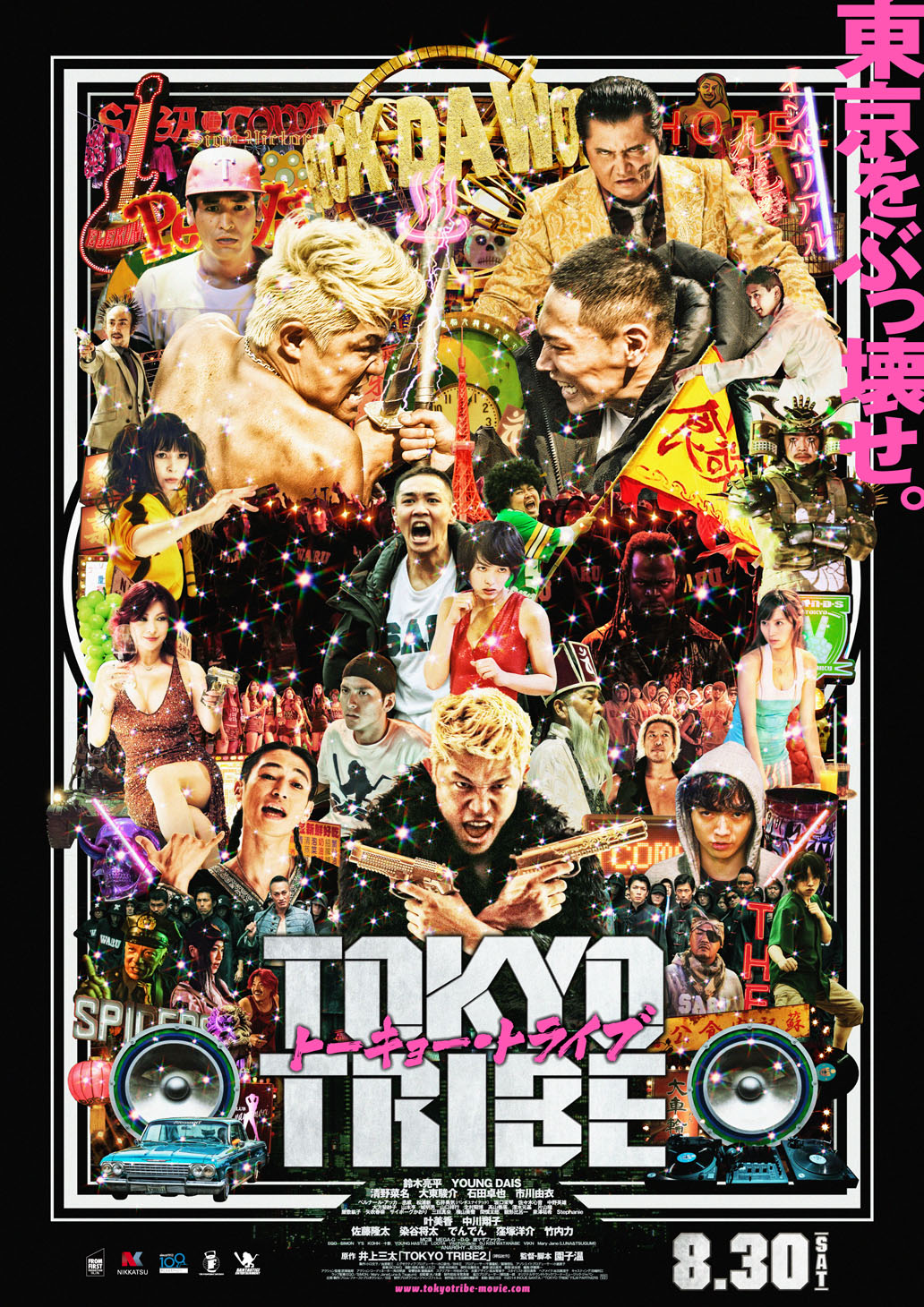
Movies should aspire to be the best in their genre. There’s no point existing as a movie unless you can at least be better than everything that has gone before in your genre. If you can’t do that, then why not mold yourself a new genre completely?
With that in mind, I am proud to announce that Tokyo Tribe is the best Japanese-language rap-musical in the tribal gang realm.
The story is pretty hard to explain. To summarise, we are let into a highly stylised version of modern Tokyo, where tribal gangs vie to rule the city. Set over one night, we see the heightening tensions as ganglord Buppa (Riki Takeuchi), his henchman Mera (Ryuhei Suzuki) and son Nkoi (Yosuke Kubozuka) declare war on all other tribes in Tokyo, announcing as much by killing the popular peace advocate Tera (Ryuta Sato). The uprising against their power trip is led by central heroine Sunmi (Nana Seino), and multiple stylised battles culminate in a dawn all-out-war.
Sunmi beat the living daylights out of another bunch of extras
Amazingly, the intertwining of multiple storylines and characters is reminiscent of Love Actually, though the comparisons inevitably end there. In fact, at times it’s simply hard to follow just who the central characters are. About 90% of the dialogue is delivered as rapping, so as an English native who barely speaks any Japanese it is hard to follow what are clearly some very fast and rhythmical lyrics. On this occasion, it really pays to speak the language.
Another issue is the excessive number of characters that are continuously being introduced into the mix. It felt at times like several characters were frivolously being added in too late for us to care about who they are, often getting only a handful of lines to describe who they are, what tribe they represent and a little about themselves before disappearing for the rest of the film.
That said, there is a memorable turn from Cyborg Kaori as a beatboxing servant, which is worth watching out for. She does things with her voice that seem completely unnatural. The results are fascinating and her various YouTube videos are worth checking out. This is an example of a distinct character being given the chance to shine; it’s a shame that the cast wasn’t smaller so more focus could be given to each of the talented artists involved.
Many of the featured actors and actresses, however, are new to the hip hop world and the intriguing on-disc Making Of documentary reveals a lot of the insecurities of the stars, particularly with standout performer Nana Seino. She’s clearly a talented actress but it’s sad she was the focus of such a lot of “fan-service” throughout the film.
Stylisitically, the film is top notch. From start to finish there is no break in the feeling that the characters inhabit this entirely alternate reality and in that sense it is a great success.
The same cannot be said for the storyline.
At times it’s a brilliantly unique film that threatens instant cult-classic status. Often it’s just a complete mess that loses itself in style over storyline. If you know of Sono Shion and liked his previous efforts then you know you’ll enjoy this. If not, then approach with caution.
White Sky
The Changingman
From the Floorboards Up
I’m Where I Should Be
Long Time
That’s Entertainment
Above the Clouds
Saturn’s Pattern
Going My Way
Friday Street
Porcelain Gods
Broken Stones
You Do Something to Me
Start!
Peacock Suit
Whirlpool’s End
Town Called Malice
Well, there we have it. Another year of good-hearted, fun-loving live music done and dusted as Glastonbury 2015 comes to a close. All the flaws my body has developed over its first thirty years have come to the surface and I am out of both alcohol and money. It has been emotional.
The highlight set on the Sunday was a crowd-pleasing effort from Paul Weller. With a career spanning 40 years he had plenty to go on and the song selection was spot on.
Fittingly, he opened the set with a storming rendition of “White Sky”, the lead track from the new album Saturn’s Pattern. It’s a great song, though I don’t think I was alone in the crowd wondering whether the set was just going to be full of songs from his recently-released album.
This concern was put to bed with second track “The Changingman”. It immediately got the packed crowd singing along and on-side and truly kicked-off a night of fun with The Who just around the corner.
Indeed, the mid-nineties tracks he played – including “Peacock Suit”, “Broken Stones”, “Friday Street”, “Porcelain Gods” and “You Do Something To Me” – were only the tip of the iceberg. Whilst The Style Council were completely bypassed, he found space for three of The Jam’s biggest hits: “Start!”, “That’s Entertainment” and “Town Called Malice”.
The highlight for me was “Above The Clouds”, a track from his eponymous debut solo album. It has always been a favourite of mine and the rendition here was one of the highlights of a very special festival.
His voice didn’t even have a hint of cracking at any point, which bodes well for a long future of touring yet, something not possible for every artist that has been around for as long as Mr Weller. It was also nice to see Ocean Colour Scene guitarist Steve Cradock on stage with him again.
Main Setlist:
Pantomime Horse
Moving
Trash
Animal Nitrate
We Are the Pigs
Killing of a Flashboy
It Starts and Ends With You
He’s Dead
Pale Snow
I Don’t Know How to Reach You
The Living Dead
The Drowners
So Young
Metal Mickey
Beautiful Ones
Encore:
She’s in Fashion (acoustic)
New Generation
Today was the big day. Kanye West arrived at Glastonbury with his own brand of Yeezus-y goodness, set to wow the crowds and berate anyone who tried to stop him. Probably. I didn’t go to his crappy set because I was too busy being blown away by a breathtaking performance from Suede on the John Peel Stage. Brett Anderson had the audience in the palm of his hand and the whole band were on top tight form from start to finish. I’d waited for 15 years to actually see them live and it was well worth the wait.
I first got into Suede in 2000 when my first proper girlfriend bought me three Suede albums for my birthday. I didn’t know much about them outside the then-recent hit singles “Electricity” and “She’s In Fashion”, but she was a huge fan and I thought I’d go along with it. After all she was slightly older than me and seemed to know a lot more about music (and life) than me. Whilst the relationship sadly didn’t last much longer, those three albums (the Bernard Butler ones, if you’re interested) stuck with me for a long time through to the end of my education and subsequent career.
So it was a thrilling moment when Suede took to the stage and burst into “Pantomime Horse” and then “Moving” from their eponymous debut album. The fact they were crowd-pleasers shows how much of an impact that debut has had over the years, given both were actually album tracks. Brett Anderson looked as fit as he did when they first appeared on the Glastonbury line-up some 22 years ago. The years have withered neither the angst in his eyes nor the emotional electricity of the performances. He owned the stage in a way so few performers manage.
The next song was “Trash”, a timeless slice of outsider pop rock. They absolutely nailed it, the crowd went ballistic and the band used it as a platform to launch into a string of huge hits (and noted b-side “Killing of a Flashboy”), sporadically taken from various points of their career. It was a sight to behold and has fortunately been captured beautifully by the BBC who have turned a intoxicating live performance into a cinematic work-of-art.
Not many songs featured that post-date 1996 album Coming Up. Of those that did, “She’s In Fashion” stood out as particularly poignant. In its altered form as an slow acoustic song in the encore, the focus shifted more to the lyrics and melody in a way that was hidden by the oddly aged production of the original album recording.
“Pale Snow” and “I Don’t Know How To Reach You”, both new songs yet to be released, hinted at a lot of promise for the future material and will have the Suede fans around the world buzzing with interest. The former is a slightly sparse song built around a repeating guitar riff by Richard Oakes, whilst the latter has a slightly fuller sound and a catchy chorus that sits it alongside the great work they put out some twenty years ago.
For all the excitement around hearing their new material, being floored by a stunning rendition of “Beautiful Ones” will doubtless be one of the lasting memories of this festival for me and the many 1000s inside the rammed tent. It was a long wait but well worth it. If only Kanye could have been there to see it.
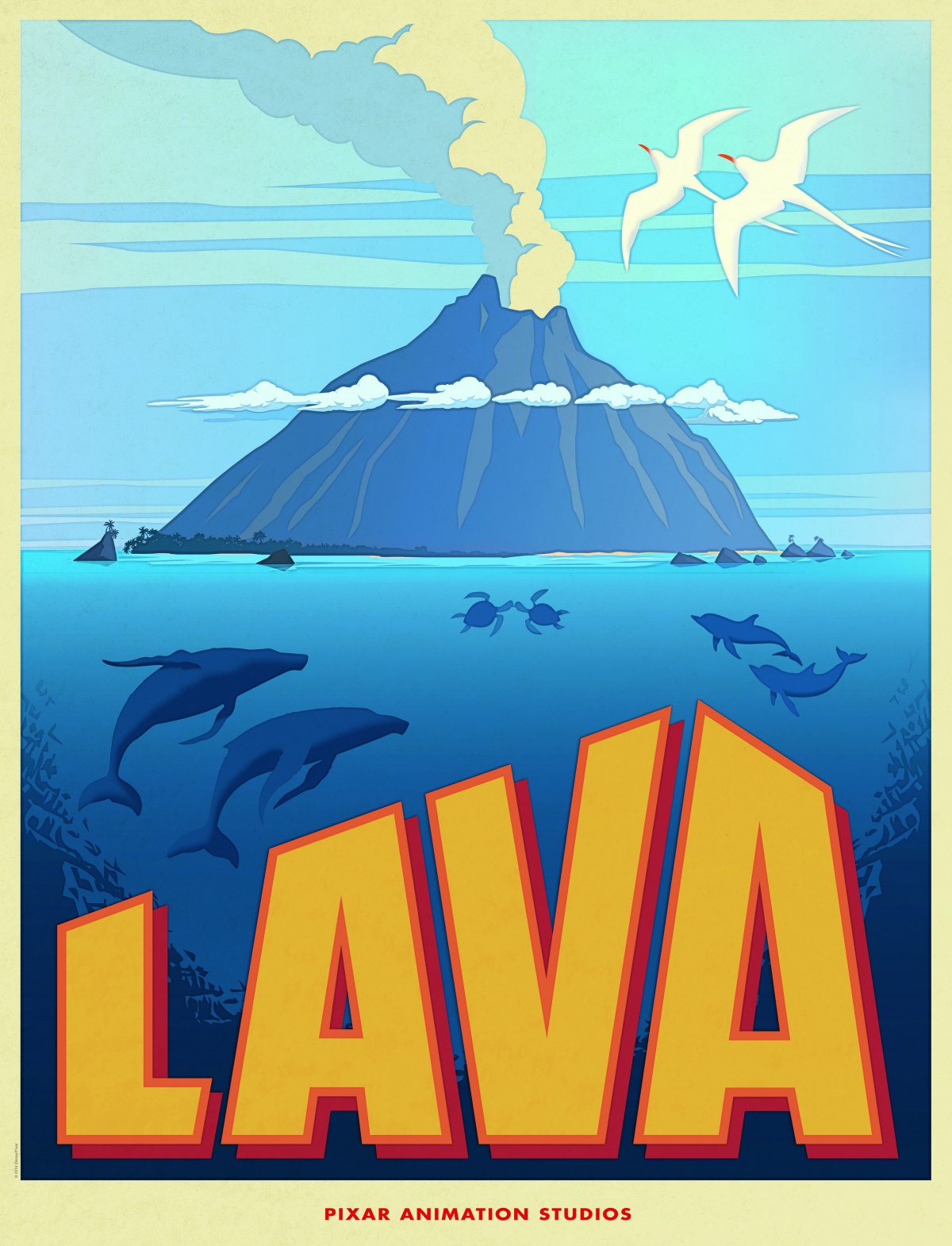
The opening short film you will see before Inside Out later this summer is a sweet film called Lava, probably the first musical love story to take place over millions of years. It involves two volcanoes and is set to a beautiful song sung by Kuana Torres Kahele.
This volcano is in lava.
It was met with audible gasps, sighs and whoops in the screening I saw at this year’s Glastonbury Festival. Please make sure you get there in time to see this volcano’s story!
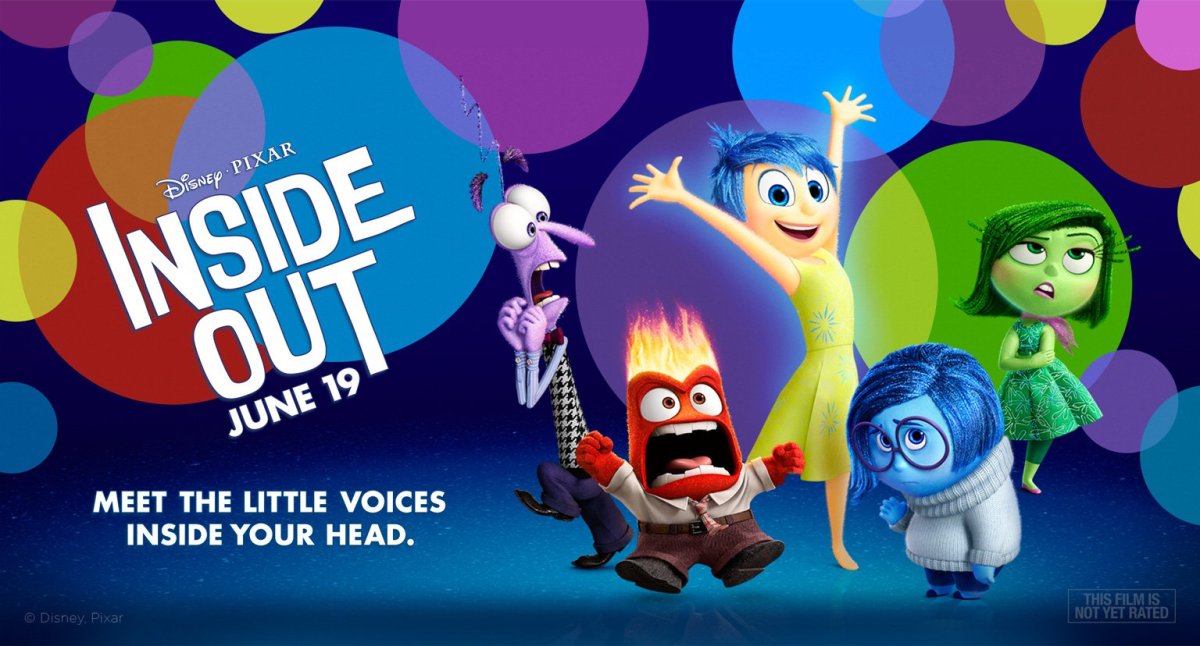
The latest film from Pixar Animation Studios is one I approached with considerable anticipation. There has been a reluctant feeling amongst close followers of Pixar’s output that they are now running low on original ideas as we are seeing a shift towards sequels rather than original storylines. Of the first ten Pixar motion pictures, only Toy Story 2 was a sequel. Of the following four films, only the poorly received (but excellent) Brave was an original concept. Monsters University was an enjoyable film but not a patch on the original; Cars 2 was on a par with the first installment but that just means neither are good. Only the two Toy Story sequels were both a critical and commercial success and the first of these started life as a direct-to-video sequel.
So when the next few films were announced and they included Toy Story 4 and Finding Dory a lot of questions focused on how many original ideas were left in the tank. It’s cruel to be concerned in many ways, but after such a frantic amount of original ideas pumped so much life into the animation industry it was sad to think it might be slowing down.
However, seeing they were releasing two new franchises was a cause for hope. The Good Dinosaur will be seen in cinemas later this year, but first up is the film set to be a summer blockbuster – Inside Out.
L-R: Joy, Fear, Anger, Disgust and Sadness
The story is an unusual but simple one, much like all the best Pixar films. It is set inside the brain of a young girl named Riley Anderson (Kaitlyn Dias) as she is forced to move house with her parents from icy Minnesota to the slightly milder San Francisco, leaving behind her friends, beautiful house and successful ice hockey team. Her five emotions are represented by five distinctly hilarious characters: Joy (Amy Poehler), Anger (Lewis Black), Disgust (Mindy Kaling), Fear (Bill Hader) and Sadness (Phyllis Smith). Each one controls her emotional response based on how they interpret what she is experiencing, and these are converted into memories in the form of tiny glass orbs, rich in one or more type of emotion, which are stored in her mind for her to recall later.
This concept is highly original and is a brilliant platform for some hilarious cutaway scenes where we see what Riley is seeing and the reaction shots of what to do with our five emotional manifestations. The most memorable case of this was a very typical family meal, into which a lot of careful consideration was evidently given to get the perfect balance between heartfelt and humour.
I won’t ruin any specifics of the plot but I would recommend taking a tissue if you are liable to cry. They reach first-eight-minutes-of-Up levels of emotions.
The real-life characters are highly realistic and the world in which they live is very believable. However, the one place the film lets itself down is with the character design of the five emotions. Whilst they are cutely colourful and well animated, the actual design doesn’t seem up to the standard expected from Pixar and I wonder how it got this far down the line without someone saying it needs to be improved. A couple of other characters – Richard Kind’s Bing Bong and a particularly scary clown – inhabit a wholly different world and have more in common stylistically with Aardman Animation. I can’t help think they were designed with merchandising in mind.
This is truly up there with the best Pixar films, no easy achievement given they have been responsible for so many of the best animated films over the last twenty years. It’s the perfect emotional rollercoaster to ride on whilst celebrating reaching the start of their third decade in the motion picture business.
Inside-Out was previewed at Glastonbury Festival on Sunday 28th June and is set for release in late July in the UK. It is preceded by the short film Lava.
Well, there we have it. Another year of good-hearted, fun-loving live music done and dusted as Glastonbury 2015 comes to a close. All the flaws my body has developed over its first thirty years have come to the surface and I am out of both alcohol and money. It has been emotional.
The highlight set for my party on the Sunday was a crowd-pleasing effort from Paul Weller. With a career spanning 40 years he had plenty to go on and the song selection was spot on, allowing him to promote his new material a little whilst reminding everyone just how good he is. My favourite track was “Above The Clouds”, though “Peacock Suit” was a close second. His voice didn’t even have a hint of cracking at any point, which bodes well for a long future of touring yet. It was also nice to see Ocean Colour Scene guitarist Steve Cradock on stage with Mr Weller again. Well done sirs. It was a stunning set.
The Who were the first headline act we saw on the main stage. Hit after hit arrived on the sound-system as a genuine rock giant showed the Glastonbury crowd what a real gig was like. Kanye take note – you can get cocky once you’ve had some quality output. Two hours of rocking inevitably ended with a bit of set destruction, but we wouldn’t have expected anything less.
Apparently they were having sound issues but I didn’t really notice; far worse was Lionel Richie earlier in the day who sounded like the bass drum was being played by someone keeping time to a different tune. Wholly off putting and a genuine set ruined for everyone I could hear complaining vocally in the crowd.
The Shires were an odd but fruitful choice. I was pushing to see them, against the will of at least one of my party. Everyone was pleasantly surprised by the gorgeous country tunes and beautiful vocals they are blessed with. They aren’t a groundbreaking act and I think everyone there knows that, but what they do have are some excellent songs to sing along to and an inspiring attitude that got the whole audience on side immediately. “State Lines” is still in my head now.
Elsewhere Eric Bibb and The Bootleg Beatles were juxtaposed on the Acoustic Stage but were equally brilliant; Patti Smith seemed like she was struggling to engage with the crowd, although the Dalai Lama saved the day with some thought-provoking messages; and the night was rounded off by a secret DJ set from 2manydjs at Arcadia, because we love having our faces burned off by a giant spider [1]. We even managed to take in an under-advertised sneak preview of the new Pixar film Inside Out (more on that at a later date).
The countdown has now begun to the return home and have a proper shower and a comfy. Believe me, it is much-needed.
Thank you Mr Eavis for inviting us all to the best party of the summer. Sorry we wrecked everything. We promise we’ll be tidier next time.
[1] To be honest, we felt so claustrophobic that we went back to our campsite and listened from there. You know, like all the cool kids.
Today was the big day. Kanye West arrived at Glastonbury with his own brand of Yeezus-y goodness, set to wow the crowds and berate anyone who tried to stop him. Probably. I didn’t go to his crappy set because I was too busy being blown away by a breathtaking performance from Suede on the John Peel Stage. Brett Anderson had the audience in the palm of his hand and the whole band were on top tight form from start to finish. I’d waited for 20 years to actually see them live and it was well worth the wait. Being floored by a stunning rendition of “Beautiful Ones” will doubtless be one of the lasting memories of this festival for me and the many 1000s inside the rammed tent.
Earlier in the day, Swim Deep were completely lost on me as the first band of the day; Jane Weaver literally and figuratively blew me away on West Holts [1]; and both Giant Sand and Gaz Coombes proved to be solid choices at The Park Stage mid-afternoon.
Gregory Porter looked set to be a great way to see in the evening but we left a little underwhelmed. I actually blame it on his style being well suited to relaxation, meaning we ended up almost falling asleep. His record has been on constant play in my house at times this year and it translated well into a live show. I suspect it was a case of bad timing on my part, mixed with the fact we were absolutely shattered.
Fortunately Paloma Faith and Pharrell Williams picked the pace up with a couple of hit-packed sets that got the Pyramid crowd ready to start the Saturday party. Im a huge fan of Paloma and she was on top form tonight, playing tracks from all of her albums along with a memorable Jimi Hendrix cover. Her outfits are always talking points and this was no different.
Paloma was very apologetic throughout, implying she made a misinterpreted comment in the media at some point. I’m not privy to this info as I’ve been stuck in a field for almost a week now, but who cares when she sounds this good? Inevitably whatever she said has seen her words twisted to sell newspapers and clicks.
I was shocked how many tracks of Pharrell’s I knew. Obviously he’s been around for a long time now and has produced many hits off different artists, but he’s an excellent artist and we were left wondering why he wasn’t headlining. When you’re partly or fully responsible for three of the biggest-selling singles in the last two years (“Blurred Lines”, “Get Lucky”, “Happy”, all of which broke the million mark on sales) you deserve to top the bill, especially when the act above you has had nothing of note out for a while. He’s one of the best frontmen I’ve ever seen, and it comes entirely from his cocksure confidence. My only criticism for Pharrell was that a couple of songs sounded like they were heavily reliant on a backing track, though perhaps my ears deceived me.
I caught the end of La Roux’s set and she sounded spot on. She’s still underrated in my eyes and is slowly building up a solid catalogue for her live performances, which far outclass the recorded versions. If you like her style then make sure you see her this tour before she disappears on another hiatus.
I’m sure Kanye will be the most talked about act tomorrow outside the festival, just like Florence probably was this morning. Let them. With any luck the chat will have ran out by the time the festival finishes and I re-enter the real world. Anyone who was at the Suede performance will testify just how special that set was, even though it won’t grab headlines.
Oh and I managed to wash my hair. So that was nice.
[1] Sorry Jane. When your set started the bass was ridiculously loud. We loved it but we only lasted about ten seconds near the stage before retreating to a safer distance. We couldn’t take it but still loved it from afar – it wasn’t a reflection on you!
So the bands started in earnest on Friday morning and with a couple of big mysteries still on our plate (figuratively and literally) we embarked on a full day of live music.
The first such mystery act were simply listed as “Special Guests” in the programme. We had a tip off on this and it was 100% spot on, meaning we enjoyed a full one hour set from The Charlatans. I used to be a big fan of Tim Burgess and Co., getting on board in the Melting Pot days and discovering their diverse back catalogue. Their set list for this gig was very much a greatest hits playlist and included the likes of Weirdo, North Country Boy, One To Another and The Only One I Know. It was fantastic to be reminded just how great some of their songs were and I’ll be picking up on some lost years when I get home.
James Bay blew away a rammed Pyramid Stage with some breathtaking vocals and subtly restrained guitars. He has been something of a revelation this year and has been playlisted frequently on both BBC Radio 1 and 2. He’s clearly very popular now and it’s easy to see why, especially when around 60,000 people are singing every word back to him on a couple of the bigger numbers. I saw Jake Bugg in the same slot a few years ago and the stage and occasion dwarved him, but I was glad this didn’t happen again to Bay, who revelled in his successes. For someone who was largely unknown a year ago he clearly has what it takes to command the largest of audiences. Well done sir, you were fantastic.
We stuck around at the Pyramid Stage for a couple of hours, some of which we were stranded under a tree when the showers hit. There really is no cover if you’re desperate here and not near one of the big tents. How I rued the moment I didn’t buy a poncho.
We saw all of both Alabama Shakes and Mary J. Blige, before nipping to the John Peel Stage for Chet Faker, then back to Pyramid for the end of Motörhead. That last act were particularly awful, failing to get any interest from a positive and happy crowd grateful that the sun had returned who wanted something a bit more than loud guitars and shouty vocals. [1]
The second surprise act of the day could have been anyone’s guess until the last minute. There were several strong rumours, my favourites being: Foo Fighters doing an acoustic set, Stereophonics, One Direction and Noel Gallagher. As it turned out, none of these were correct and as the logo for The Libertines appeared the crowd clearly had mixed feelings – it was great they would be witnessing a slice of festival history but it was a shame they hadn’t yet got around to actually listening to either of their albums. You see, for all the hype generated by a couple of magazines, not many people really genuinely like Pete Doherty’s output. He has his fans, sure, but they’re in their own bubble and have never broken out into mass success. Even when they played their biggest hits – Can’t Stand Me Now and Don’t Look Back Into The Sun – a lot of the crowd failed to sing along to the chorus, either through lack of knowledge or general indifference. I was once told that The Libertines were the band of our generation, but I’ve never been on board that boat. They have simply never been good enough and don’t have the songs to substantiate the claim.
The moment of the day came whilst watching Mark Ronson smash the Other Stage. Having won the audience (and any passers by) over with a constant stream of hits, delivered by many of the original artists, Ronson followed a poignant Amy Winehouse tribute with a rendition of The Song of 2015 Uptown Funk (which I think is its full name now). Firstly he brought out Grandmaster Flash to great fanfare, followed by the powerful Mary J. Blige for lead vocal duties and finally George Clinton of Parliament [2]. The whole arena instantly turned into a massive party and I left the gig wondering whether this would have been a better fit for the main stage. On reflection, probably yes.
Our chosen headliner of the day was on The Park Stage. I’ve been a fan of Super Furry Animals for a long time and have a lot of fond memories of some awesome nights at their gigs. Thankfully this train of thought was shared with all my friends so I didn’t have to go alone. SFA didn’t go with a Welsh-language-laden set and instead went for their biggest hits. Slow Burn opened the set, a perfectly anthemic opener for a crowd clearly reduced by having a rival in the heavily promoted Florence and the Machine set in the Pyramid Stage. The people who were there signalled their intentions with this opener by singing their hearts out. Racing through almost all of their back catalogue – Do or Die, Golden Retriever, Juxtapose With You, Hello Sunshine (“You’re a Mingeeeer!” never fails to amuse) – before finishing on a very loud high with The Man Don’t Give A Fuck, SFA were excellent value for money and their set was by far and away the best of the day.
We ended up watching Erol Alkan at The Beat Café into the small hours of the morning and that drew our third night to a close.
[1] We definitely saw The Vaccines too but I fail to see how that was possible given the stage times. They weren’t very good anyway.
[2] As this was announced a drunken reveller turned round in a panic and said to his friend “It’s George Clooney! Look!”. I wish I could have seen his disappointment but, seriously, what would he have been doing on stage if it was Clooney instead of Clinton?