Destino (Dominique Monféry, 2003)

I recently saw the news that there will be a special exhibition opening at the Walt Disney Family Museum in San Francisco on 10th July. Running into January 2016, the exhibition will cover the bond between Walt Disney and surrealist painter Salvador Dali, two men whose creative outputs couldn’t seem further from one another, despite the fact they were good friends who remained in close contact throughout their lives.

destino3

You could take every frame of animation and hang it on your wall.

Were you to create a Venn diagram of the creative output of the two artists, the small ellipse in the middle would be represented by the bizarrely brilliant Destino. First conceptualised in 1946, the film was eventually released in 2003 to the general public as an unusual opening short for Calendar Girls.

Destino may have been realised and released 57 years after it was started, but it was worth the wait. It’s a beautiful, dream-like short that has been lovingly created by a team of Parisian artists based on the original storyboards by Dali and studio artists John Hench. I’ve watched it so many times. I won’t explain the storyline – it’s less than 7 minutes long so you don’t have much to lose.

The film can be watched online at YouTube here:

As a resolution snob, the very best way to watch this excellent work of art is to purchase Fantasia 2000 on Blu-ray“>. For some reason the fact it is included on this disc is barely mentioned anywhere other than on the boxart, with Amazon choosing to just describe the somewhat lacklustre film instead. I feel this is an injustice as something as important as this should be brought to the attention of anyone who might be looking. It really ought to show up when you search “Disney Destino” or “Dali Destino”. It’s a no-brainer.

It was nominated for an Academy Award for Best Animated Short in 2004, though both this and the extremely memorable Boundin’ from Pixar were beaten by a short called Harvey Krumpet, which you can watch here.

Listen Up Philip (Alex Ross Perry, 2015)

A fast-paced and uncompromising opening scene introduces us to our lead character Philip Lewis Friedman (Jason Schwartzman), a well-regarded writer on the cusp of releasing the follow-up to a popular and critically praised debut novel. On a rampage to rub his success into people from his previous life, he exposes all his character flaws. He’s rude, frank and cynical and it’s hard from this point to feel any sympathy for him, which on an emotional level makes it hard to connect with him as a central character. Indeed, not many of the characters emote any kind of solicitude at any point in the film, bar perhaps Philip’s long-suffering girlfriend Ashley (Elisabeth Moss). This, however, doesn’t necessarily make for a bad piece of cinema. Quite the contrary.

Schwarzman is at home in a role full of self-importance and low in empathy for those around him.

Schwartzman is at home in a role full of self-importance and low in empathy for those around him.

Philip’s story carries on from here, through the prolonged breakdown of his relationship with Ashley, making a connection with similarly cynical writer Ike Zimmerman (Jonathan Pryce) and his lonesome daughter Melanie (Krysten Ritter) and later on a young and jealous academic Yvette (Josephine de la Baume). It doesn’t refrain from taking gambles on the attention span of the audience, taking several sharp turns in the storyline to cover a lot of ground in a short time frame (109 minutes).

It is communicated in a form that serves as a kind of fake biography, with a narration taking a matter-of-fact tone that gives us a knowing reassurance, almost as if the person behind the voice is channeling his words from a future where it is known that Philip Lewis Friedman is one of the world’s most renowned writers. This is reinforced by the closing credits, where we see a montage of book covers released by the characters from the movie. To be honest, it is the only way the film could tie itself together. Each character is introduced to us from a position of imbalance and for the most part they spiral into a world of depression and failure. It wasn’t until a brilliant final scene that I felt like there was a reason to drag us through the emotional dirt; it perfectly balanced a fine moment of acting from Schwartzman with some clever lighting and cinematography, on top of which laid an overarching statement that justified the cause behind the story itself.

Elisabeth Moss gives an emotional charge to Ashley as she grows in confidence

Elisabeth Moss gives an emotional charge to Ashley as she grows in confidence.

Schwartzman is in fine form throughout, in a role not too dissimilar to others we’ve loved to hate him in (Rushmore, Scott Pilgrim vs. The World). Irritating and overly-confident characters are something of his forte, which is funny if not just because he comes across as anything but irritating in interviews he gives. Moss is also given the opportunity to portray a character of real emotional depth who grows in confidence as the story progresses. It’s a shame that her segment of the film seems like something of a departure from the central thread that was otherwise progressing nicely, though overall it was necessary for the final payoff.

I’ve intelligently reviewed this as this film exits cinemas, though it is seeing a home media release on Masters of Cinema Dual Format Blu-Ray & DVD in late July.

Walt Disney: An American Original (Bob Thomas, 1994)

Walt Disney once said “I would rather entertain and hope that people learned something than educate people and hope they were entertained.” Whilst this isn’t strictly true of this book, there’s an awareness from the author of who his audience is and as we journey through the life of one of the greatest Americans of the 20th Century, we certainly see the best side of him.

I’m always keen to find out more about the life of an expert filmmaker and you don’t get much more expert than Walt Disney. Alas, his life wasn’t limited to making films.

In this book we cover his upbringing, early career as a political satire cartoonist, his earliest business ventures (including Laugh-o-Gram Studios), the creation (and loss) of Oswald the Lucky Rabbit, the subsequent creation of Mickey Mouse and the Silly Symphonies, the blooming of Disney Brothers Cartoon Studio as a standalone company, the break into feature-length motion pictures, the struggles throughout World War II, the rebuilding of the company, his various television series, the creation of two theme parks, his family life and his sad passing in the mid 1960s. Evidently his life was far from boring and it makes for a fascinating read.

The book was officially supported by the Disney estate and various companies, and this means the author Bob Thomas was allowed unprecedented access to close colleagues and relatives for interviews, as well as more resources than anyone was previously afforded. Unfortunately the fact it is licensed has its price. At times the discussions seemed a little sugar-coated and I found myself wondering if something was being hidden. Certainly in the formative years things seemed to fall into place in a fairytale-like manner, with Walt having an uncanny ability to come up smelling like roses. During the studio strikes in the 1940s and throughout the war, I couldn’t help but think a lot of information was being glossed over for fear of losing support from the company. The accusations of anti-semitism that have dogged his name for many years could have been explored and disputed, but instead they simply weren’t mentioned. There are other examples of this throughout and I ended up longing to find out the whole story rather than a risk-free one.

What we end up with is an excellent read full of fascinating tales, but which shouldn’t be taken at face value. Be aware of the Disney logos slapped on the cover of the book and the fact it is so readily available in official Disney Stores. It’s worth a read if you’re happy to either put this to one side, read between the lines or blissfully ignore it all together.

Death Mills (Billy Wilder, 1946)

I talked previously about my interest in the upcoming release of the film Concentration Camps: A Factual Survey (on limited release at the moment across the UK, though no sign of a Blu-ray/DVD release as yet). Whilst this BFI restoration has been receiving plenty of attention, it isn’t the only film of its type that exists. One other such film is Death Mills, directed by Billy Wilder. In truth, the film is actually a truncated version of the longer Factual Surveys, with Wilder selecting only 22 minutes of footage to create a short film.

The films in question had a very particular purpose: to capture the first looks inside the concentration camps that had been in operation during World War II; to ensure that the atrocities inside the camps were filmed for the whole world to see and could never be forgotten, despite the Nazi Party’s best attempts to cover them up. Another important purpose was to ensure they were shown to all Germans to show them exactly what was happening at the camps, to avoid any shadow of doubt for denial.

The contents of the film are visually shocking and not for the faint-hearted. It is a wholly distressing watch. The impact of the images, which speak for themselves, is heightened by an effective score and a doom-laden voiceover. It’s one thing to see the camps being portrayed in a fictionalised film, but something else completely to see the reality first-hand. The images, quite simply, are the darkest I have ever seen committed to film.

At the time this was made, Billy Wilder was one of the hottest directorial talents in the world. He had won the Academy Awards for Best Director and Best Original Screenplay for The Lost Weekend in 1945, a year after the release of critically acclaimed Double Indemnity (which was nominated for seven Academy Awards and still regularly appears on greatest films lists). Despite his Western-sounding name, he had in fact been born Samuel Wilder in Austria-Hungary (in a region now part of Poland) and later escaped in the early 1930s to Paris in light of the rise of the Nazi Party. He eventually made his way to Hollywood in 1933, though his family remained in Poland and were murdered during the Holocaust. It is for this reason that Wilder would have felt so passionately about taking part in the project, making his visit to the camp in Auschwitz all-the-more poignant as at the time he believed this to be the place of death for his mother, grandmother and stepfather (though in fact this was later disproved by Wilder biographer Andreas Hutter). Interestingly, the film doesn’t make a particular point of detailing quite how many Jewish people were killed in the Holocaust, perhaps because the exact figures weren’t quite understood at the time.

This is a deliberately distressing film but one of such importance as a historical document that it deserves to be watched. It is important it is made available now so that those who lost their lives so needlessly are never forgotten.

Melody Time (Jack Kinney, Clyde Geronimi, Hamilton Luske and Wilfred Jackson, 1948)

Walt Disney Studios had a glorious start to the production of full-length motion pictures. The first five releases are still considered to be up there with the best animated films ever released: Snow White and the Seven Dwarves (1939), Pinocchio (1940), Fantasia (1940) Dumbo (1941) and Bambi (1942). However, the early 1940s brought a fresh set of problems to the company. First, a union strike led to a mass exodus of staff (around 40% left). Then, when the US and Canada entered World War II, almost all of the animators and production team were either signed up as soldiers or drafted in to produce propaganda cartoons for the war effort. The main production studio was occupied by US military for various reasons. A disinterested public meant that Bambi sold less than expected. 

With a skeleton staff still in place, Disney opted to produce several of what would become known as package films. The first two – Saludos Amigos (1942) and The Three Caballeros (1944) – gave Walt an excuse to leave his normal settings and escape for a few months to South and Central America. Make Mine Music (1946), Fun and Fancy Free (1947), Melody Time (1948) and The Adventures of Ichabod and Mr Toad (1949) followed, though they were approached from a position of compromise. Their sole purpose was to recoup money lost in various venture so, including the production of war propaganda films for cost only. 

Whilst these films have their own merits, they were mainly box-office flops and over the years clearly haven’t been as well regarded as the films released before of after this spell. [1]

The films tended to feature several short films on an associated theme (with the exception of The Adventures of Ichabod and Mr Toad, which was simply two unrelated stories fixed together), often based around some kind of musical accompaniment in the same vain as Fantasia, which was a huge success and is a classic film rich in experimentation and ideas. Melody Time, unfortunately, cannot be classed in the same league.

Melody Time features seven mini-musicals. Of note is the reappearance of The Three Caballeros in the short Blame It On The Samba, which gives us another chance to enjoy some crowd-pleasing characters. Another highlight is Bumble Boogie, which is essentially a cut from Fantasia that never made it near to full production at that point. If you’re a huge fan of both Fantasia and Fantasia 2000 then this is another good place to see similar styles. A personal favourite is Once Upon A Wintertime, which features a classic Disney tale backed by a perfectly chosen piece of music.

This film is a curiosity more than anything. It’s not the best of the package movies but stands alongside the Fables releases as something worth checking out to build up a full picture of the company during the late 1940s and early 1950s.

Melody Time is available on DVD but currently there are no plans to bring it tk Blu-ray.

[1] The five films released after the return to full-length motion pictures were Cinderella (1950), Alice in Wonderland (1951), Peter Pan (1953), Lady and the Tramp (1955) and Sleeping Beauty (1959). Some return to form!

Tabu: A Story of the South Seas (F. W. Murnau, 1931)

The last of four films Murnau made after moving to America – the others being the Oscar winning Sunrise, the excellent City Girl and the now-lost Four Devils – Tabu marked something of a departure for the master director. He travelled to Bora Bora near Tahiti with documentary filmmaker Robert J. Flaherty. Setting out to make a docufiction film as co-director, it quickly became apparent that Murnau wanted complete control and Flaherty was bought out of his share of the film.

Despite the unusual setting, this has all the hallmarks of a classic Murnau romance.

Despite the unusual setting, this has all the hallmarks of a classic Murnau romance.

The result of this is an opening sequence that seems very much like a documentary film, with native islanders (almost every actor in the film was an untrained native, along with most of the production crew) fishing, playing and acting naturally. According to the extensive booklet notes (thanks again Masters of Cinema), this was the only sequence Flaherty directed before he encountered technical issues with his camera and brought in cameraman Floyd Crosby to assist. The upshot of this was that the rest of the film was the responsibility of Murnau.

Subsequently, we then pick up on a more traditional method of storytelling. A girl named Reri (Anna Chevalier) is chosen by aged emissary Hitu of neighbouring island Fanuma to be the replacement maiden to the Gods. She is to be transported to the island to live there free of any kind of relationship; from this point on she is “tabu”. This is terrible news for both Reri and her lover Matahi, who defy this command and escape the island to a French-colonised island nearby.

The story of two lovers remaining together despite adversity is reminiscent of both Sunrise and City Girl, and other than the unfamiliar setting Murnau is on safe territory. It doesn’t feel stale, but it’s certainly the least dynamic of the three available Hollywood films. Both lead characters give assured performances in their roles despite a lack of experience. Matahi never worked on another film following this release. Anne Chevalier worked on two subsequent films (Polish film Czarna Perla and an uncredited role in John Ford’s The Hurricane) but neither are as fondly remembered as Tabu.

F. W. Murnau’s final film was actually released a week after his death. Whilst working on the sound for the film, Murnau was being driven up the coast from Los Angeles by a 14-year-old Fillipino servant and was involved in a car crash, dying a day later in hospital. It’s a shame that this was his last film and a tragedy that his life was cut short so early, robbing the world of countless more exceptional films. He had actually spent most of his final months on the island Bora Bora, having enjoyed his time there so much.

The definitive version of Tabu is available on Masters of Cinema Blu-ray and DVD dual-format release, packed with extras (deleted scenes, a short film directed by Flaherty using leftover footage, a documentary) and with an immaculate transfer. It also restores scenes that were cut before its original release, as well as those taken out in subsequent cuts over the intervening years (the explanation for all of this is in the extensive booklet that’s included in the box)

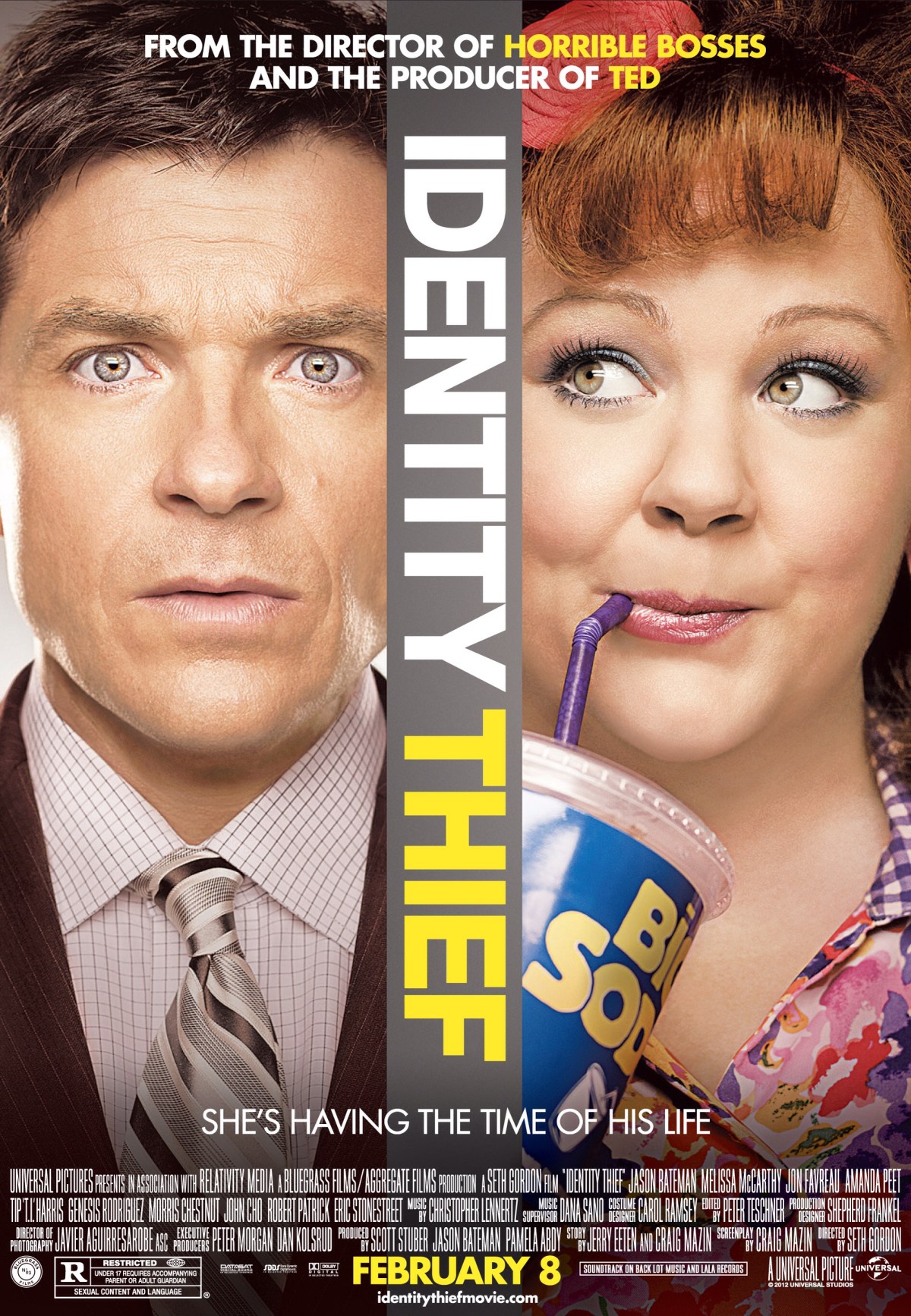
Film review – Identity Thief (Seth Gordon, 2013)

Sandy Patterson (Jason Bateman), an accounts processor from Denver, has his identity stolen by a woman (Melissa McCarthy) from Winter Park, Florida. When his accounts are frozen and the police get involved, his employer (John Cho) threatens to sack him. Realising the police will move too slowly, he chooses to travel to Florida himself to track the thief down, with hilarious consequences.
I imagine that’s how it was sold it anyway. The problem is that despite having an interesting premise and a few laughs at the beginning, it loses its way and sort of stops being funny by about halfway through. Both Bateman and McCarthy end up playing the same characters we’ve seen them play time and time again, in particular Bateman who could be the same character from Gordon’s previous film Horrible Bosses. There’s also some dreadful CGI work on a snake attack to endure.

It must have been a slow month for films in February 2013 as Identity Thief made $150m at the box office despite mainly negative reviews. I guess reviews, word-of-mouth and being entertained don’t count for everything.

Identity Thief is available now on Blu-ray, DVD and Netflix.

F For Fake (Orson Welles, 1973)

Orson Welles film F For Fake (also known as Fake or simply “?”) is a brilliantly bizarre piece of cinema that shows off the art of deception in storytelling. The purpose of the film isn’t to reveal a scandal, despite its superficial attempts to make the viewer think it’s a straightforward documentary. Rather, the ultimate goal is to tie us up in knots, frustrate us and lead us down as many blind alleys as possible in a relatively short running time (85 minutes for this version). In this respect the film is a glowing success and if you keep this in mind the whole thing is absolutely hilarious.


The purported premise of the film involves Welles revealing a huge visual art scandal involving professional forgery at the hands of Elmyr de Hory. A second man, hoax-biographer, reveals all in the role of hoax-biographer Clifford Irving, whilst Oja Kodar also appears in a few critical scenes.

The story it creates is almost believable but for the handful of telltale signs of fakery. The deliberate continuity errors throughout (see “practioners” and Don Amiche); the overuse of the phrases like “of course our story really starts with…”; the ridiculous conversational tone Welles uses when engaging the viewer (or disengaging them by ordering dinner halfway through a scene); swapping out Oja Kodar with her sister for one scene for no reason. There’s a lot going on besides this and I felt it was designed to deliberately deceive. I was on board. I got it. That it succeeds in this is indicative that the film was a huge success, though I’m fairly confident if I wasn’t aware it was itself a hoax I might have found the whole thing a little self-indulgent.

F For Fake is available on Masters of Cinema DVD only, but there are no plans to release it on Blu-Ray so you may as well go for that version.

Film review – Tomorrowland: A World Beyond (Brad Bird, 2015)

The big live-action summer blockbuster for Disney is always hotly anticipated [1]. The previous three summers’ blockbusters were John Carter (2012), The Lone Ranger (2013), Maleficent (2014) [2], and before that there were plenty of Pirates films to chew on. These have all been at worst reasonable sellers but have received middling to good reviews. As long as the basic premise is generally acceptable to cinema-goers and there’s enough advertising involved, they tend to do well. In recent times, it seems Disney’s summer blockbusters have been review-proof.

So how will Tomorrowland fare? It is an action-adventure film with a young female lead (Britt Robertson as the intelligent and headstrong Casey), a child as a prominent supporting character (newcomer Raffey Cassidy as humanoid robot Athena) and a big name alongside them both (guaranteed ticket-seller George Clooney as Frank Walker), so it has a good chance on that front. It is also in good hands with director Brad Bird at the helm. His previous work for Pixar as director includes The Incredibles and Ratatouille, two of my favourite animated films. He’s also responsible for excellent film The Iron Giant, a film which broke him as a director [3].

Visually stunning, but wrapped up in its own spiderweb of overthought plot.

Visually stunning, but wrapped up in its own spiderweb of overthought plot.

However, there has been a distinct lack of the blanket media coverage we’ve come to expect from these kinds of films. It’s almost as if Walt Disney Pictures hasn’t really got faith in it. Inevitably, this disinterest in the film has seeped its way down to the general public, who are simply not checking it out. It is currently on track to lose money, with a global taking of $133.2m against a budget of around $190m. It’s still ploughing on and might break even after Blu-ray sales and merchandise is taken into account.

The premise of the storyline is loosely based on the futuristic area of the Disney Theme Parks, which is also the source of the film’s name (it was originally titled 1952). It’s a time-travelling adventure with absolutely stunning visuals that make the film very easy on the eye. It’s actually very similar visually to The Rocketeer, and I felt as though this is what would have been achieved had that film been released today rather than 1991.

It’s a problematic film, however, and I put this down to the hard-to-follow plot. I don’t think it’s overly complex, I just don’t think it’s explained very well. Alongside Brad Bird as co-scriptwriter is David Lindelof of Lost fame, whose scripts tend to walk a fine line between intrigue and confusion. When he gets it right (the earlier episodes of Lost, Star Trek: Into Darkness), it can be the most gripping sci-fi around. Sometimes, though, he misses the mark and becomes far too confusing to follow. Tomorrowland is certainly in this category.

The problem is that the plot loses the plot, and therefore its own essence. I’ll try to summarise (SPOILER ALERT!). Casey, the daughter of a NASA engineer, finds a magical pin that transports her to a Utopian parallel universe. However, it has a limited lifespan and counts down to expiry, meaning you only get a glimpse of the alternate universe (we later learn it’s an advert). It also means you co-exist in the alternate reality, so if you move around in the alternate reality you might bang your head in the real world. She tries to track down a second pin and finds herself teaming up with Frank, who can access the real universe via a secret rocket inside the Eiffel Tower, and can get them there by a secret teleportation device he invented. When they get there, the Utopia is now derelict, but evil genius David Nix (played by Hugh Laurie) doesn’t want to let anyone else in, even though humanity will end within 60 days.

I won’t ruin the ending but as you can see, it does get quite far-fetched and I do seriously question whether or not the children in the cinema were fully on board with it. Indeed, it took five of us about ten minutes of debating until we settled on what exactly we’d just seen [4]. We still had some questions remaining though. Firstly, I’m assuming the robots that were sent to kill Casey were sent by David Nix. If so, he didn’t seem to know who she was when she arrived. Why weren’t they trying to kill Frank instead? He was the one known entity. Perhaps they assumed she would lead them to him, but I didn’t feel this was explained very well. Following on from this, why weren’t they all killed immediately after they arrived in the Utopia? It seemed there was a “well, they’re here now, let’s give them a shot” sort of vibe going on. I wasn’t buying it. Finally, why had the Utopia got so run down? I feel there was a huge area of the plot to explore here but it wasn’t mentioned. Oh, and why the Eiffel Tower?

In the end, it was just a huge advert for world peace, creativity, Coca-Cola, Chevrolet, and not stifling imagination. And Disney merchandise (yes, you can buy your very own copy of the Tomorrowland pin that is so integral to the plot). It was a missed opportunity. I don’t recommend you avoid it. Perhaps I’m not as intelligent as I once thought and it’s my fault alone that I don’t understand a film aimed at 12-year-olds. It’s visually stunning and is almost worth seeing just for that. Just don’t get your hopes up and don’t try to overthink it.

[1] It doesn’t necessarily mean they’re good.

[2] Despite being classed as a box-office flop, John Carter actually made money on its $263m budget at global box offices alone, pulling in $281m in receipts. Once you factor in sales of merchandise, video games, DVDs, Blu-rays and downloads, it must have made a huge amount. Not bad for a flop…

[3] Surprisingly, he also directed the music video for “Do The Bartman”, right at the start of his career. It’s less of a surprise once you know he was already involved in The Simpsons from earlier on, though this knowledge could help win you a pub quiz one day.

[4] I went to see this one with a couple of good blogger friends, whose blogs can be found at the following addresses: Nesbitt Web and Ahoy Small Fry. They’re both very different blogs but I enjoy them both on a regular basis. Check them out!