スーパーマリオブラザーズ 2 / Super Mario Bros.: The Lost Levels (Nintendo, 1986)

Following the success of Super Mario Bros. on the Family Computer in Japan in 1985, Nintendo decided to capitalise and release a sequel using the same game design and graphics. This one, titled Super Mario Bros. 2, didn’t initially see the light of day in Europe or USA, owing to the fact that it was deemed too difficult for gamers outside of the Asian market.

Instead, the Western markets got their own separate game, which might have had the same name but was actually a sprite update of Japanese game Yume Kōjō: Doki Doki Panic. In 1986, nobody in the West cared because hardly anyone knew what had happened. We got a fantastic game in which you could choose to play as Mario, Luigi, Toad or Princess Toadstool. It introduced many gameplay elements and character traits that stuck with series forever more, as well as a host of enemies. It was simply the next in the series and a welcome one at that.

It wasn’t until the the Japanese game was released as part of Super Mario All-Stars on the Super Nintendo in 1993 that the wider Western public became aware of it. What they found when they began to play it was a game full of pitfalls and frustrating game design with the sole purpose of over-challenging anyone who dared continue to see if it got any easier.

The version most readily available nowadays – and the version play-tested here – is available on both the Wii and Wii U virtual consoles. It doesn’t cost the world (500 points) so may well tempt those unaware of its background.

Playing the game now it’s clear why it wasn’t unleashed on the Western gamers of 1986. It may well have killed the franchise. The difficulty picks up at around the same difficulty or World 7 or 8 of the predecessor, meaning that by World 3 the whole game is entirely infuriating.

All the things that might have helped you in the first in the series are either toned down or flipped to trick you. In addition to the 1-UP and power-up mushrooms, there are now poison mushroom that cause you damage. In addition to the Warp Pipes that you’d expect to help you every time, there are additional pipes that take you backwards to earlier worlds, meaning that unless you do your research (remember how difficult that would have been in 1986?) you could end up going backwards. The number of coins available is greatly reduced as well.

The fun-dampening doesn’t end there. Many of the jumps are near-impossible leaps of faith that often don’t leave much confidence prior to trying them out. Doing so is a trial and error situation that can quickly cause you to game over. Trying to speed through a level? Good luck – the game designers have placed a smattering of hidden mystery boxes that usually cause instant death by knocking you off balance. The platform lengths are unforgiving too, meaning both run ups and landing spaces require pin-point precision or else Mario will fall into another pit.

There are also several levels that require a particular pathway to reach the end goal; running from left to right will just cause an infinite loop and the final goal will never be reached. The only solution is to either hope you get it right by chance or give in and search for a solution on YouTube (always a disappointment).

This is the first Mario game to introduce the concept of hidden worlds post-completion. If you manage to complete the game without using a Warp Pipe then you’ll be rewarded with World 9, which is a fantasy world that utilises a psychadelic colour scheme and some bizarre game mechanics. It’s entirely straightforward and requires no concentration whatsoever despite the fact they remove all your hard-earned lives before the start. In additional to World 9 are Worlds A-D, which were also available to anyone willing to persevere. However, anyone that wishes to see how they play (apparently they’re even trickier than the main game) will need to complete the game eight times in the same save file.

Are you FUCKING kidding me!?

Are you FUCKING kidding me!?

The one saving grace is that on the Virtual Console versions there is the opportunity to save at any point throughout the game. This will no doubt be implemented by most quite a lot towards the end of the game, as an absolute necessity. When tackling a single jump takes ten or more attempts, the thought of trying to do this without a save option will fill anyone with dread.


This is what many hours of misery will reward you with

 
This game will suit die-hard fans and people with sadistic tendencies. It is a form of self-punishment and is seldom enjoyable. Completing the game won’t fill you with joy, but it might give you more confidence to tackle the hardest levels on Mario Maker when it arrives later this year.

Super Mario Bros.: The Lost Levels is available now on the Wii U virtual console.
Yoshi’s Woolly World / Yosshī Ūru Wārudo ヨッシーウールワールド (Nintendo, 2015)

The latest entry into the Yoshi game series, Yoshi’s Woolly World, has been released in Europe and Japan as a Wii U exclusive. Due to a delay in the release of the Wii U Legend of Zelda game it is also getting a little more focus as one of two big games released by Nintendo this summer, the other being the unexpectedly popular Splatoon, released in May of this year.

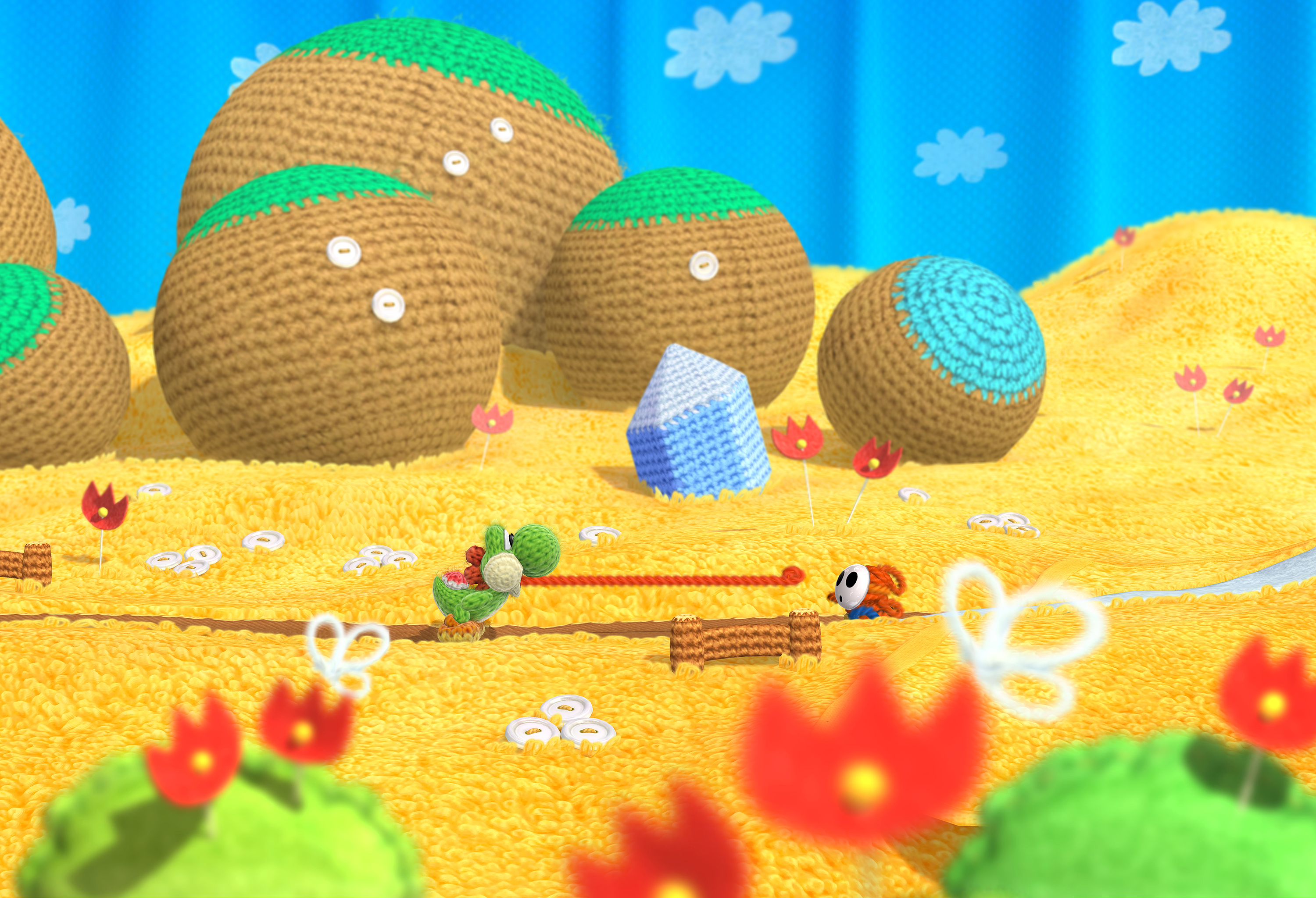
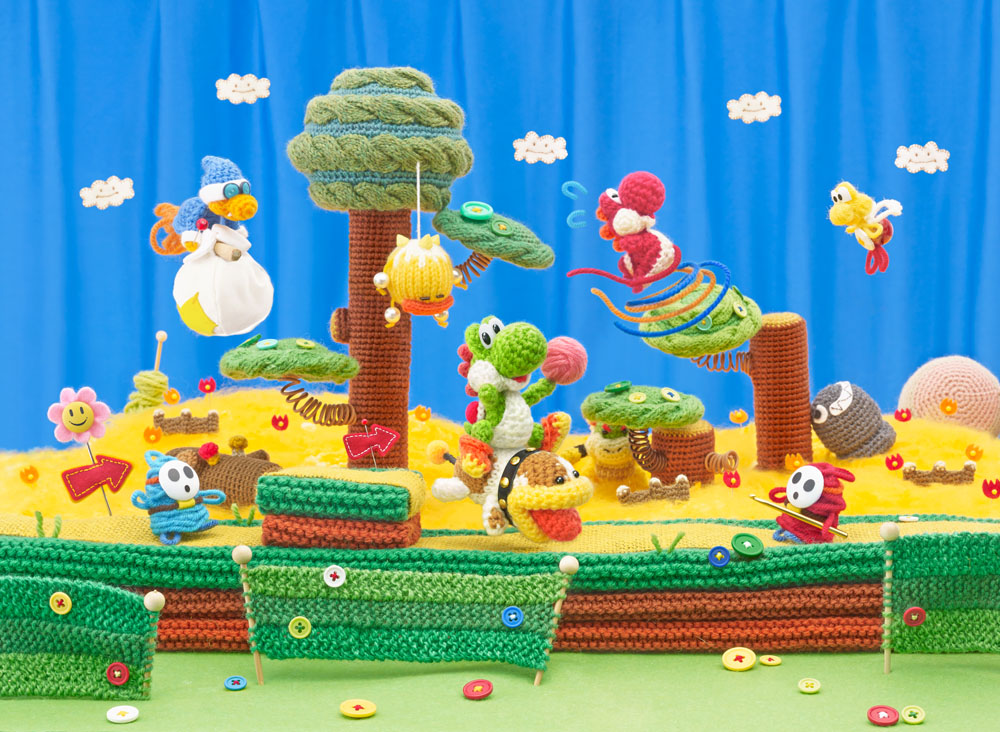
The game is set in a thoroughly gorgeous knitted world made entirely of wool. The aim of the game is to take control of Yoshi and rescue your friends following an attack by the evil wizard Kamek, who has turned the rest of the Yoshi species into balls of yarn.

If you're looking for a challenge, you're in the wrong place.

If you’re looking for a challenge, you’re in the wrong place.

Gameplay

If you’re picking this up as a fan of any of the Wii U Mario games and hoping for a new challenge, you may well be bitterly disappointed. The core gameplay is very slow in pace. The lack of time-limit gives players the opportunity to appreciate the environment around them, which sets it apart from, say, New Luigi Bros U, which gives a 100 second time-limit to each level and ensures you have no time to look around at any point. There is no way to significantly speed up a playthrough, at least not until all the collectables have been discovered.

Another factor that means players have an easy ride is the fact there is no way to die. If Yoshi meets his demise, he simply respawns at a convenient position earlier in the level. This respawning has been commonplace in the increasingly forgiving world of video games – especially those considered to be for hardcore gamers – for the last few years but has been conspicuous in its absence in the Mario franchise. It’s a disappointment to see it here and with no lives to manage it is lacking in any concern for success at all.

Remarkably, there is also an additional Mellow Mode, which allows players to fly through the stages. Literally. Yoshi grows wings and takes flight to find all the collectables and avoid all of the obstacles in half the time. Fantastic.

The only thing keeping this from being a very easy interpretation of a Mario-esque 2D platformer is the inclusion of four different collectables. To fully complete each stage you must collect five balls of yarn, five flower heads, finish the stage with full health (you start each stage with half-health) and collect twenty stamp tokens. It’s quite a lazy way to make a game challenging but it does ensure that there’s a degree of replayability.

With its handmade feel it looks very similar to the Wii game Kirby’s Epic Yarn / 毛糸のカービィ, probably because it is from the same development house, Good-Feel. Indeed, they also share a producer in Etsunobu Ebisu and the same composer in Tomoya Tomita. That game itself was inspired at least in part by Yoshi’s Story on the Nintendo 64, so it’s nice the design has come full circle. If there is one redeeming factor it is the wonderfully realised world it inhabits.

Amiibo Support

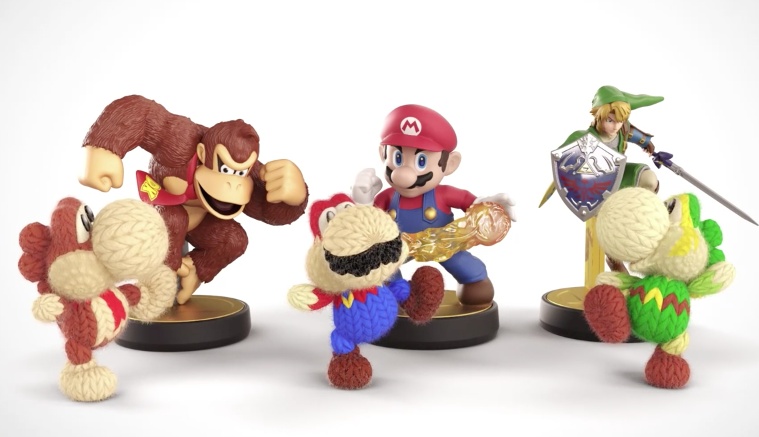
The amiibo support is minimal at best. All that can be accessed is a reskinning of the controlled character with unusual character colours. It’s a nice touch but doesn’t really add much after the initial chuckle (which lasts around two seconds).

The amiibo support is minimal at best.

The amiibo support is minimal at best.

The amiibo functionality isn’t clearly explained in-game. It is activated by tapping an amiibo on the gamepad (the one with the screen) during the playing of a stage. In single player, this causes an additional second Yoshi to appear to assist Player 1. In Co-op mode, Player 1 Yoshi will simply be reskinned. The amiibo can also be activated in the amiibo hut on the main map.

Summary

It’s difficult to determine how popular this game will be. It definitely has a market out there. It is perfect for younger players and will undoubtedly be enjoyed by parents wanting some entertainment for them to enjoy with their children. For those players who enjoyed the likes of Champions Road in the excellent Super Mario 3D World, there’s not much to be found here.

Yoshi’s Woolly World is available to purchase in Japan and Europe now. It will be released in USA in October 2015.

The Nerd Uprising

Back in the 80s and 90s, The Nerd was easy to spot. He (for it was almost always a he) was invariably skin and bones, very much into maths and computers, could probably code at least a rudimentary game on his BBC, had glasses and possibly long hair. He was single. He had acne. He was Screech from Saved by the Bell.


This was a great time to be a screenwriter of anything that needed to stereotype a nerd into the story. The stereotype was probably quite realistic, and there were so few nerds around it didn’t really matter if you upset them.


In the intervening years, however, having a home computer has gone from nothing to being the norm. It would be unusual to find someone under the age of 70 without access to some kind of computer at home. Computer literacy isn’t just a niche skill but a requirement of life.


At the same time there has been a prominent increase in the popularity of comic book characters, mainly through the string of highly successful superhero films. This led to a greater increase in comics and graphic novels themselves as people sought out the source material of their screen idols.

Finally, the popularity of video games has grown exponentially, with a different game and platform to suit everyone’s needs, from the experienced MMORPG gamer to those that want to play Kwazy Kupcakes whilst sat on the toilet. Whether we like it or not, almost everyone is a gamer of some kind. Indeed, the biggest market for video games is adult women, thanks in part to the likes of Farmville and Candy Crush Saga. [1]

The point is that everything we associated with nerds from 30 years ago is now a given of everyday life for the majority of people. More and more on nights out, especially with people I don’t really know very well, I’m confident that if conversation dries up I can strike up a conversation about the latest Marvel Studios film, or a big new video game, or some kind of off-mainstream television series. This is becoming my fall-back conversation far more than, say, ten years ago, when I would invariably go to football or another kind of mainstream sport. Just yesterday I was with some work colleagues, most of which I didn’t know, and we chatted for over an hour about the new Daredevil series (which I’m yet to see), Avengers: Age of Ultron, the future of the Marvel Cinematic Universe and the new Mario Kart DLC. Sport wasn’t mentioned once and I don’t think it would have been welcome if it had been.

So, there’s plenty of growth in the nerd-themed markets to come over the next few years and I’m sure the various industries are planning ahead to make money out of them. Maybe Revenge of the Nerds will be remade in a few years as Revenge of the Jocks. Who knows?

[1] Women over 18 made up a 36% share of all video gamers compared to men over 18, who make up 35%. The above comment is only half-true too. Whilst Farmville and Candy Crush Saga have surely helped the over 50s category, I don’t see it being a large contributing factor to the 18-30s at all. I just don’t know many people in that age range playing these kinds of games – male or female – but I do know plenty of young and experienced female gamers who wouldn’t think anything of picking up the latest 1stperson shooter, a genre traditionally associated with male gamers. One of the big wins for this is the de-fragmentation of the market. Making a game specifically designed for men or women is soon going to be a thing of the past because the lines have become so blurred and you simply can’t stereotype gaming preferences by gender any more.

Mario Party 10 / マリオパーティ10 (Nintendo, 2015)

marioparty10banner

No new Nintendo console system would complete without the release of updates of several mainstays of their library. We’ve had excellent and perhaps definitive versions of Mario Kart and Smash Bros., and a fantastic 3D platformer in the form of Super Mario 3D World. So, what’s next? Mario Party, that’s what. The Mario Party games have been a regular since it debuted on the N64 console in 1998. It was no surprise when Mario Party 10 was announced for the Wii U.

It’s a series that seems to fill everyone with indifference. The releases always get middling sales, probably due to the average reviews each receives. Indeed, the MetaCritic score received by each title had been getting progressively worse since its debut, though Mario Party 9 reclaimed some ground with some innovative gameplay and presentation techniques. The graph below ignores handheld games Advance, DS and Island Tour, but you can see it resembles something of a ski slope.

MetaCritic results for Mario Party franchise (console only)

MetaCritic results for Mario Party franchise (console only)

The following graph shows the sales for the same console games as a percentage of the total console sales. The results are again quite interesting – with the exception of Mario Party 7 the sales of the games on each console peak with the debut release then decrease in popularity with each release (source: Video Games Sales Wiki).

Mario Party sales as a percentage of total console sales

Mario Party sales as a percentage of total console sales

So as we can see, there’s a market for the games, but it’s not particularly massive in comparison to the big hitters like Mario Kart. So what reason has Nintendo given us to invest our hard-earned money in the latest release, given almost everyone who has a Wii U has one of the earlier releases, or did at one point? Well, as it turns out, quite a lot.

One of the big angles is the use of asymmetrical gaming (remember that?) through Bowser Mode, which actually provides a lot of fun, especially if you’re using the gamepad. The fun comes from the fact that you have a real person screwing you over instead of the computer, and it makes it even better when you can hear them laughing away at your misfortune. To play out in this mode you have one person using the gamepad, whilst up to four others control play via remotes and work as a team to try to escape Bowser. Each regular player rolls a die on their go and gets to move a cart forwards and individually reaps the benefit from whatever space they land on. Then Bowser rolls four dice in one and more often than not catches them up, leading to a mini-game.

The mini-games are a lot of fun, and usually leads to a lot of swearing from four people in the room and a lot of laughing from the other one. One drawback to this is the waiting time between mini-games. I think Nintendo got too involved with the animation and activities between the mini-games and didn’t take step back and realise that all it is doing is delaying the time before we get to play more mini-games. You know, the fun bit. 

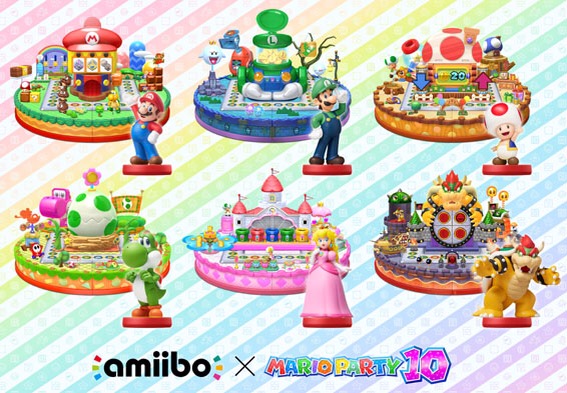
Six Mario Party 10 Amiibo have been released as a tie-in.

Six Mario Party 10 Amiibo have been released as a tie-in.


Another angle Nintendo are employing is the use of Amiibo. This isn’t a unique selling point as much as a way to get people that have already invested heavily in the Amiibos to buy the game. There are six launch Amiibii – Mario, Luigi, Yoshi, Bowser, Peach and Toad, in his Amiibo debut – that interact with the game, though I understand that the Smash Bros. versions of the Amiibo also function in the same way. As I’ve previously discussed, Amiibo are incredibly, almost unfathomably, popular and linking in this game they will be able to increase games sales. Additionally, the Toad Amiibo will function with Captain Toad: Treasure Tracker (which I have previously reviewed) and Yoshi will function with Yoshi’s Woolly World.

The downside of this is that using the Amiibo with the game is a complete pain. The Amiibo Mode involves using your model to unlock a specific character-related board game. Then you and up to three other players battle out around the board to play mini-games to earn coins to buy stars. The winner is the one with the most stars. When playing in this mode, everyone else in the room was able to roll the dice with a quick flick of the remote, whilst I was sat in the corner switching between the gamepad (which had to be plugged in due to the unimpressive battery life), the remote and the Toad Amiibo I was using. The action to get it to register also wasn’t too great and I was the one slowing the game down drastically by using the Amiibo. A quick update would remove the need to use the Amiibo to roll the dice and would severely speed up this process.

The other modes are pretty cool. The standard Mario Party was what you’d expect and a lot of fun, and the Coin Challenge mode simplifies the gameplay a little too by removing the chance aspect and rewarding the one with the most coins at the end of seven mini-games. The mini-games themselves really weren’t repetitive (the box claims there are more than 70 new ones). I think it took about three hours before we encountered a game we’d already played.

Watch out for Bowser - he's a total asshole

Watch out for Bowser – he’s a total asshole


Another big downside is the inability to make a custom playlist where you can select a series of mini-games from the total list with no breaks in gameplay between, which would mean you could select just the ones you enjoy based on difficulty and personal preference. Instead we are in the hands of the console and often have to play through games that are too easy before getting a real challenge.

I have enjoyed my time with Mario Party 10 so far and I’m sure it will be used many times in a party situation soon. However, I think some critically slow loading times and too much between-mini-game faffing will cause the game to be a bit of a drain on the excitement at a party rather than a catalyst for more enjoyment. Couple that with a lack of online multiplayer and you have a game that has potential but falls short. Though I’m sure that will be sorted out when Mario Party 11 is release in 18 months.

Mario Party 10 is available now, along with all six Amiibo (which as usual are rapidly increasing in price due to lack of availability).

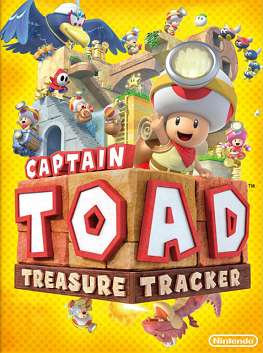
Captain Toad: Treasure Tracker / Susume! Kinopio-taichō 進め! キノピオ隊長 (Nintendo, 2014)

Release date: 21st December 2014
Publisher: Nintendo
Platform: Nintendo Wii U
Players: 1

I’m not much of a gamer any more. I probably play about two or three games a year. Last year it was Mario Kart 8, Bayonetta 2 and South Park: The Stick of Truth. I also bought Earthbound and never got ’round to playing it. This year is looking about as quiet on the gaming front – I’m interested in a couple of the new Wii U releases and I’ve still got The Walking Dead games to play, but nothing set in stone. I moved in with my fiancé in May last year, we got married in June and then both moved jobs within two months. Between DIY and redecorating, and working to pay for everything in the house, we don’t have the time or money to invest in games. When we do, we try to get co-operative titles we can enjoy together. 

So when Captain Toad: Treasure Tracker was announced, we immediately decided it wasn’t for us. Captain Toad’s levels were our least favourite part of Super Mario 3D World game, and these were clearly just more of the same, set in the same universe and using the same visuals and engine to power it. It was only when I realised I had a significant amount of points on a supermarket card that I decided to take the plunge, and I have to say that we were pleasantly surprised.

Each of the 70 levels takes the 3D jumpless platforming and puts a unique twist on the action, be it moving blocks with a press on the controller screen, getting through a pitch-black haunted house or traversing platforms that disappear on a timer. Completing each level requires a decent amount of brain power that is achievable by all but not so easy to make it feel condescending.

Special mention has to go to composer Mahito Yokota, whose score is just brilliant. He’s a regular fixture now with Nintendo, and it’s easy to hear why. You could easily listen to it in isolation from the game and thoroughly enjoy it. To be fair, almost all of the songs are recycled from its parent game Super Mario 3D World, but if you’ve heard that then you know how special it is.

There is one huge disappointment though, and that is the total playing time. You get several different tasks in each level: collecting the star concludes the level, collecting three diamonds helps unlock further levels, completing a unique one-off challenge (such as taker no damage, find a hidden gold mushroom, kill all enemies or collect a certain amount of coins) gives you 100% completion. Even so, some of the levels are extremely short and are done in a matter of minutes. I felt like I had to put the controller down after five completed levels just to drag it out a little. 

Does it work as a co-op game? Well, obviously only one person is controlling at any given time. However, a little like Braid and Limbo, the puzzle elements led to a lot of excited shouting and guided discussions as we worked out the solutions together. Perfect for a couple of engineers.

The reduced price point will help with sales (without the points I used it would have been £28, but it can be found for £25), so the length of the game isn’t such a terrible thing. If you enjoyed the Captain Toad sections of Super Mario 3D World, or you’re in desperate need for a Mario fix ahead of Mario Party 10 next month (or Yoshi’s Woolly World or The Legend of Zelda later in the year) then you’ve got a perfect stop-gap solution in this game.

Captain Toad: Treasure Tracker is out now on the Nintendo Wii U.

Will you be my Amiibro?

Something weird is happening in the world of video games. That thing is called Amiibo.

If you’ve missed these, they can be summarised quite quickly thus: Skylanders for Nintendo. But what do they really mean? Well, frankly, a huge hole in people’s wallets. Amiibos are simply small physical 2″ tall models of in-game characters that can either sit on your shelf looking cool or interact with certain titles on the console and save the development progress of your character, opening up RPG elements to games and also special features and DLC in other games.

Eighteen months ago, Nintendo was in serious trouble. Whilst their handheld console the DS (and the 3DS and 2DS and the XL versions and everything else) was still going strong, their latest home console – the Wii U – was sinking fast. On the shelves for a year, the console was still lacking a really strong title they could legitimately use as a selling point. Probably their best game was either New Super Mario Bros U, which is an 8/10 at best and only on a par with its predecessor on the Wii, or Nintendoland, a 12-mini-game compilation whose main purpose was to show off the functionality of the console’s new controller.

So they came up with a mini-masterplan:

– December 2013: release Super Mario 3D World, the best all-round multiplayer platformer ever released.
– May 2014: release Mario Kart 8, the best ever iteration of their über-successful racing franchise, along with an extremely tempting free game offer where people got a code for registering their game online, which could be used to download any of ten titles already released on the console.
– October 2014: release Super Smash Bros simultaneously on the Wii U and 3DS platforms, along with the first wave of Amiibos, just in time for Christmas and designed to milk dry the pennies of anyone willing to start collecting them.

It was a fantastic plan and this triple-whammy of excellent must-have games has pulled the Wii U back on track and places it as the only current-gen console with several games worth investing the time and money in. There’s only one thing that sells video games consoles and that’s video games, no matter how much the “entertainment system” side of things is sold to us.

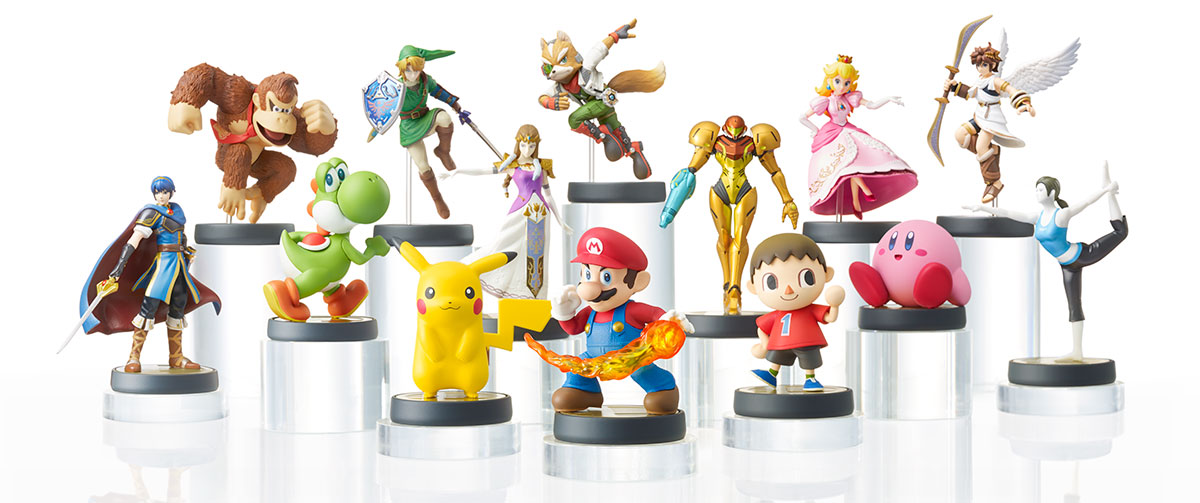
Not content with three games flying off the shelves and a first set of twelve characters (including Mario, Pikachu, Donkey Kong, Link, Fox McCloud, Kirby and other huge franchise favourites) Nintendo decided to release more and more waves of Amiibos, seeing the desire of the completionist in both the children with rich parents and the 20- and 30-something gamer with more money than sense. What happened next was probably way beyond their expectations.

What we are seeing now is that whilst the first wave was in plentiful supply, the subsequent waves have been less available. A mixture of poor predictions of popularity from Nintendo, a frenzy of excitement about new waves and, strangely, an issue with a port strike in North America has led to a serious under-supply of many of the more recent models. Bearing in mind the RRP for the models is £10.99, a quick look at Amazon has returned the following:

– Rosalina £49.99
– Captain Falcon £29.95
– Shulk £84.99
– Meta Knight £57.97
– King Dedede £57.97
– Little Mac £44.99

The fun doesn’t stop there. Plenty more are simply out of stock and unavailable, including those up for pre-order in Wave 4 at the end of March. Ridiculously, one man has bought $10000-worth of Amiibos out of spite because he doesn’t like certain characters. People are going on wild-goose hunts when a rumour surfaces online that a particular Toys “R” Us has got a stock of Toon Link (I made this one up but it probably happened). It has all got quite out of hand.

The terrible thing is that having read stories online about them, I don’t think it’s kids that are after them. The people buying Amiibos are fully-grown adults, usually men, trying to complete a set. Think about it… even if you’ve managed to get them all at face value, you’re still going to need to spend over £400 before you’ve thought about a game. I’ve got friends who bought Super Smash Bros. and picked up a couple of Amiibos to try them and have decided it isn’t for them… because they don’t really do much. They’re just nice to haves. I thought we were in a recession!?

The worst story I heard was about a man going in to buy all of a particular store’s stock on release, then walking out past a child and refusing to part with any of them, even as the child begged him for just one of the toys. So not only are you buying up toys (they’re not models really, they’re toys), you’re also now breaking the hearts of children. Way to go.

I don’t own Super Smash Bros., so I don’t see much point in investing in any. If I had one of the games that they are useful for, I might consider buying one or two, but only if they’re cheap. By the sounds of things, Nintendo won’t miss my business!

Game of the Year 2014

Mario Kart 8 (Nintendo, 2014)

A fairly easy decision for my favourite game of the year this year, Mario Kart 8 is responsible for completely rejuvenating public interest in the Nintendo Wii U. Before it was released, the writing was on the wall – purchases had slowed, there were no good games on the horizon and all the good games had been played to death and had limited replayability value (apart from maybe Super Mario 3D World).

When Mario Kart 8 was released, it came with an offer of a free downloaded game from the Nintendo store, allowing everyone to access one of 10 games on top of the physical release of Mario Kart 8. This included New Super Mario Bros, The Legend of Zelda: Wind Waker HD, Nintendoland, Pikmin 3 and The Wonderful 101, all of which are amongst the best on the platform. For £40 it was a no-brainer. I know quite a few people who took Nintendo up on this offer, and are now some of the most avid Wii U players I know. For those already on board, it was a nice thank for for sticking with them whilst they got the first must-have game ready.

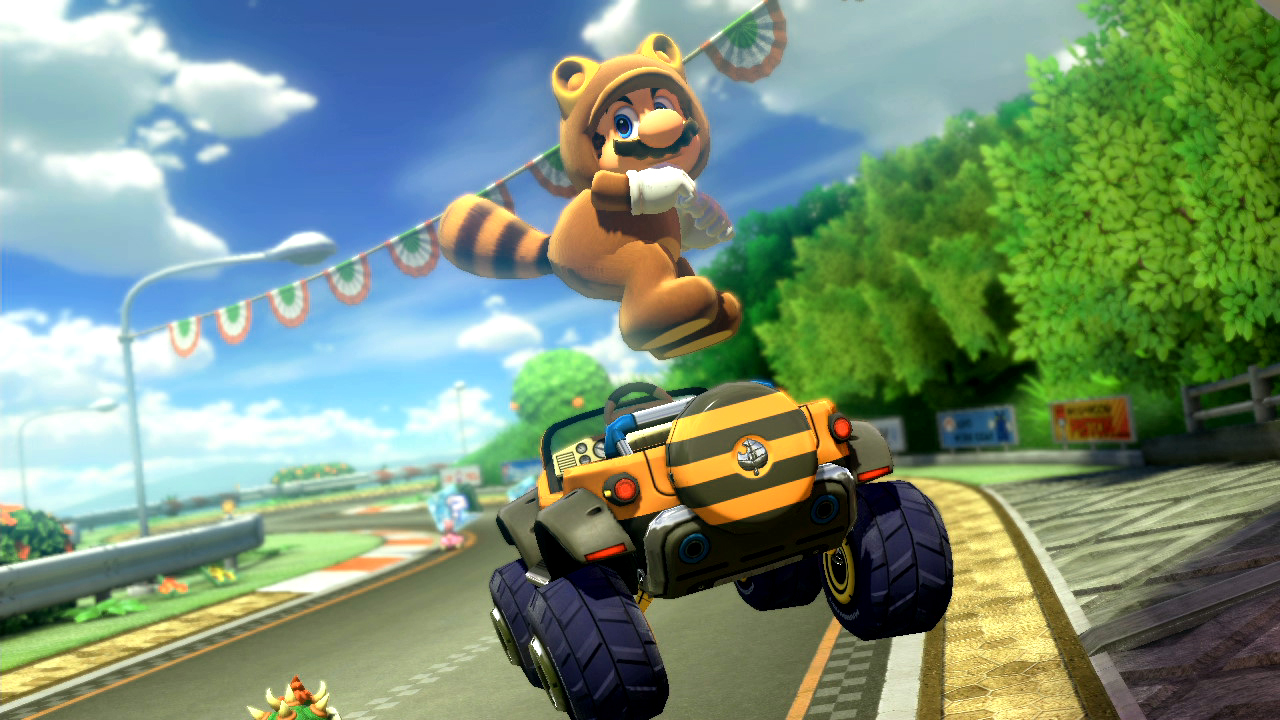
Tanooki Mario

Quite simply, the game itself is excellent. Nintendo have taken everything that was great about the series so far (fast paced action, brilliant courses, screwing over your friends), got rid of all the things we don’t like (two drivers in a kart, difficult controls on the Wii), added in one critically much-wanted new feature (online support) and pulled it together perfectly to make one of the best games of the last five years.

/home/wpcom/public_html/wp-content/blogs.dir/002/60589995/files/2014/12/img_9986.jpg

Coming out just as we approached summer, it was the perfect game to play when you had loads of friends over and wanted a way to take the fun into the evening. People were digging out their old Wii remotes and hooking them up. What people were seeing was sublimely animated and mind-bending course designs, excellent control responses, some highly detailed replays and fast paced action focused on fun.

Moreover, there has been an additional DLC pack with three extra playable characters (Link, Tanooki Mario and Cat Peach) and eight additional courses (including the as-annoying-as-you-remember SNES Rainbow Road). This has further extended the replayability and given everyone a few more options to prevent getting bored. There will be a similar DLC pack in May, centred on the perhaps less popular Animal Crossing game, but I’ve already pre-ordered it so I’ll be enjoying it either way!

/home/wpcom/public_html/wp-content/blogs.dir/002/60589995/files/2014/12/img_9987.jpg

It’s a pick-up-and-play classic and it so far hasn’t grown old, and with online support the popularity promises to carry on for years to come.

Runner up: Bayonetta 2 (Sega, 2014)

This game really annoyed me. Set for release in the “launch window”, the delays kept coming and we’ve eventually received it two years after originally planned. Having expected to be playing this and Rayman Origins (which was also delayed for over a year) on my new launch day Wii U, I was a little underwhelmed with how much use I was getting from my console for the first year or so.

Two years have gone by since the expected release. Was it worth the wait? Well, just about. The package was great and we got the first game included (though most of us already had it), and it wasn’t as expensive as I expected.

Bayonetta looking better than ever

Crucially, the game – which I’m yet to finish – plays like a dream. It’s much easier than the first, probably to help new people into what was quite a tricky series, especially for the average Wii U gamer (which I think we’re supposed to assume is a casual gamer who, in this case, has bought Bayonetta 2 by mistake instead of Nintendogs). Much like the first, the graphics are stunning. They’ve really gone to town on the intricate designs, especially with the main protagonists and end-of-level bosses. My 360 Bayonetta looks decidedly plain in comparison.

As expected, it’s a game on an epic scale and it genuinely is a lot of fun to get stuck into. Couple this with Mario Kart 8 (and Super Smash Bros.) and you have three fantastic reasons to go for the Wii U over Xbox One or the PS4, which are still struggling to find their feet.

Mario Kart 8, Bayonetta 2, Super Smash Bros. and the Wii U console are all available to buy now. For those wanting to add me as a friend on Wii U, my user profile is Hutchie.