Film review: Frankenstein (Guillermo Del Toro, 2025)

Frankenstein is a gothic novel, first published over 200 years ago. It remains Mary Shelley’s best known and most celebrated work, with an estimated 400 feature films having been made with the character as a central or supporting role. Filmmakers such as Danny Boyle, Kenneth Branagh and Mel Brooks have put their own spin on the character, and there seems to be an insatiable appetite for movie makers and cinema goers to revisit the monster.

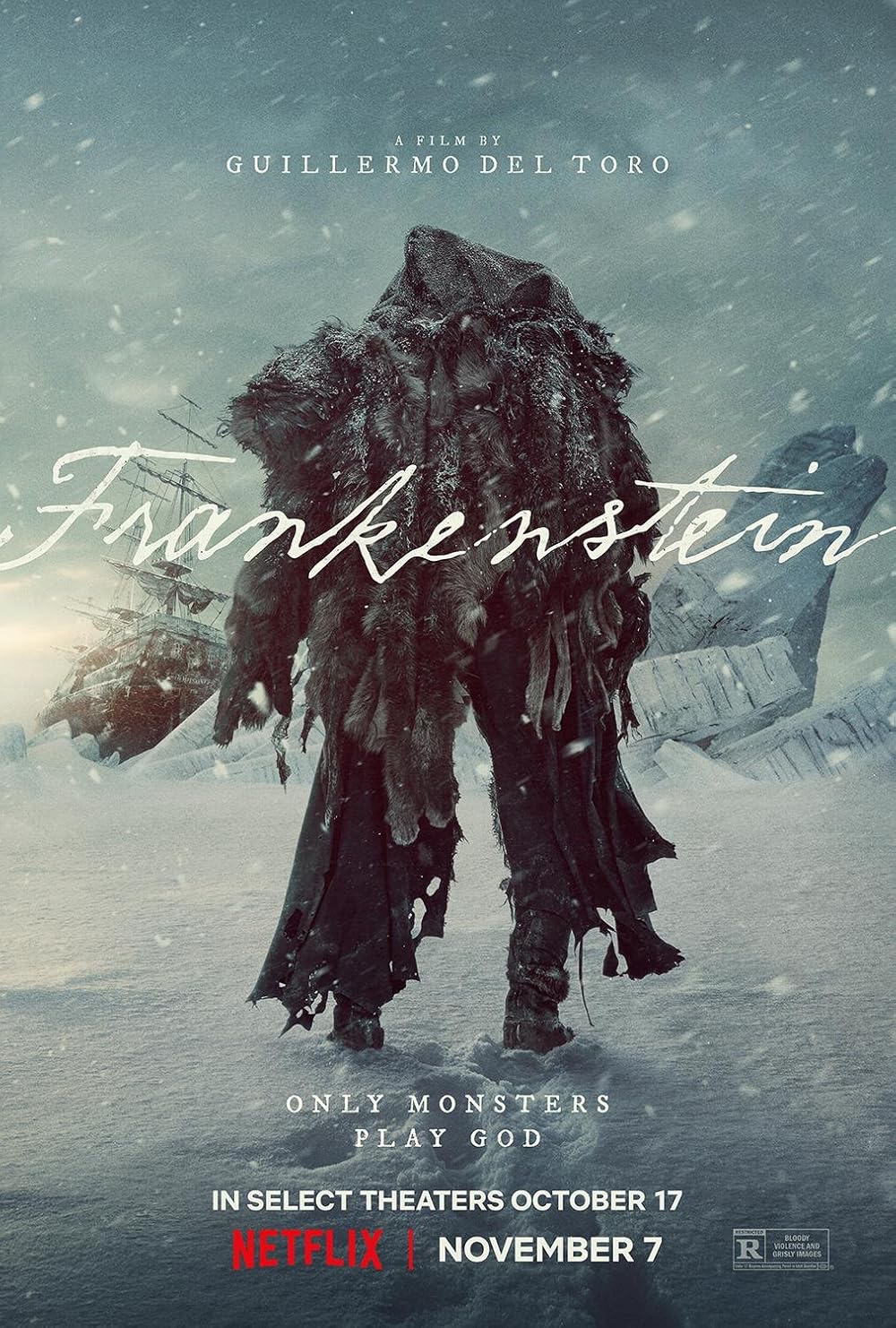
And so, in 2025, master of gothic horror Guillermo Del Toro has blessed us with his own interpretation of the work. Screening as part of the 2025 London Film Festival, it’s an interpretation that feels luxurious in scale.

The story is told in a way that remains faithful to the original novel, mixing up the ordering to create a much more effective narrative for the purpose of the big screen, much in the same way as the 1994 Kenneth Branagh adaptation did. This version opens at the original ending, with a mysterious one-legged man (Oscar Isaac) appearing out of nowhere at a shipwrecked expedition to the North Pole, chased down by an even more mysterious hooded monster (Jacob Elordi), seemingly impossible to be halted in his pursuit of vengeance. The rest of the story is told through flashbacks to how they got there, with some very strong performances across a talented and varied ensemble cast that includes Charles Dance, Mia Goth and Christoph Waltz.

Following Pacific Rim (2015), a film that many consider a misstep in his career, Del Toro has had four exceptional critically acclaimed features: the daring gothic romance Crimson Peak, Oscar-winning The Shape Of Water, psychological thriller Nightmare Alley, and his first foray into feature animation with the beautifully realised Pinocchio. Adding this powerful fifth film into the mix will only cement his position as one of modern cinema’s true masters.

At 150 minutes, it isn’t for the fainthearted. It’s hard to condense it into anything less, without losing a lot of the story. When it arrives on Netflix later in the year, I’m sure many will take the opportunity to have a break at the start of Act II. However, this is a film that deserves to be seen on the biggest of screens, to allow the total immersion into something quite grand.

Glorious.

What’s the deal with the Wes Anderson and Roald Dahl Netflix collaboration?

You may have noticed on Netflix recently a handful of sepia-tinged thumbnails popping up in your Trending Now or Recommends lists. Based on the lack of advertising generally, all you are left with is the titles alone: Poison, The Rat Catcher, The Swan and The Wonderful Story of Henry Sugar.

These curiosities make up a series of four adaptations of Roald Dahl short stories by the distinctive director Wes Anderson. Bringing together a wonderful ensemble cast – including Rupert Friend, Richard Ayoade, Benedict Cumberbatch, Ben Kingsley, Dev Patel and Ralph Fiennes – the four shorts really are quite special. Marrying the distinctive styles of two great storytellers from very different eras, there is a high-art uniqueness that lands in a place that feels fresh and intriguing.

As I finished watching my favourite of the bunch – the sharp-scripted Poison, about a man struggling under the threat of an imminent deadly poisonous snake bite – I wondered whether these could have been made twenty years ago. Or even ten years ago? I could only think of one outlet for them, which would be as part of the festive programming of a terrestrial channel, probably on Boxing Day, when the rigidities of multi-part series and familiarities are relaxed as the nation forgoes its own schedules to Quality Street and sherry.

I’m thrilled these four short films have seen the light of day, although I also wonder whether they’ve been done a disservice in the manner of release. With little fanfare, they’ve just appeared in the faces of the casual scroller, with more than a little whiff of that U2 x iPhone collab we all loved so much. I know someone who accidentally watched the longest of the bunch – The Wonderful Story of Henry Sugar – and wondered what on Earth was going on. With no explanation, it’s easy to see why the unfinished stylings of Wes Anderson could confuse. Actors look at the camera, the prop department hand items to the scenes apologetically, the elaborate sets are shifted as if they were part of an experimental theatre piece. These quirks that elevate the experience for fans of Anderson risk perturbing casual viewers, or indeed fans of Roald Dahl’s more popular output.

With results this good, perhaps Netflix decided that was a risk they were willing to take.

Why Netflix’s new Mowgli film is a waste of time and money

Andy Serkis’s take on ‘The Jungle Book’ is a waste of time and money. There, I’ve said it. It’s not awful. It’s not offensive. It’s just not brilliant. And as such, it’s not necessary.

This is a much darker take than more familiar adaptations, in keeping to the original Rudyard Kipling stories. This leaves it in no-man’s-land, not suitable enough for children but too boring to be enjoyable for adults.

We’re treading familiar ground here. It’s the tale of Mowgli (the impressive Rohan Chand), who is taken on by a pack of wolves after becoming orphaned in a horrific opening scene involving Shere Khan (Benedict Cumberbatch). There’s some character development as he learns how to live in the jungle with his animal friends, including black panther Bagheera (Christian Bale) and sloth bear Baloo (Andy Serkis, sounding like he’s about to offer you the latest Bet 365 betting odds). Cate Blanchett features sporadically and inconsequentially as Kaa, the Indian rock python.

What really doesn’t work is the facial motion capture. It makes the animals look odd and is a distraction from the story. I’m not an expert. All I know is that it doesn’t work.

The interesting part of the film comes when Mowgli arrives in the local village and starts to learn to become more human, which is something explored much less in other adaptations. It’s not amazing, but it does at least do something fresh with the material, and it results in a fresh climax to the story (particularly when Mowgli discovers a distastefully familiar menagerie).

It’s just a film that doesn’t make any sense in terms of why it was released. If the budget was anything like Disney’s live action adaptation, it was $175m. It’s a big loss to take for any studio, even one of the size of Warner Bros.

Watching this on Netflix is watching something designed for a big cinematic experience in a manner that feels like a compromise. If no previous film adaptation existed, it would maybe feel effective. As it stands, it’s just a poor business decision to plough on to complete this project in the knowledge you’ll finish second – both in speed of release and final quality.

The only singing vultures present here will be the critics.

A failure in almost every sense.

The Ballad of Buster Scruggs v The Future of Independent Cinema in the UK

‘The Ballad of Buster Scruggs’ is the latest feature film from the frequently-brilliant Coen Brothers, continuing their display of love towards the American Western genre. It is also their first for streaming platform Netflix, in a move that is becoming more and more common in the modern age of cinema.

The move to streaming platforms may feel progressive, but it isn’t great news for independent cinemas in the UK.

The film – more hit than miss

Watching ‘Buster Scruggs’, it’s easy to feel like you’re watching a Netflix series that has been mashed into a single film, perhaps to allow it to be considered as an Oscar contender. If this is the case, it’s a shame, though it is understandable.

It is, as is often the case with vignette films, a little hit and miss. The opening titular short is a high point, with a hilariously-positive character singing his way through a killing spree. Tim Blake Nelson is a joy to watch and his interactions with the locals is shot to perfection (pun not initially intended). Both ‘Near Algodones’ and ‘The Gal That Got Rattled’ are memorable and very much work in their own right, making me long for more of an expanded narrative.

‘Meal Ticket’ has really stuck with me and I kept thinking about it many days after I saw it, with Harry Melling starring as a limbless performing artist working alongside Liam Neeson. It unravels at a depressingly effective rate, with the final scene leaving me on the edge of my seat for all the wrong reasons. A perfect example of short film-making.

Whilst the ‘All Gold Canyon’ short is largely forgettable, it isn’t bad. It’s really a shame that the final vignette, ‘The Mortal Remains’, is such a disappointing way to finish the feature. It is neither emotionally effective nor steeped in humour, and it doesn’t really have much to say. It’s a missed opportunity to perhaps tie the previous five shorts together, at least with a thematic link. Instead it confirms the suspicions that these were six independently-realised pieces of art that function in their own right.

The Coen Brothers may deny it but it doesn’t run like a movie. The overarching theme is ‘American Western as a genre’ rather than there being a connecting emotional theme or associated character. Thankfully, it is a genre that the film-makers know how to handle and the results are more hit than miss.

The shift from ‘cinema as art’ to ‘cinema as disposable commodity’

Having recently become a father, Netflix is very convenient for me, but I’d never opt to experience a film at home if there’s an option to see it at the cinema. You can’t quite appreciate the magic of the cinema when watching on a small screen at home.

My main criticism, therefore, is that it was released in an exclusive deal with Curzon cinemas in the UK. As it happens, my location means I have close access to three brilliant independent cinemas: QUAD in Derby, Phoenix in Leicester and Broadway in Nottingham. Sadly, not one of these is part of the Curzon group; my nearest Curzon is 64 miles away in Sheffield. This led to Jake Harvey (Phoenix, Leicester), Caroline Hennigan (Broadway Cinema, Nottingham), Adam J Marsh (Quad Cinema, Derby) and the owners of twelve other independent cinemas to write an open letter to Netflix to reconsider their policy.

I sit on a film discussion group panel and I know that a good number of the members do not subscribe to any online streaming service. My mother, who previously attended a Coen Brothers discussion course with me, has no means of watching ‘Buster Scruggs’ unless it’s on at a cinema. By making this exclusive to Curzon, they have excluded a large demographic of their potential audience.

‘Buster Scruggs’ follows excellent Netflix exclusives like Annihilation, Okja and Roma, all critically acclaimed and well-received by cinephiles. They even funded the completion of a posthumous release from director Orson Welles. The quality is undeniable. The problem isn’t in the quality. It’s in the lack of support to  the truly independent cinemas that have supported non-mainstream releases for so long.

As it turns out, ‘Buster Scruggs’ is the first Coen Brothers film in over a decade I haven’t watched at the cinema. For me, this is a great shame and it’s saddening to think this is where some great directors are taking their latest pictures.

Overall, this is a mostly great film that some fans of the Coen Brothers will enjoy on the big screen, depending on a combination of a geographical lottery and your willingness to drive. For the rest of us, we’ll have to settle for the small screen and an increasing temptation to skip the bad segments, facilitating the shift from ‘cinema as art’ to ‘cinema as disposable commodity’.
Film review – Okja (Bong Joon Ho, 2017)

Remakes, sequels, animated children’s film. Say what you want about the film studios, but if they’re judged solely on how to make money from well-marketed films, then they know how to do it. But when you look at the UK box office for 2017 on an artistic level, the top 10 leaves a lot to be desired.

Of the top ten, only La La Land isn’t classed as a remake, sequel or children’s film. You have to stoop as low as numbers 16, 17 and 18 to find Lion, Split and Get Out respectively, to start really finding good original cinematic enjoyment for adults wanting something fresh to think about.

Paul Dano

So whilst Okja, Bong Joon Ho’s latest futuristic sci-fi action film, was booed at Cannes Film Festival when the Netflix logo appeared at the start of the film, it isn’t a surprise that the popularity of the service has really grown exponentially in recent times. In the month of June, both Okja and the excellent The Circle landed on the service, along with women’s wrestling series Glow and the new drama series Gypsy, which stars Oscar nominee Naomi Watts. I’ve finished watching all but Gypsy, and it was often the case that I actively decided to stay at home to watch these instead of going to the cinema.

My decision wasn’t financially motivated. It was because they looked like better options.

‘Superpig’ just doesn’t have the same ring to it

Okja tells the story of a new breed of superpig that has been created by the Mirando Corporation as the flagship programme for new CEO Lucy Mirando (Tilda Swinton), who has inherited the company from her controversial family and is looking to create a better image for their brand. In 2007, 26 superpigs were distributed around the world to various farmers. Now, in 2017, the corporation will crown the best pig as they simultaneously launch products using the meat from the huge slaughterhouses being used to house and kill 1000s of the new species. The ten-year-old daughter of one of the farmers, Mija (Ahn Seo-hyun) has grown close to the titular superpig and attempts to stop the competition from going ahead, teaming up with a band of animal rights activists that include Jay (Paul Dano), K (Steven Yeun) and Red (Lily Collins). Jake Gyllenhall also stars as eccentric television zoologist Johnny Wilcox.

Tilda Swinton as Lucy Mirando

Bong Joon Ho has created something exceptionally special here, getting excellent performances from all of his lead cast. But it is the performance by newcomer Ahn Seo-hyun that really captivated me. The opening sequence of the film may be all bravado and sensory overload, but the film soon settles into a much more naturalistic tone as we learn about the relationship between the young girl Mija and her best friend and childhood companion Okja. Its remarkable that the relationship feels so visceral given that there is nothing but animation for the superpig. There was a foam head made in the likeness of the eventual CGI creature to give her something to interact with. It’s an age-old technique but one that has resulted in an intimate and captivating coupling.

Jake Gyllenhall as Johnny Wilcox

The message contained within the film is at least on some levels for the viewer to consider the origin of the meat they are eating. “Okja is real,” director Bong Joon Ho said in a recent Independent interview. “It’s actually happening. That’s why I rushed making Okja, because the real product is coming.”

I personally felt disgusted by the end of the film and it brought back memories of Robert Kenner’s 2008 documentary ‘Food, Inc.’ Thry weren’t particularly positive memories, but they certainly were effective.

Given so many people have Netflix and can watch this film at no extra cost, it’s a no-brainer to seek it out and watch it. It might be the start of a new era of high quality original cinema heading first to home streaming platforms. Given the state of the year-to-date box office, it’s a movement everyone should be supporting.