Tabu: A Story of the South Seas (F. W. Murnau, 1931)

The last of four films Murnau made after moving to America – the others being the Oscar winning Sunrise, the excellent City Girl and the now-lost Four Devils – Tabu marked something of a departure for the master director. He travelled to Bora Bora near Tahiti with documentary filmmaker Robert J. Flaherty. Setting out to make a docufiction film as co-director, it quickly became apparent that Murnau wanted complete control and Flaherty was bought out of his share of the film.

Despite the unusual setting, this has all the hallmarks of a classic Murnau romance.

Despite the unusual setting, this has all the hallmarks of a classic Murnau romance.

The result of this is an opening sequence that seems very much like a documentary film, with native islanders (almost every actor in the film was an untrained native, along with most of the production crew) fishing, playing and acting naturally. According to the extensive booklet notes (thanks again Masters of Cinema), this was the only sequence Flaherty directed before he encountered technical issues with his camera and brought in cameraman Floyd Crosby to assist. The upshot of this was that the rest of the film was the responsibility of Murnau.

Subsequently, we then pick up on a more traditional method of storytelling. A girl named Reri (Anna Chevalier) is chosen by aged emissary Hitu of neighbouring island Fanuma to be the replacement maiden to the Gods. She is to be transported to the island to live there free of any kind of relationship; from this point on she is “tabu”. This is terrible news for both Reri and her lover Matahi, who defy this command and escape the island to a French-colonised island nearby.

The story of two lovers remaining together despite adversity is reminiscent of both Sunrise and City Girl, and other than the unfamiliar setting Murnau is on safe territory. It doesn’t feel stale, but it’s certainly the least dynamic of the three available Hollywood films. Both lead characters give assured performances in their roles despite a lack of experience. Matahi never worked on another film following this release. Anne Chevalier worked on two subsequent films (Polish film Czarna Perla and an uncredited role in John Ford’s The Hurricane) but neither are as fondly remembered as Tabu.

F. W. Murnau’s final film was actually released a week after his death. Whilst working on the sound for the film, Murnau was being driven up the coast from Los Angeles by a 14-year-old Fillipino servant and was involved in a car crash, dying a day later in hospital. It’s a shame that this was his last film and a tragedy that his life was cut short so early, robbing the world of countless more exceptional films. He had actually spent most of his final months on the island Bora Bora, having enjoyed his time there so much.

The definitive version of Tabu is available on Masters of Cinema Blu-ray and DVD dual-format release, packed with extras (deleted scenes, a short film directed by Flaherty using leftover footage, a documentary) and with an immaculate transfer. It also restores scenes that were cut before its original release, as well as those taken out in subsequent cuts over the intervening years (the explanation for all of this is in the extensive booklet that’s included in the box)

F For Fake (Orson Welles, 1973)

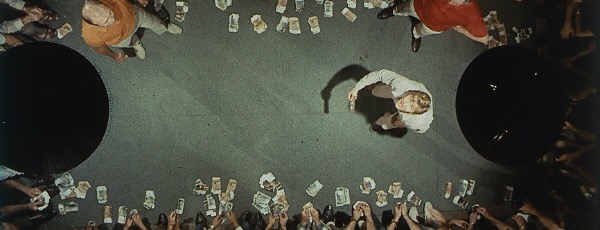
Orson Welles film F For Fake (also known as Fake or simply “?”) is a brilliantly bizarre piece of cinema that shows off the art of deception in storytelling. The purpose of the film isn’t to reveal a scandal, despite its superficial attempts to make the viewer think it’s a straightforward documentary. Rather, the ultimate goal is to tie us up in knots, frustrate us and lead us down as many blind alleys as possible in a relatively short running time (85 minutes for this version). In this respect the film is a glowing success and if you keep this in mind the whole thing is absolutely hilarious.


The purported premise of the film involves Welles revealing a huge visual art scandal involving professional forgery at the hands of Elmyr de Hory. A second man, hoax-biographer, reveals all in the role of hoax-biographer Clifford Irving, whilst Oja Kodar also appears in a few critical scenes.

The story it creates is almost believable but for the handful of telltale signs of fakery. The deliberate continuity errors throughout (see “practioners” and Don Amiche); the overuse of the phrases like “of course our story really starts with…”; the ridiculous conversational tone Welles uses when engaging the viewer (or disengaging them by ordering dinner halfway through a scene); swapping out Oja Kodar with her sister for one scene for no reason. There’s a lot going on besides this and I felt it was designed to deliberately deceive. I was on board. I got it. That it succeeds in this is indicative that the film was a huge success, though I’m fairly confident if I wasn’t aware it was itself a hoax I might have found the whole thing a little self-indulgent.

F For Fake is available on Masters of Cinema DVD only, but there are no plans to release it on Blu-Ray so you may as well go for that version.

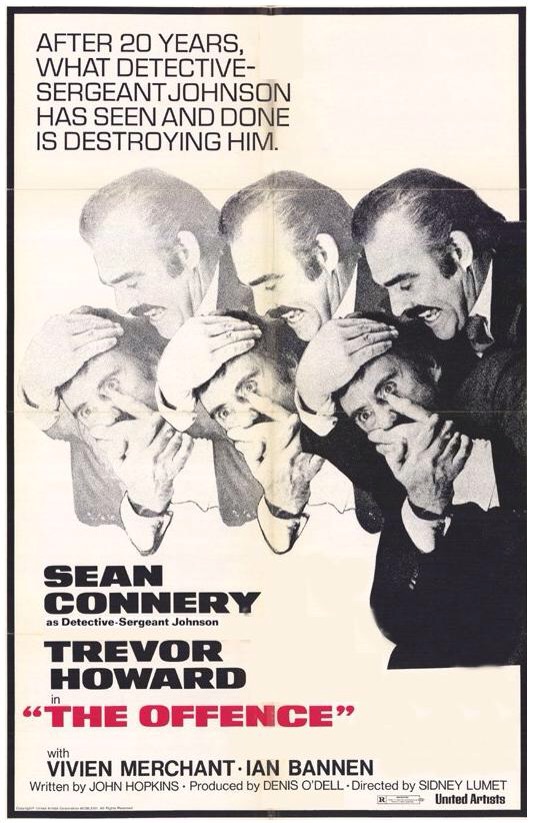
The Offence (Sidney Lumet, 1972)

Sean Connery is one of the most renowned British actors of all time. He has starred in so many well regarded and successful films, including The Hunt For Red October, The Untouchables and Indiana Jones and the Last Crusade. He is, of course, remembered most fondly for his performance as the quintessential James Bond, starting with Dr No in 1962 and finishing with Diamonds Are Forever in 1971. He also reprised Bond in 1983 with Never Say Never Again. 

His prominent films remain prominent and he will be remembered for these great successes. That said, unless you go out of your way to seek his wider body of work, it’s quite difficult to build up a fuller idea of his talents.

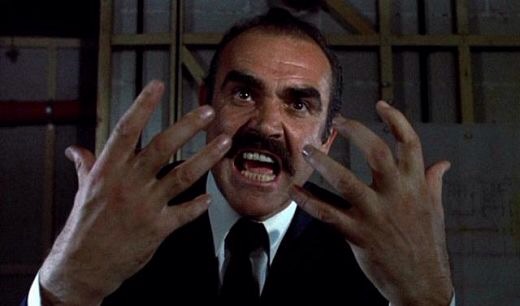
Fortunately, Masters of Cinema are on hand to help us out a little, pointing us in the direction of The Offence, Sidney Lumet’s cross-section of Detective-Sergeant Johnson (Connery) and his struggle to cope with the inner demons he has as a result of the constant horrors he sees in his line of work. Released in 1972, it was one of the earliest post-Bond films he released so was one of his first chances to show the world his full gamut of talents.

The film opens with a bold slow-motion shot of policemen rushing into an interrogation room, where we find Johnson fighting off his colleagues, with the dead beaten body of Kenneth Baxter (Ian Bannen) lying on the floor. Evidently Johnson has killed Baxter and through a series of flashbacks we discover the chain of events that lead to this happening.

This is an excellent performance from Connery, adding weight to a character that has been carefully constructed by screenwriter John Hopkins. The story is told in a non-linear way, which is cleverly executed to ensure the reveals happen at regular intervals. Bannen’s performance kept me second-guessing throughout and ensured it wasn’t just a one-man-show. It’s a stylish and grim view of Britain in the 1970s and it hits home further by being so realistic, which I credit to director Sidney Lumet and his work with cinematographer Gerry Fisher.

It’s a film that warrants a first and indeed second viewing. The latter will undoubtedly come before long. I’ll be devouring the bountiful array of extras first.

The Offence is available on Master of Cinema dual-format Blu-ray and DVD now.

City Girl (F. W. Murnau, 1930)

One of the greatest shames of the history of film is the sheer amount of films directed by F. W. Murnau that have been lost. Dying at the young age of 42 following a car accident a week before the premiere of his final film, Tabu, he left a legacy of just 21 directed films, of which twelve survive. These include: Nosferatu (1922), Faust, (1926), Sunrise (1927), City Girl (1930) and Tabu (1931) – all classics. Without a doubt the most sought after lost film is 4 Devils (1928), one of only four American films he made before his untimely death. So as a result we are left with just three films from this latter period of his life. Sunrise is the most popular, having won the first Best Film Oscar (sort of [1]). The other two are readily available, and it is City Girl that I’d like to discuss today.

City Girl is a silent film released after the advent of talking pictures. The plotline covers a young farmer named Lem (Charles Farrell), who is sent by his father to sell the wheat crop in the city. After panic-selling the wheat as the prices dropped in value, he goes to a coffee shop and falls madly in love with waitress Kate (Mary Duncan). Soon after they get married and they set back to the farm to introduce her to his family. However, his father is bitterly disappointed with the cripplingly low price his son has sold his wheat for and in his anger struggles to accept Kate into the family.

Both leading actors have been captured beautifully in this shot.

Both leading stars have been captured beautifully in this shot.

What I found really unique about this film is the surprisingly modern portrayal of Kate by Duncan. She is certainly not a typical silent leading lady, and in fact throughout the film she is usually the most headstrong character. It works well as the mother of Lem is extremely passive and non-confrontational, further underlining Kate’s strength of character. Perhaps we could attribute this to the fact Katy is from the city and Murnau wished to portray city dwellers as a different beast to those from the country, but I prefer to assume it is because he wanted to show the world one of the first truly strong female lead characters. Indeed, Murnau even has a nod to a previous leading lady of his in the opening scene, with a woman looking suspiciously like Janet Gaynor’s wife from Sunrise trying to flirt with Lem on the train, only for him to give her the cold shoulder. It could be coincidence, but more likely it was a knowing nod to the audience to let them know it won’t be a repeat of his previous work – Lem looks so disinterested in her and this is underlined for the audience.

The whole film works really well, building to a ferocious storm-set climax. It must have been something to do with the pacing, but I was on the edge of my seat by the end hoping things worked out. It was a pleasure to see such a great piece of cinema for the first time and I’m only sad I won’t be able to see it again.

I’m glad I saw this. It’s the first Murnau film I’ve seen that isn’t common to the wider audiences. Whilst Sunrise and Nosferatu are must-sees, if you liked them then you probably should see what else his catalogue has to offer. It won’t take long to see everything that’s available, but City Girl is a great place to start. The next Murnau film I’d love to see Masters of Cinema release is Der Letzte Mann, a 1924 German silent picture that is currently unavailable in the UK. Come on, you know it’s right.

City Girl is available on Masters of Cinema dual-format Blu-ray and DVD now.

[1] The first Academy Award for Best Film is disputed because there were two awards given out on the night that were never again awarded. One for Outstanding Picture went to Wings and the other for Unique and Artistic Production went to Sunrise: A Song of Two Lovers.

[2] Mary Duncan was, incidentally, the last known person to own a copy of the film 4 Devils, which she subsequently lost… but we’ll forgive her for that as she is so good in this film.

Das Cabinet des Dr. Caligari (Robert Wiene, 1920)

I finally got around to watching Dr Caligari, having had it near the top of my “to watch” list for around six months. It was a Friday 13th weekend so it was a perfectly timed purchase. Watching it was a fantastic experience and the quality of the film belies its 95-year-old lifespan.

Our story opens with a man’s recounting of a tale about the appearance of a mysterious somnambulist show that is exhibiting at a local fair in Holstenwall, a small town near Hamburg in Germany. The show is compered by the strange Dr Caligari (Werner Krauss) with the centrepiece provided by a devastatingly eerie Cesare (a pre-Casablanca Conrad Veidt). When a number of murders are committed, including one predicted by Cesare, the two exhibitors are instantly installed as the prime suspects and panic spreads across the town. [1]

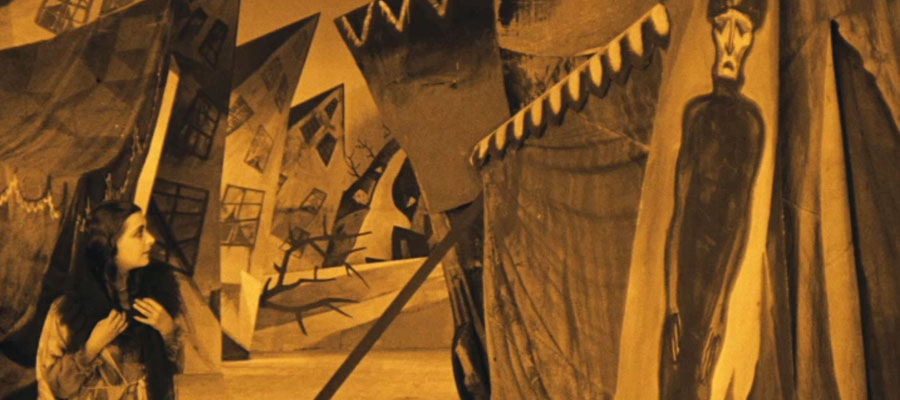
With a narrative as twisted as the set on which it plays out and a plot that throws the viewer off the scent with every turn, the film is way ahead of its time across the board. Indeed, I think the biggest blocker for me guessing what was happening was the fact I underestimated quite how advanced a film released in 1920 could be. It’s probably worth bearing that in mind before watching it.

Actually, this is a fantastic starting point for those wanting to learn more about silent films and German expressionist cinema. This was the birth of the latter, as well as both horror films and twist endings. For this reason, it is wholly a ground-breaking film that needs to be seen to fully understand the landscape of cinema at the time. That’s to disregard the political context too, which the film has been closely linked with being a metaphor for – as a German film released in the aftermath of The Great War this is somewhat inevitable, especially since the two writers Carl Mayer and Hans Janozwicz were both soldiers in this war.

I wouldn’t class myself particularly as a die-hard fan of the silent era, though I have seen a handful of the more prominent pictures (mainly Masters of Cinema releases and Charlie Chaplin’s more famous works). I am slowly getting more and more into it thanks to unrivalled access to the entire history of film via both physical media and digital streaming services. It has never been easier to dip your toes in and see what you enjoy out of a wide variety of films and television series. Couple that with the endless streams of discussion pages, essays and blogs on film and you can really think about it as a very advanced education in cinema.

Dr Caligari is a prime example. The Wikipedia page alone is like a short essay on the development, production, release history and reception of the film, complete with links should you wish to find out more information from the original sources.

The set design is as twisted as the plot itself.

It’s good to take a step back and appreciate exactly how far we have come. I remember my family’s first Windows-based computer [2] – a PC running Windows 95, which was then state of the art. As the internet wasn’t readily available we had two computer-based options to do research: Encarta Encyclopaedia and Microsoft Cinemania. The latter was a bit of a godsend for someone who was interested in cinema, with over 20000 films detailed with stills, sound clips and some even having short video clips. It was rudimentary but quite spectacular. As I was 11 at the time my main priority was watching a short but thrilling clip from Nightmare on Elm Street, so I can’t really remember whether Dr Calgari was covered, though I suspect it was.

Now, though, we can search “Dr Caligari” and retrieve 563,000 results on Google (other search engines are available but they generally aren’t as good). Two of the top results give the ability to stream it for free, with two versions available on YouTube. I just think it’s fascinating we are able to do this now, and even more amazing that we now just take it for granted. Progression, eh?

Well, it doesn’t stop there. The basic picture quality is incomparable to what was readily available some twenty years ago. Back then you had three choices if you wanted to see an older film again: wait for it to be re-released at the cinema, wait for it to come onto television, or buy a VHS copy of it for around £15. This latter one allowed you to access the film much sooner, but the picture quality was just atrocious and really unwatchable by today’s standards. Nowadays, you can pick up a Blu-ray copy of most films for less than £10, often closer £5, and the picture quality is like a dream for cinephiles.

Apologies. I digress. The film itself is pretty mind-blowing. I don’t really know where to start with it, and there has been a great deal written about this film elsewhere by people with much better vocabulary. The bottom line is that I was thoroughly impressed. The twisted design, the tense music (I listened in 5.1), the staccato body movement that gives the acting a really sinister edge, the subversive plot. They all combine to present us with a journey that was way ahead of its time. As the reality behind what I was seeing became clear I was left absolutely gobsmacked by the ending. It’s just a must watch for anyone keen to get to grips with the history of cinema.

Das Cabinet Des Dr Caligari is available now on Masters of Cinema dual-format Blu-ray and DVD.

[1] It’s funny that I’m attempting to not give away any of the plot when describing the film. It seems 95 years isn’t enough time to wait before spoilers are okay. Think about that the next time you want to talk to someone about the next episode of that show you both like but they haven’t seen.

[2] Our first home computer of any kind was the extremely popular Commodore Amiga, which was originally released in 1985. I’m not sure exactly which model we had as it has long since disappeared, though I suspect it was a 500. I don’t recall it ever being used for word processing and it certainly wasn’t connected to the internet, such was life in central Lancashire in the mid-1980s.

Masters of Cinema Cast

The MOC Cast is a constant on my podcast downloads list, and I’m always keen to download the latest installment. As a fan of the series (as you can guess by how many I have reviewed) but without too many friends that are interested in the same kind of cinema, it’s really useful to hear others delving into the details of certain releases.

The latest episode is an interview with Craig Keller, producer of the Masters of Cinema, and is such an insightful discussion between three huge film fans with a common interests. If you’re at all interested in what goes on behind the scenes of the releases, I heartily recommend downloading it. It covers a wide range of topics, including the history of the label, the role Keller has in the releases and the difficulties in gaining the rights to release certain films. Frankly it’s a joy to hear three people with such a huge passion for cinema simply having a chat.

Wake in Fright (Ted Kotcheff, 1971)

Wake in Fright, Ted Kotcheff’s disturbing 1971 drama, is the story of a lost weekend of toxic self-discovery for John (Gary Bond), a young middle-class English teacher in the middle of the Australian outback. Though he plans a trip to Sydney over the Christmas break to see his beautiful girlfriend, a series of bad decisions leads him into a catastrophic mess of a weekend of gambling, hunting and alcoholism with some new acquaintances of dubious moral conscience. We go on the awful journey with him, as he gets chewed up and barely spat out the other side, all in the isolated nothingness of Bundanyabba.

IMG_0584-0

And I thought I was watching a Harvey Dent origin story.

Gary Bond’s excellent performance is paired with an equally excellent one from Donald Pleasence, an alcoholic doctor who exists without working, taking his purpose from a relentless alcoholism. His enthusiasm for misbehaving is the catalyst that leads our main character further down a slippery path, just when we hope he’ll pull himself out of it. It’s a show stealer, and to compliment this his Australian accent is flawless.
The colour wash throughout the day scenes are scorching hot yellows, reds and oranges. It’s a clever technique to make you feel the heat. You can see the sweat dripping from the sun-baked characters, and can almost smell the day-old stench of alcohol on their hungover breath. Frankly, by the end of the film I wanted a shower.

The main talking point is a ten-minute scene that depicts an awful kangaroo hunt that the main party of four go on. The Masters of Cinema release dedicates a lot of time to it in the booklet and on-disc features, and will do it more justice than I can manage. All I’ll say is that it’s truly horrific, especially knowing it was basically just the filming of a real kangaroo hunt. Sickening stuff.

I strongly recommend this one. Just don’t watch it if you’re a fan of kangaroos.

Wake in Fright is available now on Masters of Cinema Blu-Ray and DVD.

世界 / The World (Jia Zhangke, 2004)

Time for another Masters of Cinema review, this time for Jia Zhangke’s 2004 Chinese film 世界 / The World. Originally screened in competition at the Venice Film Festival, it soon found its way onto the Eureka label on DVD and subsequently again on a Blu-ray/DVD dual-format release.


The story covers a short period of time of two workers at Beijing World Park: Tao (Zhao Tao) and Taisheng (Chen Taisheng) Tao’s boyfriend and a security guard at the park, whose relationship becomes increasingly strained throughout the period of the gloomy film. The theme park (a real park in Beijing) recreates famous cities and landmarks from around the world but in reduced scales, mainly for tourists. The story delves into the emotional and financial instability of the two lead characters and their colleagues, and how these two factors go closely hand-in-hand in modern China.


At 135 minutes long and with an extremely slow pace, The World is a tough film to sit through and maintain focus. The dialogue isn’t very focused, with the effect of making the characters feel wholly depressed. Unfortunately, whilst it’s fine to do this, when you’ve not really getting very far along the characters’ journeys your mind does start wonder. I had to take a couple of breaks to get through it, and that’s doesn’t really indicate a story that has me gripped.


There were some clever techniques utilised. Lead character Tao continually lost herself in her inner thoughts, removing herself from her own depression into a world represented by brightly coloured animation. This is something I saw more recently in Giovanni’s Island, probably to much better effect, but it doesn’t detract from the solid concept.


By the end of the film, I didn’t really feel emotionally involved in any of the characters and was quite relieved when it was all over. It’s not a film I will be revisiting any time soon.


世界 / The Worldis available on Masters of Cinema Blu-ray and DVD dual-format release now.

Les Misérables (Raymond Bernard, 1934)

I have never read Victor Hugo’s novel Les Misérables. I have never seen the stage musical of “Les Miz”. I have never seen any of the three silent film adaptations of the book, nor have I seen any of the eight spoken-word non-musical adaptations of the film. I have not seen a single other film directed by Bernard, nor have I seen a single film starring any of the actors and actresses that are in this version. Therefore, I have only one reference point. Yes, you guessed it. It’s Hugh Jackman, Anne Hathaway, Russell Crowe and Sacha Baron Cohen’s film-of-the-musical from 2012. For this, I can only apologise.

To call this a single five-hour epic would be to bend the truth slightly, not least because it clocks in at a mere 4 hours 40 minutes. Actually, it was released as separate films in an episodic manner over a period of three weeks starting on 9th February 1934.

The first and longest part, Une tempête sous un crâne (Tempest in a Skull) tells the story of Jean Valjean (Harry Baur) as he finishes his prison sentence, then becomes increasingly frustrated that his past life as a convict blights him (his only crime being stealing a loaf of bread), having to hand in his prison documentation every time he enters a new town and constantly being pursued by Javert (Charles Vanel). Seeking a new start, he disposes of his papers and assumes a new identity, beginning a new life as Champmathieu.

The second part, Les Thénardier (The Thenardiers), concentrates primarily on the titular family acting as guardians to Cosette (Gaby Triquet, who sadly passed away two years ago), milking her mother for money and treating her like a slave. Her mother Fantine (Florele) is slowly approaching death due to the illnesses contracted through overworking to pay for Cosette’s falsely expensive upkeep. As this chapter concludes, we leave Champmathieu seeking to take sole custody of Cosette.

The third part, Liberté, liberté chérie (Freedom, dear Freedom) is set around the 1832 June Rebellion in Paris, as the various interweaving plots come to dramatic conclusions.

2015/02/img_0394.jpg

I know a lot of people who class themselves as Les Miserables aficionados. You know, the type that has been to see the show 180 times, know every word inside out and tell you “You might have liked the film but I’m not sure you’d like the stage musical.” Well, I didn’t like the 2012 film because some of the main cast can’t sing. This was worsened by the contrasting excellent vocal performances from Hugh Jackman and Samantha Barks. It makes you wonder why they didn’t cast performers from one of the many stage adaptations there have been in the last 35 years. Of course, that’s because putting Borat in one of the main roles puts more bums on seats in the cinema, so it was clearly not an attempt to do a great piece of art justice, just an attempt to make money.

The main reason I say all of this is because if you want to get to the root of the purpose behind the original book, you have to read it. If you don’t have time (like me), then this is a great place to start. It is apparently the closest adaptation to the original source material there has been. What struck me was how deeply effective the characterisation was by Hugo of each of the characters. Each person is driven by a clear motive, and nothing is glossed over. It’s no small task to fully realise two or three major but conflicting characters in a story, let alone eight or more whose storylines are intertwined so tightly. It’s like Love Actually for the 19th Century. But good.

There are significant differences between this and the 2012 adaptation. Most surprising is the appearance of Valjean. Hugh Jackman he is not, so don’t expect to be swooning over him at any point. The Thenardiers are explored in great detail and are far more despicable, eliciting a far greater emotional response in me. Overall it’s just a more rounded experience, and far more satisfying as we journey through an epic story to a fittingly intense climax.

Visually, it is clear the 2012 film has borrowed from the 1934 interpretation. Most significantly I couldn’t help seeing the two stand-offs at the end with the rebellion fighters barricaded in the streets of Paris as being essentially identical shots. The tension was recreated blow-for-blow with very similar cinematography techniques. Why change something that works so well?

The Masters of Cinema release is fully loaded. The Pathé 4K transfer is extremely detailed, giving the film space over two discs to avoid unnecessary compression. The second disc features only Part III of the trilogy, so we are also treated to a large amount of supplementary features including documentaries, a 1905 short film Le Chemineau (The Vagabond) by Albert Capellani’s short film, a theatrical trailer, news reels and more. We also get a (now standard of Masters of Cinema) lavish 28-page booklet with five essays on the film.

So at almost five hours this is not for the faint-hearted, but you can cut it into three parts and digest this very faithful interpretation of the original story as you please. It’s a far cry from the 2012 musical film but it has a lot more to offer.

Les Miserables is out now on Masters of Cinema two-disc Blu-ray.

Ace In The Hole (Billy Wilder, 1951)

Billy Wilder’s 1951 film Ace In The Hole (also known as “The Big Carnival”) was a commercial and critical failure on release, despite the big names attached to it. The pairing of Billy Wilder – who was riding a wave of momentum on the back of his Oscar success with Sunset Boulevard a year earlier – with big name Kirk Douglas meant that its lack of success was doubtless a huge disappointment and an even bigger surprise for Paramount Pictures, who lost some $600k on the project (a huge amount at the time). It has taken over sixty years for the general public to realise how good it really was, and thankfully it has enjoyed a Criterion release in the USA, followed by a Masters of Cinema mirror-release in the UK.

2015/02/img_0373.jpg

The story concerns Chuck Tatem (Douglas), who is a disgraced newspaper journalist. Having been employed and subsequently fired by some of the biggest papers in the USA, he has arrived in New Mexico to seek employment at small-time and small-minded local newspaper The Albuquerque Sun-Bulletin. Determined to sit out the job and wait for his big opportunity, he waits longer than expected before a chance occurrence on the way to a rattle-snake drive leaves him at the mouth of a derelict Kentucky cave, which has collapsed and trapped a local man Leo Minosa (Richard Benedict) under some rocks. Whilst his wife Lorraine Minosa (Jan Sterling) awaits the news of her husband from the outside, Tatem sees a golden opportunity to spin the story out and build the small story into a media frenzy. But as time progresses, the carefully balanced façade Tatem has created becomes increasingly difficult to maintain, with potentially tragic consequences.

2015/02/img_0225.jpg

One thing that struck me about the storyline was the similarities between that and recent Jake Gyllenhaal film Nightcrawler – another film about a journalist taking things too far as his morals go out of the window. Whilst clearly very different films when watched without context today, it’s obvious that they both set out to shock in their respective cinematic climates. In Ace In The Hole, Tatum’s actions are clearly despicable, though the film was censored to ensure the audience saw no collusion with the sheriff, and also to give the audience closure on Tatem getting retribution of his actions. Fast forward over 60 years and actually Gyllenhaal’s character didn’t get any just-desserts in his role, committing heinous crimes and essentially getting away with it, opening up a debate amongst modern viewers about the relationships that television and written media have with politics and law and order, asking them who is really accountable for the way the media conducts itself in the modern world.

Ace in the Hole is just a genuinely excellent film. Douglas is a fantastic actor and that this hasn’t gone down as one of his great performances is a tragedy that can go someway to righting itself with these releases. It’s essentially a one-man show, just like the media circus in the film itself, but that is by no means a bad thing when the results are so effective.

Ace in the Hole is available on Masters of Cinema dual-format Blu-Ray and DVD now.